
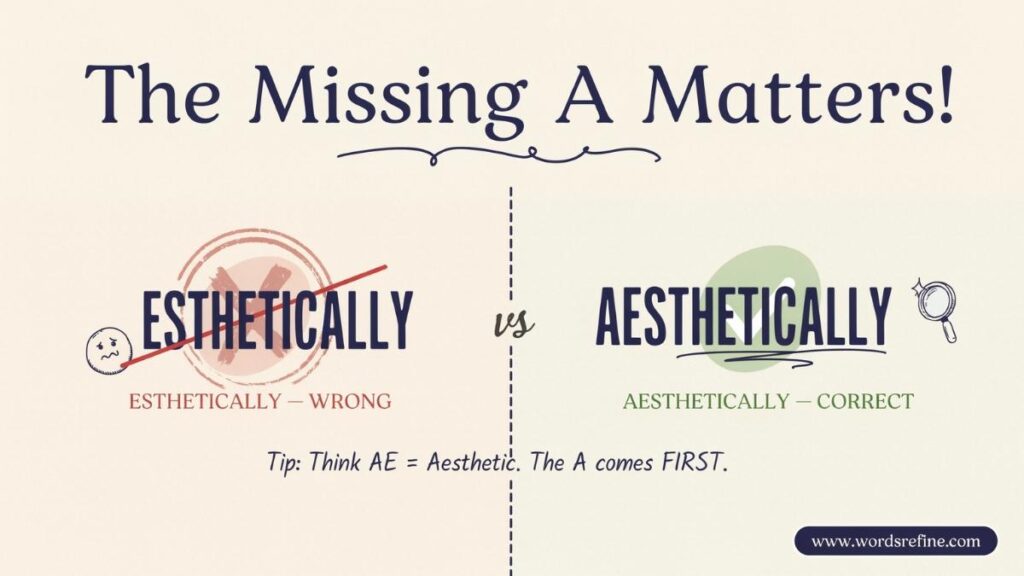
The difference between esthetically vs aesthetically may look like a tiny spelling detail, but it can leave even confident writers second-guessing themselves. Is the extra letter necessary, or does it simply make the word look fancier? The good news is that both spellings are correct and carry the same meaning. They describe beauty, artistic taste, and visual appeal. However, one spelling is more widely used than the other. By understanding their meanings, differences, and proper usage, you can avoid common spelling mistakes and choose the right form with confidence, whether you’re writing about art, fashion, design, or beauty.
Quick Answer
Here’s the good news you don’t have to choose between esthetically vs aesthetically a correct word and a spelling mistake. Both esthetically and aesthetically are grammatically correct adverbs. They describe something in relation to beauty, appearance, artistic quality, or visual appeal.
The main difference is spelling rather than meaning.
Aesthetically is the more widely recognized spelling in general English writing. Meanwhile, esthetically is an accepted alternative that removes the initial A.
For example:
The architect designed the building aesthetically to complement its surroundings.
The architect designed the building esthetically to complement its surroundings.
Both sentences communicate the same idea. Neither changes the meaning or grammatical structure.
However, aesthetically is generally the safer choice when writing for a broad audience. It follows the spelling of the widely recognized adjective aesthetic and appears frequently in academic, professional, and everyday writing.
If you’re wondering whether esthetically or aesthetically is correct, the answer is both. Choose the spelling that matches your preferred dictionary or publication style. Most importantly, remain consistent throughout your writing.
Learn the difference between confusing more English words
Too vs To Meaning Differences Examples and Grammar Rules?
What Does Esthetically Mean?
Esthetically is an adverb that means in a way related to beauty, artistic qualities, visual appearance, or the appreciation of something attractive.
It comes from the adjective esthetic, which shares its meaning with aesthetic. The word describes how something looks, how its design creates an impression, or how someone evaluates its artistic qualities.
For instance, imagine a designer arranging furniture in a small apartment. Instead of filling every corner with decorative objects, the designer chooses a few carefully selected pieces. The result feels balanced, attractive, and comfortable.
You could describe that arrangement as esthetically pleasing.
Esthetically Definition
Esthetically means in a manner relating to beauty, artistic appreciation, appearance, or visual attractiveness.
The word functions as an adverb. It modifies a verb, adjective, or another adverb by explaining the aesthetic manner or quality of something.
Consider these examples:
The artist arranged the colors esthetically to create a balanced composition.
The designer improved the room esthetically without purchasing expensive furniture.
The sculpture looks esthetically appealing from every angle.
The building combines traditional architecture with modern design esthetically.
In each example, esthetically connects an action or quality with beauty and visual presentation.
How to Use Esthetically in a Sentence
You can use esthetically when discussing subjects where appearance, artistic expression, or visual harmony matters.
1In interior design, a designer might arrange furniture esthetically to make a living room feel more inviting.
2In architecture, an architect might create an esthetically balanced structure that complements the surrounding buildings.
3In fashion, a stylist might combine different textures esthetically without making an outfit look crowded.
Similarly, in photography, a photographer might position objects esthetically to create an attractive composition.
Although this spelling is correct, remember that esthetically is less familiar to many readers than aesthetically. Therefore, the longer spelling may work better when you want to avoid distracting readers with an unfamiliar variation.
Learn the difference between commonly mixed-up more words
Fead vs Feed Which One Is Correct?
What Does Aesthetically Mean?
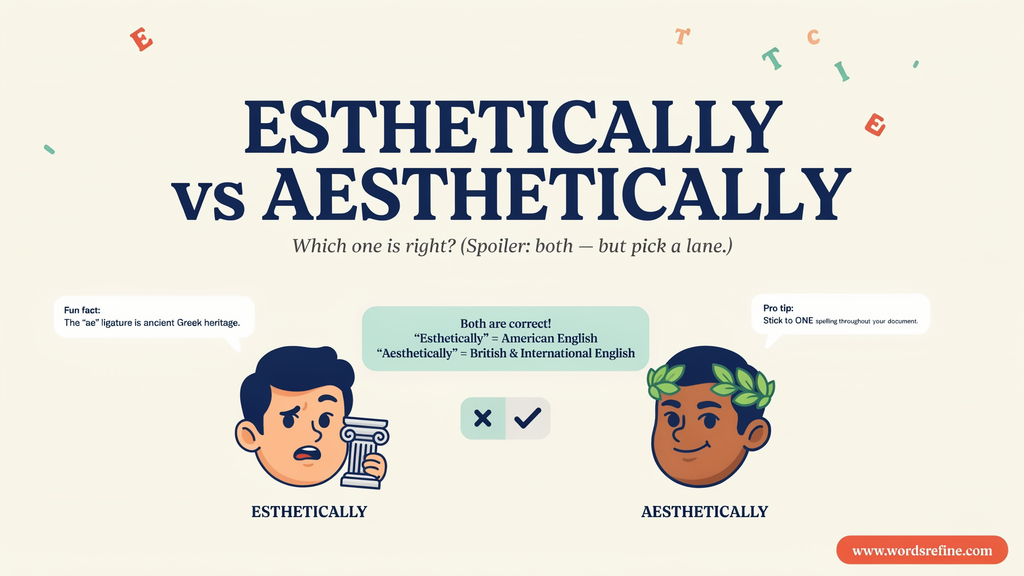
Aesthetically is an adverb that describes something in relation to beauty, artistic value, appearance, or visual appeal.
It comes from the adjective aesthetic, which relates to the appreciation of beauty and the qualities that make something visually or artistically attractive.
For example, imagine visiting a website with balanced spacing, readable typography, attractive colors, and carefully arranged images. Its design may be aesthetically pleasing because all its visual elements work together harmoniously.
The word doesn’t simply mean beautiful. Instead, it describes how something relates to beauty or how its appearance creates an artistic impression.
Aesthetically Definition
Aesthetically means in a way that relates to beauty, artistic qualities, visual attractiveness, or the appreciation of appearance.
Like esthetically, this word functions as an adverb.
Here are some natural examples:
The new restaurant is aesthetically attractive and comfortable.
The artist arranged the paintings aesthetically throughout the gallery.
The website looks aesthetically pleasing because of its clean layout.
The architect designed the house aesthetically while maintaining its practical features.
The garden combines flowers, stone pathways, and greenery aesthetically.
Notice that aesthetically doesn’t necessarily describe something expensive, luxurious, or fashionable. Even a simple object can have strong aesthetic appeal if its proportions, colors, and design create a pleasing impression.
Common Expressions With Aesthetically
Certain expressions appear frequently in everyday conversations, professional writing, and design discussions.
1Aesthetically pleasing describes something attractive or enjoyable to look at.
2Aesthetically appealing refers to something that creates a positive visual impression.
3Aesthetically beautiful describes something that has attractive artistic or visual qualities.
4Aesthetically designed refers to something created with careful attention to appearance.
5Aesthetically balanced describes an arrangement in which different visual elements work together harmoniously.
Among these expressions, aesthetically pleasing is particularly common.
For example, the minimalist kitchen looks aesthetically pleasing because its colors, lighting, and furniture complement one another.
This expression communicates more than simple attractiveness. It suggests that several design elements work together to create visual harmony.
Learn the difference between tricky grammar more words
May As Well vs Might As Well Meaning Differences?
Esthetically vs Aesthetically Key Differences
Although these spellings look different esthetically vs aesthetically they serve the same grammatical purpose and express the same idea. The distinction becomes clearer when you compare their spelling, base adjectives, pronunciation, and usage.
| Feature | Esthetically | Aesthetically |
|---|---|---|
| Meaning | Related to beauty or appearance | Related to beauty or appearance |
| Base adjective | Esthetic | Aesthetic |
| Part of speech | Adverb | Adverb |
| Spelling | Shorter variant | Longer variant |
| Pronunciation | Generally the same | Generally the same |
| American English | Accepted | Accepted |
| British English | Less commonly preferred | More widely preferred |
| General usage | Less common | More common |
The most important point is that neither word has a special meaning that the other lacks. You can replace one with the other without changing the central message.
Esthetically vs Aesthetically Difference in Meaning
The difference between esthetically vs aesthetically is primarily orthographic. In other words, it concerns how you write the word rather than what the word means.
Both forms describe visual attractiveness, artistic beauty, harmony between colors and shapes, and appreciation of design.
Consider these two sentences:
The interior was aesthetically designed to create a peaceful atmosphere.
The interior was esthetically designed to create a peaceful atmosphere.
Both describe an interior whose design focuses on visual appeal. The spelling changes, but the meaning stays the same.
However, don’t confuse the adverb aesthetically with the noun aesthetics. The noun refers to the branch of philosophy concerned with beauty, art, and artistic appreciation. It can also describe the characteristic visual style of something.
For example, the room looks aesthetically pleasing. Here, aesthetically is an adverb.
The room has a modern aesthetic. Here, aesthetic is a noun.
The designer studied aesthetics. Here, aesthetics is a noun referring to the study of beauty and art.
These words belong to the same family, but they don’t perform identical grammatical jobs.
Learn the difference between confusing word pairs
Finaly vs Finally Which One Is Correct?
Why Do People Confuse Esthetically vs Aesthetically?
The confusion begins with the unusual spelling of aesthetic. Unlike many English words, it starts with the combination of letters AE, which can look unfamiliar to writers who primarily use American English.
When people encounter esthetic, they may assume someone accidentally removed the first letter. However, the shorter spelling has a legitimate history in English.
The confusion also comes from the relationship between American and British spelling conventions. English contains numerous spelling variations, and some words have retained different forms across regions and dictionaries.
The Role of the Initial A
The A at the beginning of aesthetic isn’t an unnecessary addition. It reflects the word’s historical development from Greek.
However, English also accepts the simplified spelling esthetic. This shorter form follows a pattern found in other American spelling variations, where certain letters or combinations have been simplified.
Compare the related forms:
Aesthetic and esthetic.
Aesthetics and esthetics.
Aesthetically and esthetically.
Both sets contain accepted spellings. The shorter versions aren’t random misspellings.
Different Dictionary Preferences
Dictionaries may list one spelling before another or provide different information about regional preferences.
For example, Merriam-Webster recognizes esthetic as a variant of aesthetic. Cambridge Dictionary uses aesthetic as its standard headword and documents its established meaning and usage.
This difference in dictionary presentation can make writers believe that one form is incorrect. In reality, dictionaries often distinguish between a main spelling and an accepted alternative.
The practical lesson is simple: a less frequently listed spelling isn’t automatically wrong. Consider dictionary recognition, audience expectations, and the style guide you’re following.
Learn the difference between often confused words
Jist vs Gist Which One Is Correct ?
Esthetic vs Aesthetic Understanding the Root Words
To understand esthetically vs aesthetically properly, you need to look at their base adjectives.
The words esthetic and aesthetic describe qualities connected with beauty, artistic appreciation, and visual appearance. Both can function as adjectives.
For example, the museum displays several aesthetic masterpieces.
The museum displays several esthetic masterpieces.
Both sentences refer to artistic or visually significant works.
The Greek Origin of Aesthetic
The word aesthetic traces its roots to the Greek word aisthētikos, meaning perceptive or relating to perception and sensation. It is connected to aisthanesthai, meaning to perceive or feel.
The word entered English through European philosophical vocabulary and became closely associated with the study of beauty and art.
Over time, its meaning expanded beyond traditional philosophy. Today, people use aesthetic to discuss artistic beauty, interior design, fashion, photography, visual presentation, personal preferences, and the appearance of products and websites.
The word has also developed into a common term for a recognizable visual style.
For example, a minimalist aesthetic usually features clean lines, limited decoration, and a restrained color palette. A vintage aesthetic may include older furniture, retro patterns, and nostalgic design elements.
Aesthetic vs Esthetic Pronunciation
One reason people confuse aesthetic vs esthetic is that their pronunciation is generally the same.
Both spellings are commonly pronounced es-THET-ik.
The first syllable sounds like es, the second receives the main stress, and the final syllable sounds like ik.
The difference is mainly visible in writing rather than speech.
Aesthetic and esthetic generally share the same pronunciation.
Aesthetically and esthetically are also pronounced alike.
The exact pronunciation can vary slightly across English accents. However, the initial A in the longer spelling doesn’t create an additional spoken syllable.
Aesthetic Pronunciation
The standard American pronunciation of aesthetic is commonly represented in the International Phonetic Alphabet as /ɛsˈθɛtɪk/.
The main stress falls on the second syllable.
Esthetic Pronunciation
Esthetic generally shares the same pronunciation as aesthetic. The shorter spelling doesn’t require a different pronunciation.
Therefore, when comparing aesthetic and esthetic pronunciation, remember that the two forms generally sound alike. The spelling difference doesn’t create a meaningful pronunciation distinction.
Learn the difference between basic English word mistakes
Master’s Degree vs Masters Degree Which One Is Correct?
How to Use Esthetically vs Aesthetically in Sentences
Choosing between these words becomes easier when you understand their grammatical function.
Both words are adverbs. They describe how something happens or how an object, arrangement, or design relates to beauty.
However, they shouldn’t replace the adjective aesthetic when you need to describe a noun directly.
When to Use Esthetically
Use esthetically when you prefer the shorter spelling while discussing visual appearance, artistic qualities, or beauty.
For example, the designer arranged the artwork esthetically to create a balanced display.
The building looks esthetically impressive despite its modest size.
The photographer positioned the flowers esthetically before taking the picture.
The furniture complements the room esthetically.
The artist combined traditional patterns and modern colors esthetically.
The spelling works in both casual and formal contexts. Nevertheless, readers who rarely encounter it may find the longer spelling more familiar.
When to Use Aesthetically
Use aesthetically when discussing appearance, design, beauty, or artistic qualities. It is especially suitable for general writing because readers recognize it more readily.
For example, the hotel lobby looks aesthetically pleasing because of its warm lighting and elegant furniture.
The designer created an aesthetically balanced website.
The painting is aesthetically beautiful but emotionally unsettling.
The architect considered both functionality and appearance when designing the building.
The garden looks aesthetically appealing throughout the year.
Notice that the word can describe positive or negative artistic impressions.
For example, the painting is aesthetically interesting but visually uncomfortable.
Here, the writer acknowledges that the artwork has distinctive artistic qualities without claiming that everyone will find it beautiful.
Learn the difference between commonly misused words
Blond vs Blonde What’s the Difference?
Aesthetically Pleasing vs Esthetically Pleasing
Both expressions are grammatically correct.
However, aesthetically pleasing is the more familiar expression in contemporary general English.
It means that something looks attractive or creates a pleasant visual impression because of its design, arrangement, colors, proportions, or other visual qualities.
For example, the living room looks aesthetically pleasing because its furniture and decorations complement one another.
The website uses an aesthetically pleasing color scheme.
The restaurant combines comfortable seating with an aesthetically pleasing interior.
The painting creates an aesthetically pleasing balance between light and shadow.
You can also write that the living room looks esthetically pleasing because its furniture and decorations complement one another.
The meaning remains unchanged.
Remember that being aesthetically pleasing doesn’t necessarily mean being expensive or luxurious. A simple wooden chair can look more attractive than an elaborate designer chair if its proportions, materials, and craftsmanship work better together.
American English vs British English Which Spelling Should You Use?
American and British English often differ in spelling. Words such as color and colour, organize and organise, and center and centre demonstrate how regional conventions influence written English.
The relationship between aesthetic and esthetic is slightly different. Both spellings exist in American English, but the longer form is also the standard choice in British English.
American English Spelling of Aesthetic
American English accepts both aesthetic and esthetic.
Merriam-Webster recognizes esthetic as a variant spelling of aesthetic. However, aesthetic remains widely used in American publications, education, design discussions, and professional writing.
For example, the designer created an aesthetic interior.
The website looks aesthetically pleasing.
The artwork has considerable aesthetic value.
The building was designed esthetically to complement its surroundings.
American writers can use either form, although the longer spelling is generally more familiar to a broad audience.
British English Spelling of Aesthetic
British English generally favors aesthetic, aesthetics, and aesthetically.
These forms appear in standard British writing, academic discussions, art criticism, and everyday descriptions.
For example, the gallery celebrates the aesthetic qualities of modern sculpture.
The garden is aesthetically pleasing.
The architect considered the building’s visual appeal and aesthetic value.
Although esthetic and esthetically are recognizable alternative spellings, they aren’t the usual choices in standard British English.
the difference between everyday English mistakes
Onto vs On To What’s the Difference ?
American vs British Spelling of Aesthetically
| Word | American English | British English |
|---|---|---|
| Adjective | Aesthetic / Esthetic | Aesthetic |
| Noun | Aesthetics / Esthetics | Aesthetics |
| Adverb | Aesthetically / Esthetically | Aesthetically |
The table shows general spelling preferences rather than an absolute rule that prohibits alternative forms.
If you’re writing for an American audience, either spelling can work. If you’re writing for a British audience, aesthetically is the more appropriate standard choice.
For international publications, consistency matters more than switching between accepted forms.
Learn the difference between more words people mix up
Bougie vs Boujee Meaning Origin Spelling and Examples ?
Esthetically vs Aesthetically Common Synonyms and Alternatives
esthetically vs aesthetically Sometimes repeating aesthetically throughout an article makes the writing sound monotonous. Fortunately, English offers several alternatives that communicate similar ideas.
However, not every synonym carries exactly the same meaning. Some emphasize appearance while others focus on artistic quality, elegance, or harmony.
| Synonym | Meaning | Example |
|---|---|---|
| Visually | In terms of appearance | The website looks visually appealing. |
| Artistically | In a way related to art | The painting is artistically impressive. |
| Beautifully | In an attractive or pleasing way | The room is beautifully decorated. |
| Elegantly | In a graceful or refined way | The designer arranged the furniture elegantly. |
| Attractively | In an appealing way | The storefront is attractively designed. |
| Harmoniously | In a balanced and pleasing way | The colors blend harmoniously. |
| Tastefully | With good judgment and style | The house is tastefully decorated. |
| Gracefully | In a smooth or pleasing manner | The sculpture curves gracefully. |
When Should You Use These Alternatives?
The best alternative depends on what you want to emphasize.
For example, visually focuses on what someone sees. Artistically emphasizes creative or artistic quality. Meanwhile, elegantly suggests refinement and grace.
Compare these sentences:
1The room is aesthetically pleasing.
2The room is visually attractive.
3The room is elegantly decorated.
4The room is harmoniously arranged.
All four describe a positive impression, but each highlights a slightly different quality.
Choose the word that communicates your intended meaning rather than replacing aesthetically with a synonym simply to avoid repetition.
Learn the difference between confusing word pairs
Aluminum vs Aluminium Which One Is Correct?
Common Mistakes When Using Esthetically vs Aesthetically
Even though both esthetically vs aesthetically spellings are correct, writers sometimes use them incorrectly because they confuse spelling variations with grammatical differences.
Here are some common mistakes to avoid.
Assuming Esthetically Is Always Incorrect
One frequent mistake is treating esthetically as a misspelling of aesthetically.
However, both forms appear in recognized English dictionaries. The shorter version is an accepted spelling, not a grammatical error.
The incorrect assumption is that esthetically is never a real English word.
The correct understanding is that both spellings are acceptable, although aesthetically is more widely recognized.
Assuming the Two Words Have Different Meanings
Another mistake involves assigning separate meanings to the two spellings.
For example, someone might assume that esthetically describes physical beauty while aesthetically refers to artistic beauty.
That distinction doesn’t exist.
Both words can describe visual attractiveness, artistic qualities, and appreciation of beauty.
Confusing Adjectives and Adverbs
This mistake involves grammar rather than spelling.
An adjective describes a noun, while an adverb modifies a verb, adjective, or another adverb.
Compare these examples:
The painting has an aesthetic quality.
The painting looks aesthetically appealing.
In the first sentence, aesthetic describes the noun quality. In the second, aesthetically modifies the adjective appealing.
Using the wrong form can make an otherwise correct sentence sound awkward.
Mixing Spelling Variations
Using esthetic in one paragraph and aesthetic in another isn’t necessarily grammatically wrong. However, switching between them without a reason can make your writing look inconsistent.
Choose one spelling convention and maintain it throughout your document.
For example, if you select aesthetically, use the same spelling in your headings, paragraphs, examples, and conclusion.
Confusing Aesthetic With Aesthetics
These words belong to the same family, but they have different grammatical functions.
Aesthetic can function as an adjective describing beauty or artistic qualities. It can also function as a noun describing a particular style.
Aesthetics is a noun referring to the study or appreciation of beauty and art, or the characteristic style of something.
Aesthetically is an adverb describing something in relation to beauty or artistic qualities.
Consider these examples:
1.The designer prefers a minimalist aesthetic.
2.The designer studies aesthetics.
3.The designer arranged the furniture aesthetically.
Understanding these distinctions will help you avoid grammatical mistakes.
Incorrect vs Correct Sentences Esthetically vs Aesthetically
Sometimes the easiest way to understand a grammar rule is to see it in action. The following examples demonstrate how to use the words correctly and avoid common sentence errors.
| Incorrect or less natural | Correct | Explanation |
|---|---|---|
| The room is aesthetically beautiful designed. | The room is aesthetically designed. | The adverb describes the design. |
| The building has aesthetically appearance. | The building has an aesthetic appearance. | An adjective is needed before the noun. |
| The painting looks aesthetic pleasing. | The painting looks aesthetically pleasing. | The adverb modifies pleasing. |
| The website is aesthetic designed. | The website is aesthetically designed. | The sentence requires an adverb. |
| The garden is esthetic beautiful. | The garden is esthetically beautiful. | The adverb modifies beautiful. |
| The room has a aesthetically pleasing design. | The room has an aesthetically pleasing design. | An is appropriate before the vowel sound. |
See the Mistake, Fix the Mistake
Consider another example.
Incorrect: The architect created an aesthetically design for the house.
Correct: The architect created an aesthetic design for the house.
Why? Design is a noun, so it needs an adjective. Aesthetic describes the design, whereas aesthetically would describe how something is done.
Now consider another sentence.
Incorrect: The architect designed the house in an aesthetic mannerly way.
Correct: The architect designed the house aesthetically.
The corrected version removes unnecessary wording and communicates the idea more naturally.
The key is to understand whether you’re describing an object or explaining how someone performs an action.
Learn the difference between often confused words
Stint vs Stent Meaning Differences Examples and Correct Usage ?
Esthetically vs Aesthetically in Different Contexts
These words appear in many areas of everyday life. Their meaning remains consistent, but the qualities they describe can change depending on the subject.
Interior Design and Architecture
Interior designers and architects frequently consider aesthetic principles when planning spaces.
They pay attention to proportion, symmetry, lighting, colors, textures, and visual balance. These elements influence how people experience a room or building.
For example, the architect designed the house aesthetically by combining natural materials with clean architectural lines.
In this context, aesthetically describes the visual qualities of the design.
A space doesn’t need expensive furniture or elaborate decoration to look attractive. Sometimes a simple arrangement creates a stronger aesthetic appearance than a room filled with unnecessary objects.
Proportion describes the relationship between the sizes of different objects.
Symmetry refers to the balanced arrangement of elements around a central point.
Harmony describes how different design features complement one another.
Color influences the visual effect created by combining different shades.
Texture adds surface qualities that influence a design’s appearance.
Lighting affects how natural and artificial light change the atmosphere of a space.
When these elements work together, they can create a visually appealing environment.
Fashion and Beauty
In fashion, aesthetics influence how clothing, accessories, colors, and textures work together.
A stylist may combine neutral colors with carefully selected accessories to create an aesthetically balanced outfit.
For example, the stylist chose an aesthetically pleasing combination of colors and fabrics for the collection.
The beauty industry also uses aesthetic terminology when discussing appearance, skin care, and cosmetic procedures.
However, there’s an important distinction between aesthetics and esthetics in professional terminology.
In the beauty industry, aesthetics generally refers to the appreciation and enhancement of physical appearance.
It can involve skin care, makeup, cosmetic treatments, and procedures designed to improve or maintain someone’s appearance.
For example, a beauty professional might discuss the aesthetic qualities of a skin care treatment or the visual results of a cosmetic procedure.
You may also encounter the terms esthetician and aesthetician.
Both refer to professionals who provide skin care services, although licensing requirements and professional titles vary by location.
In American English, esthetician is commonly used, while aesthetician is also accepted.
The terms medical esthetics and medical aesthetics likewise appear in the beauty and skin care industries.
Importantly, these professional terms shouldn’t be confused with the ordinary adverbs esthetically and aesthetically. Their spelling follows established professional and regional usage.
Art and Photography
Artists and photographers use aesthetic principles to create meaningful visual experiences.
A photograph’s composition, lighting, color contrast, and subject placement can influence how viewers interpret an image.
For example, the photographer arranged the flowers aesthetically to create a balanced composition.
In art, aesthetic appreciation doesn’t always depend on whether something looks traditionally beautiful.
An abstract painting may feature unusual shapes, contrasting colors, and irregular patterns. Some viewers may find it visually appealing, while others may consider it uncomfortable or confusing.
Both reactions can reflect different aesthetic judgments.
Artistic beauty is subjective. Personal experiences, cultural backgrounds, and individual preferences influence how people respond to visual work.
Websites and Graphic Design
A website can contain excellent information and still struggle to attract visitors if its layout looks cluttered.
Graphic designers consider aesthetic design when choosing typography, colors, spacing, illustrations, and images.
For example, the company redesigned its website to make the interface more aesthetically pleasing.
However, visual attractiveness isn’t the only important factor.
A successful website also needs readable text, clear navigation, consistent typography, appropriate color contrast, well-organized information, and responsive layouts for different screen sizes.
A beautiful website that visitors cannot navigate creates frustration. Good design balances visual appeal with usability.
Academic and Professional Writing
In academic writing, aesthetic and aesthetically frequently appear in discussions about art, philosophy, architecture, literature, and design.
For example, the researcher examined the aesthetic qualities of traditional architectural structures.
Another example is that the study evaluated how viewers aesthetically responded to different forms of visual art.
The words also appear in professional discussions involving branding, product design, advertising, and creative industries.
For formal writing, aesthetically is generally the more recognizable choice. Nevertheless, esthetically remains an acceptable alternative where the relevant dictionary or publication style permits it.
Learn the difference between tricky grammar more words
Appendices vs Appendixes Meaning Difference and Usage ?
How to Remember the Difference Between Esthetically vs Aesthetically
The easiest way to remember these spellings is to recognize that they belong to the same word family.
Aesthetic becomes aesthetically.
Esthetic becomes esthetically.
Both pairs follow the same grammatical pattern.
If you’re unsure which form to choose, remember that both spellings are correct, both have the same meaning, and both function as adverbs. They relate to beauty, appearance, and artistic qualities.
However, aesthetically is more widely recognized in general English, while esthetically is an accepted alternative, particularly in American English.
A useful memory trick is to connect aesthetically with aesthetic. If you already know how to spell the base adjective, adding ally gives you the corresponding adverb.
For most general writing, choosing aesthetically will help you avoid unnecessary spelling questions.
Learn the difference between confusing word pairs
Hoover vs Hover Meaning Differences Pronunciation?
Practice Session Esthetic vs Aesthetic
1. The interior designer created an __________ space with soft lighting and neutral colors.
2. Both “esthetic” and “__________” are accepted English spellings.
3. The gallery displayed several paintings with strong __________ appeal.
4. Her clothing style reflects a minimalist __________.
5. The room was arranged __________ to create a balanced appearance.
6. An __________ appreciates beauty, art, and visual harmony.
7. The designer focused on the __________ qualities of the building.
8. The garden looks __________ pleasing because of its colorful flowers.
9. The shorter spelling of “aesthetic” is __________.
10. Good lighting can improve the __________ appeal of a photograph.
11. The artist carefully selected colors to create a pleasing __________.
12. The hotel combines modern furniture with traditional __________ details.
13. She has a strong interest in art and __________.
14. The website looks __________ balanced and easy to navigate.
15. The word “__________” describes something related to beauty or artistic taste.
16. The designer’s work demonstrates excellent __________ judgment.
17. Many Gen Z fashion trends reflect a distinct visual __________.
18. The room’s __________ design makes it feel calm and inviting.
19. A person who appreciates beauty and artistic expression is called an __________.
20. The shorter spelling, “esthetic,” has the same meaning as “__________.”
21. The photographer wanted to make the image more __________ appealing.
22. The building combines practical design with __________ beauty.
23. Her personal style has a vintage __________.
24. The magazine discussed the __________ value of modern architecture.
25. The two spellings are different, but their meanings are __________.
Answers
1. Aesthetic
2. Aesthetic
3. Aesthetic
4. Aesthetic
5. Aesthetically
6. Aesthete
7. Aesthetic
8. Aesthetically
9. Esthetic
10. Aesthetic
11. Aesthetic
12. Aesthetic
13. Aesthetics
14. Aesthetically
15. Aesthetic
16. Aesthetic
17. Aesthetic
18. Aesthetic
19. Aesthete
20. Aesthetic
21. Aesthetically
22. Aesthetic
23. Aesthetic
24. Aesthetic
25. Identical
Here’s a trusted source for clear more words Comparison:
FAQs
What is the highest level of aesthetic beauty called?
There is no single official term for the highest level of aesthetic beauty. However, words such as sublime, exquisite, breathtaking, and transcendent describe beauty that feels extraordinary or deeply moving.
Why does Gen Z say “aesthetic”?
Gen Z often uses “aesthetic” to describe a particular visual style, mood, or overall vibe. For example, a room with soft lighting, neutral colors, and vintage furniture might have a cozy aesthetic. The word also appears frequently in conversations about fashion, photography, and social media trends.
Is Botox considered aesthetics or esthetics?
Botox falls under medical or cosmetic aesthetics because it helps reduce the appearance of wrinkles and fine lines. Esthetics generally focuses on skin care and nonmedical beauty treatments. Although the fields overlap, Botox injections require the appropriate medical qualifications and legal authorization.
What is an esthetic look?
An esthetic look refers to a visual style that creates an appealing appearance. It may include coordinated colors, balanced shapes, attractive textures, or a consistent fashion theme. For instance, a minimalist outfit with neutral colors creates a simple, understated look.
Is “esthetic” a real word?
Yes, “esthetic” is a correct English word and an accepted variant of “aesthetic.” Both describe beauty, artistic taste, and visual appeal. Although “aesthetic” is more common, “esthetic” is also recognized and has the same meaning.
When should you use “esthetic” instead of “aesthetic”?
You can use “esthetic” as an alternative to “aesthetic,” especially when following a publication or dictionary that prefers the shorter spelling. However, “aesthetic” remains the more familiar choice in everyday writing. Both forms are correct, so consistency is the most important consideration.
What’s another word for “esthetic”?
Depending on the context, suitable alternatives include visual, artistic, beautiful, pleasing, stylish, and decorative. For example, you can replace “aesthetically pleasing” with “visually appealing.” Choose a word that expresses your intended meaning naturally.
Who is an aesthetic girl?
An aesthetic girl is someone whose fashion, appearance, or personal style reflects a recognizable visual theme. She might prefer vintage clothing, pastel colors, minimalist outfits, or alternative fashion. The expression describes a particular style rather than a specific personality type.
Which spelling is correct: “aesthetic” vs “esthetic”?
Both spellings are correct. “Aesthetic” is more widely used in modern English, while “esthetic” is an accepted alternative. You can use either spelling without changing the meaning, but avoid switching between them in the same piece of writing.
What is a slang word for “aesthetic”?
Words such as vibe, style, and core can sometimes replace “aesthetic” in casual conversations. For example, instead of saying, “That café has a cozy aesthetic,” you could say, “That café has a cozy vibe.” The best alternative depends on the context.
What is the Gen Z aesthetic?
The Gen Z aesthetic refers to the visual styles, fashion trends, and online cultures popular among Generation Z. Popular examples include Y2K fashion, cottagecore, dark academia, clean girl, and streetwear. Since Gen Z embraces many different styles, there is no single look that defines the entire generation.
What does “esthetically” mean?
“Esthetically” is an adverb that means in a way that relates to beauty, appearance, or artistic taste. It has the same meaning as “aesthetically.” For example, “The room is esthetically pleasing” means its appearance is attractive and visually balanced.
Is being called aesthetic a compliment?
Usually, yes. Calling someone aesthetic generally means their appearance, clothing, or personal style looks attractive and well-coordinated. However, the meaning can depend on the conversation. In most casual settings, it is a positive comment.
When did “aesthetic” become a word?
“Aesthetic” entered English in the late 18th century. It comes from Greek roots associated with perception and sensory experience. Over time, the word developed its connection with beauty, artistic judgment, and visual appeal.
Can I call myself an esthetician with a cosmetology license?
Not necessarily. The rules depend on your location and licensing authority. A cosmetology license may cover certain skin care services, but some jurisdictions require a separate esthetician license. Check your local regulations before using the professional title or offering esthetic services.
What do we call a person who loves aesthetics?
A person who appreciates beauty, art, and visual harmony is called an aesthete. The term describes someone with a strong interest in artistic taste and beautiful experiences.
Can estheticians do Botox?
Generally, estheticians cannot independently administer Botox because it is a prescription medical treatment. In many jurisdictions, only authorized medical professionals can perform injections. Although estheticians may provide various skin care treatments, they must follow local licensing rules and cannot perform medical procedures without the required qualifications.
Learn the difference between basic English word mistakes
Patronise vs Patronize Meaning Spelling Differences?
Conclusion
The difference between esthetic vs aesthetic is easier than it looks. Both spellings are correct and refer to beauty, artistic taste, and visual appeal. However, aesthetic is more common in everyday writing, while esthetic is an accepted alternative. The key is to choose one spelling and use it consistently. Whether you’re writing about art, fashion, design, or beauty, you can now use both forms with confidence. After all, an extra letter may change the appearance of a word, but it doesn’t change its meaning!

Diora AJS she is an experienced blogger and passionate English language enthusiast at Words Refine. With a keen eye for language and a love for clear communication, she writes practical content about grammar, word meanings, usage, and commonly confused terms. Her goal is to make English easier to understand through clear explanations and relatable examples, helping readers write accurately and communicate with confidence.