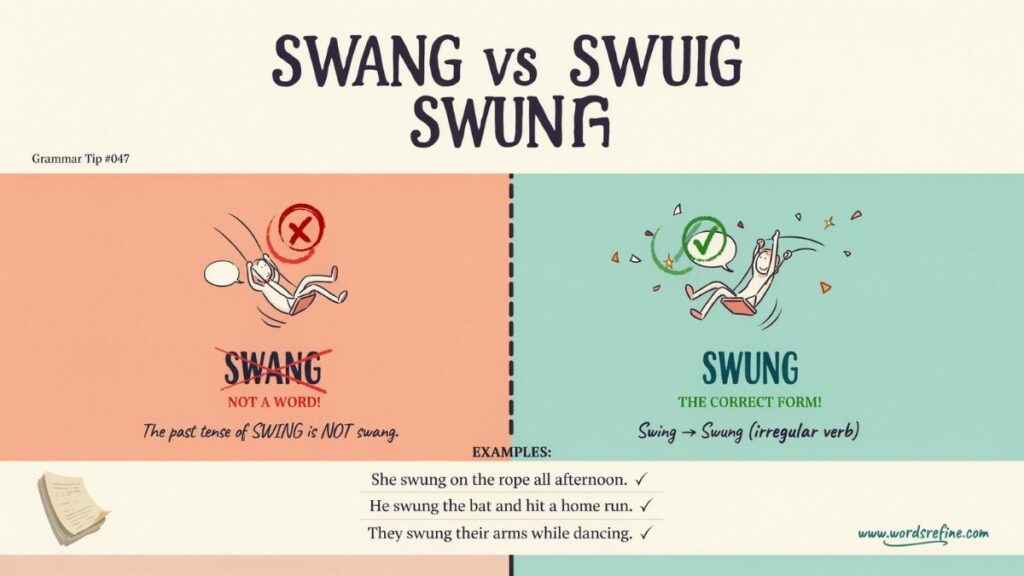
The difference between swang vs swung can be confusing, particularly because English irregular verbs don’t always follow predictable patterns. Both forms are associated with the verb “swing,” but they differ in standard usage. Swang appears in historical records and certain dialects, whereas swung is the accepted form in standard modern English. Understanding this distinction is essential for using the verb correctly in everyday conversations and formal writing. In this guide, you’ll learn what each form means, how it functions grammatically, and why swung is the preferred choice. We’ll also examine practical examples to help you recognize and avoid this common verb-form mistake.
Quick Answer Swang vs Swung
When choosing between swang vs swung the answer depends on whether you’re following standard English or intentionally using a regional dialect.
Swung is the standard past tense and past participle of swing. It works in everyday conversations, academic assignments, professional documents, and formal writing.
On the other hand, swang is a recognized dialectal form that appears in some regional varieties of English and historical texts. Although dictionaries record it, modern standard English generally favors swung.
Consider these examples:
| Sentence | Usage |
|---|---|
| The child swung higher on the playground swing. | Standard |
| The child swang higher on the playground swing. | Dialectal |
| She has swung the door open several times. | Standard |
| She has swang the door open several times. | Nonstandard |
Therefore, if you’re unsure which form to choose, swung is the safest option. It follows standard English grammar and works naturally in almost every writing situation.
Learn the difference between confusing more English words
There vs Their the Difference and Using Each Word Correctly?
What Does Swung Mean?
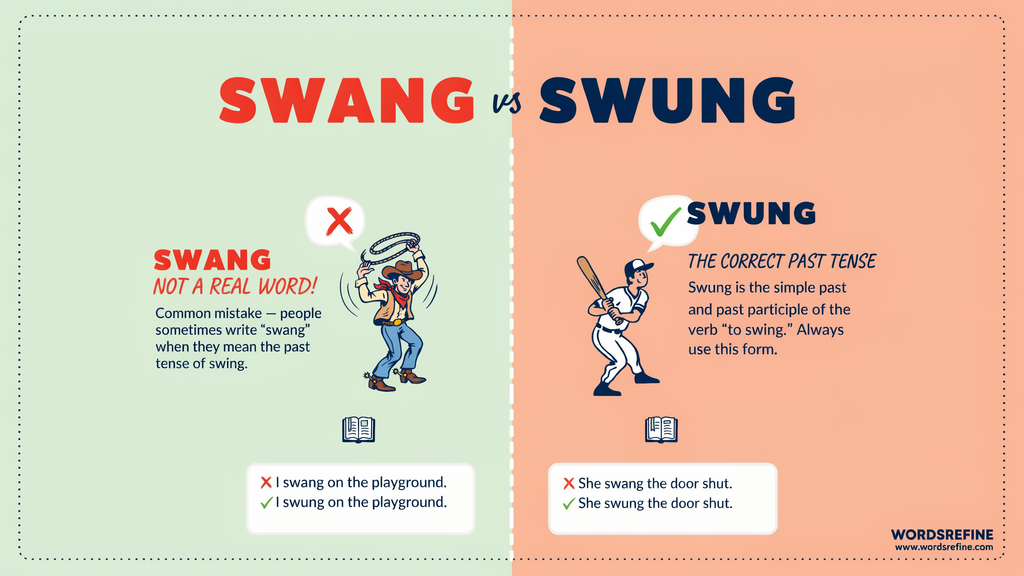
Swung is the simple past tense and past participle of the irregular verb swing. It describes an action that happened in the past or connects a previous action to another point in time.
The verb swing generally refers to moving something backward and forward, from side to side, or in a curved motion. However, it can also describe a change in direction, opinion, attitude, or circumstances.
Its meaning depends on the situation.
Physical Movement
The most familiar meaning of swung involves physical movement. Something moves freely from one position to another, often around a fixed point.
For example, the playground swing swung gently in the breeze. Similarly, a child might swing from one branch to another while playing in a tree.
Here are a few more examples:
| Example | Meaning |
|---|---|
| The monkey swung from one branch to another. | Movement between two points |
| The heavy gate swung open. | Movement around a fixed point |
| The keys swung from his belt. | Repeated movement |
| The child swung her legs beneath the chair. | Back-and-forth movement |
In each sentence, swung describes an action that has already happened.
Moving or Hitting Something
Swung can also describe using a sweeping motion to move or strike an object.
For instance, a baseball player swung the bat toward the ball. A boxer swung his arm toward his opponent. In both situations, the word describes a deliberate physical movement.
Consider these examples:
| Sentence | Context |
|---|---|
| The baseball player swung the bat and hit a home run. | Sports |
| She swung her handbag over her shoulder. | Everyday movement |
| The boxer swung his right arm toward his opponent. | Boxing |
| He swung the hammer carefully. | Manual work |
Notice that swinging something doesn’t always mean making contact with another object. A baseball player can swing the bat and miss the ball. The action still counts as swinging.
Changing Direction or Position
Sometimes swung describes a change in direction rather than the movement of an object from side to side.
For example, a car swung around a corner, while a cyclist swung left to avoid a pothole.
Other examples include:
The driver swung around at the next intersection.
The door swung inward when someone pushed it.
The boat swung toward the shore as the wind changed direction.
Although these situations involve different movements, they all use the same standard past-tense form.
Changes in Opinions and Circumstances
The verb also has a figurative meaning. People use it to describe changes in public opinion, personal attitudes, political preferences, and other situations.
For example, public opinion swung in favor of the new proposal. Similarly, someone’s mood might have swung from excitement to disappointment.
Other examples include:
The balance of power swung toward the opposition.
Her mood swung from happiness to frustration.
The conversation swung back to the original topic.
The company’s fortunes swung in a positive direction.
Here, swung doesn’t describe physical movement. Instead, it communicates a noticeable change in circumstances or direction.
Learn the difference between commonly mixed-up more words
Per Say vs Per Se Which One Is Correct?
Is Swang a Real Word?
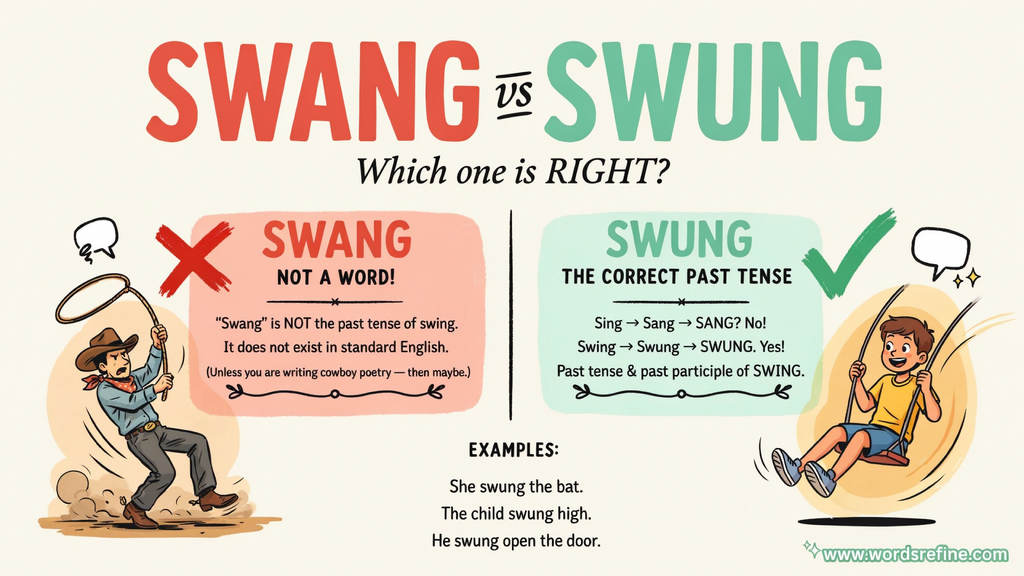
Yes, swang is a real English word. However, its recognition in dictionaries doesn’t automatically make it the preferred form in modern standard English.
The word has historical roots and appears in certain regional varieties of English. It is commonly described as a dialectal past-tense form of swing.
This distinction matters because a word can exist in English without being suitable for every writing situation.
Swang in Regional Speech
English has developed through centuries of regional variation. Different communities have maintained their own pronunciations, vocabulary, and grammatical patterns.
In some dialects, speakers have historically used swang instead of swung. This form reflects older patterns of irregular verb conjugation that have survived in particular varieties of English.
For example:
The gate swang open when the wind blew.
The branches swang above the narrow path.
The boat swang from side to side in the rough water.
These examples illustrate dialectal usage. However, standard written English generally replaces swang with swung.
Swang in Older Texts
The history of swang goes back much further than modern informal speech.
Older English and Scottish sources record the word as a past-tense form of swing. Over time, however, swung became the established standard form in modern English.
This change reflects a broader pattern in language development. Some older verb forms disappear from everyday use while others survive in particular regions or communities.
Consequently, calling swang a completely meaningless word would be inaccurate. It is better understood as a historically documented and chiefly dialectal form rather than the standard modern past tense.
Can You Use Swang in Modern English?
You can use swang when deliberately representing a dialect, reproducing historical language, or writing dialogue that reflects a particular speech pattern.
For example:
“The old gate swang open every time the wind picked up,” the farmer explained.
A writer might retain swang to preserve a character’s regional voice. However, that choice should be intentional.
For ordinary writing, swung is the better option. It is widely accepted and avoids distracting readers with a nonstandard verb form.
Understanding the difference swang vs swung becomes easier when you compare the two forms directly.
Learn the difference between tricky grammar more words
Roll Call vs Role Call Which One Is Correct?
Swang vs Swung Side-by-Side Comparison
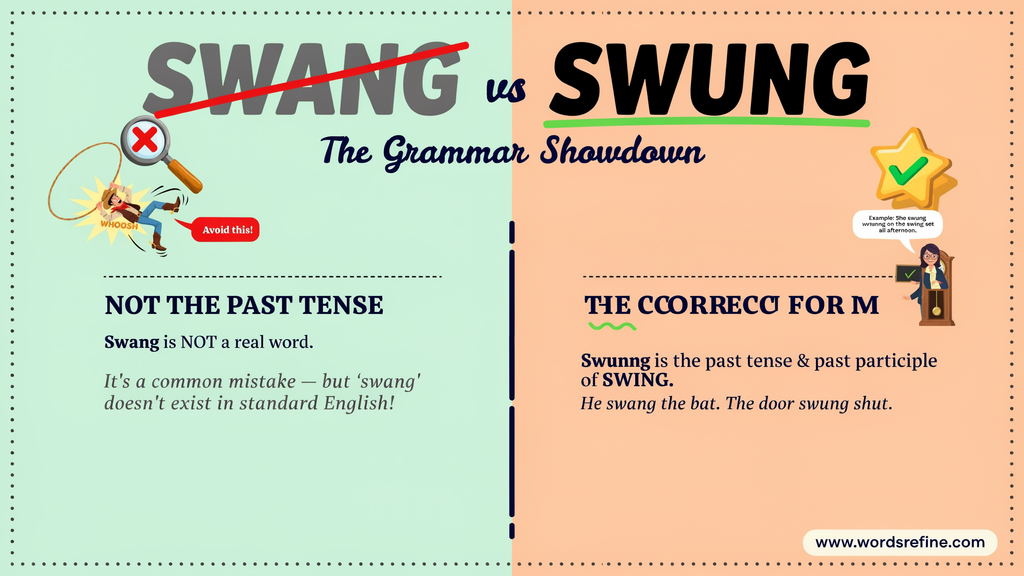
Both words relate to the verb swing, but standard English strongly favors one.
| Feature | Swang | Swung |
|---|---|---|
| Word type | Verb form | Verb form |
| Base verb | Swing | Swing |
| Standard past tense | No | Yes |
| Standard past participle | No | Yes |
| Dialectal usage | Yes | Yes |
| Historical usage | Yes | Yes |
| Formal writing | Generally avoided | Recommended |
| Academic writing | Generally avoided | Recommended |
| Everyday standard English | Not preferred | Correct |
Consider these examples:
Swang: The branches swang in the wind.
Swung: The branches swung in the wind.
Swang: He swang the bat toward the ball.
Swung: He swung the bat toward the ball.
The second version in each pair follows standard English grammar.
One important point deserves attention: swang doesn’t become the correct past participle simply because someone uses it as a dialectal past-tense form. The standard past participle remains swung.
The Three Forms of the Verb Swing
Before looking at more examples, it’s helpful to understand the complete verb pattern.
English verbs generally have different forms for present actions, past actions, and perfect tenses. Regular verbs often form their past tense by adding -ed. However, irregular verbs follow different patterns.
Swing is an irregular verb because it changes its internal vowel instead of following the regular -ed pattern.
Its three standard forms are:
| Verb form | Word | Example |
|---|---|---|
| Base form | Swing | I swing the bat every morning. |
| Simple past | Swung | I swung the bat yesterday. |
| Past participle | Swung | I have swung the bat before. |
The pattern is straightforward: swing, swung, swung.
Base Form Swing
Swing is the basic dictionary form of the verb.
You use it in the present tense with subjects such as I, you, we, and they. It also appears after modal verbs and in infinitive constructions.
For example:
I swing the bat during practice.
They swing on the playground after school.
We swing the door open when we enter.
She wants to swing by the store later.
However, when the subject is he, she, or it, add an -s to the verb.
He swings the bat confidently.
The clock swings from the wall.
She swings her arms while running.
Simple Past Swung
Use swung when describing an action that happened and finished in the past.
For example:
She swung the door open.
The children swung on the playground swings.
He swung the golf club too quickly.
The pendulum swung from one side to the other.
You can also use swung with past-time expressions such as yesterday, last night, last week, and an hour ago.
For example, yesterday the baseball player swung at every pitch.
The action happened in the past, so swung is the correct choice.
Past Participle Swung
The past participle is also swung. However, it usually works with a helping verb.
Common helping verbs include have, has, and had.
For example:
I have swung a golf club before.
She has swung the door open several times.
They had swung the equipment into position before the inspection.
He had never swung a baseball bat until that afternoon.
The difference between the simple past and past participle becomes clearer when you compare these sentences:
Simple past: She swung the bat.
Present perfect: She has swung the bat.
Past perfect: She had swung the bat.
The main verb remains the same, but the helping verb changes the grammatical structure.
Learn the difference between confusing word pairs
Here Here vs Hear Hear Which One Is Correct?
Why Do People Confuse Swang vs Swung?
The confusion doesn’t come from nowhere. English has several irregular verbs with similar spelling patterns. As a result, speakers sometimes apply one verb’s pattern to another.
For example, consider these verbs:
| Base form | Simple past | Past participle |
|---|---|---|
| Sing | Sang | Sung |
| Ring | Rang | Rung |
| Drink | Drank | Drunk |
| Swim | Swam | Swum |
| Begin | Began | Begun |
| Swing | Swung | Swung |
Look at sing and ring. Their simple past forms contain the vowel combination -ang.
Naturally, someone might assume that swing follows the same pattern:
Sing becomes sang.
Ring becomes rang.
Swing becomes swang.
The pattern seems logical. However, irregular verbs don’t always follow the same spelling changes.
The standard form is swung, not swang.
Similar Sounds Create Confusion
Pronunciation can also contribute to the mistake. Speakers may hear regional variations or encounter older forms in books and conversations.
When people repeatedly hear a particular form, they may assume it belongs in standard writing.
However, spoken language and formal written conventions don’t always follow identical patterns.
Irregular Verbs Don’t Follow One Universal Rule
Another source of confusion is the belief that irregular verbs follow predictable spelling changes.
They don’t.
For example:
Go becomes went and then gone.
Take becomes took and then taken.
See becomes saw and then seen.
Bring becomes brought and then brought.
Swing becomes swung and then swung.
Some irregular verbs change their vowels, others change completely, and some retain the same form in the simple past and past participle.
Therefore, learning each verb’s standard forms is more reliable than guessing from similar words.
Learn the difference between often confused words
Fead vs Feed Which One Is Correct?
How to Use Swung Correctly in Different Tenses
Knowing the correct past tense of swing is only part of the story. You also need to understand how swung fits into different sentence structures.
Let’s look at some practical examples.
Simple Past Tense
Use swung for an action that occurred and finished in the past.
For example:
The door swung shut after the visitor left.
The player swung the bat with all his strength.
A branch swung dangerously close to the window.
The action may have lasted a few seconds or continued for some time. What matters is that you’re presenting it as a past event.
Present Perfect Tense
Use has swung or have swung when connecting a past action to the present.
For example:
She has swung the racket many times during practice.
I have swung by that restaurant before.
They have swung the discussion toward a more practical solution.
The present perfect often describes experiences, repeated actions, or past events with present relevance.
Past Perfect Tense
Use had swung when one past action happened before another past event.
For example:
The gate had swung open before the security guard arrived.
He had swung the bat twice before the coach stopped practice.
The pendulum had swung several times before the machine stopped.
The helping verb had signals the past perfect tense.
Future Perfect Tense
Use will have swung to describe an action that will be completed before a particular future time.
For example:
By the end of practice, the player will have swung the bat hundreds of times.
This construction is less common in everyday conversation. Nevertheless, it follows the same past participle rule.
Passive Voice
You can also use swung in passive constructions when the sentence focuses on the object receiving the action.
For example:
The door was swung open by the security guard.
The heavy equipment had been swung into position.
The gate was swung shut before the storm arrived.
Here, swung appears with forms of the helping verb be.
Remember that passive voice isn’t automatically incorrect. Use it when the receiver of the action deserves more attention than the person performing it.
Swang vs Swung Common Mistakes to Avoid
Even experienced writers occasionally make mistakes with irregular verbs. The problem often appears when a familiar spelling pattern influences how someone writes an unfamiliar or less common verb form.
Here are some common mistakes involving swang and swung.
Using Swang Instead of Swung in Standard Writing
This is the most obvious mistake.
Incorrect: The children swang on the playground after lunch.
Correct: The children swung on the playground after lunch.
The standard past-tense form is swung. Although swang appears in dialectal English, it isn’t the recommended choice for ordinary standard writing.
Using Swang After Have or Has
The past participle of swing is swung. Therefore, you should use it after helping verbs such as have, has, and had.
Incorrect: She has swang the baseball bat several times.
Correct: She has swung the baseball bat several times.
Incorrect: They had swang the gate open before the visitors arrived.
Correct: They had swung the gate open before the visitors arrived.
Remember that the standard past participle doesn’t change just because the subject changes.
Using Swinged Instead of Swung
Some writers assume they can form the past tense of every verb by adding -ed. That approach works with regular verbs such as walked, played, and jumped.
However, swing is irregular.
Incorrect: He swinged the bat and missed the ball.
Correct: He swung the bat and missed the ball.
The same rule applies to the past participle.
Incorrect: She has swinged the door open.
Correct: She has swung the door open.
Confusing Simple Past and Past Participle
Both forms look identical in this case, but their grammatical functions differ.
Incorrect: I have swing the bat before.
Correct: I have swung the bat before.
Incorrect: Yesterday, she has swung the door open.
Correct: Yesterday, she swung the door open.
The first incorrect sentence uses the base form where the past participle belongs. The second mixes a specific finished past-time expression with the present perfect construction.
Assuming Swang vs Swung Are Interchangeable
Although dictionaries recognize both swang vs swung forms, they aren’t equally suitable for every situation.
Incorrect in standard writing: The pendulum swang back and forth.
Correct: The pendulum swang vs swung back and forth.
The distinction is especially important in school assignments, business documents, published articles, and formal communication.
Swang vs Swung Examples See the Mistake Fix the Mistake
Sometimes a simple comparison explains a grammar rule better than several paragraphs of theory. The following examples show how to recognize and correct common errors.
| Incorrect sentence | Correct sentence |
|---|---|
| The boy swang the bat. | The boy swung the bat. |
| She has swang the door open. | She has swung the door open. |
| The branches swang in the wind. | The branches swung in the wind. |
| He had swang from the tree. | He had swung from the tree. |
| The gate swang shut. | The gate swung shut. |
| They swang the rope over the fence. | They swung the rope over the fence. |
| The pendulum has swang several times. | The pendulum has swung several times. |
| She swinged her handbag over her shoulder. | She swung her handbag over her shoulder. |
Understanding the Corrections
Let’s examine a few sentences more closely.
Example: A baseball game
Incorrect: The player swang the bat but missed the ball.
Correct: The player swung the bat but missed the ball.
Why? The sentence describes a completed action in the past. The standard simple past form of swing is swung.
Example: A playground
Incorrect: The little girl has swang on that swing all afternoon.
Correct: The little girl has swung on that swing all afternoon.
Why? The present perfect tense requires the past participle. The correct form is swung.
Example: A moving door
Incorrect: The door swang open when the wind entered the room.
Correct: The door swung open when the wind entered the room.
Why? The sentence describes a past movement. Standard English uses swung.
Example: A change in opinion
Incorrect: Public opinion swang in favor of the proposal.
Correct: Public opinion swung in favor of the proposal.
Why? The verb describes a figurative change rather than physical movement. The same irregular verb rule applies.
These examples demonstrate an important principle: the meaning of swing can change with context, but its standard past-tense and past participle forms remain the same.
Real-World Examples of Swung in Everyday English
The word swung appears in many situations, from sports commentary to everyday conversations. Understanding these contexts will help you recognize the word and use it naturally.
Sports and Physical Activities
Sports provide some of the clearest examples because players regularly swing bats, rackets, golf clubs, and other equipment.
The batter swung at the first pitch but missed.
She swung the tennis racket with excellent timing.
The golfer swung too hard and sent the ball into the rough.
The boxer swung his arm toward the opponent.
In sports writing, swung can also describe a change in the score or momentum.
For example:
“The momentum swung in favor of the visiting team during the second half.”
Here, the word describes a shift in advantage.
Everyday Movement
You don’t need to play sports to use swung. The verb appears naturally in ordinary descriptions of movement.
The door swung open when I pushed it.
He swung his backpack over one shoulder.
The child swung her legs beneath the chair.
The keys swung from his belt as he walked.
The gate swung shut behind us.
These sentences describe familiar actions that happen in everyday life.
Changes in Opinions and Circumstances
The word also appears in discussions about decisions, public attitudes, and changing situations.
Voter support swung toward the independent candidate.
Her mood swung from happiness to frustration.
The discussion swung back to the original question.
The company’s fortunes swung in a positive direction after the new product launch.
These examples show why swung works well in both literal and figurative writing.
Swing By A Common Expression
Swing by means to visit a place briefly, often without making elaborate plans.
For example:
I swung by the grocery store after work.
She swung by my office to collect the documents.
We swung by our friend’s house before heading home.
Notice that the expression also uses swung in the past tense. You don’t need to change the word by. Only the main verb changes.
Learn the difference between basic English word mistakes
May As Well vs Might As Well Meaning Differences?
Does American or British English Make a Difference?
American and British English have many spelling and vocabulary differences. Words such as color and colour, organize and organise, and traveling and travelling demonstrate how the two varieties sometimes follow different conventions.
However, the standard past tense of swing doesn’t change between these varieties.
Both American and British standard English use:
Swing → Swung → Swung
For example:
American English: The child swung on the playground swing.
British English: The child swung on the playground swing.
The spelling remains identical.
What About Regional Dialects?
Regional speech is a different matter.
Some varieties of English have historically used swang as a past-tense form. The word appears in Scottish and Northern English usage as well as other dialectal records.
That doesn’t mean all speakers in those regions use it. Dialects vary between communities and individuals.
The important distinction is between regional language and standard written conventions.
| English variety | Standard past tense | Regional variation |
|---|---|---|
| American English | Swung | Swang is recorded as dialectal |
| British English | Swung | Swang appears in Scottish and Northern English usage |
| Standard international English | Swung | Swang is generally not preferred |
Therefore, whether you’re writing for American or British readers, swung remains the safest standard choice.
Can You Use Swang in Casual Writing Dialogue or Creative Work?
Although swung is the standard form, writers don’t always need to follow standard grammar in every piece of creative writing.
Sometimes a character’s voice matters more than formal grammatical conventions. That’s where dialectal forms such as swang may have a purpose.
Fiction and Character Dialogue
Imagine a novelist writing a character who speaks in a regional dialect.
The character might say:
“The old gate swang open every time the wind came through.”
A writer may deliberately retain swang to reflect the character’s speech.
However, the narrator’s standard descriptive language might use swung:
“The old gate swung open as the storm approached.”
This distinction helps maintain a consistent narrative voice.
Songs and Creative Writing
Songwriters and poets sometimes choose words based on rhythm, sound, rhyme, or regional identity.
A dialectal form may fit a particular line better than its standard equivalent. Historical texts may also preserve forms that modern writers rarely use.
However, creative freedom doesn’t change the standard grammatical rule.
Informal Messages and Social Media
You might encounter swang in online conversations, captions, comments, or casual messages.
That doesn’t necessarily make it a standard form. People often use regional expressions, slang, and nonstandard grammar in informal communication.
If you’re writing a professional email, school assignment, article, or business report, use swung.
Learn the difference between commonly misused words
Greatful vs Grateful Which One Is Correct?
A Simple Trick to Remember Swang vs Swung
Irregular verbs become easier when you learn their forms as a group rather than trying to remember each tense separately.
For swing, memorize this short pattern:
Swing → Swung → Swung
Here’s a simple way to apply it:
1When describing an action happening now, use swing or swings.
2When describing a completed past action, use swung.
3When using have, has, or had with the verb, use swung.
For example:
| Situation | Correct sentence |
|---|---|
| Present | I swing the bat every weekend. |
| Present with third-person singular | He swings the bat every weekend. |
| Simple past | I swung the bat yesterday. |
| Present perfect | I have swung the bat before. |
| Past perfect | I had swung the bat before the coach arrived. |
| Future perfect | I will have swung the bat 100 times by noon. |
Here’s another useful trick: compare swing with sing.
Although sing becomes sang in the simple past, swing becomes swung.
Don’t assume that two verbs with similar endings must follow identical patterns. English irregular verbs have their own histories and forms.
the difference between everyday English mistakes
It vs Its Meaning Differences Examples and Correct ?
How to Pronounce Swung
Correct spelling matters, but pronunciation matters too. If you’ve ever wondered how to say swung, the standard pronunciation is relatively straightforward.
The word swung has one syllable and uses the short vowel sound found in words such as sun and fun.
Its pronunciation is /swʌŋ/.
You don’t pronounce the final g as a separate hard sound. Instead, the ending produces the familiar nasal sound heard in words such as sing and long.
The pronunciation is the same in standard American and British English.
One useful distinction is that swang has a different vowel sound. However, that doesn’t make it the correct standard spelling. Pronunciation and grammatical usage are separate questions.
Swung in Common Expressions
The verb swing appears in several everyday expressions. When these expressions describe past events, the verb usually takes the form swung.
Understanding them will help you recognize how the word works beyond its literal meaning.
Swing By
Swing by means to visit somewhere briefly.
For example:
I swung by the pharmacy on my way home.
She swung by the office to pick up her laptop.
We swung by the restaurant before the movie started.
Swing Around
Swing around describes turning or moving in a different direction.
For example:
The driver swung around at the next intersection.
She swung around when someone called her name.
The dog swung around to face the noise.
Swing Back and Forth
This expression describes repeated movement between two positions.
For example:
The playground swing swung back and forth in the wind.
The hanging lamp swung back and forth above the table.
His arms swung back and forth as he walked.
The Pendulum Has Swung
This expression can describe a change from one position, opinion, or condition to another.
For example:
The pendulum has swung toward more traditional values.
Public opinion has swung in the opposite direction.
The balance of power has swung toward the opposition.
These expressions demonstrate the flexibility of swing. Whether you’re describing physical movement or a change in circumstances, the standard past form remains swung.
Learn the difference between often confused words
Discard vs Disgard Meaning Differences Examples and Correct ?
Swang vs Swung in Formal and Professional Writing
Choosing swang vs swung the correct verb form becomes especially important when writing for professional or academic audiences.
Although swang has a documented place in English, most readers expect standard verb conjugations in formal communication.
Using swung helps your writing remain clear and consistent.
Academic Writing
Students should use swung in essays, research papers, examinations, and other academic assignments.
For example:
Incorrect: The political pendulum swang toward the opposition after the election.
Correct: The political pendulum swung toward the opposition after the election.
The corrected sentence follows standard English grammar and communicates the same meaning.
Business Communication
Business writing often describes changes in performance, market conditions, customer preferences, and financial results.
In these contexts, swung is the appropriate standard form.
For example:
Sales swung upward during the final quarter.
Customer preferences swung toward more affordable products.
The company’s market position swung in its favor after the merger.
Using the standard form keeps professional documents polished and easy to understand.
Journalism and Online Publishing
Journalists and content writers frequently use swing when discussing elections, sports, public opinion, and economic changes.
For example:
“The election results swung dramatically after the final districts reported their votes.”
In published articles, standard grammar helps readers focus on the information rather than an unexpected verb form.
A Practical Editing Example
Consider a short paragraph written for a business report:
During the final quarter, customer preferences swang toward affordable products. The company’s sales have swang upward since the launch of its new pricing strategy.
Although readers can understand the meaning, the paragraph contains two incorrect forms in standard English.
A polished version reads:
“During the final quarter, customer preferences swung toward affordable products. The company’s sales have swung upward since the launch of its new pricing strategy.”
The corrections are simple. Swang becomes swung in the simple past tense, while have swang becomes have swung in the present perfect tense.
The original meaning remains unchanged. However, the revised paragraph follows standard grammar and reads more naturally.
Quick Recap Swang vs Swung at a Glance
Still wondering whether to write swang vs swung? Here’s the essential information in one place.
| Question | Answer |
|---|---|
| What is the base form? | Swing |
| What is the standard past tense? | Swung |
| What is the past participle? | Swung |
| Is swang a real word? | Yes, as a dialectal and historical form |
| Is swang the standard past tense? | No |
| Can swang appear in regional speech? | Yes |
| Should you use swang in formal writing? | Generally no |
| Do American and British standard English use swung? | Yes |
| Is swing an irregular verb? | Yes |
The main rule is simple: swing, swung, swung.
Use swung for both the simple past tense and the past participle in standard English.
Although swang appears in regional speech and historical sources, it isn’t the recommended form for everyday standard writing.
Learn the difference between confusing more English words
Bicep vs Biceps Meaning Grammar Spelling and Correct Usage?
Practice Session Swang vs Swung
1. The children ______ on the playground swings yesterday.
2. She ______ the door open and stepped inside.
3. The monkey ______ from one branch to another.
4. He ______ his backpack over his shoulder before leaving.
5. The heavy gate ______ shut during the storm.
6. The gymnast ______ gracefully from the high bar.
7. I ______ the bat but missed the ball.
8. The little girl ______ her legs while sitting on the bench.
9. The pendulum ______ back and forth throughout the night.
10. He had ______ the rope around the wooden post.
11. The door ______ open when the wind picked up.
12. She ______ the shopping bag onto her arm.
13. The children have ______ on these swings many times.
14. The player ______ the racket with all his strength.
15. The tree branches ______ wildly during the storm.
16. He ______ his chair around to face the audience.
17. The bridge ______ slightly under the truck’s weight.
18. The dancer ______ her arms to the rhythm of the music.
19. The boy had ______ too high and lost his balance.
20. The baseball player ______ at the first pitch.
21. The old sign ______ loosely above the entrance.
22. She has ______ the handle several times, but the door still won’t open.
23. The sailor ______ the rope to secure the boat.
24. The children were ______ happily on the playground.
25. What is the correct standard past-tense form of “swing”?
Answers
- swung
- swung
- swung
- swung
- swung
- swung
- swung
- swung
- swung
- swung
- swung
- swung
- swung
- swung
- swung
- swung
- swung
- swung
- swung
- swung
- swung
- swung
- swung
- swinging
- swung
Here’s a trusted source for clear more words Comparison:
FAQs
What does swang mean?
Swang is a dialectal or historical past-tense form of the verb “swing.” It describes movement from side to side, turning, or moving something through the air. In standard English, however, “swung” is the correct past-tense form.
Is swang a real English word?
Yes. Swang appears in historical and dialectal English. However, it is not the standard past-tense form of “swing.” In everyday and formal writing, use “swung.”
Is swang listed in the dictionary?
Yes. Some dictionaries recognize “swang” as a historical or dialectal variant of “swung.” However, its dictionary entry does not make it the preferred form in standard English.
Is swang grammatically correct?
Swang may be acceptable in certain dialects or historical contexts. However, standard English uses “swung” as both the simple past tense and past participle of “swing.”
What does swang mean in rap?
In rap and hip-hop, swang can refer to movement, cruising, dancing, or a particular rhythmic style. Its meaning depends on the lyrics and cultural context. Some artists also use it as a creative variation of “swing.”
What does swang mean in Spanish?
Swang has no single Spanish equivalent. Depending on the context, it may translate as “se balanceó” (swung back and forth) or “balanceó” (swung something). The surrounding sentence determines the most natural translation.
What is the difference between swang vs swung?
Swang is a dialectal or historical variant, whereas swung is the standard English form. For example, “The child swung on the playground swing” is correct in standard English.
Can I use swang in formal writing?
No. Use “swung” in formal writing, academic assignments, business communication, and standard English. Reserve “swang” for contexts where dialect, historical language, or a character’s voice matters.
Is swang ever used as a past participle?
Swang appears in some nonstandard and dialectal usage, but standard English uses “swung” as the past participle. For example, “The door had swung open” is correct.
What are the three forms of the verb swing?
The three main forms are swing (V1), swung (V2), and swung (V3). Unlike regular verbs, “swing” does not form its past tense by adding “-ed.”
What is the difference between swing swung vs swinging?
Swing is the base form, swung is the simple past tense and past participle, and swinging is the present participle. For example, “I swing every morning,” “I swung yesterday,” and “I am swinging now.”
Is swang acceptable in a song or poem?
Yes. Songwriters and poets may use swang to create a particular rhythm, rhyme, or dialect-based voice. However, this creative use does not make it the standard past-tense form.
What is the correct past tense of swing?
Swung is the correct standard past tense of swing. For example, “She swung the door open” is correct, while “She swang the door open” is nonstandard.
Does swang mean the same as swung?
Both forms generally describe the action of swinging. However, they differ in standard usage: swung is accepted in modern standard English, while swang is associated with dialectal or historical speech.
Learn the difference between tricky grammar more words
Expense vs Expenditure Meaning Differences and Correct Usage?
Conclusion
The difference between swang vs swung may seem minor, but using the wrong form can make your writing sound awkward. Although swang appears in historical and dialectal English, swung is the correct form in standard modern English. Whether you swung a bat, opened a door, or moved from one tree branch to another, the rule stays the same: swing, swung, swung. English already has plenty of irregular verbs to keep you on your toes, so there’s no need to make this one more complicated! Remember the correct forms, and you’ll avoid this common grammar mistake with ease.

Diora AJS she is an experienced blogger and passionate English language enthusiast at Words Refine. With a keen eye for language and a love for clear communication, she writes practical content about grammar, word meanings, usage, and commonly confused terms. Her goal is to make English easier to understand through clear explanations and relatable examples, helping readers write accurately and communicate with confidence.