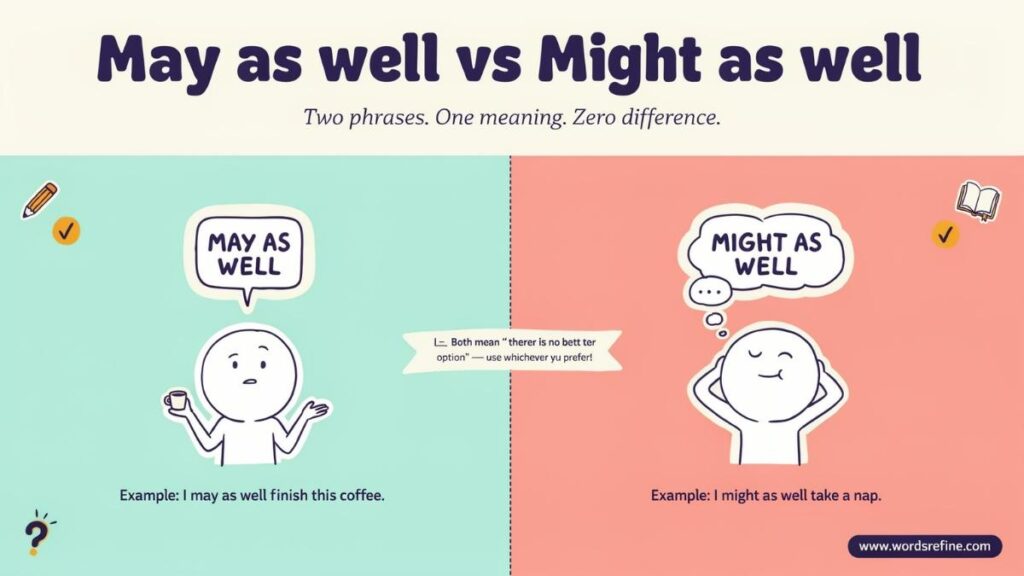
May as well vs might as well these two phrases look almost identical, yet they can leave even confident writers second guessing their grammar. Which one should you use, and does choosing the wrong one really matter? Fortunately, the answer is simpler than you might think. Both expressions often convey the same idea: doing something because it seems reasonable or worthwhile under the circumstances. However, understanding their subtle differences can help you use them more naturally. Whether you’re chatting with friends or writing a professional email, this guide explains their meanings, usage, and common mistakes, helping you choose the right phrase without turning a simple sentence into a grammar headache.
Quick Answer May As Well vs Might As Well
Both expressions suggest that an action is reasonable, worthwhile, or the best available option under the circumstances.
“May as well” suggests that an action makes sense or is worth doing. “Might as well” expresses the same general idea but can sound more conversational or suggest that the speaker accepts a situation without expecting a better alternative.
Consider these examples:
“We may as well walk to the restaurant since it’s only two blocks away.”
“We might as well walk to the restaurant since the bus isn’t coming.”
Both sentences recommend walking. In the first, walking seems like a sensible choice because the restaurant is nearby. In the second, walking makes sense because the bus isn’t coming.
However, the difference isn’t fixed. Either expression can work naturally in both situations.
The simple rule is to use “may as well” or “might as well” when an action seems reasonable given the circumstances. Choose whichever expression best fits your intended tone.
Learn the difference between confusing more English words
Appendices vs Appendixes Meaning Difference and Usage ?
What Does “May As Well” Mean?
The phrase “may as well” means that an action seems sensible, useful, or worthwhile in a particular situation. People often use it when they compare available options and decide that one is good enough, even if it wasn’t their original plan.
The Meaning of “May As Well”
The phrase goes beyond simple permission or possibility. Instead, it usually suggests that an action makes sense because of the circumstances.
For example, consider this sentence:
“Since we’re already at the grocery store, we may as well buy some milk.”
The speaker isn’t asking whether buying milk is permitted. Instead, buying milk makes sense because they’re already there.
Similarly, you might say, “You may as well save your work before shutting down the computer.” Saving the work is a practical step that prevents unnecessary trouble later.
Here are a few more examples:
“Since the meeting starts in an hour, we may as well prepare the presentation now.”
“The movie doesn’t start for another 20 minutes, so we may as well grab a snack.”
“If you’re going to the library, you may as well return those books.”
In each case, the phrase presents an action as a reasonable choice based on the situation.
How to Use “May As Well” in a Sentence
The usual sentence structure is a subject followed by “may as well” and the base form of a verb.
For example, you can say, “I may as well call her now,” “We may as well take a taxi,” or “They may as well stay for dinner.”
Each sentence suggests that the action makes practical sense.
Notice that the verb after “may as well” stays in its base form. You say “may as well go,” not “may as well to go” or “may as well going.” Although these mistakes might seem minor, they can make an otherwise clear sentence sound awkward.
Does “May As Well” Always Sound Positive?
Not necessarily. The expression can introduce a positive suggestion, a neutral decision, or reluctant acceptance.
For example, imagine that rain ruins your plans for an outdoor picnic. You might say, “We can’t play outside, so we may as well watch a movie.”
The speaker accepts the situation and chooses another activity. They might be happy with that decision, or they might simply be making the best of a disappointing afternoon.
That flexibility makes “may as well” useful in everyday conversation.
Learn the difference between tricky grammar more words
Hustle vs Hussle Which One Is Correct?
What Does “Might As Well” Mean?
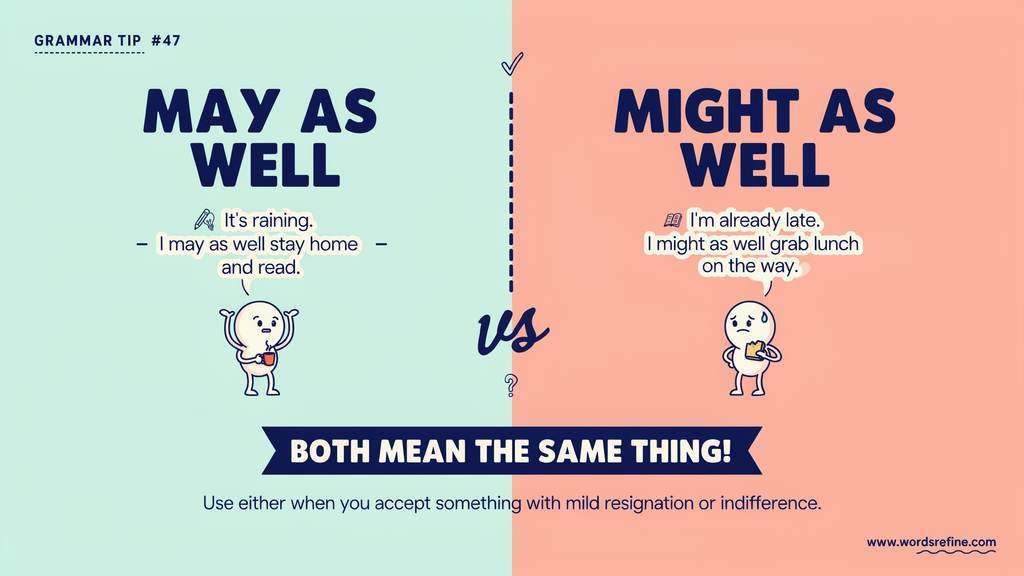
The phrase “might as well” also suggests that an action is reasonable under the circumstances. Speakers commonly use it when an alternative offers little advantage or when an unexpected situation changes their plans.
The Meaning of “Might As Well”
The expression often conveys the idea that an action is worth doing because there’s little reason not to do it.
Consider this example:
“The train is delayed by an hour, so we might as well get something to eat.”
The speaker has a long wait ahead. Rather than sit around doing nothing, getting food seems like a sensible choice.
Likewise, someone might say, “You’ve already opened the document, so you might as well finish editing it.” The suggestion follows naturally from the situation.
Other examples include:
“Since everyone is here, we might as well begin the meeting.”
“The weather has cleared up, so we might as well go for a walk.”
“If we’re already driving past the post office, we might as well mail the package.”
Each sentence presents a practical decision rather than a statement about strict possibility.
How to Use “Might As Well” in a Sentence
The usual structure is a subject followed by “might as well” and the base form of the verb.
For example, “I might as well leave now,” “She might as well ask for help,” and “We might as well order pizza” all follow the same pattern.
The phrase suggests that the action is a reasonable option given the circumstances.
As with “may as well,” the verb stays in its base form. Write “You might as well keep the receipt,” not “You might as well to keep the receipt.”
Can “Might As Well” Express Reluctance?
Yes. In fact, this is one of its familiar uses.
Consider the sentence, “There’s nothing good on television, so I might as well go to bed.”
The speaker isn’t necessarily excited about going to bed. They simply don’t see a better alternative.
Similarly, “If you’re going to be late anyway, you might as well take your time and drive safely” presents a practical response to an inconvenient situation.
However, “might as well” doesn’t always express reluctance. Someone can use it enthusiastically, too.
For example, “We have an extra day in Chicago? We might as well visit the museum!”
The surrounding words and the speaker’s tone help communicate the intended feeling.
Learn the difference between commonly mixed-up more words
Igniter vs Ignitor Which One Is Correct?
May As Well vs Might As Well Key Differences
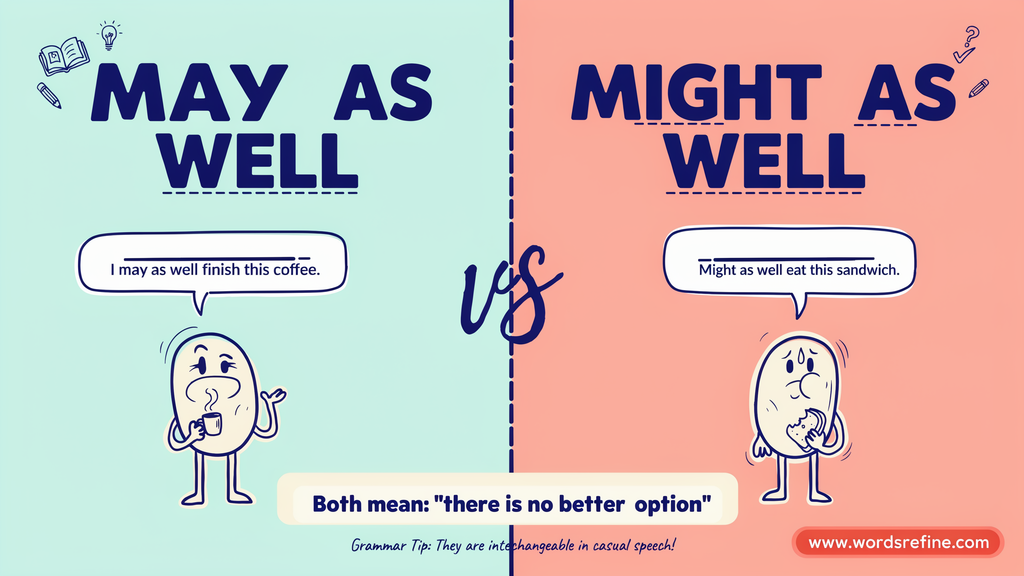
The main difference between these expressions is subtle. Both can suggest a reasonable choice, but “might as well” often appears in casual conversation when the speaker accepts an imperfect situation or sees little reason not to act.
“May as well” can communicate the same idea. It may sound slightly more direct to some speakers, but that impression depends on context and individual speech habits.
| Feature | May as well | Might as well |
|---|---|---|
| Basic meaning | An action seems reasonable or worthwhile | An action seems reasonable or worthwhile |
| Making a suggestion | Yes | Yes |
| Choosing a practical option | Yes | Yes |
| Expressing reluctance | Possible | Possible |
| Accepting circumstances | Yes | Yes |
| Grammatical correctness | Correct | Correct |
| Verb form afterward | Base form | Base form |
| General tone | Can sound neutral or direct | Can sound conversational or tentative |
| Can the expressions overlap? | Yes | Yes |
What Is the Difference Between May As Well vs Might As Well?
Consider these sentences:
“Since we have an hour before the appointment, we may as well get coffee.”
“Since we have an hour before the appointment, we might as well get coffee.”
Both suggest that getting coffee is a practical way to use the available time. The second may sound a little more casual or tentative to some readers, but the difference isn’t strong enough to establish a universal rule.
Now imagine that your plans have fallen apart.
“The concert has been canceled. We might as well go home.”
This sounds natural because the speaker accepts the disappointing news and chooses a practical alternative.
You could also say, “The concert has been canceled. We may as well go home.” That sentence is correct, too.
The important point is that the difference between “may as well” and “might as well” is usually a matter of nuance rather than a strict difference in meaning.
Are “May As Well” and “Might As Well” Interchangeable?
In many situations, yes. Both phrases can recommend the same action without changing the essential meaning.
For example, “We may as well start early” and “We might as well start early” both recommend starting early.
However, the phrases aren’t interchangeable in every sentence containing “may” or “might.” Their similarity applies to the established expressions “may as well” and “might as well.” It doesn’t mean that the modal verbs “may” and “might” always mean the same thing.
Consider these examples:
“You may leave now.” This can express permission.
“You might leave now.” Depending on context, this can describe a possibility or offer a tentative suggestion.
“You might as well leave now.” This suggests that leaving now makes sense under the circumstances.
Adding “as well” changes the expression’s function. Therefore, it’s important to understand the complete phrase rather than interpret each word separately.
When to Use “May As Well”
Use “may as well” when you want to suggest a reasonable action, especially when circumstances make that action convenient or worthwhile.
Making a Practical Suggestion
Suppose a friend is already at the post office and remembers that they need to mail a package.
“You may as well send it while you’re here.”
The suggestion makes sense because your friend can complete both tasks in one visit.
Similarly, you might say, “You may as well bring an umbrella; the forecast calls for rain.” The suggestion is practical because carrying an umbrella could prevent trouble later.
Other examples include:
“We may as well book the tickets today.”
“You may as well ask the teacher before the class ends.”
Each sentence presents an action that seems sensible given the circumstances.
Making the Best of a Situation
Sometimes your preferred plan isn’t possible. In that case, “may as well” helps you suggest an alternative.
For example, “The outdoor event has moved indoors, so we may as well enjoy the music inside.”
The expression doesn’t require the speaker to love the change. Instead, it presents the available option as worthwhile.
Taking Advantage of an Opportunity
The phrase also works when an opportunity appears unexpectedly.
“If you’re visiting the city center, you may as well see the historic library.”
The speaker recommends an additional activity because the opportunity is already available. Rather than making a separate trip, the person can enjoy another attraction while they’re nearby.
When to Use “Might As Well”
Use “might as well” when an action seems worthwhile despite limited alternatives, a change of plans, or an uncertain situation.
Learn the difference between often confused words
ECT vs ETC Which One Is Correct?
Choosing the Most Sensible Option
Imagine that you arrive at a restaurant only to discover that your reservation is for an hour later.
“We might as well take a walk until our table is ready.”
The suggestion turns an inconvenience into an opportunity.
Similarly, you might say, “The store closes in ten minutes, so we might as well shop quickly.” The speaker recognizes the time limit and suggests making the most of it.
Other examples include:
“Since you’re already logged in, you might as well update your account details.”
“We might as well check the schedule before leaving.”
Accepting an Unavoidable Situation
The expression frequently appears when people accept circumstances they can’t easily change.
“The roads are flooded, so we might as well stay home.”
The speaker has concluded that staying home is the practical choice.
Likewise, “There’s no point in waiting for the delivery today. We might as well rearrange the room instead” shifts attention toward an activity the speaker can complete.
Making a Casual Suggestion
“Might as well” also fits relaxed conversations between friends, family members, and coworkers.
“We’re already downtown. Might as well grab lunch!”
In informal speech, people sometimes omit the subject when the meaning remains clear. The complete sentence would be “We might as well grab lunch.”
Both forms can sound natural in the right setting.
Common Mistakes With May As Well vs Might As Well
Because these expressions look similar, writers sometimes invent rules that English grammar doesn’t require. Others confuse the phrases with different uses of the modal verbs “may” and “might.”
Assuming One Expression Is Incorrect
A common misconception is that you should always say “might as well” because “may as well” is grammatically wrong.
That’s incorrect. Both expressions are standard English.
For example, “We may as well leave before traffic gets worse” and “We might as well leave before traffic gets worse” are both correct.
You don’t need to replace “may” with “might” every time you use this expression.
Adding “To” Before the Verb
Incorrect: “We might as well to leave now.”
Correct: “We might as well leave now.”
The expression takes the base form of the verb directly. Don’t insert “to” between “as well” and the verb.
The same rule applies to “may as well.” You should write “You may as well call them,” not “You may as well to call them.”
Using the Wrong Verb Form
Incorrect: “She may as well going home.”
Correct: “She may as well go home.”
The verb after the expression doesn’t take the -ing form. Use the base form, such as “go,” “leave,” “ask,” “finish,” or “wait.”
Learn the difference between confusing word pairs
Smokey vs Smoky Which One Is Correct?
Assuming “Might” Always Means Less Certainty
In ordinary modal-verb usage, “might” can indicate possibility or uncertainty. However, “might as well” has an established meaning of its own.
For example, “We might as well order dinner now” doesn’t necessarily mean the speaker is uncertain that dinner can be ordered. It means ordering dinner seems like a sensible choice.
Treating the phrase as a literal statement about probability can lead to confusing interpretations.
Confusing “May As Well” With Permission
Compare these sentences:
“You may enter the room.” This grants permission.
“You may as well enter the room.” This suggests that entering is a reasonable choice.
The addition of “as well” changes the meaning. The second sentence isn’t simply a more elaborate way to grant permission.
Overcorrecting Correct Sentences
Suppose someone writes, “We may as well take the earlier train.”
There’s no grammatical reason to change it to “We might as well take the earlier train.” An editor may prefer the second version for its tone, but that preference doesn’t make the first sentence wrong.
The best correction fixes a genuine problem rather than replacing one valid expression with another.
May As Well vs Might As Well Sentence Examples
The following examples show how both phrases work in common situations. Notice that many sentences allow either expression without a meaningful change in the message.
| Situation | May as well | Might as well |
|---|---|---|
| Waiting | We may as well read while we wait. | We might as well read while we wait. |
| Travel | We may as well leave early. | We might as well leave early. |
| Work | You may as well finish the report now. | You might as well finish the report now. |
| Shopping | We may as well buy the groceries today. | We might as well buy the groceries today. |
| Weather | We may as well stay indoors. | We might as well stay indoors. |
| Plans | We may as well invite everyone. | We might as well invite everyone. |
May As Well Examples in Context
Example: A delayed appointment
“Dr. Lee is running 30 minutes behind schedule. I may as well answer my emails while I wait.”
The speaker identifies a useful activity that fits the delay.
Example: A work deadline
“The report is almost finished, so we may as well proofread it before lunch.”
The remaining task is small enough to complete now.
Example: A travel opportunity
“We’re driving through the mountains anyway, so we may as well stop at the scenic overlook.”
The speaker suggests taking advantage of an opportunity that already exists.
Might As Well Examples in Context
Example: A canceled plan
“Our picnic is canceled because of the storm. We might as well make lunch at home.”
The speaker accepts the change and chooses an alternative.
Example: An unexpected free afternoon
“The client postponed the meeting, so I might as well organize my notes.”
The speaker makes practical use of unexpected free time.
Example: A long wait
“The bus won’t arrive for another 40 minutes. We might as well walk to the café.”
The speaker chooses an activity that seems more useful than waiting.
A Short Dialogue Using Both Expressions
Consider this conversation between two coworkers.
Mia: “The meeting doesn’t start until 2:00 p.m.”
Daniel: “We may as well review the presentation before then.”
Mia: “Good idea. We might as well check the figures, too.”
Both phrases fit naturally. Neither speaker needs to follow a different grammatical rule. The wording simply reflects two suggestions made in the same conversation.
May As Well Have vs Might As Well Have
Adding “have” changes the grammatical structure and usually shifts the meaning toward a past action or an action viewed as having occurred before a reference point.
The construction “may as well have” or “might as well have” followed by a past participle can express a conclusion about a past situation. It often suggests that an action made little practical difference or produced an outcome similar to another action.
For example, “You might as well have stayed home; the event ended before you arrived.”
The speaker suggests that attending made little difference because the event had already ended.
This construction can also appear in hypothetical or counterfactual comments, depending on the context.
Learn the difference between basic English word mistakes
Complement vs Compliment Meaning Differences and Examples?
What Does “Might As Well Have” Mean?
“Might as well have” often comments on a past action by suggesting that another action would have produced a similar result or been just as sensible.
Examples include:
“I might as well have thrown the money away; the broken appliance couldn’t be repaired.”
“He might as well have stayed in bed; the office closed before he got there.”
“We might as well have taken the train; the traffic made driving just as slow.”
These sentences express a judgment about the outcome. They don’t necessarily mean that the action was literally pointless in every respect.
For instance, someone might still have learned something from attending an event even if it ended early.
What Does “May As Well Have” Mean?
“May as well have” can also describe a past action or outcome, although “might as well have” often sounds more natural in casual American English when expressing resignation or suggesting that an action made little difference.
Examples include:
“We may as well have waited at home; the delivery arrived hours late.”
“She may as well have sent the document yesterday, given that the deadline was extended.”
“I may as well have walked; the taxi took just as long.”
The exact interpretation depends on context. These examples compare what happened with an alternative that might have been just as sensible.
The Difference Between “May As Well Have” and “Might As Well Have”
In many contexts, the two forms overlap. However, speakers often prefer “might as well have” for retrospective comments that express regret, resignation, or a sense that an action was effectively pointless.
| Construction | Example | Meaning |
|---|---|---|
| May as well + base verb | We may as well leave. | Leaving seems sensible now. |
| Might as well + base verb | We might as well leave. | Leaving seems sensible now. |
| May as well have + past participle | We may as well have stayed home. | Staying home might have been just as sensible. |
| Might as well have + past participle | We might as well have stayed home. | Staying home might have been just as sensible. |
Remember that the past participle follows “have”: “have gone,” “have stayed,” “have waited,” or “have chosen.” The construction doesn’t use the simple past form alone.
May As Well Be vs Might As Well Be
When followed by “be,” the expressions can suggest that something is effectively equivalent to another thing or that a description fits the situation.
For example, “This old laptop might as well be a paperweight.”
The speaker exaggerates to suggest that the laptop is so slow or unreliable that it’s practically useless.
You could also say, “This old laptop may as well be a paperweight.” The meaning remains essentially the same.
Other examples include:
“Without reliable evidence, the claim might as well be a guess.”
“If nobody can hear the announcement, the microphone might as well be switched off.”
“With all these delays, the trip may as well be canceled.”
The phrase often carries humor or exaggeration in these examples. It doesn’t mean the laptop literally is a paperweight or that the microphone has no physical function.
Learn the difference between commonly misused words
Too vs To Meaning Differences Examples and Grammar Rules?
“Just Might As Well” Is It Correct?
Yes, “just might as well” can appear in natural English, especially in informal conversation. The word “just” adds emphasis or reinforces the idea that an action is the practical choice.
For example, “If we’re going to the store anyway, we just might as well pick up some bread.”
However, many speakers would find “we might as well pick up some bread” simpler and more natural. “Just” isn’t required for the phrase to be grammatical.
The expression “just as well” is different and deserves attention.
Just As Well vs Might As Well
“Might as well” suggests that an action is a reasonable choice under the circumstances.
“We might as well take the train.”
“Just as well” can mean that an outcome is fortunate or that one option is equally suitable. It often appears in phrases such as “It’s just as well that…”
“It’s just as well we took the train; the highway was closed.”
In the second sentence, “just as well” suggests that taking the train turned out to be fortunate.
Although both expressions contain “as well,” they don’t always perform the same job in a sentence.
May As Well vs Might As Well in American and British English
Both expressions appear in American and British English. Neither is exclusive to one variety, and neither is inherently incorrect across the Atlantic.
May As Well vs Might As Well in American English
American speakers commonly use “might as well” in everyday conversation, especially when accepting a situation or making a practical suggestion.
For example, “The store is closing soon, so we might as well head out.”
However, “may as well” is also standard American English.
“We may as well head out before the store closes.”
Both sentences sound natural. The choice may depend on the speaker’s habits, the surrounding conversation, and the tone they want to convey.
May As Well vs Might As Well in British English
British English also uses both expressions.
“We may as well catch the earlier train.”
“We might as well catch the earlier train.”
Both are acceptable. Regional preferences and individual speech patterns can influence which one a speaker chooses, but there is no reliable rule that reserves “may as well” for British English or “might as well” for American English.
You don’t need to switch expressions just because you’re writing for an American or British audience.
May As Well vs Might As Well in Formal Writing
Both phrases are grammatically correct, but they often sound conversational. That doesn’t make them unsuitable for professional or academic writing. The key is whether the expression fits the purpose and tone of the document.
Is “May As Well” Formal or Informal?
“May as well” can appear in formal writing, but it often sounds more natural in everyday communication than in highly technical or academic prose.
For example, this sentence works in an informal workplace email:
“We may as well review the figures before sending the report.”
In a formal report, a more precise alternative might be:
“Reviewing the figures before submitting the report would be prudent.”
The second version sounds more formal, but it isn’t automatically better. Choose wording that suits the audience and purpose.
Is “Might As Well” Formal or Informal?
“Might as well” is also common in conversational English. It can sound relaxed, tentative, or resigned, depending on context.
For example, “We might as well postpone the meeting until the team is available” works perfectly well in an ordinary business conversation.
However, if a formal recommendation needs to sound decisive, you could write:
“Postponing the meeting until the team is available would be the most practical option.”
The revised version states the recommendation more directly.
Better Alternatives for Formal Writing
Depending on the intended meaning, you can replace either expression with a more precise phrase.
| Intended meaning | Alternative | Example |
|---|---|---|
| A sensible action | It makes sense to | It makes sense to review the figures first. |
| A practical recommendation | It would be advisable to | It would be advisable to confirm the schedule. |
| Little reason not to act | There is little reason not to | There is little reason not to proceed with the update. |
| A reasonable option | It would be reasonable to | It would be reasonable to request clarification. |
| A useful next step | The next practical step is to | The next practical step is to contact the supplier. |
These alternatives don’t have exactly the same meaning in every situation. For instance, “it would be advisable to” sounds more like formal advice, while “there is little reason not to” emphasizes the lack of an obstacle.
Choose the wording that expresses your actual point rather than replacing every conversational phrase with formal language.
Learn the difference between everyday English mistakes
Lay Down vs Lie Down Meaning and Examples ?
Synonyms for May As Well and Might As Well
There isn’t one perfect synonym for either expression. The best replacement depends on whether you’re making a suggestion, accepting a situation, or emphasizing a practical choice.
Useful alternatives include “it makes sense to,” “we could,” “we should probably,” “there is no reason not to,” and “it would be reasonable to.”
For example, consider the sentence, “We may as well start now.”
You could also say, “It makes sense to start now,” “We could start now,” or “There’s no reason not to start now.”
Although these sentences share a general idea, their tone differs. “We could start now” merely presents an option, while “there’s no reason not to start now” makes a stronger case for taking action.
A good synonym preserves the intended meaning, not just the basic sentence structure.
What Is the Difference Between “May” vs“Might”?
Understanding the modal verbs “may” and “might” helps explain why the two expressions seem so similar.
Both words can express possibility. “May” can also express permission, while “might” often appears in tentative suggestions and hypothetical statements.
Consider these examples:
“It may rain this afternoon.” Rain is a possibility.
“It might rain this afternoon.” Rain is also a possibility, often presented tentatively.
“You may leave early.” This can grant permission.
“You might want to leave early.” This offers a tentative suggestion.
The difference between “may” and “might” depends on the sentence and context. Although “might” sometimes suggests less certainty, it doesn’t always express a lower probability than “may.”
The established phrases “may as well” and “might as well” have their own idiomatic meaning. You shouldn’t apply every distinction between the standalone modal verbs directly to these expressions.
For example, “We might as well leave” usually recommends leaving because it seems sensible. It doesn’t simply mean that there’s a small chance the speaker will leave.
That distinction is especially useful for English learners who understand the individual words but find the complete phrase confusing.
Learn the difference between more words people mix up
Internet vs Internet Which One Is Correct?
Practice Session May As Well vs Might As Well
- Since we’re already at the store, we ______ buy some bread.
- The train is delayed, so we ______ grab a cup of coffee.
- You’ve finished your homework, so you ______ organize your desk.
- The weather is pleasant, so we ______ take a walk.
- The restaurant is nearby, so we ______ walk instead of driving.
- There’s nothing interesting on television, so I ______ read a book.
- Everyone has arrived, so we ______ begin the meeting.
- The shop closes in ten minutes, so we ______ hurry.
- You’re already using the computer, so you ______ update the software.
- Since we’re passing the post office, we ______ mail the package.
- The bus isn’t coming anytime soon, so we ______ call a taxi.
- You have an extra ticket, so you ______ invite your friend.
- The assignment is almost complete, so we ______ finish it today.
- The rain has stopped, so we ______ go outside.
- Since you’re visiting the museum, you ______ see the special exhibition.
- The meeting has been canceled, so I ______ work on another project.
- You’re already in the kitchen, so you ______ make some tea.
- We have plenty of time before the flight, so we ______ have lunch.
- The old printer isn’t working properly, so we ______ replace it.
- The deadline is tomorrow, so you ______ submit the application today.
- The movie has already started, so we ______ wait for the next show.
- If you’re going to the library, you ______ return my book, too.
- The road is blocked, so we ______ take another route.
- You’ve read the instructions, so you ______ start the task.
- We can’t change the weather, so we ______ enjoy our day indoors.
Answers
- May as well
- Might as well
- May as well
- Might as well
- May as well
- Might as well
- May as well
- Might as well
- May as well
- Might as well
- May as well
- Might as well
- May as well
- Might as well
- May as well
- Might as well
- May as well
- Might as well
- May as well
- Might as well
- May as well
- Might as well
- May as well
- Might as well
- May as well
Here’s a trusted source for clear more words Comparison:
FAQs
What Is Another Way to Say “Might As Well”?
You can say “it makes sense to,” “we could,” “there’s little reason not to,” or “it would be reasonable to,” depending on the context. For example, “We might as well start now” could become “It makes sense to start now.”
Where Does the Expression “Might As Well” Come From?
“Might as well” developed from the ordinary English words “might” and “as well.” The phrase gradually acquired its familiar idiomatic meaning of suggesting an action that seems reasonable under the circumstances. Its exact historical origin is difficult to establish without tracing dated examples in historical dictionaries.
When Should You Use “Might As Well” in a Sentence?
Use “might as well” when an action seems worthwhile or practical, especially when your options are limited. For example, “The train is delayed, so we might as well get something to eat.” The phrase presents eating as a sensible way to spend the waiting time.
Is It Better to Use “May” or “Might”?
Neither word is always better. “May” often expresses possibility or permission, while “might” can express possibility, tentativeness, or hypothetical situations. In the expressions “may as well” and “might as well,” both are correct and often interchangeable.
What Are Some Synonyms for “May” and “Might”?
Depending on the meaning, alternatives include “could,” “possibly,” “perhaps,” “be allowed to,” and “be likely to.” However, these words aren’t exact replacements in every sentence. For example, “could” may express ability or possibility, while “may” can grant permission. Choose a synonym that preserves the intended meaning.
Learn the difference between basic English word mistakes
Greatful vs Grateful Which One Is Correct?
Conclusion
Choosing between “may as well vs might as well” doesn’t have to turn into a grammar puzzle. Both expressions are correct and often interchangeable when you suggest that an action is sensible under the circumstances. The main rule is simple: follow either phrase with the base form of a verb. For example, you can say, “We may as well leave now” or “We might as well leave now.” Both work perfectly well, so there’s no need to let one little phrase ruin your day. Once you understand the meaning and usage, choosing between them becomes much easier. After all, English has enough tricky rules already. You may as well master this one and move on!

Diora AJS she is an experienced blogger and passionate English language enthusiast at Words Refine. With a keen eye for language and a love for clear communication, she writes practical content about grammar, word meanings, usage, and commonly confused terms. Her goal is to make English easier to understand through clear explanations and relatable examples, helping readers write accurately and communicate with confidence.