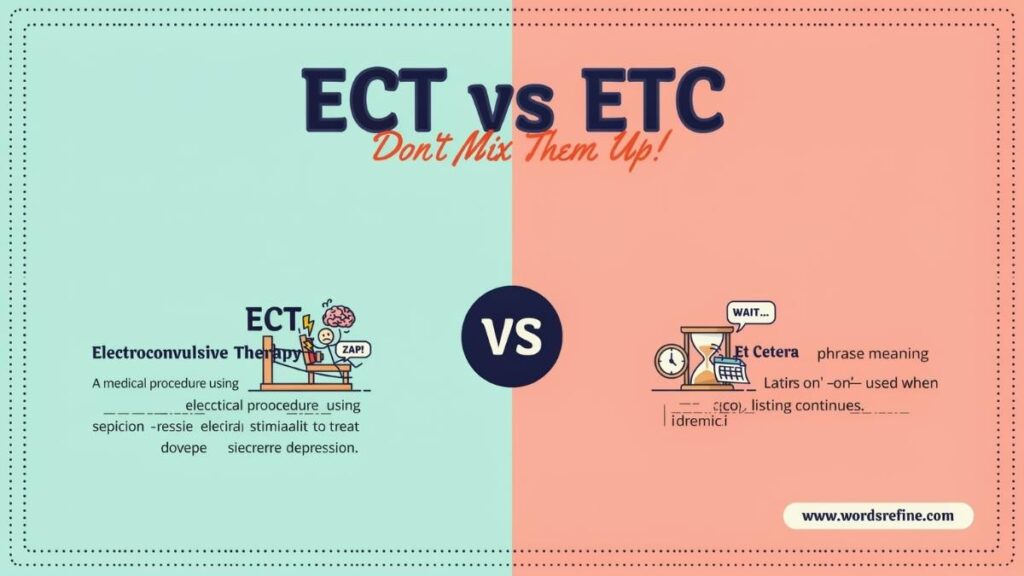
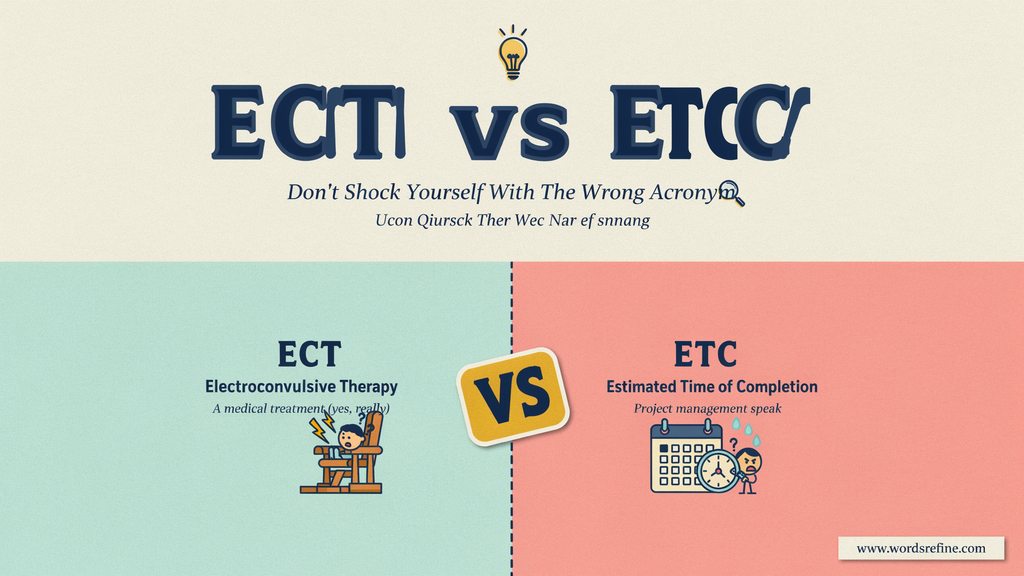
Have you ever wondered whether to write ECT vs ETC? Although these abbreviations different by just one letter, they have distinct meanings. ETC stands for et cetera, a Latin expression meaning “and other similar things.” Writers use it at the end of a list to indicate that additional examples have been left out. ECT, by contrast, commonly stands for electroconvulsive therapy in medical contexts. Using ect. instead of etc. when listing items is a common spelling mistake. Understanding the difference helps you choose the right abbreviation, avoid grammatical errors, and keep your writing clear, accurate, and professional.
ECT vs ETC Quick Answer
ECT vs ETC is the correct abbreviation when you want to indicate that a list continues beyond the examples you have provided. It comes from the Latin phrase et cetera, which means “and other things” or “and so on.”
ECT is not the correct spelling of etc. when you want to continue a list. Nevertheless, ECT is a valid abbreviation in medical writing and other specialized contexts. In medicine, it commonly stands for electroconvulsive therapy, a treatment performed under medical supervision.
For example, you might write, “Please bring your notebook, pens, pencils, etc.” The abbreviation tells readers that other similar supplies may also be needed.
On the other hand, if a medical article discusses ECT as a treatment for certain mental health conditions, the abbreviation has an entirely different meaning.
The key is to consider the context. If you are listing similar items, use etc. and If you are referring to electroconvulsive therapy, ECT may be the appropriate term. If you accidentally write ect. in an ordinary list, correct it to etc.
Learn the difference between confusing more English words
Councillor vs Counsellor Difference Spelling and Usage ?
What Does ETC Mean?
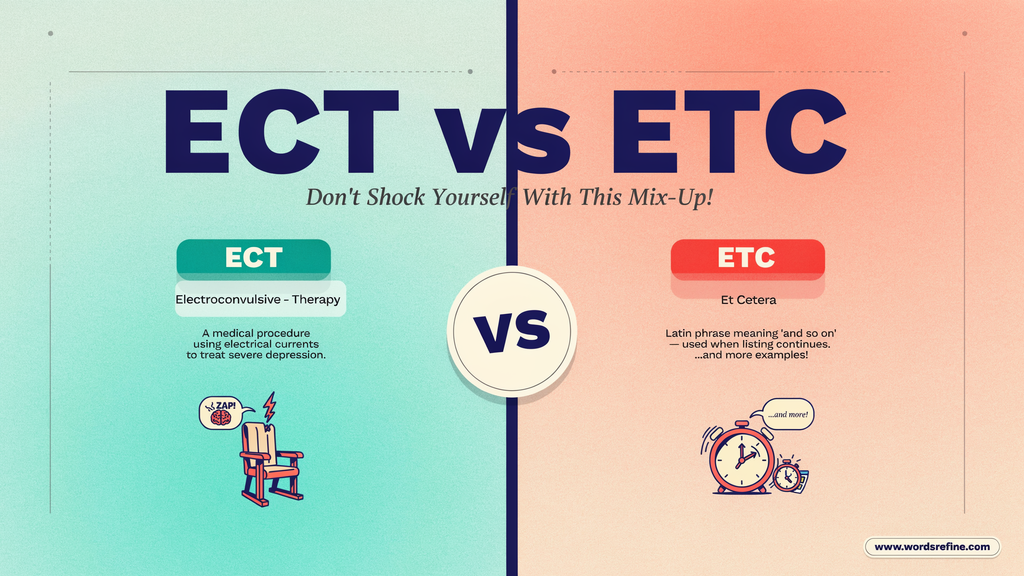
ECT vs ETC stands for et cetera, a Latin phrase that translates roughly to “and the rest” or “and other similar things.” In everyday English, it serves as a convenient way to show that a list contains additional examples.
Imagine you are writing a shopping list that includes milk, bread, eggs, fruit, and several other items. You do not necessarily need to name every item in a sentence. Instead, you can write, “We need milk, bread, eggs, fruit, etc.”
The abbreviation keeps your writing concise while making it clear that the list continues.
You will often see etc. in emails, notes, informal messages, instructions, and general writing. It can also appear in academic or professional documents when the additional examples are obvious and the context allows it. However, formal writing sometimes benefits from a more precise description of the remaining items.
For example, a sentence such as “The store sells notebooks, folders, pens, etc.” works when the reader understands that you are referring to other stationery supplies.
However, if the exact contents of a list matter, it is better to name the remaining items rather than leave readers guessing.
What Does Et Cetera Mean?
Et cetera is the full Latin expression behind etc. The word et means “and,” while cetera refers to the remaining things. Together, the phrase communicates that other similar items have been left out of the list.
Although the expression comes from Latin, English speakers use it regularly. Most people write the abbreviated form because it is shorter and familiar.
For example, you could write, “The children brought toys, books, puzzles, et cetera.” That sentence is correct, although “toys, books, puzzles, etc.” is more concise.
Both forms communicate the same general idea. The choice depends on your preferred style and the needs of your sentence.
When Should You Use ETC?
Use etc. when you have already provided examples and want to indicate that other similar examples exist.
For instance, “You can use a notebook, a planner, sticky notes, etc., to organize your tasks” suggests that other organizational tools may also be useful.
Similarly, you might write, “The recipe calls for onions, tomatoes, peppers, etc.” This works when you are referring to additional ingredients of the same general kind.
However, etc. should not replace information your reader genuinely needs. If someone asks which documents they must submit for an application, simply writing “identification, proof of address, etc.” may leave them uncertain about the requirements. In that situation, provide the complete list.
Also, avoid using etc. when the omitted examples are unrelated or when the reader cannot reasonably infer what belongs in the group. The abbreviation works best when the pattern is already clear.
Learn the difference between commonly mixed-up more words
skepticism vs scepticism Meaning Spelling and Correct Usage
What Does ECT Mean?
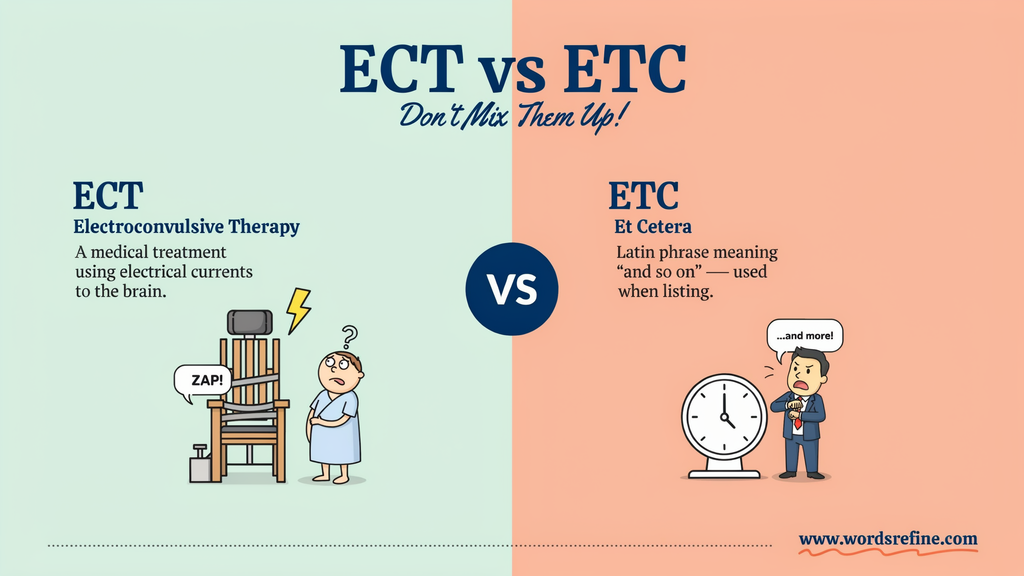
ECT is a valid abbreviation, but it does not serve the same purpose as etc. Its meaning depends on the subject being discussed.
In medical contexts, ECT commonly stands for electroconvulsive therapy. This treatment involves delivering controlled electrical stimulation to the brain while the patient receives anesthesia and muscle relaxation. Medical professionals may recommend it for certain serious mental health conditions when appropriate.
For example, a medical article might say, “The treatment team discussed ECT as one possible treatment option.” Here, ECT refers to electroconvulsive therapy, not a list of additional examples.
Outside medicine, ECT may have other meanings in particular industries, organizations, or technical fields. Therefore, readers should use the surrounding text to understand what the abbreviation represents.
The important distinction is that ECT is not an alternative spelling of etc. You cannot replace one with the other simply because the letters look similar.
Is ECT a Real Word?
ECT is a recognized abbreviation, although it is not a regular word in the same way that “book” or “table” is. In medical writing, it is commonly used as a shortened form of electroconvulsive therapy.
However, if you intend to write “and so on” at the end of a list, ECT is the wrong choice. Use etc. instead.
For example, “Bring your books, notebooks, pens, etc.” is correct. Writing “Bring your books, notebooks, pens, ect.” introduces a spelling error.
The distinction becomes clearer when you focus on meaning rather than appearance. ETC signals that a list continues, whereas ECT generally functions as an initialism whose meaning comes from a particular field.
Learn the difference between everyday English mistakes
Nevertheless vs Nonetheless Meaning and Usage?
What Is the Difference?
The main difference between ECT and ETC is their meaning and use.
ETC is a shortened form of et cetera. It appears at the end of a list to indicate that additional similar items have not been mentioned. It is common in everyday writing, although writers should avoid it when a complete list is necessary.
ECT, by contrast, is a separate abbreviation. In medicine, it commonly refers to electroconvulsive therapy. Other fields may use the same letters for different terms, so context matters.
The form ect. is usually incorrect when someone intends to write etc. This mistake often happens because the writer remembers the sound of the abbreviation but mixes up the final two letters.
Consider the difference in these sentences.
“Please pack your toothbrush, shampoo, soap, etc.” uses etc. correctly because the list includes toiletries and may contain other similar items.
“The doctor explained how ECT works.” uses ECT correctly if the discussion concerns electroconvulsive therapy.
“Please pack your toothbrush, shampoo, soap, ect.” contains a spelling mistake because ect. does not mean “and other similar things.”
Although the difference looks small, the context makes the intended meaning clear. When you proofread your writing, check both the spelling and the purpose of the abbreviation.
Learn the difference between tricky grammar more words
Moustache vs Mustache Meaning Spelling and Usage ?
How to Use ETC Correctly in a Sentence
Using etc. correctly is simple once you understand its role. It usually appears after a series of examples and indicates that the list continues.
For example, “My desk is covered with papers, notebooks, envelopes, etc.” tells readers that the desk contains other similar items.
Likewise, “We discussed transportation, accommodation, meals, etc., during the meeting” suggests that the conversation covered additional travel-related topics.
Notice that the examples belong to a recognizable group. In the first sentence, they are items found on a desk. In the second, they are topics related to travel arrangements.
However, the abbreviation should not become a substitute for clear writing. If the reader needs exact details, give them those details.
Should You Put a Period After ETC?
Yes. In standard English writing, etc. is written with a period because it is an abbreviation of et cetera.
The period remains part of the abbreviation even when it appears at the end of a sentence. You do not need to add a second period.
For example, “The office needs paper, ink, folders, etc.” is correct.
When etc. appears in the middle of a sentence, the abbreviation still takes its period. Any additional punctuation depends on the sentence structure.
For example, “We ordered paper, folders, envelopes, etc., before the office opened” uses a comma after etc. because the sentence continues and the comma helps separate the introductory time clause.
In everyday writing, this punctuation may look unusual at first. Nevertheless, it follows the same general principle as other abbreviations: the period belongs to the abbreviation, while any following punctuation serves the sentence.
Do You Need a Comma Before ETC?
When etc. follows the final item in a series, a comma usually comes before it in standard American writing.
For example, “She packed shirts, pants, shoes, etc.” uses a comma before etc. because it follows the final example in a list.
However, punctuation can vary with sentence structure and the style guide you follow. The most important thing is to keep your list readable and apply your chosen style consistently.
Also, remember that etc. usually works best when the items belong to the same category. If the examples are too broad, readers may struggle to understand what else the list includes.
Learn the difference between more words people mix up
Attorneys vs Attornies Which one Is Correct?
Can You Use ETC in Formal Writing?
You can use etc. in some formal writing, but it is not always the best choice. In academic papers, research reports, contracts, and official instructions, precision often matters more than brevity.
For example, “The study examined age, income, education, etc.” may be acceptable in a general discussion, but it could be too vague in a research report. Readers may need to know exactly which variables the researchers examined.
In a business email, however, etc. may be perfectly suitable when the omitted details are obvious.
Consider this sentence: “Please bring the presentation, handouts, name tags, etc., to the conference room.” The abbreviation works because the reader can reasonably infer that other meeting supplies may be included.
Even so, if you are writing instructions that someone must follow exactly, list every required item. Clear communication is more valuable than saving a few words.
Mortality vs Fatality Meaning Differences and Correct Usage ?
Common Mistakes When Using ECT vs ETC
The most common mistake is writing ECT vs ETC instead of etc. when listing examples. Because ECT vs ETC the letters are similar, the error can slip into a message without attracting attention.
For example, “The kitchen needs plates, cups, spoons, ect.” should read, “The kitchen needs plates, cups, spoons, etc.”
Another mistake is using ECT when you mean “and so on.” Although ECT is a valid abbreviation in certain fields, it does not replace etc. in an ordinary list.
Writers also sometimes use etc. when they should provide more information. For example, “Submit your identification, application form, etc.” may not be sufficient if the recipient needs to know every required document.
In addition, some writers use both and ECT vs ETC. at the end of a list. This creates unnecessary repetition because etc. already carries the meaning of “and other things.”
For example, “We bought apples, oranges, bananas, and etc.” is incorrect. A better version is “We bought apples, oranges, bananas, etc.”
Finally, do not assume that etc. makes every list complete enough. It indicates that more examples exist, but it does not tell readers exactly what those examples are. When accuracy matters, spell out the information.
ETC vs ECT in Text Messages and Emails
In casual messages, ECT vs ETC is useful because it allows you to communicate quickly without typing every example.
You might text a friend, “I need to buy groceries, cleaning supplies, snacks, etc.” The message is short, natural, and easy to understand.
Likewise, an email might say, “Please review the attached forms, receipts, invoices, etc., before the meeting.” In this situation, etc. indicates that several similar documents need attention.
However, casual writing still benefits from correct spelling. Using ect. instead of etc. may not prevent someone from understanding your message, but it remains a mistake worth correcting.
ECT vs ETC on the other hand, should appear when you mean a term represented by those initials. If you are discussing a medical treatment, the abbreviation may be appropriate. If you are listing groceries or office supplies, it almost certainly is not.
When in doubt, pause for a moment and ask yourself what the letters are supposed to mean. That small check can prevent an easy spelling error.
Learn the difference between often confused words
Skiddish vs Skittish Which One Is Correct and Why It Matters
ETC vs Et Al Are They the Same?
No. Etc vs et al. are different abbreviations, and they serve different purposes.
Etc. comes from et cetera and refers to additional things or examples. Et al. is short for the Latin phrase et alii, et aliae, or et alia, depending on the grammatical context. It generally means “and others” and is often used when referring to people or coauthors.
For example, “The store sells notebooks, folders, pens, etc.” uses etc. because the writer is listing objects.
By contrast, “Garcia et al. examined the results” may use et al. in an academic citation to indicate Garcia and other authors.
Therefore, the two abbreviations are not interchangeable. Use etc. for additional items in a list and et al. when the relevant writing convention calls for referring to other people or authors.
What Can You Use Instead of ETC?
Although etc. is widely understood, you have several alternatives. The best choice depends on your sentence and the tone you want to convey.
“And so on” is a natural option for everyday writing. For example, “We discussed budgets, schedules, staffing, and so on” sounds conversational and clear.
“And so forth” serves a similar purpose, although it may sound slightly more formal in some contexts. You could write, “The training covers communication, teamwork, problem-solving, and so forth.”
“Other similar items” is useful when you want to be more explicit. For example, “The box contains cables, adapters, chargers, and other similar items” makes the meaning clear without relying on an abbreviation.
Sometimes, the strongest alternative is to provide a complete list. If your reader needs exact instructions, replacing etc. with specific details can prevent confusion.
For instance, rather than writing “Bring identification, forms, etc.,” you could name every required document. That approach takes more space, but it also leaves less room for misunderstanding.
Easy Ways to Remember ETC
A simple memory trick can help you avoid mixing up ect. and etc. Think of ETC as the abbreviation that comes from et cetera. The final letters in etc. follow the order of the words in that Latin expression.
You can also connect etc. with the familiar phrase “and so on.” Whenever you want to communicate that more similar examples exist, etc. is probably the form you need.
For example, if you write “pens, pencils, markers, etc.,” you are saying that the list may include other writing supplies.
ECT requires a different thought process. Rather than treating it as another spelling of etc., remember that it represents a separate term whose meaning depends on context. In medical writing, it commonly means electroconvulsive therapy.
Most importantly, do not choose the abbreviation based only on how it sounds. Check what you intend to communicate. Meaning is the best guide to correct usage.
Mama vs Mamma Meaning Spelling and Usage?
Practice Session ECT vs ETC
1. I bought apples, bananas, oranges, and ______ for the picnic.
2. Please bring your notebooks, pens, pencils, ______ to class.
3. The doctor explained how ______ works as a medical treatment.
4. We need to pack clothes, shoes, toiletries, ______ before leaving.
5. She enjoys reading novels, short stories, biographies, ______.
6. The medical team discussed ______ as a possible treatment option.
7. My desk contains paper clips, sticky notes, folders, ______.
8. You can use a laptop, tablet, smartphone, ______ to access the website.
9. The article explains the medical use of ______.
10. We discussed budgets, schedules, deadlines, ______ during the meeting.
11. The school supplies include rulers, erasers, markers, ______.
12. The patient received information about ______ from the medical team.
13. For the recipe, you need flour, sugar, butter, eggs, ______.
14. The office sells envelopes, printer paper, labels, ______.
15. The specialist answered questions about ______ and its clinical use.
16. My favorite hobbies include painting, gardening, photography, ______.
17. Please bring your identification, application form, supporting documents, ______.
18. The medical report refers to ______ in its discussion of treatment.
19. We packed sandwiches, juice, fruit, snacks, ______ for the trip.
20. The teacher asked students to bring colored pencils, crayons, markers, ______.
21. In a list of similar items, the correct abbreviation for “and so on” is ______.
22. The spelling “______” is incorrect when you intend to write “and other similar things.”
23. The Latin expression behind the abbreviation etc. is et ______.
24. When writing a list of office supplies, use “etc.” rather than “______.”
25. If a sentence discusses electroconvulsive therapy, the abbreviation ______ may be appropriate.
Answers
- etc.
- etc.
- ECT
- etc.
- etc.
- ECT
- etc.
- etc.
- ECT
- etc.
- etc.
- ECT
- etc.
- etc.
- ECT
- etc.
- etc.
- ECT
- etc.
- etc.
- etc.
- ect.
- cetera
- ect.
- ECT
Here’s a trusted source for clear more words Comparison:
FAQs
How do Americans pronounce etc.?
Americans commonly pronounce etc. as “et SET-er-uh” or “et SET-ruh.” In everyday conversation, they may use phrases such as “and so on” or “and the rest” instead. The pronunciation varies slightly, but the meaning remains the same.
What can I say instead of etc.?
You can use “and so on,” “and so forth,” “and other similar things,” or “among others,” depending on the context. For example, “We discussed travel plans, hotel bookings, and so on” sounds natural in everyday American English. Choose an alternative that keeps your meaning clear and fits the tone of your writing.
Is it grammatically correct to use etc.?
Yes, etc. is grammatically correct when you use it to indicate that a list includes additional similar items. For example, “The store sells notebooks, pens, folders, etc.” is correct. However, avoid using it when readers need a complete list or cannot easily identify the omitted items.
Why do people say etc. twice?
People sometimes repeat etc. while speaking because of nervousness, emphasis, or habit. However, repeating it is usually unnecessary because the abbreviation already indicates that more examples exist. In formal writing, use etc. only once when appropriate, and avoid unnecessary repetition.
What does “cetera” mean?
“Cetera” refers to the remaining things or other items in a group. It appears in the Latin expression “et cetera,” which means “and the rest” or “and other similar things.” The abbreviation etc. represents the entire expression, not just the word cetera.
Do French people say “et cetera”?
Yes, French speakers use “et cetera,” often written as etc. in French text. The expression has Latin origins and is used to indicate that a list continues. Its meaning is similar to the English “and so on.” Although the expression is shared across languages, pronunciation and conversational preferences may vary.
What does etc. mean when a girl uses it?
When a girl uses etc. in a text message, it generally means “and so on” or suggests that additional examples or details have been left out. The exact meaning depends on the conversation. For instance, “I like coffee, tea, smoothies, etc.” simply continues a list. The abbreviation does not have a special meaning based on the sender’s gender.
Is a comma needed before etc.?
In standard American English, a comma usually comes before etc. when it follows the final item in a list. For example, “Bring paper, pens, notebooks, etc.” is correct. If the sentence continues after the abbreviation, you may also need a comma afterward, depending on the sentence structure. Always follow the relevant style guide when writing for a specific publication or organization.
Learn the difference between commonly misused words
Stripes vs Strips Meaning Differences and Correct Usage ?
Conclusion
ECT vs ETC may look like a tiny spelling difference, but one misplaced letter can change the meaning of your sentence. When listing books, snacks, office supplies, or just about anything else, use etc. to mean “and so on.” However, when discussing electroconvulsive therapy, ECT is the correct abbreviation. As for ect., leave it out of your lists because it’s a spelling mistake, not a shortcut!
The easiest way to remember the difference is to connect ECT vs ETC with et cetera. Before you send an email, finish an assignment, or publish an article, take a moment to check your spelling. After all, good grammar doesn’t mean memorizing every rule in the dictionary. Sometimes, getting one little letter right is all it takes to keep your writing clear, accurate, and free from confusion.

Diora AJS she is an experienced blogger and passionate English language enthusiast at Words Refine. With a keen eye for language and a love for clear communication, she writes practical content about grammar, word meanings, usage, and commonly confused terms. Her goal is to make English easier to understand through clear explanations and relatable examples, helping readers write accurately and communicate with confidence.