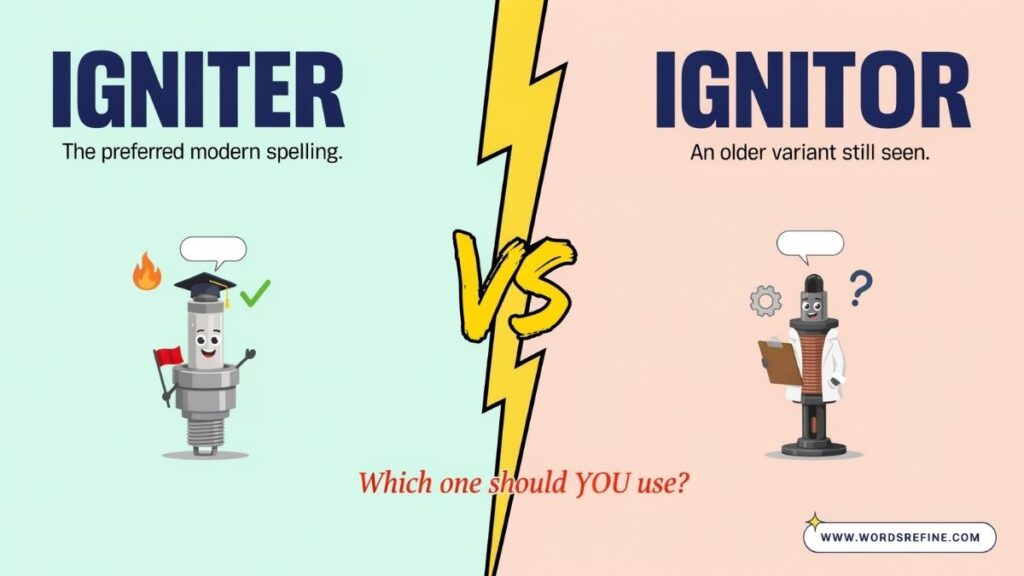
Have you ever looked at two spellings and wondered whether English is trying to trick you? The difference between igniter vs ignitor can confuse even confident writers. Fortunately, both spellings are correct and generally refer to a device that starts the ignition process. However, choosing the right form depends on the context, particularly when discussing furnaces, gas stoves, cars, or replacement parts. So, is one spelling better than the other? Before a tiny vowel sparks a grammar debate, let’s explore the meanings, differences, common mistakes, and practical uses of both words so you can write clearly and confidently.
Igniter vs Ignitor Quick Answer
Igniter and ignitor generally have the same meaning. Both refer to a device or component that initiates ignition, such as the part that helps a furnace start burning fuel or a system produce a spark.
The main difference is spelling rather than meaning. Igniter ends in “-er,” while ignitor ends in “-or.” Both forms appear in English, although the preferred spelling can vary by manufacturer, product category, and technical context.
For general writing, igniter is a straightforward choice. However, if you are referring to a specific product, follow the spelling used by its manufacturer. This is especially important when you are looking for a replacement part or reading an equipment manual.
Learn the difference between basic English word mistakes
Broke vs Broken Meaning Differences and Correct Usage ?
What Does Igniter Mean?
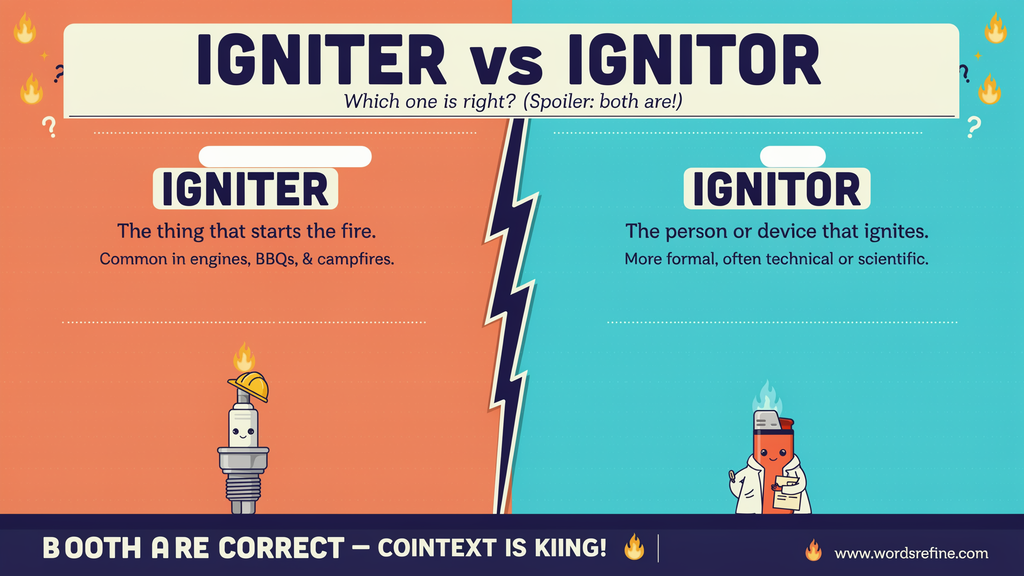
An igniter is a device or component that starts the ignition process. Depending on the equipment, it may create an electrical spark, become hot enough to ignite fuel, or use another mechanism to initiate combustion.
You will commonly encounter igniters in furnaces, gas appliances, vehicles, and industrial equipment. Although their designs differ, they share a basic purpose: helping a system begin the ignition process.
For example, a gas furnace may use a hot surface igniter that heats up until it can ignite the gas. A different appliance may use an electric spark to start a flame. In both cases, the component helps initiate ignition.
The word igniter follows a familiar English spelling pattern. The ending “-er” appears in many words that describe a person or thing performing an action. A heater produces heat, a starter begins something, and an igniter initiates ignition.
Here are a few examples that show how to use the word naturally.
The technician replaced the faulty igniter before testing the furnace again.
The gas grill would not start because its igniter failed to produce a spark.
The mechanic checked the ignition system after the driver reported starting problems.
In each example, igniter refers to a component that helps start an ignition process. The exact design and operation depend on the equipment.
Learn the difference between confusing more English words
Teams vs Teams Meaning Differences Accounts and Features ?
What Does Ignitor Mean?
Ignitor has essentially the same meaning as igniter. It refers to a device or component that initiates ignition, particularly in equipment that burns fuel or requires a controlled starting process.
Although ignitor looks less familiar to some readers, it is a recognized spelling. You may encounter it in product names, technical descriptions, equipment catalogs, and replacement-part listings.
For instance, a manufacturer might label a particular furnace component an ignitor rather than an igniter. Another company might use igniter for a similar type of part. That difference in wording does not automatically mean the components perform different functions.
Consider these examples.
The technician ordered a replacement ignitor for the heating system.
The appliance manual explains how to inspect the ignitor for signs of damage.
The industrial equipment uses an ignitor to begin the combustion process.
These sentences work in much the same way as sentences containing igniter. The spelling changes, but the general meaning remains the same.
Is Ignitor a Real Word?
Yes, ignitor is a real word. It is an accepted spelling of the noun used for a device that initiates ignition.
You do not need to treat it as a spelling mistake simply because igniter looks more familiar. Both forms are used in English, and the appropriate choice often depends on the terminology used in a particular industry or product description.
However, acceptance as a word does not mean that every manufacturer uses it. If you are writing about a specific appliance, vehicle component, or industrial system, check the relevant documentation before deciding which spelling to use.
What Is the Difference Between Igniter vs Ignitor?
The main difference between igniter vs ignitor is their spelling. In ordinary technical usage, both words generally describe a component that starts ignition.
Igniter ends in “-er,” while ignitor ends in “-or.” English contains many words with these different endings, and their spelling patterns do not always follow a simple rule. In this case, the two forms can refer to the same general type of component.
Their meaning, however, does not guarantee that every product sold under these names is interchangeable. A furnace igniter and an automotive ignition component may serve different purposes, even if their names look similar. Likewise, two products described as ignitors may have different specifications, designs, and compatibility requirements.
Therefore, it helps to separate the spelling question from the equipment question. If you are asking which word is correct, both are accepted. If you are asking which part to buy, you need to check the product specifications.
Spelling and Word Formation
The difference becomes easy to spot when you compare the endings. Igniter uses “-er,” while ignitor uses “-or.” Both forms are associated with the idea of initiating ignition.
English has several words that use different endings to describe related actions or roles. However, you cannot assume that every word ending in “-er” has an identical “-or” version with the same meaning. Each word needs to be checked in its own context.
With igniter and ignitor, the two forms overlap in meaning, so the choice usually comes down to convention and context rather than a major difference in definition.
Meaning and Function
In general use, an igniter and an ignitor both help initiate ignition. Neither spelling automatically identifies a specific mechanism.
For example, an igniter may create a spark in one system, while another may heat a surface to ignite fuel. The same range of functions may be described using the word ignitor, depending on the manufacturer and product terminology.
Consequently, the word alone may not tell you exactly how a component works. Always consult the equipment documentation when you need technical details.
Pronunciation
Igniter and ignitor are usually pronounced similarly. Both have the same basic word structure and refer to the same general concept.
The exact pronunciation can vary slightly with accent and speaking habits. However, the spelling difference does not usually create a major difference in pronunciation.
If you are learning English, focus on recognizing both forms and understanding their meaning. You do not need to memorize two separate definitions simply because the words end differently.
Learn the difference between commonly mixed-up more words
Peak vs Pique Differences Examples and Correct Usage ?
Igniter vs Ignitor in American and British English
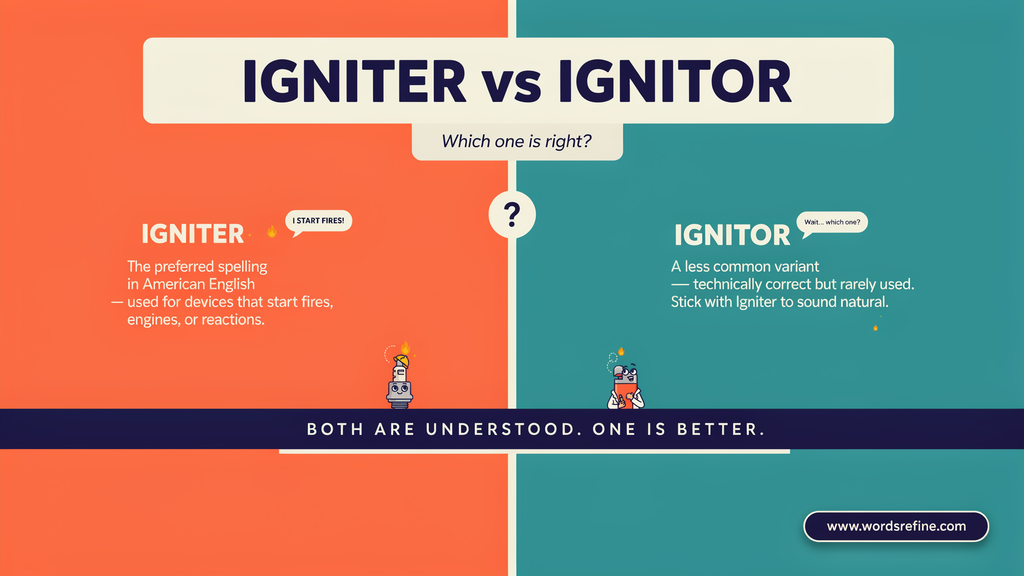
Spelling differences between American and British English often involve familiar pairs such as color and colour or center and centre. Igniter and ignitor are a little different because the choice is not always determined by a strict American-versus-British rule.
Both spellings can appear in technical and commercial contexts. Their use may depend more on the manufacturer, industry, product documentation, or established terminology than on the country where the writing appears.
For that reason, it is best not to assume that igniter is exclusively American or that ignitor is exclusively British. Such a rule would be too broad.
If you are writing for an American audience, igniter is a reasonable general choice. Nevertheless, consistency matters more than forcing one spelling into every situation. If a manufacturer calls a component an ignitor, retain that spelling when discussing the specific product.
The same principle applies to British English and other varieties of English. Follow the terminology used by the relevant source, particularly in technical writing.
Where Are Igniters vs Ignitors Used?
Although igniter and ignitor have similar meanings, the components they describe can appear in many different systems. Understanding the equipment helps you understand what the part does.
Igniters in Cars and Automotive Systems
Automotive ignition systems help an engine start and run. However, the word igniter does not always refer to the same component in every vehicle.
Depending on the design, an automotive igniter may be an electronic component involved in controlling ignition. Other ignition-related parts include spark plugs, ignition coils, and control modules. These components work together in different ways depending on the engine and ignition system.
For example, a mechanic might inspect an ignition-related component after a vehicle develops starting problems. The mechanic would need to identify the specific part before ordering a replacement.
This distinction matters because the terms are not interchangeable in every automotive context. A spark plug produces a spark inside the engine cylinder, while an electronic ignition component may control or help trigger the ignition process.
If you are searching for a car part, use the vehicle’s make, model, year, engine details, and the manufacturer’s part number when available. These details are more reliable than choosing a component based on the word igniter or ignitor alone.
Learn the difference between commonly misused words
Labor Day vs Labour Day Meaning and Usage ?
Igniters in Furnaces
Furnaces commonly use ignition components to start combustion. Depending on the system, the furnace may use a hot surface igniter, a spark ignition system, or another ignition arrangement.
A hot surface igniter becomes extremely hot and helps ignite the fuel when the system calls for heat. If it fails, the furnace may not start properly. Other problems, such as gas supply issues or faulty controls, can also prevent ignition, so a failed start does not automatically prove that the igniter is defective.
You may see both igniter and ignitor in furnace parts listings. When comparing products, check the furnace model, part number, electrical specifications, and manufacturer recommendations.
Choosing the correct component is important for safe and reliable operation. If you are unsure which part your furnace needs, consult the manual or a qualified technician rather than relying on the spelling alone.
Igniters in Gas Stoves and Ovens
Many gas stoves and ovens use an ignition system to light the burner. Depending on the appliance, the system may create a spark or use another method to initiate ignition.
A faulty ignition component may cause a burner to click repeatedly, fail to light, or behave inconsistently. However, these symptoms can have several causes, including moisture, dirt, electrical problems, or issues with the gas supply.
In appliance descriptions, you may encounter either igniter or ignitor. The spelling can vary between brands and replacement-part catalogs.
If you need a replacement, check the appliance model and the part number recommended by the manufacturer. Do not assume that two parts are interchangeable simply because their names are similar.
Also, treat gas appliances with care. If you smell gas, avoid operating electrical switches or attempting repairs. Leave the area and contact your gas provider or emergency service according to local safety guidance.
Learn the difference between everyday English mistakes
Traveled vs Travelled Which one Is Correct in English?
Igniters in Water Heaters
Some gas water heaters use an ignition component to start the burner that heats the water. Depending on the design, the system may use an electronic spark, a hot surface igniter, or another ignition method.
If the water heater fails to ignite, the problem may involve the igniter, power supply, gas supply, safety controls, or another component. The symptoms alone may not identify the cause.
Both spellings may appear in product descriptions and repair guides. To identify the correct part, check the water heater’s model number and service documentation.
Igniters in Industrial Equipment
Industrial systems may use ignition components in burners, heating equipment, combustion systems, and other specialized machinery. In these settings, accurate terminology is particularly important because equipment specifications can affect safety and performance.
A technical document may use igniter or ignitor according to the manufacturer’s established naming convention. Engineers and maintenance teams should follow the terminology in the relevant manuals, drawings, and parts lists.
Although the words often share a general meaning, industrial components can differ considerably in their operating requirements. Their temperature ratings, electrical characteristics, mounting arrangements, and intended applications may not match.
Therefore, technical accuracy requires more than choosing the correct spelling. It also requires identifying the correct component for the system.
Learn the difference between tricky grammar more words
Absence vs Absense Correct Spelling Meaning and Usage ?
Common Mistakes When Using Igniter vs Ignitor
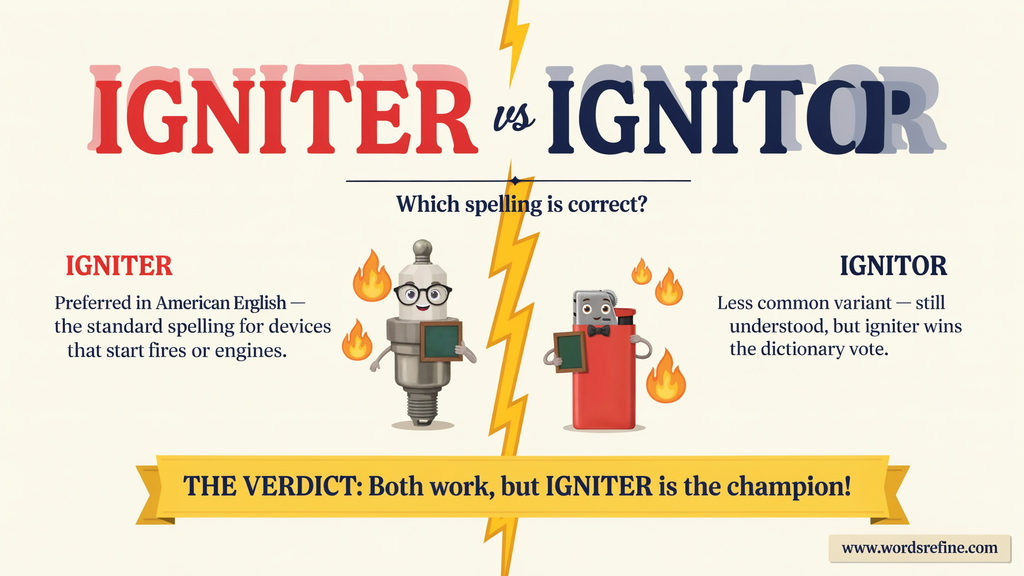
The easiest mistake is assuming that one spelling is correct and the other is wrong. Both forms are accepted, so there is no need to label ignitor a misspelling simply because you prefer igniter.
Another common mistake is assuming that the two words always identify identical products. They generally share a meaning, but the equipment and specifications still matter. A component described as an igniter in one context may not be suitable for a system that uses a different ignition design.
People also sometimes confuse an igniter with every other part of an ignition system. These components may work together, but they do not necessarily perform the same job. A spark plug, ignition coil, control module, and furnace hot surface igniter are not interchangeable simply because they relate to ignition.
In addition, changing a manufacturer’s spelling can create confusion. If a manual calls a part an ignitor, using igniter in your own general explanation may be understandable. However, changing the name in a product listing or technical reference could make it harder for someone to find the exact component.
Finally, do not rely on spelling alone when purchasing replacement parts. Check the model number, product specifications, and compatibility information. A familiar word cannot guarantee that a part will fit or function correctly.
Examples of Igniter vs Ignitor in Sentences
The following examples show how both spellings work in everyday and technical writing.
The furnace igniter failed, so the technician inspected the ignition system.
The replacement ignitor must match the manufacturer’s specifications.
The gas grill uses an electric igniter to help light the burner.
The service manual identifies the component as an ignitor.
The mechanic checked the ignition system after the engine failed to start.
The appliance manufacturer recommends replacing the faulty igniter with the specified part.
The industrial burner uses an ignitor designed for its particular operating conditions.
The technician checked the part number before ordering a new ignition component.
These examples show that both igniter and ignitor can fit naturally into a sentence. The spelling you choose should reflect the context, especially when you refer to a specific product or technical document.
How to Choose Between Igniter vs Ignitor
When you are writing a general explanation, choose one spelling and use it consistently. Igniter is a practical choice if you have no specific product terminology to follow.
However, if you are describing a named product, use the spelling provided by the manufacturer. This approach keeps your writing accurate and makes it easier for readers to locate the relevant part.
If you are preparing a technical report, check the terminology in the equipment manual, engineering documents, or parts catalog. Consistency is useful, but accuracy comes first.
When searching for replacement components, include the equipment model and the part number whenever possible. You can also try both igniter and ignitor if your initial search produces limited results. Manufacturers and retailers may use different spellings for similar products.
Most importantly, distinguish between a word’s meaning and a component’s specifications. Igniter and ignitor generally mean the same thing, but that does not make every ignition component suitable for every appliance or machine.
Learn the difference between confusing word pairs
Want vs Wont Meaning Differences and Usage ?
Practice Session Igniter vs Ignitor
- Both igniter and ignitor refer to a component that starts the ______ process.
- The word ______ ends with “-er.”
- The alternative spelling of igniter is ______.
- A furnace ______ helps start the combustion process.
- A spark igniter produces an electrical ______ to ignite fuel.
- A hot surface igniter becomes ______ enough to ignite fuel.
- You can identify the correct replacement part by checking the equipment’s model ______.
- A gas grill may use an electric ______ to light its burner.
- The main difference between igniter and ignitor is their ______.
- Both igniter and ignitor are accepted English ______.
- A furnace igniter is commonly located near the ______ assembly.
- A spark igniter uses an electrical discharge to initiate ______.
- A component’s compatibility depends on its specifications, not just its ______.
- The word “ignition” describes the process of starting ______.
- A faulty igniter may prevent a furnace from ______.
- When writing about a specific product, follow the ______ terminology.
- A spark plug and an igniter do not always perform the same ______.
- Before replacing a furnace component, consult the equipment ______.
- The German word for “flamethrower” is ______.
- The word igniter contains an “______” before the final “r.”
- The word ignitor contains an “______” before the final “r.”
- In a gas appliance, an igniter helps light the ______.
- A technician should check the part number before ordering a ______ component.
- The preferred spelling may depend on the product or technical ______.
- If you smell gas, leave the area and contact the appropriate gas provider or emergency ______.
Answers
- Ignition
- Igniter
- Ignitor
- Igniter
- Spark
- Hot
- Number
- Igniter
- Spelling
- Spellings
- Burner
- Ignition
- Name
- Combustion
- Starting
- Manufacturer’s
- Function
- Manual
- Flammenwerfer
- E
- O
- Burner
- Replacement
- Context
- Service
Here’s a trusted source for clear more words Comparison:
FAQs
What is another word for igniting?
Depending on the context, alternatives to igniting include lighting, starting, kindling, and sparking. In technical writing, initiating combustion may be more precise when describing the process of starting a fuel-burning system.
What is the igniter called on a furnace?
A furnace igniter may be called a hot surface igniter or a spark igniter, depending on the system. Some furnaces use a hot surface that heats up to ignite the fuel, while others use an electrical spark. Check your furnace manual to identify the correct type.
Where is the ignitor located?
The ignitor’s location depends on the equipment. In a furnace, it is usually near the burner assembly, where it can ignite the fuel. In gas stoves and other appliances, its position varies by design. Before inspecting or replacing an ignitor, consult the equipment manual and follow the manufacturer’s safety instructions.
What is a spark igniter?
A spark igniter is a device that produces an electrical spark to ignite fuel. It is commonly used in gas grills, stoves, and some heating appliances. Unlike a hot surface igniter, which heats up to ignite the fuel, a spark igniter uses an electrical discharge to start the ignition process.
Which is correct, ignitor or igniter?
Both ignitor and igniter are correct spellings. They generally have the same meaning, and neither is automatically a spelling mistake. However, when referring to a specific appliance or replacement part, use the spelling found in the manufacturer’s documentation.
How do you pronounce flamethrower in German?
The German word for “flamethrower” is “Flammenwerfer.” It combines “Flammen,” meaning “flames,” with “Werfer,” meaning “thrower.” Together, the word refers to a device that throws flames.
How do I spell igniter?
The word is spelled igniter, with an “e” before the final “r.” However, ignitor, with an “o,” is also an accepted spelling. Both words generally refer to a device or component that starts the ignition process.
Learn the difference between often confused words
Want vs Wont Meaning Differences and Usage ?
Final Thoughts
Choosing between igniter vs ignitor is easier than it looks. Both spellings are correct, and both generally refer to a device that starts the ignition process. The only real difference is the final vowel, so there’s no reason to let one little letter ignite a grammar debate.
However, context matters. If you’re writing a general explanation, igniter is a practical choice. When discussing a specific furnace, gas appliance, or replacement part, use the spelling provided by the manufacturer. After all, choosing the wrong word is a small mistake, but ordering the wrong component can create a much bigger headache.
Ultimately, remember that clear writing starts with understanding the words you use. Choose the spelling that fits your context, check technical details when necessary, and keep your explanations accurate. Once you understand the difference, you can put this spelling dilemma to rest without creating unnecessary sparks.

Diora AJS she is an experienced blogger and passionate English language enthusiast at Words Refine. With a keen eye for language and a love for clear communication, she writes practical content about grammar, word meanings, usage, and commonly confused terms. Her goal is to make English easier to understand through clear explanations and relatable examples, helping readers write accurately and communicate with confidence.