Peak, pique vs peek may sound alike, but confusing them can lead to mistakes that change the meaning of your sentence. Although their pronunciation is similar, each word has a distinct purpose. Peak refers to the highest point or level, pique means to spark curiosity or interest, and peek describes taking a quick look. For example, an unusual question can pique your interest, a mountain has a peak, and a curious child might peek inside a present. Understanding peak vs pique helps you avoid common spelling errors and express your ideas clearly. Let’s explore their meanings, differences, and everyday usage so you can choose the right word with confidence.
Peak vs Pique Quick Answer
The main difference between peak vs pique lies in what you want to express. Use peak when describing the highest point, maximum level, or most successful stage of something. Use pique when something stimulates your curiosity or provokes a feeling of annoyance.
Consider these examples. A company’s profits reached their peak in December. Meanwhile, an unexpected announcement piqued the public’s interest. The first sentence describes a maximum level of success, while the second explains how something attracted attention.
Although the words sound identical in standard English pronunciation, their meanings are distinct. You must rely on context rather than sound to choose the correct spelling.
Peak can function as a noun, verb, or adjective. Pique generally functions as a verb or noun. Understanding these grammatical roles makes the distinction even clearer.
What Does Peak Mean?
Peak refers to the highest point of something, whether you’re talking about a mountain, a business trend, physical performance, or a person’s success. The word can describe a literal height or a figurative high point.
For example, the peak of a mountain is its summit. Similarly, the peak of a company’s sales represents the highest level of sales it reaches during a particular period. In both cases, peak expresses the idea of reaching the top.
The word also appears in everyday expressions such as peak season, peak hours, and peak performance. These phrases describe periods or levels associated with maximum activity, demand, or ability.
Peak as a Noun
As a noun, peak identifies the highest point or greatest level of something. It can refer to a physical location or an abstract idea.
For example, a climber might reach the peak of a mountain after hours of walking. In business, a company’s profits might reach their peak after a successful product launch. An athlete might perform at the peak of their abilities during a major competition.
The word doesn’t always describe something positive. A city can experience peak traffic during rush hour, which is hardly anyone’s favorite part of the day. Likewise, energy consumption can reach its peak when households use more electricity than usual.
Here are a few examples in context.
The hikers reached the mountain’s peak shortly before sunset.
Tourism reaches its peak during the summer holidays.
Her career reached its peak after she won the national championship.
Electricity demand often reaches its peak on extremely hot afternoons.
In each sentence, peak identifies the highest point or level within a particular setting.
Peak as a Verb
As a verb, peak means to reach the highest point or maximum level. The word often describes changes over time, especially when something rises and eventually stops increasing.
For example, temperatures may peak in the afternoon before falling in the evening. A company’s revenue might peak during the holiday shopping season and decline afterward. Similarly, an athlete may reach peak performance at the right moment in a competition.
The past-tense form is peaked, while peaking describes an action that is happening or developing.
Consider these sentences.
Demand for air conditioners peaked during the hottest week of summer.
The athlete is peaking at the right time for the championship.
Housing prices peaked several months before the market began to cool.
The band’s popularity peaked after the release of its most successful album.
Notice that none of these examples involves sparking curiosity. Each describes reaching a high point, which is why peak is the correct choice.
Learn the difference between confusing more English words
Weighed vs Weighted Which One Is Correct ?
Peak as an Adjective
Peak can also function as an adjective when it describes a period of maximum activity, demand, or performance.
For instance, peak hours are the busiest times on a road, public transportation system, or business schedule. Peak season refers to the time of year when a destination or industry experiences its highest demand.
You might hear someone say, “We should leave early to avoid peak traffic hours.” Similarly, a travel agent might explain that hotel prices increase during peak season because more people want to book rooms.
Other common expressions include peak performance, peak demand, and peak condition.
These phrases all relate to a high or maximum level. That connection offers a helpful way to remember the meaning of peak, regardless of its grammatical role.
What Does Pique Mean?
Pique has a different purpose. As a verb, it commonly means to stimulate someone’s interest or curiosity. It can also mean to provoke irritation, resentment, or wounded pride.
When something piques your interest, it makes you want to know more. Perhaps you see an unusual headline, hear an unexpected fact, or discover a mysterious detail in a conversation. Something catches your attention and encourages you to investigate further.
For example, a documentary about an unexplained historical event might pique your curiosity. A surprising comment from a colleague might pique your interest in a project. In another situation, a careless remark might pique someone’s pride.
The intended meaning depends on the context. Although the word often appears in positive or neutral situations involving curiosity, it can also describe an unpleasant emotional reaction.
Pique as a Verb
As a verb, pique describes the act of stimulating interest or provoking a feeling. One of its most familiar uses appears in the expression “pique someone’s interest.”
Suppose you read a book description that reveals only a small part of the story. That detail might pique your curiosity and encourage you to read the entire book. Likewise, a surprising scientific discovery can pique public interest and inspire people to learn more about the subject.
Here are some examples.
The mysterious photograph piqued my curiosity.
Her question piqued the professor’s interest in the research.
The announcement piqued public interest in the upcoming event.
His unusual explanation piqued my interest in the subject.
The unexpected criticism piqued her pride.
In the first four sentences, pique refers to stimulating curiosity or interest. In the final sentence, it describes a reaction involving pride.
The past-tense form is piqued. The present participle is piquing. Both retain the same central meaning, although the surrounding sentence determines whether that meaning involves curiosity or irritation.
For example, “The article is piquing my curiosity” means the article is making me increasingly interested. Meanwhile, “The comment piqued his pride” means the comment provoked a personal or emotional reaction.
Pique as a Noun
Pique can also function as a noun, although this use is less common in everyday conversation. As a noun, it usually refers to a feeling of irritation, resentment, or wounded pride.
The expression “in a fit of pique” describes someone acting out of annoyance or offended pride rather than calm judgment.
For example, imagine an employee who receives criticism during a meeting. Feeling insulted, the employee abruptly leaves the room. Someone might describe the reaction by saying, “He left in a fit of pique.”
The phrase suggests that wounded pride or irritation influenced the person’s behavior.
Another example would be, “She rejected the invitation out of pique after feeling overlooked.” Here, pique describes the resentment behind her decision.
This noun usage differs from the familiar phrase “pique your interest.” In that expression, pique is a verb. Recognizing the grammatical role helps you understand the word’s meaning without confusing it with peak.
Learn the difference between commonly mixed-up more words
Annual vs Anual Which one Is Correct?
What Does “Piqued My Interest” Mean?
The expression “piqued my interest” means that something stimulated your curiosity or made you want to learn more. It describes the moment when a subject, idea, person, or event catches your attention.
For example, suppose a friend tells you about a restaurant with an unusual menu. You might say, “That description piqued my interest, so I decided to visit.” The description encouraged you to explore something unfamiliar.
The expression also works in academic, professional, and everyday situations. A research finding might pique a scientist’s curiosity. A job advertisement might pique an applicant’s interest. A news story might pique a reader’s curiosity about an event.
The phrase is useful because it expresses more than simply noticing something. It suggests that the information has sparked a desire to discover more.
Consider these examples.
The opening chapter piqued my interest in the novel.
Her presentation piqued the audience’s curiosity about renewable energy.
The unexpected result piqued the researcher’s interest in further testing.
My interest was piqued when I learned about the company’s new project.
In the final example, the sentence uses a passive construction, but the meaning remains the same. Something caused the speaker’s interest to grow.
The key point is that piqued refers to stimulated curiosity. It does not mean that interest reached its highest possible level.
Why Do People Confuse Peak vs Pique?
The confusion begins with pronunciation. Peak vs pique sound alike in standard English, so hearing the words doesn’t tell you which spelling the speaker intends.
This similarity becomes especially troublesome when someone learns an expression by listening rather than reading. A person might hear “piqued my interest” many times without ever seeing it written down. When the time comes to use the phrase, peak may seem like a reasonable spelling because it is a familiar English word.
The meanings can also seem related at first glance. When something piques your interest, your attention increases. Since peak describes a high point, a writer might mistakenly assume that peaked my interest means the same thing.
However, the two expressions communicate different ideas. Piqued my interest means something stimulated my curiosity. Peaked, when used as a verb, means something reached its highest point or level.
Another source of confusion is the relationship between peak, peek, and pique. All three words sound alike in standard English, but each has a distinct meaning. Learning their differences together can prevent several common spelling errors at once.
How to Remember the Difference Between Peak vs Pique
A simple memory trick can make the correct spelling easier to recall. Connect peak with a mountain and pique with curiosity.
Imagine standing at the top of a mountain. You’ve reached the peak, the highest point of your climb. The image connects the word with height, maximum levels, and reaching the top.
Now imagine reading a mystery story that leaves you desperate to know what happens next. The story piques your curiosity. In other words, it stimulates your desire to discover more.
You can also remember the difference through two short examples.
The mountain climber reached the peak.
The mysterious ending piqued my curiosity.
The first sentence describes a highest point. The second describes stimulated interest.
When you’re unsure which spelling to choose, ask yourself what the sentence means. Are you describing something reaching its maximum level, or are you describing something that makes someone curious? That question usually reveals the answer.
Learn the difference between tricky grammar more words
Instinctually vs Instinctively Which One Is Correct ?
Common Mistakes With Peak vs Pique
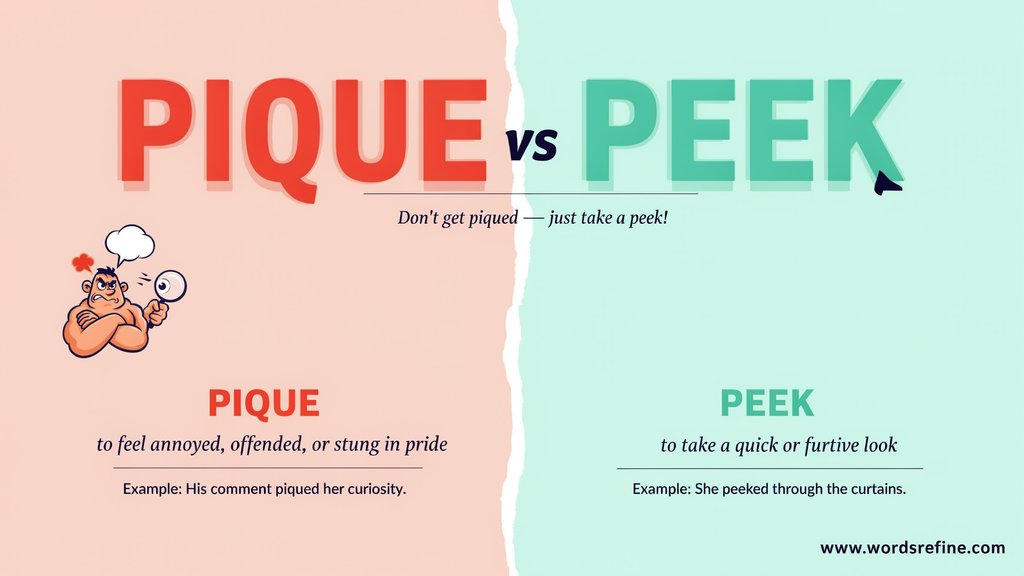
Even experienced writers sometimes confuse these words, especially when typing quickly. Fortunately, a few simple corrections can help you avoid the most common errors.
“Peaked My Interest” or “Piqued My Interest”?
When you mean that something stimulated your curiosity, the correct expression is “piqued my interest.”
Incorrect: The documentary peaked my interest in ancient history.
Correct: The documentary piqued my interest in ancient history.
The distinction matters because peak does not mean to stimulate curiosity. Although peaked is a correctly spelled word, it doesn’t communicate the intended meaning in this sentence.
However, peaked can be correct when interest itself reaches a maximum level. For example, “Public interest in the investigation peaked after new evidence emerged.” Here, interest increased until it reached its highest point. That is a valid use of peak.
“Peak Interest” or “Pique Interest”?
These expressions serve different purposes, so the right choice depends on what you want to say.
If an article makes readers curious, it piques their interest. If interest in a product reaches its highest level, that interest peaks.
For example, “The advertisement piqued customers’ interest in the new product” means the advertisement encouraged customers to learn more.
By contrast, “Interest in the product peaked in June” means June was the period when interest reached its highest level.
The difference becomes clear when you identify the action. One expression describes stimulating interest, while the other describes the level that interest reaches.
Learn the difference between confusing word pairs
Ingenuine vs Ungenuine Which One Is Correct ?
Using Pique When Peak Is Correct
Writers can also make the opposite mistake by choosing pique when they need peak.
Incorrect: Traffic piqued around eight in the morning.
Correct: Traffic peaked around eight in the morning.
The second sentence makes sense because traffic reached its highest level at that time. The first incorrectly uses pique to describe a maximum level of activity.
Similarly, you would say, “The company’s revenue peaked last quarter,” rather than “The company’s revenue piqued last quarter,” when you mean that revenue reached its highest point.
Confusing Peaked vs Piqued
The difference between peaked and piqued comes down to their base words. Peaked is the past tense of peak, while piqued is the past tense of pique.
Peaked describes reaching a high point. Piqued describes stimulating interest or provoking irritation.
For example, “The athlete peaked during the final race” describes the athlete reaching a high level of performance. Meanwhile, “The coach’s advice piqued the athlete’s curiosity” means the advice encouraged the athlete to learn more.
Both forms are correct English. They simply express different ideas.
Peak vs Pique in Sentences
Examples are often the easiest way to understand English word differences. The following sentences show how each word works in everyday, academic, and professional contexts.
Peak appears when something reaches a high point, maximum level, or period of greatest activity.
The hikers reached the peak of the mountain before noon.
The company’s profits peaked during the final quarter.
Hotel rates usually increase during peak season.
Her confidence reached its peak after the successful presentation.
Traffic tends to peak during the evening commute.
The athlete hopes to achieve peak performance at the championship.
Pique appears when something stimulates curiosity or causes irritation.
The headline piqued my interest in the investigation.
His question piqued the teacher’s curiosity.
The documentary piqued public interest in ocean conservation.
The surprising discovery piqued the scientist’s interest in further research.
Her colleague’s remark piqued her pride.
He left the meeting in a fit of pique.
Notice how the context guides the spelling in every example. The words may sound identical, but their meanings remain distinct.
Learn the difference between often confused words
Cadaver vs Corpse Which One Is Correct ?
Peek vs Pique What’s the Difference?
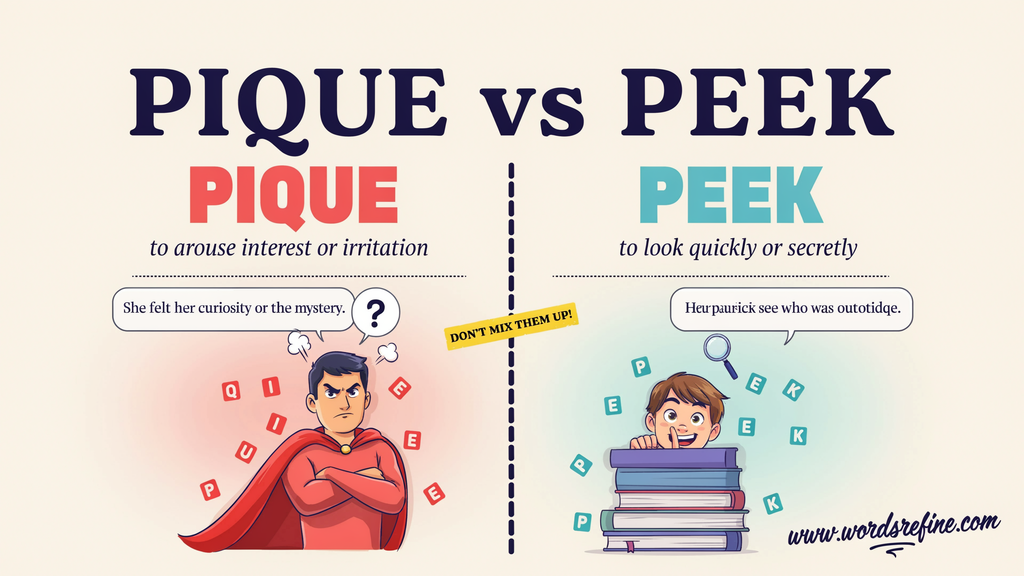
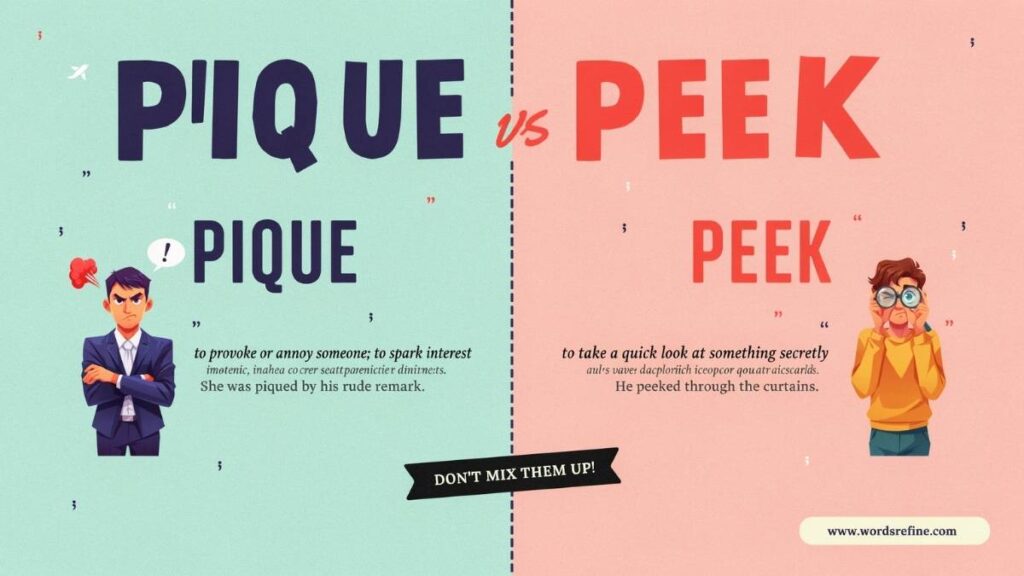
Peak vs pique aren’t the only words that can confuse English learners. Peek belongs to the same group of homophones, and its spelling creates another common challenge.
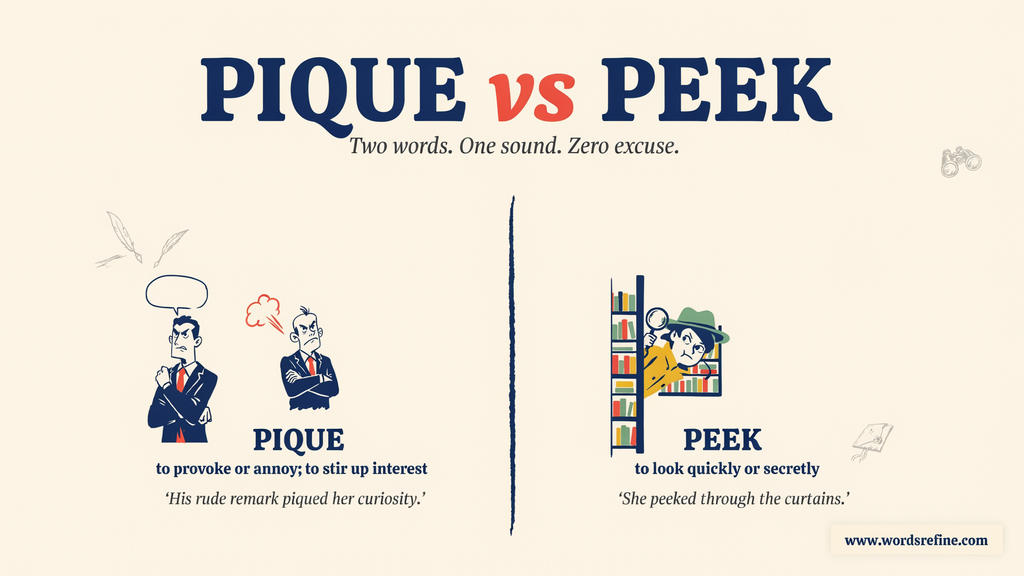
Peek means to take a quick or secret look at something. You might peek through a window, take a peek at a gift, or peek at the final page of a book before finishing it.
Peak refers to the highest point or level, while pique means to stimulate interest or provoke irritation.
The three words become easier to remember when you connect each one with a different action.
Peak: The climbers reached the peak before sunset.
Peek: The child took a peek inside the gift box.
Pique: The unusual gift piqued the child’s curiosity.
Consider another example. You might peek through a doorway to see what’s happening inside. If you discover something surprising, it could pique your curiosity. Later, your excitement might peak when you finally learn the truth.
Each word has a specific role. Peek describes looking, peak describes a high point, and pique describes stimulated interest or irritation.
Is Peak vs Pique Correct in American and British English?
Both peak vs pique are standard spellings in American and British English. Unlike words such as color and colour, these spellings don’t reflect a regional difference.
Instead, the meaning determines which word you should use. American and British writers both use peak to describe a summit or maximum level. Likewise, both use pique in expressions such as “pique someone’s interest” and “a fit of pique.”
For example, a British writer might say, “The announcement piqued my interest,” while an American writer could use exactly the same sentence.
Regional spelling preferences don’t affect this distinction. The important thing is to understand what your sentence means and choose the word that expresses it accurately.
Learn the difference between basic English word mistakes
Ironic vs Unironic Meaning, Differences, and Correct Usage
Practice Session Peak vs Pique
1. The hikers finally reached the mountain’s ______ before sunset.
2. The mysterious headline ______ my interest in the story.
3. She took a quick ______ inside the gift box.
4. Traffic usually reaches its ______ during the evening rush hour.
5. The documentary ______ the audience’s curiosity about marine life.
6. The company’s profits ______ in December before declining.
7. The unusual question began to ______ the teacher’s curiosity.
8. The little boy was ______ through the window.
9. Hotel prices tend to rise during ______ season.
10. His rude comment ______ her pride.
11. The athlete hopes to achieve ______ performance in the final race.
12. I couldn’t resist taking a ______ at the surprise before my birthday.
13. Public interest in the investigation ______ after new evidence appeared.
14. The book’s opening chapter is ______ my curiosity.
15. She left the meeting in a fit of ______.
16. The climbers reached the ______ of the hill early in the morning.
17. The announcement ______ public interest in the new project.
18. My brother was ______ at the presents hidden in the closet.
19. Demand for electricity often ______ during extremely hot weather.
20. The detective’s strange discovery ______ my curiosity.
21. We should leave early to avoid ______ traffic hours.
22. He tried to ______ through the partly open door.
23. The unexpected criticism ______ his pride.
24. Sales are ______ as the holiday shopping season approaches.
25. The fascinating mystery story managed to ______ the reader’s interest.
Answers
- Peak
- Piqued
- Peek
- Peak
- Piqued
- Peaked
- Pique
- Peeking
- Peak
- Piqued
- Peak
- Peek
- Peaked
- Piquing
- Pique
- Peak
- Piqued
- Peeking
- Peaks
- Piqued
- Peak
- Peek
- Piqued
- Peaking
- Pique
Here’s a trusted source for clear more words Comparison:
FAQs
What Is the Difference Between Peak vs Pique?
Peak refers to the highest point or level of something, while pique means to stimulate curiosity or interest. It can also mean to provoke irritation or wounded pride. For example, you might reach a mountain peak, while an unusual story can pique your curiosity.
Is It Correct to Say “Peaked My Interest”?
The phrase “piqued my interest” is correct when something makes you curious. However, “my interest peaked” is also correct when your interest reaches its highest level. Although the phrases sound similar, they express different ideas. Use “piqued my interest” to describe something that caught your attention or made you want to learn more.
What Is Another Word for Pique?
When pique means to stimulate interest, suitable alternatives include spark, arouse, stimulate, intrigue, and awaken. For example, “The mysterious headline sparked my curiosity” conveys a meaning similar to “The mysterious headline piqued my interest.” When pique refers to irritation, words such as annoy, provoke, or offend may fit better.
What Does Peak Mean in Everyday English?
Peak means the highest point, greatest level, or most intense stage of something. You might reach the peak of a mountain, travel during peak hours, or perform at your peak. As a verb, peak means to reach the highest level. For example, “The company’s sales peaked in December.”
What Is Another Way to Say “Pique My Interest”?
You can say “spark my curiosity,” “catch my attention,” “intrigue me,” or “make me curious.” Each expression suggests that something has encouraged you to pay attention or learn more. For instance, “The unusual title sparked my curiosity” communicates the same general idea as “The unusual title piqued my interest.”
Why Do We Say “Take a Peek”?
“Take a peek” means to take a quick or brief look at something, sometimes secretly. The word peek can function as either a noun or a verb. For example, “I took a peek inside the package before opening it.” In this sentence, peek refers to a brief glance rather than a thorough inspection.
Why Is Pique Spelled That Way?
Pique entered English through French, and English retained its French-derived spelling. The word developed meanings associated with stimulating interest, provoking a reaction, or arousing irritation. Although pique sounds like peak, the two words have different origins and meanings. Their similar pronunciation does not make their spellings interchangeable.
Why Should You Use Pique Instead of Peak When Talking About Curiosity?
Use pique when something stimulates your curiosity or interest. For example, “The strange photograph piqued my curiosity” means the photograph made you want to know more. Peak, on the other hand, refers to the highest point or level of something. Therefore, “pique my curiosity” is the correct expression when you mean to spark someone’s interest.
Does Peak Have More Than One Meaning?
Yes. Peak can refer to the top of a mountain, the highest level of an activity, or the best stage of a person’s career or performance. It can also function as a verb meaning to reach the highest point. For example, “Her popularity peaked last summer” means her popularity reached its highest level during that period.
Which Is Correct: “Peak My Interest” or “Peek My Interest”?
Neither is the standard expression when you mean to make someone curious. The correct phrase is “pique my interest.” Peak refers to the highest point or level, while peek means to take a quick look. Remember the distinction, and you’ll know which word to use when something catches your attention.
Learn the difference between commonly misused words
Enflamed vs Inflamed Which One Is Correct ?
Conclusion
Although peak, pique vs peek sound similar, they serve different purposes. Peak refers to the highest point or level, pique means to stimulate curiosity or interest, and peek means to take a quick look. Using the right word helps you communicate clearly and avoid confusing your readers.
For example, a surprising discovery can pique your interest, a mountain climber can reach a peak, and a curious child might peek inside a wrapped gift. Mix them up, however, and your sentence could leave readers wondering whether your curiosity climbed a mountain or simply looked over the edge!
Fortunately, remembering the difference is simple. When something sparks your curiosity, it piques your interest. When something reaches its highest level, it peaks. and When you take a quick glance, you peek. Keep these meanings in mind, and you’ll avoid a common spelling trap while making your writing more accurate, natural, and engaging. After all, your writing should reach its peak, but your confusion doesn’t have to!

Diora AJS she is an experienced blogger and passionate English language enthusiast at Words Refine. With a keen eye for language and a love for clear communication, she writes practical content about grammar, word meanings, usage, and commonly confused terms. Her goal is to make English easier to understand through clear explanations and relatable examples, helping readers write accurately and communicate with confidence.