
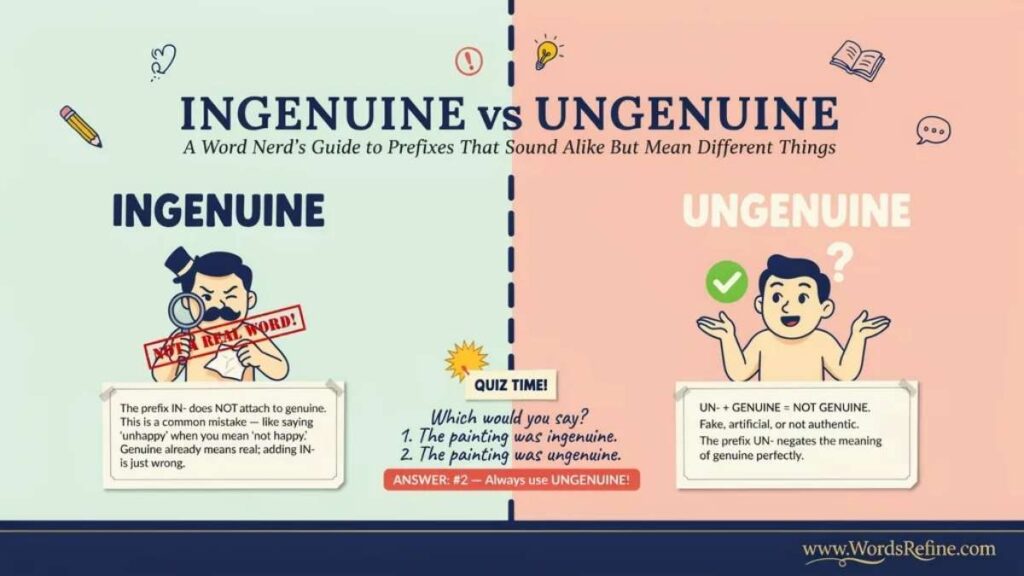
Have you ever stared at the words ingenuine vs ungenuine and wondered which one belongs in your sentence? You’re not alone. These two forms can look like grammatical twins, yet their usage is not quite as simple as swapping one for the other. Both have appeared in English, but one is more familiar to modern readers. To make matters trickier, words such as genuine, inauthentic, insincere, and disingenuous can express related ideas without meaning exactly the same thing. That’s where confusion creeps in. In this guide, you well learn the ingenuine or ungenuine meaning, see clear examples, avoid common mistakes, and choose the right word without playing grammatical roulette.
Ingenuine vs Ungenuine Quick Answer
Both ingenuine vs ungenuine are documented English words. They can describe something that isn’t genuine, authentic, or sincere.
Ungenuine is the more familiar form for many readers. It can describe something false, artificial, or lacking genuineness.
Ingenuine has the same general idea. However, it is considerably less common, so some readers may find it unusual or wonder whether it was intended to be another word.
That leads to a useful rule.
If you simply want to say that something isn’t genuine, ungenuine is understandable and established. However, when a more specific word exists, that word may be a better choice.
For example, an apology that isn’t heartfelt is usually better described as insincere. A fake designer bag may be counterfeit. A misleading argument may be disingenuous. Something that doesn’t feel authentic may be described as inauthentic.
In other words, the best choice depends on the meaning you want to communicate.
What Does Genuine Mean?
Before comparing ingenuine vs ungenuine, it helps to understand genuine itself.
Genuine is an adjective that generally means real, authentic, or sincere. The word can describe physical objects, emotions, reactions, intentions, and behavior.
When you say something is a genuine product, you mean it is authentic rather than fake.
For example:
- She bought a genuine leather jacket.
- The painting is a genuine work by the artist.
- The signature appears genuine.
- The dealer assured us that the watch was genuine.
Genuine can also describe feelings or behavior.
For example:
- He showed genuine concern for his friend.
- Her excitement was genuine.
- The student had a genuine interest in science.
- His reaction looked completely genuine.
This distinction matters because not everything that is not genuine should be described in exactly the same way.
A fake watch isn’t sincere. An insincere apology isn’t counterfeit. A misleading explanation isn’t necessarily artificial.
The situation determines the most useful word.
Ingenuine vs Ungenuine Meaning What Do These Words Mean?
The ingenuine vs ungenuine meaning is closely connected to the idea of something lacking genuineness.
Both forms can express the general idea of something being false, unauthentic, artificial, or not genuine. However, their familiarity and practical use aren’t exactly the same.
Ingenuine Meaning
The ingenuine meaning is generally understood as false, not genuine, or unauthentic.
For example:
His enthusiasm seemed ingenuine.
The sentence suggests that his enthusiasm did not appear sincere or authentic.
Another example might be:
The response seemed ingenuine to everyone in the room.
Here, the writer is saying that the response did not seem genuine.
The word is understandable in context. However, because it isn’t commonly used by many readers, it can create a moment of hesitation.
A reader may wonder whether the writer meant ingenuine, ingenuous, ingenious, or another similar-looking word.
That’s one reason a more familiar alternative may sometimes work better.
Learn the difference between confusing more English words
Vender vs Vendor Which one Is Correct?
Ungenuine Meaning
The ungenuine meaning is more straightforward. It refers to something that is not genuine or that appears false.
For example:
Her apology sounded ungenuine.
The sentence suggests that her apology did not seem sincere.
You could also say:
The signature looked ungenuine.
In this case, the writer means that the signature didn’t appear authentic.
So, when considering the ungenuine definition, the central idea is simple: something is not genuine.
However, the word can cover several shades of meaning. Depending on the situation, you may actually want to use inauthentic, insincere, artificial, fake, or false.
What’s the Difference?
The difference between ingenuine and ungenuine is not as dramatic as some people assume.
Both words can communicate the idea of something that isn’t genuine. The more noticeable difference is their familiarity and how natural they sound to different readers.
Consider this comparison:
| Word | General meaning | Familiarity | Common alternatives |
|---|---|---|---|
| Genuine | Real, authentic, or sincere | Very common | Authentic, sincere |
| Ungenuine | Not genuine or false | Less common | Inauthentic, insincere, fake |
| Ingenuine | Not genuine or unauthentic | Uncommon | Ungenuine, inauthentic, false |
| Disingenuous | Not completely honest or candid | Common | Misleading, insincere |
| Inauthentic | Not authentic or genuine | Common | Fake, artificial |
Therefore, the ingenuine vs ungenuine difference is mostly a matter of usage and familiarity rather than a completely different definition.
If your goal is clarity, choose the word that your readers will understand immediately.
Is Ingenuine a Word?
The question “is ingenuine a word?” comes up frequently because the word looks unusual.
Yes, ingenuine is documented as an English adjective. It has been used with the meaning of false, not genuine, or unauthentic.
However, that doesn’t mean it is equally common or equally natural in every situation.
English contains many words that are technically documented but rarely appear in everyday conversation. A word can exist without being the first choice for most speakers.
That’s important here.
If you write:
His reaction seemed ingenuine.
the meaning can be understood.
However, if you write:
His reaction seemed insincere.
the meaning is immediately clear to a much wider audience.
Good writing isn’t only about finding a word that technically works. It’s also about choosing a word that communicates your meaning without making the reader stop.
Is Ungenuine a Word?
If you’re asking, “is ungenuine a word?” the answer is yes.
Ungenuine is an established adjective used to describe something that is false or not genuine.
The construction also looks familiar because English often uses the prefix un- to create negative adjectives.
For example:
- happy becomes unhappy.
- fair becomes unfair.
- kind becomes unkind.
- true becomes untrue.
- natural becomes unnatural.
Because of this familiar pattern, ungenuine is relatively easy to understand.
For example:
Her concern seemed ungenuine.
Most readers can quickly understand what the sentence means.
Even so, you shouldn’t automatically use ungenuine whenever you mean that something isn’t genuine. A more specific word may communicate the idea more effectively.
Learn the difference between commonly mixed-up more words
Discrete vs Discreet What the Difference and which is Correctly?
Why Do People Confuse Ingenuine vs Ungenuine?
The confusion comes partly from English word formation.
Both in- and un- can create negative meanings. However, English doesn’t apply these prefixes according to one simple formula.
For example, we say inaccurate rather than unaccurate. We say insincere rather than unsincere. At the same time, we say unfair rather than infair and unkind rather than in-kind.
That inconsistency can make English feel like it has a few hidden rules.
The history of the language helps explain why. English developed from several linguistic influences, including Germanic and Latin sources. As a result, different prefixes became attached to different groups of words over time.
Therefore, you can’t always create a standard English word simply by adding in- or un- to an adjective.
A form may look perfectly logical and still sound unusual to native speakers.
That is exactly why people hesitate over ingenuine and ungenuine.
The Prefixes In- and Un-
The negative prefix un- is common in English adjectives.
For example:
- fair becomes unfair.
- true becomes untrue.
- clear becomes unclear.
- certain becomes uncertain.
- natural becomes unnatural.
The prefix in- also creates negative adjectives.
For example:
- accurate becomes inaccurate.
- complete becomes incomplete.
- visible becomes invisible.
- correct becomes incorrect.
- sincere becomes insincere.
However, these patterns aren’t interchangeable.
You can’t simply decide that in- belongs with one group of adjectives and un- belongs with another. English developed its vocabulary over centuries, so word formation doesn’t always behave like a clean mathematical system.
That explains why ingenuine and ungenuine can both look plausible.
Ingenuine Correct Spelling and Ungenuine Correct Spelling
If you’re searching for the ingenuine correct spelling or the ungenuine correct spelling, both forms are documented.
However, spelling isn’t the only issue.
The more important question is whether the word is the clearest choice for your sentence.
Suppose you’re describing a fake watch.
You could say:
The watch was ungenuine.
However, this is more precise:
The watch was counterfeit.
Now suppose you’re describing an apology.
You could write:
The apology sounded ungenuine.
A more natural choice might be:
The apology sounded insincere.
The meaning changes slightly depending on the word.
That is why choosing the correct spelling is only part of the problem. Choosing the right word is even more important.
What’s the Difference?
The question of ungenuine or disingenuous deserves special attention because the two words can overlap.
Ungenuine generally means not genuine.
Disingenuous carries a more specific idea. It often describes someone who isn’t completely honest, open, or straightforward.
For example:
Her smile seemed ungenuine.
This sentence focuses on the appearance of the smile.
Now consider:
His explanation was disingenuous.
This sentence suggests that his explanation wasn’t completely honest or candid. It may have deliberately left out important information or created a misleading impression.
The difference becomes clearer when you compare physical objects with communication.
A counterfeit watch can be ungenuine or fake. It isn’t normally disingenuous because an object doesn’t intentionally mislead anyone.
A person who knowingly sells that counterfeit watch while claiming it is authentic could behave disingenuously.
That distinction is subtle but useful.
Learn the difference between tricky grammar more words
Hierarchical vs Hierarchal Which One Is Correct?
Which One Should You Use?
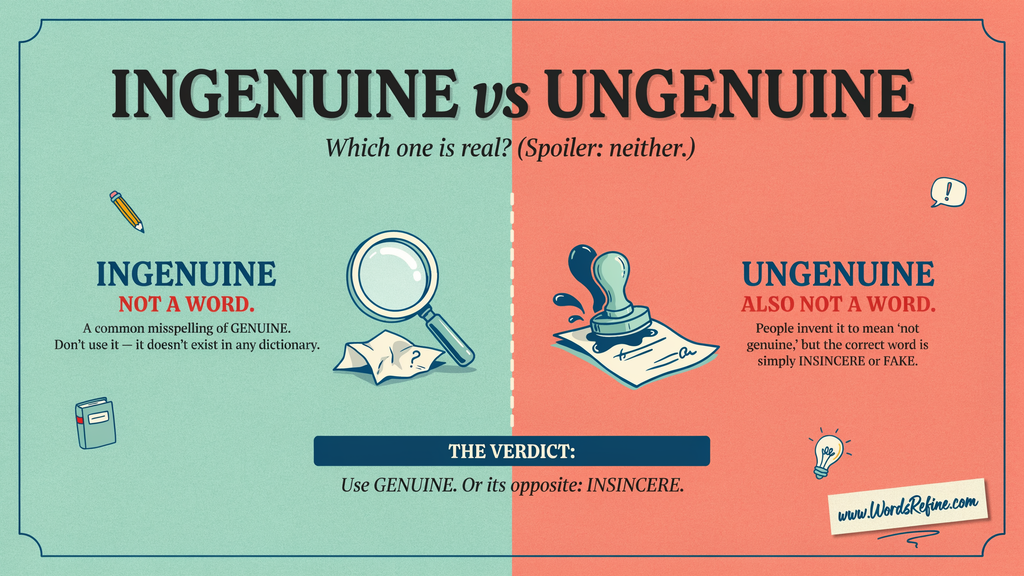
If you’re choosing between ingenuine or disingenuous, first decide what you mean.
Use a word related to genuine when you’re talking about authenticity.
For example:
The product didn’t seem genuine.
Use insincere when you’re talking about feelings or expressions that aren’t heartfelt.
For example:
Her apology seemed insincere.
Use disingenuous when you’re talking about misleading or incomplete honesty.
For example:
His explanation was disingenuous.
These words overlap in certain situations, but they aren’t perfect substitutes.
Good writing pays attention to those small differences.
Ingenuous, Ingenuine, and Ingenious Are Not the Same
This is one of the easiest places to make a mistake.
Ingenuine, ingenuous, and ingenious look similar, but their meanings are completely different.
Genuine means real, authentic, or sincere.
Ingenuine means not genuine or unauthentic.
Ungenuine means not genuine.
Ingenuous means honest, open, trusting, or somewhat naive.
Ingenious means clever, inventive, or skillful.
Consider these examples:
She gave an ingenuous answer.
This means her answer was open, sincere, or trusting.
She designed an ingenious solution.
This means her solution was clever and inventive.
Her reaction seemed ingenuine.
This means her reaction did not seem genuine.
The spelling differences are small. The meanings are not.
Ingenuine vs Ungenuine Examples
Examples make the distinction much easier to see.
When Talking About an Apology
His apology sounded ungenuine.
This means the apology didn’t seem sincere.
A more precise alternative would be:
His apology sounded insincere.
When Talking About a Product
The watch appeared ungenuine.
This means the watch didn’t appear authentic.
If it was deliberately manufactured as a fake, counterfeit would be more precise.
When Talking About Behavior
Her friendliness seemed ungenuine.
This suggests that her friendliness appeared forced or unnatural.
You could also say:
Her friendliness seemed insincere.
When Talking About an Argument
His argument was disingenuous.
This suggests that his argument wasn’t completely honest or straightforward.
Each sentence points to a slightly different problem.
Ungenuine in a Sentence
If you’re looking for ungenuine in a sentence, these examples show how the word can work naturally.
- Her apology sounded ungenuine.
- His enthusiasm seemed ungenuine after the meeting ended.
- The salesman’s smile appeared ungenuine.
- The signature looked ungenuine to the expert.
- Their concern seemed ungenuine because they never asked what had happened.
- The company’s response felt ungenuine to many customers.
The word generally works best when the context makes it obvious what isn’t genuine.
Ingenuine in a Sentence
Here are several examples of ingenuine in a sentence.
- His enthusiasm appeared ingenuine.
- The response seemed ingenuine to the audience.
- She described the reaction as ingenuine.
- The writer considered the apology ingenuine.
- His concern seemed ingenuine after he changed the subject.
These examples are understandable. However, many readers will find more familiar alternatives easier to process.
For example:
His enthusiasm appeared insincere.
The sentence says almost exactly what the reader needs to know without introducing an uncommon word.
Learn the difference between confusing word pairs
Further vs Farther The Simple Difference and Each Correctly?
Ingenuine vs Ungenuine Usage in Everyday Writing
When choosing between uncommon and familiar words, think about your audience.
In casual conversation, people usually prefer familiar expressions.
In professional writing, clarity matters even more.
For example, imagine an email that says:
The company’s response appeared ingenuine.
The reader may understand it, but the wording may feel slightly unusual.
Now compare:
The company’s response appeared insincere.
The second sentence is smoother and more direct.
Similarly, when describing a product, inauthentic or counterfeit may be much clearer than ungenuine.
This is why natural English expression often depends on more than dictionary definitions. Common English usage matters too.
Common Mistakes With Ingenuine vs Ungenuine
One common mistake is assuming that ingenuine must be completely wrong simply because it sounds unusual.
Its documented use shows that the situation is more complicated.
Another mistake is treating ungenuine as the perfect replacement for every word meaning fake or dishonest.
It isn’t.
A third mistake is confusing ingenuine with ingenuous.
That mistake can completely reverse the intended meaning.
Another common problem is using disingenuous whenever something seems fake.
Disingenuous is more closely connected with honesty, candor, and misleading communication.
Finally, some writers focus so heavily on finding the “correct” word that they forget about precision.
Sometimes the best answer isn’t ingenuine or ungenuine at all.
Sometimes it’s simply fake.
How to Choose the Right Word
The easiest way to solve the problem is to identify what you’re actually describing.
1Use Genuine for Something Real or Sincere
- The painting is genuine.
- Her concern was genuine.
- His interest in the project was genuine.
2Use Inauthentic for Something That Isn’t Authentic
- The experience felt inauthentic.
- The product was inauthentic.
- His behavior seemed inauthentic.
3Use Insincere for Feelings or Words That Aren’t Heartfelt
- His apology sounded insincere.
- Her compliment felt insincere.
- The expression of concern seemed insincere.
4Use Counterfeit for Fake Goods
- The watch was counterfeit.
- Police seized counterfeit currency.
- The store was accused of selling counterfeit products.
5Use False or Untrue for Incorrect Statements
- The claim was false.
- The information was untrue.
- The report contained a false statement.
6Use Disingenuous for Misleading Communication
- His explanation was disingenuous.
- Her response seemed disingenuous.
- The argument was disingenuous because it ignored important evidence.
This approach gives you a much more accurate vocabulary.
British English and American English
The question isn’t really a British English versus American English spelling issue.
Words such as color and colour have clear regional spelling differences. Ingenuine and ungenuine don’t fit neatly into that category.
Instead, the main issue is familiarity and usage.
A word may appear in British writing without becoming a standard preference in American writing, and the reverse can also happen. However, that doesn’t mean one spelling automatically belongs to one country.
Therefore, don’t assume that ungenuine is simply the British form and ingenuine is the American form.
The better approach is to consider meaning, established usage, and your audience.
For US English, which favors clear and familiar wording, alternatives such as genuine, inauthentic, insincere, false, fake, and disingenuous will often be easier for readers to understand.
Ingenuine vs Ungenuine in Professional and Academic Writing
Professional and academic writing benefits from precise language.
That doesn’t mean using the longest word available. In fact, simple language is often stronger.
Consider this sentence:
The employee’s response appeared ungenuine.
It is understandable.
However, if the employee clearly wasn’t sincere, this may be better:
The employee’s response appeared insincere.
If the employee deliberately presented a misleading version of events, this may be better:
The employee’s response was disingenuous.
Likewise, if a product isn’t authentic, write:
The product was inauthentic.
If it was deliberately made as a fake, write:
The product was counterfeit.
The goal isn’t to sound sophisticated.
The goal is to make the meaning unmistakable.
Learn the difference between confusing word pairs
Capital vs Capitol Which One Is Correct?
What Do Dictionaries Tell Us?
Dictionary definitions help separate actual usage from assumptions.
Genuine is widely established as an adjective meaning real, authentic, or sincere.
Ungenuine is documented as an adjective meaning false or not genuine.
Ingenuine is also documented with the meaning false, not genuine, or unauthentic.
Disingenuous has a more specific meaning related to a lack of honesty, openness, or complete candor.
Inauthentic describes something that isn’t authentic or doesn’t match what it claims to be.
These definitions show why the words overlap without being identical.
A dictionary can tell you whether a word exists and what it means. However, good writing also requires attention to frequency, audience, tone, and context.
That’s especially important with uncommon words.
Real-World Examples of the Right Word
Consider a fake luxury watch.
If you simply want to say it isn’t genuine, you could call it ungenuine. However, counterfeit gives the reader a clearer description if the watch was deliberately produced as a fake.
Now consider a forced apology.
Ungenuine can describe the apology, but insincere may communicate the idea more naturally.
Next, imagine someone giving an explanation that deliberately avoids important facts.
Calling the explanation disingenuous makes more sense because the problem concerns honesty and candor.
Finally, imagine a person who behaves in a way that doesn’t feel authentic.
Inauthentic may be the most natural choice.
These examples show why there isn’t always one universal opposite of genuine.
Ungenuine Synonyms and Ingenuine Synonyms
There are several possible synonyms for ungenuine and ingenuine, but each carries its own shade of meaning.
1For something that isn’t authentic, use inauthentic.
2For something deliberately fake, use fake or counterfeit.
3For an emotion that isn’t sincere, use insincere.
4For something manufactured or unnatural in appearance, artificial may fit.
5For an incorrect statement, false or untrue may be better.
6For communication that isn’t fully honest or candid, disingenuous may be the strongest choice.
Therefore, synonyms for ungenuine and synonyms for ingenuine aren’t interchangeable in every sentence.
The context decides which one fits.
Ingenuine vs Ungenuine Pronunciation
Pronunciation is another reason people sometimes hesitate over these words.
Genuine has a familiar pronunciation in standard English, but the longer forms can sound less natural because many speakers don’t encounter them often.
For ungenuine pronunciation, the word follows the expected sound pattern of un- followed by genuine.
Ingenuine pronunciation similarly combines in- with genuine.
However, pronunciation isn’t usually the biggest problem with these words.
Recognition is.
When a listener rarely encounters ingenuine, they may wonder whether the speaker meant ingenuous or ingenious.
That is another reason familiar alternatives can sometimes make communication smoother.
A Simple Rule to Remember Ingenuine vs Ungenuine
Instead of memorizing a complicated rule, remember this:
1When you mean real or sincere, use genuine.
2When you mean not authentic, consider inauthentic.
3When you mean not sincere, consider insincere.
4When you mean fake goods, use counterfeit.
5When you mean misleading communication, consider disingenuous.
6When you simply mean not genuine, ungenuine can express the idea.
Ingenuine is also documented, but it is much less familiar.
This approach is more useful than trying to memorize a single “correct” prefix.
Learn the difference between often confused words
Lay vs Lie Difference and which is correct?
Quick Recap Ingenuine vs Ungenuine at a Glance
| Question | Answer |
|---|---|
| Is ingenuine a word? | Yes. It is documented with the meaning not genuine or unauthentic. |
| Is ungenuine a word? | Yes. It is an established adjective meaning false or not genuine. |
| What is the difference between ingenuine and ungenuine? | Their basic meanings overlap. Ungenuine is generally more familiar. |
| What is the opposite of genuine? | Depending on context, it may be ungenuine, inauthentic, false, fake, or insincere. |
| Is disingenuous the same as ungenuine? | No. Disingenuous usually involves a lack of candor or misleading communication. |
| What does ungenuine mean? | It means not genuine or false. |
| What does ingenuine mean? | It means not genuine, false, or unauthentic. |
| What is the best word for a fake product? | Usually fake, counterfeit, or inauthentic. |
| What is the best word for a fake apology? | Usually insincere or ungenuine. |
| What word describes misleading honesty? | Disingenuous often fits best. |
Practice session ingenuine vs ungenuine
- Her apology sounded __________ because she didn’t seem truly sorry.
- The antique dealer confirmed that the painting was __________ and not a reproduction.
- The watch turned out to be __________, even though the seller claimed it was an original.
- His concern seemed __________ because he never asked how she was feeling.
- The manager gave a __________ explanation that left out several important facts.
- She showed __________ excitement when she heard the good news.
- The engineer came up with an __________ solution to the problem.
- His response seemed __________ rather than sincere.
- The store was investigated for selling __________ handbags with fake brand labels.
- The customer’s praise sounded __________ because he had complained about the product just moments earlier.
- The actor’s emotional reaction appeared __________ to the audience.
- The student gave an __________ answer that showed she was honest and trusting.
- The spokesperson’s explanation seemed __________ because it avoided the most important part of the issue.
- The museum confirmed that the signature was __________.
- Her friendliness felt __________, as though she was only pretending to care.
- The advertisement contained several __________ claims about the product.
- His apology seemed __________ because he immediately blamed someone else for the problem.
- The jeweler determined that the diamond was __________ rather than a fake.
- His explanation sounded __________ because he carefully left out several relevant details.
- The reviewer’s reaction seemed __________ and overly rehearsed.
- The company recalled the __________ products after discovering that they were not authentic.
- Her interest in helping the new employee was completely __________.
- The salesman gave an __________ smile that failed to hide his annoyance.
- The argument sounded __________ because it presented a misleading version of the facts.
- If you mean that something is simply not genuine, __________ can express that idea, although a more precise word may fit the context better.
Answers
- Insincere
- Genuine
- Counterfeit
- Ungenuine
- Disingenuous
- Genuine
- Ingenious
- Ungenuine
- Counterfeit
- Insincere
- Ungenuine
- Ingenuous
- Disingenuous
- Genuine
- Inauthentic
- False
- Insincere
- Genuine
- Disingenuous
- Ungenuine
- Inauthentic
- Genuine
- Artificial
- Disingenuous
- Ungenuine
Here’s a trusted source for clear more words Comparison:
FAQs
Can ingenuine vs ungenuine be used interchangeably?
They can both describe something that isn’t genuine, but they aren’t equally common in everyday English. Ungenuine is generally easier for readers to understand, while ingenuine is uncommon. In many situations, inauthentic, insincere, fake, or false may sound more natural.
When should I use ungenuine in a sentence?
Use ungenuine when you want to describe something that appears false, artificial, or not sincere. For example, you could say, “His concern seemed ungenuine because he never asked what had happened.”
Why does ingenuine sound unusual to many English speakers?
Ingenuine is an uncommon word in modern English. Although it appears in some dictionaries and historical usage, most speakers are more familiar with genuine and ungenuine or with alternatives such as inauthentic and insincere.
Does ungenuine describe a person or an object?
It can describe either. You might call a person’s behavior ungenuine if it seems insincere. You can also describe an object, product, or document as ungenuine if it isn’t authentic.
Can ungenuine describe an apology?
Yes. If an apology sounds forced or lacks real sincerity, ungenuine can describe it. However, insincere is often a more natural choice when you specifically mean that the speaker doesn’t truly regret what they did.
Is ungenuine commonly used in everyday English?
Ungenuine is a recognized but relatively uncommon adjective. Native speakers may understand it immediately, but they often choose clearer alternatives such as fake, inauthentic, insincere, or false.
Does ingenuine have a different meaning from ungenuine?
Not in the basic sense. Both can refer to something that isn’t genuine. The main difference is usage and familiarity rather than a sharply different definition.
Can you use ungenuine for someone’s behavior?
Yes. Ungenuine can describe behavior that seems artificial, forced, or lacking sincerity. For example, “Her enthusiasm seemed ungenuine after the decision was announced.”
Is ungenuine appropriate in formal writing?
It can be used, but context matters. In formal or academic writing, a more precise word such as inauthentic, insincere, deceptive, or false may communicate your meaning more clearly.
What is the noun form related to genuine?
Genuineness is the standard noun for the quality of being genuine. Authenticity is another useful noun when you mean that something is real, original, or true to its nature.
Can ungenuine describe a product?
Yes. It can describe a product that isn’t authentic. However, counterfeit is more precise when the product is an unauthorized imitation of a branded or protected item.
What does ungenuinely mean?
Ungenuinely is the adverbial form related to ungenuine. It describes an action or statement that isn’t genuine or sincere. For example, “He apologized ungenuinely” means his apology did not seem sincere.
Is genuine always the opposite of ungenuine?
Generally, yes. Genuine describes something real, authentic, or sincere, while ungenuine describes something that lacks those qualities. The best opposite can still depend on the context.
Why might a writer choose inauthentic instead of ungenuine?
Inauthentic is often clearer when discussing something that doesn’t feel real, natural, or true to its original character. It works especially well for behavior, experiences, brands, identities, and styles.
Can a statement be ungenuine without being a lie?
Yes. Something can feel ungenuine without being deliberately false. For example, someone may give a forced compliment because they feel uncomfortable. The compliment might not be a lie, but it may still sound insincere.
How is ungenuine different from fake?
Fake often suggests that something is deliberately presented as something it isn’t. Ungenuine is broader and can describe a lack of sincerity or authenticity without necessarily implying a deliberate attempt to deceive.
Can a smile be described as ungenuine?
Yes. If a smile appears forced rather than natural, you can describe it as ungenuine. In everyday English, forced or insincere may sound more natural depending on exactly what you mean.
Does ungenuine always imply dishonesty?
No. Ungenuine can suggest a lack of authenticity or sincerity, but it doesn’t automatically prove that someone intended to deceive another person. The surrounding context determines the meaning.
What are some natural alternatives to ungenuine?
Depending on the situation, you could use inauthentic, insincere, artificial, forced, false, fake, or deceptive. Choose the alternative that expresses the exact problem rather than relying on one word for every situation.
Can ingenuine appear in older English writing?
Yes. Ingenuine has appeared in historical and less-common English usage. Its presence in older texts doesn’t mean it’s the most natural choice for modern everyday writing.
Why is word choice important when describing something as not genuine?
Different words carry different meanings. Calling something inauthentic focuses on a lack of authenticity, while insincere focuses on a lack of genuine feeling. Counterfeit points to an imitation, while disingenuous often involves misleading communication. Choosing the precise word makes your meaning much clearer.
Conclusion
The confusion between ingenuine vs ungenuine is a little like trying to choose between two nearly identical keys. They look as if they should unlock the same door, yet one feels much less familiar in everyday English. Both forms have appeared in English, but ungenuine is the more recognizable choice when you simply mean “not genuine.” Even then, context matters.
If you mean something isn’t real or authentic, genuine and inauthentic can make the point clearly. and If you’re talking about someone who isn’t being sincere, insincere may fit better. If a person is deliberately misleading you while pretending to be honest, disingenuous can be the sharper choice. And if a product is an unauthorized imitation, counterfeit is the word you want.
The biggest mistake is treating every “not genuine” situation as if it needs the same word. English gives you several options because meaning matters. A fake diamond, a forced smile, a misleading explanation, and a dishonest apology may all feel “not genuine,” but they aren’t exactly the same thing.
So, before you let ingenuine and ungenuine turn your sentence into a grammar guessing game, pause and ask what you actually mean. Once you identify the idea, the right word usually becomes much easier to spot. Your sentence gets clearer, your meaning gets stronger, and your reader doesn’t have to play detective.

Diora AJS she is an experienced blogger and passionate English language enthusiast at Words Refine. With a keen eye for language and a love for clear communication, she writes practical content about grammar, word meanings, usage, and commonly confused terms. Her goal is to make English easier to understand through clear explanations and relatable examples, helping readers write accurately and communicate with confidence.