
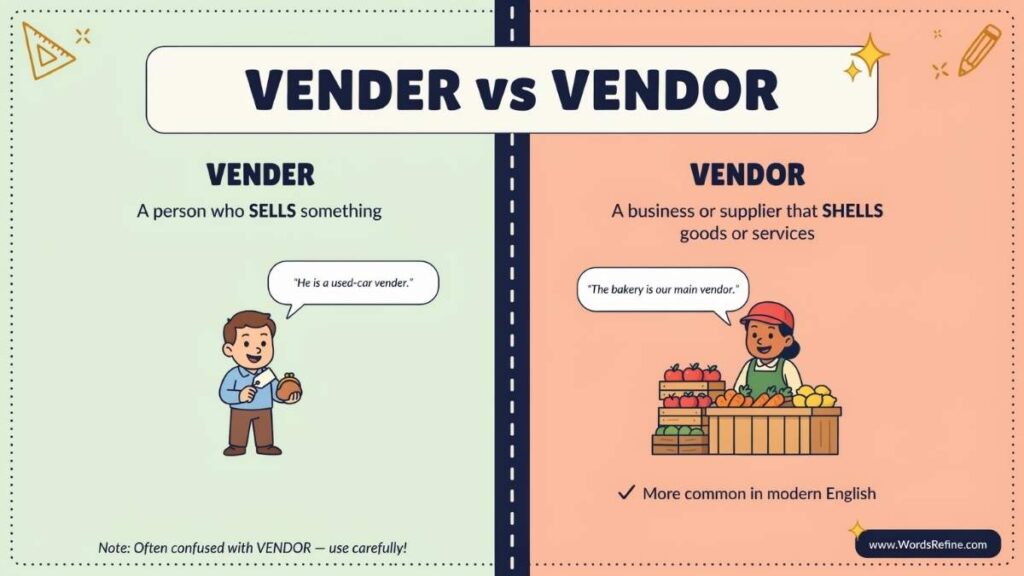
Vender vs vendor is a small spelling difference that can cause a surprisingly big headache. Both words refer to someone who sells goods or services, so it’s easy to wonder why English needs two spellings in the first place. The good news? The confusion is easier to clear up than it looks. Vendor is the standard and much more common spelling in modern English, especially in business and professional writing. Vender is also a real word, but you well see it far less often. In this guide, we well explain the meaning, spelling, and usage of both words, with simple examples to help you choose the right one confidently.
Vender vs Vendor Quick Answer
If you are wondering whether to use vender or vendor, the short answer is simple: vendor is the standard choice.
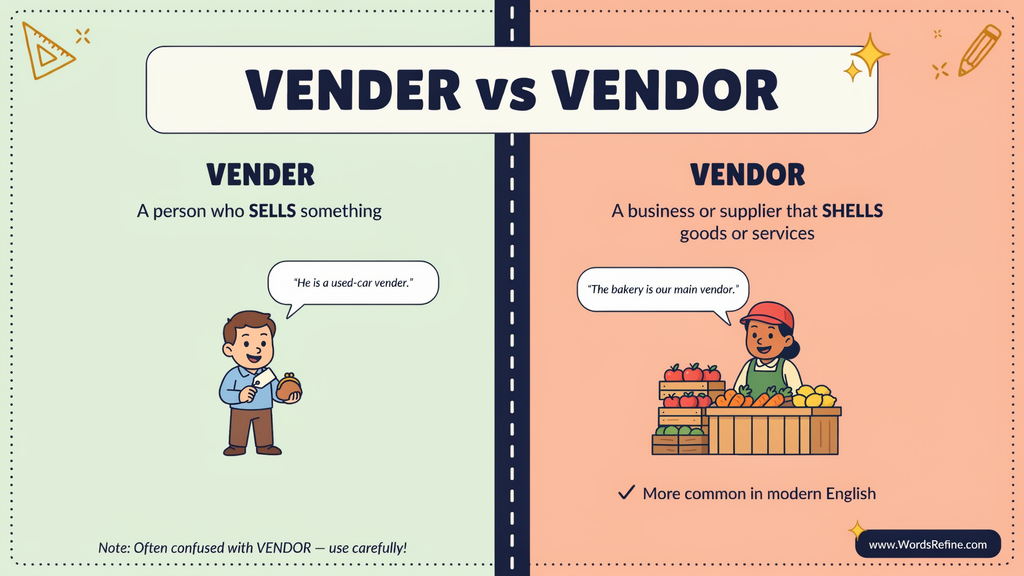
A vendor is a person or company that sells goods or services. The word works in everyday English as well as business, retail, technology, and commercial writing.
Vender also exists as a noun. It refers to someone who vends or sells something. However, it is much less common than vendor.
Here’s the easiest way to remember the difference:
| Word | Meaning | Commonness | Recommended use |
|---|---|---|---|
| Vendor | A person or business that sells goods or services | Very common | Standard choice |
| Vender | A person who vends or sells | Uncommon | Use only when the context specifically calls for it |
So, if you’re asking “vendor or vender which is correct?” the practical answer is vendor.
If you’re asking “is vender a word?” the answer is yes.
That second answer is where things get interesting.
Vendor Definition What Does Vendor Mean?
The vendor definition is fairly straightforward. A vendor is a person or business that sells something.
The word can describe someone selling a product directly to customers. It can also describe a company that provides goods or services to another business.
In simple terms, the vendor meaning is:
A vendor is a person or business that sells goods or services.
For example:
The vendor delivered the office furniture on Friday.
In that sentence, vendor refers to the business or person responsible for selling and delivering the furniture.
The word can also describe a company:
The company selected a new software vendor.
Here, vendor doesn’t mean a single salesperson. It refers to a company that provides software.
That’s one reason the word appears so often in modern business terminology.
Vendor as a Person
A vendor can be an individual who sells products directly to customers.
For example:
The food vendor sold sandwiches outside the stadium.
The street vendor offered fresh fruit to passing customers.
The local vendor sells handmade candles at the weekend market.
In each example, the vendor is someone who sells goods.
Vendor as a Business
Modern English also uses vendor for companies.
A business can act as a vendor when it supplies products or services to customers or other organizations.
For example:
The hospital works with several medical equipment vendors.
The company changed its software vendor last year.
We contacted the vendor about the delayed shipment.
This broader use makes vendor particularly common in professional and commercial English.
Vender Meaning What Does Vender Mean?
The vender meaning is closely related to the meaning of vendor.
A vender is someone who vends or sells something. The word connects directly with the verb vend, which means to sell.
If you’re searching for a vender definition, the simplest explanation is:
A vender is a person who sells something.
For example:
The fruit vender stood near the entrance to the market.
The sentence makes sense, but most modern readers would expect vendor instead.
That distinction is important. Vender isn’t simply a meaningless spelling mistake. It exists as an English word. However, it isn’t the form most writers normally use today.
Is Vender a Word?
Yes, vender is a word.
If you’ve been wondering “is vender a word?” the answer isn’t “no.” Dictionaries recognize the term, particularly as a US commerce variant related to vendor.
However, recognizing that a word exists doesn’t mean that it is equally common or equally suitable in every situation.
English has plenty of words that are technically valid but uncommon. Vender falls into that category.
A useful way to think about it is this:
Vendor is the standard modern form. Vender is a legitimate but uncommon variant.
That explanation is more accurate than simply calling vender wrong.
Vender vs Vendor Meaning What Is the Difference?
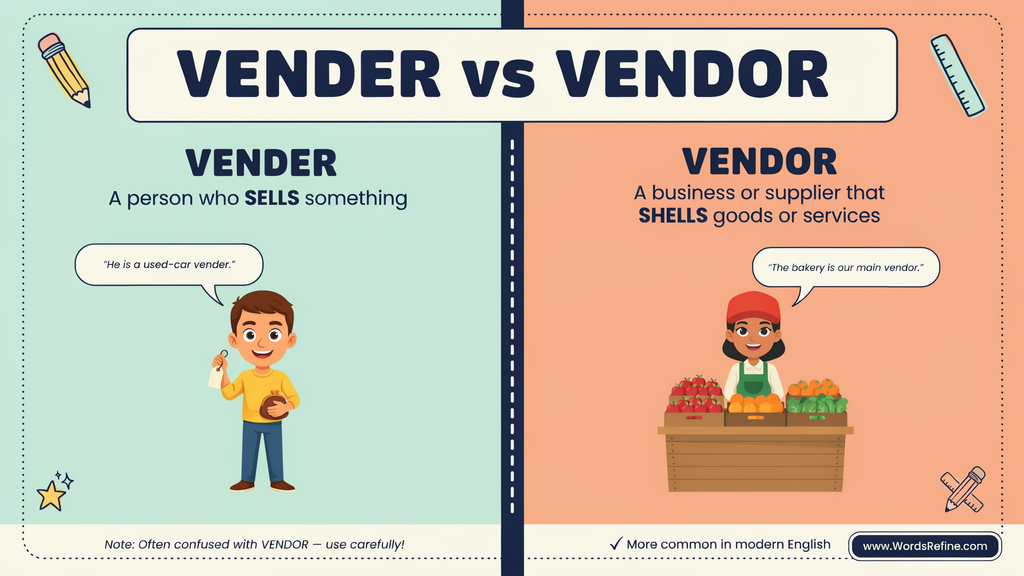
The main difference between vender and vendor isn’t their basic meaning. Both words can refer to someone who sells something.
The bigger difference is usage.
Vendor is widely used in modern English. Vender is much less common.
You can think of vendor as the main highway and vender as a rarely used side road. Both exist, but almost everyone takes the main road.
For example:
The company hired a new vendor.
This sounds completely natural.
The company hired a new vender.
A reader can understand the sentence, but the spelling looks unusual because vendor is the expected form.
This is why the vendor vs vender meaning question can be misleading. The words don’t have sharply different meanings. Their main distinction comes from frequency, convention, and context.
Vender vs Vendor Grammar
Both vendor and vender can function as nouns.
Vendor:
The vendor delivered the products.
Vender:
The vender sold handmade goods at the market.
The grammar in both sentences works.
The issue is word choice rather than sentence structure.
In modern professional English, vendor is normally the better choice because readers recognize it immediately.
This is especially true in business writing, where terms such as vendor contract, vendor management, software vendor, and approved vendor are well established.
Vendor vs Vender Spelling Why Do People Get Confused?
The vendor vs vender spelling confusion has a perfectly reasonable source.
The verb vend means to sell.
From there, vender looks like a logical noun:
vend + er = vender
English often uses the suffix -er to describe someone who performs an action. A runner runs. A writer writes. A singer sings.
So why doesn’t everyone simply use vender?
Because languages don’t always build vocabulary according to a single clean formula. Historical development matters too.
Vendor became the established standard noun for a seller, while vender remained a much less common variant.
That’s why the vender spelling can seem so convincing. It follows a pattern that looks familiar.
The problem is that familiar-looking isn’t always the same as standard.
Is Vender the Correct Spelling?
If you’re asking “is vender the correct spelling?” the answer depends on what you mean.
Vender is a recognized word. However, if you’re referring to a person or business that sells goods or services in ordinary modern English, vendor is the standard spelling.
For example:
We contacted the vendor about the invoice.
That’s the natural choice for business writing.
You might still encounter vender in dictionaries, older texts, or specific US commercial contexts. In those cases, the word isn’t automatically an error.
The key is context.
If you’re writing for a general audience, vendor will almost always be the clearer and more familiar option.
Learn the difference between confusing word pairs
Whoever vs Whomever How to Use Each Word Correctly
Vendor in American English
The question of vendor in American English is especially interesting because vender has a documented connection with US usage.
American English commonly uses vendor to describe people and companies that sell goods or services.
You’ll see the word in everyday phrases such as:
- street vendor
- food vendor
- local vendor
- online vendor
- retail vendor
- software vendor
- service vendor
- wholesale vendor
The word also appears frequently in professional business terminology.
For example:
The purchasing department approved the new vendor.
The IT team is evaluating several software vendors.
The company signed a contract with an outside service vendor.
Although vender can appear in American English, vendor remains the normal choice.
It would therefore be misleading to present vender and vendor as an American English versus British English spelling difference. The distinction isn’t that simple.
Vendor Pronunciation and Vender Pronunciation
Vendor pronunciation and vender pronunciation are very similar.
The difference you see on the page is much more noticeable than the difference you hear.
That’s another reason this pair causes confusion. If someone says the word aloud, pronunciation probably won’t help you decide which spelling to use.
The safest solution is to remember the standard written form:
Vendor is the spelling you normally want for a seller or selling business.
Vendor Examples in Everyday English
The word vendor appears in many parts of everyday life.
Street Vendor
The street vendor sold cold drinks to people leaving the train station.
Here, vendor refers to an individual selling goods directly to customers.
Food Vendor
The food vendor served hot meals throughout the event.
A food vendor can be a person, food truck, stall, or business.
Online Vendor
The online vendor offered free shipping on large orders.
An online vendor sells products through a website or marketplace.
Software Vendor
The company contacted its software vendor about a technical problem.
In this context, vendor refers to a company providing software.
Local Vendor
We bought decorations from a local vendor.
The word simply identifies the seller as a local business or individual.
Wholesale Vendor
The retailer buys clothing from several wholesale vendors.
Here, the vendor operates within a larger commercial supply chain.
These examples show how flexible the word has become. A vendor isn’t necessarily someone standing behind a market stall. The term can describe anything from a small independent seller to a large technology company.
Vender in a Sentence
If you’re specifically looking for a vender in a sentence example, consider this:
The fruit vender stood near the market entrance.
Another example is:
Several venders attended the weekend market.
These sentences use vender as a noun meaning someone who sells something.
However, most modern readers would find these versions more natural:
The fruit vendor stood near the market entrance.
Several vendors attended the weekend market.
This difference illustrates an important point about English word usage.
A word can be valid without being the most natural choice.
Vendor vs Supplier What’s the Difference?
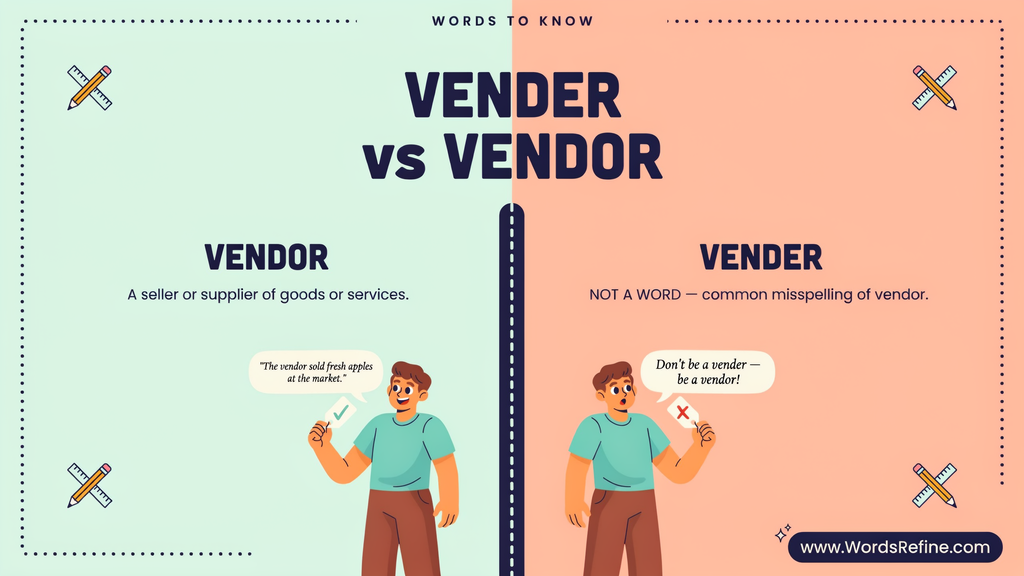
A supplier usually focuses on providing goods, materials, products, or resources to another business or organization.
For example:
The restaurant buys fresh vegetables from a local supplier.
The restaurant hired a software vendor to manage its reservations.
The first sentence focuses on the supply of physical goods. The second focuses on a company providing a service.
The terms aren’t strict categories in every industry. A company can be both a supplier and a vendor depending on the relationship.
Vendor vs Seller
Seller is a broad term for anyone who sells something.
For example:
The seller accepted the offer.
Vendor often sounds more commercial or business-oriented:
The software vendor renewed the contract.
Both words can describe someone involved in a sale. The context determines which one sounds more natural.
Vendor vs Merchant
A merchant is generally a person or business involved in buying and selling goods.
A vendor can be a merchant, but the words don’t always carry exactly the same emphasis.
Merchant often suggests commercial trade, while vendor commonly focuses on the person or company offering something for sale.
Vendor vs Retailer
A retailer sells goods directly to consumers.
A vendor can also sell directly to consumers, but the term has a broader meaning.
For example, a software company that sells its product to another business can be called a software vendor. It isn’t necessarily a retailer.
Dealer vs Vendor
A dealer often sells or distributes a particular type of product.
Common examples include:
- car dealer
- equipment dealer
- authorized dealer
- electronics dealer
A vendor can also sell these products, but dealer may suggest a specific commercial role or distribution arrangement.
Common Vendor Phrases in Business Writing
Vendor is especially common in business terminology.
Here are some phrases you’ll frequently encounter:
| Phrase | Meaning |
|---|---|
| Vendor management | Managing relationships with vendors |
| Vendor contract | A contract involving a vendor |
| Vendor agreement | An agreement between a business and vendor |
| Vendor selection | Choosing a vendor |
| Vendor relationship | The working relationship with a vendor |
| Approved vendor | A vendor that meets a company’s requirements |
| Third-party vendor | An outside company providing goods or services |
| Software vendor | A company that provides software |
| Service vendor | A company that provides a service |
| Vendor invoice | An invoice from a vendor |
| Vendor payment | A payment made to a vendor |
These expressions are common in procurement, accounting, technology, operations, and general business communication.
That’s another reason vendor is usually the stronger choice. It fits naturally into a large network of established business expressions.
Vendor vs Vender Common Mistakes
Assuming Vender Is Always Wrong
One of the biggest mistakes is claiming that vender isn’t a word.
It is a recognized word.
The more accurate statement is that vender is uncommon compared with vendor.
Assuming Both Forms Are Equally Common
The opposite mistake is to assume that because both words exist, you can use them interchangeably without affecting style.
Technically, the meanings overlap. Practically, vendor is much more familiar.
Choosing Vender Because of the Verb Vend
The logic behind vender is understandable.
Vend means to sell, so vender looks like a natural noun.
However, the established standard noun is vendor.
English vocabulary doesn’t always reward the most obvious construction.
Using Vender in Professional Writing
Even though vender exists, vendor is normally the better choice in:
- Business emails
- Reports
- Contracts
- Procurement documents
- Articles
- Websites
- Resumes
- Professional correspondence
- Technical documentation
When clarity matters, familiar language usually wins.
How to Spell Vendor
If you’re wondering how to spell vendor, use:
V-E-N-D-O-R
The key letter to remember is the o.
You can reinforce the spelling by remembering familiar phrases:
- software vendor
- food vendor
- street vendor
- online vendor
- vendor management
Seeing the standard form repeatedly makes it easier to remember.
How to Spell Vender
If you’re asking how to spell vender, the spelling is:
V-E-N-D-E-R
The word ends with -der rather than -dor.
Again, the important point isn’t whether you can spell it. You can.
The question is whether you should use it.
For ordinary modern writing about a seller, vendor remains the better choice.
Vendor vs Vender Which One Should You Use?
If you’re still asking “should I use vendor or vender?” this simple guide should settle it.
Use vendor when:
- You mean a person who sells goods.
- You mean a business that sells products.
- You mean a company that provides services.
- You’re writing a business email.
- You’re preparing a report.
- You’re writing professional or formal English.
- You’re discussing software or technology.
- You’re talking about procurement.
- You’re writing for a broad audience.
Vender may appear when:
- You’re discussing the word itself.
- You’re quoting a source that uses it.
- You’re dealing with a historical text.
- A particular source or context specifically uses the variant.
For almost every ordinary situation, vendor is the safer and more natural choice.
Vender vs Vendor Examples Side-by-Side
| Less common form | Standard modern form |
|---|---|
| The fruit vender opened early. | The fruit vendor opened early. |
| We contacted the software vender. | We contacted the software vendor. |
| Several venders attended the market. | Several vendors attended the market. |
| The vender offered a discount. | The vendor offered a discount. |
| The company selected a service vender. | The company selected a service vendor. |
The left-hand sentences are understandable, and the word vender itself is legitimate. However, the right-hand versions sound more natural to modern readers.
Case Study Choosing the Right Word in Business Writing
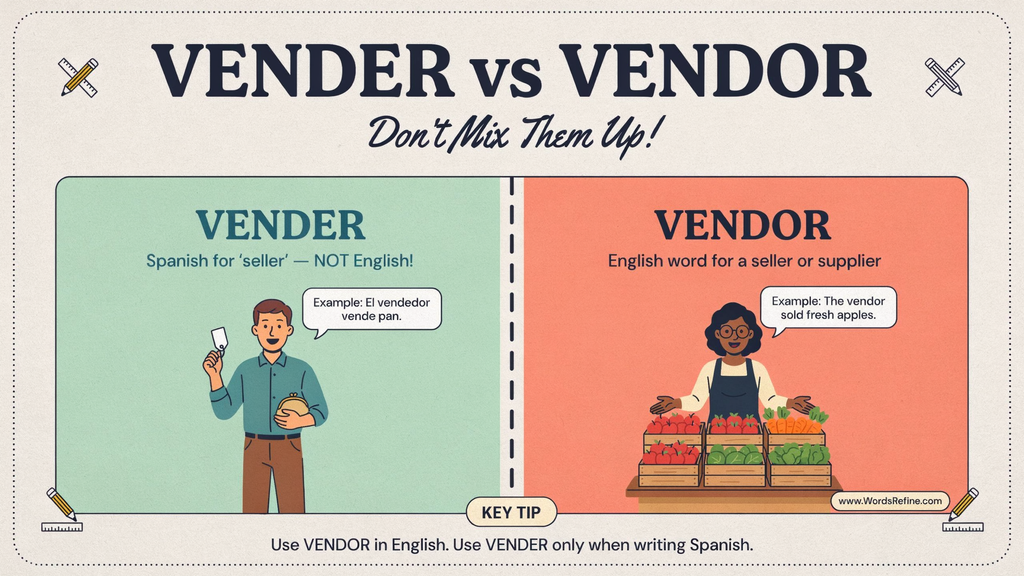
Imagine a company wants to compare three businesses that provide cloud accounting software.
The first draft says:
We contacted three software venders before choosing our provider.
Nothing about the sentence makes the intended meaning difficult to understand. The problem is word choice.
A more natural version is:
We contacted three software vendors before choosing our provider.
Why does vendor work better?
Because software vendor is an established expression in modern business English. Readers immediately understand that the phrase refers to companies providing software.
Now imagine a city market:
The city issued permits to local food vendors.
Again, vendor feels natural.
The lesson is useful beyond this particular spelling pair. Good writing isn’t only about asking whether a word exists. You also need to consider whether the word fits the audience, context, and conventions of modern English.
Vendor Word Meaning Related Terms
Understanding vendor becomes easier when you compare it with related words.
| Word | Basic meaning |
|---|---|
| Vendor | A person or company that sells goods or services |
| Seller | A person or organization that sells something |
| Supplier | A person or company that provides goods or materials |
| Merchant | A person or business involved in trade |
| Retailer | A business that sells goods to consumers |
| Dealer | A person or business that sells or distributes particular products |
| Salesperson | An individual whose job involves selling |
| Trader | A person or business involved in buying and selling |
These terms overlap, but context matters.
For example, a software company is naturally described as a software vendor. A person selling vegetables at a roadside market can also be called a vendor.
The word covers a surprisingly wide range of commercial situations.
Vender Word Meaning Why Does It Still Appear?
The vender word meaning remains easy to understand because it connects naturally with vend.
Vend means to sell.
From that verb, vender has the intuitive meaning of someone who sells.
That connection helps explain why the word still appears occasionally.
You may encounter vender in:
- Dictionary entries
- Historical texts
- Older publications
- Some US commercial contexts
- Discussions about spelling
- Sources that retain the variant
However, its presence shouldn’t encourage you to replace vendor with vender in ordinary writing.
Vender exists. Vendor is standard.
Both facts can be true at the same time.
Is Vender an English Word?
Yes, vender is an English word.
If someone asks, “Can vender be used in English?” the answer is technically yes.
But that doesn’t mean it is the preferred form for general writing.
Modern English often contains words that survive in limited contexts while another form becomes dominant. Writers need to understand not only whether a word exists but also how commonly people use it.
That’s why the distinction between vender and vendor is best described as one of standard usage rather than a simple correct-versus-incorrect spelling rule.
Is Vender Outdated?
Calling vender completely outdated would go too far.
The word still appears in dictionaries and can still be encountered in English. It hasn’t disappeared from the language.
However, it is uncommon compared with vendor.
A better description is:
Vender is a rare or uncommon variant, while vendor is the standard modern form.
That wording gives readers a more accurate picture.
It avoids two extremes: saying vender is completely wrong and pretending that vender and vendor are equally common.
Vendor vs Vender Grammar and Word Choice
From a grammar perspective, both words can serve as nouns.
From a practical writing perspective, vendor is usually the stronger choice.
That difference matters because grammar and word choice aren’t the same thing.
A sentence can be grammatically possible while still sounding unnatural.
For example:
The vender submitted the invoice.
The sentence has a normal grammatical structure. Yet:
The vendor submitted the invoice.
sounds more familiar and professional to most readers.
Good writing considers both grammar and usage.
Practice Session Vender vs Vendor
- The food ________ sold fresh sandwiches outside the stadium.
- Our company contacted a software ________ about the new program.
- The street ________ arranged the fruit neatly on the table.
- We need to find a reliable ________ for office supplies.
- The online ________ offered free shipping on large orders.
- Several local ________ participated in the weekend market.
- The purchasing manager approved the new equipment ________.
- The customer contacted the ________ about a damaged product.
- The technology ________ provides software to businesses around the world.
- The market ________ opened the stall early in the morning.
- We compared prices from three different ________ before placing the order.
- The clothing ________ offered a discount to returning customers.
- The company signed a contract with an outside service ________.
- A fruit ________ stood near the entrance to the market.
- The event organizers invited several food ________ to participate.
- The retailer works with a number of wholesale ________.
- The ________ delivered the products earlier than expected.
- Our IT department is looking for a dependable software ________.
- The local ________ sells handmade products at the weekend fair.
- The business replaced its old service ________ after several delays.
- The street ________ sold cold drinks to people leaving the station.
- The company is reviewing its relationships with several ________.
- The online ________ responded quickly to the customer’s complaint.
- The manager asked the ________ to send a revised invoice.
- When you’re writing professional English, ________ is usually the preferred spelling.
Answers
- vendor
- vendor
- vendor
- vendor
- vendor
- vendors
- vendor
- vendor
- vendor
- vendor
- vendors
- vendor
- vendor
- vendor
- vendors
- vendors
- vendor
- vendor
- vendor
- vendor
- vendor
- vendors
- vendor
- vendor
- vendor
Here’s a trusted source for clear more words Comparison:
Grammar Update
FAQs
Which is correct: vender or vendor?
Vendor is the standard and more commonly used spelling. Vender is also a valid word, but it is uncommon. In most modern, professional, and business writing, vendor is the better choice.
Is vender a word?
Yes, vender is a word. It means a person who sells something. However, vendor is much more common, so most readers expect to see vendor rather than vender.
What does vendor mean?
Vendor means a person or business that sells goods or services. For example, a company that provides software to other businesses is a software vendor.
What does vender mean?
Vender means someone who sells goods or services. It has essentially the same meaning as vendor, but it is a less common spelling.
Does vender mean seller?
Yes. Vender can mean seller because both words refer to someone who sells goods or services. However, seller is more general, while vendor is especially common in business and commercial contexts.
What is a vendor in business?
A vendor is a person or company that provides goods or services to customers or other businesses. Companies may work with vendors for products such as office supplies, equipment, software, food, or professional services.
What is a vendor in reselling?
In reselling, a vendor is a person or business that supplies products to a reseller. For example, someone who buys clothing from a wholesale vendor and sells it to customers is working with a vendor.
What is a retail vendor?
A retail vendor is a person or business that sells products to customers or supplies products for retail sale. A seller operating a booth at a shopping event or local market can be a retail vendor.
What is a market vendor?
A market vendor is a person or business that sells products at a market, fair, festival, or similar event. A person selling fresh produce at a weekend market is a typical example.
What is a vendor company?
A vendor company is a business that sells products or provides services to customers or other businesses. A company that supplies cybersecurity software, for example, can be called a software vendor.
Is a vendor the same as a seller?
A vendor and a seller can refer to the same person or business, but the words aren’t always used in exactly the same way. Seller is a broad term, while vendor often appears in commercial, business, and service-related contexts.
What is the difference between a vendor and a supplier?
A vendor sells goods or services, while a supplier generally provides products, materials, or resources to another business. The terms can overlap, so their exact meaning depends on the context.
What is another word for vendor?
Depending on the situation, another word for vendor could be seller, supplier, merchant, dealer, retailer, trader, or service provider. The best alternative depends on what the person or company sells or provides.
What is another word for vender?
Seller is the closest simple synonym for vender. Depending on the context, you could also use vendor, merchant, dealer, trader, or supplier.
Who is called a vendor?
A person or business that sells goods or services can be called a vendor. The term can describe everyone from a street food seller to a company that supplies technology to large businesses.
Who is the vendor in a transaction?
The vendor is the person or business that sells or provides the product or service. The buyer or customer receives the product or service and typically pays the vendor in return.
Is a vendor always the owner of a business?
No. A vendor doesn’t have to own a business. An individual, independent seller, or company can act as a vendor when selling goods or providing services.
What is an example of a vendor?
A food truck selling meals, a company supplying office equipment, an online business selling products, and a software company providing business applications can all be vendors.
What is vendor used for?
Vendor is used to describe a person or business that sells goods or provides services. You may see the word in business, retail, technology, procurement, online commerce, and event-related contexts.
How do you spell vendor?
The standard spelling is vendor: V-E-N-D-O-R.
How do you spell vender?
Vender is spelled V-E-N-D-E-R. It is a valid but uncommon variant of vendor.
Why do people confuse vendor and vender?
The confusion comes partly from the verb vend, which means “to sell.” Since English often forms nouns for people who perform an action with an “-er” ending, vender may seem like the obvious spelling. However, vendor is the form most commonly used today.
Is vender used in American English?
Yes. Vender appears in American English as an uncommon variant of vendor. Even so, vendor is far more common and is generally the safer choice for everyday and professional writing.
Should I use vendor or vender in professional writing?
Use vendor. While vender isn’t necessarily incorrect, vendor is the familiar standard spelling and is much more likely to match the wording used in business documents, websites, contracts, and professional communication.
Is vender wrong?
No, not necessarily. Vender is a legitimate word, but it is uncommon. If you want the spelling that most readers recognize immediately, choose vendor.
What is the opposite of a vendor?
There isn’t a single exact opposite of vendor. In a buying and selling relationship, buyer or customer can serve as the practical opposite because the vendor sells while the buyer purchases.
Can a vendor be a person or a company?
Yes. A vendor can be an individual who sells goods or services or a company that supplies products or services to customers or other businesses.
Are vendor and merchant the same?
They can have similar meanings, but they aren’t always interchangeable. Merchant usually refers to someone involved in buying and selling goods, while vendor can describe a wider range of people or businesses that sell goods or services.
Are vendor and retailer the same?
Not always. A retailer usually sells products directly to consumers, while vendor is a broader term that can include sellers who work with consumers or other businesses.
What does vendor mean in legal or business language?
In legal and business contexts, vendor generally refers to the person or business that sells or provides something. The exact meaning can depend on the agreement, transaction, or industry involved.
What is the easiest way to remember vendor vs vender?
Think of vendor as the default spelling. If you’re writing about a person or company that sells goods or services and you’re unsure which form to use, choose vendor. It’s the spelling most readers expect.
Conclusion
The confusion between vender vs vendor is easy to understand. Both words can describe someone who sells goods or services, but they aren’t equally common. Vendor is the standard spelling you’ll see most often in modern English, especially in business and professional writing. Vender is a real word, but it’s much less common.
So, which one should you use? In most cases, choose vendor. Whether you’re talking about a food vendor, an online vendor, or a software vendor, this spelling is clear, familiar, and widely accepted. When spelling starts making you second-guess yourself, remember one simple rule: vendor is the safer choice. That little “o” can save you from a lot of unnecessary spelling trouble.

Diora AJS she is an experienced blogger and passionate English language enthusiast at Words Refine. With a keen eye for language and a love for clear communication, she writes practical content about grammar, word meanings, usage, and commonly confused terms. Her goal is to make English easier to understand through clear explanations and relatable examples, helping readers write accurately and communicate with confidence.