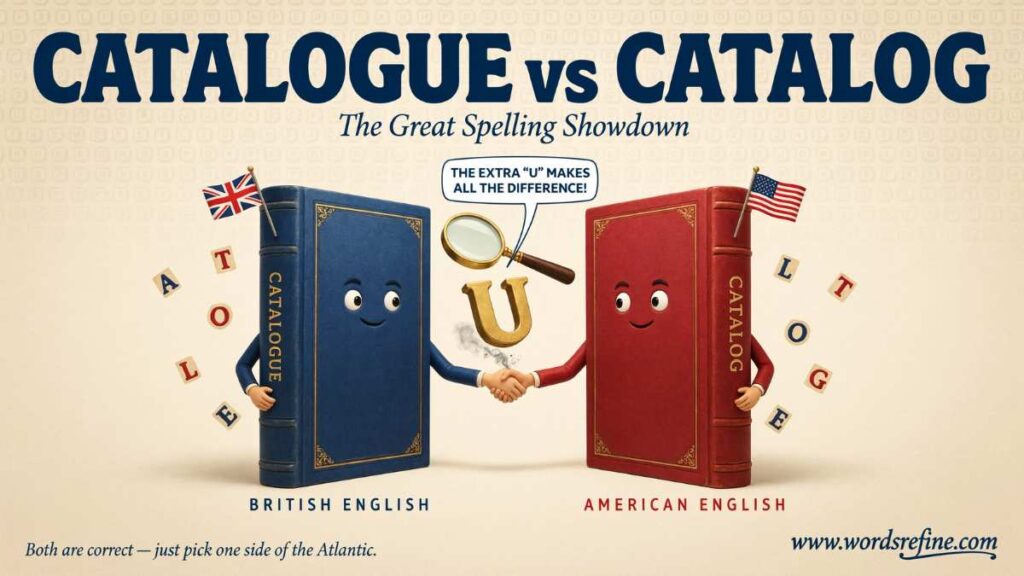
Have you ever wondered why some people write catalog while others insist on catalogue? Are those extra letters necessary, or has someone simply made a spelling mistake? Fortunately, neither form is wrong! The difference between catalogue vs catalog comes down to regional spelling preferences. American English uses catalog, whereas British English generally favors catalogue. Both words have the same meaning and function, so there’s no need to treat them as grammatical rivals. However, choosing the right spelling for your audience matters. Let’s clear up the confusion, explore their meanings, and discover how to use each form correctly in everyday writing.
Quick Answer catalogue vs catalog
The main difference between catalogue vs catalog is regional spelling.
Catalogue is the traditional spelling used in British English. You will commonly see it in the United Kingdom, Australia, New Zealand, and other places that follow British spelling conventions.
Catalog is the preferred spelling in American English. It appears in American books, business documents, online stores, library systems, and everyday writing.
Both words refer to an organized collection of information or items. For example, a furniture store might publish a catalogue vs catalog showing its available products. A library might also maintain a catalogue vs catalog to help visitors find books.
The meaning doesn’t change when you remove the final letters ue. Only the spelling preference changes.
Learn the difference between commonly mixed-up more words
Bicep vs Biceps Meaning Grammar Spelling and Correct Usage?
What Does Catalogue Mean?
Catalogue is a noun or a verb. As a noun, it means an organized list of items, products, books, services, or other information. As a verb, it means to arrange, record, or organize things in a systematic way.
You might encounter a catalogue in a store, library, museum, or educational institution. Its purpose is simple: to help people find and understand what is available.
For example, a clothing company might publish a catalogue featuring its latest collection. Each entry could include a product name, description, price, and photograph.
Here are some examples:
The bookstore released a new catalogue featuring its latest novels.
Our university library has a digital catalogue that students can search online.
The museum created a catalogue of its historical paintings.
The company plans to catalogue every item in its warehouse.
The librarian spent the afternoon cataloguing newly donated books.
In each example, catalogue refers to an organized collection or the process of arranging information.
What Does Catalog Mean?
Catalog has the same meaning as catalogue. The difference is that catalog is the standard American English spelling.
As a noun, it describes an organized list or collection of items. As a verb, it means to record, classify, or arrange information so people can find it easily.
American businesses frequently use the word when describing product collections, online shopping systems, and databases. Libraries also use catalog to describe searchable records of books and other materials.
Consider these examples:
The company mailed its latest catalog to customers.
I found the book through the university’s online catalog.
The store updated its catalog with new furniture designs.
The manager asked employees to catalog all the equipment.
Our team is cataloging thousands of digital photographs.
Notice that the meaning remains the same as catalogue. The American spelling simply drops the final ue.
Learn the difference between tricky grammar more words
Discard vs Disgard Meaning Differences Examples and Correct ?
Catalogue vs Catalog Which Spelling Is Correct?
Both spellings are correct. Your choice depends on the type of English you’re using and the audience you’re addressing.
If you’re writing for an American audience, use catalog. If you’re writing for a British audience, catalogue is generally the better choice.
The same principle applies to other words that have different American and British spellings. For instance, American English uses color, while British English uses colour. Neither spelling is incorrect. They simply follow different conventions.
Here’s how the preference generally differs across English-speaking regions.
| Region | Common spelling |
|---|---|
| United States | Catalog |
| United Kingdom | Catalogue |
| Canada | Catalogue is traditionally common |
| Australia | Catalogue |
| New Zealand | Catalogue |
| Ireland | Catalogue |
These are general preferences rather than absolute rules. Individual companies, publishers, and institutions may follow their own style guides.
For example, a Canadian business might use catalog if it follows an American company’s writing standards. Similarly, an international organization might choose one spelling for all its publications to maintain consistency.
The most important thing is to choose one form and use it consistently throughout your writing.
How Do You Pronounce Catalogue vs Catalog?
Catalogue vs catalog have essentially the same pronunciation. The spelling changes, but the spoken word does not gain an extra syllable.
Both words generally have three syllables, with the stress on the first syllable:
CAT-uh-log
The exact vowel sounds can vary slightly between accents. However, the final ue in catalogue is not pronounced as a separate syllable.
For example, an American speaker might say catalog, while a British speaker might write catalogue. When spoken, the words sound virtually identical.
This is why the difference can be confusing. You can hear the word clearly but still need to decide which spelling suits your writing.
A Simple Way to Remember the Difference
Think about the audience before choosing your spelling.
If you’re writing for readers in the United States, use catalog. If you’re writing for readers in the United Kingdom or another region that generally follows British English, use catalogue.
You don’t need to memorize two different meanings because there aren’t any. Both words describe an organized collection of information or the act of arranging items systematically.
For example, an American online store might call its product list a catalog. A British retailer might call the same collection a catalogue. The products, descriptions, and purpose remain exactly the same.
The spelling changes, but the meaning stays put.
Catalogue vs Catalog Plurals, Word Forms, Uses, and Examples
The difference between catalogue vs catalog doesn’t stop at their basic spelling. Both words also have different forms when used in the past tense, present participle, or plural. These variations follow the same regional spelling patterns.
Understanding these forms will help you write clearly and avoid mixing American and British spellings in the same document.
Learn the difference between confusing word pairs
Expense vs Expenditure Meaning Differences and Correct Usage?
Cataloged vs Catalogued Which One Is Correct?
Both cataloged and catalogued are correct. The choice depends on the type of English you use.
Cataloged is the standard American spelling, while catalogued is generally preferred in British English and other regions that follow British spelling conventions.
Both forms describe something that someone has recorded, listed, or organized.
For example:
The librarian cataloged the new books before placing them on the shelves.
The librarian catalogued the new books before placing them on the shelves.
The meaning stays the same. Only the spelling changes.
Here are a few more examples:
The museum cataloged its collection of ancient photographs.
The museum catalogued its collection of ancient photographs.
We cataloged every product in the warehouse.
We catalogued every product in the warehouse.
The easiest way to remember the difference is to follow the same spelling pattern as catalog and catalogue. American English generally drops the final ue, while British English keeps it.
Cataloging vs Cataloguing Understanding the Difference
Cataloging and cataloguing are both correct spellings. They describe the process of organizing, recording, or classifying information.
American English generally uses cataloging, while British English prefers cataloguing.
For example:
The library is cataloging hundreds of donated books.
The library is cataloguing hundreds of donated books.
The company hired a specialist for cataloging historical documents.
The company hired a specialist for cataloguing historical documents.
Both versions communicate the same idea. The difference is regional, not grammatical.
If you’re writing for an American audience, use cataloging. For British readers, cataloguing is generally the more familiar choice.
Learn the difference between often confused words
Onstage vs On Stage Meaning Differences and Correct Usage ?
What Is the Plural of Catalog and Catalogue?
The plural forms are straightforward. The plural of catalog is catalogs, while the plural of catalogue is catalogues.
Both forms refer to more than one organized collection or list.
For example:
The store publishes several catalogs throughout the year.
The store publishes several catalogues throughout the year.
Our library keeps separate catalogs for books, journals, and digital resources.
Our library keeps separate catalogues for books, journals, and digital resources.
You don’t need to change the meaning when making either word plural. Simply add s to the end.
How Are Catalog and Catalogue Used in Different Industries?
Catalog and catalogue appear in many industries. Although the spelling changes between regions, their purpose remains the same: organizing information so people can find what they need.
Retail and Online Shopping
Retail businesses use catalogs to display products, prices, descriptions, and other shopping details.
A printed catalog might feature furniture, clothing, electronics, or household products. Online stores use digital catalogs to help customers browse products without visiting a physical shop.
For example, a furniture retailer might organize its catalog into sections for sofas, beds, dining tables, and office furniture.
Customers can browse the available products, compare prices, and decide what they want to buy. It’s much easier than wandering through an enormous store and hoping to find the right item.
In British English, the same collection would usually be called a catalogue.
Libraries and Education
Libraries use catalogs to organize information about books, journals, newspapers, research papers, and other resources.
A library catalog helps visitors search for materials by title, author, subject, or publication details.
Imagine entering a large university library without knowing where to find a particular book. Instead of checking every shelf, you can search the library catalog. It tells you whether the book is available and helps you locate it.
Schools and universities also maintain catalogs containing course descriptions, academic programs, admission requirements, and other useful information.
Music and Entertainment
Music companies and streaming platforms use catalogs to organize songs, albums, artists, and recordings.
For example, a record company might maintain a catalog of all the music it owns or distributes. This makes it easier to manage recordings, licensing information, and artist details.
The term music catalog can also refer to an artist’s complete collection of released songs.
In British English, you may see music catalogue instead.
Museums and Historical Collections
Museums use catalogs to record information about paintings, sculptures, photographs, historical objects, and other valuable items.
A museum catalog might include an object’s name, creator, date, materials, historical background, and location.
For example, a museum might catalog hundreds of ancient coins to preserve their records and make them easier to study.
This process also helps researchers understand the history and significance of each object. Without proper records, finding a particular artifact in a large collection could become quite a challenge.
Technology and Databases
Technology companies use catalogs to organize digital information, software, services, and data resources.
An online catalog might contain product descriptions, technical specifications, images, and availability details.
Similarly, a database catalog can store information about database objects, tables, and other resources.
These systems help users find information without searching through countless files manually.
Learn the difference between basic English word mistakes
Temporary vs Temporarily Meaning Difference and Correct Usage?
Catalogue vs Catalog in Everyday Sentences
Both spellings work naturally in everyday writing. The right choice depends on your audience and the spelling convention you follow.
The company sent customers its latest catalog.
The British retailer published a new catalogue for its spring collection.
I searched the online catalog to find a book about American history.
The university updated its course catalogue before the new semester.
The librarian is cataloging recently donated books.
The museum has catalogued its entire collection of historical photographs.
Our store offers a large catalog of home improvement products.
The publisher released a catalogue featuring its latest titles.
These examples show that both spellings fit naturally into ordinary communication. You don’t need to change the sentence structure or meaning when switching between them.
Common Mistakes to Avoid
Although catalogue vs catalog are easy to understand, writers sometimes make mistakes when using them.
One common mistake is mixing American and British spellings in the same document without a good reason. For example, using catalog in one paragraph and cataloguing in another can make your writing look inconsistent.
Another mistake is assuming catalogue is incorrect because it contains extra letters. It isn’t. British English commonly uses this form, while American English generally prefers catalog.
Some writers also confuse the noun and verb forms. As a noun, the word describes an organized collection. As a verb, it describes the process of arranging or recording information.
Consider these examples:
The store published a new catalog. Here, catalog is a noun.
The manager will catalog the products. Here, catalog is a verb.
The library updated its catalogue. Here, catalogue is a noun.
The librarian will catalogue the new books. Here, catalogue is a verb.
The word can serve both purposes, so pay attention to how it functions in the sentence.
Finally, don’t assume the spelling difference changes the pronunciation or meaning. Both versions refer to the same idea and sound almost identical when spoken.
Catalogue vs Catalog Choosing the Right Spelling
Now that you understand the meanings, regional differences, and different forms of catalogue vs catalog, choosing between them should be much easier.
The important thing is to consider your audience and remain consistent. You don’t need to learn two separate meanings or worry that one spelling is incorrect. Both are accepted English words.
When Should You Use Catalog?
Use catalog when writing in American English. It is the standard spelling in the United States and appears in everyday communication, business documents, educational materials, and online stores.
For example, an American retailer might publish a product catalog showing its latest clothing collection. A university might maintain an online catalog containing course descriptions and admission information.
You should also use the related American forms:
Catalogs
Cataloged
Cataloging
For example:
The company updated its product catalog.
The librarian cataloged the donated books.
Our team is cataloging thousands of digital records.
These forms follow the same American spelling convention.
When Should You Use Catalogue?
Use catalogue when writing in British English or following a style guide that prefers British spelling.
This spelling is commonly used in the United Kingdom, Australia, New Zealand, and other regions influenced by British English.
Its related forms include:
Catalogues
Catalogued
Cataloguing
For example:
The store published a new catalogue.
The librarian catalogued the historical documents.
The museum is cataloguing its collection of paintings.
The spelling may look longer, but the meaning remains exactly the same.
What Is the Difference Between a Catalog and a Brochure?
A catalog and a brochure are both used to share information, but they serve different purposes.
A catalog usually contains an organized collection of products, services, books, or other items. It often includes detailed descriptions, prices, photographs, and specifications.
A brochure is generally a short publication designed to introduce, explain, or promote something. It might describe a company, advertise a service, present a destination, or provide information about an event.
For example, a furniture store might publish a catalog containing hundreds of products with prices and descriptions. The same store might create a brochure highlighting its most popular furniture collection.
The main difference is their purpose. A catalog helps readers browse an organized collection, while a brochure usually provides a focused overview or promotional message.
Learn the difference between commonly misused words
Saucey vs Saucy Meaning Differences and Correct Usage ?
Related Words With Similar American and British Spellings
Catalogue vs catalog aren’t the only words that follow different spelling conventions in American and British English.
Several other words use a similar pattern. The differences can seem small, but they are worth understanding if you regularly write for readers in different countries.
| American English | British English |
|---|---|
| Analog | Analogue |
| Dialog | Dialogue |
| Monolog | Monologue |
| Catalog | Catalogue |
For example, American English generally uses dialog, while British English commonly uses dialogue. Similarly, analog is the usual American spelling, whereas analogue is more common in British English.
However, spelling preferences can vary depending on the word, context, and style guide. Some American writers also use dialogue and analogue. These differences aren’t always as straightforward as catalog and catalogue.
A Simple Trick to Remember the Correct Spelling
Here’s an easy way to remember which spelling to use.
Think of the final ue in catalogue as a feature of traditional British spelling. American English usually removes those letters and uses catalog.
If you’re writing for an American company, choose catalog. If you’re preparing a document for a British publisher, catalogue is generally the safer choice.
You can also remember the difference through familiar examples:
An American store publishes a catalog.
A British store publishes a catalogue.
Both stores are doing the same thing. They simply follow different spelling traditions.
Most importantly, don’t switch between the two forms without a reason. Consistency makes your writing look more professional and easier to read.
Learn the difference between everyday English mistakes
Stary vs Starry Meaning Differences Examples and Correct ?
Practice Session Catalogue vs Catalog
1. The American bookstore published a new product ________.
2. The British library updated its online ________.
3. Our university has several course ________ for students.
4. The company plans to ________ all its products before launching its website.
5. The librarian spent the morning ________ newly donated books.
6. The museum has ________ hundreds of historical paintings.
7. American English generally uses the spelling ________.
8. British English generally prefers the spelling ________.
9. The plural of catalog is ________.
10. The plural of catalogue is ________.
11. The company sent its latest ________ to customers in the United States.
12. The British retailer printed a colorful ________ for its customers.
13. The librarian is ________ thousands of books in the university database.
14. The museum carefully ________ its collection of ancient coins.
15. A product ________ usually includes descriptions, photographs, and prices.
16. A library ________ helps visitors locate books and other resources.
17. The American spelling of catalogued is ________.
18. The British spelling of cataloging is ________.
19. A furniture store uses a ________ to display its available products.
20. The museum created a detailed ________ of its historical collection.
21. To ________ something means to organize and record information about it.
22. A ________ is generally shorter and focuses on promoting a product or service.
23. The company is updating its online ________ to include new products.
24. The librarian has finished ________ the latest collection of books.
25. Both catalog and catalogue have the same basic ________.
Answers
1. Catalog
2. Catalogue
3. Catalogues
4. Catalog
5. Cataloging
6. Catalogued
7. Catalog
8. Catalogue
9. Catalogs
10. Catalogues
11. Catalog
12. Catalogue
13. Cataloging
14. Catalogued
15. Catalog
16. Catalog
17. Cataloged
18. Cataloguing
19. Catalog
20. Catalogue
21. Catalog
22. Brochure
23. Catalog
24. Cataloging
25. Meaning
Here’s a trusted source for clear more words Comparison:
FAQs
Can you still get printed catalogues?
Yes, printed catalogues are still available. Many retailers, furniture stores, travel companies, and specialty businesses produce them for customers who enjoy browsing physical pages. Some companies also offer digital versions that customers can download and print at home.
What are the three types of catalogues?
Three common types are product catalogues, library catalogues, and exhibition catalogues. Product catalogues display items for sale, library catalogues organize books and other resources, and exhibition catalogues provide details about artwork, historical objects, and displayed collections.
Should I use catalog or catalogue?
Use catalog when writing in American English and catalogue when following British English conventions. Both spellings are correct. Choose the form that suits your audience and use it consistently throughout your writing.
What is another word for cataloging?
Depending on the context, alternatives include organizing, classifying, documenting, listing, and recording. For example, a librarian might describe cataloging new books as organizing and recording them in the library’s system.
What is meant by a catalog?
A catalog is an organized collection of information about products, books, services, or other items. It helps people browse available options, compare details, and find specific information without searching through unrelated material.
What’s another name for catalog?
Other terms for a catalog include directory, inventory, register, listing, and collection. However, their meanings can differ slightly. A directory helps people locate information, while an inventory usually records items owned or managed by a person or business.
Is “catalog” spelled correctly?
Yes, catalog is the correct American English spelling. Catalogue is also correct and is generally preferred in British English. Neither form is a spelling mistake.
What were the old catalogues called?
Older printed catalogues were often called mail-order catalogues, trade catalogues, or sales catalogues, depending on their purpose. Mail-order catalogues became especially popular because customers could browse products, choose what they wanted, and place orders without visiting a store.
What is an example of a catalog?
A furniture store’s product catalog is a common example. It might feature photographs of sofas, tables, beds, and chairs, along with prices, descriptions, and available sizes. Customers can browse the collection and compare options before making a purchase.
What does it mean to catalog something?
To catalog something means to record, describe, and organize it so people can identify and locate it easily. For example, a museum might catalog its paintings by recording each artwork’s title, artist, creation date, and historical background.
Is a catalogue a brochure?
No, they aren’t exactly the same. A catalogue presents an organized collection of products, services, or other items, often with detailed descriptions and prices. A brochure is usually shorter and focuses on introducing or promoting a particular business, product, service, or event. Both provide information, but they serve different purposes.
Learn the difference between more words people mix up
Scrapped vs Scraped Differences Examples and Correct Usage?
Conclusion
The difference between catalogue vs catalog may seem small, but those extra letters can easily confuse writers. Fortunately, the rule is simple: both spellings are correct, and neither changes the meaning.
Use catalog when writing in American English and catalogue when following British English conventions. The same pattern applies to their related forms, including catalogs and catalogues, cataloged and catalogued, and cataloging and cataloguing.
The most common mistake is assuming that one spelling is incorrect or switching between the two without a clear reason. Always consider your audience and keep your spelling consistent.
So, the next time you see catalogue vs catalog, don’t let those extra letters cause a spelling crisis. Just remember where you’re writing, choose the appropriate form, and let your words do the talking.

Diora AJS she is an experienced blogger and passionate English language enthusiast at Words Refine. With a keen eye for language and a love for clear communication, she writes practical content about grammar, word meanings, usage, and commonly confused terms. Her goal is to make English easier to understand through clear explanations and relatable examples, helping readers write accurately and communicate with confidence.