
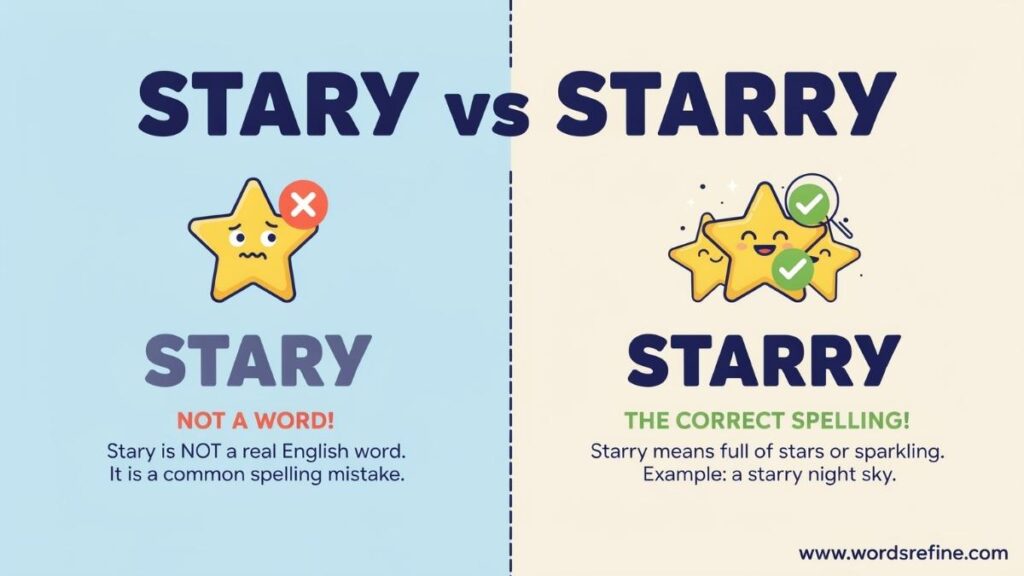
The difference between stary vs starry may seem small, but one missing letter can turn a simple spelling choice into a common writing mistake. Have you ever wondered whether to write “stary night” or “starry night”? You’re not alone! These spellings can cause confusion, especially when you’re typing quickly. Fortunately, the correct choice is easy to remember. “Starry” is the standard English word for something filled with stars or resembling them. “Stary” isn’t the standard spelling for this meaning. In this article, you’ll explore their meanings, learn through practical examples, and discover simple ways to avoid this spelling mistake.
Stary vs Starry The Quick Answer
Starry is the standard English spelling when you want to describe something full of stars, illuminated by stars, or resembling a star. Stary is generally an incorrect spelling when used with this meaning.
For example, you might write, “We watched the stars beneath a starry vs sky.” However, writing “We watched the stars beneath a stary sky” would be incorrect because the adjective is missing an r.
The same rule applies to other expressions. A starry night is a night when stars are visible in the sky. A starry pattern is a design decorated with stars. Likewise, starry eyes can describe an expression filled with wonder or excitement.
In each case, starry is the appropriate spelling.
Nevertheless, stary has a limited, documented use as an alternative spelling of starey, an adjective meaning characterized by staring. This usage is different from the familiar meaning associated with stars. The spelling can also appear in names and foreign-language contexts.
Therefore, the key is to consider what you want to say. If you’re describing a sky full of stars, a sparkling night, or something shaped like a star, choose starry.
What Does Starry Mean?
Starry is an adjective that describes something full of stars, illuminated by stars, or resembling a star. The word often appears in descriptions of nighttime scenery, artwork, decorations, and dreamy expressions.
Imagine sitting outside on a clear evening. Above you, bright stars cover the dark sky. You could describe the scene as a starry sky because the adjective immediately gives readers a picture of what you’re seeing.
The word also adds atmosphere to a sentence. Instead of saying that two people walked outside at night, you might say they walked beneath a starry sky. That small detail makes the scene more vivid and memorable.
However, starry doesn’t always refer to actual stars. Depending on the context, it can describe star-shaped decorations or a person’s dreamy expression. It can also carry an informal meaning associated with expecting to receive special treatment like a celebrity.
Learn the difference between confusing more English words
Simular vs Similar Which One Is Correct?
Starry Meaning in Everyday English
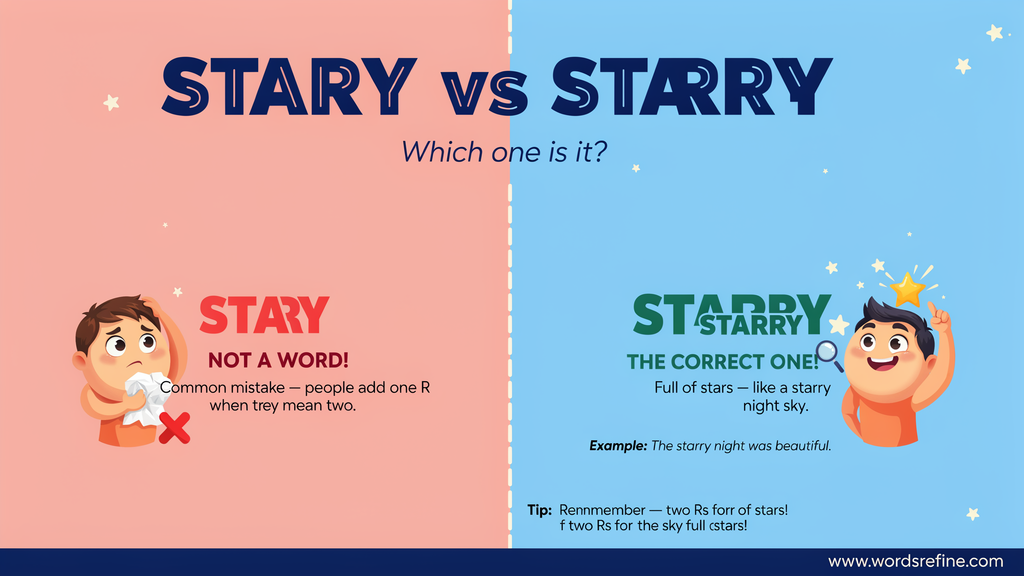
In everyday English, starry most often describes a sky filled with visible stars. It can also refer to something decorated with star shapes or something that looks as though it shines like a star.
Consider these examples.
1A starry sky describes a sky in which many stars are visible.
2A starry night refers to a night when stars shine in the sky.
3A starry pattern describes a design covered with star shapes.
4A starry expression may suggest wonder, excitement, or dreamy optimism.
Although these expressions share the same adjective, their meanings depend on the words around it.
For example, a starry ceiling doesn’t mean that the ceiling contains real celestial objects. It might simply have painted stars or small lights that resemble them. Similarly, a starry expression describes someone’s appearance or mood rather than the actual presence of stars.
This flexibility makes starry a useful descriptive word. It helps writers communicate both literal appearances and figurative ideas.
What Does Starry Sky Mean?
A starry sky is a sky in which stars are visible. People often use the expression when describing stargazing, camping trips, quiet evenings, or places far from bright city lights.
For example, consider this sentence: “We drove into the countryside and watched the bright stars scattered across the starry sky.”
The phrase helps readers imagine a dark background filled with points of light. It also creates a sense of space and wonder without requiring a long explanation.
Interestingly, not every starry sky looks the same. In places with little artificial light, observers can often see many more stars than they can in brightly lit cities. Clouds can hide stars, while light pollution can make faint ones difficult to see.
A starry sky is a descriptive expression rather than a scientific measurement. It doesn’t specify how many stars must be visible before the sky qualifies as starry.
Learn the difference between commonly mixed-up more words
Loosing vs Losing Which Is Correct? Meaning, Spelling, and Usage
What Does Starry Night Mean?
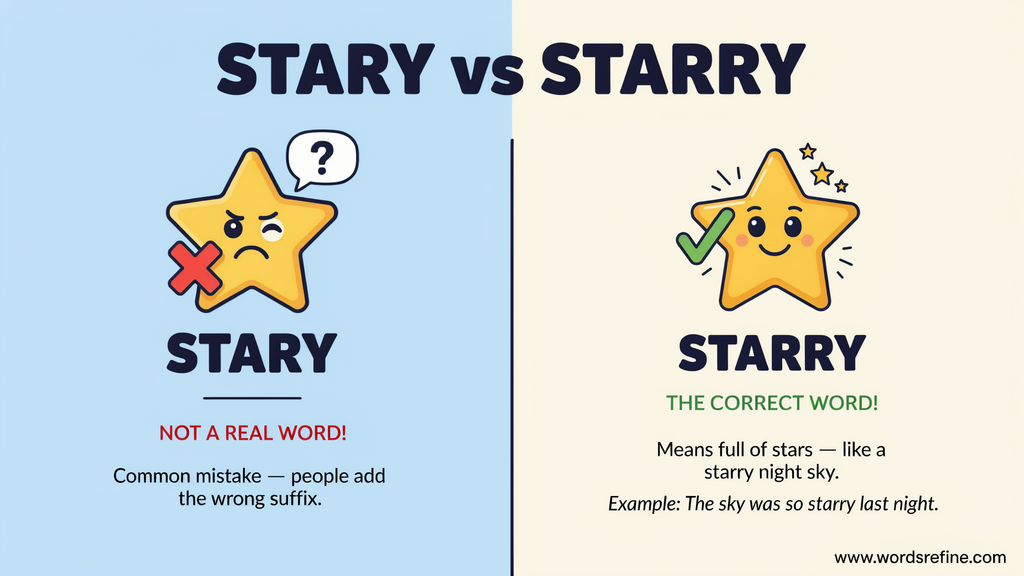
A starry night is a night when stars are visible in the sky. Writers frequently use this expression to create a peaceful, romantic, mysterious, or dreamlike atmosphere.
For example, “They sat beside the lake on a quiet, starry night.”
The adjective gives the reader a clearer picture of the setting. Rather than simply mentioning that the characters sat beside a lake after dark, the sentence suggests that they could see stars overhead.
The phrase also appears in art and popular culture. Vincent van Gogh’s famous painting The Starry Night depicts a swirling night sky above a village. Its title uses the standard spelling of starry.
Although the phrase often appears in poetic descriptions, you can use it in ordinary conversation as well. You might describe a camping trip, a romantic evening, or a memorable view from your backyard as a starry night.
What Does Stary Mean?
Stary is generally a spelling mistake when someone intends to describe a sky full of stars. In standard English, the correct word is starry.
However, the distinction isn’t quite as simple as saying that stary never exists. The spelling has limited documented usage as an alternative form of starey, meaning characterized by staring. It may also appear in personal names or in other languages.
These uses don’t make stary an acceptable substitute for starry in ordinary descriptions of the night sky.
For example, “The children admired the stary sky” contains a spelling error if the writer means that the sky is full of stars. The correct sentence is “The children admired the starry sky.”
By contrast, an author might deliberately use stary in a literary passage where it means starey. In that situation, the writer isn’t necessarily making a mistake.
The surrounding context matters. A spelling that looks unusual in one sentence might have a specific purpose in another.
Is Stary a Word?
The answer depends on how the word is being used.
Stary has a limited, documented place in English as an alternative spelling of starey. It can also appear as a surname, a proper name, or a word in another language. However, it isn’t the standard adjective used to describe something full of stars.
This distinction is important because unfamiliar words aren’t always misspellings. English contains rare forms, regional expressions, historical spellings, and specialized terms. At the same time, recognizing that a spelling exists somewhere doesn’t mean it’s appropriate in every situation.
For ordinary writing, the choice remains straightforward. If you’re describing a star-filled sky, use starry.
Learn the difference between tricky grammar more words
Inclusivity vs Inclusiveness Which One Is Correct?
What Does Stary Mean in Other Languages?
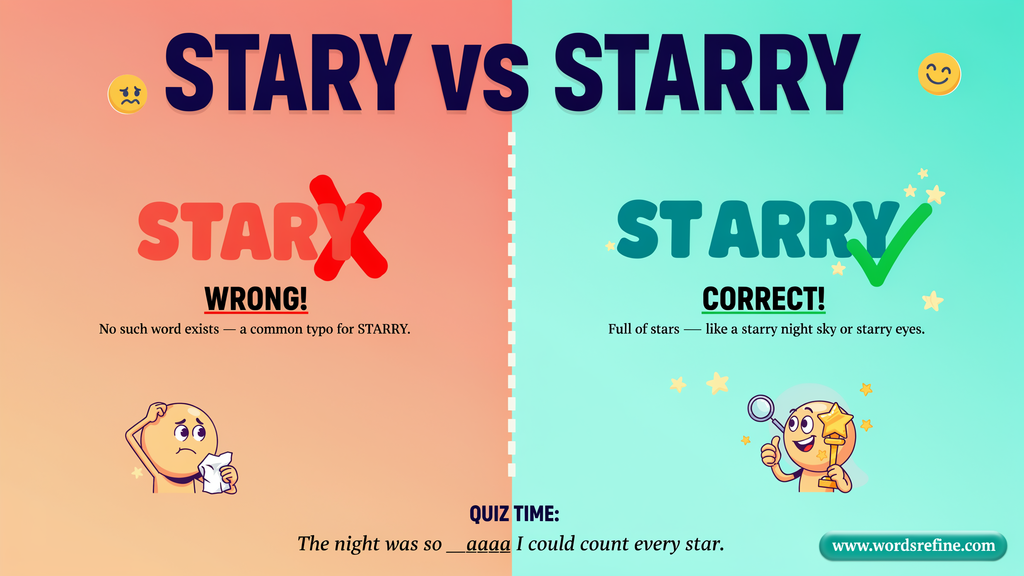
The spelling stary also appears in languages such as Polish and Czech, where it can mean old. In Czech, the form is written starý, with an accent mark over the y.
These meanings have nothing to do with the English adjective starry. When writing in another language, you should follow that language’s spelling and grammar rules. When writing in English about a sky full of stars, however, starry remains the correct choice.
This is a useful reminder that words can look similar across languages without sharing the same meaning or grammatical role.
Stary vs Starry Understanding the Difference
The difference between stary vs starry comes down to spelling, meaning, and context.
Starry is the standard English adjective used to describe something full of stars or resembling a star. Stary has limited alternative usage, but it doesn’t carry the same ordinary meaning.
| Feature | Starry | Stary |
|---|---|---|
| Standard spelling for a sky full of stars | Yes | No |
| Describes something resembling a star | Yes | Not with this intended meaning |
| Common in everyday English | Yes | Limited or specialized usage |
| Can appear in a name or another language | Yes | Yes |
| Correct in the phrase “a starry night” | Yes | No |
As the comparison shows, the two spellings aren’t interchangeable when you’re talking about stars.
The easiest way to avoid confusion is to identify the meaning first. If the sentence describes stars in the sky, a star-shaped design, or a starry-eyed expression, use starry.
Learn the difference between confusing word pairs
Labelled vs Labeled Which one Is Correct?
Why Do People Confuse Stary vs Starry?
The confusion usually comes from a small spelling difference stary vs starry .Both words share the same basic letters, and the missing r in stary is easy to overlook.
Typing habits also play a role. When people write quickly, they sometimes leave out repeated letters. Because stary looks similar to starry, the error may go unnoticed during a quick reread.
The Missing Letter R
The clearest difference is the extra r in starry.
The word star contains four letters: s, t, a, and r. The adjective starry contains five letters: s, t, a, r, and r, followed by y. By contrast, stary contains only one r.
That small difference explains the common mistake.
For example, “It was a beautiful stary night” is incorrect when the writer means a night filled with stars. Changing stary to starry fixes the sentence.
This is why proofreading matters. A word can look familiar even when it contains a spelling error.
Pronunciation and Spelling Habits
In American English, starry has two syllables, with the stress on the first syllable. Its pronunciation is commonly represented as /ˈstɑːr.i/ in dictionary notation.
The word sounds similar to the beginning of star, followed by the ending heard in words such as happy. However, the pronunciation doesn’t clearly tell you that the spelling contains two r’s.
As a result, someone might pronounce the word correctly but still write it incorrectly. This happens with many English words because pronunciation and spelling don’t always match perfectly.
The best approach is to learn the written form alongside its meaning. Once you become familiar with starry, the double r will feel more natural.
Typing Errors and Autocorrect
Digital writing makes spelling mistakes easy to produce. A person typing quickly might leave out a repeated consonant without noticing it. An autocorrect tool may catch the error, but it isn’t wise to rely on software alone.
For instance, a spell-checker might not flag every unusual word, especially when a spelling has a legitimate use in another context. Therefore, you should always check whether the word fits the sentence.
If you’ve written “We admired the stary sky,” stop and consider what you want to describe. Since the sentence refers to stars, the correct word is starry.
A quick reread can prevent a minor typo from appearing in an email, school assignment, article, or professional document.
How to Spell Starry Correctly
The correct spelling is starry: s-t-a-r-r-y.
The easiest way to remember it is to connect the word to its root, star. When the adjective is formed, the standard spelling includes two consecutive r’s before the final y.
This is a word-specific spelling pattern worth remembering. Although English uses several rules for forming adjectives, not every word follows the same pattern.
How Is the Word Starry Formed?
Starry is formed from the noun star and the suffix -y. In English, this suffix often helps create adjectives that describe a quality or characteristic.
For example, cloud becomes cloudy, rain becomes rainy, and wind becomes windy. These adjectives describe conditions associated with clouds, rain, and wind.
Star becomes starry, an adjective associated with stars.
The spelling isn’t identical across all these examples. Cloudy and rainy retain their usual final consonants, while starry has a double r. Therefore, you shouldn’t assume that adding y always requires doubling the final consonant.
Instead, learn the established spelling of common words and check a dictionary when you’re unsure.
Learn the difference between often confused words
Flyer vs Flier Which one Is Correct?
Why Is Starry Spelled With Two R’s?
The standard spelling of starry retains the r from star and uses a doubled r before the final y.
Although English has rules about consonant doubling, the addition of y doesn’t automatically cause a final consonant to double in every word. Starry is best learned as the established spelling of this adjective.
For example, cloud becomes cloudy rather than clouddy. Rain becomes rainy rather than rainny. However, star becomes starry.
Remembering these word forms will help you avoid applying one spelling pattern too broadly.
The most useful rule is simple: when describing something full of stars, write starry with two r’s.
Correct and Incorrect Examples of Stary vs Starry
Examples make the difference stary vs starry easier to recognize because they show how the word works in real sentences.
Starry Examples in Sentences
“We drove beyond the city to admire the starry sky.”
The adjective describes a sky filled with visible stars.
“The campers slept beneath a starry canopy.”
Here, the sentence creates an image of stars shining overhead.
“They walked along the beach on a warm, starry evening.”
The word helps establish the mood and appearance of the scene.
“The children painted a starry pattern across the bedroom ceiling.”
In this example, the pattern contains star shapes rather than actual stars.
“The author described a peaceful village beneath a starry night sky.”
The adjective makes the setting more vivid and helps readers picture the scene.
“Silver decorations created a starry effect across the dark fabric.”
Here, starry describes an appearance created by decorative shapes or reflective details.
These examples show that starry can describe both literal stars and objects that resemble them. The meaning depends on the noun and the surrounding sentence.
Common Stary Spelling Mistakes
Consider the following incorrect sentences and their corrections.
Incorrect: We sat beneath a stary sky.
Correct: We sat beneath a starry sky.
Incorrect: It was a beautiful stary night.
Correct: It was a beautiful starry night.
Incorrect: The children drew a stary pattern.
Correct: The children drew a starry pattern.
Incorrect: She admired the stary heavens.
Correct: She admired the starry heavens.
In each example, the problem is the same. The writer has left out one r from the adjective.
Once you recognize the pattern, correcting these mistakes becomes much easier.
When Is Stary Appropriate?
There are limited situations in which stary may be intentional rather than a typo.
An author might use it as an alternative spelling of starey in a literary passage. It may also appear in a surname, a proper name, or a quotation written in another language.
These situations differ from ordinary spelling mistakes because the writer has a specific reason for using that form.
However, if you’re writing a general article, an email, a school assignment, or a description of the night sky, use starry. Don’t choose stary simply because it looks shorter or seems easier to type.
Starry Night Understanding the Phrase and Its Uses
The phrase starry night is a familiar way to describe a night when stars are visible. It also helps writers create a mood without using a long list of descriptive words.
For example, “We walked beneath a starry night sky” gives readers an immediate visual impression. They can imagine the dark sky and the points of light scattered across it.
What Makes a Night Starry?
Several conditions affect how many stars people can see. Cloud cover may hide them, while artificial lighting can make faint stars difficult to distinguish. In places with darker skies, observers can often see more stars than they can in brightly lit urban areas.
Atmospheric conditions and the observer’s location also affect the view. Even so, the phrase starry night doesn’t require a particular number of visible stars. It simply describes a night in which stars can be seen.
Starry Light and Starry Skies in Descriptive Writing
Writers sometimes use expressions such as starry light and starry vs skies to create a peaceful or dreamlike atmosphere.
Consider this sentence: “Soft starlight fell across the garden beneath the starry sky.”
Here, starlight is a noun referring to light from stars, while starry is an adjective describing the sky. Although the words share the same root, they perform different grammatical jobs.
Similarly, a starry ceiling might have painted stars or small decorative lights. The adjective describes the appearance of the ceiling rather than suggesting that actual stars are inside the room.
These details make starry a useful word in storytelling, poetry, and everyday descriptions.
Starry Eyes and the Meaning of Starry-Eyed
The word starry also appears in expressions about people, especially when writers want to convey wonder, excitement, or idealism.
However, starry eyes and starry-eyed don’t always mean exactly the same thing.
Can Starry Describe a Person’s Eyes?
Yes. A writer can describe someone’s eyes as starry when they appear bright or expressive with wonder.
For example, “The child looked at the decorated tree with starry eyes.”
The sentence suggests excitement and amazement. It doesn’t mean that the child’s eyes literally contain stars.
The expression is figurative, and its meaning depends on the context. Sparkling eyes can convey a similar impression, although sparkling often emphasizes brightness or liveliness rather than dreamy wonder.
What Does Starry-Eyed Mean?
Starry-eyed commonly describes someone who is idealistic, hopeful, or overly optimistic. A starry-eyed person may focus on an appealing possibility without fully considering the practical challenges.
For example, “He was starry-eyed about starting a business and hadn’t yet considered the costs.”
The sentence suggests enthusiasm mixed with a lack of practical planning.
People can be starry-eyed about a career, a relationship, a creative project, or a future opportunity. The expression often implies that their hopes may be unrealistic.
Notice the hyphen in starry-eyed. It connects the two words to form a compound adjective, as in “a starry-eyed dreamer.”
Starry Synonyms and Words With Similar Meanings
Choosing a synonym can make your writing more precise. However, no single alternative replaces starry in every situation. Some words describe the presence of stars, while others emphasize brightness, beauty, or a particular visual effect.
Star-filled is one of the closest alternatives when describing a sky containing many visible stars. Star-studded works well for something dotted or decorated with stars. Celestial refers more broadly to the sky or heavens, while sparkling and glittering describe brightness rather than the presence of stars themselves.
For example, you could write, “We watched the star-filled sky until midnight.” You could also say, “The ceiling had a star-studded design.”
In a different context, “The glittering decorations reflected the light” might be more precise than using starry.
The best word depends on the image you want to create. If the sentence specifically describes a sky full of stars, starry remains a clear and natural choice.
Does American or British English Affect Stary vs Starry?
No. American and British English both use starry when describing something full of stars or resembling a star.
The pronunciation may vary slightly by accent, but the spelling remains the same. You don’t need to choose stary for American English or starry for British English.
English does have genuine regional spelling differences. For example, American English generally uses color, while British English uses colour. However, stary versus starry isn’t one of those differences.
Therefore, the correct choice doesn’t depend on which variety of English you’re using. If you’re describing a starry sky, write starry in both American and British English.
Learn the difference between commonly misused words
Any time vs anytime meaning Difference with Examples ?
How to Check the Correct Spelling
When you’re unsure whether to write stary vs starry, start by identifying the meaning you want to express.
If the sentence describes a sky filled with stars, a star-shaped design, or a dreamy expression, starry is the appropriate choice.
A reliable dictionary can confirm the spelling, definition, and pronunciation. Spell-checking tools can also help, although they may not recognize every unusual word or specialized use.
Context matters just as much. If you’re quoting a name or writing in another language, the spelling may be intentional. However, if you’re writing an ordinary English sentence about stars, the standard spelling is starry.
Finally, pay attention to repeated letters when proofreading. They’re easy to overlook, especially when you’re typing quickly. A short review can catch a missing r before it reaches your reader.
Learn the difference between everyday English mistakes
Cancell vs Cancel Which one Is Correct?
Practice Session Stary vs Starry
- We spent the evening gazing at the ______ sky.
- The children admired the ______ night from their campsite.
- Millions of stars sparkled in the ______ heavens.
- They enjoyed a romantic dinner beneath a ______ sky.
- The photographer captured a beautiful ______ landscape.
- We could see the Milky Way on that clear, ______ night.
- The travelers rested beneath a ______ sky in the desert.
- The painting showed a village under a ______ sky.
- She looked up at the ______ sky and made a wish.
- The mountain offered a breathtaking view of the ______ heavens.
- A ______ sky made the evening feel magical.
- The telescope revealed distant objects in the ______ sky.
- We took photographs of the ______ sky after sunset.
- The children drew a ______ night scene for their art project.
- The beach looked peaceful beneath the ______ sky.
- The poem describes a quiet evening under a ______ sky.
- They lay on the grass and admired the ______ heavens.
- The artist painted a ______ background filled with tiny points of light.
- We enjoyed the beauty of the ______ night.
- The travelers stopped to admire the ______ sky above the hills.
- The campsite offered a wonderful view of the ______ heavens.
- He wrote a poem about a beautiful ______ night.
- The astronomer studied distant galaxies in the ______ sky.
- The children imagined stories while watching the stars in the ______ sky.
- Remember to spell “______” with two r’s when describing a sky full of stars.
Answers
- Starry
- Starry
- Starry
- Starry
- Starry
- Starry
- Starry
- Starry
- Starry
- Starry
- Starry
- Starry
- Starry
- Starry
- Starry
- Starry
- Starry
- Starry
- Starry
- Starry
- Starry
- Starry
- Starry
- Starry
- Starry
Here’s a trusted source for clear more words Comparison:
FAQs
Is “stary” a real word?
“Stary” appears in limited English usage, sometimes as a variant of “starey.” However, it isn’t the standard spelling for something related to stars. Use “starry” when describing a sky filled with stars.
How do you spell “starry” as in “starry night”?
The correct spelling is “starry,” with two r’s. For example, “We gazed at the stars on a clear, starry night.”
What does “stary” mean?
“Stary” has limited use as a variant of “starey,” which describes someone or something characterized by staring. It isn’t the correct spelling when you mean full of stars.
What does “starry” mean?
“Starry” is an adjective that describes something full of stars, illuminated by stars, or resembling stars. For example, “The children watched the starry sky from their backyard.”
Is “starry” a noun or an adjective?
“Starry” is an adjective because it describes a person, place, or thing. In “a starry sky,” the word “starry” describes the sky.
What is another word for “starry”?
Depending on the context, you can use “star-filled,” “star-studded,” “stellar,” or “celestial.” For example, “a star-filled sky” conveys the same basic idea as “a starry sky.”
What is the adjective for “star”?
“Starry” is the most common adjective formed from “star.” “Stellar” is another option, especially in astronomy or when describing something exceptional.
Is it “starry night” vs “stary night”?
“Starry night” is correct when describing a night filled with stars. “Stary night” is a spelling mistake in standard English.
Why does “starry” have two r’s?
The word “starry” combines “star” with the suffix “-y,” doubling the final r in the standard spelling. Remember the two r’s whenever you describe a star-filled sky.
How do you pronounce “starry”?
“Starry” has two syllables, with the stress on the first syllable. Its vowel sound can vary slightly between American and British English.
Is “stary” a valid Scrabble word?
Scrabble validity depends on the official word list used in your game. Since “stary” is not the standard spelling for the usual star-related meaning, check your edition’s dictionary before playing it.
Is “starry” a valid Scrabble word?
“Starry” is a standard English adjective. However, its eligibility in a Scrabble game depends on the official word list your edition uses, so check that list to confirm.
Learn the difference between more words people mix up
Compair vs Compare Which One Is Correct?
Conclusion
When choosing between stary vs starry remember that “starry” is the correct spelling for a sky filled with stars or anything that resembles them. Although “stary” appears in limited usage, it isn’t the standard choice for describing a star-filled night.
Fortunately, this spelling mistake is easy to avoid. Just remember the two r’s in “starry,” and you’ll be ready to describe a beautiful night sky with confidence. After all, the stars have enough sparkle of their own. Your spelling doesn’t need to lose any along the way!

Diora AJS she is an experienced blogger and passionate English language enthusiast at Words Refine. With a keen eye for language and a love for clear communication, she writes practical content about grammar, word meanings, usage, and commonly confused terms. Her goal is to make English easier to understand through clear explanations and relatable examples, helping readers write accurately and communicate with confidence.