
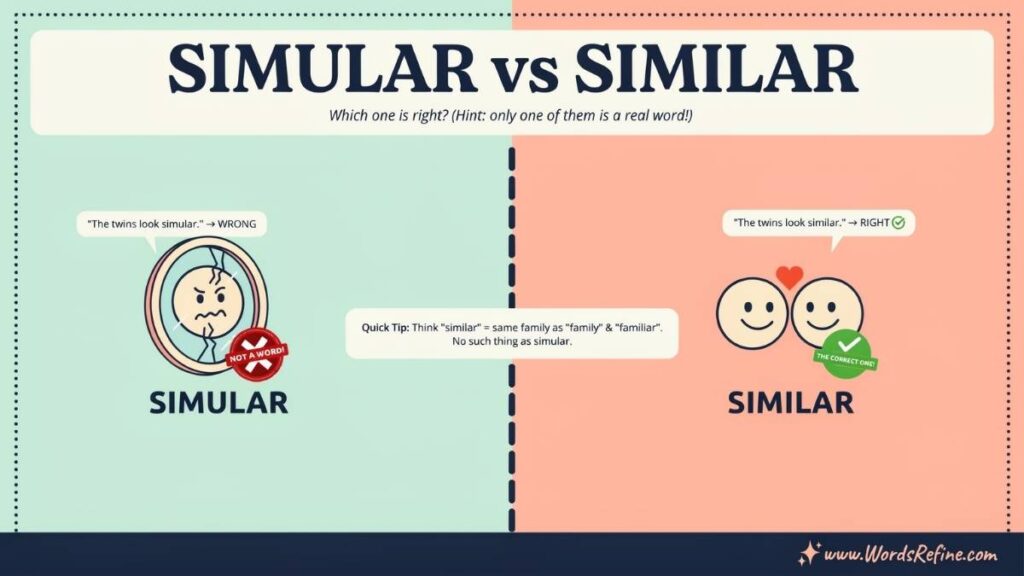
Have you ever typed “simular” and paused, wondering whether your spelling had suddenly gone rogue? You are not alone. The confusion between simular vs similar is surprisingly common because the words look and sound almost alike. However, when you mean “alike” or “having common features,” “similar” is the standard spelling in modern English. In this guide, we’ll untangle the simular vs similar confusion without turning grammar into a snooze fest. You’ll discover the correct spelling, meanings, pronunciation, usage, and common mistakes. By the end, you’ll know exactly when to use “similar” and why “simular” can send your sentence in the wrong direction.
Simular vs Similar Quick Answer
For modern English, similar is the correct spelling when you mean “alike,” “resembling,” or “having common features.”
For example, you might write:
The two houses have similar designs.
Sarah and Mia have similar interests.
These products have similar features.
Your answer is similar to mine.
In each example, similar means that two or more things share certain characteristics without necessarily being exactly the same.
The short answer is simple: similar is the standard modern English word. Simular is a rare and archaic word with historical meanings that are different from the everyday meaning of similar.
What Does Similar Mean?
The word similar means “alike in some way” or “having qualities or characteristics in common.”
It doesn’t mean that two things are completely identical. Instead, it shows that they share one or more noticeable features.
For example, consider this sentence:
My new phone is similar to my old one.
This sentence doesn’t mean the two phones are exactly the same. They might have similar screens, features, or designs while still having important differences.
The similar meaning in English is therefore connected to resemblance, likeness, and shared characteristics.
Similar as an Adjective
Similar is primarily an adjective. It describes a person, thing, idea, or situation that resembles another.
For example:
The twins have similar personalities.
We faced similar problems last year.
The two paintings use similar colors.
Their opinions are similar in several ways.
Because similar describes nouns, it fits naturally into everyday English grammar.
Similar Does Not Mean Identical
This distinction matters.
If two things are similar, they have something in common. If they are identical, they are exactly alike in every relevant detail.
For example:
The two shirts are similar.
They might have the same color and style but different sizes.
Now compare that with:
The two copies are identical.
Here, there is no meaningful difference between them.
A useful way to remember the difference is simple. Similar means alike in some ways, while identical means exactly the same.
What Does Simular Mean?
Here’s where the spelling mystery becomes more interesting.
Simular is not simply a modern spelling mistake invented by autocorrect. Historical dictionaries record it as a real English word. However, its historical meanings differ from the modern meaning of similar.
The simular meaning has been associated with ideas such as false, counterfeit, sham, or deceptive. It could also refer to a person who pretended to be something they were not.
In other words, simular has a historical connection to imitation or false appearance, but it isn’t the standard modern word for “alike.”
This distinction matters because someone searching for the simular definition might find historical dictionary entries and assume that “simular” is simply an alternative spelling of “similar.”
It isn’t.
Simular as an Archaic Word
Historical English contains many words that have disappeared from ordinary conversation. Simular belongs largely to that category.
An archaic word is a word that was once used but is now rarely used in ordinary modern English.
Think of it as a linguistic antique. It may still appear in dictionaries or historical texts, but you probably shouldn’t bring it into an everyday email unless you’re intentionally writing in a historical style.
So, if you’re wondering is simular a word, the answer is technically yes. If you’re wondering whether you should use it instead of similar in normal modern English, the answer is no.
Learn the difference between confusing more English words
Socialise vs Socialize Which one Is Correct ?
Is Simular a Word?
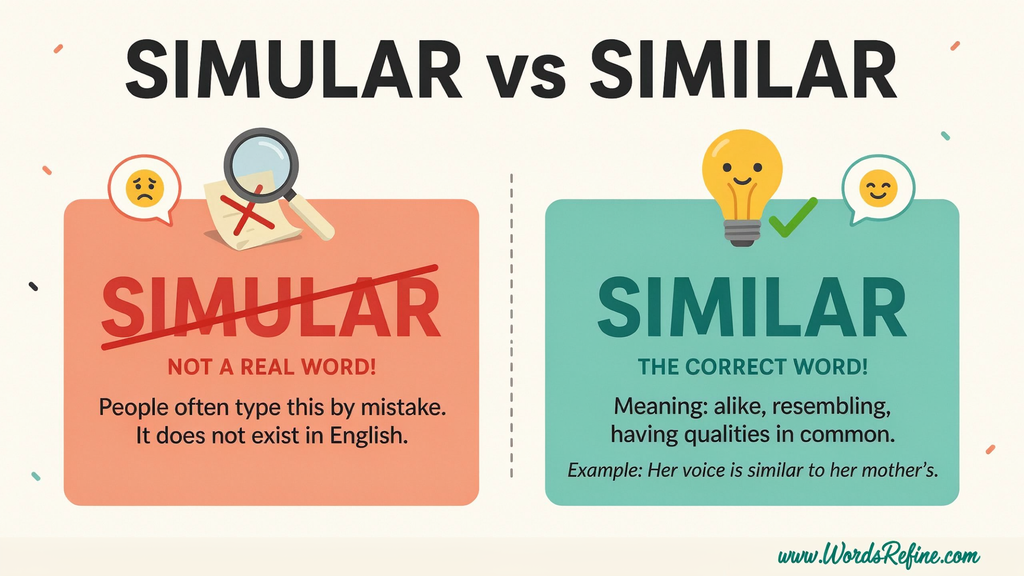
Yes, simular is a word, but that answer needs an important qualification.
Modern English speakers generally use similar when they mean “alike” or “resembling.” Simular is rare and mainly appears in historical or archaic contexts.
This creates a classic dictionary trap.
You look up a strange spelling, find it in a dictionary, and think, “Aha! I was right all along.”
Not quite.
A word can exist without being the appropriate word for the meaning you want.
For example, simular may appear in historical dictionaries, but that doesn’t make it the standard modern spelling of similar.
Is Simular a Real English Word?
Yes, historically.
Is Simular the Modern Spelling of Similar?
No.
Can You Use Simular in Ordinary Modern Writing?
Generally, no. Use similar when you mean “alike” or “resembling.”
That small distinction can save you from a surprisingly large spelling headache.
What’s the Difference?
The main difference between simular vs similar involves both meaning and usage.
Similar is a common modern adjective meaning alike or resembling.
Simular is a rare, archaic term historically connected with false or counterfeit appearances and pretenders.
The distinction becomes clearer when you look at how each word functions.
Similar belongs to standard modern English and appears frequently in everyday, academic, professional, and informal writing.
Simular belongs mainly to historical vocabulary. You may encounter it when reading older texts or researching the history of English, but it isn’t the normal choice for modern communication.
Therefore, if you’re comparing similar vs simular, don’t treat them as two interchangeable spellings of one modern word.
They have different histories and different uses.
Why Are They Confused?
The similar vs simular confusion mostly comes from pronunciation and familiar spelling patterns.
When people hear similar, the final syllables can sound less obvious than the written spelling suggests. That makes it tempting to spell the word according to how it sounds.
You might hear something like “SIM-uh-ler” and instinctively write “simular.”
English spelling, unfortunately, doesn’t always work like a perfect sound-to-letter machine. If only it did, spelling tests would be much shorter.
Pronunciation Can Mislead You
The similar pronunciation varies slightly between American and British English, but the spelling remains similar.
In many American English accents, the word sounds approximately like “SIM-uh-ler.”
In many British English accents, it may sound closer to “SIM-ih-luh.”
The exact pronunciation can vary depending on the speaker and accent. However, neither pronunciation changes the spelling.
The key point is simple: pronunciation may vary, but the standard modern spelling is similar.
The “-ar” Spelling Trap
Many English words end in -ar, so your brain may automatically expect that ending.
Words such as familiar, popular, regular, and particular can make simular look visually believable.
However, similar follows its own spelling pattern.
The correct spelling is:
s-i-m-i-l-a-r
A useful way to remember it is to focus on the i after “sim.”
Think:
similar
not:
simular
That extra i is small, but it makes all the difference.
Which Should You Use?
For modern writing, choose similar.
Whether you’re writing a school assignment, business email, blog post, academic paper, social media caption, or everyday message, similar is the standard choice when you mean “alike.”
For example:
The two designs are similar.
Writing “The two designs are simular” would be incorrect for the intended modern meaning.
The second sentence uses a historical word where modern English requires similar.
That’s why simular vs similar spelling questions are really questions about both spelling and word choice.
You aren’t merely choosing between two accepted spellings of one modern word. You’re choosing between a common modern word and a rare historical term.
Learn the difference between commonly mixed-up more words
Instalments vs Installments Which one Is Correct?
Similar Correct Spelling in American English
The similar correct spelling in American English is similar.
American English does not change this word to “simular.”
You can write:
1similar ideas
2similar products
3similar results
4similar experiences
5similar problems
The spelling remains the same regardless of the noun that follows it.
Similar Spelling in American English
If you’re writing for an American audience, remember that similar is the standard spelling.
There is no American English spelling variation that changes similar into simular.
This is different from words such as “color” and “colour,” where American and British English use different spellings.
With similar, there is no such spelling difference.
Similar UK Spelling Is It Different?
No.
The similar UK spelling is also similar.
British English and American English spell this word the same way.
Some English words have different US and UK spellings. For example, American English commonly uses “color,” while British English uses “colour.”
However, similar doesn’t follow that pattern.
The spelling remains similar in American English, British English, Canadian English, and Australian English.
The pronunciation may vary depending on the speaker, but the spelling stays the same.
So, if you’ve been wondering whether similar spelling in American English differs from similar UK spelling, you can relax. The same spelling works in both varieties.
Simular vs Similar Pronunciation
Pronunciation is one reason people make this spelling mistake.
The word similar can sound slightly different depending on the speaker’s accent.
In many American English varieties, you’ll hear something close to:
SIM-uh-ler
In many British English varieties, you may hear something closer to:
SIM-ih-luh
The important point is that neither pronunciation is spelled simular vs similar.
Similar Pronunciation
A simplified pronunciation guide for many American English speakers is SIM-uh-ler.
The first syllable receives the strongest stress.
If you’re learning English, it helps to separate pronunciation from spelling. Otherwise, you may write exactly what you think you hear, which doesn’t always work well in English.
Learn the difference between tricky grammar more words
Copyright vs Copywrite Which One Is Correct?
Simular Pronunciation
Historical sources may provide pronunciations for simular, but that doesn’t make it a modern alternative pronunciation of similar.
In other words, similar and simular aren’t simply two accepted pronunciations of the same modern word.
They are distinct words with different histories.
Simular Archaic Meaning A Historical Surprise
The historical story behind simular is probably the most surprising part of this spelling comparison.
Today, most people who write simular probably intend to write similar. Historically, however, the word had legitimate uses.
Its meanings were connected with false appearance, imitation, counterfeit things, or people pretending to be something they weren’t.
That historical sense helps explain why the word existed independently rather than being merely a spelling error.
However, language changes.
A word can move from common use to rare use, change meaning, or disappear from everyday vocabulary altogether. That’s what happened with simular.
Today, you’re much more likely to encounter it while reading older texts or researching historical vocabulary than in an ordinary email, newspaper article, or modern textbook.
What Did It Mean Historically?
One historical sense of simular relates to something false, counterfeit, or deceptive.
The connection makes sense when you think about the idea of imitation.
A counterfeit object imitates a genuine one. A pretender imitates a role or identity. The historical word simular could describe this kind of false appearance.
However, don’t confuse that historical meaning with the modern meaning of similar.
For example:
The two paintings are similar.
This means they resemble each other.
It does not mean:
The two paintings are fake.
That’s an entirely different idea.
Therefore, searches such as simular meaning fake or simular meaning counterfeit can lead you into historical vocabulary rather than ordinary modern English.
Similar Word Usage How to Use Similar Correctly
The word similar appears constantly in modern English.
You can use it to compare people, objects, experiences, ideas, results, designs, or characteristics.
One of the most important grammar patterns is:
similar to
For example:
Her writing style is similar to mine.
The new design is similar to the original.
Their approach is similar to ours.
Her experience was similar to yours.
Similar to, Not Usually Similar With
When making a direct comparison, similar to is the standard construction.
For example:
Her writing style is similar to mine.
This sounds natural and follows standard English usage.
By contrast:
Her writing style is similar with mine.
This isn’t the usual construction for a direct comparison.
So, if you’re working on similar English grammar, remember the simple pattern:
similar + to + noun or pronoun
This is one of the easiest ways to use the word naturally.
Similar vs Same
Similar and same are related, but they don’t mean exactly the same thing.
When two things are similar, they share some qualities.
When two things are the same, they are identical in the relevant sense.
Consider this sentence:
We bought similar cars.
The cars may have the same brand, model, or color, but they aren’t necessarily the exact same vehicle.
Now compare it with:
We bought the same car.
Depending on the context, this can mean that both people bought one specific car or that they bought an identical model. The important point is that same expresses a stronger relationship than similar.
Another example is:
The students gave similar answers.
Their answers resemble each other.
Compare that with:
The students gave the same answer.
This suggests that their answers were identical.
That difference matters when precision counts.
Learn the difference between commonly g confusing ord pairs
Dreamt vs Dreamed Which One Is Correct?
Similar vs Identical
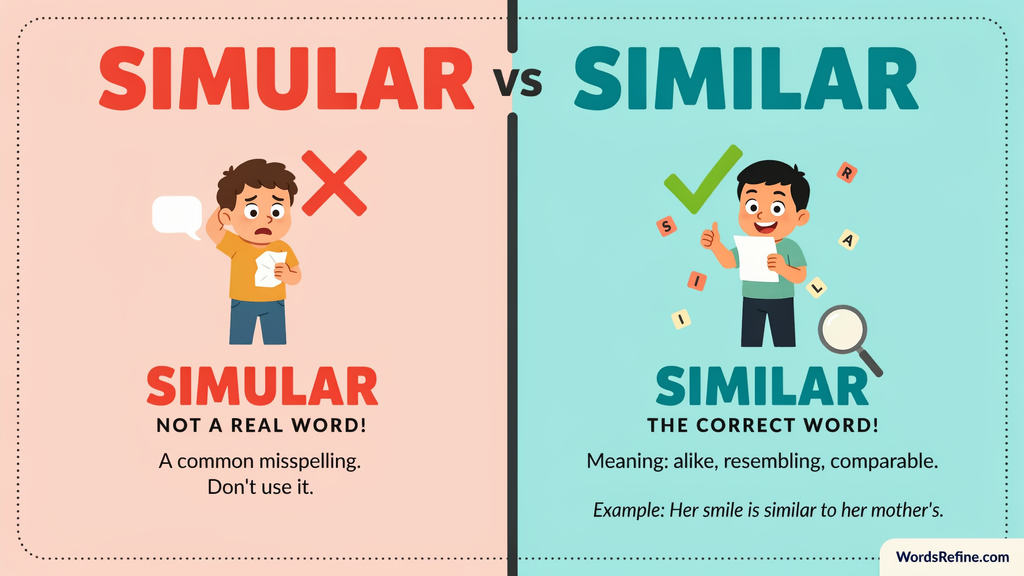
The difference between simular vs similar and identical is even clearer.
Similar means alike but not necessarily exactly alike.
Identical means exactly the same in all relevant respects.
For example:
The two houses have similar layouts.
This tells us that the houses share certain design features.
Now consider:
The two documents are identical.
This tells us that the documents match exactly.
Think of similar as two cousins wearing matching outfits. They look alike, but they’re still different people.
Identical is more like making an exact duplicate.
That distinction becomes especially important in academic, technical, legal, and professional writing.
Simular vs Similar Examples
Examples make the simular vs similar difference much easier to understand. Once you see how each word works, the confusion starts to disappear.
Consider this sentence:
The two dresses are similar.
Here, similar means that the dresses share some characteristics. Perhaps they have similar colors, styles, or designs.
Now consider:
The two dresses are simular.
If the writer means “alike,” this is a spelling mistake. The correct modern English word is similar.
The historical word simular has a different meaning and isn’t normally used in modern English.
Learn the difference between often confused words
Mobil vs Mobile Which one Is Correct?
Incorrect and Correct Examples
Incorrect:
The two buildings have simular designs.
Correct:
The two buildings have similar designs.
Incorrect:
Your experience sounds simular to mine.
Correct:
Your experience sounds similar to mine.
Incorrect:
These two products are very simular.
Correct:
These two products are very similar.
Incorrect:
Her opinion is simular to yours.
Correct:
Her opinion is similar to yours.
In each modern example, similar is the correct choice because the intended meaning is “alike” or “resembling.”
More Examples With Similar
You can use similar in many different contexts.
The students had similar answers.
We experienced similar problems during the project.
This restaurant has a similar menu to the one downtown.
The two machines perform similar functions.
Their writing styles are surprisingly similar.
The new model has a similar design to the previous version.
These two situations are similar in several important ways.
Notice how the word works naturally with people, objects, ideas, experiences, designs, and situations.
That flexibility explains why simular vs similar is such a common word in modern English.
Can You Use Simular in a Sentence?
Technically, yes, but context matters.
Because simular is an archaic or rare word, using it in an ordinary modern sentence can confuse your reader. If you intend to say that two things are alike, similar is the appropriate choice.
For example:
The two paintings are similar.
This is completely natural modern English.
Using simular instead would likely make your reader assume that you made a spelling mistake.
However, a historical text may use simular according to its older meaning. In that context, the word can be legitimate.
So, if someone asks, “Can you use simular in a sentence?” the answer depends on the type of writing.
For modern everyday English, use similar.
For historical discussion or deliberately archaic writing, simular may appear when its historical meaning is relevant.
That distinction is important because being technically possible isn’t the same as being appropriate.
Similar Word Meaning and Examples
The similar word meaning and examples become easier to remember when you focus on the central idea of resemblance.
If two things have characteristics in common, they can be described as similar.
For example:
The sisters have similar hairstyles.
The hairstyles share certain characteristics.
The two cars have similar engines.
The engines have comparable features or functions.
We had similar experiences at the conference.
The experiences shared important characteristics.
Their opinions are similar.
Their opinions are alike in certain respects.
The word doesn’t claim that everything matches. Instead, it points out a meaningful connection between two things.
That’s why similar is useful when you want to compare things without claiming complete equality.
Learn the difference between basic English word mistakes
Any time vs anytime meaning Difference with Examples ?
Similar Synonyms and Antonyms
If you’re building your English vocabulary, learning similar synonyms and antonyms can help you understand the word more precisely.
Common synonyms for similar include alike, comparable, resembling, analogous, akin, related, corresponding, matching, and close.
However, these words aren’t always interchangeable.
For example, alike usually describes two things that resemble each other:
The twins look alike.
Comparable often means that two things can reasonably be compared because they share relevant qualities:
The two companies are comparable in size.
Analogous is more formal and often describes a relationship between things that are similar in a particular way:
The two systems have analogous functions.
Akin often describes things that are related or simular vs similar in nature:
The two ideas are closely akin.
Choosing the right synonym depends on the context.
Antonyms of Similar
Common opposites include different, dissimilar, unlike, and distinct.
For example:
The two approaches are similar.
The opposite could be:
The two approaches are completely different.
You could also write:
The two approaches are dissimilar.
The word dissimilar is especially useful in formal writing because it directly expresses the opposite of similar.
Similar Definition and Usage in Mathematics
The word similar has a specialized meaning in mathematics, particularly in geometry.
Two geometric figures can be called similar when they have the same shape but not necessarily the same size. Their corresponding angles are equal, while their corresponding sides have a consistent proportional relationship.
For example, two triangles can have different sizes while maintaining the same shape. In that case, they are similar triangles.
This is a useful reminder that words can develop specialized meanings in different fields.
In everyday English, similar means alike in certain ways.
In geometry, similar describes figures that have the same shape and proportional corresponding sides.
The basic idea of resemblance remains, but mathematics makes the relationship more precise.
Similar in Everyday and Formal Writing
Similar works comfortably in both casual and formal English.
You can use it in a conversation:
Your jacket looks similar to mine.
You can also use it in professional writing:
The researchers observed similar patterns across the two groups.
In academic writing, the word can help establish relationships between studies, findings, theories, or observations.
For example:
Similar results were reported in earlier studies.
In business writing, it can help compare products, services, strategies, or market trends.
For example:
The company introduced a product with similar features at a lower price.
In everyday writing, it simply helps you describe things that have something in common.
Because of this wide range of uses, learning the correct spelling of similar is worthwhile. You’ll encounter the word again and again.
Common Mistakes With Simular vs Similar
The most common mistake is writing simular when you mean similar.
However, spelling isn’t the only potential problem. Writers sometimes use similar incorrectly because they misunderstand how comparisons work.
Writing Simular Instead of Similar
The most obvious error looks like this:
The results were simular.
The correct version is:
The results were similar.
If you mean “alike,” always choose similar in modern English.
Confusing Similar With Same
Another common mistake is assuming that similar means exactly the same.
For example:
The two plans are similar.
This doesn’t necessarily mean the plans are identical. They may share several important features while differing in other areas.
Using same when you mean only “alike” can make your statement sound stronger than intended.
Using the Wrong Preposition
The standard construction is usually similar to.
Correct:
This design is similar to the original.
Less natural for this meaning:
This design is similar with the original.
Remembering similar to will make your writing sound more natural.
Treating Similar as a Verb
Similar is normally an adjective, not a verb.
You wouldn’t normally write:
The two products similar each other.
Instead, you could write:
The two products are similar.
Or:
The two products resemble each other.
This small grammar point can make a big difference in sentence structure.
How to Spell Similar Correctly
If you frequently write simular by mistake, a simple memory trick can help.
Focus on the middle of the word:
similar
The second i is the letter people often forget.
Try saying the spelling slowly in your head:
sim-i-lar
Then write:
similar
Another helpful trick is to connect the word with similarity.
The noun is:
similarity
Not:
simularity
Once you remember similarity, the spelling of similar becomes easier to recognize.
You can also connect the word with similarly.
For example:
The two designs are similar.
Similarly, the two methods produce comparable results.
Both words begin with the same core spelling: simil.
Similarity, Similarly, and Dissimilar
Learning related word forms can make the spelling easier to remember.
The noun form is similarity.
For example:
There is a strong similarity between the two designs.
The adverb form is similarly.
For example:
Similarly, the second group showed comparable results.
The opposite adjective is dissimilar.
For example:
The two approaches are completely dissimilar.
Notice the shared spelling pattern:
similar
similarity
similarly
dissimilar
The common part is simil. Keeping that pattern in mind can help prevent the simular spelling mistake.
Learn the difference between everyday English mistakes
Choose vs Chose Difference and which one is Correct?
Why Do People Spell Similar vs Simular?
The question “why do people spell similar vs simular” has a fairly simple answer: pronunciation strongly influences spelling.
When people hear a word before seeing it written, they often spell it according to the sounds they recognize.
The ending of similar can sound like “ler” or “luh,” depending on the speaker’s accent. This can make the spelling less obvious.
There is also a visual reason.
English contains many familiar words ending in -ar, such as popular, regular, and familiar. As a result, simular can look like a believable English word even though it isn’t the standard spelling for “alike.”
Another factor is simple memory.
When someone has seen similar only occasionally, they may remember the general shape of the word but forget the second i.
That’s why repeated exposure and correct usage can help.
Similar vs Simular A Quick Test
When you’re unsure whether to write similar or simular, ask yourself what you mean.TIf you mean alike, choose similar.
1.If you mean resembling, choose similar.
2.If you’re comparing characteristics, choose similar.
3.If you’re writing normal modern English, choose similar.
4.If you’re reading or discussing an old text in which simular has its historical meaning, then simular may be relevant.
The easiest modern rule is:
If you mean “alike,” spell it similar.
That one sentence solves most simular vs similar spelling problems.
Similar Word Usage More Natural Sentence Patterns
Once you know the spelling, the next step is using similar naturally.
One common pattern is:
Subject + be + similar to + noun
For example:
Her approach is similar to mine.
Another pattern is:
Subject + have + similar + noun
For example:
The two companies have similar goals.
You can also use similar with in when explaining the particular quality being compared.
For example:
The two products are similar in design.
Or:
The sisters are similar in personality.
This structure is useful when you want to explain exactly how two things resemble each other.
You can also strengthen the comparison with words such as very, quite, closely, or remarkably.
For example:
The two solutions are very similar.
Their approaches are remarkably similar.
The designs are closely similar in appearance.
However, choose modifiers naturally. Sometimes simply saying “similar” is clearer and stronger than adding unnecessary words.
Similar in Professional and Academic Writing
Correct word choice becomes especially important in professional and academic writing.
If you accidentally write simular, readers will probably understand what you mean, but the spelling error can make your writing appear less polished.
For example, compare these sentences:
The researchers identified simular patterns.
The researchers identified similar patterns.
The second sentence immediately looks professional and standard.
This matters because small spelling errors can distract readers from your actual message.
In academic writing, similar is especially useful when comparing studies, findings, theories, methods, or observations.
For example:
The researchers found similar results across both experiments.
In professional writing, you might use it when discussing products, services, strategies, or customer behavior.
For example:
Customers reported similar concerns across both surveys.
In both cases, similar communicates the comparison clearly without suggesting that everything is exactly the same.
Similar vs Equivalent
Another useful distinction is between similar and equivalent.
Similar means alike in some respects.
Equivalent usually means equal in value, function, meaning, or effect within a particular context.
For example:
The two products are similar.
This tells us that they share features.
But:
The two products are equivalent.
This suggests that they provide essentially the same value or function in the relevant context.
The words can overlap, but they shouldn’t automatically replace each other.
If you only know that two things look alike, similar is safer.
If you know that they have equal value, function, or effect, equivalent may be more precise.
Similar vs Alike
Similar and alike are close in meaning, but their grammar differs.
You can say:
The two houses are similar.
You can also say:
The two houses are alike.
However, you generally wouldn’t say:
The two houses are alike to each other.
With similar, the common pattern is similar to.
For example:
The two houses are similar to each other.
Alike often works naturally after linking verbs:
The twins look alike.
This is one reason you shouldn’t assume that synonyms always follow the same grammatical patterns.
The meaning may be close, but the sentence structure can differ.
Similar vs Resembling
Resembling comes from the verb resemble, while similar is an adjective.
You can write:
The new building resembles the old one.
Or:
The new building is similar to the old one.
These sentences communicate a related idea, but their grammatical structures are different.
You wouldn’t normally write:
The new building is resemble the old one.
Likewise, you shouldn’t treat similar as though it were a verb.
Understanding these differences helps you avoid grammar mistakes while expanding your vocabulary.
Similar Synonyms in Different Contexts
The best simular vs similar synonym depends on what you’re trying to express.
1If two people or objects look alike, alike may work well.
2If two things can reasonably be compared, comparable may be more precise.
3If two things share a deeper relationship, akin may fit.
4If two systems perform related functions, analogous can work in formal writing.
5If two things are close but not exactly the same, resembling may be appropriate.
For example:
The two paintings are alike.
The two companies are comparable in size.
Their ideas are closely akin.
The two systems perform analogous functions.
The new building resembles the original.
These words all connect with the idea of similarity, but each one carries its own shade of meaning.
That’s why choosing a synonym shouldn’t be a simple matter of replacing one word with another. Context matters.
Learn the difference between more words people mix up
Further vs Farther The Simple Difference and Each Correctly?
Quick Comparison
When you need a fast reminder, keep this distinction in mind.
Similar is the standard modern English word meaning alike, resembling, or sharing characteristics.
Simular is a rare and archaic English word associated historically with false, counterfeit, sham, or deceptive appearances.
If you are writing a modern sentence such as “The two products are alike,” use similar.
If you are researching historical English and encounter simular, don’t automatically assume it is a spelling mistake. Its historical meaning may be relevant to the text.
The key is context.
Similar in Everyday English
The word similar appears frequently in everyday conversations because people constantly compare things. You might compare clothes, opinions, experiences, prices, personalities, or even the way two people laugh.
For example:
Your new laptop looks similar to mine.
Here, similar tells the reader that the two laptops share certain features. They might have the same size, color, or design, but they don’t have to be exactly the same.
You can also use similar when comparing experiences.
We had similar experiences during our first week at college.
This doesn’t mean both experiences were identical. It simply means they had important features in common.
The word also works naturally when comparing opinions.
Our opinions are quite similar.
Again, this suggests agreement in certain areas without claiming complete agreement.
This flexibility makes similar one of the most useful comparison words in English.
Similar in Formal Writing
Similar is also common in formal, academic, and professional writing.
Researchers often use the word when comparing findings, patterns, results, or observations.
For example:
The researchers observed similar patterns in both groups.
Business writers may use similar when comparing products, services, strategies, or customer behavior.
For example:
The company introduced a similar product for younger customers.
Students can use the word when comparing arguments or ideas.
For example:
The two authors present similar views on the subject.
In each case, similar provides a clear comparison without suggesting that everything is exactly the same.
That makes it particularly useful when you need precise but straightforward language.
Similar in Academic Writing
Academic writing often requires careful distinctions between words that appear to have almost the same meaning.
Similar is useful because it allows you to point out relationships without overstating them.
For example:
The results of the two experiments were similar.
This statement does not claim that every result matched perfectly. It simply says that the results shared important characteristics.
You can also use similar when comparing theories.
Both theories offer similar explanations for the observed behavior.
Or when comparing research findings:
Previous studies produced similar results.
This careful use of language helps academic writing remain accurate.
If you use identical when you only mean similar, you may make a claim that is stronger than the evidence supports.
Similar in Business Communication
Clear word choice matters in business communication because small differences in meaning can affect how a message is understood.
Suppose a company is comparing two products.
You might write:
Product A and Product B have similar features.
This means the products share several characteristics.
However, saying:
Product A and Product B have identical features.
makes a much stronger claim. It suggests that their features match exactly.
Using similar allows you to describe a relationship without exaggerating it.
The word can also describe business strategies.
Both companies use similar marketing strategies.
Or customer preferences:
Customers in both markets showed similar preferences.
In professional writing, this kind of precise comparison can make your message clearer and more credible.
Similar With Common Prepositions
One of the most important grammar patterns to remember is similar to.
For example:
This phone is similar to my old phone.
Her writing style is similar to yours.
The new design is similar to the original.
Their approach is similar to ours.
The word similar is normally followed by to when you directly compare one thing with another.
You can also use similar with in when you want to identify the particular quality that two things share.
For example:
The two products are similar in size.
The sisters are similar in personality.
The designs are similar in appearance.
The structure similar in + characteristic helps explain exactly how two things resemble each other.
Is Similar With Correct?
Similar with is not normally the standard construction when you are making a direct comparison.
For example, this sentence sounds unnatural:
My car is similar with yours.
A more natural version is:
My car is similar to yours.
Similarly:
Her approach is similar to mine.
is preferable to:
Her approach is similar with mine.
The preposition to is the one you should remember for ordinary comparisons.
There can be contexts where similar appears near with for other grammatical reasons, but that doesn’t make similar with the standard replacement for similar to.
For everyday English, remember the simple pattern:
similar to
Can Similar Describe People?
Yes, similar can describe people, especially when you are comparing their characteristics, behavior, appearance, opinions, or personalities.
For example:
The two sisters have similar personalities.
The students have similar interests.
The candidates expressed similar opinions about the issue.
You can also describe physical appearance:
The brothers look similar.
However, similar does not mean identical.
Two people can look similar while having completely different personalities, backgrounds, or preferences.
This distinction helps you avoid making assumptions simply because two people share certain characteristics.
Can Similar Describe Things?
Yes. In fact, similar is commonly used with objects and physical things.
For example:
The two chairs have similar designs.
These phones have similar features.
The houses have similar layouts.
The products have similar packaging.
You can also use it for abstract things.
The two ideas are similar.
Their experiences were similar.
The situations are similar.
The word is therefore useful for both concrete and abstract comparisons.
Learn the difference between commonly mixed-up more words
Capital vs Capitol Which One Is Correct?
Similar and Comparative Language
Similar is part of a broader group of words used to compare things.
Other useful comparison words include different, identical, equivalent, alike, related, comparable, and distinct.
Each word expresses a slightly different relationship.
For example:
The two designs are similar.
1This means they share characteristics.
The two designs are different.
2This means they have distinguishing characteristics.
The two designs are identical.
3This means they match exactly.
The two designs are comparable.
4This means they can reasonably be compared, often because they share relevant features or occupy a similar category.
Understanding these distinctions gives you more control over your writing.
Similar and Dissimilar
Dissimilar is the direct opposite of similar.
If two things are similar, they share certain characteristics.
If two things are dissimilar, they differ in important ways.
For example:
The two products are similar in price.
The opposite could be:
The two products are dissimilar in price.
However, different is often more natural in casual English.
For example:
The two products have different prices.
In formal writing, dissimilar can be useful when you want a direct opposite of similar.
For example:
The researchers compared similar and dissimilar groups.
Learning related forms such as dissimilar can also make the spelling of similar easier to remember.
Similar and Resemble
The Similar and resemble are closely related, but they belong to different grammatical categories.
Similar is an adjective.
Resemble is a verb.
For example:
The two paintings are similar.
Here, similar describes the paintings.
You could also write:
The two paintings resemble each other.
Here, resemble acts as the verb.
You should not combine the two structures incorrectly.
Incorrect:
The two paintings are resemble each other.
Correct:
The two paintings are similar.
Or:
The two paintings resemble each other.
Understanding this difference is useful for anyone learning English grammar.
Similar and Alike
Similar and alike have closely related meanings, but their sentence patterns differ.
You can write:
The two children are similar.
You can also write:
The two children are alike.
However, similar commonly appears with to:
The two children are similar to each other.
Alike does not normally take the same construction.
You would naturally say:
The two children look alike.
rather than:
The two children look alike to each other.
The meanings overlap, but the grammar does not always overlap.
That’s a useful lesson when learning synonyms: words can share meanings while behaving differently in a sentence.
Similar and Comparable
Comparable is another useful synonym for similar, but it often carries a more specific meaning.
If two things are comparable, they have enough relevant qualities in common to make a meaningful comparison.
For example:
The two universities are comparable in size.
This means their sizes are reasonably similar for the purpose of comparison.
You could also say:
The two universities are similar in size.
Both sentences work, but comparable emphasizes the possibility of making a meaningful comparison.
This difference becomes particularly useful in academic and professional writing.
Similar and Analogous
Analogous is a more formal word that can describe things that are similar in a particular way.
For example:
The two systems have analogous functions.
This means the systems perform functions that correspond to each other in some meaningful way.
You could use similar in a less specialized sentence:
The two systems have similar functions.
Analogous often sounds more technical or academic, while similar is much more common and flexible.
For everyday writing, similar is usually the simpler choice.
Similar and Equivalent
The Similar and equivalent can sometimes appear in related contexts, but they don’t carry exactly the same meaning.
Similar indicates resemblance.
Equivalent usually indicates equal value, function, meaning, or effect in a particular context.
For example:
The two courses are similar.
This means they share certain characteristics.
But:
The two courses are equivalent.
This suggests that they have equal value or satisfy the same requirement, depending on the context.
That distinction can matter in education, business, mathematics, science, and technical writing.
If you only know that two things resemble each other, similar is usually the safer word.
Similar and Identical in Detail
The difference between similar and identical becomes especially important when precision matters.
Imagine two documents.
They have the same general structure, similar wording, and the same number of sections. However, several sentences are different.
You could say:
The documents are similar.
You shouldn’t necessarily say:
The documents are identical.
Identical suggests that the documents match exactly.
The same principle applies to objects, people, ideas, images, products, and results.
For example:
The two photographs are similar.
means they resemble each other.
The two photographs are identical.
means they are effectively the same image or exact copies.
Choosing similar instead of identical can therefore prevent you from making a stronger claim than you intend.
Common Spelling Mistakes With Similar
The most common spelling mistake is writing simular.
For example:
The results were simular.
The correct sentence is:
The results were similar.
Another mistake is forgetting the second i when writing related words.
For example, some writers may incorrectly write simularity instead of similarity.
The correct spelling is similarity.
Likewise, the adverb is similarly, not simularly.
Remembering the core spelling simil can help you recognize the correct forms.
The pattern is:
similar
similarity
similarly
dissimilar
Once you recognize this pattern, the spelling becomes much easier to remember.
How to Remember Similar Spelling
A simple memory trick is to remember that similar contains two i’s before the final ar.
You can break the spelling into sounds or parts:
sim-i-lar
Then connect it with the related noun:
similarity
The shared beginning helps reinforce the correct spelling.
You can also remember the phrase:
Similar things share an “i.”
It’s a simple trick, but small memory devices can be surprisingly effective when you repeatedly make the same spelling mistake.
Another useful strategy is to write the word several times in real sentences instead of memorizing it in isolation.
For example:
The two ideas are similar.
Their experiences were similar.
The products have similar features.
Seeing the word in context makes it easier to remember.
Is Simular Ever Correct?
Yes, but only in specific historical or specialized contexts.
If you are writing ordinary modern English and want to say that two things are alike, simular is not the correct choice.
However, when discussing historical English, old texts, or the history of vocabulary, simular may be relevant.
For example, a discussion of an older text might explain that simular was once used in a sense connected with false appearance or a pretender.
In that context, the word is being discussed because of its historical meaning.
The important point is that you should not use simular simply because you believe it is another spelling of similar.
It isn’t.
Simular as a Historical English Word
The existence of simular explains why the word can sometimes appear in dictionaries even though modern writers are usually told to use similar.
Historical vocabulary doesn’t always disappear completely. Some words survive in dictionaries, old literature, historical documents, or specialized discussions.
Simular is one of those words.
Its historical meanings are connected with ideas such as imitation, false appearance, counterfeit objects, and pretended identity.
Modern English, however, has largely moved away from this word.
That means seeing simular in a dictionary doesn’t automatically mean that you should use it in modern writing.
Dictionaries record words from different periods, regions, and fields. They don’t all represent equally common choices for present-day communication.
Why Dictionary Entries Can Cause Confusion
Many English learners assume that if a word appears in a dictionary, it must be suitable for ordinary modern writing.
That isn’t always true.
Dictionaries may include archaic, obsolete, historical, dialectal, technical, or specialized words.
This is why finding simular in a dictionary shouldn’t convince you that it is the standard spelling of similar.
Instead, check the word’s meaning, usage, and status.
If you want to describe two things as alike in modern English, similar is the appropriate word.
If you encounter simular in an old text, examine the surrounding context. The word may be carrying its historical meaning.
Context is often the key to understanding unusual vocabulary.
Simular vs Similar for English Learners
English learners can find the simular vs similar spelling especially confusing because pronunciation doesn’t always reveal the correct spelling.
The best approach is to learn similar as a complete vocabulary item rather than trying to spell it entirely from sound.
1Remember that similar means alike or resembling.
2Remember the common structure similar to.
3Remember the related forms similarity and similarly.
Then practice the word in natural sentences.
For example:
This color is similar to that one.
The two answers are similar.
Their experiences were remarkably similar.
Repeated exposure will gradually make the correct spelling feel natural.
Similar in Digital Communication
In text messages, social media posts, emails, and online discussions, people often type quickly and rely heavily on sound-based spelling.
That can make errors such as simular more common.
Autocorrect may sometimes catch the mistake, but you shouldn’t depend entirely on spelling software.
A writing tool may correct the spelling without explaining why it is wrong. Understanding the distinction yourself is more useful in the long run.
If you know that similar is the modern word for “alike,” you can recognize the error even when a spelling checker isn’t available.
This is especially useful when writing professional messages, academic assignments, articles, or important documents.
Learn the difference between tricky grammar more words
Loose vs Lose Difference and which is Correctly?
Similar in Sentence Construction
There are several natural ways to use similar in a sentence.
1You can use it after a linking verb:
The two products are similar.
2You can use it with to:
The two products are similar to each other.
3You can use it with in:
The two products are similar in design.
4You can use it before a noun:
The company released similar products.
5You can also modify it with an adverb:
The two products are remarkably similar.
These patterns give you flexibility while keeping your sentences grammatically natural.
Practice Session Simular vs Similar
Test your understanding of the difference between “similar” vs “simular.” Complete each sentence by filling in the blank with the correct word.
- The two houses look very ______ from the outside.
- My new phone is ______ to the one I had before.
- These two paintings have ______ colors and patterns.
- Her opinion is ______ to mine.
- The twins have ______ facial features.
- This problem is ______ to the one we solved yesterday.
- The two designs are quite ______, although they are not identical.
- Your writing style is ______ to your teacher’s style.
- The two products have ______ features but different prices.
- These shoes are ______ in size and shape.
- The new employee has a ______ approach to solving problems.
- The two stories have ______ themes.
- This word has a meaning ______ to another common English word.
- Their answers were remarkably ______.
- The two machines perform ______ functions.
- This situation is ______ to what happened last year.
- The colors in these photographs are very ______.
- His experience is ______ to mine.
- The two buildings have a ______ architectural style.
- These examples are ______ enough to be compared.
- The two documents contain ______ information.
- Her dress is ______ to the one worn by her sister.
- The results from both experiments were ______.
- The two languages have some ______ grammatical structures.
- The correct modern English spelling is ______, not “simular.”
Answers
- similar
- similar
- similar
- similar
- similar
- similar
- similar
- similar
- similar
- similar
- similar
- similar
- similar
- similar
- similar
- similar
- similar
- similar
- similar
- similar
- similar
- similar
- similar
- similar
- similar
Here’s a trusted source for clear word meanings:
FAQs
Is “simular” a word or a misspelling?
“Simular” is a real historical English word, but it is rare and archaic. In modern English, it is not the standard spelling for the word meaning “alike.” Use “similar” in everyday, academic, and professional writing.
What is the correct spelling: “similar” vs “simular”?
“Similar” is the correct modern English spelling when you mean “alike” or “having common features.” “Simular” is not the standard spelling of this word.
Why do people spell “similar” as “simular”?
People often write “simular” because the pronunciation of “similar” can make the middle vowel sound unclear. Familiar spelling patterns can also lead writers to choose “-ular” instead of the correct “-ilar.”
What does “similar” mean?
“Similar” means alike in some ways, qualities, characteristics, or features. It shows that two or more things have something in common without necessarily being exactly the same.
What does “simular” mean?
“Simular” is an uncommon historical English word associated with ideas such as a pretender, counterfeit, or something deceptive. It does not normally mean “similar” in modern English.
How do you pronounce “similar”?
“Similar” is commonly pronounced with three syllables in standard English. The exact pronunciation can vary slightly by accent, but the word begins with the same “sim” sound found in “simple.”
Is “simular” used in modern English?
“Simular” may appear in historical, literary, or dictionary contexts, but it is not normally used in modern everyday English. If you want to say that two things are alike, use “similar.”
Can “similar” describe people?
Yes. “Similar” can describe people when they share characteristics, interests, personalities, appearances, experiences, or behaviors.
The two sisters have similar interests.
Can “similar” describe things?
Yes. You can use “similar” for objects, ideas, situations, designs, products, sounds, colors, results, and many other things.
The two phones have similar features.
What is the difference between “similar” and “identical”?
“Similar” means that things are alike in certain ways, while “identical” means they are exactly the same in the relevant respects. Two similar shirts may have different colors, while identical shirts match completely.
Is “similar to” the correct expression?
Yes. “Similar to” is the standard construction in modern English.
This design is similar to the original.
“Similar with” is generally not the natural choice when you mean that two things resemble each other.
What are some synonyms for “similar”?
Depending on the context, synonyms for “similar” include alike, comparable, resembling, related, corresponding, analogous, and akin. The best choice depends on the exact relationship you want to describe.
Can “similar” mean exactly the same?
No. “Similar” normally suggests that two things share certain qualities but have differences as well. If you mean that two things are exactly the same, “identical” or “the same” may be more appropriate.
What is the difference between “similar” and “alike”?
“Similar” is an adjective that commonly appears before a noun or after a linking verb, while “alike” usually comes after a linking verb or at the end of a sentence.
The two houses are similar.
The two houses look alike.
How can you use “similar” in a sentence?
You can use “similar” to compare people, objects, ideas, or situations that share particular features.
Their approaches to the problem are similar.
Is “similar” spelled differently in American and British English?
No. “Similar” has the same spelling in both American and British English. Unlike words such as “color” and “colour,” this word does not change spelling between the two varieties.
Is “simular” ever correct in English?
It can be correct when referring to the rare historical word “simular,” but it is not correct as the modern spelling of “similar.” In normal contemporary writing, choose “similar” when you mean “alike.”
What is the easiest way to remember the spelling of “similar”?
Remember the middle letters: “similar” contains “-ilar,” not “-ular.” Connecting “similar” with “similarity” can also help you remember the correct spelling.
Which is correct: “simular” vs “similar”?
For modern English, “similar” is correct when you mean “alike.” “Simular” is a rare historical word and should not be used as the ordinary spelling of “similar.”
Conclusion
The “simular vs similar” confusion is a small spelling trap with a surprisingly long history. If you’re talking about things that are alike, share features, or have something in common, “similar” is the word you want. “Simular” may appear in older or historical English, but it isn’t the modern spelling of “similar.”
The easiest way to remember the difference is to connect “similar” with “similarity.” Both keep the same “-ilar” spelling, so there’s no need to let that sneaky “u” crash the party.
Next time you write, “These two ideas are simular,” give that sentence a quick spelling check. Replace “simular” with “similar,” and your grammar will be back on track. After all, the words may look almost similar, but only one belongs in your everyday English.

Diora AJS she is an experienced blogger and passionate English language enthusiast at Words Refine. With a keen eye for language and a love for clear communication, she writes practical content about grammar, word meanings, usage, and commonly confused terms. Her goal is to make English easier to understand through clear explanations and relatable examples, helping readers write accurately and communicate with confidence.