

Have you ever typed, “I don’t want to loose you,” and immediately wondered whether something went wrong? You’ are certainly not alone. Loose vs lose is a classic English word pair that causes confusion for writers of all levels. While the two words look remarkably similar, they have entirely different meanings and functions. The good news is that learning the difference doesn’t have to be confusing. In this guide, you’ll discover the meanings, pronunciations, and correct uses of loose and lose, along with clear examples and easy memory tricks to help you avoid this common grammar mistake and write with confidence.
Quick answer
The easiest way to separate these words is to focus on their meanings.
Lose is usually a verb. It means to no longer have something, to misplace something, to fail to win, or to experience a reduction.
Loose is usually an adjective. It means not tight, not firmly attached, or free from restraint.
Consider these sentences:
- I don’t want to lose my phone.
- My phone case is loose.
- Our team could lose the game.
- The screw on the chair is loose.
In the first and third sentences, lose describes something happening. In the second and fourth, loose describes a condition.
That basic distinction solves most of the confusion.
What Does Lose Mean?
Lose is a verb with several common meanings. Although the exact meaning depends on the sentence, the central idea is that something is no longer possessed, maintained, achieved, or available.
For instance, if you misplace your wallet, you lose it. If your team doesn’t win a match, it loses. If you become less confident, you lose confidence.
Here are some of the most common uses.
Lose Means to Misplace Something
When you have something but can’t find it anymore, you lose it.
- I always lose my keys.
- She lost her wallet yesterday.
- Don’t lose your passport.
- He lost his phone somewhere at the airport.
In each sentence, the object existed in your possession but you no longer know where it is.
That’s why the correct expression is “lose your keys,” not “loose your keys.”
Lose Means to Fail to Win
Lose also describes the opposite of winning.
For example:
- Our team lost the game.
- They lost the match by two points.
- She doesn’t want to lose the competition.
- The team lost the championship.
If someone fails to win, that person or team loses.
Therefore, the correct phrase is “lose a game.” The phrase “loose a game” is incorrect when you mean that someone didn’t win.
Lose Means to No Longer Have Something
Lose isn’t limited to physical objects. You can lose things that aren’t tangible.
For example:
- She lost her job.
- He lost an important opportunity.
- They lost several customers.
- I don’t want to lose my confidence.
- He was afraid of losing his friendship.
In these examples, lose describes something that disappears from a person’s life or is no longer available.
This broader use is one reason the word appears so often in everyday English.
Learn the difference between often confused words
T- Shirt vs Tee Shirt Which One Is Correct and Why?
Lose Weight, Money, Hair, and More
Some expressions cause more confusion than others because people often write loose instead of lose.
Is It Lose or Loose Weight?
The correct phrase is “lose weight.”
For example:
- I want to lose weight.
- She has lost weight recently.
- He’s trying to lose weight.
- They changed their routine because they wanted to lose weight.
The reason is straightforward. Lose is the verb because the person’s weight is decreasing.
However, loose can appear in the same situation with a different meaning.
Consider this sentence:
“After losing weight, her clothes became loose.”
Here, both words are correct.
Losing weight means the amount of weight decreased. Loose clothes means the clothes no longer fit tightly.
That small distinction is worth remembering because it demonstrates how meaning determines the correct word.
Is It Lose vs Loose Money?
When you’re talking about financial loss, use lose.
For example:
- The company could lose money.
- He lost money on the deal.
- Nobody wants to lose money.
- The business lost a large amount of money last year.
Loose money can be used in other contexts to describe money that isn’t secured or organized, such as coins sitting in a pocket. However, it isn’t the normal expression for financial loss.
Is It Lose vs Loose Hair?
This is an interesting case because both words can be correct.
Lose hair means that hair falls out or is no longer retained.
For example:
- Some people lose hair as they get older.
- He’s beginning to lose his hair.
Loose hair means hair that isn’t tied or secured.
For example:
- She wore her hair loose.
- Her loose hair moved in the breeze.
Therefore, the correct word depends entirely on what you mean.
Learn the difference between everyday English mistakes
Whoever vs Whomever How to Use Each Word Correctly
What Does Loose Mean?

Loose is most commonly an adjective. It describes something that isn’t tight, isn’t firmly attached, or isn’t being held or controlled.
The word can describe clothing, objects, hair, animals, physical connections, and even abstract situations.
Loose Means Not Tight
This is probably the first meaning that comes to mind.
Something is loose when it has extra space or movement rather than fitting tightly.
For example:
- This shirt is too loose.
- My shoes feel loose.
- The belt is loose.
- She prefers loose clothing.
- The jacket has a loose fit.
The word describes the condition of the object.
Compare these two sentences:
“My shirt is loose.”
“I don’t want to lose my shirt.”
The first sentence describes how the shirt fits. The second describes the possibility of no longer having the shirt.
The spelling is similar, but the meaning is completely different.
Loose Means Not Firmly Attached
Something can also be loose when it isn’t securely fixed in place.
For example:
- The screw is loose.
- One of the buttons is loose.
- There’s a loose wire behind the desk.
- The floorboard feels loose.
- His tooth is loose.
In these situations, the object hasn’t necessarily disappeared. Instead, it isn’t firmly secured.
Loose Tooth vs Lose a Tooth?
Both phrases can be correct, but they describe different things.
A loose tooth is a tooth that isn’t firmly fixed in place.
To lose a tooth means that the tooth comes out or is no longer present.
For example:
“The child has a loose tooth.”
“The child may lose the tooth soon.”
The first sentence describes the tooth’s condition. The second describes what may happen to it.
Loose Means Free
Loose can also describe something that isn’t restrained.
For example:
- The dog got loose.
- The horse broke loose.
- Several animals were running loose.
- The children were finally set loose to play.
Here, loose means free from restraint or control.
This meaning appears in several common expressions, including “break loose” and “set loose.”
Common Expressions With Loose
Loose appears in many familiar expressions.
Loose Change
The Loose change refers to coins or small amounts of money that aren’t stored securely.
For example:
“I found some loose change under the car seat.”
Loose Ends
Loose ends are unfinished details that still need attention.
For example:
“Before leaving the office, she tied up a few loose ends.”
Loose Clothing
Loose clothing doesn’t fit tightly around the body.
For example:
“He prefers loose clothing during hot weather.”
Loose Hair
Loose hair isn’t tied or secured.
For example:
“She usually wears her hair loose.”
These expressions all connect to the central idea of something being free, unsecured, or not tightly held.
Learn the difference between confusing word pairs
Vender vs Vendor Which one Is Correct?
Loose vs Lose Pronunciation
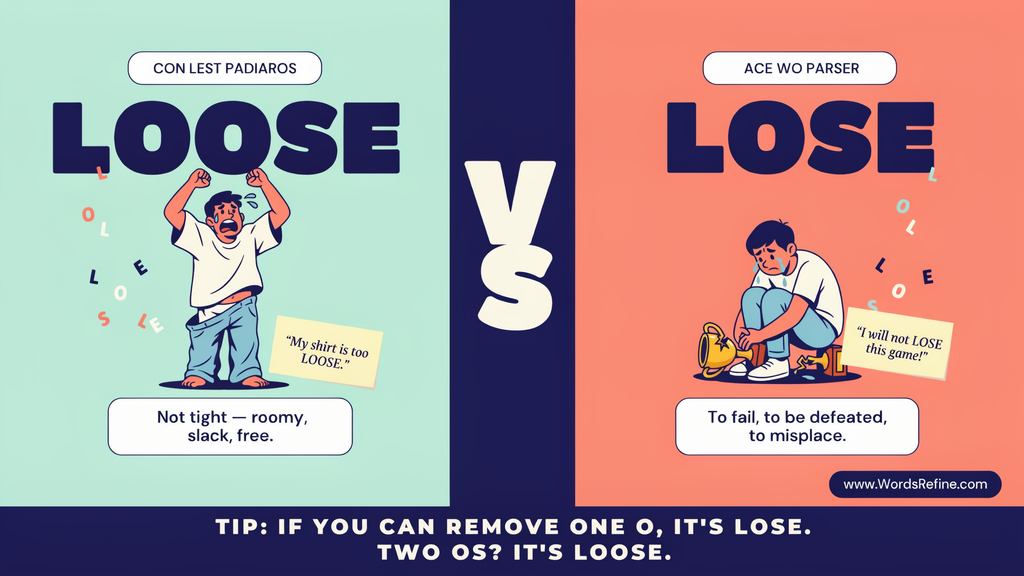
Pronunciation provides another useful clue.
Although the two words look nearly identical, they don’t end with the same sound.
Loose ends with an /s/ sound.
Lose ends with a /z/ sound.
Both words begin with the same long vowel sound, so the final consonant is the important difference.
You can hear the distinction by comparing these words:
- Loose rhymes with goose.
- Lose rhymes with choose.
There’s also a physical way to notice the difference. Place your fingers lightly against your throat while saying each word. The final sound in lose involves vocal-cord vibration, while the final sound in loose doesn’t.
Pronunciation alone won’t solve every spelling problem, but it can help reinforce the difference.
The Grammar Difference Between Loose vs Lose
One of the easiest ways to understand these words is to look at their grammatical roles.
Loose is usually an adjective.
Lose is a verb.
An adjective describes something.
A verb describes an action, event, or state.
Consider these examples:
- The rope is loose.
- The button is loose.
- The clothes are loose.
- Don’t lose the rope.
- Don’t lose the button.
- We might lose the match.
The first three sentences describe conditions. The last three describe actions or events.
So, as a quick grammar reminder:
Loose describes.
Lose acts.
This isn’t an absolute rule because loose can occasionally function as a verb. Still, it’s an excellent shortcut for everyday writing.
Loose vs Lose Comparison
| Feature | Loose | Lose |
|---|---|---|
| Most common role | Adjective | Verb |
| Main idea | Not tight or secure | No longer have or fail to win |
| Final sound | /s/ | /z/ |
| Spelling | Two O’s | One O |
| Clothing | Loose clothes | — |
| Weight | Clothes may become loose | Lose weight |
| Sports | Loose ball | Lose a game |
| Hair | Loose hair | Lose hair |
| Money | Loose change | Lose money |
| Tooth | Loose tooth | Lose a tooth |
| Control | Set something loose | Lose control |
This comparison shows why simply memorizing the spelling isn’t enough. You need to understand what each word is doing in the sentence.
Common Mistakes With Loose vs Lose
These mistakes appear frequently in informal writing, school assignments, messages, and online conversations.
“Loose Weight”
Incorrect: “I want to loose weight.”
Correct: “I want to lose weight.”
Weight can decrease, so lose is the correct verb.
“Loose a Game”
Incorrect: “Our team might loose the game.”
Correct: “Our team might lose the game.”
A team loses when it fails to win.
“Loose Your Keys”
Incorrect: “Don’t loose your keys.”
Correct: “Don’t lose your keys.”
You lose something when you misplace it or no longer have it.
“Loose Control”
Incorrect: “She started to loose control.”
Correct: “She started to lose control.”
The expression is “lose control.”
“Loose Money”
Incorrect: “The company could loose money.”
Correct: “The company could lose money.”
Financial loss requires the verb lose.
“Lose Clothing”
Incorrect: “She prefers lose clothing.”
Correct: “She prefers loose clothing.”
Here, you’re describing clothing that isn’t tight, so loose is the correct adjective.
Loose vs Lose Examples in Everyday Situations
Seeing the words side by side is one of the best ways to understand their difference.
| Loose | Lose |
|---|---|
| My shirt is loose. | I don’t want to lose my shirt. |
| The screw is loose. | Don’t lose the screwdriver. |
| Her hair is loose. | She doesn’t want to lose her hair. |
| The dog got loose. | We might lose the dog in the crowd. |
| The knot is loose. | Don’t lose the rope. |
| The tooth is loose. | The child may lose the tooth. |
| His clothes are loose. | He wants to lose weight. |
| There is loose change in my pocket. | I don’t want to lose my money. |
These examples reveal an important point: both words can appear in the same topic or even the same sentence.
That’s why context matters.
A Simple Example That Explains Everything
Consider this sentence:
“After he lost weight, his clothes became loose, so he loosened his belt.”
This one sentence contains three related words with three different meanings.
Lost describes a reduction in weight.
Loose describes clothing that isn’t tight.
Loosened describes the action of making something less tight.
Understanding this relationship makes the spelling difference much easier to remember.
Learn the difference between basic English word mistakes
Envisage vs Envision Meaning Differences Examples ?
Loose, Lose, and Loosen
Another common source of confusion is the word loosen.
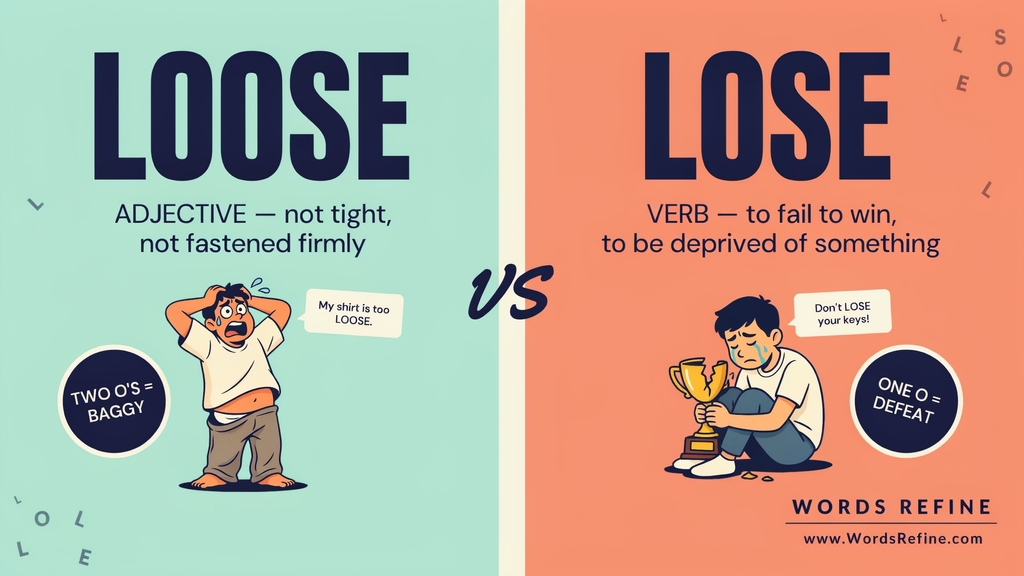
Loose means not tight.
Lose means no longer have something or fail to win.
Loosen means to make something less tight.
For example:
- The knot is loose.
- Don’t lose the rope.
- Loosen the knot carefully.
Each word has a different role.
Here’s another example:
“The screw is loose, so loosen it carefully.”
Even though loose and loosen are related, they aren’t interchangeable. Loose describes the screw’s condition, while loosen describes the action of making something less tight.
Can Loose Be Used as a Verb?
Yes, although this use is less common in everyday English.
As a verb, loose can mean to release, free, or set something free.
For example:
- They loosed the horses.
- The sailors loosed the ropes.
- The hunters loosed their arrows.
In modern everyday conversation, however, speakers often choose words such as release, free, or loosen instead.
For example:
“Release the animal.”
“Set the dog loose.”
“Loosen the rope.”
So, while loose is primarily an adjective, it can have a legitimate verb use.
Why Are Loose vs Lose So Often Confused?
There are several reasons.
First, the spelling is almost identical. Both words begin with “lo” and contain the same final letters.
Second, the pronunciation is very similar. The main difference is the final consonant.
Third, both words can appear in related situations.
For example:
“She wants to lose weight because her clothes are loose.”
The words appear together because losing weight can cause clothes to become loose.
Finally, people often type quickly and rely on visual patterns rather than meaning. Since loose contains the same basic letters as lose with an extra “o,” it’s easy to choose the wrong form without noticing.
How to Remember Loose vs Lose
A few simple memory tricks can make the distinction stick.
Remember the Two O’s in Loose
Loose has two O’s.
Think of those extra O’s as extra room.
1.A loose shirt has extra room.
2.A loose knot has extra movement.
3.A loose connection isn’t held tightly.
This is simply a memory trick, but it’s easy to recall.
Connect Lose With Loss
Lose has one O.
Think of the word loss.
If something is gone, reduced, or no longer available, you probably need lose.
For example:
- Lose weight.
- Lose money.
- Lose time.
- Lose interest.
- Lose confidence.
- Lose a game.
- Lose your keys.
Ask What the Word Is Doing
When you’re unsure, don’t focus on the spelling first.
Ask yourself:
“Am I describing something that isn’t tight or secure?”
If yes, use loose.
“Am I talking about something disappearing, decreasing, being misplaced, or not being won?”
If yes, use lose.
This simple question works in most everyday situations.
Learn the difference between commonly misused words
Apprised vs Appraised Which One Is Correct and Why It Matters ?
Practice Session Loose vs Lose
- Be careful not to ______ your phone at the airport.
- These shoes are too ______ for me.
- Our team might ______ the final match.
- She wants to ______ weight before the wedding.
- The dog managed to get ______ from the yard.
- My shirt feels ______ around the waist.
- Don’t ______ your keys again.
- One of the buttons on my coat is ______.
- He began to ______ his hair in his twenties.
- The children were allowed to run ______ in the park.
- If you don’t study, you may ______ the opportunity to pass the exam.
- The rope is ______, so please tighten it.
- She doesn’t want to ______ control of the situation.
- I think this screw is ______.
- We could ______ money if we don’t plan carefully.
- His belt is too ______, so his pants keep falling down.
- Try not to ______ your patience with the children.
- The horse broke through the fence and got ______.
- Don’t ______ sight of your goals.
- She prefers to wear her hair ______.
- The lid on this bottle is ______.
- If we don’t hurry, we’ll ______ the game.
- He accidentally ______ his wallet on the bus.
- This jacket is too ______ around the shoulders.
- You could ______ your balance if you stand on one foot.
Answers
- lose
- loose
- lose
- lose
- loose
- loose
- lose
- loose
- lose
- loose
- lose
- loose
- lose
- loose
- lose
- loose
- lose
- loose
- lose
- loose
- loose
- lose
- lose
- loose
- lose
Here’s a trusted source for clear word meanings:
FAQs
What is the simplest way to tell loose and lose apart?
Use lose when you mean misplace, fail, no longer have, or experience a reduction. Use loose when you mean not tight, not secure, or free.
Example: “I might lose my keys.”
Example: “The knot is loose.”
What kind of word is loose?
Loose is usually an adjective. It describes something that isn’t tight, firmly attached, or restricted. It can also be used as a verb meaning to release something.
Example: “The lid is loose.”
What kind of word is lose?
Lose is a verb. It describes an action or change, such as misplacing something, failing to win, or no longer having something.
Example: “Don’t lose your ticket.”
Can loose and lose sound different when spoken?
Yes. Loose ends with an /s/ sound, while lose ends with a /z/ sound. Loose rhymes with “goose,” while lose rhymes with “choose.”
How do I use loose to describe an object?
Use loose when an object isn’t firmly fixed or attached.
Example: “The handle on the door is loose.”
How do I use loose to describe clothing?
Use loose when clothing fits with extra space rather than closely against the body.
Example: “He prefers loose shirts.”
How do I use lose when talking about possessions?
Use lose when you mean that you no longer have something because it was misplaced, forgotten, or taken.
Example: “She doesn’t want to lose her phone.”
Can lose describe failure?
Yes. Lose can describe failing to win a contest, competition, match, or other event.
Example: “Our team can’t afford to lose.”
Can lose describe a decrease?
Yes. Lose can describe a reduction in things such as time, money, weight, energy, or value.
Example: “We could lose valuable time.”
Can loose describe something that has been released?
Yes. Loose can mean free from restraint or no longer controlled.
Example: “The horse broke free and ran loose.”
What is the difference between loose and loosen?
Loose describes something that isn’t tight. Loosen means to make something less tight or to become less tight.
Example: “The screw is loose.”
Example: “Please loosen the screw.”
Does adding an extra O change the meaning?
Yes. The extra O in loose isn’t just a spelling difference. Loose and lose are separate words with different meanings.
Example: “The rope is loose.”
Example: “Don’t lose the rope.”
Why can one wrong letter change the meaning?
English contains many words that look almost identical but have different meanings. Loose and lose are a good example. The extra O changes both the spelling and the meaning.
What is a useful memory trick for loose and lose?
Think of the two O’s in loose as creating extra space. That matches the idea of something being not tight. Lose has one O and relates to things you no longer have or fail to keep.
What should I check before choosing loose or lose?
First, ask what you mean. If you’re talking about something being free, relaxed, or not tight, choose loose. If you’re talking about misplacing, failing, or no longer having something, choose lose.
Conclusion
Loose vs lose may look almost identical, but they have completely different jobs in a sentence. Lose is a verb used when you misplace something, fail to win, or no longer have something. Loose usually describes something that isn’t tight, firmly attached, or under control.
The good news? You don’t need to wrestle with these two words forever. Remember that loose has two o’s, giving it a little “extra room.” Lose has one o, which you can connect with loss. That simple trick can save you from many common spelling mistakes.
So, before you write “I don’t want to loose you,” pause for a second. Unless you’re talking about making something less tight, lose is the word you want. Once you get the difference, you’ll be far less likely to lose your confidence or let loose grammar mistakes sneak into your writing!

Diora AJS she is an experienced blogger and passionate English language enthusiast at Words Refine. With a keen eye for language and a love for clear communication, she writes practical content about grammar, word meanings, usage, and commonly confused terms. Her goal is to make English easier to understand through clear explanations and relatable examples, helping readers write accurately and communicate with confidence.