
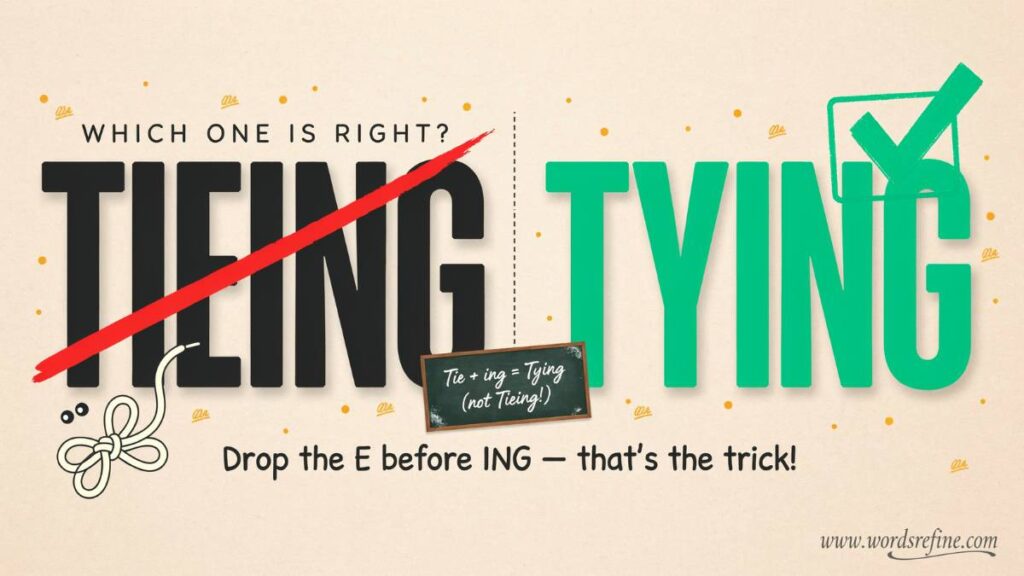
Have you ever hesitated while writing a sentence because you weren’t sure whether to use tying vs tieing? Although both spellings may look reasonable, only one follows standard English spelling rules. The confusion often comes from the base verb tie, as adding ing directly might seem like the natural choice. However, English has a specific rule for verbs ending in ie, which explains why tying is correct and tieing is nonstandard. Understanding this small spelling difference can help you avoid common grammar mistakes and write with greater confidence. Let’s explore the correct form, examine practical examples, and make this tricky spelling choice easier to remember.
Tying vs Tieing Quick Answer
The correct spelling is tying vs tieing, not tieing. Standard English follows the ie-to-y spelling rule when adding ing to verbs that end in ie.
The base verb tie ends with the letters ie. When you add ing, you replace those two letters with y before attaching the ending.
The transformation looks like this:
Tie + ing = Tying
Here are a few examples:
She is tying her shoes before leaving the house.
He is tying a ribbon around the gift.
The two teams are tying in the final quarter.
Although readers will probably understand tieing, it doesn’t follow the standard spelling convention. You should use tying in school assignments, professional emails, articles, reports, and everyday writing.
| Spelling | Usage |
|---|---|
| Tying | Correct in standard American and British English |
| Tieing | Nonstandard spelling |
If you’re unsure which form to use, choose tying. It’s the accepted spelling in modern English.
Learn the difference between confusing more English words
Appendices vs Appendixes Meaning Difference and Usage ?
What Does Tying Mean?
Tying is the present participle and gerund form of the verb tie. It describes the action of fastening, securing, joining, or connecting something.
The meaning depends on the situation. Most often, it refers to using a rope, string, ribbon, lace, or another material to hold something in place. However, people also use the word when talking about sports, relationships, and connections between ideas.
Tying as Fastening or Securing Something
The most familiar use of tying involves fastening two or more things together with a knot, string, rope, ribbon, or similar material.
For example:
She is tying her shoelaces before going for a run.
Dad is tying the boxes together with a strong rope.
I am tying a ribbon around the birthday present.
The worker is tying the loose cables together.
In each sentence, tying describes an action that holds something securely in place.
Tying as Connecting Two Things
Tying can also describe linking separate objects, ideas, events, or pieces of information.
For example:
The detective is tying the evidence to the suspect.
The teacher is tying the lesson to real-life situations.
The report is tying several events together.
She is tying the two arguments together with a clear explanation.
In these examples, nobody is necessarily using a physical knot. Instead, tying describes a connection between different things.
Tying in Sports and Competitions
In sports, tying means reaching the same score as another player or team. It can also describe a competition in which two opponents finish with equal scores.
For example:
The visiting team is tying the game in the final minutes.
Our school is tying for first place in the tournament.
The players are tying the match after scoring an equal number of goals.
Here, tying has nothing to do with ropes or shoelaces. It describes two competitors reaching the same score.
Tying the Knot
The expression tying the knot is an idiom that means getting married.
For example:
Sarah and Daniel are tying the knot next summer.
After dating for six years, they are finally tying the knot.
My cousin is tying the knot in a small family ceremony.
The expression has a figurative meaning. It doesn’t describe fastening a physical rope or string. Instead, it refers to getting married.
Learn the difference between more words people mix up
Hustle vs Hussle Which One Is Correct?
Why Is Tying Correct Instead of Tieing?
The answer comes down to a simple English spelling convention.
When a verb ends in ie, you generally change the final ie to y before adding ing. This creates the correct spelling and avoids an awkward combination of letters.
For example:
Tie becomes tying.
Lie becomes lying.
Die becomes dying.
Vie becomes vying.
Notice what happens in each example. The original ie disappears and y takes its place. The ing ending then attaches to the new form.
This is why tying is correct instead of tieing.
Understanding the IE-to-Y Spelling Rule
The rule is straightforward. When a verb ends in ie, remove those two letters, replace them with y, and then add ing.
Here are some common examples:
| Base verb | Correct form |
|---|---|
| Tie | Tying |
| Lie | Lying |
| Die | Dying |
| Vie | Vying |
For example, lie becomes lying, not lieing. Similarly, die becomes dying, not dieing.
The same pattern explains why tie becomes tying. You don’t keep the original ie when adding ing.
Learn the difference between commonly mixed-up more words
Igniter vs Ignitor Which One Is Correct?
Why Doesn’t Tieing Work?
Writing tieing means keeping the original ie and adding ing without making the required spelling change.
Although that might seem logical, English spelling doesn’t always work by attaching an ending to a word without changing its form. Some verbs require a small adjustment before taking a suffix.
The same thing happens with lie and die. We write lying rather than lieing and dying rather than dieing.
The easiest way to remember the rule is to think of these three familiar words together: tying, lying, and dying. All follow the same spelling pattern.
Tying vs Tieing Understanding the Difference
The main difference between tying vs tieing is their spelling. Tying follows standard English spelling rules, while tieing does not.
Both forms may look understandable, but only tying is appropriate in standard modern writing. The difference becomes clearer when you look at how the verb changes when you add different endings.
| Word | Correct form | Meaning |
|---|---|---|
| Base verb | Tie | To fasten or connect something |
| Third-person singular | Ties | Fastens or connects |
| Past tense | Tied | Fastened or connected |
| Present participle | Tying | Currently fastening or connecting |
| Past participle | Tied | Used with helping verbs such as has or had |
For example, you might say, “I tie my shoes every morning.” If you’re describing an action happening right now, you would say, “I am tying my shoes.” If the action happened yesterday, you would say, “I tied my shoes before leaving.”
The spelling changes according to the grammatical form, but tying remains the correct form when you add ing.
Tying in Everyday Sentences
Tying appears in many everyday situations. You might use it when describing a household task, a sports competition, or a connection between two ideas.
Here are some natural examples that show how the word works in different contexts.
Tying Shoelaces
Tying shoelaces is one of the most common uses of the word. It describes fastening the laces so your shoes stay securely on your feet.
My younger brother is tying his shoelaces before school.
She learned how to tie her shoes without anyone’s help.
He was tying his sneakers when the bus arrived.
Tying a Knot
When you fasten a rope, string, or piece of fabric by making a knot, you’re tying it.
The sailor is tying a strong knot in the rope.
She is tying the string around the package.
We spent several minutes tying the tent securely.
Tying a Ribbon or Bow
People also use tying when decorating gifts, arranging flowers, or securing ribbons.
Mom is tying a beautiful bow around the gift box.
The florist is tying ribbons around the flower arrangements.
I am tying the balloon strings together before the party.
Tying a Game or Match
In sports, tying describes reaching the same score as an opponent. It often happens when a team scores shortly before a match ends.
The home team is tying the game with a late goal.
The two players are tying for first place.
Our team was tying the match until the final whistle.
Tying Ideas Together
In writing, education, and conversation, tying can describe connecting related ideas or explaining how different points support one another.
The final paragraph is tying the main arguments together.
The speaker is tying historical events to current issues.
A good conclusion helps tie the discussion together.
Learn the difference between tricky grammar more words
ECT vs ETC Which One Is Correct?
Tie Tied Ties and Tying Understanding the Verb Forms
The verb tie changes its form depending on the tense and the subject. Understanding these forms helps you avoid mistakes when writing sentences.
Tie is the base form. You use it for general statements, commands, and after certain helping verbs.
Ties is the third-person singular form. It usually appears with he, she, or it in the present tense.
Tied is both the simple past tense and the past participle. It describes an action that has already happened or appears with a helping verb.
Tying is the present participle and gerund. It describes an ongoing action or an activity used as a noun.
| Verb form | Example |
|---|---|
| Tie | I tie my shoes every morning. |
| Ties | She ties her hair before exercising. |
| Tied | He tied the package yesterday. |
| Tying | They are tying the boxes together. |
Is Tying a Gerund or a Present Participle?
Tying can function as both a gerund and a present participle. Its role depends on how you use it in a sentence.
When tying acts as a noun, it is a gerund.
For example: Tying a secure knot takes practice.
Here, tying names an activity and functions as the subject of the sentence.
When tying forms part of a verb phrase, it is a present participle.
For example: She is tying her shoelaces.
In this sentence, tying works with the helping verb is to describe an action happening now.
The spelling stays the same in both cases. You always write tying, not tieing.
Learn the difference between confusing word pairs
Smokey vs Smoky Which One Is Correct?
Common Mistakes When Using Tying vs Tieing
Even simple words can cause confusion when their spelling doesn’t follow the pattern people expect. tying vs tieing is a good example because adding ing directly to tie might seem reasonable.
Here are some mistakes to watch for when using the word.
Writing Tieing Instead of Tying
This is the most common spelling mistake. People sometimes keep the original ie and attach ing directly to the base verb.
Incorrect: She is tieing her shoes.
Correct: She is tying her shoes.
Remember to replace ie with y before adding ing.
Confusing Tying With Tied
Tying and tied are both correct, but they serve different grammatical purposes.
Incorrect: Yesterday, she was tied her shoes.
Correct: Yesterday, she tied her shoes.
Correct: She is tying her shoes now.
Use tied for a completed action in the simple past. Use tying when describing an ongoing action.
Using Tieing in Formal Writing
You might occasionally encounter tieing in informal writing or older material. However, that doesn’t make it the standard spelling.
In professional documents, academic assignments, business communication, and published articles, use tying.
A spelling checker may also flag tieing as an error. When that happens, choose the standard form rather than trying to defend an unnecessary spelling variation.
Forgetting That the Same Rule Applies to Other Words
The spelling pattern isn’t limited to tie. Other verbs ending in ie follow it as well.
For example, lie becomes lying and die becomes dying.
Once you recognize the pattern, you’ll be less likely to make the same mistake with other words.
Learn the difference between often confused words
Complement vs Compliment Meaning Differences and Examples?
Is Tying Spelled the Same Way in American and British English?
Yes. Both American and British English use tying as the correct spelling.
Some English words have different spellings depending on the country. For example, American English uses color, while British English generally uses colour. However, tying doesn’t change across these varieties.
| English variety | Correct spelling |
|---|---|
| American English | Tying |
| British English | Tying |
| Canadian English | Tying |
| Australian English | Tying |
You don’t need to change the spelling when writing for readers in different English-speaking countries.
Whether you’re preparing an American school assignment, a British business email, or an Australian article, tying is the form to use.
Other Words That Follow the Same Spelling Rule
Tying isn’t the only word that follows the ie-to-y spelling pattern. Several other English verbs change in the same way when you add ing.
Learning these examples makes the rule easier to recognize and helps you avoid similar spelling mistakes.
Lie and Lying
The verb lie means to rest in a horizontal position or to say something untrue.
When you add ing, lie becomes lying.
For example:
The dog is lying beside the fireplace.
She is lying on the sofa and reading a book.
He was lying about where he had been.
In each sentence, lying is the correct form. Lieing is nonstandard.
Die and Dying
The verb die refers to the end of life or the failure of something to function.
When you add ing, die becomes dying.
For example:
The flowers are dying because nobody has watered them.
The old battery is dying and needs replacing.
The patient was dying when the doctors arrived.
Just like tying and lying, dying follows the same spelling pattern. You replace ie with y before adding ing.
Vie and Vying
The verb vie means to compete or struggle for something.
When you add ing, vie becomes vying.
For example:
Several students are vying for the scholarship.
The two companies are vying for the same contract.
Many athletes are vying for a place on the national team.
Although vying is less common in everyday conversation than tying or lying, it follows the same rule.
A Quick Comparison
| Base verb | Correct form | Nonstandard form |
|---|---|---|
| Tie | Tying | Tieing |
| Lie | Lying | Lieing |
| Die | Dying | Dieing |
| Vie | Vying | Vieing |
These examples show a consistent pattern. When a verb ends in ie, replace those letters with y before adding ing.
Common Expressions With Tying
Tying appears in several familiar English expressions. Some describe physical actions, while others have figurative meanings.
Understanding these expressions will help you recognize how people use the word in everyday conversations and writing.
Tying Up
Tying up can mean fastening something securely. It can also mean finishing a task or keeping someone occupied.
For example:
She is tying up the loose ends of the project.
The farmer is tying up the animals before leaving.
I have a few emails to answer, so I’ll be tying up some work this afternoon.
Tying Together
Tying together means connecting two or more things. It can refer to physical objects, ideas, or related events.
For example:
The rope is tying the two wooden pieces together.
The final chapter is tying the story’s different events together.
The teacher is tying together everything the students learned during the lesson.
Tying Down
Tying down means securing something so it cannot move freely.
For example:
We are tying down the furniture before transporting it.
The workers are tying down the equipment on the truck.
Strong straps are useful for tying down heavy objects.
Tying Off
Tying off means securing the end of a rope, thread, or another material with a knot. People also use this expression in activities such as sewing and sailing.
For example:
The sailor is tying off the rope near the dock.
She is tying off the thread after finishing the repair.
Tying the Knot
Tying the knot means getting married. It is a familiar expression that people often use when discussing weddings.
For example:
My best friend is tying the knot this weekend.
They are tying the knot after years of dating.
The couple announced that they would be tying the knot next spring.
Synonyms of Tying
The best synonym for tying depends on the meaning you want to express. If you’re talking about fastening something, you might use securing or knotting. If you’re describing a connection between ideas, linking or connecting may work better.
Here are some useful alternatives.
| Synonym | Meaning | Example |
|---|---|---|
| Fastening | Holding something in place | She is fastening the strap. |
| Securing | Making something stable or safe | He is securing the package. |
| Binding | Holding things together | The string is binding the papers. |
| Knotting | Making a knot | She is knotting the rope. |
| Attaching | Joining one thing to another | He is attaching the label. |
| Connecting | Bringing things into contact or relationship | The bridge is connecting two areas. |
| Linking | Creating a connection | The report is linking the events. |
| Wrapping | Covering or winding something around an object | She is wrapping the ribbon around the box. |
| Joining | Bringing separate things together | They are joining the two pieces. |
Keep in mind that these words aren’t always interchangeable. For example, fastening and securing work well when describing physical objects, while linking and connecting are often more suitable for ideas or information.
Learn the difference between basic English word mistakes
Too vs To Meaning Differences Examples and Grammar Rules?
How to Remember the Correct Spelling
If you regularly confuse tying vs tieing, a simple memory trick can help.
Think of three familiar words: tying, lying, and dying. All three follow the same spelling pattern. Their base forms end in ie, but those letters change to y before ing is added.
You can remember this simple rule: when a verb ends in ie, change ie to y before adding ing.
For example:
Tie becomes tying.
Lie becomes lying.
Die becomes dying.
Once you remember these examples, you’ll have a much easier time spelling similar words correctly.
Learn the difference between commonly misused words
Lay Down vs Lie Down Meaning and Examples ?
Practice Session Tying vs Tieing
Complete each sentence with the correct word or verb form.
1. She is ______ her shoelaces before going for a walk.
2. My father taught me how to ______ a strong knot.
3. The children are ______ ribbons around their gift boxes.
4. He spent several minutes ______ the rope to the fence.
5. The two teams are ______ the game after scoring the same number of goals.
6. My best friend is ______ the knot next weekend.
7. The sailor is ______ the boat securely to the dock.
8. She was ______ her hair when the phone rang.
9. The teacher is ______ the lesson to real-life examples.
10. We are ______ the boxes together before moving them.
11. The correct spelling is ______, not tieing.
12. He is ______ his tie before leaving for the wedding.
13. The players are ______ for first place in the competition.
14. She is ______ a ribbon around the birthday present.
15. The workers are ______ down the equipment on the truck.
16. I am ______ up the loose ends of the project.
17. The dog is ______ beside the fireplace.
18. The flowers are ______ because nobody has watered them.
19. Several students are ______ for the scholarship.
20. The couple announced that they are ______ the knot next spring.
21. She ______ her shoes every morning before leaving home.
22. Yesterday, he ______ the package with a piece of string.
23. The final paragraph is ______ all the main ideas together.
24. Is ______ a knot difficult for beginners?
25. The visiting team is ______ the score in the final minutes.
Answers
1. Tying
2. Tie
3. Tying
4. Tying
5. Tying
6. Tying
7. Tying
8. Tying
9. Tying
10. Tying
11. Tying
12. Tying
13. Tying
14. Tying
15. Tying
16. Tying
17. Lying
18. Dying
19. Vying
20. Tying
21. Ties
22. Tied
23. Tying
24. Tying
25. Tying
Here’s a trusted source for clear more words Comparison:
FAQs
Is tieing or tying correct?
Tying is the correct spelling in standard English. Tieing is nonstandard. When you add ing to the verb tie, you replace ie with y to form tying.
Is it correct to say “tying out” vs“tieing out”?
Tying out is the correct spelling if you’re using the verb tie. Depending on the context, it can describe fastening something outside or securing an animal with a rope. However, if you mean testing something, the correct phrase may be trying out.
Why do people say “tying the knot”?
Tying the knot is a familiar expression that means getting married. It represents the idea of joining two people together through marriage. The phrase has been used figuratively for generations.
How do you spell tying, as in “I’m tying my shoes”?
The correct spelling is tying. For example, “I’m tying my shoes before going outside.” The verb tie changes to tying when you add ing. You replace the final ie with y rather than keeping both letters.
How do you write tying a tie?
The correct phrase is tying a tie. For example, “He is tying a tie before attending the wedding.” The first word describes the action, while the second refers to the piece of clothing.
Is it tying vs tieing a game?
Tying a game is correct. In sports, tying means bringing the score level with the opposing team. For example, “The players are tying the game with a late goal.” Tieing a game is nonstandard.
What is another word for tying?
The best alternative depends on the context. Common options include fastening, securing, knotting, binding, attaching, and connecting. For example, you could say “securing a package” instead of “tying a package.”
What does tying up mean?
Tying up has several meanings. It can describe fastening something securely, finishing a task, or keeping someone occupied. For example, “I’m tying up the loose ends of the project” means completing the remaining details.
Which is correct: “tying up” vs “tieing up”?
Tying up is correct. The verb tie changes to tying when you add ing. For example, “She is tying up the boxes before moving them.” Tieing up is a nonstandard spelling.
Is it tied to vs tied too?
Tied to is correct when you mean connected, attached, or related to something. For example, “Her success is tied to her hard work.” Too means also or more than necessary, so it doesn’t fit this expression.
Is it correct to say “tying the knot” or “tieing the knot”?
Tying the knot is correct. It is a common expression that means getting married. For example, “My friends are tying the knot next month.” Tieing the knot is not the standard spelling
Learn the difference between everyday English mistakes
Internet vs Internet Which One Is Correct?
Conclusion
A tiny spelling mistake can turn a perfectly good sentence into an unexpected grammar puzzle. That’s exactly what happens with tying vs tieing. Although both may look reasonable, tying is the correct spelling in standard English. The trick is to replace ie with y before adding ing. The same rule explains why we write lying, dying, and vying. Once you remember this pattern, there’s no need to tie yourself in knots over the spelling! Whether you’re fastening your shoes, securing a package, or talking about a couple getting married, always choose tying. After all, tying your shoelaces should be easier than tying your brain in knots over two letters.

Diora AJS she is an experienced blogger and passionate English language enthusiast at Words Refine. With a keen eye for language and a love for clear communication, she writes practical content about grammar, word meanings, usage, and commonly confused terms. Her goal is to make English easier to understand through clear explanations and relatable examples, helping readers write accurately and communicate with confidence.