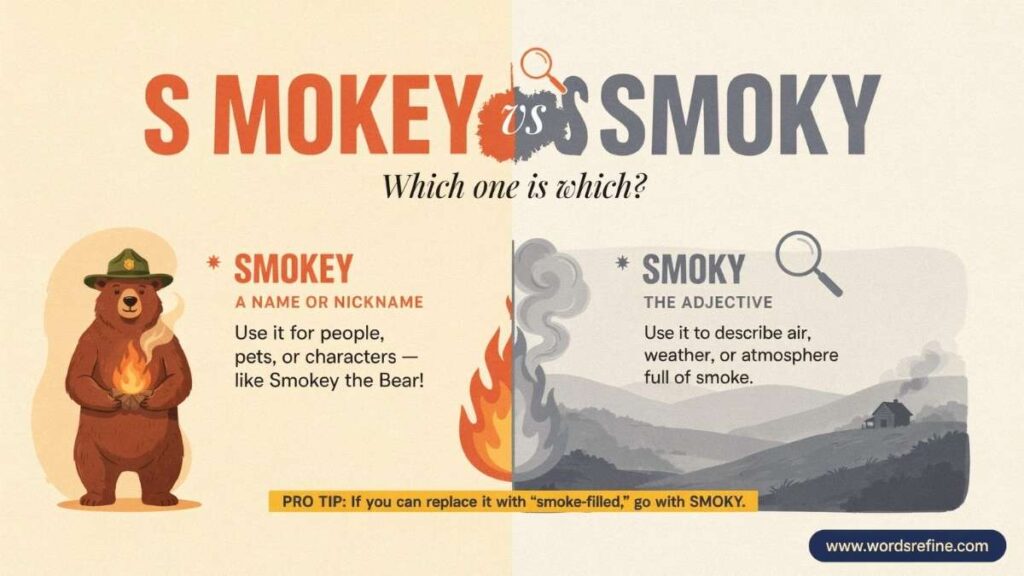
The difference between Smokey vs Smoky may look like a tiny spelling detail, but that extra “e” can turn an ordinary description into a name. If you have ever paused while writing about smoky barbecue sauce or the Great Smoky Mountains, you are not alone. The confusion makes sense because both spellings exist, yet they do not always fit the same situations. So, which one should you choose? This guide to smoky vs. Smokey explains the difference with clear examples, common mistakes, and practical tips. By the end, you will know which spelling to use without letting one little letter cloud your judgment.
Smokey vs Smoky Quick Answer
Smoky is the standard spelling of the adjective in both American and British English. It describes something that contains smoke, produces smoke, resembles smoke, or has a smoke-related smell or flavor.
Smokey is also a recognized spelling variant. Additionally, it appears in proper names, including Smokey Bear, the well-known wildfire-prevention mascot.
The easiest way to remember the difference is to use smoky in ordinary descriptions and preserve Smokey when it belongs to an established name.
For example, you would write, “The kitchen became smoky after the toast burned.” However, you would write, “Smokey Bear teaches people how to prevent wildfires.”
The first sentence describes an environment, while the second refers to a specific character. Although the words look similar, their roles in these sentences differ.
Learn the difference between commonly misused words
Saucey vs Saucy Meaning Differences and Correct Usage ?
What Is the Difference Between Smokey vs Smoky?
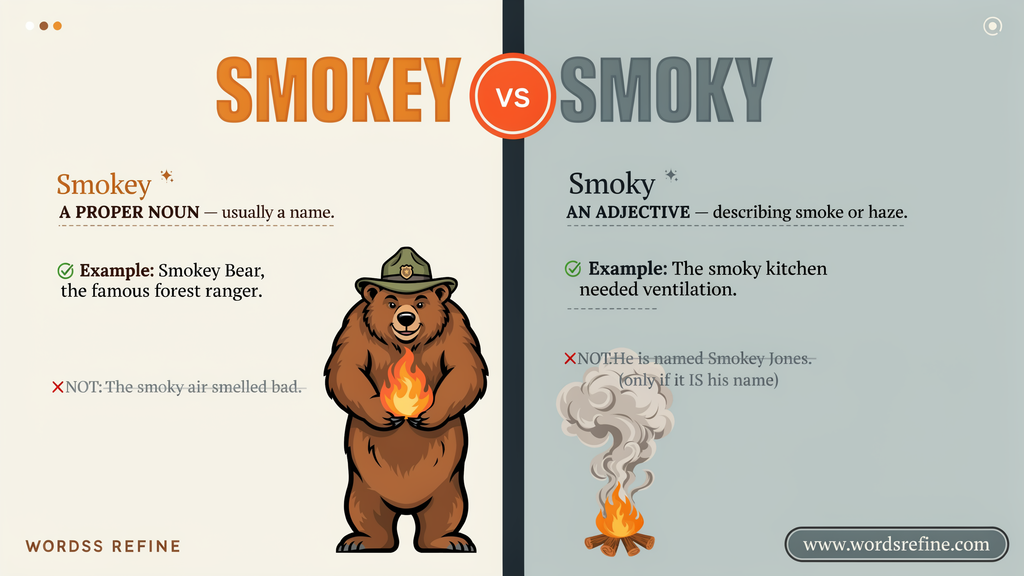
The difference between smoky vs smokey mainly involves spelling conventions and context. Both forms can describe something associated with smoke, but smoky is the conventional choice in standard English.
The extra letter in smokey doesn’t usually create a different meaning. Instead, it produces an alternative spelling that appears in certain writing styles, informal descriptions, and proper names.
| Feature | Smoky | Smokey |
|---|---|---|
| Standard adjective spelling | Yes | Recognized variant |
| Describes smoke-related qualities | Yes | Yes, when used as an adjective |
| Preferred in formal writing | Generally | Less commonly |
| Appears in proper names | Yes | Yes |
| Example | Smoky barbecue sauce | Smokey Bear |
As the table shows, neither spelling is automatically correct in every situation. The surrounding sentence determines which form makes sense.
For instance, smoky describes a quality in the sentence, “The room smells smoky.” In contrast, Smokey forms part of a proper name in the sentence, “Smokey Bear appeared in a public-service announcement.”
Capitalization helps distinguish names from ordinary descriptions. However, the spelling of a proper name also depends on its established form.
Is Smokey Ever Correct?
Yes, smokey is a real spelling. It appears as a variant of smoky and can describe a smoke-related smell, flavor, or appearance.
Nevertheless, a recognized spelling variant isn’t necessarily the best choice for every piece of writing. In school assignments, business reports, recipes, and professional articles, smoky is generally the safer option.
Consider these examples:
1The restaurant serves smoky grilled chicken.
2The restaurant serves smokey grilled chicken.
3The restaurant calls its signature dish the Smokey Mountain Burger.
The first sentence follows standard spelling. The second uses the less common variant. The third preserves a deliberately chosen dish name.
Therefore, the best approach is to follow standard spelling for ordinary descriptions while respecting the established spelling of names.
Learn the difference between commonly mixed-up more words
Temporary vs Temporarily Meaning Difference and Correct Usage?
What Does Smoky Mean?
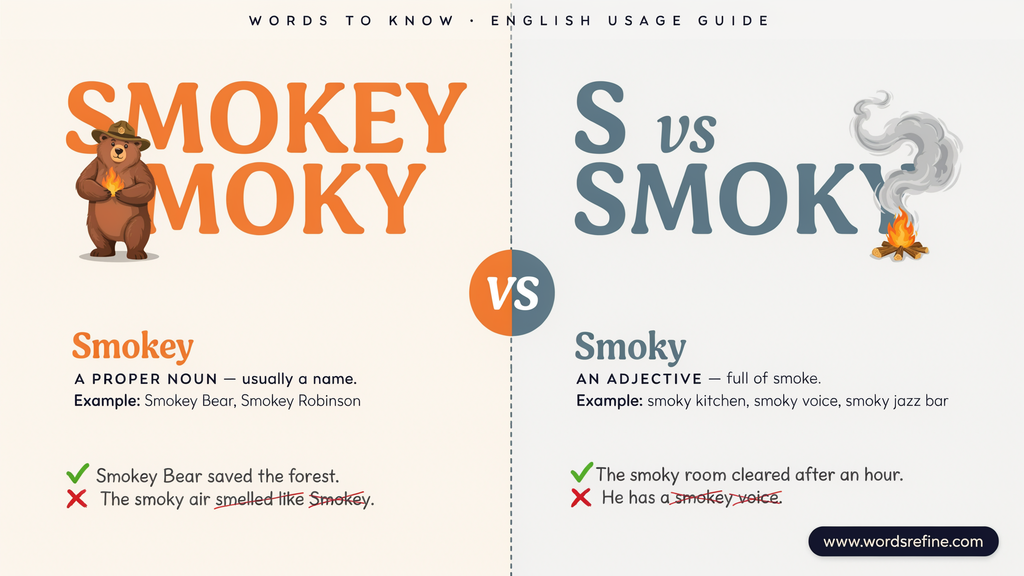
Smoky is an adjective that describes something containing, producing, or resembling smoke. It can also describe a smell, flavor, color, or appearance associated with smoke.
For example, a smoky room contains smoke, while a smoky flavor suggests the taste or aroma of food cooked over a fire. Similarly, a smoky gray color resembles the muted appearance of smoke.
However, the word doesn’t always mean that actual smoke is present. A smoky-tasting sauce might contain smoke flavoring rather than ingredients exposed to burning wood.
Smoky as Something Filled With Smoke
A room, building, or outdoor area becomes smoky when smoke fills the air or creates a hazy atmosphere.
For example, the kitchen became smoky after someone burned the toast. Likewise, a smoky haze might drift across a road after a brush fire.
In these situations, smoky describes the environment and the visible or noticeable effects of smoke. It can suggest a strong odor, reduced visibility, or discomfort.
The word also appears in descriptions of fire-related situations. Heavy smoke can contain harmful particles and gases, so a smoky environment isn’t always harmless.
Although smoky and smoke-filled have similar meanings, they aren’t identical in every context. Smoky describes the overall quality of an environment, while smoke-filled emphasizes the presence of smoke.
Smoky as a Smell or Aroma
A smoky smell often reminds people of a fireplace, campfire, burning wood, or food cooked over an open flame.
For instance, a cabin might have a pleasant smoky smell after someone lights a fireplace. Similarly, a jacket might smell smoky after an evening spent around a campfire.
The adjective describes what someone senses without necessarily identifying the source.
A smoky odor might come from burning wood, tobacco smoke, charred food, or another material. Therefore, the word alone doesn’t tell you exactly what caused the smell.
Smoky as a Flavor
Food writers often use smoky to describe a taste associated with smoke, char, or wood-fired cooking.
Smoky barbecue sauce, smoked cheese, grilled vegetables, and smoked meats are familiar examples. Depending on how food is prepared, its smoky flavor may develop through exposure to wood smoke, charcoal grilling, or high-heat cooking.
However, not every product with a smoky taste has been exposed to actual smoke. Some manufacturers use smoke flavoring to create a similar effect.
A smoky flavor profile can include earthy, charred, woodsy, and savory notes. These qualities often work together, although they don’t mean exactly the same thing.
For example, a smoky barbecue sauce might combine a deep smoke flavor with sweetness, tanginess, and spice. That combination gives the sauce more complexity than smoke flavor alone.
When writing a recipe or food review, use smoky flavor or smoky taste. These are the conventional expressions in standard English.
It’s also helpful to distinguish smoky from smoked. Smoky describes a flavor or characteristic, while smoked often describes a preparation method.
Smoky cheese, for instance, describes cheese with a smoke-related flavor. Smoked cheese usually refers to cheese that has undergone a smoking process.
Smoky as a Color or Appearance
Smoky can also describe something that resembles smoke in color or appearance.
A smoky gray wall might have a muted gray tone, while smoky glass may look tinted or translucent. Similarly, a smoky quartz gemstone has a characteristic brownish-gray to dark brown color.
In these examples, the adjective describes appearance rather than the presence of smoke.
This meaning shows how descriptive words can develop beyond their literal origins. A smoky-colored object doesn’t need to contain smoke, just as a sky-blue fabric doesn’t contain the sky.
Smoky in Makeup and Beauty
In makeup, smoky eye is the conventional term for a style that uses blended eyeshadow to create a soft, shadowy effect around the eyes.
The look often features black, gray, brown, or bronze shades, although colorful variations are also popular.
For example, a makeup artist might create a smoky eye by blending charcoal eyeshadow around the eyelids. The result can look subtle or dramatic, depending on the colors and techniques used.
Although smokey eye makeup appears in advertisements, tutorials, and social media posts, smoky eye makeup is the preferred spelling in standard writing.
Learn the difference between tricky grammar more words
Stary vs Starry Meaning Differences Examples and Correct ?
What Does Smokey Mean?
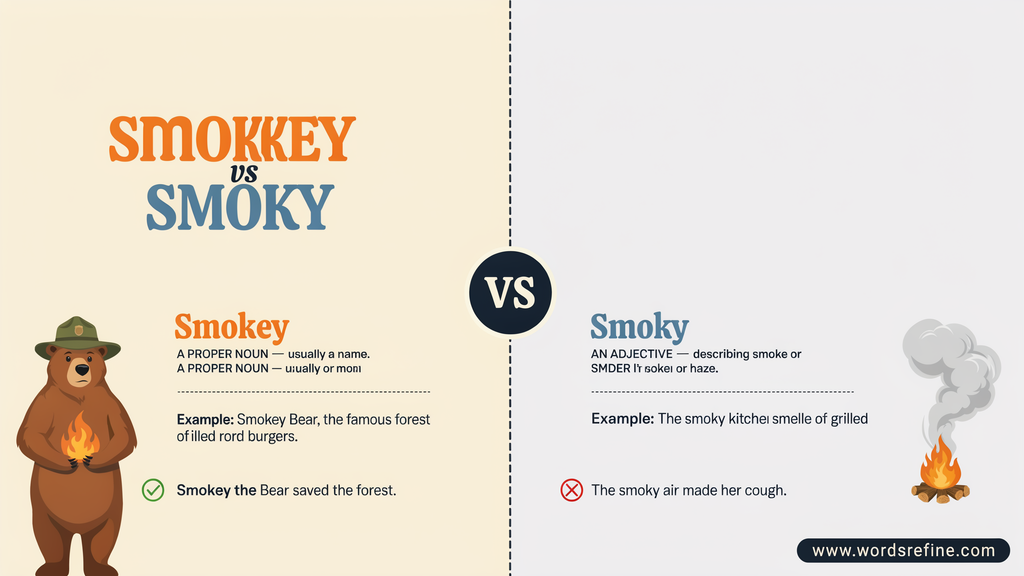
Smokey can function as a variant spelling of smoky. It also appears as a proper name or nickname.
When used as an adjective, smokey generally carries the same smoke-related meaning as smoky. For instance, both smokey aroma and smoky aroma can describe a smell associated with smoke.
However, smoky remains the more conventional spelling in edited English. Therefore, writers should consider their audience and purpose before choosing the variant.
Smokey as a Proper Name
A proper noun identifies a particular person, place, organization, character, or other specific entity. Unlike ordinary adjectives, proper names follow their established spellings.
Smokey Bear is a familiar example. The mascot promotes wildfire prevention in the United States through public education campaigns.
Smokey Robinson provides another example. He is an American singer, songwriter, and record producer known for his connection to Motown.
The 1977 film Smokey and the Bandit also uses this spelling in its official title.
In each case, Smokey forms part of an established name. Changing it to Smoky would alter the name rather than correct a spelling mistake.
The same principle applies to business names, product titles, and other official labels. If a restaurant calls its signature sandwich the Smokey Mountain Special, preserve that spelling when referring to the dish by its official name.
Smokey as a Nickname
People sometimes use Smokey as a nickname. Such names can develop from a person’s appearance, habits, occupation, or personal associations.
For example, a group of friends might call someone Smokey because he enjoys tending a wood-burning smoker during weekend barbecues.
In this sentence, Smokey functions as a nickname rather than an ordinary adjective. Capitalization signals that the writer is referring to a particular person.
Once a spelling becomes part of someone’s chosen name, it should remain consistent even if it differs from the standard spelling of the related adjective.
Smokey in Informal Writing
Some writers use smokey when describing food, drinks, scents, or colors. You might encounter the variant on restaurant menus, product packaging, promotional material, and social media.
However, its appearance in informal writing doesn’t make it the preferred spelling for every situation.
For example, a recipe would generally describe a sauce as having a smoky flavor. A restaurant might instead use Smokey Chipotle Sauce as the official name of a product.
Both forms can make sense in their respective contexts. The first follows conventional spelling, while the second preserves a chosen product name.
Smokey vs Smoky in American and British English
A common misconception is that smoky belongs to American English while smokey belongs to British English, or the other way around. That distinction isn’t accurate.
Smoky is the standard adjective spelling in both varieties of English. Smokey also appears as a variant, but it isn’t an exclusively British or American form.
Smoky vs Smokey in American English
In American English, smoky is the preferred spelling for ordinary descriptions.
For example, an American writer would generally describe a room as smoky after someone burns toast. A food critic might praise a restaurant’s smoky barbecue ribs, while a makeup artist might recommend a smoky eye for an evening event.
The same spelling applies to Great Smoky Mountains National Park and smoky quartz.
Meanwhile, established names such as Smokey Bear and Smokey Robinson retain their original spelling.
American English includes many spelling conventions that differ from British English. However, smoky versus smokey isn’t a regional distinction in the same way as color versus colour.
Smoky vs Smokey in British English
British English follows the same basic rule. Smoky is the conventional spelling for the adjective, while smokey may appear as a variant or as part of a proper name.
For example, a British writer might describe a smoky kitchen, a smoky barbecue sauce, or a smoky haze above the hills.
Although British English often uses different spellings from American English, writers don’t need to switch from smoky to smokey when addressing a British audience.
Consequently, smoky is the safest choice for standard descriptive writing on either side of the Atlantic.
Learn the difference between confusing word pairs
Scrapped vs Scraped Differences Examples and Correct Usage?
Smokey vs Smoky in Everyday Expressions
Everyday expressions make the difference between the two spellings easier to understand. Food, makeup, geographical names, and familiar titles all show how context affects word choice.
Smoky vs Smokey Food
When describing food, smoky is the conventional spelling.
A smoky barbecue flavor might come from wood smoke, charcoal grilling, or a combination of spices and smoke flavoring. The adjective describes the taste rather than necessarily identifying the cooking method.
For example, a restaurant might serve smoky barbecue ribs, while a chef might add smoked paprika to give a soup a smoky aroma.
Smokey barbecue flavor also appears in informal writing. However, smoky barbecue flavor is the better choice for recipes, restaurant reviews, and professional food articles.
The distinction between smoky and smoked is particularly useful in food writing. Smoky barbecue describes a smoke-related flavor, while smoked meat refers to meat prepared using smoke.
Although the terms can overlap, they aren’t interchangeable in every sentence.
Smoky vs Smokey Mountains
The correct geographical name is Great Smoky Mountains, not Great Smokey Mountains.
Great Smoky Mountains National Park lies along the border of Tennessee and North Carolina. The park is known for its forested mountains, scenic trails, wildlife, and the bluish haze that often appears above its ridges.
The name reflects the smoke-like appearance of this natural haze. Vegetation releases volatile organic compounds that contribute to atmospheric processes responsible for the characteristic bluish effect.
When referring to the park, always preserve its official spelling. Great Smoky Mountains National Park is the correct name.
Smoky vs Smokey Quartz
Smoky quartz is a recognized variety of quartz with a brownish-gray to dark brown color.
Some specimens appear pale and translucent, while others look much darker. Their color develops through natural processes that affect the mineral’s crystal structure.
For example, a jeweler might set a smoky quartz stone in a silver ring, or a collector might display a smoky quartz crystal alongside other minerals.
Smokey quartz is less conventional in ordinary mineral descriptions. However, a seller may use Smokey in an official product name, in which case the chosen name should remain unchanged.
Smokey Bear Why the Name Has an E
Smokey Bear is a familiar mascot used to promote wildfire prevention in the United States.
The campaign encourages people to act responsibly around fires and take steps to prevent human-caused wildfires.
Although smoky is the standard adjective, the mascot’s established name is Smokey Bear. Writers should preserve that spelling rather than changing it to match the ordinary adjective.
People sometimes call the mascot Smokey the Bear in casual conversation. However, its official name is Smokey Bear.
Smokey Robinson and Smokey and the Bandit
Other familiar names demonstrate the same principle.
Smokey Robinson is an American singer, songwriter, and record producer closely associated with Motown. His established professional name uses Smokey.
Similarly, Smokey and the Bandit is the title of a 1977 American action-comedy film starring Burt Reynolds.
Changing Smokey to Smoky in either case would make the reference inaccurate. Proper names and titles retain their established spellings even when they differ from conventional adjective forms.
Smokey as Police Officer Slang
In some informal American contexts, Smokey appears as slang for a police officer, particularly in trucking and highway-related conversations.
The term is associated with the image of a highway patrol officer wearing a broad-brimmed hat and with the familiar Smokey Bear name.
For example, a truck driver might warn another driver that a Smokey is watching traffic near a highway exit.
However, the slang varies by context and region. In formal writing, police officer or highway patrol officer is usually clearer and more appropriate.
Learn the difference between often confused words
Tinder vs Tender Differences Examples and Correct Usage?
Common Mistakes With Smokey vs Smoky
Although the spelling difference looks small, a few common mistakes can make writing less accurate or consistent.
One mistake is assuming that smokey is always wrong. The word exists as a spelling variant and appears in established names. The better approach is to distinguish ordinary descriptive usage from proper names.
Another mistake is treating smokey as an exclusively British spelling. Both American and British English generally use smoky as the standard adjective.
Capitalization can also cause confusion. In the sentence “The air became smoky,” the adjective doesn’t need a capital letter. However, Smokey should retain its capital letter when it forms part of a proper name.
Writers should also avoid changing official names to match a general spelling rule. Great Smoky Mountains National Park and Smokey Bear use different spellings because those are their established names.
Finally, don’t confuse smoky with smoked. Smoky describes a characteristic, such as a smell or flavor, while smoked often describes something exposed to smoke during preparation.
For instance, smoky sauce describes the sauce’s flavor, while smoked salmon refers to salmon prepared using a smoking process.
Smokey vs Smoky Examples in Sentences
The following examples show how to use both spellings naturally.
Examples of Smoky in a Sentence
The fireplace left a smoky smell in the living room.
A smoky haze drifted across the road after the brush fire.
The chef added chipotle peppers to create a smoky barbecue sauce.
Her smoky eye makeup complemented her evening dress.
The jeweler set a smoky quartz stone in a silver ring.
The smoky air made it difficult to see the road clearly.
I prefer smoky cheese with a deep, earthy flavor.
The mountains looked blue and smoky in the morning light.
The grilled mushrooms had a rich, smoky taste.
A smoky aroma filled the kitchen as the vegetables roasted.
In each sentence, smoky functions as a descriptive adjective. It describes a quality rather than naming a particular person or entity.
Examples of Smokey in a Sentence
1Smokey Bear appears in wildfire-prevention campaigns.
2mokey Robinson helped shape the Motown sound.
3Smokey and the Bandit became a well-known American comedy film.
The restaurant named its signature sandwich the Smokey Mountain Special.
The product description used smokey to describe the sauce’s aroma.
His friends called him Smokey because he loved cooking over a wood fire.
These examples show why context matters. Some use Smokey in established names, while others illustrate its use as a nickname or adjective variant.
Learn the difference between basic English word mistakes
Jibe vs Jive What’s the Difference?
Practice session Smokey vs Smoky
1. The kitchen became ______ after the toast burned.
2. The chef added a ______ flavor to the barbecue sauce.
3. ______ Bear teaches people how to prevent wildfires.
4. We noticed a ______ haze above the mountains.
5. She created a ______ eye look using gray eyeshadow.
6. The restaurant serves ______ grilled chicken.
7. The cabin smelled ______ after we lit the fireplace.
8. ______ Robinson is famous for his music career.
9. The jeweler displayed a beautiful ______ quartz ring.
10. The air became ______ as the campfire grew larger.
11. The chef prepared a ______ sauce with chipotle peppers.
12. The official name of the national park is Great ______ Mountains National Park.
13. The film ______ and the Bandit was released in 1977.
14. The jacket had a ______ smell after our camping trip.
15. The menu described the ribs as having a rich, ______ flavor.
16. My friends gave him the nickname ______ because he loved tending the grill.
17. The makeup artist created a dramatic ______ eye look.
18. A ______ aroma filled the room as the wood burned.
19. The wildfire-prevention mascot is named ______ Bear.
20. The mountains looked blue and ______ in the morning light.
21. The restaurant named its signature burger the ______ Mountain Burger.
22. We ordered ______ cheese to serve with crackers.
23. The living room became ______ after someone burned wood in the fireplace.
24. The famous singer’s name is spelled ______ Robinson.
25. The trail offered a beautiful view of the Great ______ Mountains.
Answers
- smoky
- smoky
- Smokey
- smoky
- smoky
- smoky
- smoky
- Smokey
- smoky
- smoky
- smoky
- Smoky
- Smokey
- smoky
- smoky
- Smokey
- smoky
- smoky
- Smokey
- smoky
- Smokey
- smoky
- smoky
- Smokey
- Smoky
Here’s a trusted source for clear more words Comparison:
FAQs
Why is it spelled smoky instead of smokey?
Smoky is the standard spelling of the adjective used to describe something filled with smoke, smelling of smoke, or having a smoke-like flavor or appearance. Smokey is a recognized variant, but it also appears in proper names. For everyday descriptions, smoky is the preferred choice.
Which spelling is correct, smokey or smoky?
Both spellings exist, but smoky is the standard form in ordinary writing. For example, you would describe a smoky room, smoky barbecue sauce, or a smoky aroma. However, you should preserve Smokey in established names such as Smokey Bear.
Why don’t the Smoky Mountains have an E?
The official name is Great Smoky Mountains. The word smoky describes the blue, smoke-like haze that often hangs over the mountains. The name reflects their distinctive appearance, so the established spelling does not include an E.
Is smokey or smoky the correct spelling in the UK?
Smoky is the standard spelling in British English, just as it is in American English. Although smokey occasionally appears as a variant, smoky is the conventional choice when describing smoke, smells, flavors, or appearances.
Why are dogs not allowed on most trails in the Smokies?
Great Smoky Mountains National Park restricts dogs on most trails to protect wildlife, limit disturbances, and keep pets and visitors safe. However, dogs are permitted on the Gatlinburg Trail and the Oconaluftee River Trail. They are also allowed in designated areas, including certain campgrounds and picnic areas. Where permitted, dogs must remain on a leash no longer than six feet.
Is it spelled Smoky Mountain or Smokey Mountain?
The official name is Great Smoky Mountains National Park, with no E in Smoky. Use Smoky Mountain when referring to the mountains with that spelling. However, retain Smokey when it forms part of an established name, such as Smokey Bear.
Learn the difference between commonly misused words
Foward vs Forward Meaning Spelling and Correct Usage
Conclusion
The difference between smoky vs Smokey is easier to remember than you might think. Use smoky when describing a smell, flavor, appearance, or anything associated with smoke. On the other hand, use Smokey when writing established names such as Smokey Bear or Smokey Robinson. Both American and British English favor smoky as the standard adjective, so you don’t need to worry about regional spelling differences. Once you understand this simple rule, choosing the correct spelling becomes much easier. After all, a little smoke is fine in your writing, but spelling confusion shouldn’t leave you in a haze!

Diora AJS she is an experienced blogger and passionate English language enthusiast at Words Refine. With a keen eye for language and a love for clear communication, she writes practical content about grammar, word meanings, usage, and commonly confused terms. Her goal is to make English easier to understand through clear explanations and relatable examples, helping readers write accurately and communicate with confidence.