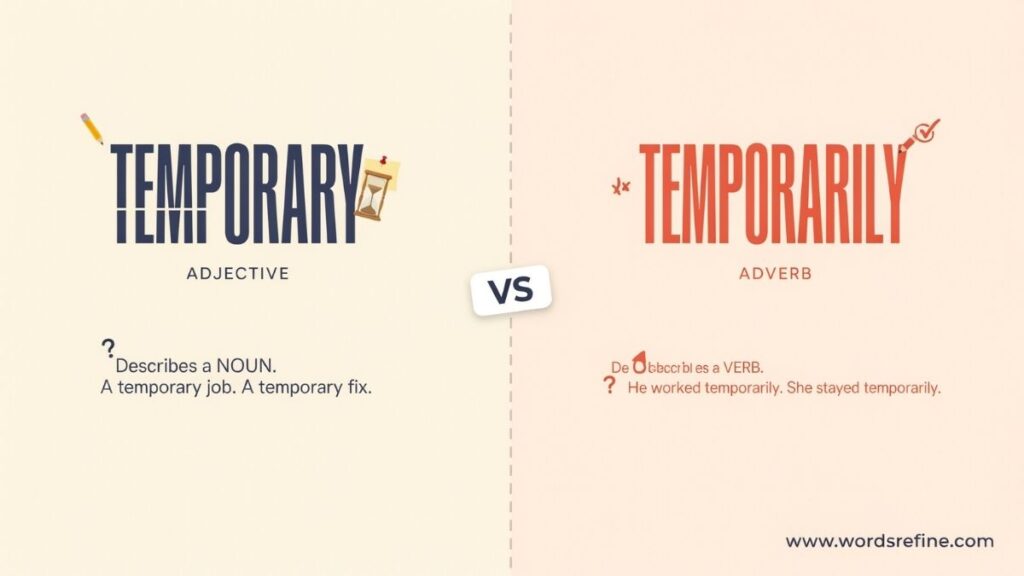
Have you ever hesitated over temporary vs temporarily while writing a sentence? These similar-looking words can trip up anyone, but choosing the right one doesn’t have to feel like a grammar test. Although both relate to something that lasts for a limited time, they serve different purposes. “Temporary” describes a person, thing, or situation, while “temporarily” modifies an action or describes a short-lived condition. For instance, you might find a temporary job while your favorite café temporarily closes for repairs. Once you understand this simple distinction, you’ll avoid common mistakes and write with greater confidence. Let’s explore their meanings, differences, and everyday uses.
What Is the Difference Between Temporary vs Temporarily?
Although temporary vs temporarily both relate to limited duration, they have different grammatical roles. Temporary is an adjective, whereas temporarily is an adverb. This difference determines where each word belongs in a sentence.
Temporary describes a noun or explains the condition of a subject. Temporarily usually modifies a verb or an adjective to show that an action or state won’t continue indefinitely.
Consider these examples:
Temporary: The company hired a temporary employee.
Temporarily: The company temporarily transferred an employee to another branch.
In the first sentence, temporary describes the employee’s position or employment arrangement. In the second, temporarily explains the limited duration of the transfer.
The same distinction appears in many everyday expressions. A temporary job describes a type of job, while working temporarily describes how long someone works in a particular role or place. Likewise, a temporary suspension describes the suspension itself, while temporarily suspended explains the condition of a person, account, or service.
Both words are correct, so neither is automatically better than the other. The right choice depends on the sentence you’re writing.
For example, write “temporary position” rather than “temporarily position” because position is a noun. However, write “the office is temporarily closed” rather than “the office is temporary closed” because temporarily modifies closed.
The same principle applies when you describe a situation after a linking verb. You can say, “The arrangement is temporary,” because temporary describes the arrangement. You can also say, “The arrangement is temporarily unavailable,” because temporarily modifies unavailable.
Learn the difference between commonly misused words
Waving vs Waiving Which One Is Correct ?
What Does Temporary Mean?
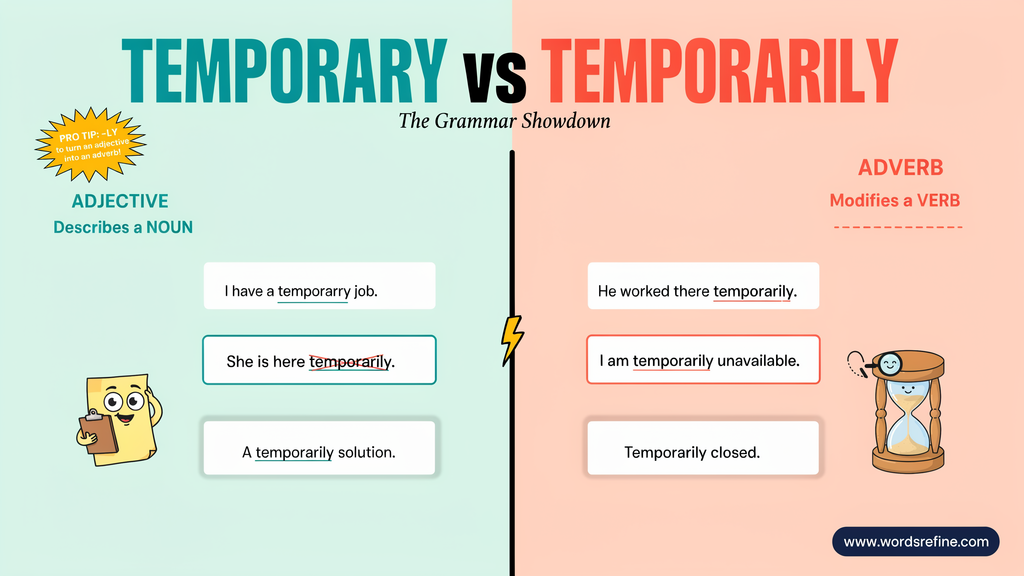
Temporary means lasting for a limited period rather than indefinitely. It describes something that isn’t intended to remain permanent, although the exact duration depends on the situation.
A temporary job might last three months, while temporary housing might be necessary for several weeks during home renovations. Similarly, a temporary solution may address an immediate problem while someone works on a more lasting answer.
In each case, temporary describes a person, thing, or situation rather than an action.
Temporary as an Adjective
An adjective describes a noun or pronoun. It can tell you what kind of thing something is or explain its condition.
In the phrase “a temporary solution,” solution is the noun and temporary is the adjective. The adjective tells you that the solution is intended to serve for a limited period.
Temporary commonly appears before a noun. For example, a company might offer a temporary position, a family might arrange temporary housing, or a technician might install a temporary fix for a software problem.
It can also appear after linking verbs such as is, seems, became, and remains.
Consider these sentences:
The arrangement is temporary.
His position became temporary after the department reorganized.
The improvement seems temporary.
Their housing situation remains temporary.
In each example, temporary describes the subject. The linking verb connects the subject to that description, which is why the adjective is appropriate.
Understanding the Meaning of Temporary
In everyday English, temporary usually describes something that will change, end, or give way to another arrangement. However, it doesn’t always mean that something will last only a few minutes or days.
For example, a temporary password might expire after one use. A temporary employee might work for several months, while a temporary building might serve a community for years until officials complete a permanent facility.
The word doesn’t specify an exact length of time. It simply indicates that the situation is limited in duration or isn’t intended to continue indefinitely.
This distinction matters in workplace policies, contracts, housing arrangements, and public notices. If the exact duration matters, explain it separately.
For example, “The company offered a temporary position lasting six months” tells the reader both the nature of the position and its expected duration.
Examples of Temporary in Everyday Sentences
Temporary appears naturally in many situations. A hospital might advertise a temporary nursing position, a business might need a temporary assistant, and a school might introduce a temporary schedule during renovations.
You might also hear people talk about a temporary solution to a difficult problem, temporary relief from discomfort, or a temporary change in their daily routine.
Here are some more examples:
The business hired a temporary assistant.
We need a temporary solution to the problem.
The road closure is temporary.
She moved into temporary accommodation.
The school introduced a temporary schedule.
The patient experienced temporary relief.
The website uses a temporary access code.
The team appointed a temporary manager.
Notice how temporary describes a noun or a condition in every example. That pattern is a reliable clue when you’re deciding which word to use.
Learn the difference between commonly mixed-up more words
Mobil vs Mobile Which one Is Correct?
What Does Temporarily Mean?
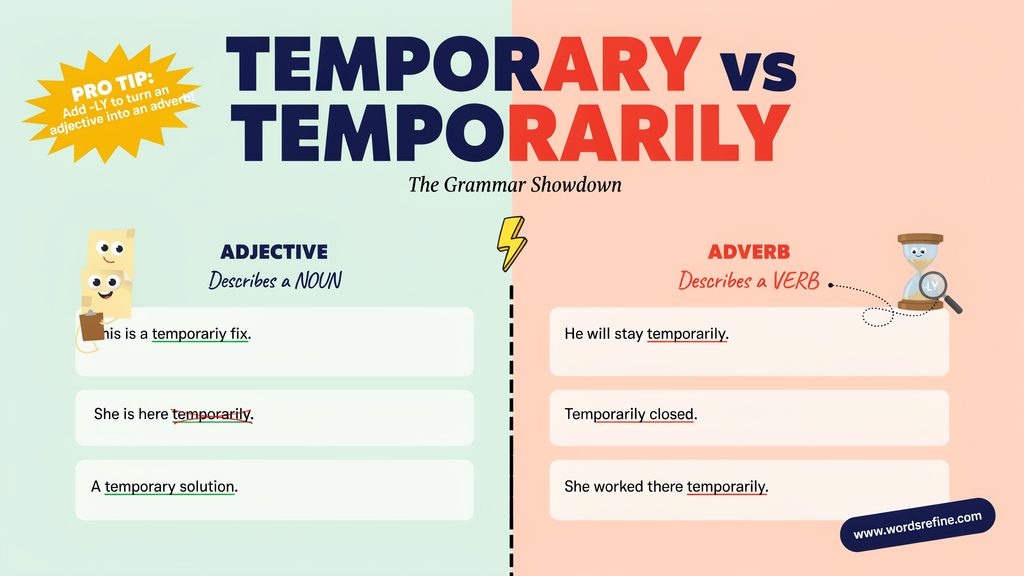
Temporarily means for a limited time or during a period that isn’t expected to continue indefinitely. It is the adverb form of temporary and usually describes an action or condition.
For example, consider the sentence, “The restaurant is temporarily closed.”
The word temporarily modifies closed and explains that the restaurant’s current state isn’t intended to be permanent. The sentence doesn’t tell you when the restaurant will reopen, but it indicates that the closure is limited in duration.
Similarly, “The technician temporarily disabled the feature” tells you that the technician disabled it for a limited period rather than indefinitely.
Temporarily as an Adverb
An adverb can modify a verb, an adjective, or another adverb. It often explains how, when, where, or to what extent something happens. Temporarily focuses on duration by showing that an action or state applies for a limited period.
When temporarily modifies a verb, it describes an action.
The manager temporarily transferred two employees.
We temporarily moved the equipment to another room.
The technician temporarily disconnected the server.
The school temporarily suspended afternoon classes.
In these sentences, temporarily explains the duration of the actions rather than describing the people, equipment, or classes.
However, temporarily can also modify an adjective or a participle that describes a condition.
The service is temporarily unavailable.
The entrance is temporarily blocked.
The account is temporarily restricted.
The machine is temporarily out of order.
These sentences describe current conditions that aren’t expected to last indefinitely. The adverb tells the reader that the situation applies for a limited time.
An adverb can also modify another adverb, although such constructions aren’t always necessary. For instance, instead of writing, “The system was temporarily offline almost completely,” a clearer sentence would be, “The system was almost completely offline for a short time.”
Good writing isn’t only about choosing the right part of speech. It’s also about expressing an idea in the clearest possible way.
Understanding the Meaning of Temporarily
Temporarily emphasizes the duration of an action or state. It tells readers that something happens or remains true for a limited period, but it doesn’t necessarily identify when the situation will end.
For example, “The meeting was temporarily postponed” suggests a limited change to the schedule, although the writer should provide the new time if readers need that information.
Likewise, “Internet access was temporarily interrupted” indicates that the interruption wasn’t indefinite. “She is temporarily living with her sister” describes a living arrangement that won’t necessarily continue permanently.
A notice stating “The service is temporarily unavailable” doesn’t promise that the service will return within ten minutes. Instead, it communicates that the current unavailability is not presented as permanent.
Examples of Temporarily in Everyday Sentences
Temporarily appears frequently in workplace announcements, customer service messages, technology updates, and everyday conversations.
The store temporarily closed for repairs.
The company temporarily relocated its office.
The administrator temporarily blocked access.
The team temporarily paused the project.
The website is temporarily unavailable.
The machine was temporarily disconnected.
The school temporarily changed its schedule.
The manager temporarily promoted an employee.
In each sentence, temporarily explains the limited duration of an action or condition. Once you recognize that function, the correct word becomes easier to identify.
Temporary vs Temporarily Key Differences
The easiest way to distinguish these words is to focus on their grammatical functions instead of their similar meanings.
Temporary is an adjective that describes a noun or a subject’s condition. Temporarily is an adverb that usually modifies a verb or an adjective.
For instance, “temporary suspension” describes a type of suspension, while “temporarily suspended” describes the condition of something that has been suspended for a limited period.
Similarly, “temporary replacement” describes the replacement, whereas “temporarily replaced” explains what happened to the person or thing being replaced.
Consider the difference between these sentences:
The company announced a temporary closure.
The company temporarily closed its office.
The first sentence focuses on the closure as an event or arrangement. Temporary describes the noun closure.
The second sentence focuses on the company’s action. Temporarily modifies the verb closed.
The same principle works in other contexts. A temporary restriction describes a restriction that isn’t intended to last indefinitely. An account that is temporarily restricted has had its access or activity limited for a period.
These expressions share a similar idea, but their grammatical structures differ. Once you understand the role each word plays, you won’t need to memorize every possible combination.
How to Use Temporary vs Temporarily in a Sentence
Choosing the correct word becomes much easier when you identify what you want to describe. If you’re describing a noun or a subject’s condition, temporary is usually the right choice. If you’re explaining the duration of an action or condition, temporarily is often more appropriate.
Temporary in Workplace and Employment Situations
Workplace writing frequently uses temporary because employers need to distinguish short-term arrangements from permanent roles.
A hospital might advertise a temporary nursing position. A company might hire a temporary replacement for an office manager. A department might create a temporary role to handle an unusually busy season.
For example, “Marcus accepted a temporary job while completing his studies” describes the nature of Marcus’s employment.
By contrast, “Marcus is temporarily working at another branch” describes the limited period during which he works at that location.
Employers might also temporarily assign an employee to another department or temporarily promote someone while a manager is away.
These expressions are grammatically correct because temporarily modifies the action or arrangement being described. However, a temporary assignment doesn’t automatically mean that the employee has a temporary employment contract. Someone with a permanent job may receive a temporary assignment without changing their employment status.
Learn the difference between tricky grammar more words
Discrete vs Discreet What the Difference and which is Correctly?
Temporary vs Temporarily in Business and Customer Service
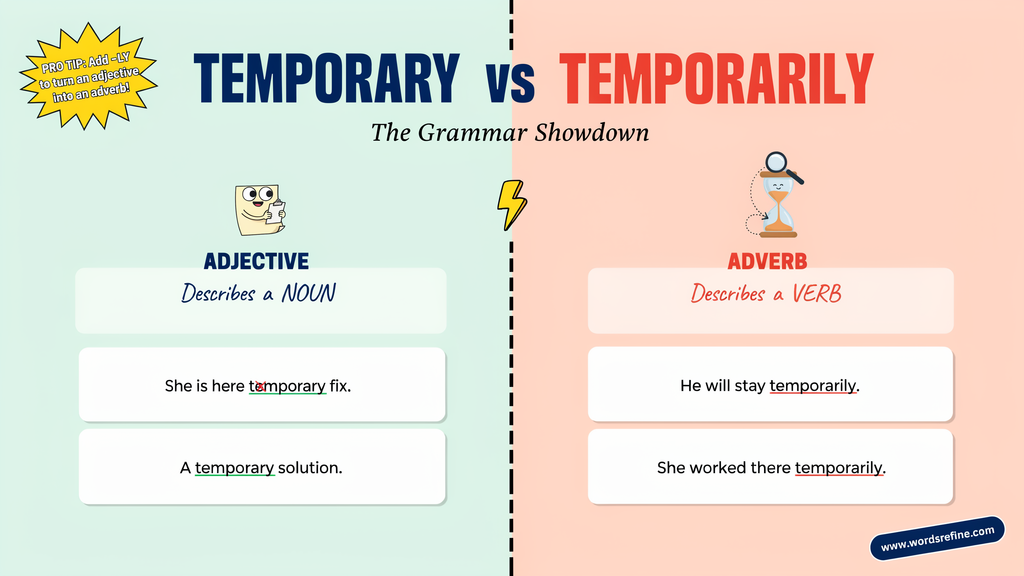
Businesses use both words in signs, announcements, emails, and service updates.
A company might announce a temporary closure for renovations or introduce a temporary refund policy. It might also issue a temporary access code to customers.
Alternatively, a store might be temporarily closed for repairs, a website might be temporarily unavailable, or customer accounts might be temporarily suspended.
The difference is particularly important in customer service because clear wording helps customers understand what is happening.
“Temporary closure” describes the type of closure. “Temporarily closed” describes the current condition of the business.
Both expressions are correct, but each serves a different purpose.
Temporary vs Temporarily in Technology
Technology provides some of the clearest examples of the difference between these words.
Imagine that a website stops working during routine maintenance. A support team might explain, “The website is experiencing a temporary outage.”
It could also announce, “The website is temporarily unavailable.”
Both sentences communicate that the interruption is limited in duration. However, temporary describes the noun outage, while temporarily modifies unavailable.
Other examples include a temporary fix for a software problem, a temporary access restriction, or a temporary interruption in service.
A technician might temporarily disable a feature, temporarily disconnect a server, or temporarily block access while investigating an error.
A temporary fix isn’t necessarily a poor solution. It may restore service while engineers investigate the underlying problem. However, the word temporary alone doesn’t tell users how reliable the fix is or when a permanent solution will be available.
Temporary vs Temporarily in Housing and Travel
The same grammatical distinction applies to housing and travel.
A family might arrange temporary housing while repairing its home. A company might provide temporary accommodation for visiting staff. Travelers might need a temporary address during an extended stay.
By contrast, a family might temporarily move into a nearby apartment, a person might be temporarily living with relatives, or an airline might temporarily relocate its check-in desk.
In these examples, temporary describes the housing or address, while temporarily explains the duration of the move or living arrangement.
In legal and administrative situations, a temporary address doesn’t automatically determine someone’s legal residence or domicile. Those terms can have specific meanings depending on the jurisdiction and circumstances.
Temporary vs Temporarily in Everyday Life
You don’t need a professional setting to use these words correctly.
You might make a temporary arrangement for dinner, experience a temporary change in your plans, or find temporary relief from discomfort.
Alternatively, you might temporarily stop drinking coffee, temporarily move your desk into another room, or temporarily disconnect your social media accounts.
The adjective describes the arrangement, change, or relief. The adverb explains the duration of the action or condition.
When you can identify the noun being described, temporary is often the correct choice. When you’re explaining how long an action takes place, temporarily is usually the better option.
Learn the difference between confusing word pairs
Capital vs Capitol Which One Is Correct?
Common Mistakes When Using Temporary vs Temporarily
Even experienced writers sometimes confuse these words because they share a meaning. Fortunately, most errors become easy to correct once you understand the grammar behind them.
Using Temporarily Before a Noun
Consider this incorrect sentence: “I accepted a temporarily position.”
The correct version is “I accepted a temporary position.”
Position is a noun, so the sentence needs an adjective to describe it. Temporary fits the construction because it describes the nature of the position.
The same rule applies to other expressions. Write “a temporary solution” rather than “a temporarily solution,” and “a temporary job” rather than “a temporarily job.”
Using Temporary to Modify an Action
Consider this sentence: “The store closed temporary.”
The correct version is “The store closed temporarily.”
Here, closed expresses an action, and temporarily explains how long the closure lasts.
Similarly, write “The technician temporarily disabled the feature” rather than “The technician disabled the feature temporary.”
You can also write, “The family lived there temporarily,” because temporarily describes the duration of the living arrangement.
Writing Temporary Closed
“The restaurant is temporary closed” is incorrect in standard English.
The correct sentence is “The restaurant is temporarily closed.”
In this construction, closed describes the restaurant’s current condition. Temporarily modifies closed and indicates that the condition isn’t intended to last indefinitely.
However, temporary closure is correct because temporary describes the noun closure.
Compare these examples:
The restaurant is temporarily closed.
The restaurant announced a temporary closure.
The first sentence describes the restaurant’s state. The second describes the type of closure.
Writing Temporary Unavailable
“The service is temporary unavailable” is another common mistake.
The correct version is “The service is temporarily unavailable.”
Unavailable is an adjective describing the service. Temporarily modifies that adjective and explains that the service won’t remain unavailable indefinitely.
You can use temporary before a noun in a related sentence, such as “The service is experiencing a temporary interruption.”
Both constructions are correct because the words perform different grammatical functions.
Assuming Temporary vs Temporarily Are Interchangeable
Consider these sentences:
“The restriction is temporary.”
“The account is temporarily restricted.”
Both are correct, but temporary describes the restriction in the first sentence, while temporarily modifies restricted in the second.
The words share a core meaning, yet you can’t substitute one for the other without considering sentence structure. This is an important lesson in English grammar: similar meanings don’t always make words interchangeable.
Learn the difference between often confused words
Lay vs Lie Difference and which is correct?
An Easy Way to Remember the Difference Between Temporary and Temporarily
If you frequently hesitate between these words, ask yourself one simple question: Am I describing a thing, or am I describing an action or condition?
Use temporary when describing a noun or a subject’s condition. Use temporarily when explaining how long an action or condition lasts.
For example, a temporary job describes a type of job. Someone working temporarily describes an arrangement that lasts for a limited period.
A temporary solution describes the solution itself. A team that temporarily changed its plan performed an action that applies to a limited period.
You can also use the noun test. Look for the noun in your sentence and ask whether you’re describing it as nonpermanent. If so, temporary is likely the correct choice.
For example, a temporary change, temporary restriction, and temporary replacement all use the adjective correctly.
The action test works just as well. Ask whether you need to explain the duration of an action. If so, temporarily may be the word you need.
For instance, a team might temporarily stop production, a school might temporarily change its schedule, or a technician might temporarily block access.
Comparing related sentences is another useful way to learn the distinction.
“The change is temporary.”
“The system changed temporarily.”
“The suspension is temporary.”
“The account was temporarily suspended.”
In each pair, the sentences express a related idea but use different grammatical structures.
Synonyms and Related Words
Synonyms can help you express ideas more precisely, but they don’t always fit the same grammatical positions. Choose an alternative that matches both the intended meaning and the sentence structure.
Synonyms for Temporary
Common alternatives include short-term, brief, interim, provisional, transitory, fleeting, impermanent, and momentary.
Short-term describes something expected to last for a limited period. Brief emphasizes a short duration. Interim often describes a person or arrangement that fills a gap until a longer-term option becomes available.
Provisional suggests that an arrangement or decision may change after further consideration. Transitory describes something that passes or doesn’t last. Fleeting and momentary usually emphasize an especially short period.
For example, a company might hire an interim manager, a business might develop a short-term solution, or a committee might approve a provisional arrangement.
These words aren’t interchangeable in every context. An interim manager, for instance, usually fills a role until another arrangement is made, while a fleeting thought may last only a moment.
Synonyms for Temporarily
Common alternatives include briefly, for a while, for the time being, for now, on a temporary basis, provisionally, and until further notice.
For example, a manager might step away briefly, an office might remain closed for the time being, or a company might hire someone on a temporary basis.
Until further notice has a slightly different emphasis. It means that an arrangement will continue until another announcement or instruction changes it. It doesn’t necessarily tell readers whether the arrangement will last a short or long time.
Momentarily also requires care in American English because it can mean either for a moment or, in some contexts, in a moment. When you want to emphasize limited duration, briefly or for a short time may communicate your meaning more clearly.
Temporary vs Permanent Understanding the Difference
The opposite of temporary is usually permanent. These words describe different temporary vs temporarily expectations about duration.
Temporary refers to something that lasts for a limited period or isn’t intended to continue indefinitely. Permanent describes something intended or established to continue indefinitely.
For example, a company might hire a temporary employee to cover an absence and later hire someone for a permanent position.
Similarly, a plumber might apply a temporary fix to stop a leak before replacing the damaged pipe. The temporary repair addresses the immediate problem, while the permanent repair aims to resolve it for the long term.
Other examples include temporary housing compared with permanent residence, temporary restrictions compared with permanent restrictions, and temporary changes compared with permanent changes.
Keep in mind that permanent doesn’t necessarily mean something can never change. It describes the intended or established duration rather than guaranteeing that a situation will last forever.
Also, temporary versus permanent is a comparison of meaning, while temporary versus temporarily is a comparison of grammatical function. Understanding both distinctions will help you choose words more accurately.
How to Pronounce Temporarily
Temporarily can feel awkward to pronounce because it contains several syllables. In American English, it is commonly pronounced “TEM-puh-rair-uh-lee,” with the main stress near the beginning.
The related adjective temporary is commonly pronounced “TEM-puh-rair-ee.”
A useful way to practice is to say temporary first and then add the ending in the adverb form. Pay attention to the additional syllable instead of rushing through the word.
Both forms are standard in American English. Their pronunciation doesn’t change their grammatical roles: temporary remains an adjective, and temporarily remains an adverb.
Learn the difference between basic English word mistakes
Whoever vs Whomever How to Use Each Word Correctly?
Practice Session Temporary vs Temporarily
- The company hired a ______ worker to manage the extra workload.
- The museum is ______ closed for renovations.
- We need a ______ solution until the plumber fixes the leak.
- The road will remain ______ blocked while workers repair the bridge.
- She accepted a ______ position at the local hospital.
- The website is ______ unavailable because of a technical problem.
- The family arranged ______ housing while their home underwent repairs.
- The manager ______ transferred the employee to another department.
- You can use this ______ password until you create a permanent one.
- The school ______ suspended outdoor activities because of heavy rain.
- He bought a ______ phone while his regular device was being repaired.
- The doctor advised her to ______ avoid strenuous exercise.
- The store introduced a ______ discount for the holiday season.
- Severe weather ______ interrupted the train service.
- We need a ______ arrangement until everyone agrees on a final plan.
- The company ______ relocated its office during construction.
- Their stay at the hotel was ______ because their apartment was not ready.
- The teacher assigned a ______ task while preparing the main lesson.
- The main entrance is ______ blocked, so please use the side door.
- Workers installed a ______ fence around the construction site.
- The system will ______ stop working during the scheduled update.
- She took a ______ break from her studies to care for her family.
- The restaurant is ______ offering a limited menu this week.
- The government introduced a ______ measure to address the immediate problem.
- Technicians ______ took the machine out of service for maintenance.
Answers
- temporary
- temporarily
- temporary
- temporarily
- temporary
- temporarily
- temporary
- temporarily
- temporary
- temporarily
- temporary
- temporarily
- temporary
- temporarily
- temporary
- temporarily
- temporary
- temporary
- temporarily
- temporary
- temporarily
- temporary
- temporarily
- temporary
- temporarily
Here’s a trusted source for clear more words Comparison:
FAQs
Do you say “temporary” vs “temporarily”?
Use “temporary” to describe a person, thing, or situation that lasts for a limited time. For example, “She found a temporary job.” Use “temporarily” to describe an action or condition that will not last forever, as in “The store is temporarily closed.”
What is a fancy word for temporary?
“Transitory” is a more formal alternative to “temporary.” It describes something that lasts for a limited period. For example, “The excitement was transitory” means the excitement did not last long.
What is the simple meaning of temporary?
“Temporary” means lasting for a limited time rather than forever. A temporary job, for instance, lasts for a set period or until a particular need ends.
How do you use temporarily in a sentence?
Use “temporarily” when you want to show that an action or condition will last only for a while. For example, “The company temporarily suspended deliveries because of bad weather.”
What is the opposite of temporarily?
“Permanently” is the most common opposite of “temporarily.” For example, “The library is temporarily closed” means it will reopen, while “The library is permanently closed” suggests it will not reopen.
What is the short form of temporary?
“Temp” is a common informal abbreviation for “temporary.” People often use it in phrases such as “temp job” and “temp worker” when referring to short-term employment.
What are some examples of temporary things?
Common examples include temporary housing, a temporary password, a temporary job, a temporary road closure, and a temporary solution to a problem. Each serves a purpose for a limited time rather than indefinitely.
What is another term for something temporary?
Depending on the context, something temporary may be called an interim arrangement, a provisional measure, or a short-term solution. An interim arrangement fills a gap until a longer-term option becomes available, while a provisional measure may change once more information becomes available.
What is another word for “temporarily”?
Common alternatives include “briefly,” “for a while,” “for now,” and “for the time being.” For example, “The service is temporarily unavailable” could become “The service is unavailable for the time being.”
What does “temporarily” mean?
“Temporarily” is an adverb that means for a limited period, not permanently. In the sentence “He temporarily moved to another office,” the word indicates that the move is not intended to be permanent.
How long does something temporary last?
There is no fixed time limit for something temporary. It might last a few minutes, several days, or even a few years. The duration depends on the situation and the conditions that determine when the arrangement or condition will end.
Learn the difference between commonly misused words
Vender vs Vendor Which one Is Correct?
Conclusion
The difference between “temporary” vs“ temporarily” is easier to remember than you might think. “Temporary” describes something that won’t last forever, such as a temporary job or a temporary solution. In contrast, “temporarily” explains that an action or condition will last only for a limited period, as in “The store is temporarily closed.”
Although these words share the same root, they aren’t interchangeable. The trick is to look at how each word functions in your sentence. If you’re describing a person, place, thing, or situation, “temporary” is usually the right choice. If you’re modifying an action or describing a short-lived condition, “temporarily” will often fit.
With a little practice, you’ll stop mixing them up and start using both with confidence. Remember, your job might be temporary, your favorite café might temporarily close, but your grammar skills don’t have to remain uncertain. Give these words the right role, and let your confusion become a thing of the past!

Diora AJS she is an experienced blogger and passionate English language enthusiast at Words Refine. With a keen eye for language and a love for clear communication, she writes practical content about grammar, word meanings, usage, and commonly confused terms. Her goal is to make English easier to understand through clear explanations and relatable examples, helping readers write accurately and communicate with confidence.