
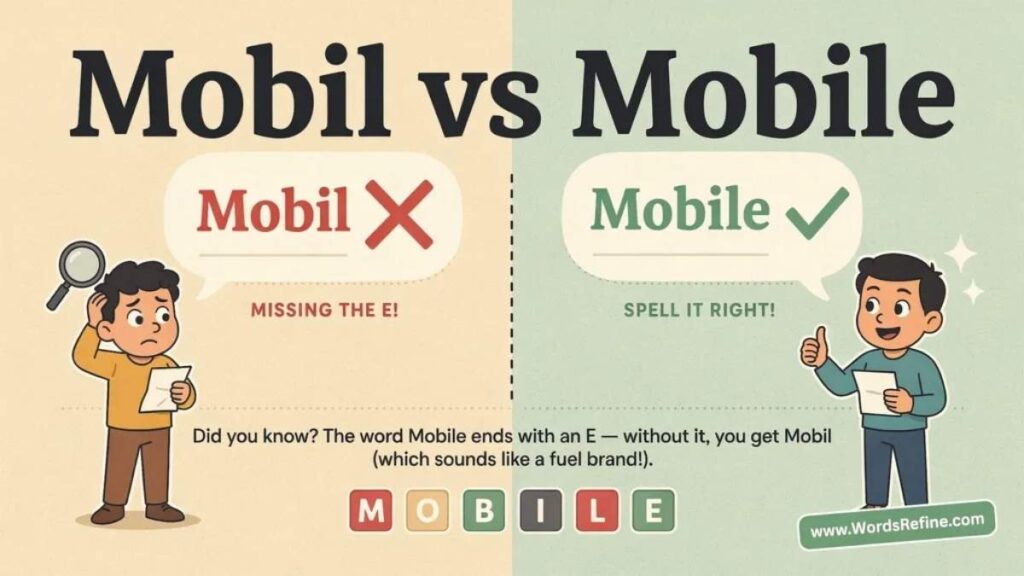
Have you ever written “Mobil” when you meant “mobile” and wondered whether one missing letter really matters? In this case, it does. The difference between Mobil vs Mobile is small in spelling but significant in meaning and usage. “Mobile” is the standard English word for something that can move, something portable, or a phone or device you can carry with you. “Mobil,” however, is primarily a brand name associated with fuel, motor oil, and automotive products. In this guide, you well learn how to distinguish these commonly confused words, understand their meanings and pronunciation, and use each correctly. One letter can make quite a difference!
Mobil vs Mobile The Simple Answer
The easiest way to understand Mobil vs Mobile is to look at their roles in a sentence.
Mobile is a regular English word. It can describe something that moves, something that can be carried from one place to another, or something related to modern wireless communication.
For example:
- I bought a new mobile phone.
- The hospital operates a mobile clinic.
- She uses a mobile device for work.
- The equipment is light and mobile.
Mobil is mainly a proper name. It is associated with a well-known automotive brand that sells fuel, lubricants, and motor oil.
For example:
- The mechanic recommended Mobil 1 motor oil.
- The station sells Mobil fuel.
- The workshop uses Mobil lubricants.
Therefore, mobile and Mobil aren’t simply two spellings of the same word. They have different uses.
What Does Mobile Mean?
Mobile has several meanings in English, but they all connect in some way to movement, portability, or the ability to operate in different places.
At its most basic level, mobile means able to move or be moved.
For example, a mobile piece of equipment can be taken from one location to another. A mobile worker may travel between different places rather than staying in one office. A mobile clinic can travel to communities instead of operating from one permanent building.
The word can also describe something that moves freely.
Consider the sentence:
“The machine is mobile.”
This tells you that the machine can move.
Now consider:
“The company provides mobile services.”
Here, mobile suggests that the services can be accessed or delivered while people are moving between locations.
The meaning becomes even more familiar when technology enters the picture.
Mobile in Technology
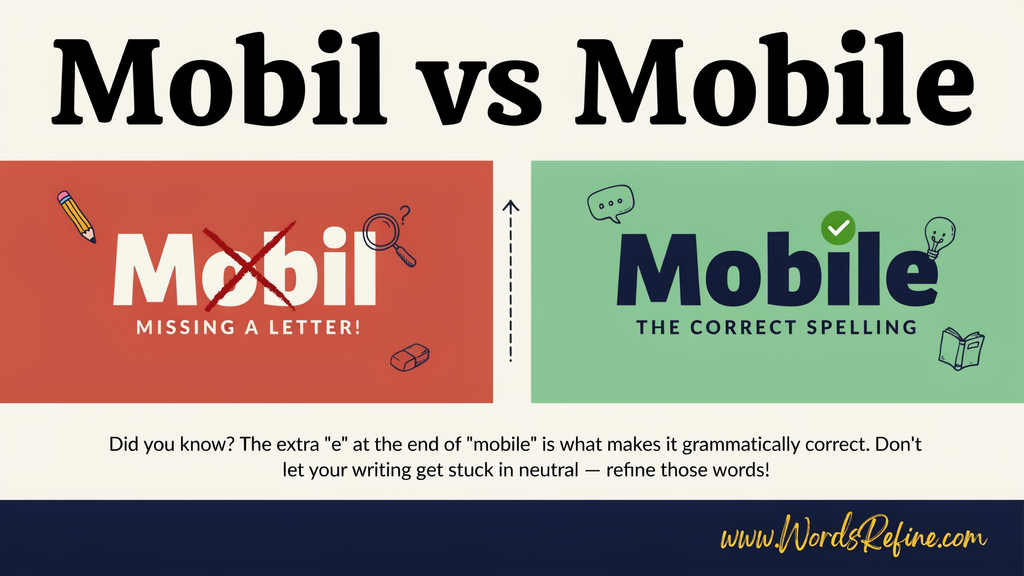
Today, the word mobile is strongly associated with phones, apps, and digital devices. That’s hardly surprising. Smartphones have become such an important part of everyday life that expressions like mobile phone and mobile device now sound completely natural.
Common Technology Terms With Mobile
You’ll often see mobile used in a variety of technology-related expressions, including:
- Mobile phone
- Mobile device
- Mobile application
- Mobile network
- Mobile data
- Mobile internet
- Mobile technology
- Mobile communication
For example:
“My mobile phone is charging.”
Here, mobile describes the type of phone and indicates that it’s designed to be carried and used without a fixed connection.
Mobile Phone and Mobile Device
In American English, cell phone is generally more common than mobile phone. However, mobile phone remains a standard expression and is widely understood.
The word mobile also applies to more than phones. Tablets, portable computers, and other wireless devices can all be described as mobile devices. Likewise, services and technologies designed for people who aren’t tied to a fixed location may be called mobile.
Learn the difference between commonly mixed-up more words
Fiancé vs Fiancée What’s the Difference and which is Correctly?
What Does Mobile Mean in Technology?
In a technology context, mobile generally suggests portability, wireless connectivity, or the ability to use a device or service while away from a fixed location. In simple terms, when you see mobile in technology, think portable and connected on the go.
Mobile Can Describe Movement
The meaning of mobile isn’t limited to technology.
Imagine a medical team that travels from town to town. Instead of asking patients to travel to a permanent facility, the team brings its services to different locations.
That could be called a mobile clinic.
Similarly, you might hear expressions such as mobile laboratory, mobile office, or mobile unit.
In each case, mobile describes the ability to operate in different places.
For example:
“The organization opened a mobile laboratory.”
The laboratory isn’t necessarily a laboratory that walks around on its own. Rather, it is designed to be transported or operated at different locations.
That is the basic idea behind the word.
Mobile as a Noun
Mobile can also function as a noun.
One familiar example is a hanging mobile. You’ve probably seen one hanging above a baby’s crib or displayed as a piece of art.
A hanging mobile consists of objects suspended from a frame. The pieces move gently when air currents affect them.
For example:
“The baby watched the colorful mobile above the crib.”
Here, mobile doesn’t refer to a phone at all.
This is a good reminder that one word can have several meanings. Context tells you which meaning is intended.
What Does Mobil Mean?
Mobil is different.
When written with a capital M, Mobil is mainly recognized as a brand name associated with fuel, lubricants, and automotive products.
That’s why you may see names such as Mobil 1, Mobil motor oil, Mobil fuel, and Mobil lubricants.
In these situations, Mobil isn’t describing something as movable. It identifies a particular brand.
For example:
“The mechanic recommended Mobil 1 for the engine.”
Here, Mobil is part of the product’s name.
If you changed the word to mobile, you would no longer be referring to the brand correctly.
Learn the difference between tricky grammar more words
Any time vs anytime meaning Difference with Examples ?
Is Mobil a Proper Noun?
When Mobil refers to the brand, it functions as a proper name.
That means capitalization matters.
Compare these two sentences:
“The company launched a mobile service.”
“The company sells Mobil lubricants.”
In the first sentence, mobile is an ordinary adjective. It describes the service.
In the second sentence, Mobil identifies a brand.
This is one of the clearest ways to understand the difference between Mobil and mobile.
One describes something. The other names something.
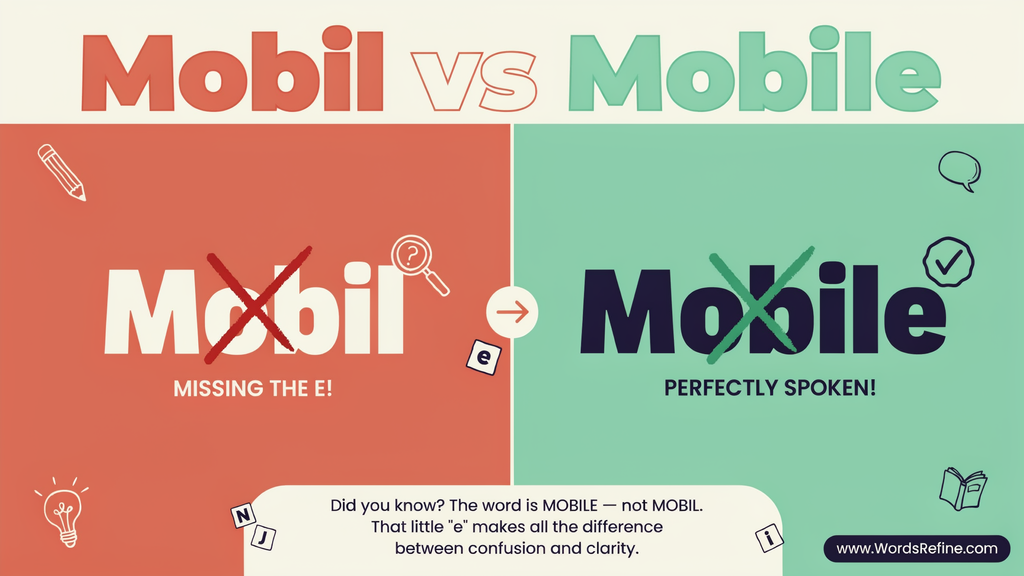
Mobil vs Mobile Spelling
The spelling difference is simple:
Mobile is spelled M-O-B-I-L-E.
Mobil is spelled M-O-B-I-L.
The final e makes the ordinary English word mobile different from the brand name Mobil.
If you’re writing about phones, technology, movement, or portability, mobile is normally the spelling you need.
If you’re referring to the automotive brand, Mobil is the correct name.
This distinction becomes especially important when you’re writing advertisements, product descriptions, school assignments, business documents, or technical material.
A missing letter can change the meaning of the sentence.
Why Is Mobile Spelled With an E?
You may wonder why mobile has an e when people don’t always pronounce that final part clearly.
The spelling comes from the history of the word. Mobile entered English through French and ultimately traces back to the Latin word mobilis, which relates to movement.
English spelling often preserves historical forms even when pronunciation changes over time.
That is why the final e remains part of the standard spelling.
So, if you’re asking why is Mobile spelled with an e, the short answer is that mobile is the established English form of the word.
The e isn’t optional.
For example:
“I bought a mobile phone.”
is correct.
“I bought a mobil phone.”
is normally a spelling mistake.
Why Is Mobil Spelled Without an E?
“Mobil” is spelled without an e because it is a brand name rather than a shortened form of the English word “mobile.” It is associated with automotive products such as fuel, gasoline, and motor oil. By contrast, “mobile” is the standard English spelling when you’re describing something that can move, something portable, or something related to phones and technology.
So, the missing e isn’t a spelling shortcut. It’s simply part of the brand name. When you mean the ordinary English word, keep the e in “mobile.”
Mobil Is a Brand Name
Mobil has a different history because it is a brand name. It became established as a commercial name associated with petroleum and automotive products.
Therefore, Mobil isn’t simply a shortened form of the English word mobile. It has its own specific identity and purpose.
Learn the difference between confusing commonly g word pairs
Choose vs Chose Difference and which one is Correct?
Mobil Is Not a Shortened Form of Mobile
It might be tempting to think that Mobil is just mobile with the final e removed. However, that’s not how the word works.
You shouldn’t remove the e from mobile simply to make the word shorter. English doesn’t recognize “mobil” as a standard abbreviation of mobile.
Why “Mobil Phone” Is Incorrect
Writing “mobil phone” doesn’t create a shorter version of “mobile phone.” Instead, it creates a spelling mistake.
If you’re talking about a phone, the correct expression is “mobile phone.” In American English, “cell phone” is also commonly used.
When Is “Mobil” Correct?
“Mobil” is correct when you’re referring to the brand or one of its products. For example, “Mobil 1” is a brand name for motor oil.
The easiest rule is simple: use mobile for the ordinary English word and Mobil for the brand. One little e can keep your sentence from taking the wrong turn.
Learn the difference between often confused words
Discrete vs Discreet What the Difference and which is Correctly?
Mobil vs Mobile Pronunciation
Pronunciation adds another wrinkle to this word comparison.
In American English, mobile is commonly pronounced something like “MOH-buhl.” In British English, it is commonly pronounced closer to “MOH-byle.”
Mobil can also have slightly different pronunciations depending on the variety of English being spoken.
In American English, the Mobil brand is commonly pronounced something like “MOH-buhl.”
So, in American speech, the two can sound extremely similar.
That’s one reason the spelling can be confusing.
You may hear the word correctly and still be unsure whether the speaker means mobile or Mobil. The surrounding context usually provides the answer.
If the conversation is about smartphones, the word is almost certainly mobile.
If the conversation is about motor oil or fuel, Mobil may be the intended word.
Mobile vs Mobil in American and British English
The spelling doesn’t normally change between American English and British English.
Both varieties use mobile for the ordinary English word.
What can change is pronunciation.
American English commonly uses a pronunciation similar to “MOH-buhl.”
British English commonly uses a pronunciation closer to “MOH-byle.”
The word mobile remains spelled with an e.
So, you shouldn’t hear a British pronunciation and assume the spelling has changed to mobil.
Pronunciation and spelling don’t always move in lockstep. English has plenty of examples where the letters and sounds refuse to cooperate as neatly as we’d like.
When Should You Use Mobile?
Use mobile when you’re talking about movement, portability, phones, or wireless technology.
For example:
- The company launched a new mobile application.
- She bought a mobile phone.
- The hospital operates a mobile clinic.
- The device connects to a mobile network.
- The team uses mobile equipment.
- He works from a mobile office.
- The company provides mobile communication services.
In each example, mobile either describes movement or refers to portable and wireless technology.
The word works naturally because it carries the idea of being able to move or operate away from a fixed location.
Learn the difference between basic English word mistakes
Further vs Farther The Simple Difference and Each Correctly?
When Should You Use Mobil?
Use Mobil when you’re referring to the brand.
For example:
- The driver purchased Mobil 1 motor oil.
- The station sells Mobil gasoline.
- The mechanic uses Mobil lubricants.
- The workshop keeps Mobil products in stock.
- The customer asked about Mobil engine oil.
Notice how different the context is.
Mobile belongs to everyday English vocabulary.
Mobil belongs to a brand name.
That’s the key distinction.
Mobil vs Mobile Phone?
This is one of the easiest questions to answer.
The correct phrase is:
“mobile phone”
Not:
“mobil phone”
For example:
“My mobile phone is on the table.”
The word mobile describes the phone as a portable communication device.
In American English, you will also frequently hear cell phone.
Therefore, these are both standard expressions:
“mobile phone”
“cell phone”
But “mobil phone” is not the standard spelling.
Mobile vs Mobil App?
The correct expression is mobile app.
For example:
“Download the mobile app to manage your account.”
Here, mobile describes an application designed for use on mobile devices.
Using Mobil would make the sentence appear to refer to the automotive brand, which obviously isn’t the intended meaning.
The same rule applies to mobile website, mobile device, mobile network, and mobile data.
Learn the difference between misused words
Capital vs Capitol Which One Is Correct?
Mobil vs Mobile Oil?
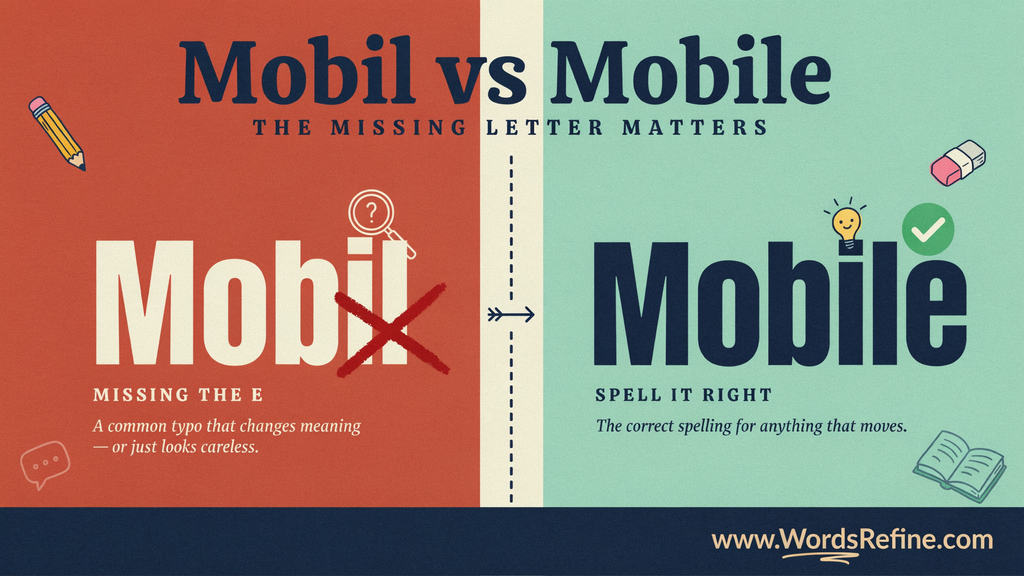
Here, context changes the answer.
If you’re referring to the Mobil brand, use Mobil.
For example:
“I bought Mobil motor oil.”
You wouldn’t normally write:
“I bought mobile motor oil.”
That phrase could be interpreted as motor oil that is mobile or movable rather than a particular brand.
The product name is what determines the spelling.
Learn the difference between everyday English mistakes
Whoever vs Whomever How to Use Each Word Correctly?
Mobil vs. Mobile Common Mistakes
These words cause a few predictable errors.
Writing “Mobil Phone” Instead of “Mobile Phone”
One common mistake is writing “mobil phone.”
The correct form is “mobile phone.”
Writing “Mobil App” Instead of “Mobile App”
Another common mistake is writing “mobil app.”
The correct form is “mobile app.”
Confusing “Mobil 1” With “Mobile 1”
A third mistake happens with product names. Someone may write “Mobile 1” when they actually mean “Mobil 1.”
That changes the brand name.
How to Choose Between Mobil and Mobile
A useful way to catch these mistakes is to stop and ask what the word is doing in the sentence.
Is it describing something? If so, “mobile” may be the right choice.
Is it naming the automotive brand? If so, “Mobil” is the likely choice.
Mobil vs Mobile Examples
Here are some straightforward examples that show the difference.
| Sentence | Correct word | Reason |
|---|---|---|
| I bought a new mobile phone. | Mobile | Describes a phone |
| The hospital runs a mobile clinic. | Mobile | Describes a clinic that can operate in different places |
| She uses a mobile application. | Mobile | Relates to mobile technology |
| The device connects to a mobile network. | Mobile | Relates to wireless communication |
| The mechanic recommended Mobil 1. | Mobil | Refers to a product brand |
| The station sells Mobil fuel. | Mobil | Refers to the fuel brand |
| The workshop uses Mobil lubricants. | Mobil | Refers to branded lubricant products |
The pattern becomes obvious once you focus on meaning instead of appearance.
Learn the difference between more words people mix up
Loose vs Lose Difference and which is Correctly?
Mobile vs Mobil A Real World Example
Imagine that a car repair company offers a service where mechanics travel to customers.
Its advertisement says:
“We provide mobil car repair and use Mobile 1 oil.”
There are two problems.
The first word should be mobile because the repair service travels to the customer.
The second should be Mobil because Mobil 1 is the product brand.
The corrected sentence would be:
“We provide mobile car repair and use Mobil 1 motor oil.”
Notice how both words can appear in the same sentence without causing confusion once their roles are clear.
Mobile describes the service.
Mobil identifies the product.
That’s the whole difference in action.
Is Mobil and Mobile the Same Thing?
No.
They may look related, and their forms have historical connections, but modern English uses them differently.
Mobile is a regular English word with several meanings.
Mobil is primarily recognized as a brand name.
Think of it this way:
Mobile describes.
Mobil identifies.
Mobile can describe something that moves.
Mobil can identify a company brand or product.
Once you remember that distinction, the spelling becomes much easier.
Is Mobile a Proper Noun?
Usually, no.
Mobile is generally a common noun or adjective.
For example:
“She bought a mobile device.”
Here, mobile is an adjective.
However, Mobile can appear as part of a proper name. For instance, Mobile is also the name of a city in Alabama.
So capitalization depends on context.
That doesn’t make Mobile and Mobil interchangeable.
Learn the difference between more words people mix up
Lay vs Lie Difference and which is correct?
Is Mobil an English Word?
Mobil is certainly used in English as a proper name, particularly as the name of the automotive brand.
However, that doesn’t mean mobil is a standard lowercase replacement for mobile.
For example:
“I bought a mobil phone.”
is not normally correct English.
But:
“I bought Mobil 1.”
can be correct when referring to the product.
The difference is context and capitalization.
How to Remember Mobil vs Mobile
A simple memory trick can save you from repeatedly checking the spelling.
Think:
“Mobile moves. Mobil motors.”
If you’re talking about movement, portability, phones, or wireless technology, think mobile.
If you’re talking about fuel, motor oil, lubricants, or the automotive brand, think Mobil.
Another useful trick is to remember the final e.
Mobile has the e because it’s the everyday English word.
Mobil doesn’t have the e because the brand name is spelled Mobil.
It takes only a second to check, but that second can prevent an embarrassing typo.
Mobil vs Mobile Quick Comparison
| Word | Meaning | Typical use | Example |
|---|---|---|---|
| Mobile | Able to move, portable, or related to mobile technology | Common English vocabulary | Mobile phone |
| Mobile | A hanging moving artwork | Noun | A decorative mobile |
| Mobil | A brand associated with fuel and lubricants | Proper name | Mobil 1 |
| Mobil | Brand-related product name | Automotive context | Mobil motor oil |
The two forms may look like close relatives, but they have different jobs.
Practice Session Mobil vs Mobile
- I bought a new ______ phone last week.
- The mechanic recommended ______ 1 motor oil for my car.
- This ______ device can connect to the internet anywhere.
- She downloaded a ______ application for learning English.
- ______ is a well-known brand associated with fuel and motor oil.
- My grandmother prefers using a ______ phone instead of a landline.
- The company uses ______ lubricants in some of its vehicles.
- A ______ home can be moved from one location to another.
- The store sells several ______ phone accessories.
- The mechanic checked the engine oil and found that ______ 1 was being used.
- A smartphone is a type of ______ device.
- ______ gasoline stations are found in many locations.
- The artist hung a colorful ______ from the ceiling.
- The company is known for its ______ motor oil products.
- Many people use ______ technology every day.
- Is ______ the correct spelling when you mean a phone that you carry with you?
- ______ is normally written with a capital letter when referring to the fuel brand.
- A ______ phone allows you to make calls without being connected to a traditional landline.
- The driver stopped at a ______ station to buy fuel.
- The word “______” describes something that can move or be moved easily.
- My brother uses his ______ phone for work, school, and entertainment.
- The mechanic suggested ______ oil for the vehicle.
- A hanging ______ can move gently when air passes through it.
- Remember that “______” and “mobile” don’t usually have the same meaning in English.
- If you’re talking about a phone, device, or something capable of movement, ______ is usually the correct word.
Answers
- Mobile
- Mobil
- Mobile
- Mobile
- Mobil
- Mobile
- Mobil
- Mobile
- Mobile
- Mobil
- Mobile
- Mobil
- Mobile
- Mobil
- Mobile
- Mobile
- Mobil
- Mobile
- Mobil
- Mobile
- Mobile
- Mobil
- Mobile
- Mobil
- Mobile
Here’s a trusted source for clear word meanings:
FAQs
What is the difference between “Mobil” and “Mobile”?
“Mobile” is the standard English word used to describe something that can move, be moved, or be carried easily. It can also refer to a phone or other portable device. “Mobil,” on the other hand, is primarily a brand name associated with fuel, motor oil, and automotive products.
Is “Mobil” spelled correctly?
Yes. “Mobil” is correctly spelled when you’re referring to the Mobil brand. However, if you mean something that can move or a portable device, “mobile” is the correct English spelling.
Is it “mobile phone” or “Mobil phone”?
“Mobile phone” is correct. It refers to a portable phone that connects to a cellular network. “Mobil phone” is not the standard spelling when referring to the device.
Is a car “Mobil” or “mobile”?
A car can be described as “mobile” because it can move from one place to another. “Mobil” is only appropriate when you’re referring to the brand, such as Mobil fuel or Mobil motor oil.
How do Americans pronounce “mobile”?
In American English, “mobile” is commonly pronounced “MOH-buhl.” The first syllable receives the main stress, and the final part sounds like “buhl.”
How do British speakers pronounce “mobile”?
In British English, “mobile” is commonly pronounced “MOH-byle,” particularly when referring to a mobile phone.
What does “mobile” mean?
“Mobile” generally means able to move or be moved. It can also mean portable, as in “mobile phone,” “mobile device,” or “mobile unit.” As a noun, it can also refer to a hanging decoration that moves freely.
What does “Mobil” mean?
“Mobil” is primarily a brand name associated with fuel, gasoline, motor oil, lubricants, and other automotive products. Because it is a brand name, it is normally written with a capital M.
Is “Mobil” an English word?
“Mobil” is used in English mainly as a proper brand name. It isn’t the standard spelling of the English word “mobile.” Therefore, you generally shouldn’t use “mobil” as a shortened spelling of “mobile” in ordinary English writing.
Why is “mobile” spelled with an e?
The final e is part of the standard English spelling of “mobile.” It isn’t optional. Whether you’re talking about movement, portability, phones, or technology, the word is spelled “mobile” with an e.
Does “Mobil” have an e?
No. “Mobil” is spelled without a final e when referring to the brand. “Mobile,” however, is spelled with an e when used as the ordinary English word.
Can “mobile” refer to a phone?
Yes. “Mobile” can refer to a mobile phone, especially in British English and other varieties of English. In American English, “cell phone” is more common, although “mobile phone” is also understood.
What does “mobile” mean when describing a vehicle?
When “mobile” describes a vehicle, it means the vehicle is capable of moving. For example, if a mechanic says a vehicle is still mobile, they mean it can be driven or moved rather than being completely disabled.
How can I remember the difference between “Mobil” and “Mobile”?
A simple trick is to remember: “Mobile” moves. “Mobil” motors. The word “mobile” has the final e because it’s the standard English word. “Mobil” without the e is mainly associated with the automotive brand.
Which is correct: “Mobil” or “Mobile”?
Both can be correct, but they have different uses. Use “mobile” for the ordinary English word related to movement, portability, phones, and technology. Use “Mobil” when referring to the brand. Context tells you which spelling belongs in the sentence.
Conclusion
The difference between “Mobil” vs“mobile” comes down to one small letter, but that little e carries plenty of meaning. “Mobile” is the standard English word for something that can move, something portable, or a phone or device you can carry with you. “Mobil,” however, is mainly a brand name associated with fuel, motor oil, and automotive products.
So, when you’re writing about phones, technology, movement, or portability, choose “mobile.” When you’re referring to the automotive brand, use “Mobil.” A simple way to remember it is: mobile moves, while Mobil motors.
Once you understand the difference, this commonly confused pair is easy to handle. After all, one missing letter might seem harmless, but in English, even a tiny letter can send your sentence in the wrong direction!

Diora AJS she is an experienced blogger and passionate English language enthusiast at Words Refine. With a keen eye for language and a love for clear communication, she writes practical content about grammar, word meanings, usage, and commonly confused terms. Her goal is to make English easier to understand through clear explanations and relatable examples, helping readers write accurately and communicate with confidence.