

Have you ever paused while writing and wondered whether choose vs chose is the correct word? This small difference can create surprisingly big grammar mistakes. Although both words come from the same verb, they serve different grammatical purposes. Choose is the base and present form, while chose is the simple past form used for a decision that happened earlier. The distinction becomes even clearer when you understand where chosen fits into the verb pattern. In this guide, you will learn how to use choose, chose, and chosen correctly, understand their grammatical differences, explore practical examples, and avoid common mistakes that can weaken otherwise clear writing.
Choose vs Chose The Quick Answer
Choose is the present form of the verb. Chose is its simple past form.
| Word | Verb form | Example |
|---|---|---|
| Choose | Present/base form | I choose tea every morning. |
| Chose | Simple past | I chose tea yesterday. |
| Chosen | Past participle | I have chosen tea. |
| Choosing | -ing form | I am choosing a drink. |
| Chooses | Third-person present | She chooses tea every morning. |
A useful way to remember this is to think about a timeline.
The If the decision is happening now or belongs to the present, use choose.
If the decision happened before now, use chose..If you are using have, has, or had, you usually need chosen instead.
That one little timeline can save you from a surprising number of grammar mistakes.
Learn the difference between often confused words
Discrete vs Discreet What the Difference and which is Correctly?
What Does Choose Mean?
Choose means to select one person, thing, or possibility from two or more options.
In simple terms, it means to make a decision or pick something.
For example:
“I need to choose a new phone.”
“She can choose any seat she likes.”
“We usually choose the window table.”
In each sentence, the decision belongs to the present or the future.
Learn the difference between basic English word mistakes
Further vs Farther The Simple Difference and Each Correctly?
Choose for a Current Decision
You can use choose when someone is making a decision at the moment.
For example:
“I choose the chocolate cake.”
“You can choose the movie tonight.”
“Please choose one answer.”
Here, the decision has not been completed in the past. It is current or still open.
Choose for a Habit
Choose can also describe something that happens regularly.
For example:
“I choose fruit instead of dessert.”
“He usually chooses the cheapest option.”
“They choose the same restaurant every Friday.”
In these examples, choose describes a repeated preference rather than one particular decision.
Choose for the Future
Interestingly, choose can also refer to a future decision.
For example:
“I will choose my seat later.”
“You can choose your room tomorrow.”
“We will choose a restaurant after work.”
The word choose remains in its base form after will.
Therefore, “I will choose” is correct.
“I will chose” is incorrect.
What Does Chose Mean?
Chose is the simple past form of choose.
Use it when someone made a decision at an earlier time.
For example:
“I chose the red dress yesterday.”
“She chose the window seat.”
“They chose a different restaurant last night.”
The important clue is that the decision has already happened.
Words such as yesterday, last night, last week, earlier, and previously often make the past meaning especially clear. However, you do not always need one of these time expressions.
For example:
“She chose the blue one.”
The sentence is still clearly talking about a completed decision in the past.
Learn the difference between often confused words
Capital vs Capitol Which One Is Correct?
Choose vs Chose The Main Difference
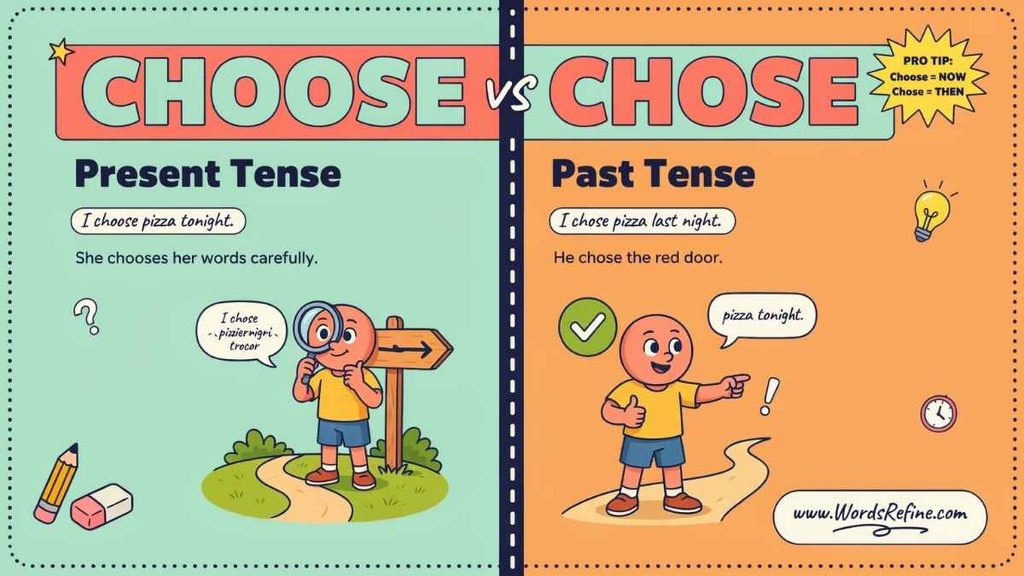
The easiest way to understand choose and chose is to connect each one with time.
Choose belongs to the present or base form.
Chose belongs to the simple past.
Consider these examples:
“I choose coffee every morning.”
“I chose coffee this morning.”
The first sentence describes a habit. The second describes a completed choice.
Here is another example:
“I choose the red car.”
“I chose the red car.”
Without any other context, the first sentence sounds like a current decision. The second tells us that the decision happened earlier.
So, when you ask, “What is the difference between choose and chose?” the short answer is this:
Choose = present or base form.
Chose = simple past form.
Choose, Chose, and Chosen What’s the Difference?
This is where things become slightly more interesting.
Choose, chose, and chosen are three forms of the same irregular verb.
The basic pattern is:
Choose → Chose → Chosen
Each form has a different grammatical job.
Choose
Choose is the base form and present-tense form.
“I choose my clothes carefully.”
“I want to choose a different option.”
Chose
Chose is the simple past form.
“I chose the black jacket.”
“She chose the larger room.”
Chosen
Chosen is the past participle.
It normally appears with helping verbs such as have, has, or had.
“I have chosen my seat.”
“She has chosen a new career.”
“They had chosen the restaurant before we arrived.”
Notice the difference:
“I chose the restaurant.”
“I have chosen the restaurant.”
Both sentences describe a completed decision, but the grammar is different.
The first uses the simple past.
The second uses the present perfect.
Learn the difference between confusing word pairs
Loose vs Lose Difference and which is Correctly?
Choose vs Chose Pronunciation
Spelling is not the only difference. Choose and chose are pronounced differently as well.
Choose has a long “oo” sound, similar to the sound in “food.”
Chose has a long “o” sound, similar to the sound in “go.”
Think of them this way:
Choose → “chooz”
Chose → “chohz”
The pronunciation difference can be helpful when speaking because it gives you another clue about which form you are using.
However, spelling still matters in writing. Even if your listener understands you from context, choosing the wrong written form can make your sentence grammatically incorrect.
How to Use Choose in a Sentence
There are several common sentence patterns with choose.
Choose + Noun
You can place a noun directly after choose.
For example:
“I choose the blue shirt.”
“She chose the vegetarian meal.”
“We need to choose a winner.”
Choose Between
Use choose between when you are deciding between alternatives.
For example:
“I cannot choose between these two dresses.”
“You need to choose between the two plans.”
“They chose between the available rooms.”
Choose to + Verb
You can also use choose followed by to and another verb.
For example:
“I choose to stay home.”
“She chose to accept the offer.”
“They chose to wait.”
This structure is especially useful when talking about someone’s decision to take a particular action.
Choose From
Use choose from when several options are available.
For example:
“You can choose from three desserts.”
“We had several hotels to choose from.”
“Customers can choose from different sizes.”
The phrase makes it clear that a selection is being made from a group of possibilities.
How to Use Chose in a Sentence
Because chose is the past form, use it when the decision has already happened.
For example:
“I chose the blue shirt yesterday.”
“She chose to leave early.”
“We chose a different route.”
“They chose the smaller apartment.”
You can also use chose with many of the same sentence patterns used with choose.
Compare:
1.I choose the blue one.”
2.I chose the blue one.”I choose to stay.”I chose to stay.”
3.I choose from three options.”
4.I chose from three options.”
The sentence structure remains similar. The main difference is the time of the action.
Learn the difference between commonly mixed-up more words
Whoever vs Whomever How to Use Each Word Correctly?
Choose vs Chose After Helping Verbs

One of the easiest ways to make a mistake is to use chose after a helping verb.
Fortunately, there is a simple rule.
After words such as will, can, could, should, must, and may, use the base form choose.
For example:
“I will choose later.”
“You can choose any seat.”
“She should choose carefully.”
“We must choose soon.”
Do not write:
“I will chose later.”
“You can chose any seat.”
“She should chose carefully.”
The same principle applies after do and did.
Use choose after did.
“I did choose the blue one.”
Not:
“I did chose the blue one.”
Why?
Because did already carries the past tense. The main verb returns to its base form.
This rule applies to many English verbs, not just choose.
Choose vs Chose After “To”
After to, use the base form choose.
For example:
“I want to choose a new color.”
“She decided to choose another option.”
“They had to choose quickly.”
This is another common mistake because people sometimes think that a past sentence requires chose everywhere.
It does not.
Look at this sentence:
“I had to choose.”
Even though had is in the past tense, choose remains in its base form.
Therefore:
“I had to choose” is correct.
“I had to chose” is incorrect.
The same idea applies to sentences such as:
“I wanted to choose.”
“She needed to choose.”
“They decided to choose.”
Have Chosen or Have Chose?
This is another very common grammar problem.
After have or has, use chosen, not chose.
Correct:
“I have chosen a new laptop.”
“She has chosen her favorite dress.”
“They have chosen the final option.”
Incorrect:
“I have chose a new laptop.”
“She has chose her favorite dress.”
The same rule applies to had.
Correct:
“I had chosen the restaurant before they arrived.”
Incorrect:
“I had chose the restaurant before they arrived.”
So remember:
Have chosen.
Has chosen.
Had chosen.
Not have chose, has chose, or had chose.
Common Mistakes With Choose and Chose
These mistakes are easy to make because the words look and sound related. However, once you understand the patterns, they become much easier to avoid.
Using Chose for a Current Choice
Incorrect:
“I chose the blue one.”
If you are making the decision right now, use choose.
Correct:
“I choose the blue one.”
Using Choose for a Completed Past Choice
Incorrect:
“Yesterday, I choose the red dress.”
Because the action happened yesterday, use chose.
Correct:
“Yesterday, I chose the red dress.”
Using Chose After Did
Incorrect:
“I did chose the blue one.”
Correct:
“I did choose the blue one.”
Remember that did already shows the past tense.
Using Chose After Will
Incorrect:
“I will chose later.”
Correct:
“I will choose later.”
Will is followed by the base form of the verb.
Using Chose After Have
Incorrect:
“I have chose the winner.”
Correct:
“I have chosen the winner.”
Have requires the past participle in this structure.
Choose vs Chose in Everyday Situations

The difference becomes much easier when you see these words in ordinary situations.
Shopping
Imagine you are standing in a clothing store.
You look at two shirts and say:
“I choose the black one.”
Later, you tell a friend about the shopping trip:
“I chose the black one.”
The situation is the same. The time has changed.
Restaurants
At a restaurant, you might say:
“I choose the pasta.”
Later, you could tell someone:
“I chose the pasta because it looked delicious.”
Again, choose describes the decision as current. Chose describes it as something that already happened.
Career Decisions
Suppose someone is deciding between two careers.
“I need to choose a career.”
After making the decision, the person might say:
“I chose teaching.”
The first sentence describes the decision process. The second describes the completed decision.
Travel
Before a trip:
“We need to choose a hotel.”
After booking it:
“We chose a hotel near the airport.”
The difference is small in spelling, yet it clearly changes the time of the action.
Real Life Example A Simple Conversation
Here is a natural conversation that shows how both words work.
Maya: “Which dessert should we get?”
Sara: “I choose the chocolate cake.”
Maya: “Good choice. I chose the cheesecake last time.”
Sara: “Then maybe we should try both.”
Notice how naturally the tense changes.
Sara uses choose because she is making the decision now.
Maya uses chose because her decision happened before.
That is the whole idea in action.
Choose vs Chose Examples
Here are several examples to make the difference even clearer.
Present or Base Form
- I choose tea every morning.
- Please choose your favorite color.
- We need to choose a restaurant.
- She wants to choose the blue dress.
- You can choose any seat.
- I will choose after I compare the options.
- They must choose before Friday.
Simple Past
- I chose tea yesterday.
- She chose the blue dress.
- We chose a restaurant near the station.
- They chose the cheaper option.
- He chose to stay home.
- I chose the wrong answer.
- She chose a different career.
Past Participle
- I have chosen my favorite option.
- She has chosen a new apartment.
- We have chosen the final design.
- They had chosen their seats before the show began.
- He has chosen to remain quiet.
A Simple Trick to Remember Choose and Chose
If you often confuse these words, stop trying to memorize complicated grammar explanations.
Instead, connect them with time.
Think:
Choose = now.
Chose = before.
Chosen = used with have, has, or had.
You can even picture a tiny timeline:
Now → choose
Past → chose
Completed with have/has/had → chosen
For example:
The“I choose the red one.”
“I chose the red one yesterday.”
“I have chosen the red one.”
Once you see the three forms together, the pattern becomes much easier to remember.
Learn the difference between confusing more English words
Vender vs Vendor Which one Is Correct?
Choose vs Chose Spelling Difference
The spelling difference is only one letter, but that letter matters.
Choose contains two “o” sounds in its spelling pattern.
Chose removes the “u” and ends with “se.”
Choose → present/base form
Chose → past form
Chosen → past participle
Because the words are so similar, it is easy to type one when you mean the other. Before submitting an important piece of writing, check the time of the action. That quick check often reveals the correct form immediately.
Practice Session Choose vs Chose
- I need to ______ a new laptop for work.
- She ______ the blue dress yesterday.
- We have ______ a restaurant for dinner tonight.
- He will ______ his seat after everyone arrives.
- They ______ to stay home last night.
- You can ______ any color you like.
- I have ______ the best option for the project.
- She wants to ______ a different career.
- We ______ the shorter route yesterday.
- You should ______ your words carefully.
- They had ______ their hotel before leaving.
- I usually ______ tea instead of coffee.
- She ______ the red car last week.
- You must ______ one answer.
- We have ______ a new team leader.
- I want to ______ the larger room.
- He ______ the wrong answer during the test.
- She has ______ a beautiful wedding dress.
- They will ______ a new captain tomorrow.
- We ______ the Italian restaurant last night.
- You should ______ the option that suits you best.
- I had to ______ between two options.
- She ______ to study abroad several years ago.
- Have you ______ a movie for tonight?
- He can ______ whichever option he prefers.
Answers
- choose
- chose
- chosen
- choose
- chose
- choose
- chosen
- choose
- chose
- choose
- chosen
- choose
- chose
- choose
- chosen
- choose
- chose
- chosen
- choose
- chose
- choose
- choose
- chose
- chosen
- choose
Here’s a trusted source for clear word meanings:
FAQs
What is another word for “choose”?
Another word for “choose” is “select.” Depending on the context, you can also use “pick,” “decide,” or “opt for.”
What does “choose” mean?
“Choose” means to select one person, thing, or option from several possibilities. For example, “Please choose a seat” means “Please select a seat.”
What is another word for “chose”?
Another word for “chose” is “selected.” Other alternatives include “picked,” “decided on,” and “opted for.” These words describe a decision made in the past.
What does “chose” mean?
“Chose” means selected or decided on something in the past. For example, “She chose the red dress” means she selected the red dress earlier.
What can I say instead of “choosing”?
Depending on the context, you can use “selecting,” “picking,” “deciding,” or “opting for.” For example, “I am choosing a gift” can become “I am selecting a gift.”
What is the opposite of “choose”?
There is no single opposite of “choose.” Depending on the context, words such as “reject,” “refuse,” “decline,” or “avoid” may express the opposite idea. Someone who cannot make a decision may also remain “undecided.”
What are the three forms of “choose”?
The three main forms are:
- Choose — base and present form
- Chose — simple past form
- Chosen — past participle
For example: “I choose,” “I chose,” and “I have chosen.”
Should I say “choose” or “chose”?
Use “choose” for a present or future decision and after helping verbs such as “will,” “can,” “should,” and “must.” Use “chose” for a completed decision in the past.
For example, “I choose the blue one” describes a current decision, while “I chose the blue one yesterday” describes a past decision.
Is “I chose you” correct?
Yes, “I chose you” is grammatically correct. It means “I selected you” or “I decided on you” in the past.
For example: “I chose you for the team because you have the right skills.”
What is the opposite of a choice?
A choice does not have one exact opposite. Depending on the situation, the opposite idea may be indecision, rejection, refusal, or making no decision.
What is a formal word for “choice”?
“Selection” is a formal alternative to “choice” in many situations. Other possibilities include “decision,” “preference,” and “option.” The best word depends on the sentence.
Is “chose” an actual word?
Yes. “Chose” is a correct English word. It is the simple past form of “choose.”
For example: “She chose the blue dress.”
Which is correct “I have chosen” or “I have chose”?
“I have chosen” is correct. “Chosen” is the past participle of “choose,” so it follows “have” or “has.”
Correct: “I have chosen a new option.”
Incorrect: “I have chose a new option.”
What does “to choose” mean?
“To choose” means to select, pick, or decide on something. It is the infinitive form of the verb.
For example: “I need to choose a new apartment.”
Is it “Why did I choose” or “Why I chose”?
“Why did I choose?” is correct when asking a direct question because “did” is followed by the base form “choose.”
For example: “Why did I choose this option?”
However, “why I chose” is correct when it appears within a statement.
For example: “I explained why I chose this option.”
Is it “she chose” or “she choose”?
Use “she chose” for a past action.
For a present action or regular habit, use “she chooses.”
For example:
1.“She chooses carefully.”
2.“She chose the blue dress yesterday.”
3.“She choose” is not correct in standard English.
What does “I chose” mean?
“I chose” means “I selected” or “I decided on” something in the past.
For example: “I chose the window seat because I wanted a better view.”
Conclusion
Choose vs chose may look like twins, but they do not do the same job. The difference is all about time. Use choose for a present or future decision, while chose describes a decision that has already happened. When have, has, or had appears before the verb, use chosen instead.
The easiest way to remember the pattern is simple: choose for now, chose for the past, and chosen after have, has, or had. Once you connect each form with its place in time, the confusion becomes much easier to manage.
So, the next time you pause over choose vs chose, do not let one little letter turn your sentence into a grammar mystery. Check when the action happened, pick the correct form, and move on with confidence.

Diora AJS she is an experienced blogger and passionate English language enthusiast at Words Refine. With a keen eye for language and a love for clear communication, she writes practical content about grammar, word meanings, usage, and commonly confused terms. Her goal is to make English easier to understand through clear explanations and relatable examples, helping readers write accurately and communicate with confidence.