
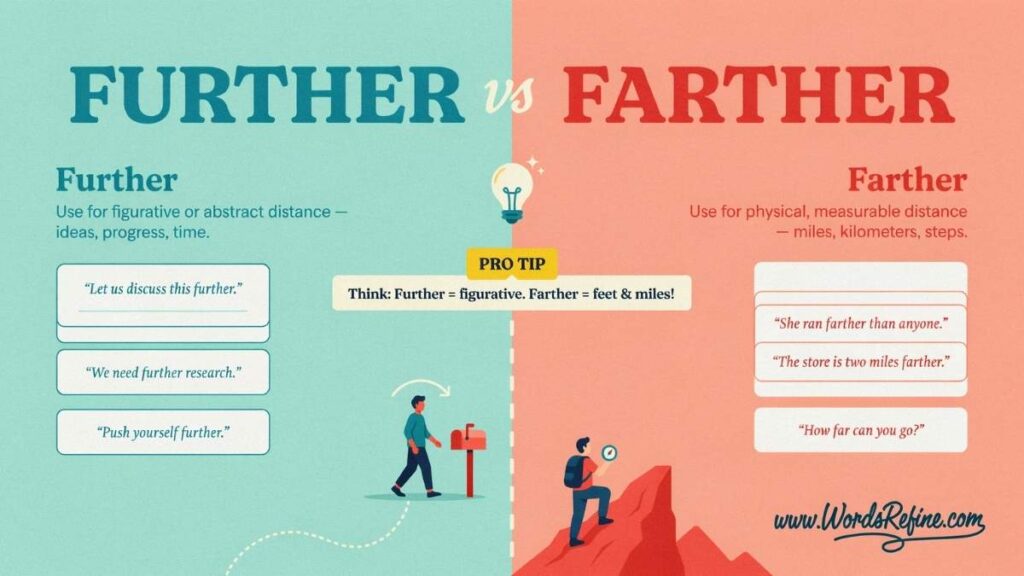
Have you ever written “further vs farther” and then stared at the sentence wondering which one actually belongs there? English has a talent for creating exactly these little grammar puzzles. Although the two words look nearly identical, they do not always mean the same thing. Farther traditionally describes physical or measurable distance, while further often relates to additional information, progress, or an abstract idea. Yet, just to keep things interesting, further can also describe physical distance in everyday English. In this guide, you’ll learn the difference between further and farther through clear rules, practical examples, and simple tips that make the choice much easier.
Further vs Farther The Quick Answer
The easiest way to remember the difference is to connect farther with the word far.
When you’re talking about actual space, farther is usually the better choice.
For example:
The next town is farther than I expected.
Here, the sentence describes a physical distance between locations.
Further, on the other hand, often means more, additional, or to a greater extent.
For example:
We need further information before making a decision.
In this sentence, further means additional. There is no physical distance involved.
The basic rule can be remembered this way:
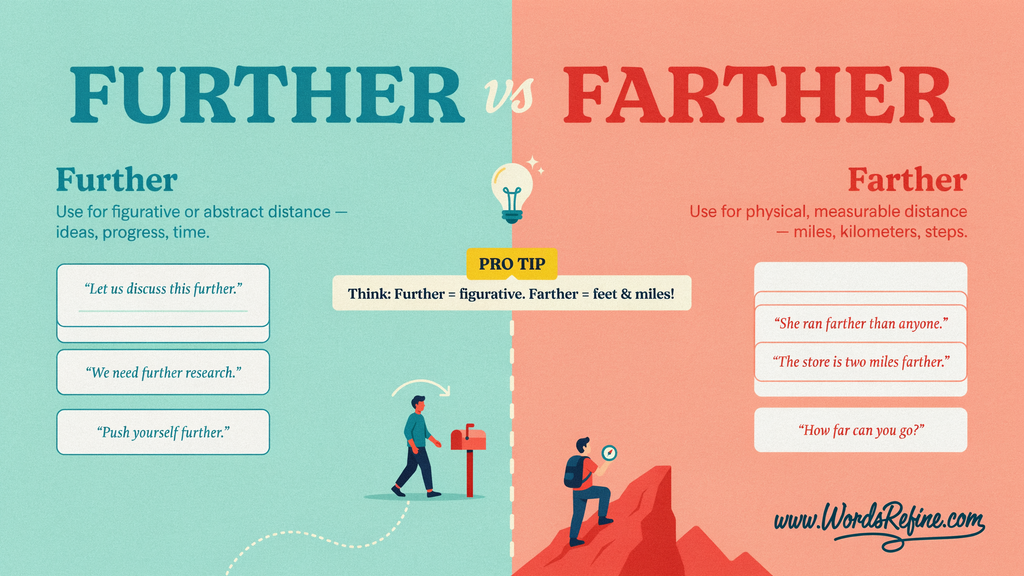
- Use farther when you’re talking about physical distance.
- Use further when you mean additional, more, continued, or greater in degree or extent.
- When physical distance is involved, further can also be acceptable in modern English.
- With familiar expressions, follow the established wording rather than forcing the basic rule.
That last point matters because some expressions naturally use further, even when the idea of distance appears in the phrase.
What Is the Difference Between Further vs Farther?
The main difference comes down to the type of distance being discussed.
Farther traditionally describes literal or physical distance. It works especially well when you can picture two locations and measure the space between them.
For example:
The new house is farther from the school.
You could measure the distance between the house and the school. That makes farther a natural choice.
Further usually describes an abstract kind of distance. Instead of moving through physical space, something moves toward a greater level of understanding, development, discussion, or progress.
For example:
We need to investigate the problem further.
You can’t measure the investigation in miles or feet. The word further describes taking the investigation to a greater extent.
However, further has another important meaning: additional.
Consider:
Please provide further details.
Here, further means more or additional. That meaning has nothing to do with distance.
Because of these different uses, the two words overlap in some situations but cannot always replace each other.
Learn the difference between confusing more English words
Capital or Capitol Which One Is Correct?
When to Use Farther
The Farther works best when a sentence describes physical space.
Farther for Physical Distance
Suppose two restaurants are on the same road. One is two miles away and the other is five miles away. You could say:
The second restaurant is farther away.
The word describes the greater distance between the restaurant and your starting point.
Similarly, you might say:
We walked farther than we planned.
The airport is farther from downtown.
The cabin is farther down the road.
How much farther do we have to go?
Each example involves movement or position in physical space.
Farther for Measurable Distance
The traditional preference for farther becomes particularly clear when a distance has a specific measurement.
For example:
We drove farther than 200 miles.
The second checkpoint is farther away.
The trail extends farther than five miles.
When a distance can be expressed in miles, feet, kilometers, or another unit, farther makes the physical meaning especially clear.
Farther With Directions
Farther also works naturally when describing geographical direction.
For example:
The town is farther north.
The farm is farther south.
The road continues farther east.
Their new home is farther from the city.
In each case, the sentence describes physical location or movement.
Farther as an Adjective
Farther can function as an adjective when it describes a noun.
For example:
We chose the farther route.
The word compares two routes and identifies the one that covers a greater physical distance.
Another example is:
The farther location has better parking.
Here, farther describes the location that is more distant.
Farther as an Adverb
Farther can also function as an adverb when it modifies a verb.
For example:
The runner went farther than everyone expected.
Don’t walk farther without telling someone.
We decided to travel farther before stopping.
In these sentences, farther describes how far an action extends through physical space.
Learn the difference between commonly mixed-up more words
Loose vs Lose Difference and which is Correctly?
When to Use Further
Further has a broader role in English, so its uses are worth examining separately.
Further for Abstract Ideas
When there is no physical distance involved, further is usually the natural choice.
For example:
Let’s discuss the matter further.
The issue requires further consideration.
Researchers need to examine the evidence further.
She wants to take her work further.
These sentences describe ideas, discussions, investigations, or progress. None involves measurable space.
Further Means Additional
One of the most common meanings of further is additional or more.
For example:
We need further information.
This means:
We need additional information.
The same pattern appears in many everyday expressions.
- Further details
- Further explanation
- Further research
- Further discussion
- Further investigation
- Further consideration
- Further assistance
- Further action
- Further development
- Further education
For example:
The report needs further explanation.
The writer isn’t asking for an explanation that is physically farther away. The writer wants more explanation.
Further Means to a Greater Extent
Further can also describe something continuing beyond its current point.
For example:
The discussion went further than expected.
The investigation went further than the original plan.
The project has progressed further than anticipated.
Here, further suggests movement toward a greater degree or extent.
Further as an Adjective
When further modifies a noun, it often means additional.
For example:
We need further information.
No further action is required.
The committee requested further evidence.
The company announced further development of the project.
In each case, further means something like more or additional.
Further as an Adverb
As an adverb, further can describe continuation or a greater degree.
For example:
We need to investigate further.
Please explain the issue further.
The conversation continued further than expected.
The word tells the reader that something should continue beyond its current point.
Further as a Verb
Further can also function as a verb. In this form, it means to advance, promote, or help something develop.
For example:
The program aims to further education.
The campaign hopes to further the cause.
New funding could further scientific research.
Here, further doesn’t describe distance at all. It means to help something move forward or develop.
Learn the difference between confusing word pairs
Lay vs Lie Difference and which is correct?
Can Further Be Used for Physical Distance?
Yes. This is where the traditional rule needs a little context.
For generations, grammar guides have commonly taught that farther belongs with physical distance and further belongs with abstract ideas. That rule remains useful, especially for careful writing.
However, native English speakers frequently use further for physical distance.
For example:
How much further do we have to drive?
We walked further into the forest.
The road continues further north.
These sentences are natural in everyday English.
So, if you’re asking whether further can describe distance, the answer is yes.
The distinction is often one of emphasis.
Farther can emphasize the actual physical distance:
We drove farther than the other group.
Further can emphasize continuation:
We drove further before stopping.
The difference is subtle, and in many situations both forms will be understood without difficulty.
Further vs Farther for Figurative Distance?
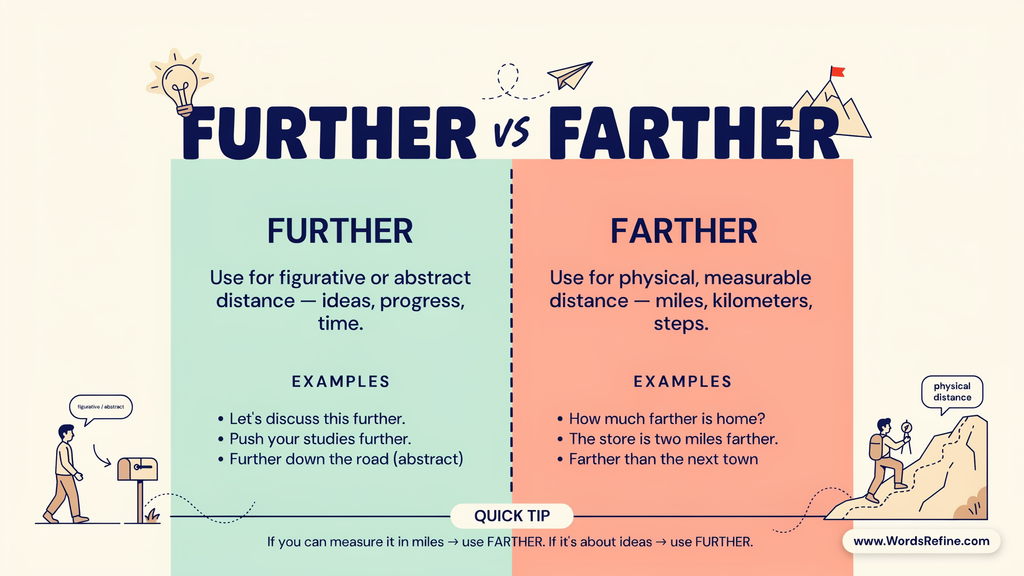
When the idea of distance is figurative rather than physical, further is generally the better choice.
For example:
We need to look further into the problem.
The phrase doesn’t describe looking through physical space. It means examining the issue more deeply.
Similarly:
The discussion needs to go further.
She wants to take the research further.
The company hopes to further its goals.
These examples involve progress, depth, or development.
A useful test is to ask whether you could replace the word with more or additional.
If you can, further is probably the right choice.
For example:
We need further information.
can become:
We need additional information.
That substitution works perfectly.
However:
We walked farther.
cannot become:
We walked additional.
The meaning clearly involves physical distance.
Learn the difference between often confused words
Whoever vs Whomever How to Use Each Word Correctly
Further vs Farther Common Examples
Context becomes much easier to understand when you compare similar sentences.
Further vs Farther Down the Road
Consider:
The gas station is farther down the road.
Here, the phrase describes a physical location. Farther is the traditional choice.
However, the phrase can also have a figurative meaning:
Further down the road, we’ll discuss the consequences.
Now the phrase refers to a later point in a discussion or explanation rather than a physical location.
The surrounding context determines the meaning.
Further vs Farther Away
Both forms occur in English.
The second house is farther away.
This clearly emphasizes physical distance.
You can also hear:
The sound seemed further away.
Further is common here, particularly in conversational English.
When you want to make the physical-distance distinction especially clear, farther remains the safest traditional choice.
Further vs Farther North
For geographical distance, farther is traditionally preferred.
The village lies farther north.
However, further north is also common when the meaning emphasizes continued movement or extension in a direction.
The road continues further north.
Both forms can therefore appear naturally depending on the sentence.
Further vs Farther From the Truth
This is a case where the established expression matters.
The familiar expression is:
Nothing could be further from the truth.
The distance here is figurative. Nobody is measuring a physical gap between a statement and the truth.
The expression means that something is completely or extremely different from the truth.
For that reason, further is the conventional choice.
Learn the difference between basic English word mistakes
Vender vs Vendor Which one Is Correct?
Further vs Farther in Common Expressions
Certain phrases appear so frequently that it’s helpful to recognize their standard forms.
Expressions Commonly Used With Further
- Further information
- Further details
- Further explanation
- Further discussion
- Further research
- Further investigation
- Further consideration
- Further assistance
- Further action
- Further education
- Further development
- Until further notice
- Look no further
- Nothing could be further from the truth
For example:
Contact the office for further information.
The scientists called for further research.
No further action is required.
The store will remain closed until further notice.
In each sentence, further relates to addition, continuation, or an abstract idea.
Expressions Commonly Used With Farther
- Farther away
- Farther down the road
- Farther north
- Farther south
- Farther from home
- Travel farther
- Walk farther
- Drive farther
- Move farther
- Go farther
These expressions generally involve physical distance or movement.
Further vs Farther Common Mistakes
The easiest way to avoid confusion is to watch for a few recurring mistakes.
Mistake Using Farther When You Mean Additional
Incorrect:
Please provide farther information.
Correct:
Please provide further information.
Why? Because the writer wants more information, not information located at a greater physical distance.
Believing Further Never Describes Physical Distance
This is an overly strict interpretation of the traditional rule.
The sentence:
How much further do we need to walk?
is common and natural.
If you’re writing a formal sentence where measurable physical distance is the main focus, farther may provide greater precision. However, further isn’t automatically wrong whenever distance appears.
Assuming the Words Are Always Interchangeable
They aren’t.
You can’t normally replace further with farther when further means additional.
For example:
We need further research.
Changing further to farther changes the meaning and makes the sentence incorrect.
Likewise, when you’re clearly comparing physical distances, farther usually communicates the idea more precisely.
Ignoring Familiar Expressions
Some expressions have become fixed through common usage.
For example:
Look no further.
Nothing could be further from the truth.
These expressions sound natural because speakers recognize them as established phrases.
Trying to change them simply to follow a physical-distance rule doesn’t improve the sentence.
Further or Farther A Simple Decision Test
When you’re unsure which word to choose, work through these questions.
Is the sentence about physical distance?
If yes, farther is usually the traditional choice.
The store is farther from my house.
Does the word mean more or additional?
If yes, use further.
We need further information.
Does it describe an abstract idea?
If yes, further is generally the better option.
Let’s discuss this further.
Does it describe continued progress or development?
Further usually fits.
The company wants to further its research.
Is it a familiar expression?
Use the established form.
Look no further.
This approach is much more reliable than trying to memorize every possible sentence.
Further vs Farther Side-by-Side Examples
| Sentence | Best choice | Reason |
|---|---|---|
| We walked farther than yesterday. | Farther | Physical distance |
| Please send further details. | Further | Additional details |
| The airport is farther from the city. | Farther | Physical location |
| We need to investigate further. | Further | Greater extent of investigation |
| She wants to further her education. | Further | Advance or develop |
| Nothing could be further from the truth. | Further | Figurative expression |
| The trail goes farther into the valley. | Farther | Physical distance |
| We need further research. | Further | Additional research |
| How much farther do we have to go? | Farther | Physical distance |
| How much further do we have to go? | Further | Common modern usage |
Notice the final pair. Both can be heard in everyday English. The first emphasizes physical distance more directly, while the second treats the journey as continued progress.
Further vs Farther A Practical Case Study
Imagine a family driving to a vacation destination.
At first, someone asks:
How much farther is the hotel?
The question focuses on the remaining physical distance. Farther fits naturally.
After another hour, someone says:
How much further do we have to drive?
Further also sounds natural because the speaker is asking about continuing the journey.
Once the family arrives, they discuss their plans:
We need further information about the hiking trails.
Now further means additional.
Later, they decide:
Let’s explore the area further tomorrow.
This time, further means to a greater extent.
The same word can therefore appear in several contexts, but its meaning changes according to what the sentence describes.
How to Remember Further vs Farther
There’s a simple memory trick that works well.
Think of the word far inside farther.
If you’re talking about how far something is, farther is a strong choice.
For example:
We need to travel farther.
Then connect further with the idea of more.
If you mean more information, more discussion, more research, or greater progress, further usually works.
For example:
We need further discussion.
The shortcut is:
- Farther connects naturally with physical distance.
- Further connects naturally with additional information or greater extent.
- Further can also describe physical distance, especially in everyday usage.
- Fixed expressions should be learned as they naturally occur
Further vs Farther Practice Session
- The grocery store is ________ from my house than the pharmacy.
- We need to discuss this issue ________ before making a final decision.
- How much ________ is the nearest gas station?
- After visiting the city, she decided to travel ________ north.
- Please contact me if you need any ________ information.
- The hikers walked ________ than they had originally planned.
- We should investigate the problem ________ before reaching a conclusion.
- The lake is ________ away than I expected.
- Nothing could be ________ from the truth.
- She wants to continue her ________ education after college.
- The village is ________ from the main road than the town.
- We need a ________ explanation before we can fully understand the situation.
- She threw the ball ________ than her brother.
- The students were asked to conduct ________ research before writing their reports.
- The discussion could go no ________ because nobody was willing to compromise.
- If you walk any ________, you’ll reach the end of the trail.
- The company needs to make ________ improvements to its services.
- The restaurant is ________ down the road than I remembered.
- We cannot go any ________ without more evidence.
- He moved ________ away from the crowded area.
- For ________ details, please speak with the manager.
- The two cities are ________ apart than they appear on the map.
- She decided to look ________ into the causes of the problem.
- The mountain is ________ from here than the hill.
- We need to take ________ action if the problem continues.
Answers
- farther
- further
- farther
- farther
- further
- farther
- further
- farther
- further
- further
- farther
- further
- farther
- further
- further
- farther
- further
- farther
- further
- farther
- further
- farther
- further
- farther
- further
Here’s a trusted source for clear word meanings:
FAQs
Is the saying “look no further” or “look no farther”?
The standard expression is “look no further.” It means you don’t need to search, consider, or investigate anything else because you’ve already found what you need.
Example: “If you’re looking for a simple explanation, look no further.”
Which is correct: “farthest” or “furthest”?
Both “farthest” and “furthest” are correct. Generally, “farthest” refers to physical distance, while “furthest” often refers to an abstract degree, extent, or point in a process.
Example: “That village is the farthest from the city.”
Example: “This decision takes the discussion furthest.”
Do British people say “further” or “farther”?
British English uses both words, although “further” appears more often in situations where American English might prefer “farther.” In everyday British usage, the distinction between physical and figurative distance is less strict.
Is it “could not be further from the truth” or “could not be farther from the truth”?
“Could not be further from the truth” is the standard and most familiar expression. Here, “further” describes an abstract degree of difference rather than a literal distance.
Example: “That claim could not be further from the truth.”
How do you pronounce “farther” and “further”?
Both words have two syllables and begin with the same sound. The main difference comes at the end: “farther” contains the sound associated with “far,” while “further” uses a different middle vowel sound.
Which is correct: “I can’t walk any further” or “I can’t walk any farther”?
Both can be correct. Traditionally, “farther” is preferred when you’re talking about physical distance.
Example: “I can’t walk any farther because my legs are exhausted.”
However, “further” is also widely used in modern English when the meaning is simply “continue.”
When should I use “farther” vs “further”?
A simple rule is to use “farther” for physical or measurable distance and “further” for additional information, progress, discussion, or abstract ideas.
Example: “The airport is farther from here than the station.”
Example: “We need further information before deciding.”
Is it correct to say “looking further out” or “farther out”?
Both can be used, depending on context. “Farther out” is a natural choice when you mean a greater physical distance from a particular location.
Example: “The fishermen moved farther out into the water.”
“Further out” can also describe physical position and is common in everyday English.
Which is correct: “farther in life” or “further in life”?
“Further in life” is generally the better choice because the phrase refers to a later stage or point in life rather than a measurable physical distance.
Example: “You may see things differently further in life.”
Which is correct: “money goes farther” or “money goes further”?
Both expressions are used in English. “Money goes farther” traditionally emphasizes how much a fixed amount can accomplish or cover. “Money goes further” is also common, particularly when talking about getting more value from your money.
Example: “Your money goes farther when you shop carefully.”
Which is correct: “walk further” or “walk farther”?
When you mean a greater physical distance, “walk farther” is the traditional choice.
Example: “We had to walk farther than we expected.”
That said, “walk further” is also common in everyday English, especially when the emphasis is on continuing the activity rather than measuring the distance.
Is it “farther” or “further” down the road?
Use “farther down the road” when you mean a greater physical distance along an actual road.
Example: “There’s a small café farther down the road.”
However, “further down the road” is common when the phrase has a figurative meaning.
Example: “We can deal with that problem further down the road.”
Is it “run further” or “run farther”?
If you mean running a greater physical distance, “run farther” is the traditional choice.
Example: “With regular training, you’ll be able to run farther.”
“Run further” is also widely used, particularly when the meaning is simply to continue running.
Is it “step further” or “step farther”?
Use “step farther” when you’re talking about physical movement.
Example: “Please step farther away from the door.”
Use “step further” when you mean advancing an idea, discussion, or process.
Example: “Let’s take the conversation a step further.”
Conclusion
Further vs farther may look almost identical, but they don’t always travel in the same direction. The simplest rule is this: use farther for physical or measurable distance, while further usually refers to something additional, continued, or abstract. You can walk farther down the road, for example, but you can take a conversation further.
Still, English likes to keep things interesting. In modern usage, further can also refer to physical distance, especially in everyday speech. So, if someone says, I can’t walk any further, there’s no need to call the grammar police. The sentence is perfectly understandable and widely accepted.
Ultimately, context makes the choice clearer. If you’re measuring actual distance, farther is often the best fit. If you’re talking about an idea, degree, progress, or something additional, further usually wins. Once you understand that small distinction, further vs farther becomes much less confusing. After all, good grammar should not make you travel farther than necessary to find the right word.

Diora AJS she is an experienced blogger and passionate English language enthusiast at Words Refine. With a keen eye for language and a love for clear communication, she writes practical content about grammar, word meanings, usage, and commonly confused terms. Her goal is to make English easier to understand through clear explanations and relatable examples, helping readers write accurately and communicate with confidence.