
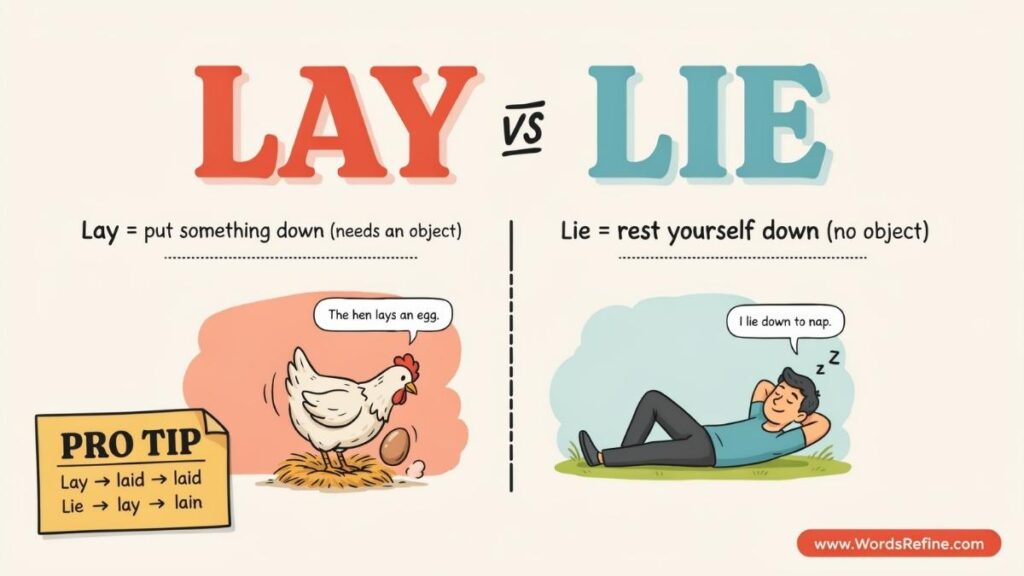
Lay vs lie is one of those grammar challenges that can make an otherwise simple sentence surprisingly confusing. You may know exactly what you want to say, yet still hesitate over whether to lie on the couch or lay on it. The confusion becomes even greater because “lay” is also the past tense of “lie.” Fortunately, understanding the difference doesn’t require memorizing complicated grammar rules. Once you know whether someone is resting or placing something, the correct choice becomes much clearer. In this guide, well explain the difference, highlight common mistakes, and show you how to use these easily confused verbs correctly.
Lay vs Lie The Simple Rule
The easiest way to choose between lay and lie is to ask what is happening in the sentence.
If someone is placing something somewhere, use lay.
- Lay the book on the table.
- Lay the keys beside the door.
- Lay the blanket on the bed.
If someone is reclining or resting, use lie.
- I need to lie down.
- She likes to lie on the couch.
- The dog is lying under the table.
The important grammatical difference is that lay normally takes a direct object when it means “put” or “place.” Lie does not.
Consider these two sentences:
- Lay the book on the desk.
- The book lies on the desk.
In the first sentence, someone is placing the book. In the second, the book is simply in a particular position.
That distinction is the foundation of the whole rule.
Lay vs Lie Meaning
Before dealing with verb forms and tense, it helps to understand what each word actually means.
Lay means to put or place something in a particular position.
For instance, when you say, “Lay the phone on the table,” you’re asking someone to move the phone into a specific position.
The object can be physical:
- Lay the clothes on the bed.
- Lay the plates on the table.
- Lay the papers beside the computer.
It can also be more abstract:
- The project laid the foundation for future research.
- The agreement laid the groundwork for further discussions.
In each case, something is being placed, established, or set down.
Lie, on the other hand, means to recline, rest, or remain in a particular position.
You might say:
- I want to lie on the couch.
- She likes to lie in bed on quiet mornings.
- The cat lies near the window.
- The papers lie scattered across the floor.
Here, nobody is placing an object. The subject is simply resting or remaining in a position.
Lay vs Lie in a Sentence

The difference becomes much clearer when the two verbs appear in similar sentences.
- Lay the book on the table.
- The book lies on the table.
The first sentence describes an action. Someone puts the book on the table.
The second describes a position. The book is already there.
Now consider another pair:
- She laid the baby in the crib.
- The baby lay in the crib.
Again, the first sentence describes someone placing the baby somewhere. The second describes where the baby was.
This is a useful way to understand the difference between lay and lie without relying on complicated grammar terminology.
When you’re placing something, use lay. When you’re talking about resting or being in a position, use lie.
Lay vs Lie Verb Forms
This is where things become more confusing because both verbs are irregular.
The forms look like this:
| Verb | Present | Past | Past Participle | Present Participle |
|---|---|---|---|---|
| Lay | lay | laid | laid | laying |
| Lie | lie | lay | lain | lying |
At first, the table may look like a grammar puzzle. The important thing is to learn each verb as a complete family rather than memorizing isolated words.
The forms of lay are:
- Present: lay
- Past: laid
- Past participle: laid
- Present participle: laying
The forms of lie are:
- Present: lie
- Past: lay
- Past participle: lain
- Present participle: lying
Notice the problem immediately: lay appears in both sets.
In one sentence, lay can be the present tense of the verb meaning “put.”
For example:
“I lay the book on the desk every morning.”
In another sentence, lay can be the past tense of lie.
For example:
“I lay on the couch yesterday.”
The spelling is the same, but the verbs are different.
Lay vs Lie Past Tense
1.The past tense causes more mistakes than almost any other part of this distinction.
2.The past tense of lay is laid.
3.The past tense of lie is lay.
That means:
- Present: I lay the book down.
- Past: I laid the book down.
But:
- Present: I lie down.
- Past: I lay down.
This is why “I lay down yesterday” is correct when you mean that you reclined yesterday.
It may look strange because lay is usually associated with placing something. However, in that sentence, lay is the past tense of lie.
The following comparison makes the difference easier to see:
| Meaning | Present | Past |
|---|---|---|
| Put something somewhere | I lay the book down. | I laid the book down. |
| Recline or rest | I lie down. | I lay down. |
Once you see the pattern, the confusion starts to disappear.
Is Lay the Past Tense of Lie?
Yes, when lie means “recline” or “rest.”
The verb forms are:
- Present: lie
- Past: lay
- Past participle: lain
- Present participle: lying
So you can say:
- I lie on the bed every afternoon.
- I lay on the bed yesterday.
- I have lain on the bed for an hour.
- I am lying on the bed now.
Each sentence uses a different form of the same verb.
However, lay also belongs to another verb:
- I lay the book on the desk.
- I laid the book on the desk yesterday.
- I have laid the book on the desk.
- I am laying the book on the desk.
This overlap explains why these verbs cause so much trouble.
Learn the difference between often confused words
Vender vs Vendor Which one Is Correct?
Laid vs Lay Which One Is Correct?
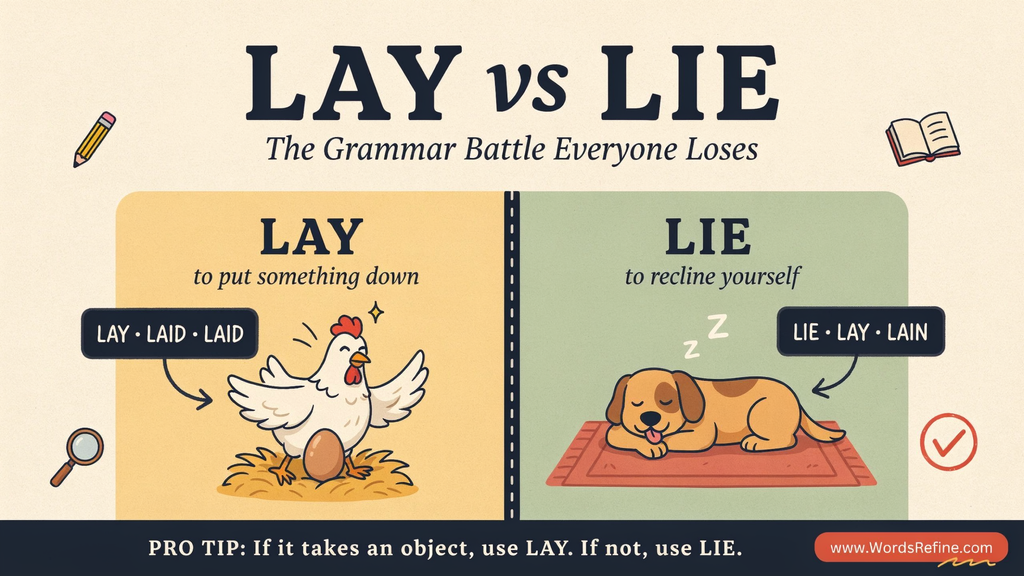
The choice between laid and lay depends on the verb and the tense.
Use laid when you mean that something was placed somewhere in the past.
For example:
- She laid the keys on the counter.
- He laid his jacket on the chair.
- They laid the papers on the table.
Use lay when you mean that someone reclined or rested in the past.
For example:
- She lay on the couch all afternoon.
- He lay in bed for several hours.
- The dog lay beside the fireplace.
So, if you’re asking whether it should be laid or lay, first ask what happened.
Was something placed somewhere?
Use laid for the past tense.
Was someone or something resting or reclining?
Use lay for the past tense of lie.
Lay vs Lie Down
The phrase “lay or lie down” creates a particularly common problem.
When you’re talking about reclining, the standard form is lie down.
- I need to lie down.
- She went upstairs to lie down.
- You should lie down and rest.
However, lay down can also be correct when something is being placed.
- Lay the book down.
- Lay the blanket down.
- Lay the baby down carefully.
The difference is the object.
In “Lie down,” there is no direct object.
In “Lay the book down,” the book is the object being placed.
Therefore, when deciding between “lie down or lay down,” ask whether you’re resting or putting something somewhere.
Is It Lay Down vs Lie Down?
If you’re talking about yourself reclining, say:
“I need to lie down.”
If you’re telling someone to put an object somewhere, say:
“Lay the book down.”
If you’re putting a baby or another person into a resting position, lay can also take an object:
“Lay the baby down.”
The difference between lay and lie down becomes much easier when you focus on the action rather than the sound of the sentence.
In everyday conversation, “lay down” is common in places where traditional grammar would use “lie down.” However, in careful or formal writing, “lie down” remains the standard choice when no object follows.
Lay the Book Down vs Lie the Book Down?
The correct expression is “lay the book down.”
That’s because the book is being placed somewhere.
You can also say:
- Lay the book on the table.
- Lay the book beside the lamp.
- Lay the book down gently.
You cannot normally use lie in the same way:
“Lie the book on the table” is incorrect in standard English.
This gives you another useful test. If the sentence involves placing an object, lay is the appropriate verb.
Lay vs Lie Past Participles
The past participle forms are laid and lain.
For lay:
“I have laid the book on the desk.”
For lie:
“I have lain on the couch all morning.”
The difference matters because past participles commonly appear with helping verbs such as have, has, and had.
Consider these examples:
- She has laid the clothes on the bed.
- He has laid the documents on the desk.
- She has lain awake for hours.
- They had lain on the beach all afternoon.
A common mistake is using laid when lain is required.
For example:
“I have laid in bed all morning” is not the traditional standard form when the meaning is reclining.
The standard construction is:
“I have lain in bed all morning.”
Likewise, “I have lain the book on the table” is incorrect because placing the book requires laid.
Laying vs Lying?
The present participles create another familiar problem.
Laying comes from lay.
Lying comes from lie.
For example:
- She is laying the plates on the table.
- He is laying the documents on the desk.
- She is lying on the couch.
- He is lying in bed.
The difference is straightforward once you return to the basic meanings.
Laying means placing something.
Lying means reclining or resting.
Therefore, “She is lying on the bed” is correct when she is resting there.
“She is laying the clothes on the bed” is correct when she is placing the clothes there.
Learn the difference between often confused words
Whoever vs Whomever How to Use Each Word Correctly
Common Lay vs Lie Grammar Mistakes
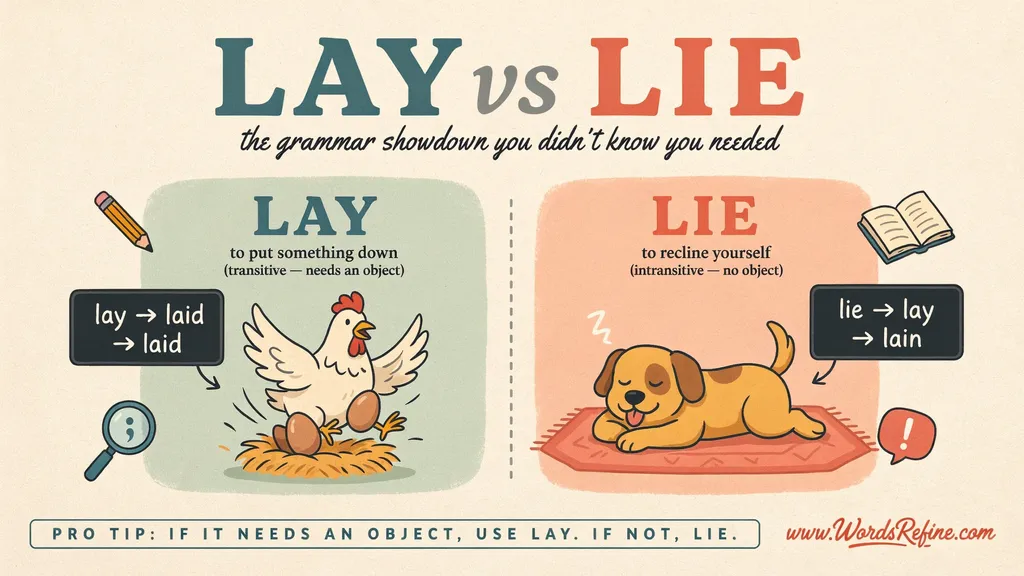
These mistakes are so common because the wrong forms often sound perfectly natural in casual conversation.
“I’m going to lay down.”
In traditional standard grammar, use:
“I’m going to lie down.”
That’s because the speaker is reclining and no object follows the verb.
However, this sentence is correct:
“I’m going to lay the baby down.”
Here, “the baby” is the object being placed.
“I laid down yesterday.”
When the meaning is “I reclined yesterday,” the standard form is:
“I lay down yesterday.”
The reason is simple: lay is the past tense of lie.
“She is laying on the couch.”
If she is resting on the couch, use:
“She is lying on the couch.”
But if she is placing something on the couch, use:
“She is laying the blanket on the couch.”
“I have laid in bed all morning.”
When the intended meaning is reclining, use:
“I have lain in bed all morning.”
The word lain is the past participle of lie.
“I have lain the book on the table.”
When you’re placing the book, use:
“I have laid the book on the table.”
Again, the object tells you which verb you need.
Lay vs Lie Ahead
The expression “lie ahead” has a different use from the physical meanings discussed above.
When something is waiting in the future, lie is the standard choice.
For example:
- Many opportunities lie ahead.
- Difficult decisions lie ahead.
- Nobody knows what lies ahead.
- A challenging road lies ahead.
Here, lie means that something exists or remains in a particular position or state.
You wouldn’t normally say “lay ahead” when you mean that something awaits in the future.
Therefore, when deciding between lay or lie ahead, use lie in expressions such as “what lies ahead.”
A Practical Method for Choosing the Right Verb

When you’re unsure about the correct use of lay and lie, take a moment to work through the sentence.
Look at the meaning
First, ask whether the verb means “put” or “place.”
If it does, use lay.
If the meaning is “recline,” “rest,” or “remain in a position,” use lie.
Look for a direct object
Next, check whether something receives the action.
For example:
“She laid the book on the table.”
The book receives the action of being placed.
By contrast:
“She lay on the couch.”
There is no direct object.
Check the tense
Finally, determine when the action happened.
For the verb meaning “place”:
- Present: lay
- Past: laid
- Past participle: laid
- Present participle: laying
For the verb meaning “recline”:
- Present: lie
- Past: lay
- Past participle: lain
- Present participle: lying
This three-step method can solve most problems involving these verbs.
Lay vs Lie Examples in Everyday English
Real-life examples make the distinction much easier to remember.
At Home
- I need to lie down for a few minutes.
- Lay the towels on the bed.
- The dog is lying under the table.
- She laid her purse on the counter.
At Work
- Please lay the documents on my desk.
- He laid the report beside the computer.
- The old files lie in the cabinet.
- The unfinished project has lain untouched for months.
In School
- Lay your notebook on the desk.
- The teacher asked the students to lay their papers on the table.
- The books lay scattered across the classroom floor.
Notice the tense in the last sentence. “Lay” doesn’t mean someone placed the books. Instead, it is the past tense of lie, describing where the books were.
A Useful Comparison of Lay vs Lie
| Situation | Correct form | Example |
|---|---|---|
| Put something somewhere now | lay | Lay the phone here. |
| Put something somewhere in the past | laid | She laid the phone here. |
| Recline now | lie | I need to lie down. |
| Recline in the past | lay | I lay down earlier. |
| Have reclined | lain | I have lain here for an hour. |
| Place something while doing it | laying | She is laying the clothes out. |
| Recline while doing it | lying | She is lying on the bed. |
| Something exists ahead | lie | Several challenges lie ahead. |
How to Remember Lay vs Lie
If all these forms still seem tangled, don’t try to memorize every example separately.
Instead, remember two simple ideas.
Lay goes with placing.
Lie goes with reclining.
Then remember the past forms:
“Lay becomes laid.”
“Lie becomes lay.”
Finally, remember the past participle:
“Lie becomes lain.”
That gives you the essential pattern:
- Lay, laid, laid, laying.
- Lie, lay, lain, lying.
You can then build the correct sentence from the meaning and tense.
For example:
“I lie down every evening.”
“Yesterday, I lay down early.”
“I have lain down several times today.”
Now switch to the other verb:
“I lay the book on the table.”
“Yesterday, I laid the book on the table.”
“I have laid the book on the table.”
The pattern is consistent even though the words overlap.
Lay vs Lie Practice Session
- I usually ______ down for a few minutes after lunch.
- Please ______ the keys on the table.
- Yesterday, I ______ on the couch for two hours.
- She ______ the baby in the crib before leaving the room.
- He has ______ awake all night.
- We ______ the books on the desk before class started.
- The dog is ______ on the floor.
- Please ______ the blanket on the bed.
- I need to ______ down because I’m exhausted.
- She ______ the phone beside her laptop.
- Yesterday, he ______ the package on the kitchen counter.
- The children were ______ on the grass and watching the clouds.
- I have ______ in this bed many times when I’ve been sick.
- She ______ down for a short nap yesterday afternoon.
- Please ______ your jacket over the chair.
- The cat has ______ quietly under the table all morning.
- He is ______ the plates on the dining table.
- I ______ down every night around 11 p.m.
- Yesterday, I ______ my coat on the chair.
- The book was ______ on the floor.
- She has ______ the documents on my desk.
- After the long walk, we decided to ______ down and rest.
- He ______ the baby down gently and covered her with a blanket.
- The old house ______ beyond the hill.
- I ______ the newspaper on the table before I went outside.
Answers
- lie
- lay
- lay
- laid
- lain
- laid
- lying
- lay
- lie
- laid
- laid
- lying
- lain
- lay
- lay
- lain
- laying
- lie
- laid
- lying
- laid
- lie
- laid
- lies
- laid
Here’s a trusted source for clear more words Comparison
Grammar Update
FAQs
Do humans lie or lay?
Humans lie when they mean to rest or recline. For example, “Humans lie down to sleep.” Use lay when someone places something somewhere, such as “I lay the baby in the crib.”
Can I lie by your side?
Yes. “Can I lie by your side?” is correct when you mean to rest or recline next to someone. “Lay by your side” is incorrect in standard English when there is no object.
Is it laying or lying on the bed?
“Lying on the bed” is correct when you mean resting or reclining. For example, “She is lying on the bed.” The form “laying” requires an object, such as “She is laying the blanket on the bed.”
Is it lying or laying by the pool?
“Lying by the pool” is correct when you mean relaxing or reclining there. For example, “We spent the afternoon lying by the pool.”
Am I lying low or laying low?
“Lying low” is the standard expression. It means staying out of sight or avoiding attention. For example
Conclusion
Lay and lie may be small words, but they create surprisingly big grammar headaches. The key is simple: use lie when someone or something rests, and lay when someone puts something somewhere.
Remember, lie becomes lay in the past tense, while lay becomes laid. So you can “lie down tonight,” “lay down yesterday,” or “lay the book on the table.”
Once you focus on whether you’re resting or placing, the confusion disappears. Your grammar can finally lie down and relax!

Diora AJS she is an experienced blogger and passionate English language enthusiast at Words Refine. With a keen eye for language and a love for clear communication, she writes practical content about grammar, word meanings, usage, and commonly confused terms. Her goal is to make English easier to understand through clear explanations and relatable examples, helping readers write accurately and communicate with confidence.