
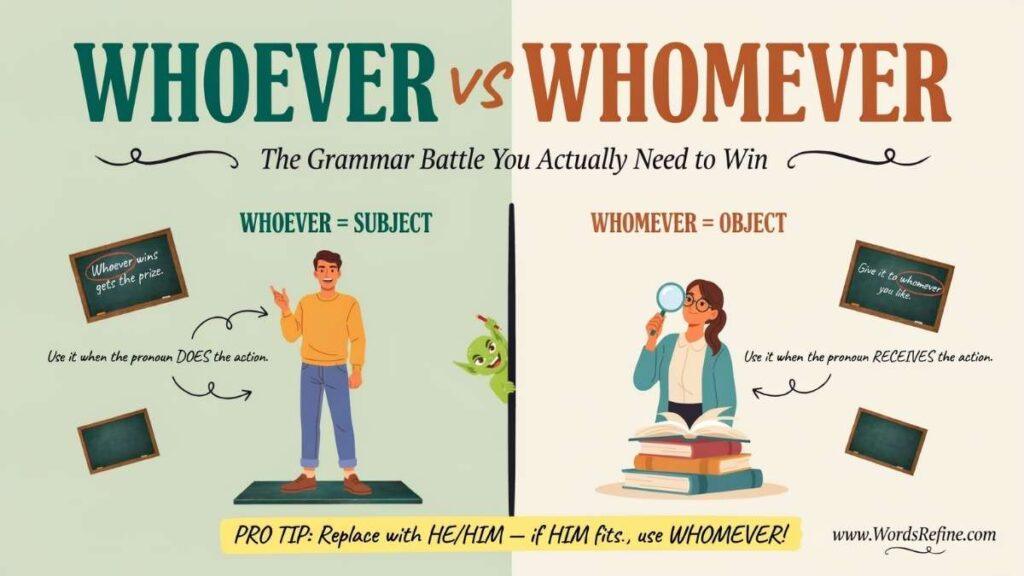
Whoever vs whomever can turn a simple sentence into a surprisingly tricky grammar puzzle. Although the two words look nearly identical, choosing the right one can make even experienced writers pause and rethink their sentence. The key is to look at each word’s grammatical role rather than where it appears in the sentence. In traditional grammar, whoever functions as a subject, while whomever functions as an object. The distinction becomes especially tricky when these words introduce clauses or appear after prepositions. In this guide, you well learn the simple rule for choosing between whoever and whomever, avoid common mistakes, and use both forms confidently in everyday and formal writing.
Whoever vs Whomever The Basic Difference
The difference between whoever vs whomever is mainly a matter of grammatical case.
Whoever is the subjective form. It refers to a person who performs an action or acts as the subject of a clause.
Whomever is the objective form. It refers to a person who receives an action or functions as an object.
A quick comparison makes the distinction clearer:
| Word | Role | Example |
|---|---|---|
| Whoever | Subject | Whoever calls should leave a message. |
| Whomever | Object | Call whomever you trust. |
So, when you’re deciding between the two, ask one simple question: Is the person doing the action or receiving it?
If the person performs the action, use whoever.
If the person receives the action, traditional grammar calls for whomever.
However, don’t stop there. The structure of the sentence can make the answer less obvious.
What Does Whoever Mean?
Whoever means approximately “any person who” or “anyone who.”
For example:
Whoever finishes first can leave early.
The sentence doesn’t identify one particular person. Instead, it refers to any person who finishes first.
Here are a few more examples:
- Whoever knows the answer should speak.
- Whoever arrives first can choose a seat.
- Whoever broke the window should tell the truth.
- Whoever wants to participate can sign up.
- Whoever needs assistance should ask.
In every example, whoever performs the action expressed by the verb.
1.Whoever knows.
2.Whoever arrives.
3.Whoever broke.
4.Whoever wants.
5.Whoever needs.
That’s why whoever takes the subject form in these sentences.
Learn the difference between confusing more English words
Vender vs Vendor Which one Is Correct?
What Does Whomever Mean?
Whomever means approximately “any person whom” or “anyone whom.” It serves as the objective form of whoever in traditional grammar.
Consider this sentence:
Choose whomever you trust.
The person performing the action is you. The verb is trust, and the person you trust receives the action.
You trust him.
That gives you the traditional objective form: whomever.
More examples include:
- Choose whomever you prefer.
- Ask whomever you trust.
- Invite whomever you want.
- Contact whomever the manager recommends.
- She’ll interview whomever the committee selects.
In each case, another person performs the verb’s action. The person represented by whomever functions as the object.
The Most Important Rule for Whoever vs Whomever
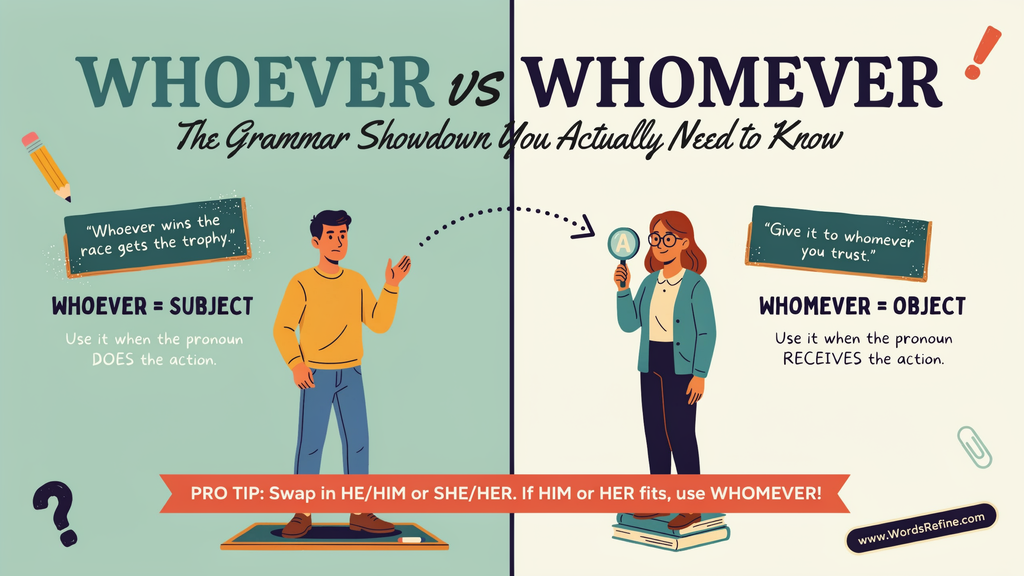
Here’s the rule worth remembering:
Whoever is the subject of its clause.
Whomever is the object of its clause.
The phrase “of its clause” matters enormously.
Why? Because the word’s position in the larger sentence doesn’t necessarily tell you whether you need whoever or whomever.
Look at this sentence:
Give the package to whoever answers the door.
At first glance, you might think whomever must be correct because whoever follows the preposition to.
But look more closely.
The relevant clause is:
whoever answers the door
Who performs the action of answering?
Whoever.
You could rewrite the idea as:
He answers the door.
Because he works as the subject, whoever is the traditional choice.
Now compare it with:
Give the package to whomever you choose.
The smaller clause is:
you choose whomever
Who performs the action?
You.
Who receives the action?
Whomever.
You choose him.
Therefore, whomever is the traditional objective form.
The two sentences look remarkably similar, but their internal grammar is different.
The He or Him Test
When the answer isn’t obvious, the traditional substitution test can help.
Replace whoever with they.
Replace whomever with him or her.
If they makes sense, choose whoever.
If him or her makes sense, choose whomever.
For example:
Whoever is responsible should speak up.
Try the substitution:
He is responsible.
That works, so whoever is correct.
Now try:
Choose whomever you trust.
Look at the smaller clause:
You trust him.
That works, so whomever is the traditional choice.
This test is useful because it turns an abstract grammar problem into a familiar pronoun choice.
However, there’s one major warning: don’t apply the test to the entire sentence without identifying the relevant clause first.
Why the He or Him Test Sometimes Confuses People
Consider this sentence:
Give the award to whoever finishes first.
Someone might reason like this:
Give the award to him.
That sentence sounds perfectly possible. So why isn’t whomever required?
Because that’s not the clause you need to examine.
The relevant clause is:
whoever finishes first
Now test that part:
He finishes first.
That works.
Therefore, whoever is the traditional choice.
This is one of the most common points of confusion. A preposition such as to may appear directly before whoever, but the word can still function as the subject of the clause that follows.
In other words, don’t let the word immediately before whoever or whomever make the decision for you.
Look deeper.
Whoever vs Whomever After a Preposition
Prepositions create some of the hardest examples because traditional grammar often associates them with objective pronouns.
For example:
Give the book to whomever you choose.
Here, whomever is part of a clause in which you is the subject and whomever is the object of choose.
However:
Give the book to whoever arrives first.
Here, whoever is the subject of arrives.
Therefore, the fact that both words follow to doesn’t determine the answer.
Compare these examples:
| Sentence | Explanation |
|---|---|
| Give it to whoever arrives first. | Whoever is the subject of arrives. |
| Give it to whomever you select. | Whomever is the object of select. |
| Work with whoever can help. | Whoever is the subject of can help. |
| Work with whomever you trust. | Whomever is the object of trust. |
This distinction is much more reliable than the old shortcut “a preposition must be followed by whomever.”
That shortcut works in some situations, but it fails when whoever introduces a clause in which it acts as the subject.
Whoever at the Beginning of a Sentence
A word’s location doesn’t determine its grammatical case.
For example:
Whoever arrives first gets the front seat.
Whoever appears at the beginning and serves as the subject of arrives.
But consider:
Whomever you invite will receive a confirmation.
Here, whomever begins the sentence, yet it functions as the object of invite.
The structure is:
You invite whomever.
The fact that the entire clause appears at the beginning doesn’t change the grammatical relationship inside it.
This is why sentence position isn’t a dependable way to choose between whoever and whomever.
Whoever at the End of a Sentence

The same principle applies when the word appears near the end.
Consider:
You can invite whoever you want.
This form is extremely common in everyday American English.
Traditional grammar may favor:
You can invite whomever you want.
Why the difference?
Inside the clause “you want,” the implied object is the person being chosen. Under the traditional subject-object distinction, that calls for whomever.
However, modern English frequently uses whoever in this kind of construction. In ordinary conversation, “whoever you want” sounds natural to many speakers.
That brings us to an important point: grammar rules describe a language that continues to change.
Whoever vs Whomever in Modern English
Whomever remains a legitimate English word. However, it appears much less often in everyday speech than whoever.
The reason is connected to the broader decline of whom in ordinary conversation. Many English speakers naturally use who in situations where older formal grammar would use whom.
The same pattern affects whoever and whomever.
For example:
I’ll talk to whoever you recommend.
This sounds completely natural to many speakers.
A more traditionally formal version is:
I’ll talk to whomever you recommend.
Both forms can be encountered in modern English, but they carry slightly different stylistic impressions.
Whoever tends to sound more natural and conversational.
Whomever tends to sound more formal and deliberate.
That doesn’t mean whomever is wrong, old-fashioned in every situation, or something you should avoid. It simply means that writers should consider both grammatical structure and audience.
For highly formal writing, maintaining the traditional distinction can be useful. For casual communication, whoever may sound more natural even in constructions where traditional grammar would favor whomever.
Is Whomever Outdated?
No. Whomever isn’t obsolete.
It simply isn’t as common as whoever.
You can still find whomever in formal correspondence, edited writing, academic prose, legal language, and other contexts where writers maintain the traditional distinction between subject and object forms.
The mistake is assuming that the longer or more formal looking word is automatically the better choice.
For example:
Whomever arrives first should begin.
This doesn’t become correct because whomever sounds formal.
The person represented by the word performs the action of arriving. Therefore:
Whoever arrives first should begin.
is the traditional grammatical construction.
Good writing isn’t about choosing the fanciest word available. It’s about choosing the word that fits the sentence.
Whoever vs Whomever Examples
The easiest way to understand the distinction is to compare real sentence structures.
Examples with whoever
- Whoever calls should leave a message.
- Whoever arrives first can choose a seat.
- Whoever knows the answer should raise a hand.
- Whoever wants to come along is welcome.
- Give the documents to whoever handles the account.
- Work with whoever has the most experience.
- Whoever wins the competition will receive the award.
Notice how whoever performs the action in each clause.
1.Whoever calls.
2.Whoever arrives.
3.Whoever knows.
4.Whoever wants.
5.Whoever handles.
6.Whoever has.
7.Whoever wins.
Examples with whomever
- Choose whomever you trust.
- Invite whomever you prefer.
- Ask whomever you think can help.
- Contact whomever the manager recommends.
- She’ll hire whomever the department selects.
- Send the information to whomever you choose.
- The committee will interview whomever the director nominates.
Here, another subject performs the action.
1.You trust whomever.
2.You prefer whomever.
3.You think whomever can help.
The manager recommends whomever.
The department selects whomever.
That internal structure determines the traditional form.
Whoever vs Whomever Side-by-Side Examples
Sometimes the easiest way to see the difference is to put nearly identical sentences next to each other.
| Whoever | Whomever |
|---|---|
| Whoever calls should wait. | Call whomever you trust. |
| Whoever arrives first can begin. | Choose whomever you prefer. |
| Give it to whoever answers the phone. | Give it to whomever you select. |
| Work with whoever can help. | Work with whomever you hire. |
| Whoever knows the answer should speak. | Ask whomever you believe can help. |
The most useful pair is probably this:
Give it to whoever arrives first.
and:
Give it to whomever you choose.
Both contain the preposition to. Yet they don’t take the same pronoun.
The reason is simple.
In the first sentence, whoever performs the action.
In the second, whomever receives the action.
I Depend on Whoever vs Whomever?
The phrase “I depend on whoever vs whomever” provides another useful example.
Consider:
I depend on whoever can help me.
Who can help?
Whoever.
The person represented by whoever performs the action of helping. Therefore, whoever is the traditional choice.
Now change the sentence:
I depend on whomever you recommend.
Who performs the action of recommending?
You.
Who receives that recommendation?
Whomever.
Therefore, whomever is the traditional objective form.
Compare the structures:
whoever can help
versus:
you recommend whomever
Once again, the preposition on doesn’t settle the issue. The clause does.
Whoever vs Whomever Is Available?
The natural traditional choice is:
Whoever is available should answer the phone.
Why?
Because whoever is the subject of is.
The sentence means:
Any person who is available should answer the phone.
The same structure appears in:
Ask whoever is available to help.
Here, whoever remains the subject of is available.
So, although whoever follows the verb ask in the larger sentence, it still functions as the subject of its own clause.
This is an excellent example of why you need to look at the smaller grammatical unit.
Whoever vs Whomever Can Make It?
The traditional choice is:
Whoever can make it should RSVP.
Why?
Because whoever is the subject of can make it.
You could substitute they:
He can make it.
That works.
Therefore, whoever is the appropriate traditional form.
The same pattern appears in:
Whoever can attend should arrive by six.
Whoever wants to participate should register.
Whoever needs a copy can ask for one.
In each case, whoever performs or experiences the action expressed by the following verb.
Whoever vs Whomever It May Concern
One phrase deserves special attention because it doesn’t follow the pattern people sometimes expect.
The established formal expression is:
To Whom It May Concern
This is the conventional phrase used when the recipient of a letter or document isn’t known.
You generally shouldn’t replace it with “To Whoever It May Concern” simply because you’re trying to apply the whoever rule.
This is a good reminder that English contains established expressions alongside general grammar patterns.
When you’re writing a formal letter, “To Whom It May Concern” remains the conventional choice.
Whoever vs Who and Whomever vs Whom
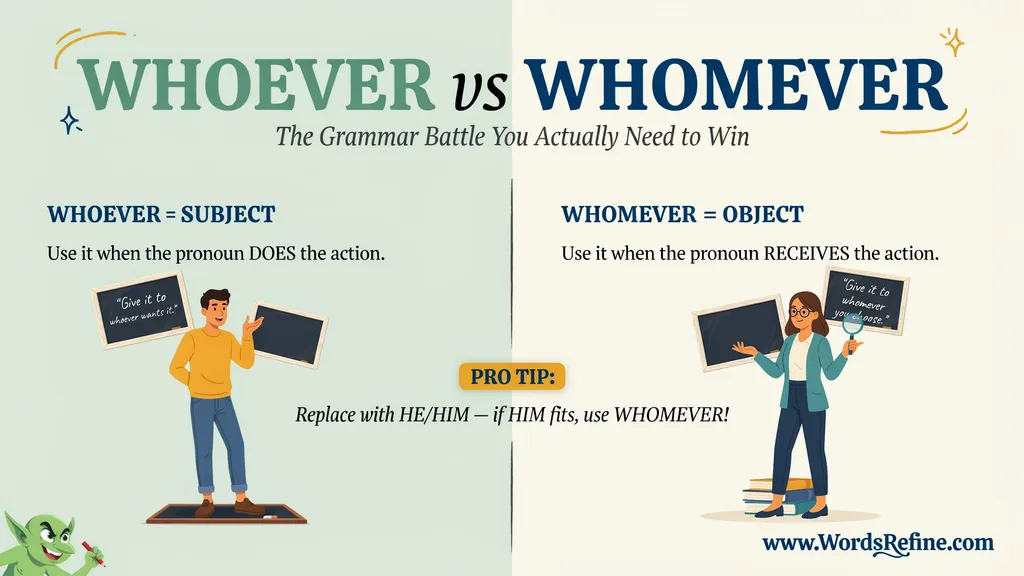
Understanding who and whom makes whoever and whomever much easier.
| Subject form | Object form |
|---|---|
| Who | Whom |
| Whoever | Whomever |
The basic relationship is:
For example:
Who called?
Who performs the action of calling?
Who.
Now:
Whom did you call?
You perform the action of calling. Whom receives that action.
The same distinction extends to the longer forms.
Whoever called left a message.
Call whomever you trust.
The ending -ever adds the meaning of an unspecified or unrestricted person, but the underlying subject-object distinction remains.
This is why whoever and whomever belong to the larger family of English pronouns that change form according to grammatical function.
Can Whoever Be the Object?
In modern English, yes, whoever can appear in a position where traditional grammar would use whomever.
For example:
I’ll invite whoever you recommend.
Many modern speakers use this naturally.
Traditional grammar would generally prefer:
I’ll invite whomever you recommend.
This difference reflects the changing use of whom in English.
Therefore, the answer depends partly on context.
If you’re speaking casually or writing informal material, whoever often sounds more natural.
If you’re writing formal material and want to preserve the traditional distinction, whomever may be preferable when it functions as the object.
The important thing is to understand the distinction rather than assuming one form is always correct.
Can Whomever Be the Subject?
Under traditional grammar, no.
If the person represented by the pronoun performs the action, use whoever.
For example:
Whoever arrives first gets the prize.
Not:
Whomever arrives first gets the prize.
Why?
Because whoever is the subject of arrives.
You can verify it with the substitution test:
He arrives first.
That works.
Therefore, whoever is the correct traditional form.
Common Mistakes with Whoever and Whomever
Several mistakes appear repeatedly because people memorize shortcuts instead of understanding the sentence.
Assuming a preposition always requires whomever
This is probably the most common mistake.
Give it to whoever answers the door.
The word follows to, but whoever is the subject of answers.
Choosing whomever because it sounds more sophisticated
A formal-sounding word isn’t automatically a correct word.
Whomever arrives first should begin.
sounds formal, but the structure requires whoever under the traditional rule.
Looking only at the main verb
Consider:
She’ll hire whoever has the strongest qualifications.
The main verb is hire, and whoever appears to be its object. Yet whoever is the subject of has inside the clause.
That smaller clause determines the form.
Treating whoever and whomever as completely different meanings
They aren’t opposites.
Both refer to an unspecified person. Their main distinction comes from grammatical function.
Assuming modern usage makes every traditional rule irrelevant
Modern English does favor whoever in many situations where older grammar would use whomever.
Still, whomever has a legitimate role in formal English. Understanding the traditional distinction remains useful, especially when writing carefully edited material.
A Simple Method for Choosing the Right Word
When you’re unsure, follow this process.
- Find the clause introduced by whoever or whomever.
- Find the verb in that clause.
- Ask who performs the action.
- If the answer is the pronoun, choose whoever.
- If another person performs the action and the pronoun receives it, choose whomever under the traditional rule.
- Try replacing the word with they.
- If he they works, use whoever.
- Try him or her when you suspect an object.
- If him or her works, use whomever.
- Finally, consider the tone of your writing. In casual modern English, whoever may be more natural in some object constructions.
This method works much better than memorizing a list of phrases.
A Closer Look at Difficult Sentences
Some sentences become difficult because they contain several verbs.
Consider:
Give the responsibility to whoever you think is best qualified.
This sentence contains several layers:
you think
and:
whoever is best qualified
Who is best qualified?
Whoever.
Therefore, whoever is the subject of is.
Now consider:
Give the responsibility to whomever you think the committee will choose.
Here, the committee performs the action of choosing.
The structure is:
the committee will choose whomever
Therefore, traditional grammar favors whomever.
These sentences show why complicated sentence structures require you to identify the individual clause before choosing the pronoun.
Whoever vs Whomever in Formal Writing

Formal writing benefits from grammatical precision, but precision doesn’t mean making every sentence sound stiff.
If a sentence clearly requires the objective form, whomever can be appropriate.
For example:
The panel will interview whomever the department recommends.
However, if whoever is the subject of the clause, don’t replace it with whomever simply to make the sentence sound more formal.
For example:
The award will go to whoever demonstrates the strongest leadership.
Here, whoever is the subject of demonstrates.
That sentence is already formal and precise. There’s no need to force whomever into it.
Good formal writing combines correctness with clarity.
Whoever vs Whomever A Quick Reference
| If the person… | Traditional choice |
|---|---|
| Performs the action | Whoever |
| Acts as the subject | Whoever |
| Receives the action | Whomever |
| Acts as the object | Whomever |
| Is the subject of the clause | Whoever |
| Is the object of the clause | Whomever |
One sentence captures the rule nicely:
Practice Session Whoever vs Whomever
- ______ arrives first should save us a seat.
- You can invite ______ you trust to the meeting.
- ______ answers the door should sign for the package.
- Give the keys to ______ is waiting outside.
- She will choose ______ the committee recommends.
- ______ wants to participate should sign up today.
- Speak with ______ you believe can help.
- ______ finishes the project first can leave early.
- We will support ______ you select for the position.
- ______ knows the answer should raise a hand.
- Send the report to ______ handles the account.
- The manager will interview ______ the director selects.
- ______ arrives before noon can join the tour.
- You may work with ______ you prefer.
- ______ wins the contest will receive a prize.
- I depend on ______ can help me solve this problem.
- I will contact ______ you recommend.
- Give the documents to ______ needs them.
- The company will hire ______ the manager chooses.
- ______ wants to join the team should register.
- Choose ______ you think is most qualified.
- ______ is responsible for the decision should explain it.
- We will welcome ______ comes to the event.
- She can speak with ______ you believe is right for the job.
- Give the award to ______ demonstrates the strongest leadership.
Answers
- Whoever
- Whomever
- Whoever
- Whoever
- Whomever
- Whoever
- Whoever
- Whoever
- Whomever
- Whoever
- Whoever
- Whomever
- Whoever
- Whomever
- Whoever
- Whoever
- Whomever
- Whoever
- Whomever
- Whoever
- Whomever
- Whoever
- Whoever
- Whoever
- Whoever
Here’s a trusted source for clear more words Comparison:
Grammar Update
FAQs
Which is correct: “whosoever” vs “whomsoever”?
Both are valid words, but they have different grammatical roles. Whosoever is the subject form, while whomsoever is the object form. However, both sound quite formal and are much less common than whoever and whomever in modern English.
Why is “whom” not used anymore?
Whom hasn’t disappeared, but people use it less often in everyday English. In conversation, who often replaces whom because it sounds more natural and easier to use. Whom still appears in formal writing and established expressions such as “To Whom It May Concern.”
Was it “whoever” vs “whomever” in the office?
It depends on the sentence. Use whoever when the person performs the action and whomever when the person receives the action under the traditional rule.
For example:
“Whoever is in the office can help.”
“Ask whomever you find in the office.”
What is another word for “whomever”?
Depending on the sentence, you can often use “anyone whom,” “any person whom,” or simply “whoever” in informal modern English. The best alternative depends on the sentence structure.
What does “whomsoever” mean?
Whomsoever means “any person whom.” It is the objective form of whosoever and usually has a very formal or old-fashioned tone.
Does “whoever” mean “anyone”?
Yes. Whoever can mean “anyone who” or “any person who.” For example, “Whoever wants to join us is welcome” means “Anyone who wants to join us is welcome.”
Is it “whoever it may concern” or “whomever it may concern”?
Neither is the standard expression. The conventional phrase is “To Whom It May Concern.” It is commonly used at the beginning of a formal letter or document when the recipient’s name is unknown.
Is it “I depend on whoever” vs “whomever”?
Either can be correct, depending on what follows.
“I depend on whoever can help” uses whoever because it is the subject of can help.
“I depend on whomever you recommend” uses whomever because it functions as the object of recommend under the traditional rule.
Is it “Dear whomever” vs “whoever”?
Neither is a standard formal greeting. If you know the person’s name, use “Dear [Name].” If you don’t know the recipient, choose a suitable general greeting such as “Dear Hiring Manager” or “Dear Customer Service Team.”
Is it correct to say “whoever you are” or “whomever you are”?
“Whoever you are” is correct.
In this construction, whoever is linked to the verb are and refers to the person being described as “you.” Whomever would not be appropriate here under the traditional subject-object distinction.
Is it “forward to whomever” or “forward to whoever”?
It depends on what comes next.
“Forward it to whoever is responsible” uses whoever because it is the subject of is responsible.
“Forward it to whomever you choose” uses whomever because it is the object of choose under the traditional rule.
Therefore, the preposition to doesn’t automatically determine the answer.
Is it correct to say “whoever that might be” or “whomever that might be”?
“Whoever that might be” is the standard choice.
For example:
Whoever that might be, please ask them to call me.
Whoever refers to the person being identified, and the phrase functions as a subject-like expression. Whomever would not fit the traditional grammatical structure.
Conclusion
Whoever vs whomever may look confusing, but the rule is simple: whoever is the doer, while whomever is the receiver.
For example, “Whoever arrives first gets the seat” uses whoever because the person performs the action. “Invite whomever you trust” uses whomever because the person receives the action.
When in doubt, use the he-or-him test. If he they fits, choose whoever. If him or her fits, choose whomever.
So, don’t let these two little words turn into a grammar headache. Find the doer, find the receiver, and choose accordingly.

Diora AJS she is an experienced blogger and passionate English language enthusiast at Words Refine. With a keen eye for language and a love for clear communication, she writes practical content about grammar, word meanings, usage, and commonly confused terms. Her goal is to make English easier to understand through clear explanations and relatable examples, helping readers write accurately and communicate with confidence.