
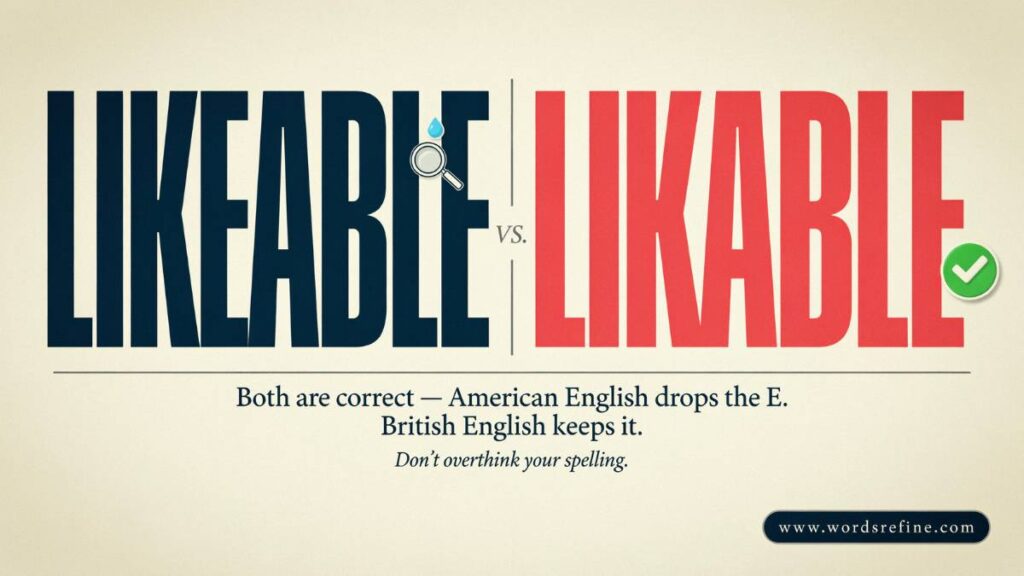
English spelling can be surprisingly tricky, especially when two versions of the same word look almost identical. Take likeable vs likable for example. Both spellings are correct, yet that tiny extra “e” often leaves writers wondering which one to choose. Is one more appropriate than the other, or does the difference depend on where you live? The answer is simpler than you might expect. Both words share the same meaning and pronunciation, but regional spelling preferences set them apart. Let’s look at how these forms differ, when to use each one, and which common mistakes to avoid so your writing stays clear and consistent.
Quick Answer likeable vs likable
Both likeable vs likable are correct spellings of the same adjective. They mean pleasant, appealing, agreeable, or easy to like. The primary difference is regional spelling preference rather than meaning or pronunciation.
Likable is generally preferred in American English, while likeable is commonly used in British English. Both forms are accepted in both varieties.
For example:
Emma is a likeable person who makes everyone feel welcome.
Emma is a likable person who makes everyone feel welcome.
Neither sentence contains a spelling or grammatical error. However, if you’re writing primarily for an American audience, likable is usually the better choice.
Learn the difference between confusing more English words
Mortality vs Fatality Meaning Differences and Correct Usage ?
What Is the Difference?
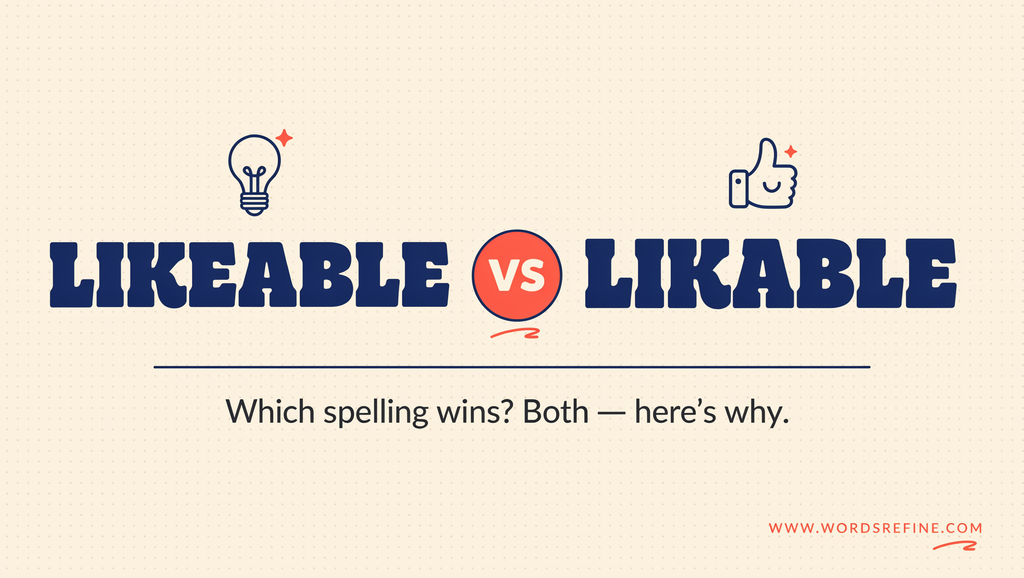
The difference between likeable vs likable is just one letter: e.
The word likeable retains the final e from the base word like, while likable drops it before adding the suffix able. Both forms express the same idea and perform the same grammatical function.
Consider these examples:
A likeable teacher can make even a difficult subject enjoyable.
A likable teacher can make even a difficult subject enjoyable.
Both sentences describe a teacher whose personality makes students feel comfortable and positive.
The distinction becomes more noticeable when you consider regional spelling preferences. American writers generally favor the shorter form, likable. British writers often retain the final e and write likeable.
However, this isn’t an absolute geographical rule. American dictionaries recognize likeable, and British dictionaries recognize likable. The choice often depends on the writer’s preferred English variety and the publication’s style guide.
Likeable Meaning and Usage
Likeable is an adjective that describes someone or something that people find pleasant, appealing, or easy to like.
A likeable person often has qualities that make others enjoy their company. These qualities might include kindness, friendliness, honesty, humor, patience, and a warm personality.
For example, Daniel is a likeable coworker who always treats people respectfully. Her warm personality makes her instantly likeable. The novel also features a likeable character with a refreshing sense of humor.
The word isn’t limited to describing people’s personalities. You can also use it for fictional characters, public figures, animals, and even certain objects or ideas.
For instance, a movie might feature a likeable main character, while a business might develop a likeable brand personality through friendly customer service.
Importantly, being likeable doesn’t mean being perfect, exceptionally attractive, or universally loved. It simply suggests that someone or something has qualities that make people feel positively toward them.
Likable Meaning and Usage
Likable has precisely the same meaning as likeable. It describes someone or something that people find agreeable, appealing, pleasant, or enjoyable to be around.
The meaning doesn’t change because the word loses its final e. It remains an adjective that expresses a positive impression.
For example, Marcus is a likable person who makes new employees feel comfortable. The actor plays a surprisingly likable character. Her honest approach makes her a likable manager.
A likable individual doesn’t have to be the funniest, most outgoing, or most popular person in a room. Sometimes, a quiet person becomes likable through small gestures, thoughtful conversations, and genuine consideration for others.
In everyday English, likable works naturally in personal descriptions, workplace communication, reviews, entertainment writing, and informal conversations.
The important point is that both spellings describe exactly the same qualities.
Learn the difference between commonly mixed-up more words
Mama vs Mamma Meaning Spelling and Usage?
Which Spelling Should You Use?
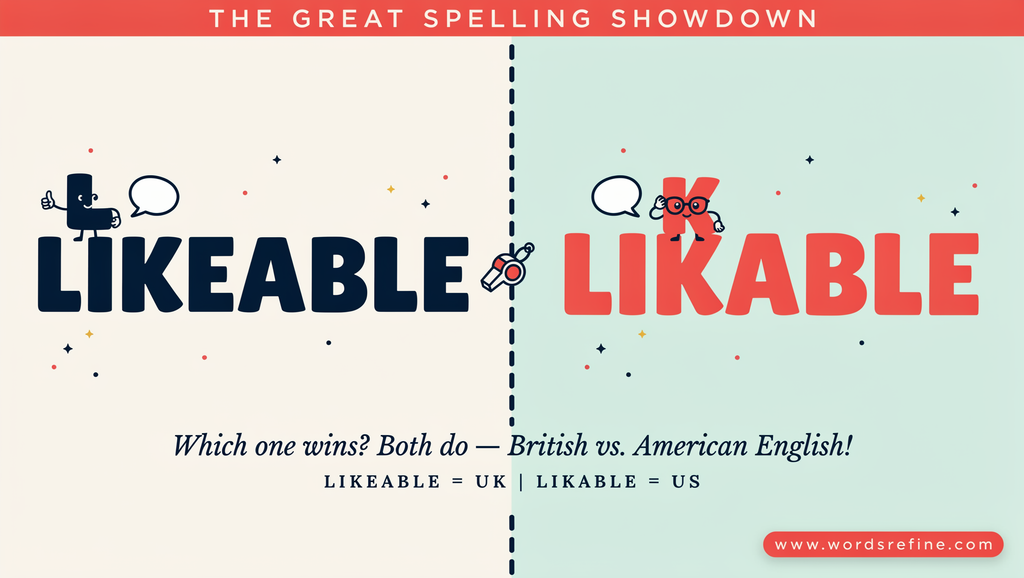
Choosing between these spellings depends mainly on your audience and the spelling conventions you follow.
If you’re writing for American readers, likable is generally the preferred form. If your audience primarily uses British English, likeable is a familiar and widely accepted choice.
Nevertheless, both spellings remain valid. You don’t need to change an entire document simply because you discover the alternative version.
American English generally favors likable, while British English commonly favors likeable. Canadian and Australian English may use either form depending on the publication’s preferences.
For professional and academic writing, follow the relevant style guide or dictionary. Most importantly, choose one spelling and use it consistently throughout your document.
Likeable vs Likable in American English
When choosing between these spellings in American English, the shorter version generally wins.
American English commonly drops the final e from certain words before adding a suffix that begins with a vowel. Likable follows this spelling pattern.
For example, like becomes likable, use becomes usable, and move becomes movable.
However, English spelling conventions contain exceptions, and likeable remains an accepted alternative in the United States.
Merriam-Webster recognizes both forms, with likable serving as its standard headword spelling. This makes likable a sensible choice when you want to follow common American dictionary usage.
Consider these examples:
She is one of the most likable people in the office.
The director created a likable character with realistic flaws.
His likable personality helped him connect with customers.
The new teacher seems friendly, patient, and likable.
For American blog posts, business documents, and general publications, likable will usually align with readers’ expectations.
Likeable vs Likable in British English
British English commonly favors likeable, which retains the final e from the base word like.
This preference reflects a broader pattern in British spelling, although it doesn’t apply consistently to every word ending in e.
British dictionaries recognize likeable as a standard spelling. However, likable is also understood and accepted.
Consider these examples:
She’s a likeable colleague with a wonderful sense of humor.
The main character is surprisingly likeable.
His likeable personality makes him popular among his neighbors.
It was an enjoyable story with several likeable characters.
If you’re preparing content for a British publication, follow its preferred spelling conventions. Consistency matters more than trying to enforce a spelling rule that doesn’t apply universally.
Learn the difference between tricky grammar more words
Stripes vs Strips Meaning Differences and Correct Usage ?
Likeable vs Likable in Canadian and Australian English
Canadian and Australian English follow their own spelling traditions, which often combine British and American influences.
As a result, you may encounter both likeable and likable in these varieties.
Canadian English frequently shares spelling conventions with British English, but it also adopts many American forms. Australian English generally follows British spelling traditions, although individual publications may make different choices.
Neither country requires every writer to use one spelling exclusively.
For Canadian writing, follow the spelling used by your institution, publisher, or preferred dictionary. Australian writers should check their organization’s editorial guidelines.
International publications can choose whichever form best suits their intended audience. The important thing is to maintain consistency.
Regional spelling preferences are useful guides, not rigid rules that automatically make the alternative incorrect.
Pronunciation and Part of Speech
Although the spelling differs, the pronunciation doesn’t. Both words sound exactly alike in standard English.
The usual pronunciation is /ˈlaɪ.kə.bəl/. The word has three syllables, with the primary stress on the first syllable.
Both spellings also belong to the same part of speech: adjective.
An adjective describes or provides additional information about a noun. In this case, likeable and likable describe a person’s personality, a character’s qualities, or something that inspires positive feelings.
Consider these examples:
She has a likable personality.
He’s a likeable neighbor.
The film introduces a likable protagonist.
The new manager seems likeable.
The main character is likable.
Both forms also work in comparative constructions.
Sarah is more likable than her previous supervisor.
This character becomes more likeable as the story develops.
Both spellings follow the same grammatical patterns. You don’t need to change the sentence structure when switching between them.
The Origin and History of Likeable vs Likable
To understand why two spellings exist, it helps to examine how English forms adjectives.
Both words come from the verb like, which means to find someone or something pleasant, appealing, or agreeable.
The suffix able means capable of, suitable for, or worthy of a particular action or quality. When you combine like and able, you create an adjective that describes someone or something capable of inspiring positive feelings.
In simple terms, both forms come from the same combination: like and able.
The two spellings developed through different approaches to handling the final e in the base word.
English has never maintained one perfectly consistent rule for every word ending in e. Some suffix combinations preserve the original letter, while others drop it.
This variation explains why both spellings survived in standard written English.
Learn the difference between confusing word pairs
Nevertheless vs Nonetheless Meaning and Usage?
Why Does Likeable Keep the E?
The spelling likeable retains the final e from the base word like.
This approach makes the connection between the original verb and the adjective visually clear.
For example, like becomes likeable, while love becomes loveable.
Writers who use this form preserve the original spelling of the base word before adding the suffix.
Why Does Likable Drop the E?
The spelling likable removes the final e before adding able.
This follows a common English word-formation pattern in which a silent final e disappears before a vowel-starting suffix.
For example, like becomes likable, use becomes usable, and value becomes valuable.
However, English has several exceptions. You shouldn’t assume that every word ending in e must lose that letter before receiving a suffix.
The existence of likeable and likable demonstrates that English spelling can preserve more than one accepted form of the same word.
Learn the difference between tricky grammar more words
Attorneys vs Attornies Which one Is Correct?
How to Use Likeable vs Likable in Sentences
Knowing the definition is helpful, but understanding how each spelling works in real sentences makes the distinction easier to remember.
Both likeable and likable describe someone or something that people find pleasant, enjoyable, or easy to appreciate. The meaning stays the same regardless of which spelling you choose. The main difference comes down to regional spelling preferences.
Here are some examples:
The new teacher is friendly, patient, and genuinely likable.
Everyone agreed that the main character was likeable despite his unusual habits.
Her warm personality makes her instantly likable.
The movie features a likeable lead character who wins the audience’s sympathy.
He may seem quiet at first, but he is actually very likable.
The spelling changes, but the meaning does not. You can use either form to describe a person, character, or thing that people enjoy or appreciate.
More Examples of Likeable vs Likable in Everyday English
You can use likeable and likable in many everyday situations. Both words work when describing people, fictional characters, public figures, or even qualities that make something enjoyable.
Consider these examples:
The new manager is approachable and likable, so employees feel comfortable sharing their ideas.
Despite his stubborn behavior, the character remains likeable throughout the story.
Her honest nature makes her a likable person to work with.
The author gave the villain a few likeable qualities, making the story more interesting.
Our new neighbor seems friendly, thoughtful, and likable.
The two spellings work equally well in these sentences. Your choice depends on the type of English you’re using.
Can You Describe Things as Likeable vs Likable?
Yes. Although people are the most common subjects, you can also use likeable or likable to describe fictional characters, ideas, designs, and other things that people find appealing.
For example:
The film introduces a likable character with a refreshing sense of humor.
The book has a likeable writing style that keeps readers interested.
The company developed a likable brand personality through its friendly communication.
The game features several likeable characters with memorable personalities.
In these examples, the words express a positive impression. They suggest that something attracts people’s interest or makes them feel favorable toward it.
Learn the difference between commonly misused words
Skiddish vs Skittish Which One Is Correct and Why It Matters
Likeable vs Likable What Should You Remember?
The difference between these spellings is simple once you understand their regional preferences.
Both words are adjectives, and both mean easy to like or pleasant to appreciate.
Likable is generally the preferred spelling in American English.
Likeable is commonly used in British English.
Both forms have the same pronunciation.
Neither spelling is grammatically incorrect.
The related noun can be written as likability or likeability.
These points are enough to help you choose the appropriate form in most writing situations. You don’t need to memorize two different definitions because there aren’t any.
Learn the difference between often confused words
Dork vs Nerd Meaning Differences Examples?
Common Mistakes When Using Likeable and Likable
Although likeable and likable are both correct, writers sometimes make a few mistakes when using them. Understanding these common errors will help you choose the right spelling and keep your writing clear.
Assuming Likeable Is Incorrect
Some writers believe likeable is a misspelling because American English generally prefers likable. However, likeable is a valid spelling, particularly in British English.
Thinking the Words Have Different Meanings
Likeable and likable do not describe different qualities. Both mean pleasant, appealing, or easy to like. The extra e does not change the definition.
Mixing Both Spellings in the Same Article
Using likeable in one paragraph and likable in another can make your writing look inconsistent. Choose the spelling that suits your audience and stick with it throughout the article.
Forgetting Regional Spelling Preferences
American English generally favors likable, while British English commonly uses likeable. Ignoring these preferences may make your writing feel inconsistent with your intended audience.
Confusing Likeable With Lovable
Likeable and lovable have related meanings, but they are not identical. Someone who is likable is easy to appreciate or get along with. Someone who is lovable inspires affection or deeper emotional attachment.
Using Likeable or Likable as a Noun
Both words are adjectives, not nouns. Use them to describe a person, character, or thing. When you want to name the quality of being easy to like, use likability or likeability instead.
Assuming the Extra E Changes Pronunciation
The spelling difference does not affect pronunciation. Both words are pronounced the same way: LYE-kuh-buhl.
Ignoring Your Style Guide
Professional publications may follow specific spelling conventions. If your organization or publication requires a particular style guide, follow its recommendation instead of switching between spellings based on personal preference.
The easiest way to avoid these mistakes is to remember three things: both spellings are correct, their meanings are identical, and consistency matters more than the extra letter.
Learn the difference between commonly misused words
favour vs Favor Meaning Differences Spelling and Examples ?
Practice Session Likeable vs Likable
- The new teacher is friendly, patient, and ________.
- Everyone found the main character warm and ________.
- Her honest personality makes her especially ________.
- The British author created a ________ character for the novel.
- His sense of humor makes him easy to ________.
- The movie features a funny and ________ leading character.
- Despite his mistakes, the hero remains ________ throughout the story.
- Our new neighbor seems friendly and ________.
- The American magazine described the actor as ________.
- Her cheerful attitude makes her a ________ person to work with.
- The book introduces a ________ character with an unusual personality.
- His friendly behavior makes him more ________ to his colleagues.
- The British newspaper called the character charming and ________.
- Everyone agreed that the new manager was ________.
- The story becomes more enjoyable because its characters are ________.
- She has a warm and ________ personality.
- The author made the villain surprisingly ________.
- His quiet nature does not make him any less ________.
- The company wants to create a friendly and ________ brand image.
- The American writer described the character as ________.
- Her kindness makes her an especially ________ colleague.
- The film’s main character is both funny and ________.
- The new employee quickly became a ________ member of the team.
- The British reviewer described the actor as naturally ________.
- Both spellings are correct, but American English generally prefers ________.
Answers
- Likable
- Likeable
- Likable
- Likeable
- Likable
- Likable
- Likeable
- Likable
- Likable
- Likable
- Likeable
- Likable
- Likeable
- Likable
- Likeable
- Likable
- Likeable
- Likable
- Likable
- Likable
- Likeable
- Likable
- Likeable
- Likeable
- Likable
Here’s a trusted source for clear more words Comparison:
FAQs
Is there an English word that contains only vowels?
Yes. English has words such as “I” and “a” that contain only vowels. A few rare words, such as “euouae,” also consist entirely of vowel letters.
What is the silent E rule called?
It is commonly known as the silent E rule or final E rule. It explains how a silent e at the end of a word often makes the preceding vowel use its long sound. For example, the vowel sound changes between “cap” and “cape.”
What are the seven basic rules of spelling?
There is no single, universally accepted list of seven spelling rules. However, common guidelines include the silent E rule, the I-before-E guideline, dropping a final E before certain suffixes, changing Y to I, doubling a final consonant, forming plurals correctly, and adding prefixes and suffixes.
Why do silent K’s exist in English?
Silent K’s remain in English because many spellings preserve older forms of words. In the past, speakers pronounced the K in words such as “knight” and “knee.” Over time, pronunciation changed, but the traditional spelling remained.
In which grade do students learn the silent E rule?
Many students learn the silent E rule between kindergarten and second grade. The exact timing depends on the school’s reading curriculum and the child’s progress.
Does horse have a long O sound?
No. “Horse” does not have the standard long O sound found in words such as “hope” and “home.” In many American English accents, it contains an /ɔr/ sound, although pronunciation can vary by region.
Why do some people say “like” so often?
Some people use “like” as a filler when they are thinking, explaining an experience, or searching for the right words. Others use it to introduce examples, soften statements, or describe something approximately. Its meaning depends on the context.
How can you stop saying “you know” while speaking?
Start by noticing how often you use the phrase. Instead of filling every pause, take a short breath and organize your thoughts before continuing. You can also record yourself speaking to identify repeated phrases. With practice, you’ll become more comfortable expressing ideas without unnecessary fillers.
When did Americans start using “like” as a conversational filler?
The conversational use of “like” became increasingly noticeable in American speech during the twentieth century, particularly among younger speakers. However, the word has served different conversational purposes for much longer. Its use as a filler developed gradually rather than appearing at one specific moment.
How can you tell if someone is unlikeable?
There is no objective test for determining whether someone is unlikeable. However, repeated dishonesty, disrespect, constant criticism, and selfish behavior can make relationships difficult. Remember that a person’s behavior in certain situations does not define their entire personality.
What traits make someone likable?
People often appreciate qualities such as kindness, honesty, confidence, empathy, and a good sense of humor. Being approachable, respectful, and genuinely interested in others can also help build positive relationships.
How can you become a nicer person whom others enjoy being around?
Listen without interrupting, show genuine interest in other people, keep your promises, and treat everyone with respect. You don’t have to agree with everyone or make everyone happy. Being considerate while maintaining healthy boundaries is far more important.
Who is the most likable person in the world?
There is no universally recognized most likable person in the world. Likability depends on personal experiences, cultural expectations, and individual preferences. Someone admired by millions may not appeal to everyone, and that’s perfectly normal.
How can you tell if you are a likable person?
People may enjoy spending time with you, feel comfortable sharing their thoughts, and appreciate your company. However, genuine connections and mutual respect are better signs of likability than simply counting how many people approve of you.
What is the most attractive personality?
There is no single personality type that everyone finds attractive. However, kindness, confidence, emotional maturity, honesty, and a good sense of humor are qualities many people appreciate. Being genuine also matters because people generally value authenticity over a carefully manufactured personality.
What makes a person not likable?
Behaviors such as dishonesty, arrogance, disrespect, excessive negativity, and a lack of consideration can make someone difficult to connect with. These habits may damage relationships, especially when a person refuses to acknowledge or improve them.
What makes people instantly likable?
A warm smile, friendly body language, genuine attention, and respectful conversation can create a positive first impression. However, lasting likability comes from consistent behavior, not just one pleasant interaction.
What are the most likable personality traits?
Some widely appreciated traits include empathy, honesty, patience, kindness, reliability, humility, and a good sense of humor. These qualities help people build trust and maintain healthy relationships. Still, no combination of personality traits can guarantee that everyone will like you.
Learn the difference between more words people mix up
Sited vs Cited Meaning Differences Examples and Correct Usage
Conclusion
The choice between likeable vs likable is easier than it first appears. Both spellings are correct, carry the same meaning, and have identical pronunciations. The difference is simply a matter of regional spelling preferences. American English generally uses likable, whereas British English commonly favors likeable. When writing, consider your audience and stick to one spelling throughout your work. There’s no need to let a tiny letter create a major spelling dilemma. Once you understand the difference, choosing between these two forms becomes simple. After all, whether someone is likeable or likable, they’re still easy to like!

Diora AJS she is an experienced blogger and passionate English language enthusiast at Words Refine. With a keen eye for language and a love for clear communication, she writes practical content about grammar, word meanings, usage, and commonly confused terms. Her goal is to make English easier to understand through clear explanations and relatable examples, helping readers write accurately and communicate with confidence.