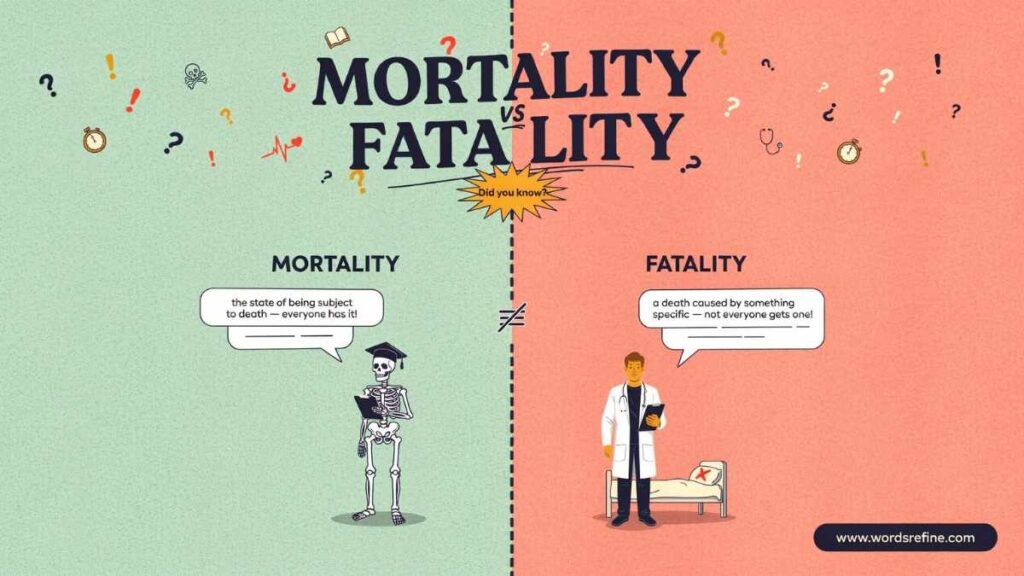
Some words walk into English looking almost identical, then quietly choose completely different jobs. Mortality vs fatality are two such troublemakers. If you are unsure about mortality vs fatality the confusion is understandable because both terms relate to death. However, they aren’t interchangeable. Mortality generally describes deaths within a defined population, while fatality refers to deaths associated with a particular disease, injury, condition, or event. That difference matters, especially in medical research, public health, and statistical writing, where one word can change the meaning of a number. Let’s untangle these terms with clear definitions, practical examples, and simple explanations that make the distinction easy to remember.
Mortality vs Fatality The Simple Answer
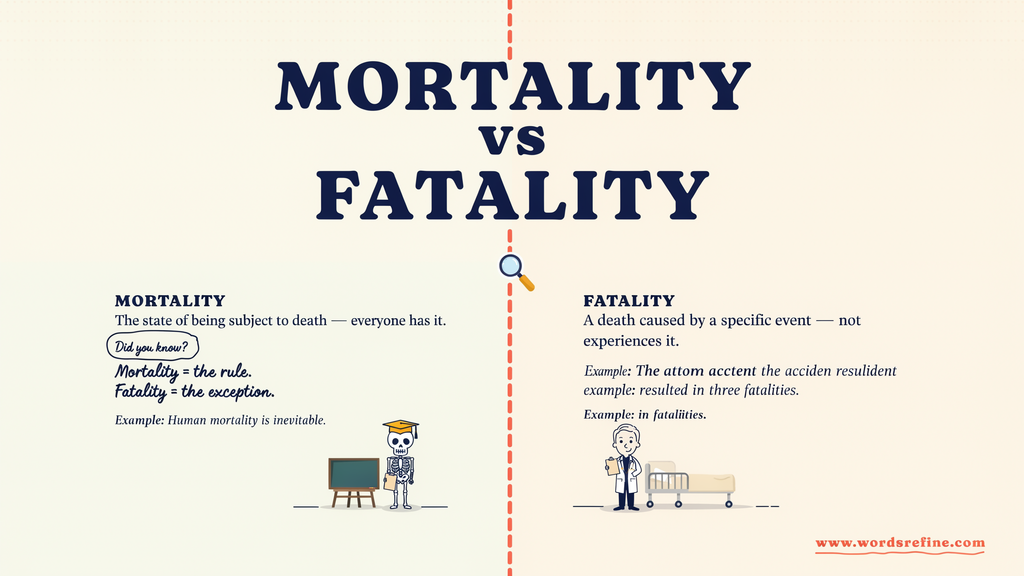
The Mortality vs fatality both involve death, but they approach the subject from different angles.
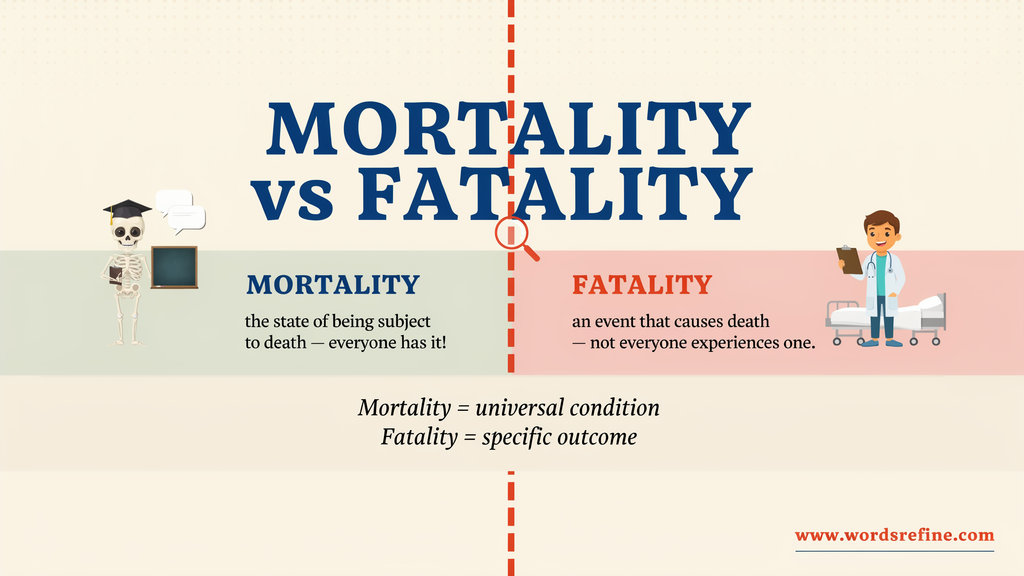
Mortality usually describes death as a population-level outcome. It can refer to the number or frequency of deaths within a particular population during a specific period. Researchers might examine mortality among children, older adults, people with a particular disease, or residents of a particular region.
Fatality, on the other hand, usually points to a death resulting from a particular cause or event. For example, a traffic accident may result in several fatalities. A natural disaster may cause hundreds of fatalities. A serious disease may also have a particular fatality rate among the people who develop it.
The difference isn’t merely a matter of style. It can change what a sentence actually tells the reader.
Consider two statements:
A region has a high mortality rate.
A disease has a high fatality rate among diagnosed patients.
The first statement concerns deaths in a population. The second focuses on deaths among people affected by a particular disease.
That distinction is the foundation of the difference between mortality vs fatality.
What Does Mortality Mean?
Mortality refers broadly to death or the condition of being subject to death. In health and statistical contexts, it commonly describes deaths within a defined population.
Mortality Meaning and Definition
The meaning becomes clearer when mortality is connected to a specific group and time period.
For example, researchers might study mortality among adults over 65 during a ten-year period. They aren’t necessarily interested in one particular death. Instead, they want to understand how frequently death occurs within that group.
You may encounter mortality in expressions such as infant mortality, maternal mortality, cancer mortality, disease-specific mortality, and all-cause mortality.
Each expression gives mortality a particular context.
For instance, cancer mortality concerns deaths attributed to cancer. All-cause mortality considers deaths from all causes within the population being studied.
Learn the difference between confusing more English words
Mobil vs Mobile Which one Is Correct?
How Mortality Is Used
Mortality commonly appears when researchers discuss population health.
Suppose a town has 1,000 residents and 10 people die during one year. A simple calculation would place those 10 deaths against the town’s population.
10 deaths ÷ 1,000 residents = 1%
That percentage describes deaths in relation to the population. It doesn’t tell us that all 10 people died from the same illness or experienced the same event.
That’s the important point.
Mortality gives us a wider view.
What Does Fatality Mean?
Fatality generally refers to a death caused by a particular event, disease, injury, disaster, or other condition.
Fatality Meaning and Definition
If a highway accident kills three people, those three deaths can be described as three fatalities.
Similarly, if a severe storm causes 20 deaths, a report may refer to 20 storm-related fatalities.
The word connects the death to a specific cause or circumstance.
That makes fatality more focused than mortality in many contexts.
How Fatality Is Used
Fatality commonly appears in discussions about accidents, disasters, injuries, conflicts, and diseases.
For example:
The crash resulted in two fatalities.
The earthquake caused hundreds of fatalities.
The disease has caused several fatalities among hospitalized patients.
In each example, the deaths are connected to something specific.
This is why saying that an accident caused “three mortalities” sounds unnatural in ordinary English. “Three fatalities” is the natural expression.
The Main Difference
The easiest way to understand mortality versus fatality is to ask what group you’re measuring.
Mortality generally asks:
How many people died within this population?
Fatality generally asks:
How many people died as a result of this particular disease, event, injury, or condition?
Here’s the distinction at a glance:
Learn the difference between commonly mixed-up more words
Fiancé vs Fiancée What’s the Difference and which is Correctly?
| Mortality | Fatality |
|---|---|
| Focuses on death within a defined population | Focuses on death connected to a specific cause or event |
| Often used in population health | Often used for diseases, injuries, accidents, and disasters |
| Commonly appears in mortality rates | Commonly appears in fatality rates |
| Can describe deaths from all causes | Usually has a more specific cause or event |
| Often uses a population-based denominator | Often considers an affected or diagnosed group |
Therefore, mortality vs fatality overlap in meaning, but they aren’t interchangeable in every sentence.
Mortality Rate vs Fatality Rate
The distinction becomes even more important when discussing rates.
A mortality rate generally tells us how frequently deaths occur within a particular population over a defined period.
A fatality rate, particularly a case fatality rate, generally tells us how many people within an affected group die from the relevant condition.
The biggest difference often lies in the denominator.
What Is a Mortality Rate?
A mortality rate measures deaths in relation to a defined population.
A simplified formula looks like this:
Mortality rate = Number of deaths ÷ Population × multiplier
The multiplier might be 1,000, 10,000, 100,000, or another standard figure.
For example, imagine a population of 100,000 people experiences 500 deaths during one year.
500 ÷ 100,000 × 100,000 = 500 deaths per 100,000 people
The resulting figure describes mortality within that population.
Learn the difference between tricky grammar more words
Any time vs anytime meaning Difference with Examples ?
What Is a Fatality Rate?
A fatality rate looks at deaths associated with a particular disease, condition, event, or affected group.
For a disease, the more specific term case fatality rate is commonly used.
A simplified calculation is:
Case fatality rate = Deaths among cases ÷ Number of cases × 100
Suppose 20,000 people are diagnosed with a disease and 400 die from it.
400 ÷ 20,000 × 100 = 2%
The case fatality percentage is therefore 2% in this simplified example.
Notice the difference.
The mortality calculation uses the population.
The case fatality calculation uses the cases.
That one change can produce dramatically different percentages.
Why the Denominator Matters
The denominator may look like a small mathematical detail, but it carries much of the meaning.
Imagine that a disease causes 1,000 deaths.
That number alone doesn’t tell you how deadly the disease is.
If those deaths occur among 1 million cases, the proportion is much smaller than if they occur among 2,000 cases.
For example:
1,000 ÷ 1,000,000 × 100 = 0.1%
But:
1,000 ÷ 2,000 × 100 = 50%
The number of deaths stayed exactly the same. The denominator changed.
As a result, the interpretation changed completely.
That’s why epidemiologists pay close attention to the numerator, denominator, population, case definition, and time period.
The Numerator
The numerator is the number of deaths being counted.
For example, if 400 people with a particular disease die, 400 is the numerator in a simplified case fatality calculation.
The Denominator
The denominator tells you which group you’re comparing those deaths with.
For a population mortality measure, the denominator may be the population at risk.
For a case fatality calculation, the denominator generally consists of the identified cases.
The Time Period
The period also matters.
A statistic covering one month cannot automatically be compared with another statistic covering ten years. Researchers need to know when the deaths and cases were counted.
Without that context, even an accurate number can be misleading.
Learn the difference between confusing word pairs
Choose vs Chose Difference and which one is Correct?
Mortality Rate vs Case Fatality Rate
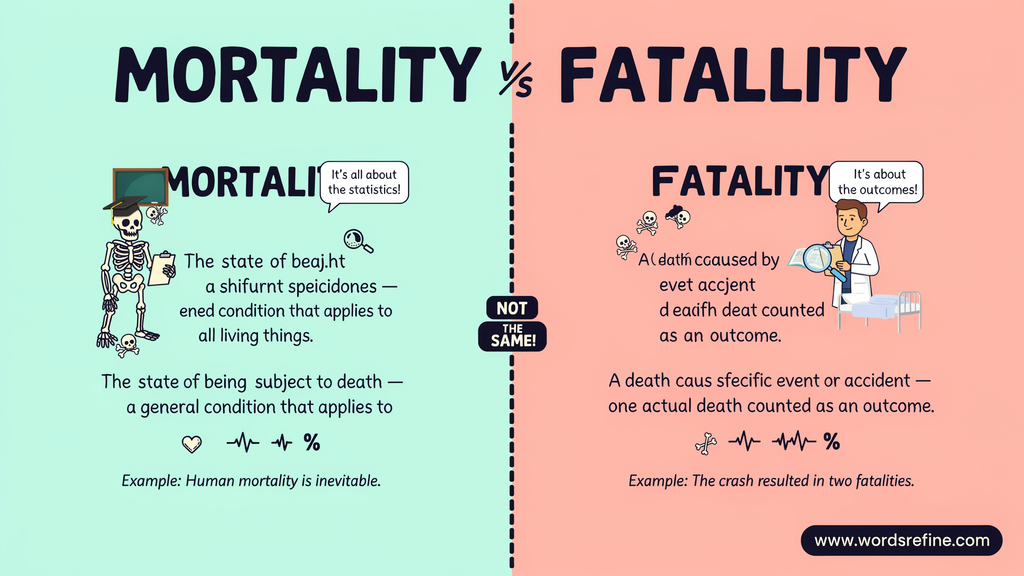
The Mortality rate and case fatality rate both involve death, but they answer different questions.
Imagine a country with 10 million residents. Suppose 100,000 people are diagnosed with a particular disease and 2,000 of those people die.
A simplified population-level calculation would be:
2,000 ÷ 10,000,000 × 100 = 0.02%
Now consider the cases:
2,000 ÷ 100,000 × 100 = 2%
Both calculations use the same 2,000 deaths.
However, the first figure relates those deaths to the entire population. The second relates them to the diagnosed cases.
Consequently, neither figure is automatically more correct. Each serves a different purpose.
What Is Case Fatality Rate?
Case fatality rate describes the proportion of identified cases of a disease or condition that result in death.
You may also encounter the terms case-fatality rate, case fatality ratio, or CFR.
In technical contexts, case fatality ratio can be a more precise term because the calculation represents a proportion rather than a conventional population rate.
For example, if 10,000 people are confirmed to have a disease and 100 die from it, the simplified case fatality percentage is:
100 ÷ 10,000 × 100 = 1%
That doesn’t mean 1% of the entire population died.
It means 1% of the defined cases resulted in death under the conditions and definitions used for that calculation.
Why Can Fatality Be Higher Than Mortality?
The question of why fatality can be higher than mortality becomes simple when you examine the denominator.
Suppose a city has 1 million residents.
A disease affects 20,000 people, and 400 people die.
The population-level percentage is:
400 ÷ 1,000,000 × 100 = 0.04%
The case fatality percentage is:
400 ÷ 20,000 × 100 = 2%
The fatality percentage is higher because it considers only the affected group.
The mortality figure considers the much larger population.
Therefore, the two numbers aren’t contradicting each other. They’re answering different questions.
Mortality vs Fatality vs Morbidity
Death isn’t the only outcome researchers measure.
Morbidity concerns illness, disease, or other health problems. Mortality concerns death. Fatality focuses on deaths associated with a particular cause or event.
Consider a disease affecting 50,000 people.
Perhaps 8,000 develop severe symptoms, 1,000 require hospitalization, and 200 die.
These numbers describe different aspects of the same health problem.
Morbidity helps describe illness and its effects.
Mortality describes deaths within the relevant population.
Case fatality describes deaths among the identified cases.
Incidence describes new cases during a defined period.
Prevalence describes existing cases within a population at a particular time or during a specified period.
These measures work together. None of them should be treated as interchangeable.
Learn the difference between often confused words
Capital vs Capitol Which One Is Correct?
A Simple Comparison
| Term | General meaning |
|---|---|
| Mortality | Deaths within a defined population |
| Fatality | Death caused by or associated with a specific event or condition |
| Morbidity | Illness or health problems |
| Incidence | New cases during a defined period |
| Prevalence | Existing cases within a population |
This distinction is especially useful in public health because a disease can produce a large amount of illness without producing a large number of deaths.
Mortality vs Incidence vs Prevalence
These terms frequently appear together in epidemiology, yet each measures something different.
Incidence focuses on new cases.
Prevalence focuses on existing cases.
Mortality focuses on deaths.
Fatality focuses on deaths among people affected by a particular condition or event.
For example, a chronic disease can have high prevalence because many people live with it for years. At the same time, its mortality may be relatively low during a short period.
Conversely, an uncommon disease can affect relatively few people but have a high case fatality among those diagnosed.
Context always matters.
Traffic accident
Suppose a highway collision involves 12 people and three die.
Those three people can be described as three fatalities.
The deaths are directly connected to the crash.
A broader mortality statistic would answer a different question, such as how many people in the surrounding population died during the year.
Infectious disease
Suppose 50,000 people are diagnosed with an infectious disease and 500 die.
A simplified case fatality calculation would be:
500 ÷ 50,000 × 100 = 1%
Now imagine that the region contains 5 million residents.
The same 500 deaths represent:
500 ÷ 5,000,000 × 100 = 0.01%
The first figure concerns deaths among diagnosed cases.
The second places those deaths against the entire population.
Again, the denominator changes the meaning.
Workplace accident
Imagine a factory employs 1,000 workers and one worker dies in a machinery accident.
That death can be described as a workplace fatality.
A broader mortality analysis could examine how many workers died from all causes over a particular period.
The two measurements would tell different stories.
Learn the difference between basic English word mistakes
Mama vs Mamma Meaning Spelling and Usage?
Common Mistakes With Mortality vs Fatality
Mortality vs fatality often get mixed up because both deal with death. However, using one in place of the other can create confusion, especially in medical, academic, and public health writing.
A common mistake is using mortality when the focus is on people with a specific disease or condition. Mortality usually describes deaths within a defined population. Fatality, on the other hand, focuses on deaths among people affected by a particular disease, injury, condition, or event.
Another mistake involves confusing mortality rate with case fatality rate. A mortality rate generally compares deaths with the total population being studied. A case fatality rate compares deaths with the number of people who have the condition. Changing the denominator can completely change what a statistic tells you.
Some writers also use fatality simply as a synonym for death. While the words are related, fatality usually carries a more specific connection to a harmful event, condition, or cause.
A simple way to avoid these mistakes is to identify the group being measured. If you’re looking at deaths across a population, mortality is usually the right term. If you’re looking at deaths among people affected by a particular condition or event, fatality is the better choice.
Using fatality when you mean mortality
A common error occurs when someone uses fatality to describe general population death statistics.
For example:
The country has a high fatality rate from all causes.
A clearer sentence would be:
The country has a high mortality rate.
The second sentence makes it clear that the statistic concerns deaths across the population.
Using mortality for an individual death
Another common mistake is using mortality to describe a specific death.
For example:
The accident caused three mortalities.
A natural correction would be:
The accident caused three fatalities.
Fatality works because the deaths resulted from a particular accident.
Confusing fatality rate with mortality rate
This mistake becomes particularly serious in medical and statistical writing.
If the denominator consists of diagnosed cases, the measure may be a case fatality rate.
If the denominator represents the wider population, the measure may be a mortality rate.
The words might appear similar, but the statistics answer different questions.
Learn the difference between commonly misused words
Loose vs Lose Difference and which is Correctly?
Treating the words as perfect synonyms
Mortality vs fatality share a connection to death. Nevertheless, they aren’t interchangeable in every context.
Think of them as two overlapping circles rather than identical circles.
They share some territory, but each has its own area of meaning.
Mortality vs Fatality in Professional Writing
Precise terminology matters in academic, medical, and professional writing because readers may rely on the information to understand risks and make decisions.
A researcher studying population health may discuss mortality statistics.
An epidemiologist studying disease severity may discuss case fatality.
A transportation report may discuss traffic fatalities.
A disaster report may discuss fatalities caused by an earthquake.
Each context calls for its own terminology.
1.Use mortality when discussing
- Deaths across a population.
- Population health.
- General death rates.
- Cause-specific death patterns.
- Age-specific death patterns.
- Long-term changes in deaths.
- Public health outcomes.
2.Use fatality when discussing
- Deaths caused by a particular event.
- Accident-related deaths.
- Injury-related deaths.
- Disaster deaths.
- Deaths associated with a disease.
- Deaths among a defined group of cases.
3.Use case fatality rate when discussing
- Deaths among identified disease cases.
- The proportion of cases that result in death.
- Disease severity within a defined case group.
- Case-based health statistics.
A Simple Case Study
Consider a fictional region with 1,000,000 residents.
During an outbreak, 50,000 people become confirmed cases and 1,000 die from the disease.
The simplified population-level percentage is:
1,000 ÷ 1,000,000 × 100 = 0.1%
The simplified case fatality percentage is:
1,000 ÷ 50,000 × 100 = 2%
Both calculations are correct within the assumptions of the example.
The 0.1% figure shows the deaths in relation to the entire population.
The 2% figure shows the deaths in relation to the confirmed cases.
This example captures the most important lesson in mortality versus fatality: the denominator determines what the number means.
Learn the difference between everyday English mistakes
Lay vs Lie Difference and which is correct?
Factors That Can Affect Case Fatality
A case fatality estimate isn’t necessarily a fixed characteristic of a disease.
Several factors can influence the observed figure.
Age can make a major difference because some diseases are more dangerous for older adults than younger people.
Healthcare access also matters. A population with better access to timely diagnosis, treatment, and supportive care may experience different outcomes from a population with limited healthcare resources.
Testing practices matter as well. If testing identifies many mild cases, the denominator becomes larger. As a result, the observed case fatality percentage may decrease.
Conversely, if only severe cases are diagnosed, the observed percentage may appear higher.
Other factors include disease severity, case definitions, reporting delays, treatment availability, population characteristics, and the timing of the analysis.
Therefore, a case fatality percentage should always be interpreted in context.
Why Mortality Statistics Matter
Mortality statistics provide valuable information about population health.
Researchers and public health officials can use them to examine patterns in:
- Causes of death.
- Age groups.
- Geographic regions.
- Disease outcomes.
- Long-term health trends.
- Differences between populations.
- Effects of prevention and treatment.
For example, if mortality from a particular disease falls over several years, researchers can investigate whether improved treatment, earlier diagnosis, prevention, or other changes contributed to the decline.
Mortality data therefore provide much more than a simple count of deaths.
They help reveal patterns.
Why Fatality Statistics Matter
Fatality statistics answer a narrower question.
They help researchers understand how deadly a particular disease, injury, accident, or event can be among the people affected.
For example, case fatality can help researchers assess the severity of a disease within a defined group.
However, comparisons require caution. Two diseases may have different case definitions, patient populations, testing practices, treatment options, and reporting systems.
A fatality percentage therefore shouldn’t be treated as a universal score that exists independently of context.
Mortality Rate vs Death Rate
Mortality rate and death rate are closely related expressions.
In everyday communication, people often use them in similar ways. However, professional statistics usually provide additional details about exactly what is being measured.
A meaningful mortality statistic may specify:
- The population.
- The time period.
- The cause of death.
- The age group.
- The geographic area.
- The measurement unit.
- Whether the figure has been adjusted for differences between populations.
Consequently, saying that “the death rate increased” may not provide enough information.
A precise statement explains whose death rate changed, during which period, and from what cause.
Fatality vs Casualty
Fatality and casualty aren’t identical either.
A fatality specifically refers to a death.
Casualty can have a broader meaning and may include people who were killed or injured, depending on the context.
For example, imagine an accident leaves three people dead and 17 injured.
The incident could be described as having:
3 fatalities
20 casualties
In that context, the three fatalities are part of the larger casualty figure.
Therefore, fatality is the more specific term when the discussion concerns deaths.
Fatality vs Immortality
The Fatality and immortality represent very different concepts.
Fatality relates to death resulting from a particular cause, event, injury, or condition.
Immortality refers to the idea of never dying.
Although the words may appear together in a broad discussion about life and death, they aren’t interchangeable terms and don’t belong to the same statistical category.
For medical and public health writing, mortality vs fatality are the relevant terms when discussing measurable deaths and health outcomes.
Learn the difference between more words people mix up
Whoever vs Whomever How to Use Each Word Correctly?
Quick Comparison of Mortality vs Fatality
| Question | Mortality | Fatality |
|---|---|---|
| Does it involve death? | Yes | Yes |
| Can it describe population statistics? | Yes | Sometimes, depending on context |
| Can it describe an individual death? | Usually not | Yes |
| Is it often connected to a specific event? | Sometimes | Usually |
| Is it common in epidemiology? | Yes | Yes |
| Common expression | Mortality rate | Fatality rate |
| Disease context | Disease mortality | Case fatality |
| Accident context | Population mortality | Accident fatalities |
| Main focus | Deaths in a population | Deaths connected to a specific cause or affected group |
Learn the difference between basic English word mistakes
Vender vs Vendor Which one Is Correct?
Practice Session session
- __________ refers to death within a defined population during a particular period.
- __________ usually connects death with a specific disease, injury, condition, or event.
- A __________ rate measures the frequency of deaths within a population.
- A __________ fatality rate measures deaths among people affected by a particular disease or condition.
- Mortality is generally a __________-level concept.
- Fatality focuses more specifically on deaths among __________ or affected individuals.
- A mortality rate can measure deaths from __________ causes or from a specific cause.
- __________ mortality includes deaths from every cause within a defined population.
- __________-specific mortality focuses on deaths caused by a particular disease, injury, or condition.
- The __________ in a statistical calculation determines the group being compared with the number of deaths.
- In a mortality rate, the denominator commonly represents the total __________ being studied.
- In a case fatality calculation, the denominator usually represents the number of identified __________.
- Mortality statistics are widely used to study __________ health.
- Fatality statistics can help researchers understand how __________ a disease or condition is among affected individuals.
- A death caused by a particular disease may contribute to both mortality and __________ statistics.
- Mortality does not necessarily refer only to deaths caused by __________.
- __________ mortality examines deaths within a particular age group.
- A mortality measure that focuses on one specific cause is called __________ mortality.
- The term __________ is generally more appropriate when discussing the proportion of disease cases that result in death.
- Mortality vs fatality can produce different figures because they use different __________.
- All-cause mortality includes deaths from diseases, injuries, accidents, and other __________.
- A mortality rate usually includes a defined __________ period.
- Fatality is often discussed in relation to the __________ of a disease, injury, or event.
- Mortality helps public health professionals identify patterns and __________ of death.
- Understanding the denominator is essential when interpreting mortality and __________ statistics.
Answers
- Mortality
- Fatality
- Mortality
- Case
- Population
- Cases
- All
- All-cause
- Cause
- Denominator
- Population
- Cases
- Population
- Deadly
- Fatality
- Disease
- Age-specific
- Cause-specific
- Fatality
- Denominators
- Causes
- Time
- Severity
- Causes
- Fatality
Here’s a trusted source for clear more words Comparison:
fAQs
What are the main types of mortality?
Common mortality measures include crude mortality, cause-specific mortality, and age-specific mortality. Crude mortality looks at deaths across a whole population. Cause-specific mortality focuses on deaths from a particular cause, while age-specific mortality examines deaths within a specific age group.
Is mortality the same as the death rate?
Not exactly. Mortality has a broader meaning and refers to death within a population or the occurrence of deaths. A death rate is a statistical measure that expresses how frequently deaths occur within a defined population during a particular period.
What does mortality mean in epidemiology?
In epidemiology, mortality refers to deaths occurring within a defined population over a specific period. Researchers use mortality measures to study population health, causes of death, disease outcomes, and changes in death patterns.
What is the medical difference between mortality vs fatality?
Mortality generally describes deaths within a population, while fatality connects death to a particular disease, injury, event, or condition. For example, researchers may study mortality across a population while using case fatality to examine deaths among people diagnosed with a specific disease.
Can mortality describe a single person’s death?
Generally, no. Mortality usually describes death as a population-level concept or statistical measure. When referring to one person who dies because of an accident, injury, or particular event, fatality is usually the more appropriate word.
Can fatality be used when talking about a disease?
Yes. Fatality can describe deaths associated with a disease. In medical and epidemiological writing, case fatality rate or case fatality ratio commonly describes the proportion of identified cases that result in death.
What does a mortality rate measure?
A mortality rate measures the frequency of deaths within a defined population during a specified period. The calculation may focus on all causes of death or a particular cause, depending on the purpose of the analysis.
What does a fatality rate measure?
A fatality rate measures deaths among people affected by a particular disease, condition, injury, or event. When researchers examine deaths among confirmed disease cases, they commonly use the term case fatality rate.
Why does the denominator matter in mortality vs fatality statistics?
The denominator determines which group the deaths are being compared with. A mortality measure may use the total population as its denominator, while a case fatality calculation uses the number of identified cases. Therefore, the same number of deaths can produce very different percentages.
Can the same deaths appear in mortality vs fatality statistics?
Yes. The same deaths may contribute to both types of statistics when the populations and definitions overlap. However, the resulting figures can differ because mortality vs fatality use different denominators and answer different questions.
Is mortality always related to disease?
No. Mortality can involve deaths from diseases, injuries, accidents, environmental causes, and other factors. A mortality measure can cover all causes or focus on a specific cause of death.
What is cause-specific mortality?
Cause-specific mortality refers to deaths attributed to a particular cause within a defined population. For example, researchers may examine mortality from cancer, heart disease, respiratory disease, injuries, or a specific infectious disease.
What is all-cause mortality?
All-cause mortality refers to deaths from every cause within a defined population and period. Unlike cause-specific mortality, it doesn’t limit the analysis to one particular disease, injury, or cause.
Why is mortality important in public health?
Mortality statistics help public health professionals understand patterns of death across populations. They can reveal leading causes of death, differences between groups, changes over time, and the potential effects of prevention and treatment.
Why is fatality important when studying a disease?
Fatality helps show how deadly a disease can be among people who have that disease. A case fatality measure can provide useful information about disease severity, although the result can vary with the case definition, population, healthcare access, treatment, and other factors.
Conclusion
Mortality vs fatality may sound like close relatives, but they answer different questions. Mortality describes deaths within a defined population, while fatality focuses on deaths linked to a particular disease, injury, condition, or event. The difference becomes especially important when statistics enter the picture because the denominator can quietly change the entire meaning of a figure.
A mortality rate generally looks at deaths in the broader population. A case fatality rate, by contrast, looks at deaths among people who have the condition being studied. That distinction may seem small, but it can prevent a big statistical misunderstanding.
So, when you encounter these terms in medical, academic, or public health writing, don’t let their gloomy similarity trick you. Think of mortality as the wider population picture and fatality as the outcome among affected people. Once you know who belongs in the denominator, these two confusing terms become much easier to use correctly.

Diora AJS she is an experienced blogger and passionate English language enthusiast at Words Refine. With a keen eye for language and a love for clear communication, she writes practical content about grammar, word meanings, usage, and commonly confused terms. Her goal is to make English easier to understand through clear explanations and relatable examples, helping readers write accurately and communicate with confidence.