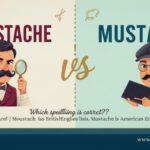
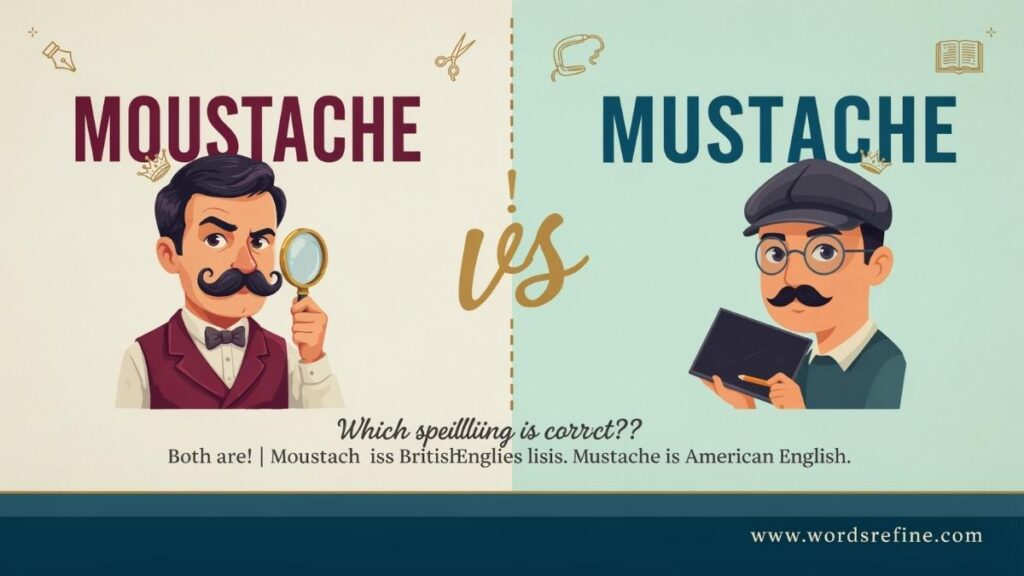
English spelling can be oddly unpredictable, and the moustache vs mustache question proves it. One version has an extra “o,” while the other leaves it out, yet both refer to the same facial hair above the upper lip. That small difference can make even confident writers pause and wonder, “Which one is correct?” Fortunately, the answer isn’t complicated. Mustache is the standard spelling in American English, while moustache is the traditional spelling in British English. Neither form is a mistake. The important thing is to match your spelling to your audience and remain consistent. Once you know the regional rule, this hairy spelling puzzle becomes easy to solve.
Moustache vs Mustache quick answer
The simplest answer to the moustache vs mustache question is that both words describe the same thing.
A moustache is facial hair that grows above the upper lip. A mustache is the same facial hair. There is no difference in the type of hair, its shape, its thickness, or the way it grows.
The spelling changes according to regional English conventions.
American English generally prefers mustache, whereas British English generally prefers moustache. Therefore, if you’re writing for an American audience, mustache will usually look more natural. On the other hand, if you’re following British English conventions, moustache is the usual choice.
Consider these two sentences:
James decided to grow a mustache.
James decided to grow a moustache.
The meaning is exactly the same. The only difference is the spelling.
So, when someone asks, “Which is correct, moustache or mustache?” the answer isn’t that one is right and the other is wrong. Instead, the better answer is that both are correct, but they belong to different regional spelling traditions.
What Does Moustache Mean?
The moustache meaning is simply hair that grows above the upper lip.
People can wear a moustache in many different shapes and lengths. Some keep it closely trimmed, while others allow it to become long and distinctive. Some styles curve outward at the ends, while others cover much of the upper lip.
For example:
His thick moustache made him instantly recognizable.
The barber carefully trimmed his moustache.
He had grown a moustache during the winter.
In British English, moustache is the conventional spelling in these sentences.
The word functions primarily as a noun. It can appear as the subject or object of a sentence, and it can also be modified by adjectives such as thick, thin, long, neatly trimmed, gray, dark, or impressive.
Learn the difference between confusing more English words
Waving vs Waiving Which One Is Correct ?
What Does Mustache Mean?
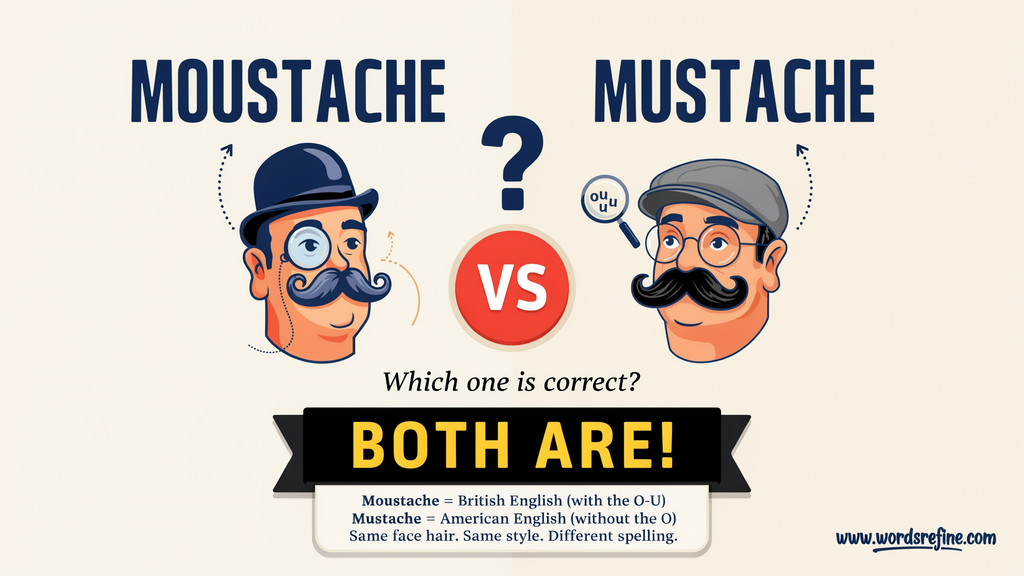
The mustache meaning is the same.
In American English, mustache is the usual spelling for facial hair growing above the upper lip.
For example:
His mustache was neatly trimmed.
Mark decided to grow a mustache.
The actor wore a fake mustache for the role.
Nothing about the meaning changes when the spelling loses the o.
This is important because people sometimes assume that moustache and mustache might describe different styles. They don’t. A handlebar mustache and a handlebar moustache are the same style. Likewise, a pencil mustache and a pencil moustache refer to the same type of facial hair.
Moustache vs Mustache Spelling at a Glance
| Feature | Moustache | Mustache |
|---|---|---|
| Meaning | Hair above the upper lip | Hair above the upper lip |
| Common variety | British English | American English |
| Part of speech | Noun | Noun |
| Meaning difference | None | None |
| Regional difference | Yes | Yes |
| Standard US preference | Less common | Common |
| Standard UK preference | Common | Less common |
| Correct spelling | Yes | Yes |
The table makes the central point clear: the difference is mainly regional.
Why Does Moustache Have an Extra O?
If you’ve ever wondered why is moustache spelled with an o, the answer lies in the history of the word.
English borrowed the word through French, where the spelling moustache was established. The word can ultimately be traced through French and Italian to older Greek forms associated with the upper lip or facial hair.
Over time, English speakers developed different spelling preferences. British English retained the form that looks closer to the French spelling, while American English adopted the shorter form mustache.
This kind of variation isn’t unusual in English. Languages borrow words, adapt them, and sometimes reshape their spelling as different communities use them over generations.
Consequently, the extra o isn’t there because it adds a special meaning. It’s simply part of one established spelling.
Learn the difference between tricky grammar more words
Wisp vs Whisp Which One Is Correct?
Moustache vs Mustache Are They the Same Word?
Yes.
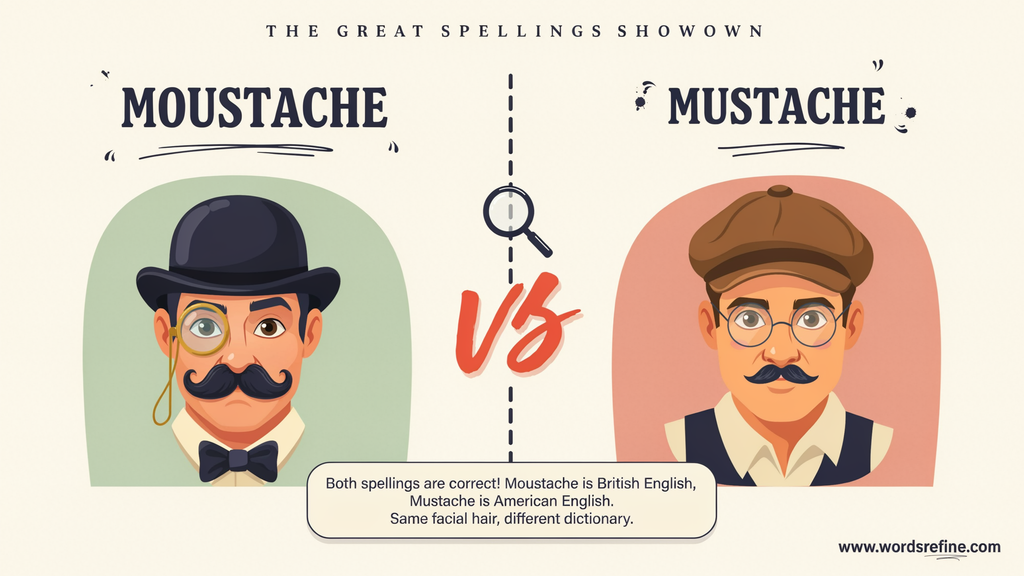
Moustache and mustache are spelling variants of the same word. They don’t represent two separate concepts.
Think of them as two roads leading to the same destination. One road is more common in the United Kingdom, while the other is more common in the United States.
For example:
The man has a large moustache.
and
The man has a large mustache.
Both tell us exactly the same thing.
Therefore, the moustache and mustache difference is about spelling and regional usage rather than meaning.
Mustache in American English
In American English, mustache is the standard spelling.
If you’re writing an article, report, school assignment, website, or business document for an American audience, mustache is generally the form you should choose.
For example:
The barber specializes in classic mustache styles.
His mustache became part of his signature appearance.
The character has a thick black mustache.
The American spelling removes the o found in moustache.
This doesn’t mean American speakers necessarily reject the longer form. Moustache is still recognizable in the United States. However, mustache is the more natural spelling for standard American writing.
That is why you’ll commonly see phrases such as mustache grooming, mustache styles, mustache wax, and mustache trim in American English.
Moustache in British English
British English generally prefers moustache.
For example:
He had a neatly trimmed moustache.
The gentleman wore a thick grey moustache.
His moustache had turned white with age.
The British spelling keeps the o after the initial m.
Therefore, if you’re writing specifically in British English, moustache is usually the better choice.
This distinction also helps explain why readers from different English-speaking regions sometimes think the other spelling looks unusual. Each group becomes accustomed to its own spelling conventions.
Learn the difference between confusing word pairs
Cancell vs Cancel Which one Is Correct?
What About Australia and New Zealand?
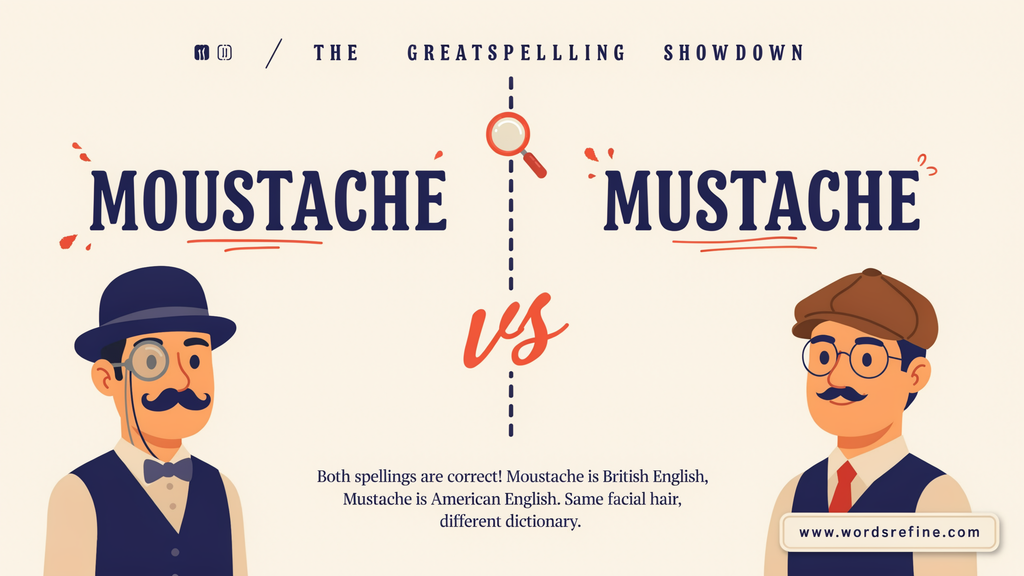
English spelling isn’t divided neatly into only American and British varieties.
Australian English and New Zealand English have their own conventions, although they share many spelling patterns with British English. In these varieties, moustache is commonly encountered.
However, regional language isn’t always completely predictable. Newspapers, publishers, schools, companies, and websites may follow their own style guides.
Therefore, if you’re writing for a particular publication or organization, its style guide should take priority over a general rule.
The same principle applies to international websites. If a website has chosen American English for all of its content, it may consistently use mustache even when its readers come from several countries.
Moustache Spelling in British English
If you’re specifically asking about moustache spelling in British English, the answer is straightforward: moustache is the traditional and widely accepted British form.
For example:
The detective stroked his moustache thoughtfully.
That sentence sounds perfectly natural in British English.
In American English, the equivalent would normally be:
The detective stroked his mustache thoughtfully.
Again, nothing about the detective’s facial hair has changed. Only the spelling has.
Mustache Spelling in American English
The same principle works in reverse.
If you’re writing in American English, use mustache:
The actor grew a mustache for the film.
Rather than:
The actor grew a moustache for the film.
The second version isn’t meaningless or incomprehensible to an American reader. It simply follows a spelling convention more strongly associated with British English.
Therefore, when you’re wondering about the correct spelling of mustache, remember that mustache is the standard American form.
Moustache vs Mustache Pronunciation
The spelling difference doesn’t automatically create two completely different pronunciations.
However, pronunciation can vary between American and British English.
In American English, mustache is commonly pronounced roughly like “MUS-tash.”
British pronunciation may sound closer to “muh-STAHSH,” depending on the speaker’s accent and regional variety.
These simplified pronunciation guides are only approximations. English pronunciation varies considerably from one speaker to another, so there isn’t a single sound that every American or every British speaker will use.
The important point is that the spelling difference isn’t the same thing as a meaning difference.
Learn the difference between often confused words
Performing vs Preforming Which One Is Correct?
Do Mustache and Moustache Sound the Same?
Not always.
American and British speakers may pronounce the word differently because of their broader accent and pronunciation patterns. However, the two spellings don’t describe different words.
So, when considering mustache vs moustache pronunciation, keep two things separate:
The spelling varies by region.
The pronunciation can vary by accent.
The meaning remains the same.
That distinction prevents a lot of unnecessary confusion.
How Do You Spell Mustache?
If you’re using American English, spell it:
Mustache
The letters are:
M-U-S-T-A-C-H-E
The key detail is that there is no o after the m.
For example:
He has a neatly trimmed mustache.
How Do You Spell Moustache?
If you’re using British English, spell it:
Moustache
The letters are:
M-O-U-S-T-A-C-H-E
The extra o is the feature that distinguishes this spelling from the American form.
For example:
He has a neatly trimmed moustache.
A simple memory trick is to associate the shorter spelling with American English and the longer spelling with British English.
Moustache vs Mustache in Everyday Writing
In everyday writing, either form can work as long as it matches the variety of English you’re using.
Imagine you’re writing a story for an American audience:
The old man adjusted his mustache before entering the room.
Now imagine the same story written according to British English conventions:
The old man adjusted his moustache before entering the room.
The sentence structure doesn’t need to change.
You don’t need to rewrite the sentence simply because the spelling changes.
This is one reason why understanding regional spelling differences is more useful than memorizing isolated “right” and “wrong” labels.
Moustache vs Mustache Examples
Examples are often the fastest way to settle a spelling question.
Examples With Mustache
David grew a mustache after leaving college.
The barber gave him a short, neat mustache.
His mustache was beginning to turn gray.
The actor wore a fake mustache during the comedy scene.
He spends several minutes each morning grooming his mustache.
These examples follow American English spelling.
Examples With Moustache
David grew a moustache after leaving college.
The barber gave him a short, neat moustache.
His moustache was beginning to turn grey.
The actor wore a fake moustache during the comedy scene.
He spends several minutes each morning grooming his moustache.
These examples use the British spelling.
Notice something else in the examples: British and American English can differ in more than one spelling. For example, British English often uses grey, while American English commonly uses gray.
That is why it helps to think about the entire English variety rather than treating one word in isolation.
Learn the difference between basic English word mistakes
Inquiries vs Queries What’s the Difference ?
Common Mistakes With Moustache vs Mustache
The most common mistake with “moustache” and “mustache” is assuming that one is wrong. In fact, both spellings are correct and have the same meaning. The difference comes down to regional English.
American English generally uses “mustache,” while British English prefers “moustache.” Writers sometimes create confusion by switching between the two spellings in the same piece of writing.
To keep your writing consistent, choose the form that matches your audience. If you’re following US English, use “mustache.” If you’re writing in British English, “moustache” is the usual choice.
Treating Moustache as a Misspelling
One of the most common mistakes is assuming that moustache is wrong because mustache is the form someone learned in American English.
That’s not accurate.
Moustache is a recognized and established spelling, particularly in British English.
Treating Mustache as a Misspelling
The reverse mistake is just as common.
A British English speaker may see mustache and assume someone forgot the o.
However, mustache is the standard American spelling.
Therefore, neither spelling should automatically be marked incorrect without considering the variety of English being used.
Assuming the Extra O Changes the Meaning
The extra o does not change what the word means.
Compare:
She has a small moustache.
She has a small mustache.
Both sentences describe the same thing.
The spelling difference doesn’t create a difference in size, style, shape, or appearance.
Mixing Regional Spellings Without a Reason
Another problem occurs when a document switches between American and British spelling without any clear purpose.
For example:
The guide explains how to trim a mustache. It then recommends several products for maintaining a moustache.
This isn’t a serious grammar error. However, if the document follows American English, the switch is unnecessary.
A consistent version would be:
The guide explains how to trim a mustache. It then recommends several products for maintaining a mustache.
Likewise, British English would normally use moustache in both sentences.
Mustache Styles and Moustache Styles
The spelling difference also appears in names for different facial-hair styles.
Common examples include:
Handlebar Mustache
A handlebar mustache has ends that curve outward, often resembling the curved handles of a bicycle.
In British English, the same style is commonly written as handlebar moustache.
Pencil Mustache
A pencil mustache is a narrow, carefully shaped strip of hair above the upper lip.
The British form is pencil moustache.
Walrus Mustache
A walrus mustache is thick and typically extends downward over the upper lip.
British English may use walrus moustache.
Horseshoe Mustache
A horseshoe mustache extends downward from the upper lip along the sides of the mouth and resembles the shape of a horseshoe.
British English can use horseshoe moustache.
The style names don’t change because of the spelling. Once again, regional English determines whether you use mustache or moustache.
Mustache and Beard Are They the Same?
No.
A mustache refers specifically to facial hair above the upper lip.
A beard generally refers to hair growing on the lower parts of the face, including areas such as the chin, cheeks, and jaw.
Someone can have:
A mustache without a beard.
A beard without a mustache.
Both a beard and a mustache.
Neither.
This distinction matters because facial-hair terminology describes different areas and styles.
For example:
He shaved his beard but kept his mustache.
The sentence clearly distinguishes the two.
Mustache Grooming and Moustache Grooming
Grooming usually involves trimming, shaping, washing, and maintaining facial hair.
The spelling again depends on the English variety.
An American website might write:
Mustache grooming requires regular trimming.
A British website might write:
Moustache grooming requires regular trimming.
The underlying advice doesn’t change simply because the spelling does.
This is a useful reminder that regional spelling differences rarely require changes to the actual information being communicated.
Learn the difference between commonly misused words
Lend vs Lent What’s the Difference and When to Use Each?
Moustache vs Mustache in Professional Writing
When you’re writing professionally, consistency matters.
Suppose you’re preparing a US company’s grooming guide. The document uses American spelling everywhere. In that case, mustache fits naturally.
Now imagine you’re editing content for a British publication. Moustache is likely to be the better choice.
The important thing is to establish the appropriate English variety before you begin.
For American Writing
Use mustache consistently.
For British Writing
Use moustache consistently.
For International Writing
Choose one established style and apply it consistently unless the publication or organization specifies otherwise.
For Quotations
If you’re reproducing someone’s exact words, preserve the original spelling when the quotation requires it.
This approach keeps your writing accurate while respecting the source.
Moustache vs Mustache in Academic Writing
Academic writing follows the same general principle.
There isn’t a universal academic rule saying that every student must write mustache or every researcher must write moustache.
Instead, the preferred form depends on the English variety and the institution, journal, publisher, or style guide involved.
For example, an American university assignment written in standard American English would normally use mustache.
A British academic publication would generally favor moustache.
Therefore, if you’re preparing academic work, check the required style guide rather than relying solely on what looks familiar.
A Simple Editing Example
Consider this paragraph:
The actor grew a mustache for the first film. In the sequel, he appeared with a moustache. The director said the moustache helped define the character.
There is nothing inherently wrong with the individual sentences. However, the spelling changes halfway through the paragraph.
If the article follows American English, an editor would probably write:
The actor grew a mustache for the first film. In the sequel, he appeared with a mustache. The director said the mustache helped define the character.
If the article follows British English, the editor would probably choose:
The actor grew a moustache for the first film. In the sequel, he appeared with a moustache. The director said the moustache helped define the character.
This is a small change, but it makes the writing feel more polished.
Which Is Correct Moustache vs Mustache?
Both.
That is the most important answer.
Use mustache when you’re following standard American English.
Use moustache when you’re following standard British English.
Neither spelling should automatically be labeled incorrect.
The choice depends on the audience, publication, location, and style of English you’re using.
Is It Mustache vs Moustache?
1If you’re writing for an American audience, choose mustache.
2If you’re writing for a British audience, choose moustache.
3If you’re writing for an organization with a specific style guide, follow that guide.
4If you’re writing casually for an international audience, either form will usually be understood, but consistency still makes the writing cleaner.
Learn the difference between everyday English mistakes
Socialise vs Socialize Which one Is Correct ?
Which Spelling Should You Use?
Here’s the practical rule:
| Situation | Recommended spelling |
|---|---|
| Standard American English | Mustache |
| Standard British English | Moustache |
| US publication | Mustache |
| UK publication | Moustache |
| American school assignment | Mustache |
| British school assignment | Moustache |
| US business writing | Mustache |
| UK business writing | Moustache |
| Organization with a house style | Follow its style guide |
| Direct quotation | Preserve the source’s spelling when appropriate |
Once you’ve selected the appropriate form, use it consistently.
Learn the difference between more words people mix up
Instalments vs Installments Which one Is Correct?
Practice Session moustache vs mustache
- In American English, ______ is the preferred spelling.
- British writers generally use ______ instead.
- His neatly trimmed ______ gave him a distinguished appearance.
- The barber helped him shape his ______.
- The actor grew a thick ______ for his new role.
- In the United States, the word is usually spelled ______.
- In British English, the traditional spelling is ______.
- A well-groomed ______ can change the appearance of the face.
- My grandfather has worn the same style of ______ for decades.
- The character appeared on screen with a large ______.
- The American spelling drops the “o” from ______.
- The British spelling keeps the “o” in ______.
- Both ______ and ______ refer to hair growing above the upper lip.
- When writing for a US audience, choose ______ for consistency.
- When following British spelling conventions, use ______.
- The photographer asked him to trim his ______ before the portrait session.
- She noticed that the article used the British spelling ______ throughout.
- The American newspaper used the spelling ______ in its article.
- Neither ______ nor ______ changes the meaning of the word.
- If you’re writing in American English, ______ is usually the better choice.
- If you’re writing in British English, ______ is usually the better choice.
- The man carefully waxed his ______ before the formal event.
- The spelling difference between ______ and ______ is mainly regional.
- A writer should choose one spelling and use it ______ throughout the article.
- The extra “o” in ______ does not make it an incorrect spelling.
Answers
- mustache
- moustache
- mustache
- mustache
- mustache
- mustache
- moustache
- mustache
- moustache
- mustache
- moustache
- moustache
- moustache, mustache
- mustache
- moustache
- mustache
- moustache
- mustache
- moustache, mustache
- mustache
- moustache
- mustache
- moustache, mustache
- consistently
- moustache
Here’s a trusted source for clear more words Comparison:
FAQs
Is mustache or moustache the correct spelling?
Both spellings are correct. Mustache is the standard form in American English, while moustache is the traditional spelling in British English.
What is the difference between moustache and mustache?
There is no difference in meaning. Both words refer to hair that grows above the upper lip. The main difference is regional spelling.
Is mustache American English?
Yes. Mustache is the standard spelling used in American English. It is the preferred form for most US-based writing and publications.
Is moustache British English?
Yes. Moustache is the traditional spelling used in British English. It is also common in other varieties of English influenced by British spelling.
Why does moustache have an extra “o”?
The spelling moustache reflects the word’s French influence. Over time, American English developed the shorter form mustache, while British English generally retained moustache.
Is moustache an incorrect spelling in American English?
No. Moustache is an established spelling and is widely understood in the United States. However, mustache is the more typical American spelling.
Is mustache an incorrect spelling in British English?
No. British readers generally understand mustache, but moustache is the more conventional spelling in British English.
Do moustache and mustache have the same meaning?
Yes. They have the same basic meaning and refer to facial hair growing above the upper lip. The spelling does not change the type or appearance of the facial hair.
Do moustache and mustache have the same pronunciation?
They can have slightly different pronunciations depending on the speaker’s accent and variety of English. The spelling difference itself does not create a difference in meaning.
How do you spell mustache in American English?
The American spelling is mustache, written M-U-S-T-A-C-H-E. It does not contain the extra o found in the British spelling.
How do you spell moustache in British English?
The British spelling is moustache, written M-O-U-S-T-A-C-H-E. The additional o distinguishes it from the American form.
Which spelling should I use in American writing?
Use mustache when following standard American English. This spelling is the natural choice for US-focused articles, websites, schoolwork, business documents, and other formal writing.
Which spelling should I use in British writing?
Use moustache when following standard British English. It is the conventional spelling for UK-focused writing and publications.
Can I use both moustache and mustache in one article?
You can use both when you’re specifically comparing American and British English. Otherwise, choosing one form and using it consistently will make the article clearer and more polished.
Is mustache a separate word from moustache?
No. They are spelling variants of the same word rather than two words with different meanings. The main distinction is the regional preference for each spelling.
Is the plural of mustache different from the plural of moustache?
The plural forms are mustaches and moustaches. The same regional spelling distinction applies: American English generally uses mustaches, while British English generally uses moustaches.
Can moustache be used in formal writing?
Yes. Moustache is fully appropriate in formal writing when you’re following British English conventions. It is not an informal or incorrect spelling.
Can mustache be used in formal writing?
Yes. Mustache is fully appropriate in formal writing when you’re following American English conventions. It is the standard US spelling rather than a shortened informal form.
Which spelling is better for an international audience?
Either spelling can work because both are widely understood. However, choosing one English variety and using it consistently is usually the better approach, especially in professional or educational content.
Should I follow a style guide when choosing between moustache and mustache?
Yes. If you’re writing for a publication, company, school, or academic journal, follow its preferred style guide. If it uses American English, choose mustache; if it uses British English, choose moustache.
Learn the difference between tricky grammar more words
Copyright vs Copywrite Which One Is Correct?
Conclusion
The moustache vs mustache debate looks more complicated than it really is. Thankfully, you don’t need to twist your vocabulary into a handlebar shape to solve it. Both spellings are correct, and both describe the same facial hair above the upper lip. The real difference comes down to regional English.
In American English, mustache is the standard spelling. In British English, moustache is the traditional choice. So, if you’re writing for an American audience, use mustache. If your readers follow British English, moustache will usually fit better.
Most importantly, don’t treat one spelling as a grammar mistake. The extra “o” doesn’t change the meaning, pronunciation category, or the facial hair itself. It simply reflects a different spelling tradition.
Once you remember the regional difference, choosing between moustache and mustache becomes as easy as choosing how to style one. Pick the spelling that matches your audience, stay consistent, and let the word do its job without growing an unnecessary grammatical beard.

Diora AJS she is an experienced blogger and passionate English language enthusiast at Words Refine. With a keen eye for language and a love for clear communication, she writes practical content about grammar, word meanings, usage, and commonly confused terms. Her goal is to make English easier to understand through clear explanations and relatable examples, helping readers write accurately and communicate with confidence.