
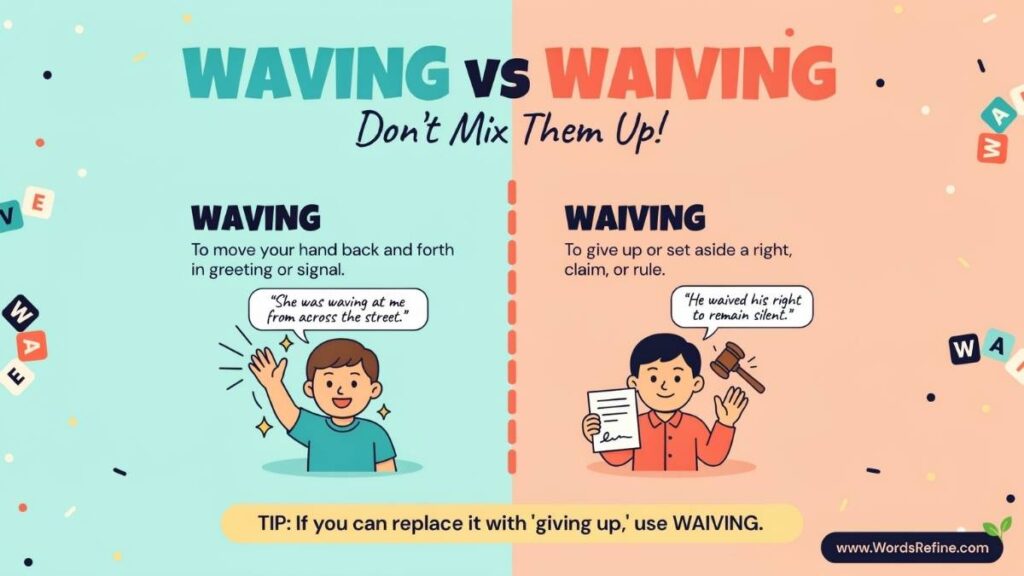
Have you ever paused over waving vs waiving and wondered which one belongs in your sentence? You are certainly not alone. These words sound the same, but their meanings take them in very different directions. Waving describes movement, such as waving your hand to greet someone or waving goodbye. Waiving, however, means giving something up or choosing not to require or enforce something, such as a fee, rule, or requirement. One extra letter may seem harmless, but it can completely change your meaning. In this guide, you’ll learn the difference between waving vs waiving, explore clear examples, and discover an easy way to remember each word without second-guessing yourself.
Waving vs Waiving quick answer
Waving vs waiving are both correct words. The problem is that they belong to different verbs and perform completely different jobs.
Waving comes from wave. It usually describes moving something from side to side or using a movement as a signal.
Waiving comes from waive. It means voluntarily giving something up or deciding not to require or enforce something.
Here is the basic distinction:
| Word | Base verb | Main idea | Example |
|---|---|---|---|
| Waving | Wave | Moving or signaling | She was waving at her friend. |
| Waiving | Waive | Giving something up or removing an obligation | The bank is waiving the late fee. |
The difference between waving vs waiving becomes even clearer when you look at what comes after each word.
1.You can wave your hand.
2.You can wave a flag.
3.You can wave goodbye.
4.You can watch waves moving across the ocean.
However, you can waive a fee.
1.You can waive a penalty.
2.You can waive a requirement.
3.You can waive a right.
4.You can waive a claim.
That contrast gives you a practical rule that works in most situations.
If the sentence describes movement or a greeting gesture, use waving.
If it describes giving something up, removing a charge, or choosing not to enforce something, use waiving.
Wave Meaning and Wave Definition
To understand waving, start with the word wave.
Wave can work as both a noun and a verb.
As a verb, wave can mean moving your hand from side to side. People often use this movement to greet someone, say goodbye, attract attention, or communicate a simple signal.
For example:
She waved at her neighbor.
He waved hello from across the street.
The children waved goodbye as the bus pulled away.
The driver waved to let the pedestrian cross.
In each case, the word describes a hand movement or another kind of signal.
Wave can also describe the movement of something other than a hand.
A flag can wave in the wind. Grass can wave in a field. Curtains can wave near an open window.
The word also has a familiar meaning connected with water. A wave is a moving ridge or swell on the surface of water.
For example:
A large wave crashed against the rocks.
We watched the waves roll toward the shore.
The children ran away when a wave reached their feet.
Therefore, the wave definition isn’t limited to greetings. The word can describe different types of movement, although the central idea remains connected to motion.
Learn the difference between commonly g confusing ord pairs
Any time vs anytime meaning Difference with Examples ?
What Does Waving Mean?
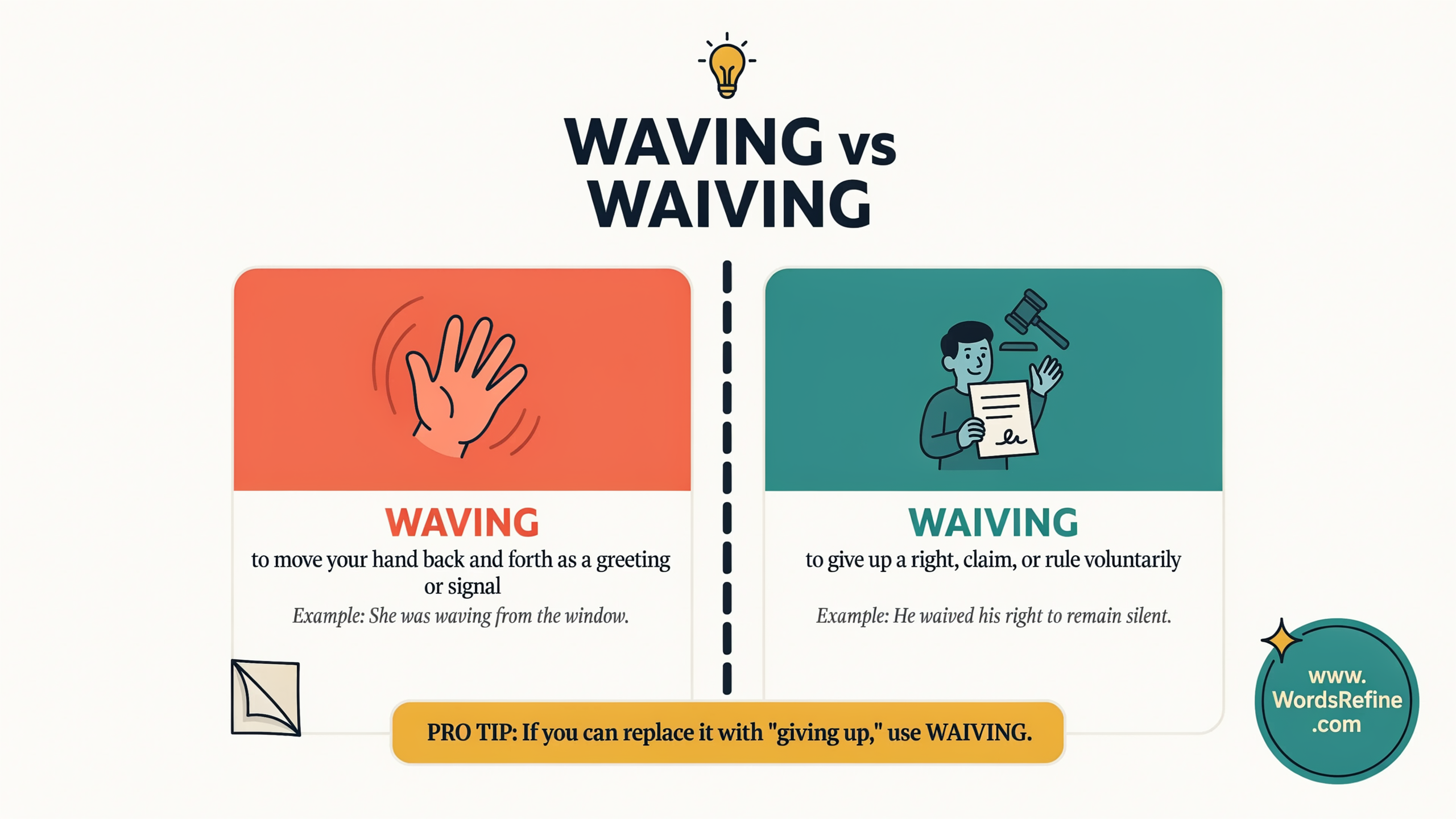
Waving is the present participle of wave. It can also function as a gerund when the action itself acts as a noun.
Most people first associate waving with a friendly greeting.
Imagine spotting a friend across a crowded room. You lift your hand and move it from side to side. You’re waving.
That simple gesture can communicate several things depending on the situation.
1. You might be waving hello.
2.You might be waving goodbye.
3.You might be waving to get someone’s attention.
4.You might be waving at someone you recognize.
For example:
Maria was waving at her sister from the other side of the street.
The little boy kept waving until his father noticed him.
Everyone stood outside waving goodbye.
However, waving doesn’t always involve people.
A flag may be waving in the wind. Tall grass may be waving across a field. A curtain may be waving near an open window.
In each case, the word describes movement.
That gives you an important clue. When you see waving, think movement first.
Learn the difference between basic English word mistakes
Socialise vs Socialize Which one Is Correct ?
Waive Meaning and Waive Definition
Waive has a completely different meaning.
The word waive means to voluntarily give up a right, claim, requirement, condition, fee, penalty, or similar obligation. It can also mean choosing not to enforce something that could otherwise be enforced.
For example:
The hotel agreed to waive the cancellation fee.
The school may waive the application requirement.
The customer asked the company to waive the charge.
She decided to waive her right to appeal.
The manager agreed to waive the penalty.
In these sentences, nobody is moving anything from side to side.
Instead, someone is choosing not to demand, collect, enforce, or exercise something.
That is the central meaning of waive.
A simple way to understand it is to think of waive as an intentional decision to let something go.
The If a bank normally charges a late fee but decides not to collect it, the bank waives the fee.
If an organization normally requires a particular document but decides not to require it in a specific situation, it may waive the requirement.
If someone voluntarily gives up a particular right, that person may waive the right.
The exact consequences can depend on the circumstances, especially in legal agreements. Nevertheless, the basic meaning remains the same: something that could otherwise be required, claimed, or enforced is voluntarily given up or set aside.
What Does Waiving Mean?
Waiving is the present participle of waive.
So, what does waiving mean?
It means the act of voluntarily giving something up or choosing not to require or enforce it.
The word commonly appears when people discuss money, rules, rights, contracts, applications, or penalties.
For example:
The company is waiving the service charge.
The university is waiving the application fee.
The bank is waiving the late fee.
The customer is waiving the right to a refund.
The organization is waiving the usual requirement.
The word can sound more formal than waving because it often appears in professional, administrative, financial, and legal contexts. However, it isn’t limited to formal writing.
You might hear someone say, “They waived the fee,” in an ordinary conversation about a hotel, bank, store, school, or service provider.
Waiving a Fee vs Waving a Hand
This is probably the most useful comparison to remember.
You wave a hand.
You waive a fee.
Consider a simple situation.
A customer arrives at a hotel and discovers a cancellation charge. The manager decides to remove the charge.
The correct sentence is:
The manager is waiving the cancellation fee.
Later, the customer leaves the hotel. The manager smiles and moves a hand from side to side.
The correct sentence is:
The manager is waving goodbye.
The actions are completely different even though waving vs waiving sound alike.
| Situation | Correct word | Example |
|---|---|---|
| Moving a hand | Waving | She was waving at her friend. |
| Greeting someone | Waving | He was waving hello. |
| Saying goodbye | Waving | They were waving goodbye. |
| Moving a flag | Waving | The flag was waving in the wind. |
| Removing a fee | Waiving | The company is waiving the fee. |
| Removing a penalty | Waiving | The bank is waiving the penalty. |
| Giving up a right | Waiving | He is waiving his right to appeal. |
| Removing a requirement | Waiving | The school is waiving the requirement. |
Once you notice the object involved, the correct spelling usually becomes obvious.
Learn the difference between everyday English mistakes
Instalments vs Installments Which one Is Correct?
Is It Waiving a Fee or Waving a Fee?
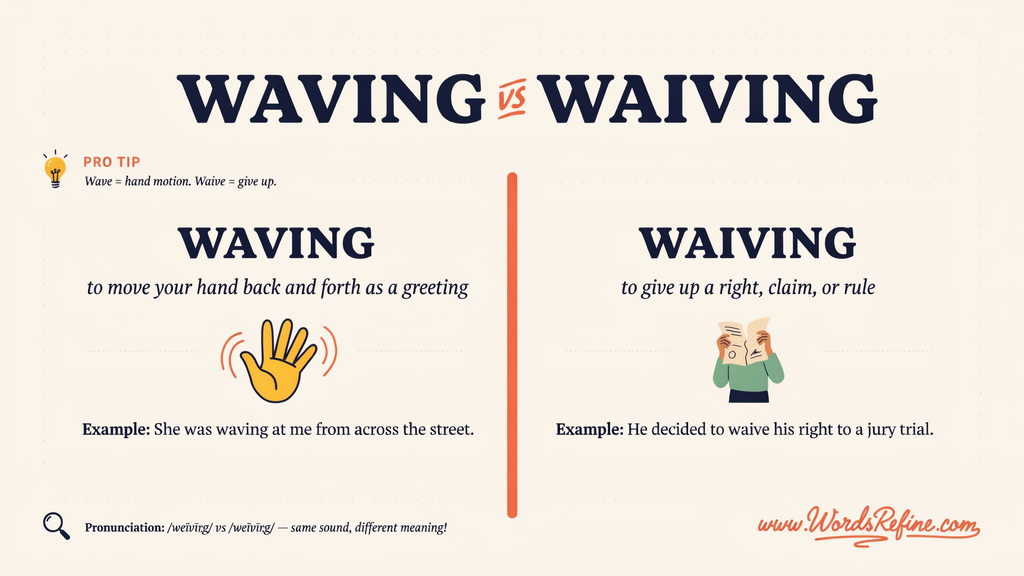
If you’re asking whether to write “waiving a fee” or “waving a fee,” the correct expression is waiving a fee when you mean that the fee will not be charged or collected.
For example:
The airline is waiving the change fee.
The restaurant waived the cancellation charge.
The bank agreed to waive the late fee.
The school is waiving the registration fee.
Waving a fee would suggest that the fee itself is somehow being moved or used as a signal. That isn’t the intended meaning in normal financial or customer-service situations.
Therefore, whenever you mean “remove the fee” or “choose not to charge the fee,” use waive.
Waive a Cost, Charge, or Penalty
Waive doesn’t only apply to fees.
You can waive a cost, although phrases such as waive a fee or waive a charge are often more specific.
For example:
The company agreed to waive the cost of delivery.
The store waived the additional charge.
The bank waived the late penalty.
The service provider waived the installation fee.
The manager waived the inspection charge.
The general idea remains the same. Someone has the authority or ability to require payment, but chooses not to do so.
This is especially common in customer service.
A business might waive a fee because of a billing mistake. A hotel might waive a charge after a service problem. A bank might waive a penalty under certain circumstances.
The reason can vary, but the meaning of waive stays consistent.
Waiving a Right or Claim
Waive can also describe something much more serious than a small charge.
1.A person can waive a right.
2.A person can waive a claim.
3.A person can waive a privilege.
4.A person can waive a condition.
For example:
The agreement states that the parties waive certain claims.
He voluntarily waived his right to appeal.
The applicant waived the right to receive a particular notice.
The parties agreed to waive the requirement under specific circumstances.
In legal settings, the word can carry important consequences. A legal waiver may involve voluntarily giving up a right or agreeing not to exercise it.
Because legal documents can have precise effects, readers shouldn’t assume that every waiver has the same consequences. The surrounding agreement and applicable law matter.
Still, the basic vocabulary remains straightforward.
Waive means voluntarily give up or choose not to enforce.
Wave does not have that meaning.
Waive vs Wave How to Use Each Word
The easiest way to decide between waive or wave is to identify the action.
Ask yourself what is happening.
Is someone moving a hand?
Use wave.
Is someone removing a fee?
Use waive.
Is someone greeting another person?
Use wave.
Is someone giving up a right?
Use waive.
Is someone choosing not to enforce a requirement?
Use waive.
Is something moving through the wind?
Use wave.
Is a company choosing not to collect a charge?
Use waive.
This simple meaning check is far more reliable than listening to the pronunciation.
How to Use Waive in a Sentence
Waive usually takes an object. That object is the thing being given up, removed, or not enforced.
For example:
The company agreed to waive the fee.
The bank may waive the penalty.
The school decided to waive the requirement.
She chose to waive her right to appeal.
The customer asked the manager to waive the charge.
The organization agreed to waive the condition.
The government agency may waive certain requirements under specific circumstances.
Notice the pattern. The word after waive often identifies what is being given up or removed.
That makes sentence structure useful when you’re checking your writing.
How to Use Wave in a Sentence
Wave has several uses.
You can use it as a verb when someone makes a hand gesture.
She waved at me.
He waved goodbye.
They waved to the driver.
You can also use it to describe movement.
The flag waved in the breeze.
The branches waved above the road.
As a noun, wave can describe moving water.
A huge wave reached the shore.
The surfers waited for the next wave.
Wave can therefore refer to both an action and a thing. Context determines which meaning applies.
Waving vs Waiving in a Sentence
Looking at the two words in complete sentences makes the distinction easier to remember.
She was waving at her parents.
The company was waiving the processing fee.
He waved goodbye before getting into the car.
The bank waived the late charge.
The students were waving from the bus.
The university is waiving the application requirement.
She waved her hand to get his attention.
The customer asked whether the company could waive the cost.
The flag was waving in the wind.
The manager agreed to waive the penalty.
The pattern is consistent. Waving describes movement or signaling. Waiving describes giving something up or not enforcing something.
Learn the difference between more words people mix up
Copyright vs Copywrite Which One Is Correct?
Waiving a Requirement
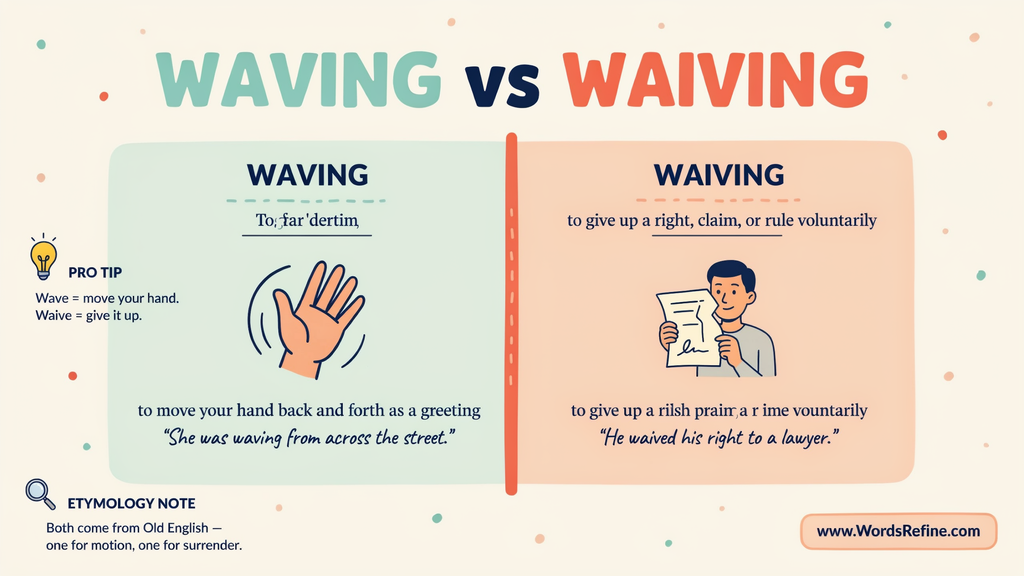
One common use of waive involves requirements.
A requirement is something that normally must be met. If an authorized person decides that the requirement doesn’t need to be met in a particular case, they may waive it.
For example:
The university waived the language requirement for the applicant.
The company waived the experience requirement for the position.
The organization waived the documentation requirement in special circumstances.
The important point is that the requirement still exists as a rule or condition. Someone has simply decided not to apply it in a particular situation.
That is different from eliminating the requirement altogether.
This distinction can matter in professional and administrative writing.
Waiving a Late Fee
Another extremely common phrase is waive a late fee.
Suppose a customer misses a payment deadline. A bank or service provider may normally charge a late fee. However, the company might decide not to collect it.
In that case, the company has waived the late fee.
For example:
The bank agreed to waive the late fee as a courtesy.
The customer requested that the company waive the late fee.
The company waived the late fee after discovering an error on the account.
This is a practical example because it shows why context matters. A fee can be waived because someone chooses not to charge it. It can’t normally be waved in that financial sense.
Waiver, Waived, and Waiving
The word waive belongs to a small family of related terms.
Waive is the base verb.
Waived is the past tense and past participle.
Waiving is the present participle.
Waiver is a noun.
Consider these examples:
1.The company may waive the fee.
2.The company waived the fee.
3.The company is waiving the fee.
The customer requested a fee waiver.
The same relationship appears with wave.
Wave is the base verb.
Waved is the past tense and past participle.
Waving is the present participle.
For example:
She waved at me.
She is waving at me.
That difference helps explain why waiver and waving are not interchangeable.
A waiver belongs to the waive family. Waving belongs to the wave family.
Waiver vs Waving Difference
A waiver is a noun. Waving is usually a verb form or gerund.
For example:
The customer signed a waiver.
Here, waiver refers to a document or formal act involving the giving up of a right or claim.
Now consider:
The customer was waving from the doorway.
Here, waving describes a hand gesture.
The two words may look somewhat related because both involve similar letters, but they come from different word families.
Learn the difference between confusing more English words
Dreamt vs Dreamed Which One Is Correct?
Waive and Wave Pronunciation
Pronunciation causes much of the confusion between these words.
In standard American English, waive and wave have the same pronunciation.
The same is true of waving vs waiving.
That means someone could say either word aloud and the listener might not know which spelling applies until the surrounding sentence provides the context.
For example:
“The company will waive the fee.”
There is no pronunciation clue that tells you to spell the verb with an i.
Likewise:
“She will wave to the crowd.”
The pronunciation doesn’t reveal the spelling either.
This is why these words are commonly described as homophones. They share a pronunciation while having different meanings and spellings.
Wave vs Waive Why Spelling Matters
Because wave vs waive sound alike, spelling carries important information.
Imagine receiving an email that says:
“We are waving the service fee.”
A reader might understand the intended meaning immediately from context, but the spelling is still wrong if the writer means that the company won’t charge the fee.
Now change the sentence:
“We are waiving the service fee.”
The intended meaning becomes clear.
The extra letters aren’t decoration. They identify a different word with a different meaning.
This is one reason commonly confused words deserve careful proofreading. A sentence can contain a perfectly real English word and still use the wrong word for the situation.
Common Mistakes With Waving vs Waiving
Some mistakes appear repeatedly because the words sound identical.
“The company is waving the fee.”
Correct version:
“The company is waiving the fee.”
“She was waiving at her mother.”
Correct version:
“She was waving at her mother.”
“The flag was waiving in the wind.”
Correct version:
“The flag was waving in the wind.”
“He waved his right to appeal.”
Correct version:
“He waived his right to appeal.”
“The hotel is waving the cancellation charge.”
Correct version:
“The hotel is waiving the cancellation charge.”
These examples show an important principle: the surrounding noun often gives away the correct verb.
Hand, flag, greeting, goodbye, and water usually point toward wave.
Fee, cost, charge, penalty, right, claim, rule, and requirement usually point toward waive.
Waive Off Meaning Waive Off or Wave Off?
The phrase “waive off” often causes another spelling problem.
People sometimes use waive off when they actually mean wave off.
Wave off is a recognized expression. It can mean signaling someone or something away, dismissing something, or indicating that something should not proceed, depending on the context.
For example:
She waved off the suggestion.
The pilot waved off the landing.
He waved the children off as they left.
Waive has a different meaning.
1.You can waive a fee.
2.You can waive a requirement.
3.You can waive a right.
4.You can waive a penalty.
Therefore, don’t automatically use waive off simply because the sentence involves getting rid of something.
In many situations, the clearer expression is simply waive.
For example:
The company agreed to waive the fee.
The school decided to waive the requirement.
The bank offered to waive the charge.
British English vs American English
The distinction between waving vs waiving doesn’t change between American and British English.
Both varieties use waving for forms of wave and waiving for forms of waive.
For example:
She was waving goodbye.
The company was waiving the fee.
The spelling difference isn’t a US-versus-UK issue.
Instead, it is a difference between two English words that happen to sound alike.
English has many pairs like this, so familiarity with the meaning of each word is more useful than trying to treat the difference as a regional spelling variation.
Learn the difference between commonly mixed-up more words
Mobil vs Mobile Which one Is Correct?
Waving vs Waiving in Professional Writing
The difference becomes especially important in professional communication.
Imagine a customer-service email that says:
“We’re waiving your late fee.”
That’s clear. The customer understands that the company won’t collect the fee.
Now imagine an administrative notice saying:
“The university is waiving the documentation requirement.”
Again, the meaning is precise. The requirement won’t be enforced for the relevant group or situation.
However, using waving instead could make the sentence look careless.
Professional writing often deals with fees, charges, conditions, rights, and requirements. Consequently, knowing when to use waive can prevent unnecessary confusion.
The same principle applies to contracts, applications, policies, financial notices, and academic correspondence.
Waving vs Waiving in Legal Contexts
Legal writing frequently uses waive, waived, waiving, and waiver.
You might encounter expressions such as:
1.waive a right
2.waive a claim
3.waive a condition
waiver of rights
legal waiver
waiver agreement
These expressions relate to voluntarily giving up or not exercising something.
For example, a document might state that a person waives a particular right under specified circumstances.
However, legal language deserves careful attention. A waiver can have specific consequences depending on the agreement and the law that applies. Therefore, a general dictionary definition shouldn’t be treated as legal advice about a particular document.
From a vocabulary perspective, though, the distinction remains simple.
Legal rights can be waived.
Hands can be waved.
Can Spellcheck Detect Waving vs Waiving Mistakes?
Sometimes, but not reliably.
The problem is that both words are correctly spelled.
If someone writes:
“The bank is waving the fee.”
A basic spellchecker may accept the sentence because waving is a legitimate English word.
The software doesn’t necessarily understand that a bank can waive a fee but cannot normally wave one.
This illustrates an important proofreading rule.
Correct spelling doesn’t always mean correct word choice.
When reviewing a sentence, ask whether the word actually expresses the intended meaning.
That extra check catches many commonly confused words that ordinary spellcheck misses.
How to Remember the Difference Between Waive vs Wave
The easiest memory trick is based on action.
Wave means movement.
Waive means give up.
Think about your hand.
You wave your hand.
Now think about a bill.
You waive a fee.
The phrase “wave your hand, waive the fee” creates a simple contrast that is easy to recall.
You can extend the same idea to other examples.
1.Wave hello.
2.Wave goodbye.
3.Wave a flag.
Watch a wave.
1.Waive a fee.
2.Waive a cost.
3.Waive a penalty.
4.Waive a right.
5.Waive a requirement.
Whenever you’re uncertain, identify the object.
If the object is a hand, flag, or greeting, wave is probably correct.
If the object is a fee, right, claim, requirement, or penalty, waive is probably correct.
Waving vs Waiving Examples
Here are several natural examples that show how the words work in everyday English.
The child was waving at the dog.
The woman waved goodbye from the train.
The fans were waving flags during the celebration.
He waved his hand to attract the server’s attention.
The waves were rolling toward the beach.
The hotel agreed to waive the cancellation fee.
The bank decided to waive the late charge.
The school may waive the application requirement.
The company offered to waive the additional cost.
She agreed to waive her claim under the terms of the agreement.
The examples may look simple, but they reveal the entire pattern.
Waving is about movement.
Waiving is about giving something up or choosing not to enforce something.
Waving vs Waiving Quick Grammar Guide
| If you mean… | Use… | Example |
|---|---|---|
| Move your hand | Waving | She was waving at me. |
| Say hello with a gesture | Waving | He was waving hello. |
| Say goodbye with a gesture | Waving | They were waving goodbye. |
| Move a flag | Waving | The flag was waving in the breeze. |
| Move across water | Wave | A large wave reached the shore. |
| Remove a fee | Waiving | The company is waiving the fee. |
| Remove a charge | Waiving | The store is waiving the charge. |
| Remove a penalty | Waiving | The bank is waiving the penalty. |
| Give up a right | Waiving | She is waiving her right to appeal. |
| Remove a requirement | Waiving | The school is waiving the requirement. |
| Give up a claim | Waiving | He waived his claim. |
This table captures the central English grammar difference between the two words.
Learn the difference between tricky grammar more words
Fiancé vs Fiancée What’s the Difference and which is Correctly?
Waving vs Waiving Practice Session
- Emma was ________ at her brother from across the street.
- The hotel agreed to ________ the cancellation fee.
- The children stood by the window, ________ goodbye to their parents.
- The bank decided to ________ the customer’s late charge.
- He kept ________ his hand until the driver noticed him.
- The company offered to ________ the additional service cost.
- The flag was ________ in the strong afternoon wind.
- The school agreed to ________ the application requirement for eligible students.
- Sarah was ________ hello to her friends at the entrance.
- The customer asked whether the store could ________ the processing fee.
- The passengers were ________ from the train as it pulled away.
- The manager agreed to ________ the penalty because of the billing error.
- The little boy started ________ at the airplane.
- The organization may ________ certain conditions in special circumstances.
- The fans were ________ flags during the parade.
- The bank offered to ________ the late fee as a courtesy.
- She stood outside, ________ goodbye to her family.
- The company decided to ________ the extra charge.
- He was ________ to get his friend’s attention.
- The university may ________ the registration fee for qualifying students.
- The woman smiled and began ________ at the children.
- The customer requested that the business ________ the delivery charge.
- The students were ________ their hands when the speaker entered.
- The landlord agreed to ________ the administrative fee.
- Before leaving, she turned around and ________ goodbye.
Answers
- waving
- waive
- waving
- waive
- waving
- waive
- waving
- waive
- waving
- waive
- waving
- waive
- waving
- waive
- waving
- waive
- waving
- waive
- waving
- waive
- waving
- waive
- waving
- waive
- waved
Here’s a trusted source for clear word meanings:
FAQs
Which is correct “waive” or “waived”?
Both are correct, but they serve different grammatical purposes. “Waive” is the base form of the verb, while “waived” is its past tense and past participle. For example, “The company may waive the fee” uses the base form, while “The company waived the fee” describes an action that already happened.
How do you use waive in a sentence?
Use “waive” when someone voluntarily gives up something or decides not to require or enforce it. For example, “The manager agreed to waive the additional charge.”
What does waiving your rights mean?
Waiving your rights means voluntarily giving up a particular right or agreeing not to exercise it. The exact effect depends on the right involved and the circumstances surrounding the waiver.
Is it waived or waived off?
“Waived” is the standard form when you mean that a fee, requirement, right, or similar obligation has been voluntarily given up or not enforced. For example, “The late fee was waived.” “Waived off” is generally unnecessary in this meaning.
What is another word for “waive fee”?
Depending on the context, alternatives include “remove the fee,” “eliminate the fee,” “forgive the fee,” or “exempt someone from the fee.” However, “waive the fee” is the clearest standard expression in many formal and business contexts.
What is the past tense of “waive”?
The past tense of “waive” is “waived.” For example, “The company waived the service charge after reviewing the complaint.”
What does waiving mean?
Waiving means voluntarily giving up something or choosing not to require, claim, or enforce it. The word commonly applies to fees, rights, requirements, penalties, claims, and conditions.
Does waived mean free?
Not necessarily. “Waived” means that a particular fee, charge, requirement, or obligation has been given up or not enforced. If a business waives a fee, that specific fee doesn’t have to be paid, but other charges may still apply.
What does it mean to waive a fee?
To waive a fee means to choose not to charge or collect that fee. For example, if a bank waives a service fee, the customer doesn’t have to pay that particular charge.
Is it correct to say “waiving a fee” or “waving a fee”?
“Waiving a fee” is correct when you mean that the fee isn’t being charged. “Waving” describes a physical movement or signal, such as waving a hand.
Is it waving vs waiving?
Both words are correct, but their meanings differ. “Waving” describes movement or signaling, while “waiving” means voluntarily giving something up or choosing not to enforce something.
Which is correct “waiving” or “waivering”?
“Waiving” is the correct form of the verb “waive.” “Waivering” isn’t the standard spelling. For example, write “The company is waiving the charge.”
What is another word for “waiving”?
Possible alternatives include “giving up,” “relinquishing,” “forgoing,” “surrendering,” “removing,” “dispensing with,” or “not enforcing,” depending on the context. The best synonym depends on what is being waived.
What is called waving?
Waving is a movement or gesture in which something, especially a hand, moves from side to side. People commonly use waving to greet someone, say goodbye, attract attention, or send a signal.
Which is correct: “waive away” or “wave away”?
“Wave away” is the standard expression when you mean dismissing or signaling something away. For example, “She waved away the suggestion.” “Waive” has a different meaning and usually applies to giving up or not enforcing something.
What is another word for “waving”?
Depending on the context, synonyms for “waving” include “gesturing,” “signaling,” “swaying,” “fluttering,” or “moving from side to side.” The appropriate synonym depends on whether you’re describing a hand gesture, an object, or natural movement.
What does “I am waving at you” mean?
“I am waving at you” means the speaker is moving their hand from side to side as a way of greeting you, getting your attention, or acknowledging you.
What does waving something mean?
Waving something means moving it from side to side or back and forth, often to attract attention or communicate a signal. For example, waving a flag can identify a group or signal a message, while waving a hand can serve as a greeting.
Conclusion
Waving vs waiving may sound almost identical, but their meanings are completely different. Waving describes movement, such as waving your hand to say hello, waving goodbye, or watching waves move across the water. Waiving, on the other hand, means giving something up or choosing not to require or enforce it, such as a fee, right, rule, or requirement.
The easiest way to remember the difference is this: you wave your hand, but you waive a fee. If something is moving from side to side, think waving. If something is being removed, excused, or given up, think waiving. Once you learn this simple distinction, you’ll know exactly which word to use and can leave this confusing spelling mix-up waving goodbye.

Diora AJS she is an experienced blogger and passionate English language enthusiast at Words Refine. With a keen eye for language and a love for clear communication, she writes practical content about grammar, word meanings, usage, and commonly confused terms. Her goal is to make English easier to understand through clear explanations and relatable examples, helping readers write accurately and communicate with confidence.