
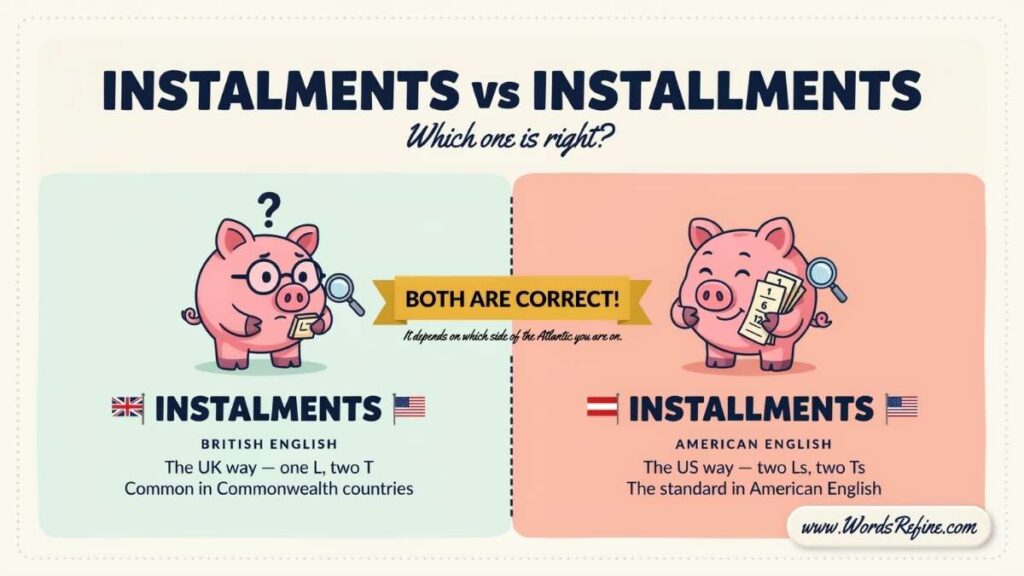
Have you ever paused over instalments vs installments and wondered whether English has added another spelling trap to the list? You’re certainly not alone. These words look almost identical, sound the same, and share the same meaning, yet one extra “l” can cause unnecessary confusion. Fortunately, the difference is easier to understand than it seems. The spelling depends mainly on which variety of English you’re using. American English generally uses “installment,” whereas British English generally uses “instalment.” Once you understand this regional spelling difference, choosing the right form becomes straightforward. Let’s clear up the confusion and make these two spellings easy to remember.
Instalments vs Installments The Simple Answer
The difference between instalments vs installments is mainly a matter of regional spelling.
British English generally uses “instalment,” while American English generally uses “installment.”
For example:
- British English: “The customer will pay the balance in three instalments.”
- American English: “The customer will pay the balance in three installments.”
Both sentences mean exactly the same thing.
The same pattern applies to the plural forms:
- One instalment → several instalments
- One installment → several installments
Therefore, if someone asks, “Which is correct: instalment or installment?” the answer depends on the English variety being used.
Learn the difference between confusing more English words
Any time vs anytime meaning Difference with Examples ?
What Does Instalment Mean?
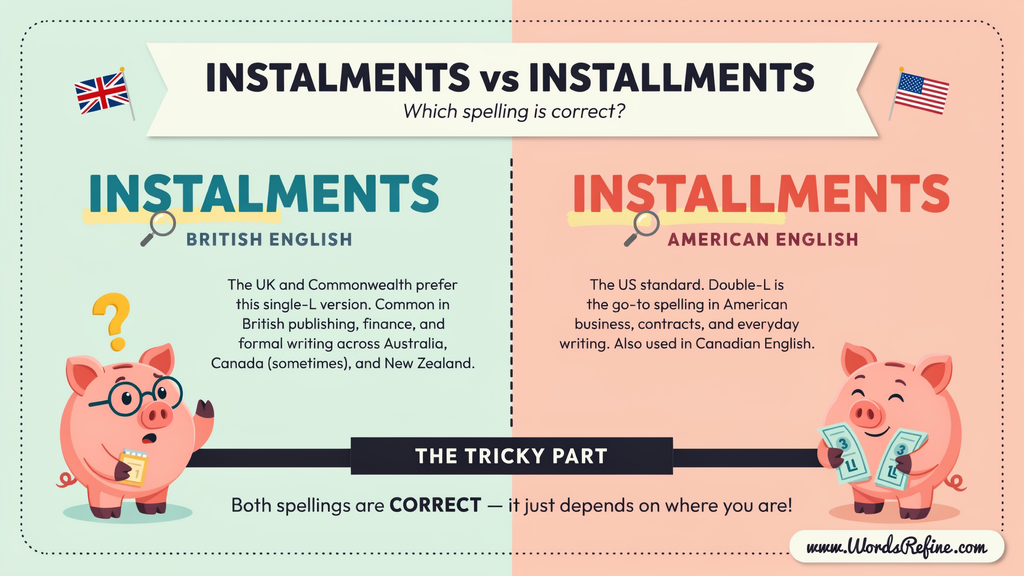
An instalment is one part of a larger amount that someone pays, receives, or completes separately.
The word most commonly appears in financial situations. For example, imagine that you buy a computer and agree to pay for it over six months. Instead of paying the entire amount immediately, you make a series of regular payments. Each payment is an instalment.
For example:
“The first instalment is due next Monday.”
Here, “instalment” means one scheduled payment.
However, the word can describe more than money. It can also refer to one part of a larger series or work.
For example:
“The next instalment of the story will appear next week.”
In this sentence, the word doesn’t describe money at all. It means the next part of a continuing story.
That broader meaning is useful because it reveals the basic idea behind the word: something larger has been divided into separate parts.
What Does Installment Mean?
Installment has the same meaning as instalment. The main difference is spelling.
American English generally uses “installment.”
For example:
“The first installment is due next Monday.”
You could replace “installment” with “instalment” in the sentence without changing the basic meaning. The spelling would simply shift from the American convention to the British convention.
The word can describe payments, purchases, loans, stories, movies, books, and other things that appear in separate portions.
For example:
“She paid for the furniture in monthly installments.”
Or:
“The final installment of the series answered all the major questions.”
In both cases, the word refers to one portion of something larger.
What Is the Difference?
The instalment vs installment question becomes much easier once you understand that the two forms don’t carry different meanings.
The difference is primarily regional.
British English uses “instalment.”
American English uses “installment.”
Both forms are nouns, and both can describe a payment or part of a series.
Consider these examples:
- “She made her first instalment yesterday.”
- “She made her first installment yesterday.”
The meaning doesn’t change.
Likewise:
- “The final instalment of the novel was exciting.”
- “The final installment of the novel was exciting.”
Again, the meaning remains the same.
Consequently, there is no need to memorize two separate definitions. You only need to remember which spelling belongs to the English variety you’re using.
Learn the difference between commonly mixed-up more words
Choose vs Chose Difference and which one is Correct?
Instalment vs Installment in British and American English
Regional spelling differences can make English look like it’s playing a practical joke on writers. Fortunately, this one has a very simple rule.
British English generally prefers “instalment.”
American English generally prefers “installment.”
Here is a quick comparison:
| British English | American English |
|---|---|
| instalment | installment |
| instalments | installments |
| instalment payment | installment payment |
| instalment plan | installment plan |
| monthly instalment | monthly installment |
| instalment loan | installment loan |
The pronunciation and meaning remain essentially the same.
Therefore, if you’re writing for readers in the United States, “installment” will usually look more natural. On the other hand, if you’re writing for readers in the United Kingdom, “instalment” will usually fit better.
Learn the difference between tricky grammar more words
Discrete vs Discreet What the Difference and which is Correctly?
Why Are There Two Spellings?
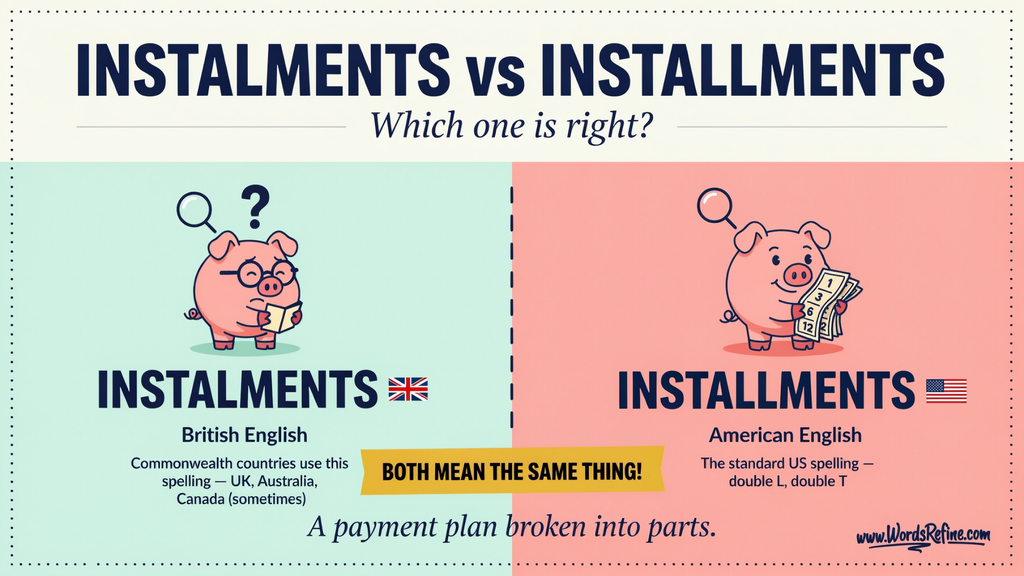
English has developed different spelling conventions in different parts of the world. That’s why readers encounter forms such as “colour” and “color,” “centre” and “center,” and “travelling” and “traveling.”
The same general pattern applies to instalment and installment.
British English has traditionally used the spelling “instalment,” while American English uses “installment.”
This doesn’t mean that one country changed the meaning of the word. Instead, the spelling developed differently within the two major varieties of English.
Consequently, seeing “instalment” in a British publication shouldn’t make an American reader think the writer made a mistake. Likewise, seeing “installment” in an American publication doesn’t mean the writer has misspelled a British word.
The important point is consistency.
Instalment Spelling vs Installment Spelling
The spelling difference is easy to see when the words sit next to each other.
“Instalment” has one “l” after “insta.”
“Installment” has two “l”s.
If you’re trying to remember how to spell instalment, associate the one-“l” form with British English.
If you’re trying to remember how to spell installment, associate the two-“l” form with American English.
The plural forms follow naturally:
- Instalment becomes instalments.
- Installment becomes installments.
Once you remember the singular form, the plural form shouldn’t cause much trouble.
Instalments vs Installments in English
Both words belong to the English language.
The form you encounter depends on the regional variety being used.
A British bank may refer to monthly “instalments.” An American lender may refer to monthly “installments.” A Canadian or Australian publication may also use spelling conventions that resemble British English.
Therefore, asking whether instalments vs installments are “English” doesn’t quite capture the issue. Both are English. They simply belong to different spelling traditions.
This is one of those cases where English refuses to give everyone the same answer.
Instalment Payment vs Installment Payment
An instalment payment is a scheduled portion of a larger amount in British English.
An installment payment means the same thing in American English.
For example, suppose a product costs $1,200 and the buyer agrees to make six equal payments. Assuming there are no additional charges, each payment would be $200.
The arrangement would look like this:
| Payment | Amount |
|---|---|
| First payment | $200 |
| Second payment | $200 |
| Third payment | $200 |
| Fourth payment | $200 |
| Fifth payment | $200 |
| Sixth payment | $200 |
| Total | $1,200 |
In a real financing agreement, however, the payments may not be this simple. Interest, taxes, fees, deposits, or other charges can change the total amount and payment schedule.
Therefore, the word “installment” tells you that the payment forms part of a larger arrangement. It doesn’t automatically tell you whether the agreement includes interest or additional costs.
Learn the difference between tricky grammar more words
Further vs Farther The Simple Difference and Each Correctly?
Instalment Plan vs Installment Plan
An instalment plan or installment plan allows someone to divide a larger payment into several scheduled payments.
For example, a school might allow a student to pay tuition in four installments instead of paying the entire amount at once.
Similarly, a retailer might offer an installment plan for an expensive purchase.
However, don’t assume that every installment plan works in exactly the same way.
One plan might require equal monthly payments. Another might require a deposit followed by smaller payments. A third could include a larger final payment.
Therefore, always read the payment schedule carefully.
The word “installment” describes the structure of the payment. It doesn’t provide every detail about the financial agreement.
Monthly Instalment vs Monthly Installment
A monthly instalment is a payment made once each month.
The American form is monthly installment.
For example:
British English:
“The monthly instalment is due on the first day of each month.”
American English:
“The monthly installment is due on the first day of each month.”
The phrase commonly appears when people discuss loans, financing, tuition, purchases, and other payment plans.
Nevertheless, the amount of a monthly payment can vary depending on the agreement. Some plans use fixed payments, while others may change over time.
Instalment Loan vs Installment Loan
An instalment loan or installment loan is generally repaid through a series of scheduled payments over an agreed period.
Depending on the type of loan, each payment can include money toward the principal, interest, and possibly other charges.
For example, someone might borrow money to purchase a vehicle and repay the debt through regular monthly payments.
The important point is that an installment describes the scheduled payment itself. It doesn’t mean that the entire payment goes directly toward reducing the principal.
That distinction matters when you’re reading a loan agreement.
Learn the difference between commonly g confusing ord pairs
Loose vs Lose Difference and which is Correctly?
Installment Purchase vs Instalment Purchase
An installment purchase allows a buyer to pay for something over time rather than paying the full price immediately.
For example:
“The customer made an installment purchase and agreed to monthly payments.”
In British English, the sentence would normally use “instalment” instead.
The exact terms of such a purchase depend on the agreement. Some arrangements include interest or fees, while others may not.
Therefore, the spelling difference is simple even when the financial details aren’t.
Instalments vs Installments Can Describe More Than Money
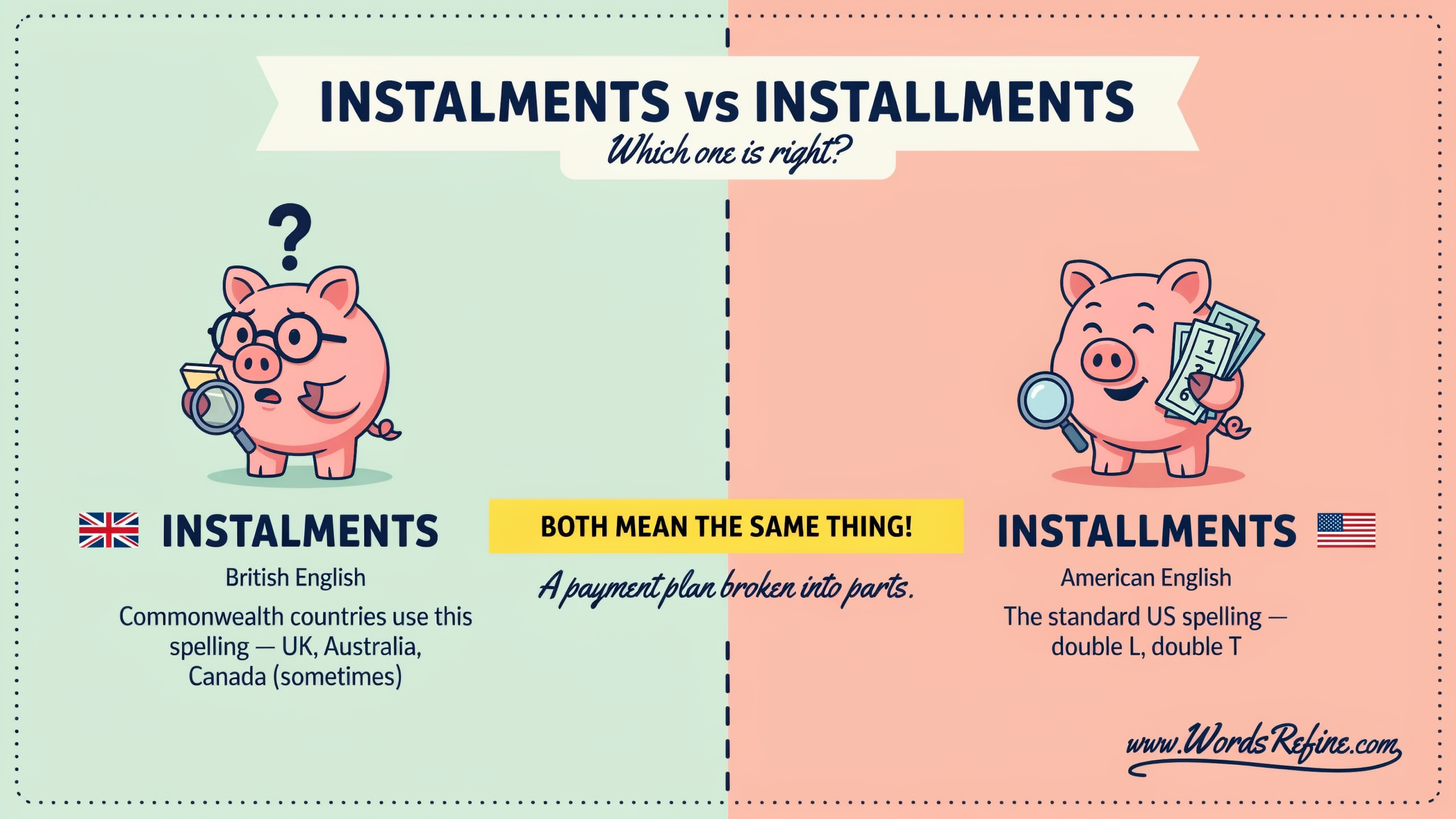
Here’s where the word becomes more interesting.
An installment doesn’t always involve a payment.
Books, movies, stories, and other serialized works can also have installments.
Imagine a mystery story released in three parts.
The first installment introduces the mystery.
The second installment reveals new clues.
The final installment solves the case.
Here, “installment” means a part of a larger work.
The British spelling would be “instalment.”
This use makes sense because each part arrives separately while still belonging to the same overall work.
Learn the difference between often confused words
Vender vs Vendor Which one Is Correct?
Installment as Part of a Series
The word often appears when talking about a continuing series.
For example:
“The next installment will introduce a new character.”
“The final installment brought the story to a satisfying conclusion.”
A television episode can sometimes be described as an installment, although “episode” is often more precise when discussing television.
Likewise, a movie can be described as the latest installment in a franchise.
The word therefore carries the idea of continuation. It tells readers that this isn’t the whole story or work. It’s one piece of a larger picture.
Instalment vs Installment Common Mistakes
The first common mistake is assuming that one spelling must be wrong.
It isn’t.
If you’re writing American English, “installment” is the normal choice.
If you’re writing British English, “instalment” is the normal choice.
Another common mistake is mixing the two forms within the same document.
Imagine reading a company’s payment information and finding:
“The first installment is due Monday.”
A few paragraphs later, it says:
“The second instalment is due next month.”
Readers will understand both sentences. However, the inconsistent spelling can make the writing look careless.
A better approach is to choose one spelling convention and use it throughout the document.
A third mistake involves assuming that the spelling changes the meaning.
It doesn’t.
The extra “l” doesn’t create a new type of payment, and the missing “l” doesn’t create a different type of series.
The meaning stays the same.
Learn the difference between basic English word mistakes
Lay vs Lie Difference and which is correct?
Instalment vs Installment in Professional Writing
Professional writing benefits from consistency.
1.If you’re preparing a contract, invoice, business website, financial document, or customer message, first determine which English variety the organization uses.
2.If the organization follows American English, use “installment.”
3.If it follows British English, use “instalment.”
4.If an established style guide exists, follow it.
This approach is much better than switching spellings based on whichever version happens to appear first in a search result.
For example, an American business might write:
“Customers may pay the balance in three installments.”
A British business might write:
“Customers may pay the balance in three instalments.”
Both sound professional because each follows a consistent spelling convention.
Instalment vs Installment in Academic Writing
Academic writing follows the same basic principle.
There isn’t one universal spelling that every English-language institution must use.
Instead, students and researchers should follow the spelling convention required by their school, publisher, instructor, or chosen style guide.
For American English:
“The author published the work in several installments.”
For British English:
“The author published the work in several instalments.”
Either sentence works within its respective spelling system.
More importantly, don’t switch back and forth without a reason.
Consistency helps readers focus on your ideas rather than small spelling distractions.
Learn the difference between often confused words
Whoever vs Whomever How to Use Each Word Correctly?
Instalments vs Installments A Quick Comparison
When you need a quick answer, this table has you covered.
| Question | Answer |
|---|---|
| Is instalment correct? | Yes, especially in British English. |
| Is installment correct? | Yes, especially in American English. |
| Do they have different meanings? | No. |
| Which spelling does US English prefer? | Installment. |
| Which spelling does UK English prefer? | Instalment. |
| British plural? | Instalments. |
| American plural? | Installments. |
| Can both describe payments? | Yes. |
| Can both describe parts of a series? | Yes. |
| Should both forms be mixed in one document? | Usually no. |
How to Remember the Difference
When the spelling starts to feel confusing, keep the rule short.
British English uses “instalment.”
American English uses “installment.”
That’s it.
There’s no need to create a complicated memory trick.
If your document follows American spelling, choose the version with two “l”s.
If your document follows British spelling, choose the version with one “l.”
Then carry that choice through the entire document.
Practice Session Instalments vs Installments
Complete each sentence by choosing the correct word: instalment or installment. Pay attention to whether the sentence refers to American or British English.
- The customer paid the first monthly __________ on the loan.
- In American English, the standard spelling is __________.
- In British English, the standard spelling is __________.
- She decided to pay for the new laptop in six monthly __________.
- The next __________ of the television series will be released soon.
- The company offers an __________ payment plan for expensive purchases.
- He made his final __________ payment yesterday.
- The British newspaper used the spelling __________ throughout the article.
- The American bank referred to the payment as an __________.
- We agreed to pay the remaining balance in three equal __________.
- The next __________ of the story was even more exciting than the first.
- The customer signed an __________ agreement with the seller.
- In British English, you would normally write “monthly __________.”
- In American English, you would normally write “monthly __________.”
- She couldn’t afford to pay the full amount, so she chose an __________ plan.
- The novel was published in several __________.
- The final __________ payment was due at the end of the month.
- The company allows customers to pay for the furniture in __________.
- Which spelling is normally used in American financial writing: __________?
- Which spelling is normally used in British financial writing: __________?
- The buyer purchased the car through a twelve-month __________ plan.
- The magazine published the story in several __________.
- The bank explained that each __________ would be due on the first day of the month.
- Both spellings have the same meaning, but American English generally uses __________.
- If you’re writing for a British audience, __________ is generally the appropriate spelling.
Answers
- installment
- installment
- instalment
- installments
- installment
- installment
- installment
- instalment
- installment
- installments
- installment
- installment
- instalment
- installment
- installment
- instalments
- installment
- installments
- installment
- instalment
- installment
- instalments
- installment
- installment
- instalment
Here’s a trusted source for clear word meanings:
FAQs
Which one is correct, installment vs instalment?
Both spellings are correct, but they belong to different regional varieties of English. “Installment” is the standard spelling in American English, while “instalment” is generally used in British English.
Is “instalment” the correct spelling in British English?
Yes. “Instalment” is the standard British spelling. For example, you might write, “The first instalment of the payment is due next month.”
Does instalment have one L or two?
“Instalment” has one “l,” while “installment” has two. The difference is a regional spelling convention rather than a difference in meaning.
Does installment have one L or two?
“Installment” is spelled with two consecutive “l” letters. This is the standard form used in American English.
What does “installment” mean?
An installment is one payment in a series of payments made over a period of time. The word can also describe one part of something released or completed in a series, such as a story or television program.
What does “installments” mean?
“Installments” is the plural form of “installment.” It refers to multiple payments or multiple parts of something released or completed in a series.
What does it mean to pay by installments?
To pay by installments means to divide the total cost into several payments made according to an agreed schedule. Instead of paying the entire amount at once, you make smaller payments over time.
What does three installments mean?
“Three installments” means that an amount is divided into three separate payments. For example, a $900 purchase paid in three equal installments would require three payments of $300 each.
Is “installment payment” correct?
Yes. “Installment payment” is a standard expression in American English. It refers to one payment within a series of scheduled payments. In British English, “instalment payment” is commonly used.
What is another word for installment payment?
Depending on the context, alternatives include “scheduled payment,” “periodic payment,” and “partial payment.” However, “installment payment” is often the clearest term when referring to a payment made as part of a payment plan.
What is another word for installment?
The best synonym depends on how the word is being used. In a financial context, “payment” or “portion” may work. When referring to part of a series, “part,” “section,” or “episode” may be appropriate.
What is an example of an installment?
Suppose you purchase a $1,200 laptop and agree to pay the amount in six equal payments. Each $200 payment is an installment.
What is it called when you pay in installments?
It is commonly called “paying in installments.” A payment arrangement that allows this is often called an “installment plan” in American English or an “instalment plan” in British English.
What is another word for paying in installments?
Depending on the situation, you could say “making scheduled payments,” “making periodic payments,” or “paying in parts.” However, “paying in installments” is the most direct and natural expression.
Can you pay in installments?
Yes, if the seller, lender, or service provider offers an installment plan. The total amount is divided into multiple payments that are made according to the agreed payment schedule.
Can “installment” refer to something other than a payment?
Yes. Although “installment” is commonly associated with money, it can also mean one part of something released in a series. For example, a novel, television series, or film franchise can have several installments.
Can “instalment” and “installment” be used interchangeably?
They have the same meaning, but the spelling should match the variety of English you are using. Use “installment” in American English and generally use “instalment” in British English. In formal writing, consistency is more important than switching between the two forms.
Conclusion
In the end, the confusion between instalments vs installments is much simpler than it first appears. Both words have the same meaning: a payment or part of something completed in a series. The only real difference is spelling. British English generally uses “instalment,” while American English uses “installment.”
So, when you’re writing for an American audience, choose “installment.” If you’re following British English, “instalment” is the standard choice. The important thing is to stay consistent throughout your writing.
After all, one extra “l” shouldn’t cost you your grammatical peace of mind. Choose the spelling that matches your variety of English, use it confidently, and save your real installments for the bills.

Diora AJS she is an experienced blogger and passionate English language enthusiast at Words Refine. With a keen eye for language and a love for clear communication, she writes practical content about grammar, word meanings, usage, and commonly confused terms. Her goal is to make English easier to understand through clear explanations and relatable examples, helping readers write accurately and communicate with confidence.