

Have you ever stopped while writing because you could not decide between discrete vs discreet? The two words look almost identical, sound the same, and come from the same historical family. Yet they don’t mean the same thing. One is about things being separate, while the other is about being careful, private, or unobtrusive.
That small spelling difference can completely change a sentence. For example, a company may offer discreet packaging when it wants to keep the contents from attracting attention. However, it may offer several discrete packaging sizes when those sizes are separate options.
Once you understand that basic distinction, the confusion becomes much easier to handle. This guide explains the meanings, pronunciation, common uses, mistakes, and practical examples so you can choose the right word with confidence.
Discrete vs Discreet The Quick Answer
The simplest way to remember the difference is this:
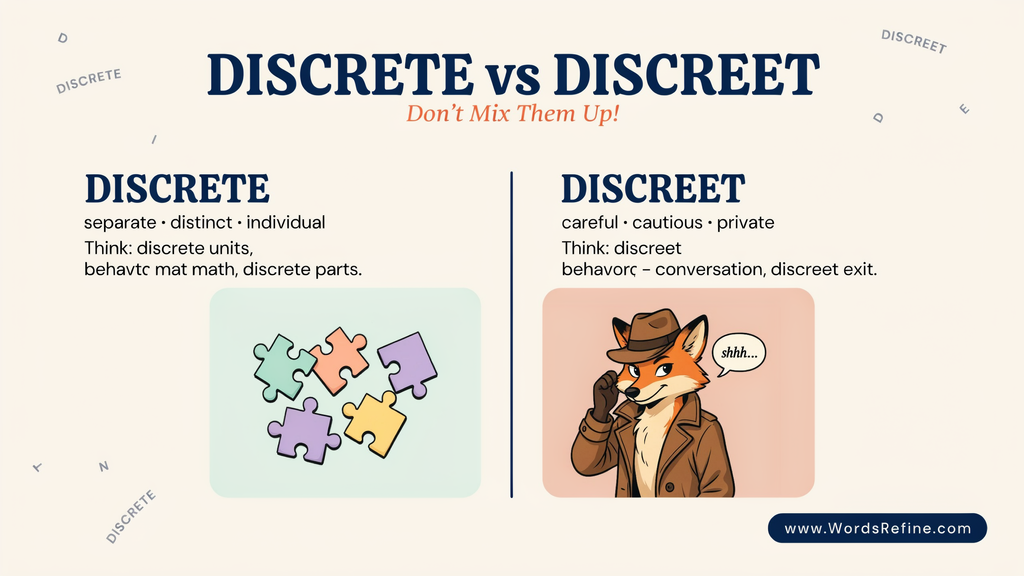
Discrete means separate, distinct, or individual.
Discreet means careful, private, tactful, or unlikely to attract attention.
Consider these two sentences:
- The survey divided the participants into four discrete groups.
- The manager was discreet when discussing the employee’s situation.
In the first sentence, the groups are separate from one another. Therefore, discrete is correct.
In the second sentence, the manager is being careful about sensitive information. Therefore, discreet is the right word.
The meaning decides the spelling.
What Does Discrete Mean?
Discrete describes something that exists separately from other things or can be recognized as an individual unit. It often refers to objects, groups, categories, components, values, or stages.
For example, imagine a project divided into five separate stages. Each stage has its own purpose and can be identified independently. You could describe them as five discrete stages.
Here are several examples:
- The report contains three discrete sections.
- The machine has several discrete components.
- The researchers studied two discrete populations.
- The course is divided into six discrete modules.
- The software processes each file as a discrete unit.
In each case, the word points to separation or distinction.
Importantly, discrete doesn’t always mean that something is physically far away from something else. Two things can sit next to each other and still be discrete if they are considered separate units.
For instance, a shelf may contain five discrete boxes. The boxes touch each other, but each box remains a separate item.
Learn the difference between more words people mix up
Lay vs Lie Difference and which is correct?
What Does Discreet Mean?
Discreet describes someone or something that shows care, good judgment, or restraint. It often appears when a person needs to protect private information or avoid unnecessary attention.
For example, suppose a friend tells you something personal. You don’t repeat it to everyone at dinner. Instead, you handle the information carefully. That behavior is discreet.
Consider these examples:
- Please be discreet about the announcement.
- She made a discreet inquiry about the position.
- He gave his colleague a discreet signal.
- They chose a discreet location for the conversation.
- The assistant handled the confidential information discreetly.
Here, the focus isn’t on separation. Instead, the focus is on privacy, caution, and tact.
A discreet person understands that not every piece of information needs to be shared publicly. They know when to speak, when to listen, and when to keep something private.
The Difference Between Discrete vs Discreet

At first glance, the difference between discrete and discreet may seem tiny. In meaning, however, the difference is significant.
Discrete is connected with separation.
Discreet is connected with restraint.
A simple comparison makes this clearer:
| Discrete | Discreet |
|---|---|
| Means separate or distinct | Means careful or private |
| Usually describes things or units | Often describes people or behavior |
| Common in technical writing | Common in social and everyday situations |
| Related to separate and distinct | Related to tact and good judgment |
| Can describe data and values | Can describe communication and information |
| Example: discrete categories | Example: discreet conversation |
Therefore, if you mean that something is separate, choose discrete. If you mean that someone is careful about privacy or attention, choose discreet.
Why Are Discrete vs Discreet So Confusing?
There are several good reasons these words cause trouble.
First, they sound the same in standard English. That means listening carefully won’t help you decide which spelling to use.
Second, their spellings are remarkably similar. The letters are almost identical, with the main difference being the placement of the t.
Third, they share a historical origin. Both words developed from the same Latin family of words connected with separating, distinguishing, and discerning.
Finally, their meanings have developed in different directions. As a result, modern English uses one spelling for separation and the other for careful or tactful behavior.
So, this isn’t simply a matter of careless spelling. The words are genuinely easy to confuse.
Discrete vs Discreet Pronunciation
Pronunciation makes the problem even more interesting because discrete and discreet are pronounced the same way in standard English.
The pronunciation is represented as /dɪˈskriːt/.
That means you can’t reliably hear the difference between the two words in ordinary speech.
For example, if someone says, “Please be discreet,” you hear the same basic sound that you would hear in “The groups are discrete.”
The spelling has to come from the meaning.
This is also why the two words are considered homophones. They sound alike but have different spellings and meanings.
Therefore, if you’re wondering how to pronounce discrete or how to pronounce discreet, the answer is essentially the same for both.
Learn the difference between everyday English mistakes
Vender vs Vendor Which one Is Correct?
How to Use Discrete Correctly
When you’re deciding whether to use discrete, look for the idea of separation.
Ask yourself whether the thing you’re describing is:
- Separate from other things.
- Clearly distinct.
- An individual unit.
- A separate component.
- A separate category.
- A countable or noncontinuous value.
If the answer is yes, discrete is probably the correct choice.
For example:
“The experiment produced four discrete results.”
The results are being treated as separate outcomes.
“The building contains several discrete sections.”
The sections are distinct parts of the building.
“The program has three discrete stages.”
Each stage is separate and identifiable.
Notice the pattern. The word doesn’t describe someone’s attitude or behavior. It describes the relationship between things.
How to Use Discreet Correctly
When you’re deciding whether to use discreet, look for the idea of careful behavior.
Ask yourself whether the situation involves:
- Keeping something private.
- Avoiding unnecessary attention.
- Showing tact.
- Protecting confidential information.
- Acting cautiously.
- Handling a sensitive situation carefully.
If so, discreet is usually the right choice.
For example:
“She was discreet about the family’s situation.”
The person avoided revealing private information.
“He asked the question in a discreet manner.”
The question was handled carefully and without attracting unnecessary attention.
“They wanted a discreet location.”
The location was chosen because it offered privacy or avoided attention.
Learn the difference between confusing word pairs
Further vs Farther The Simple Difference and Each Correctly?
Discrete in Mathematics and Science
The word discrete has an important technical meaning in mathematics, statistics, computer science, and other fields.
In these subjects, discrete often refers to things that exist as separate or countable values rather than as a continuous range.
Consider the number of books on a shelf. You can have 10 books, 11 books, or 12 books. You can’t normally have 10.5 books.
That makes the number of books a discrete quantity.
Now consider temperature. It can move gradually from one value to another, such as 20.1 degrees, 20.11 degrees, or 20.111 degrees, depending on the precision of measurement. Temperature is therefore generally treated as a continuous quantity.
| Discrete quantity | Continuous quantity |
|---|---|
| Number of students | Student height |
| Number of books | Book weight |
| Number of cars | Car speed |
| Number of goals | Temperature |
| Number of calls | Call duration |
This distinction is particularly important in statistics.
Discrete data consists of individual countable values. Continuous data can take values across a range.
The same idea appears in discrete mathematics, which deals with mathematical structures that are separate or countable rather than continuous.
Consequently, expressions such as discrete mathematics, discrete data, discrete variables, and discrete values all use discrete rather than discreet.
Discreet in Everyday Communication
Discreet appears much more often when people discuss behavior, privacy, and social situations.
Imagine that someone needs to discuss a sensitive workplace issue. Instead of announcing it in front of everyone, they quietly speak with the appropriate person.
That is discreet communication.
Similarly, if someone receives confidential information and doesn’t share it unnecessarily, that person is behaving discreetly.
Here are some natural examples:
- The assistant was discreet when handling the complaint.
- She gave him a discreet warning.
- He remained discreet about the private conversation.
- They took a discreet approach to the problem.
- The employee was discreet when discussing the matter.
The central idea remains the same: careful behavior that avoids unnecessary attention or disclosure.
Learn the difference between commonly misused words
Whoever vs Whomever How to Use Each Word Correctly?
Discrete vs Discreet Packaging?
This is one of the most common places where the two words get mixed up.
When people talk about packaging that doesn’t reveal its contents or attract attention, the correct word is discreet.
For example:
“The company uses discreet packaging.”
Here, discreet means that the packaging is plain or unobtrusive. It doesn’t draw unnecessary attention to what’s inside.
However, discrete packaging can also be grammatically meaningful when discrete means separate.
For example:
“The manufacturer offers three discrete packaging sizes.”
Here, the sizes are separate options.
So both phrases can technically exist, but they express different ideas.
Discreet packaging means packaging designed to maintain privacy or avoid attention.
Discrete packaging refers to packaging considered as separate or distinct units, sizes, categories, or formats.
The context determines the correct word.
Discrete vs Discreet Relationship?
When someone describes a relationship as discreet, they usually mean that the relationship is kept private or handled without attracting public attention.
For example:
“They maintained a discreet relationship.”
The sentence suggests that the relationship wasn’t openly discussed or displayed.
By contrast, discrete relationship would usually mean something different. It could be used in a technical context to describe a relationship that is separate or distinct from another relationship, but that’s not the ordinary meaning most people intend.
Therefore, if the idea is privacy, discreet is the natural choice.
Discrete vs Discreet Secret?
When talking about secrets or sensitive information, discreet is generally the word you want when describing how someone handles that information.
For example:
“Please be discreet about the conversation.”
The person is being asked not to reveal the information carelessly.
You can also say:
“She handled the secret discreetly.”
The action was careful and private.
However, discrete doesn’t mean secret.
If you describe something as discrete, you’re saying that it is separate or distinct.
That’s why “keep it discrete” can be confusing when the intended meaning is “keep it private.” In that situation, “keep it discreet” is the better choice.
Is Information Discreet vs Discrete?
The answer depends entirely on what you mean.
If you’re describing information that is being handled carefully or privately, discreet may fit the context.
For example:
“The assistant discussed the information discreetly.”
The assistant handled the information in a careful and private way.
If you’re describing information as separate pieces or units, discrete can be appropriate.
For example:
“The database stores the information in discrete records.”
The records are separate units.
Therefore, information itself isn’t automatically discreet or discrete. The intended meaning determines the word.
Discrete vs Discreet Synonyms
Synonyms provide a useful shortcut when you’re uncertain.
For discrete, useful alternatives include:
- Separate
- Distinct
- Individual
- Detached
- Independent
- Unconnected
- Self-contained
For discreet, useful alternatives include:
- Tactful
- Careful
- Cautious
- Private
- Prudent
- Restrained
- Unobtrusive
- Judicious
Try replacing the word in your sentence.
If separate works naturally, discrete is likely correct.
If private, tactful, or unobtrusive works better, discreet is probably the word you need.
Common Mistakes With Discrete and Discreet
Because these words sound identical, spelling mistakes are common. Fortunately, most errors fall into a few predictable patterns.
Using discrete for privacy
Incorrect:
“Please keep it discrete.”
If the intended meaning is “keep it private,” discreet is the better choice.
Correct:
“Please keep it discreet.”
Using discreet for separate groups
Incorrect:
“The study identified three discreet groups.”
If the groups are separate or distinct, discrete is correct.
Correct:
“The study identified three discrete groups.”
Calling someone discrete
If you’re describing a person who handles private matters carefully, use discreet.
Correct:
“She is very discreet.”
Calling someone discrete would suggest that the person is separate or distinct, which is rarely what you mean in ordinary conversation.
Assuming the words are regional spellings
Discrete isn’t the British spelling of discreet, and discreet isn’t the American spelling of discrete.
They are two separate words with different meanings in both varieties of English.
Discrete vs Discreet Examples
The fastest way to understand these words is to see them working side by side.
| Sentence | Why it works |
|---|---|
| The company has four discrete departments. | The departments are separate. |
| She was discreet about the complaint. | She protected private information. |
| The machine records discrete values. | The values are individual points. |
| He gave me a discreet signal. | The signal avoided attention. |
| The course has five discrete modules. | The modules are separate units. |
| They chose a discreet location. | The location offered privacy. |
| The report contains several discrete categories. | The categories are distinct. |
| She handled the conversation discreetly. | She acted carefully and tactfully. |
These examples reveal a useful pattern: discrete generally describes the structure or separation of things, while discreet generally describes how something is handled.
Learn the difference between commonly mixed-up more words
Loose vs Lose Difference and which is Correctly?
A Simple Way to Remember the Difference

There’s a useful spelling trick for remembering discrete.
Look at the letters in the middle:
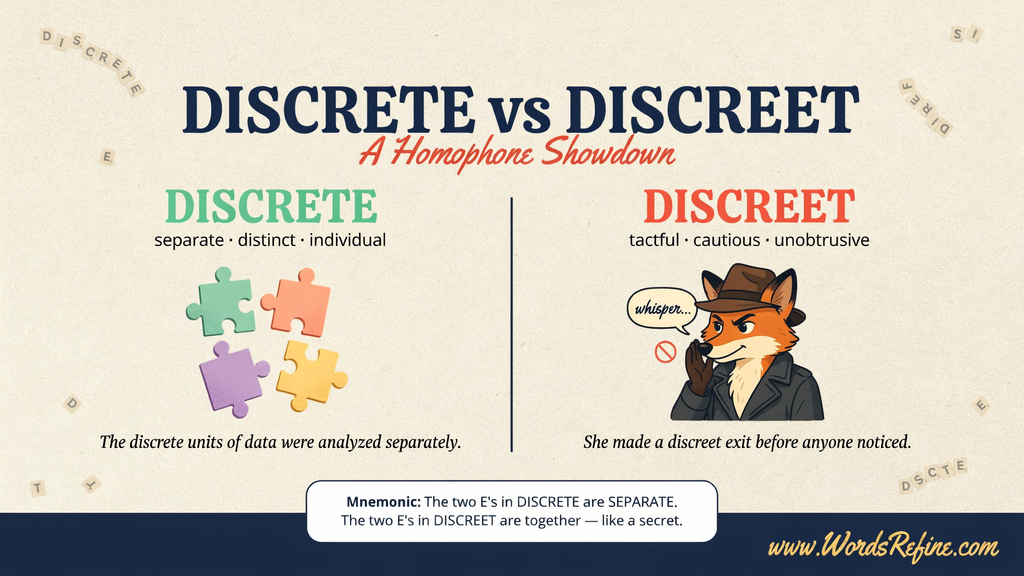
D I S C R E T E
The t separates the two e’s.
That visual separation can remind you that discrete means separate or distinct.
Now look at discreet:
D I S C R E E T
The two e’s stay together.
You can connect that with the idea of quietly keeping things together or keeping information private.
Another useful memory pair is:
Discrete = distinct.
Discreet = discretion.
The words aren’t synonyms, but these associations can make the difference easier to remember.
Learn the difference between confusing word pairs
Capital vs Capitol Which One Is Correct?
A Practical Decision Test
When you’re writing and suddenly wonder which word belongs in the sentence, don’t stare at the spelling.
Instead, ask one question:
Is the sentence about separate things or careful behavior?
If it’s about separate things, choose discrete.
If it’s about careful, private, or unobtrusive behavior, choose discreet.
For example:
“The company offers four ______ options.”
Are the options separate? Yes.
Therefore:
“The company offers four discrete options.”
Now consider:
“The company uses ______ packaging.”
Is the packaging designed to avoid attention? Yes.
Therefore:
“The company uses discreet packaging.”
This approach works because it focuses on meaning rather than appearance.
A Side-by-Side Case Study
Consider a company that sells several products online.
The company offers five different package sizes. Those sizes are separate options, so the company could describe them as five discrete sizes.
At the same time, some customers may want their purchases delivered without attracting attention. The company could therefore advertise discreet packaging.
Now put both ideas together:
“The company offers five discrete package sizes and discreet packaging.”
That sentence works because each adjective performs a different job.
Discrete tells you about the separate sizes.
Discreet tells you about the private or unobtrusive packaging.
This is a perfect example of why replacing one word with the other can change the meaning.
Practice Session Discrete vs discreet
- The teacher divided the students into three __________ groups.
- Please be __________ when discussing confidential information.
- The machine records the data in __________ units.
- She was very __________ when discussing her friend’s personal problem.
- The company offers several __________ package sizes.
- He tried to be __________ when asking about her private situation.
- The experiment produced five __________ results.
- A good manager should be __________ when dealing with sensitive issues.
- The boxes were arranged as __________ items rather than one large unit.
- She gave him a __________ signal to leave the room.
- The researcher analyzed several __________ variables.
- Please handle this matter in a __________ manner.
- The program separates the information into __________ categories.
- He tried to remain __________ during the meeting.
- The students studied __________ mathematics, including logic and graph theory.
- She made a __________ attempt to avoid attracting attention.
- The survey collected __________ data, such as the number of people in each group.
- You should be __________ when sharing someone’s personal information.
- The scientist examined each __________ component separately.
- They wanted a __________ way to discuss the employee’s complaint.
- The chart shows several __________ values rather than a continuous range.
- He asked the question in a very __________ way so that nobody else would notice.
- The computer divides the information into __________ sections.
- She is known for being __________ and respectful of other people’s privacy.
- The objects remained __________ from one another throughout the experiment.
Answers
- discrete
- discreet
- discrete
- discreet
- discrete
- discreet
- discrete
- discreet
- discrete
- discreet
- discrete
- discreet
- discrete
- discreet
- discrete
- discreet
- discrete
- discreet
- discrete
- discreet
- discrete
- discreet
- discrete
- discreet
- discrete
Here’s a trusted source for clear word meanings:
FAQs
Are discrete and discreet pronounced the same way?
Yes. In standard English, both words are pronounced the same way. Their different meanings come from their spelling and context, not from pronunciation.
Can discreet be used for a place or location?
Yes. Discreet can describe a place that is quiet, private, or unlikely to attract attention. For example, “They chose a discreet location for the meeting.”
Can discrete describe physical objects?
Yes. Discrete can describe physical objects when they exist as separate or individual units. For example, “The machine is made up of several discrete parts.”
What kind of things can be described as discrete?
Things that are separate, distinct, or individually identifiable can be described as discrete. This includes groups, objects, components, categories, units, and values.
What kind of behavior is described as discreet?
Discreet behavior involves acting carefully, tactfully, and without drawing unnecessary attention. It often matters when someone is handling private or sensitive situations.
Is discreet a positive quality?
Usually, yes. Calling someone discreet often suggests that the person has good judgment, respects privacy, and knows how to handle sensitive matters appropriately.
Can a conversation be discreet?
Yes. A discreet conversation is conducted privately or tactfully, especially when the subject is sensitive. For example, “The manager requested a discreet conversation with the employee.”
Can a design be discreet?
Yes. A discreet design is subtle or unobtrusive rather than attention-grabbing. For example, “The device has a discreet design that blends into the room.”
Can discrete describe groups?
Yes. Discrete groups are separate and clearly distinguishable from one another. For example, “The participants were divided into three discrete groups.”
Can discrete describe numbers?
Yes. In mathematics and statistics, discrete values are separate and countable rather than continuously varying. The number of books on a shelf is an example of a discrete quantity.
What does discrete mean in statistics?
In statistics, discrete usually describes data that consists of distinct, countable values. Examples include the number of customers, employees, calls, or products.
What does discreet mean in professional communication?
In professional communication, discreet means handling information or situations with tact, care, and appropriate privacy. It is especially relevant when discussing confidential or sensitive matters.
Is “discreet behavior” grammatically correct?
Yes. “Discreet behavior” is grammatically correct when the behavior is careful, tactful, private, or unobtrusive. For example, “His discreet behavior prevented unnecessary attention.”
Is “discrete behavior” grammatically correct?
It can be grammatically correct, but the meaning is different. It would describe behavior considered as separate or distinct units rather than behavior that is private or tactful.
Can discreet be used with “information”?
Yes. You can describe information as discreet when emphasizing that it is handled carefully or privately. However, “confidential information” is often a more precise expression.
Can discrete be used with “information”?
Yes. Discrete information can mean information divided into separate categories, units, or elements. It focuses on organization and separation rather than confidentiality.
What is the difference between discrete groups and discreet groups?
Discrete groups are separate or distinct groups. Discreet groups would suggest groups that behave privately or avoid attracting attention. The intended meaning determines the correct word.
Why does one extra letter matter in discrete and discreet?
The extra “e” changes the spelling and helps distinguish two words with different meanings. Discrete relates to separation and distinctness, while discreet relates to tact, privacy, and careful behavior.
Is “discreet manner” a correct expression?
Yes. “In a discreet manner” means doing something carefully, tactfully, privately, or without attracting unnecessary attention.
Is “discrete manner” a correct expression?
It is possible in specialized contexts, but it usually does not express the idea of tact or privacy. When you mean careful or private behavior, “discreet manner” is the natural choice.
Which word describes something individually identifiable?
Use discrete. If something can be recognized as a separate or distinct unit, discrete is usually the appropriate word.
Which word describes someone who respects privacy?
Use discreet. A discreet person handles sensitive matters carefully and avoids sharing information unnecessarily.
Conclusion
Discrete vs discreet may look almost identical, but their meanings are worlds apart. Discrete describes things that are separate, distinct, or individual, while discreet describes careful, tactful, private, or unobtrusive behavior. Once you connect discrete with separation and discreet with discretion, the difference becomes much easier to remember.
So, when you’re talking about separate groups, components, categories, or values, choose discrete. When privacy, tact, or avoiding unnecessary attention is the focus, choose discreet. These two words may enjoy confusing writers, but with a little practice, you can keep them in their proper places and write with confidence.

Diora AJS she is an experienced blogger and passionate English language enthusiast at Words Refine. With a keen eye for language and a love for clear communication, she writes practical content about grammar, word meanings, usage, and commonly confused terms. Her goal is to make English easier to understand through clear explanations and relatable examples, helping readers write accurately and communicate with confidence.