
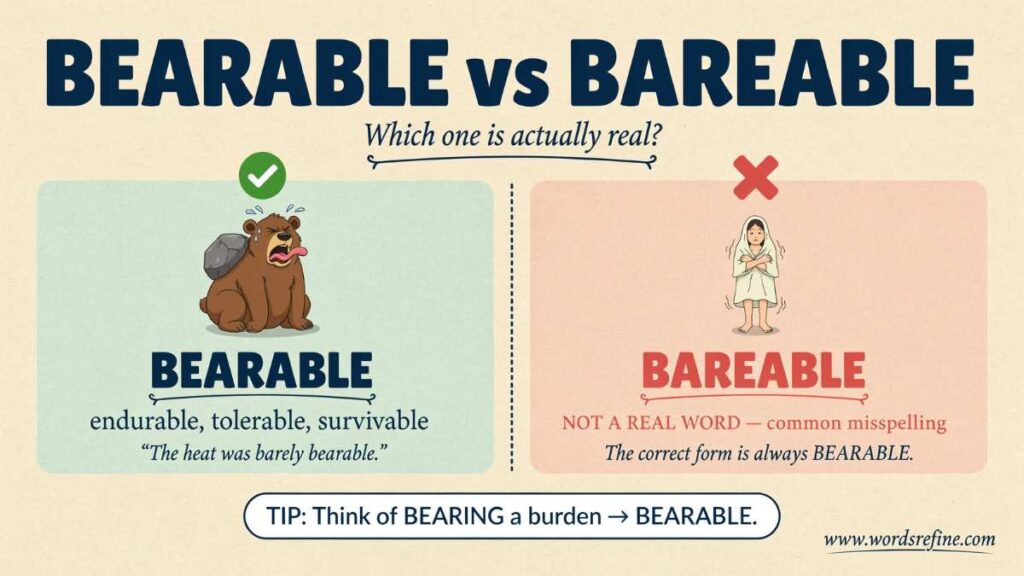
Have you ever wondered whether to write bearable vs bareable? You’re certainly not the only one. These two spellings sound identical, making them easy to confuse, but only bearable is correct when describing something you can tolerate or endure. The mistake often happens because bear and bare are homophones, yet their meanings are quite different. Bear means to carry or put up with something, while bare means uncovered or exposed. Understanding this simple distinction will help you choose the right spelling and avoid an unnecessary grammar mistake. After all, English has plenty of tricky words already. Why make one more confusing than it needs to be?
Quick Answer Bearable vs Bareable
bearable vs bareable is an adjective that describes something you can tolerate, endure, or manage. For example, you might describe a long meeting as bearable if it isn’t too boring or a difficult day as bearable if you can get through it.
Bareable, on the other hand, is not the standard spelling of this word. Although you might occasionally see it in informal writing, it is considered a spelling mistake when you mean something is tolerable.
The main difference is simple: bearable is correct, while bareable is generally incorrect.
| Word | Meaning | Correct Usage |
|---|---|---|
| Bearable | Able to be endured or tolerated | The pain was bearable after taking a break. |
| Bareable | Nonstandard spelling of bearable | Avoid using it in standard writing. |
For example, you could write, “The heat was bearable once the sun went down.” Writing “The heat was bareable once the sun went down” would be incorrect.
Learn the difference between confusing more English words
Tinder vs Tender Differences Examples and Correct Usage?
What Does Bearable Mean?
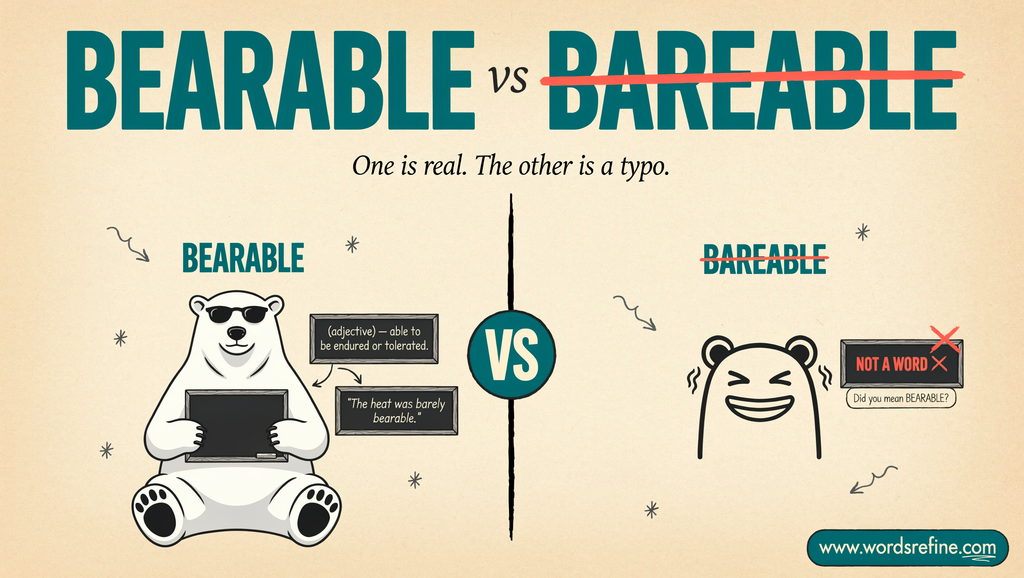
bearable vs bareable means that something is unpleasant, uncomfortable, or difficult but not so bad that you cannot tolerate it. It describes situations you can put up with, even when they aren’t particularly enjoyable.
Think about sitting through a long flight. Your seat might be uncomfortable, the food might be disappointing, and the person behind you might keep kicking your chair. Still, if you can manage the experience, you could call the flight bearable.
The word doesn’t suggest that something is pleasant or enjoyable. Instead, it means that the situation is manageable enough for you to handle.
Here are a few examples:
The pain became bearable after she rested for a while.
The weather was bearable in the early morning, but the afternoon heat was exhausting.
His workload is heavy, but it’s still bearable.
The small apartment is bearable because it has enough space for everyone.
The noise became more bearable after we closed the windows.
In each sentence, bearable describes something that may cause discomfort or difficulty but remains possible to tolerate.
Bearable Definition and Word Formation
Bearable is an adjective. It comes from the verb bear, which can mean to carry, support, or endure something, and the suffix -able, which means capable of being or suitable for something.
When you combine these parts, you get bearable: something that can be endured or tolerated.
For example, consider the sentence, “The difficult situation was bearable because everyone supported one another.”
The situation wasn’t easy, but the people involved could get through it. That’s exactly what bearable communicates.
You can also use the word to describe different levels of discomfort. A situation might be slightly bearable, barely bearable, or more bearable than before.
Here are some common examples:
The headache was bearable enough for him to finish his work.
The long wait became more bearable when we found somewhere comfortable to sit.
The financial pressure was barely bearable during the first few months.
These examples show how the word works naturally in everyday English.
The Origin of Bearable
The spelling becomes easier to understand when you look at the history of the word.
Bearable comes from the verb bear, which has roots in the Old English word beran. It meant to carry, bring, or support. Over time, bear also developed the meaning of enduring something difficult or unpleasant.
The suffix -able adds the idea that something is possible. When you add it to bear, you get bearable, meaning capable of being endured.
This origin explains why the word begins with bear rather than bare. The spelling connects directly to the idea of carrying or enduring a difficult experience.
So, when you’re unsure how to spell it, remember the connection: if you can bear something, it is bearable.
Learn the difference between commonly mixed-up more words
Jibe vs Jive What’s the Difference?
Bear vs Bare Understanding the Difference
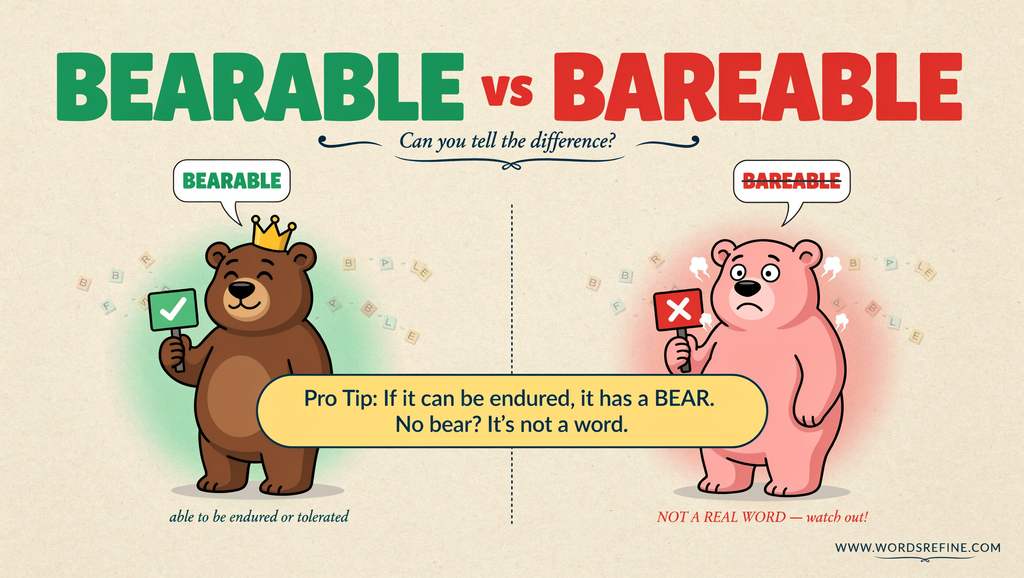
The easiest way to remember the spelling of bearable is to understand the difference between bear vs bare. Although these words sound alike, they have completely different meanings.
Bear is a verb that can mean to carry, support, or endure something. For example, when you say, “I can’t bear this noise anymore,” you mean that the noise has become too annoying to tolerate.
Bare is an adjective that means uncovered, exposed, or without something. For instance, “He walked across the grass with bare feet.” In this sentence, bare describes feet without shoes or socks.
Now consider how these words connect to bearable. Since bearable comes from the verb bear, it keeps the same spelling. It describes something you can endure, not something uncovered.
Here are a few examples to make the difference clearer:
She could barely bear the pain after the accident.
The children ran across the garden with bare feet.
The uncomfortable chair was still bearable for a short meeting.
He couldn’t bear the cold weather without a warm jacket.
The first and third sentences use bear and bearable to describe endurance. The second and fourth use bare to describe something uncovered or exposed.
How Bearable Is Used in Everyday Situations
You can use bearable in many situations where someone has to tolerate discomfort, difficulty, or an unpleasant experience. It doesn’t mean the situation is wonderful. It simply means you can manage it without feeling completely overwhelmed.
Physical Pain and Discomfort
People often use bearable to describe pain that isn’t pleasant but remains manageable. A headache, muscle ache, or minor injury might be bearable if it doesn’t stop someone from carrying out everyday activities.
For example:
The pain was bearable after she applied an ice pack.
His backache became more bearable after a few days of rest.
The dentist assured her that the discomfort would be bearable.
In these examples, bearable suggests that the discomfort is still present but not impossible to handle.
Emotional Experiences
Difficult emotions can also become bearable. Losing someone, dealing with disappointment, or going through a stressful period can feel overwhelming. However, support from family and friends can make those experiences easier to endure.
For example:
Her friends made the difficult situation more bearable.
Talking about his worries helped make the stress bearable.
The first few weeks were hard, but life gradually became more bearable.
The word works well here because emotional struggles aren’t always something you can fix immediately. Sometimes, you simply find ways to get through them.
Workplace Challenges
Work isn’t always enjoyable. Tight deadlines, demanding projects, long meetings, and heavy workloads can make a job stressful. However, a supportive team or a reasonable schedule can make those challenges more bearable.
For example:
The workload became bearable after the manager hired another employee.
A friendly team made the long working hours more bearable.
The meeting was bearable because everyone stayed focused.
These sentences show that bearable can describe working conditions that aren’t ideal but remain manageable.
Weather and Temperature
Weather is another common situation where people use bearable. Extreme heat, freezing temperatures, and uncomfortable humidity can make outdoor activities difficult. However, a change in temperature or a little shade can make the conditions easier to tolerate.
For example:
The summer heat was bearable in the evening.
The cold became more bearable after we put on our winter coats.
The humidity made the afternoon almost unbearable.
Notice that bearable and unbearable express opposite ideas. Bearable describes something you can tolerate, while unbearable describes something that feels too difficult to endure.
Living Conditions
People also use bearable when discussing housing, noise, limited space, or other everyday living conditions. A small apartment might not be ideal, but it can still be bearable if it provides the basic comforts you need.
For example:
The apartment was small, but the affordable rent made it bearable.
The noisy neighborhood became more bearable once we installed better windows.
Their living conditions improved enough to make daily life more bearable.
In each example, the situation isn’t perfect. Still, the person can manage it.
Learn the difference between tricky grammar more words
Foward vs Forward Meaning Spelling and Correct Usage
Common Expressions With bearable vs bareable
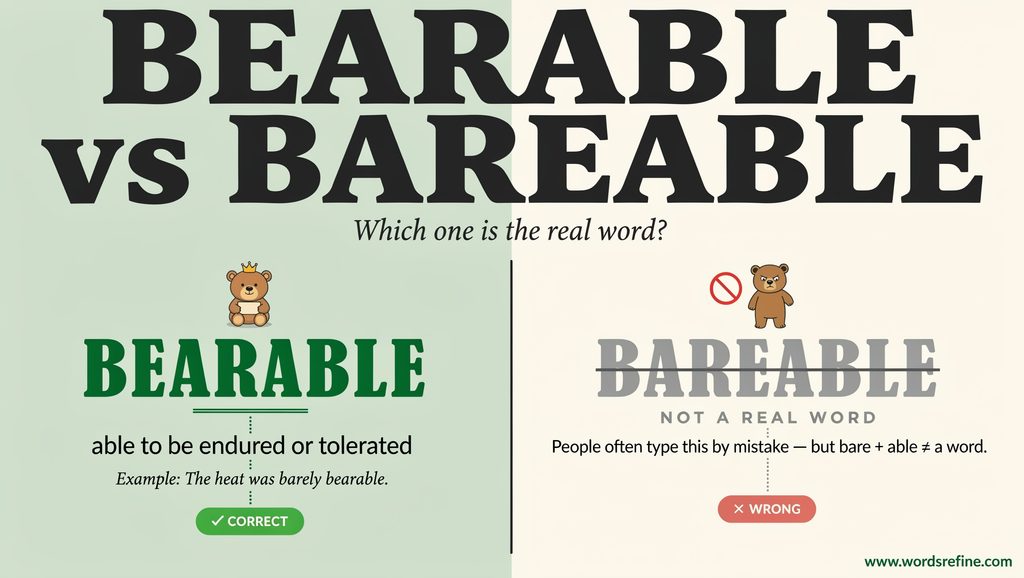
bearable vs bareable often appears in everyday expressions. These phrases help describe how difficult a situation feels and whether someone can tolerate it.
Make Life More Bearable
This expression means to make daily life easier or less difficult. It often refers to small actions, support, or changes that reduce stress.
For example:
A little extra sleep can make a busy week more bearable.
Her sense of humor made the difficult days more bearable.
More Bearable
Use more bearable when something becomes easier to tolerate than it was before.
For example:
The medicine made the pain more bearable.
Having a friend nearby made the long journey more bearable.
Barely Bearable
Barely bearable describes something that is just tolerable. The situation is extremely unpleasant, but you can still manage to endure it.
For example:
The heat inside the crowded room was barely bearable.
The noise from the construction site made working from home barely bearable.
Become Bearable
This expression describes a situation that gradually becomes easier to tolerate.
For example:
The long commute became bearable after she started listening to audiobooks.
The difficult adjustment period eventually became bearable.
Bearable Enough
You can use bearable enough to say that something is tolerable to a reasonable degree, even if it isn’t particularly pleasant.
For example:
The hotel room was basic but bearable enough for one night.
The wait was bearable enough because we had plenty of time.
These expressions make it easier to describe different levels of discomfort without repeating the same sentence.
Learn the difference between confusing word pairs
Broke vs Broken Meaning Differences and Correct Usage ?
Synonyms and Antonyms of Bearable
Sometimes, you may want to use a different word instead of bearable. Several alternatives can express the idea of tolerating or managing something difficult. However, each word has a slightly different meaning, so choosing the right one depends on the situation.
Synonyms of Bearable
Tolerable is one of the closest synonyms of bearable. It describes something unpleasant that you can accept or put up with.
For example: The noise was tolerable once we closed the windows.
Endurable describes something you can withstand, even if it causes discomfort or difficulty.
For example: The long journey was endurable because we stopped for breaks.
Manageable refers to something you can handle or control. It often describes responsibilities, problems, or workloads rather than physical or emotional discomfort.
For example: The workload became manageable after the team divided the tasks.
Acceptable describes something that meets a reasonable standard or is good enough for a particular purpose.
For example: The hotel room wasn’t luxurious, but the conditions were acceptable.
Livable usually describes living conditions that are good enough to make life comfortable or practical.
For example: The small house was simple but still livable.
Although these words are similar, they aren’t always interchangeable. Bearable focuses on enduring discomfort, while manageable emphasizes your ability to handle a situation.
Antonyms of Bearable
An antonym is a word with the opposite meaning. The most direct opposite of bearable is unbearable.
Unbearable describes something so unpleasant, painful, or difficult that you cannot tolerate it.
For example: The noise from the construction site became unbearable.
Intolerable also describes something that cannot be accepted or endured.
For example: The working conditions were intolerable, so the employees complained.
Insufferable often describes something extremely unpleasant or difficult to put up with. It can also describe someone’s annoying behavior.
For example: His constant complaining became insufferable.
Unendurable describes an experience or situation that feels impossible to withstand.
For example: The emotional pain was almost unendurable.
These words help you express different levels of discomfort, from something you can manage to something you simply cannot tolerate.
Learn the difference between often confused words
Cloth vs Clothe Differences Examples and Correct Usage ?
Common Mistakes Related to bearable vs bareable
bearable vs bareable is a straightforward word once you understand its connection to bear. However, people sometimes confuse it with other similar-looking or similar-sounding words. Knowing these differences can help you avoid common mistakes.
Bearable vs Unbearable
The Bearable and unbearable have opposite meanings.
Bearable means something can be tolerated or endured. Unbearable means something is too difficult, painful, or unpleasant to tolerate.
For example:
The headache was bearable after she rested.
The headache became unbearable by the evening.
The prefix un- changes the meaning of the word to its opposite. Remember this distinction when describing pain, stress, or difficult experiences.
Bearable vs Bearably
Bearable is an adjective, while bearably is an adverb.
Use bearable to describe a noun. Use bearably when explaining how someone experiences or handles something.
For example:
The long journey was bearable.
She managed to tolerate the uncomfortable conditionsbearable vs bareable.
The first sentence describes the journey. The second explains how the conditions were tolerated.
Barely vs Bearably
These two words look similar, but their meanings are different.
Barely means hardly or only just. It often describes something that happens with difficulty or in a very small amount.
Bearably means in a way that can be tolerated or endured.
For example:
She could barely keep her eyes open after working all night.
The room was bearably warm once the air conditioner was switched on.
A simple way to remember the difference is that barely describes how little something happens, while bearably describes how tolerable something is.
Bearing vs Baring
The Bearing and baring are also easy to confuse because they sound alike.
Bearing comes from bear and can mean carrying, supporting, or enduring something.
For example: He was bearing the responsibility for the entire project.
Baring comes from bare and means uncovering or exposing something.
For example: She was baring her arms to cool down in the summer heat.
The difference comes down to their root words. Bear relates to carrying or enduring, while bare relates to uncovering or exposing.
How to Remember the Correct Spelling of Bearable
If you often confuse bearable with bareable, a simple memory trick can help.
Think of the sentence, “I can bear it, so it is bearable.”
The word bearable comes from bear, meaning to endure or tolerate. When you add -able, the word describes something that you can endure.
You can also remember the difference between bear and bare:
Bear means to carry or endure.
Bare means uncovered or exposed.
For example, you can bear a difficult situation, but you can walk with bare feet.
Once you connect bearable with the verb bear, the spelling becomes much easier to remember. You won’t need to guess between the two versions every time you write the word.
Another helpful tip is to remember that the correct spelling stays the same in American and British English. You don’t need to change it depending on which variety of English you’re using.
Correct and Incorrect Examples of Bearable vs Bareable
Examples make spelling differences bearable vs bareable easier to understand. The following sentences show how to use bearable correctly and why bareable should be avoided in standard English.
Correct: The pain was bearable after she took a short break.
Incorrect: The pain was bareable after she took a short break.
Correct: The weather became more bearable in the evening.
Incorrect: The weather became more bareable in the evening.
Correct: His workload is difficult but still bearable.
Incorrect: His workload is difficult but still bareable.
Correct: The long wait was barely bearable.
Incorrect: The long wait was barely bareable.
Correct: Her support made the stressful experience more bearable.
Incorrect: Her support made the stressful experience more bareable.
In each incorrect example, bareable should be replaced with bearable. The correct spelling always uses bear because the word comes from the verb meaning to endure or tolerate.
Learn the difference between basic English word mistakes
Teams vs Teams Meaning Differences Accounts and Features ?
Practice Session Bearable vs Bareable
- The pain became __________ after she got some rest.
- The summer heat was more __________ in the evening.
- His busy schedule was difficult but still __________.
- The noise from the neighbors made the night almost __________.
- Her kindness made the difficult experience more __________.
- The long journey was __________ because we took several breaks.
- The cold weather was barely __________ without a warm coat.
- The working conditions became more __________ after the improvements.
- The headache was __________ enough for him to finish his assignment.
- Life became more __________ after she received support from her family.
- The uncomfortable chair made the meeting less __________.
- The stress of the new job was difficult at first but eventually became __________.
- The waiting time was __________ because we had plenty of activities to keep us busy.
- The pain wasn’t severe, so it remained __________.
- The situation was barely __________ after several unexpected problems.
- A little laughter can make a difficult day more __________.
- The heat inside the crowded room was almost __________.
- The apartment was small but __________ for a short stay.
- The long working hours became more __________ after the company changed its schedule.
- His explanation made the situation easier to understand and more __________.
- The discomfort was __________, although it wasn’t pleasant.
- The journey became more __________ once the weather improved.
- The financial pressure was hardly __________ during that difficult period.
- Her encouragement made the challenges more __________.
- The correct spelling describes something that can be __________.
Answers
- Bearable
- Bearable
- Bearable
- Unbearable
- Bearable
- Bearable
- Bearable
- Bearable
- Bearable
- Bearable
- Bearable
- Bearable
- Bearable
- Bearable
- Bearable
- Bearable
- Unbearable
- Bearable
- Bearable
- Bearable
- Bearable
- Bearable
- Bearable
- Bearable
- Endured
Here’s a trusted source for clear more words Comparison:
FAQs
Is bearable the only correct spelling?
Yes. Bearable is the standard English spelling when you mean that something can be tolerated or endured. Bareable is generally considered a misspelling and should be avoided in formal and everyday writing.
Can bareable ever be used as a word?
Bareable is not recognized as the standard spelling of bearable. You might occasionally see it used creatively as a name or in informal writing, but it isn’t correct when describing something that can be endured.
Is bearable spelled the same way in American and British English?
Yes. Both American and British English use bearable. Unlike words such as color and colour, this spelling doesn’t change between the two varieties.
How do you pronounce bearable?
Bearable is pronounced “BAIR-uh-bul.” The first part sounds like the word bear, followed by a light “uh-bul” sound.
What does “you make my life bearable” mean?
This phrase means that someone’s presence, support, or kindness makes life easier to handle during difficult times. It expresses appreciation and emotional connection. It doesn’t necessarily mean life is easy; it means that the person helps make challenges feel less overwhelming.
Is bearable a positive or negative word?
Bearable is generally neutral, although its meaning often relates to an unpleasant situation. It suggests that something isn’t enjoyable or ideal, but you can still tolerate it. For example, “The workload is bearable” means the work is manageable, even if it isn’t particularly pleasant.
Can you use bearable to describe a person?
Yes, but the meaning depends on the context. Calling someone bearable usually means their behavior or company is tolerable, even if you don’t find them especially pleasant. However, it can sound a little rude. A kinder alternative might be “easy to get along with” or “pleasant to be around.”
What is the difference between bearable and tolerable?
Both words describe something you can endure or accept. However, bearable often emphasizes getting through discomfort or difficulty, while tolerable can suggest that something meets the minimum level you are willing to accept. In many everyday sentences, you can use either word.
Does bearable have a noun form?
Yes. Bearability is the noun form of bearable. It describes the quality or degree of being capable of endurance or tolerance. For example, “The bearability of the situation improved after the changes.”
What is the difference between bearable and manageable?
Bearable means that something is possible to endure, even if it remains unpleasant. Manageable means that you can handle, control, or deal with something successfully. For example, a painful experience might be bearable, while a busy schedule might be manageable.
Learn the difference between more words people mix up
Peak vs Pique Differences Examples and Correct Usage ?
Conclusion
The difference between bearable vs bareable may seem small, but choosing the correct spelling makes your writing clearer and more accurate. Bearable is the correct word when describing something you can tolerate, endure, or manage. It comes from the verb bear, which means to carry or put up with something. Bare, on the other hand, means uncovered or exposed, so bareable doesn’t work as a substitute.
Here’s an easy way to remember the difference: if you can bear a difficult situation, it is bearable. Keep that simple connection in mind whenever you’re writing. Once you understand the meaning behind the spelling, there’s little reason to mix them up again. After all, learning English is challenging enough without making bareable mistakes along the way!

Diora AJS she is an experienced blogger and passionate English language enthusiast at Words Refine. With a keen eye for language and a love for clear communication, she writes practical content about grammar, word meanings, usage, and commonly confused terms. Her goal is to make English easier to understand through clear explanations and relatable examples, helping readers write accurately and communicate with confidence.