Have you ever wondered whether cloth vs clothe mean the same thing? Their similar spelling makes them easy to confuse, but using the wrong word can leave your sentence looking like a shirt sewn backward. Cloth refers to fabric used for making garments, cleaning surfaces, or creating household items. Clothe, on the other hand, is a verb meaning to dress someone or provide them with clothing. Although the difference seems small, understanding it can make your writing much clearer. In this guide, you’ll learn how to use cloth vs. clothe correctly, recognize common grammatical mistakes, and explore practical examples that make the distinction easy to remember.
Cloth vs Clothe Quick Answer
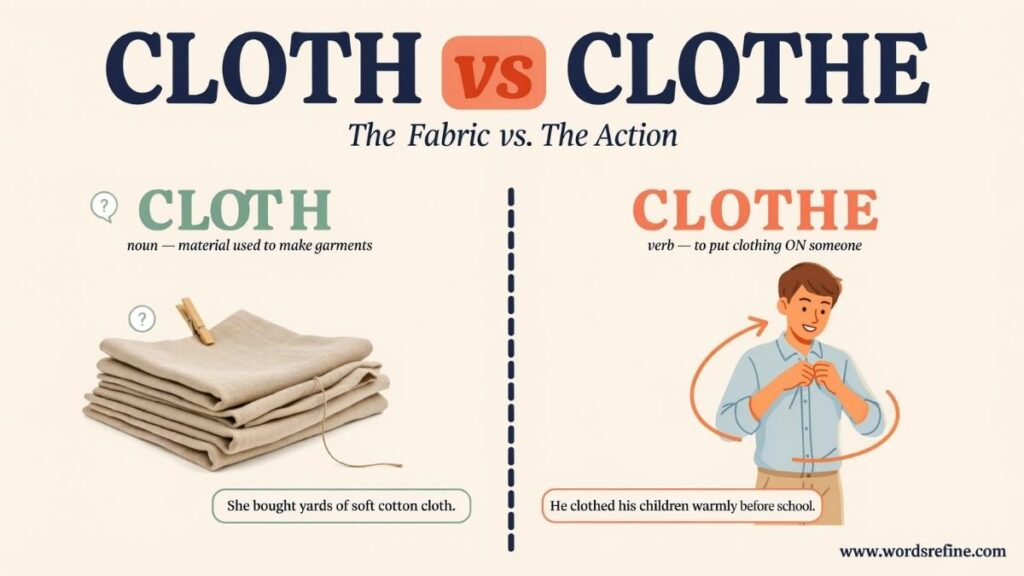
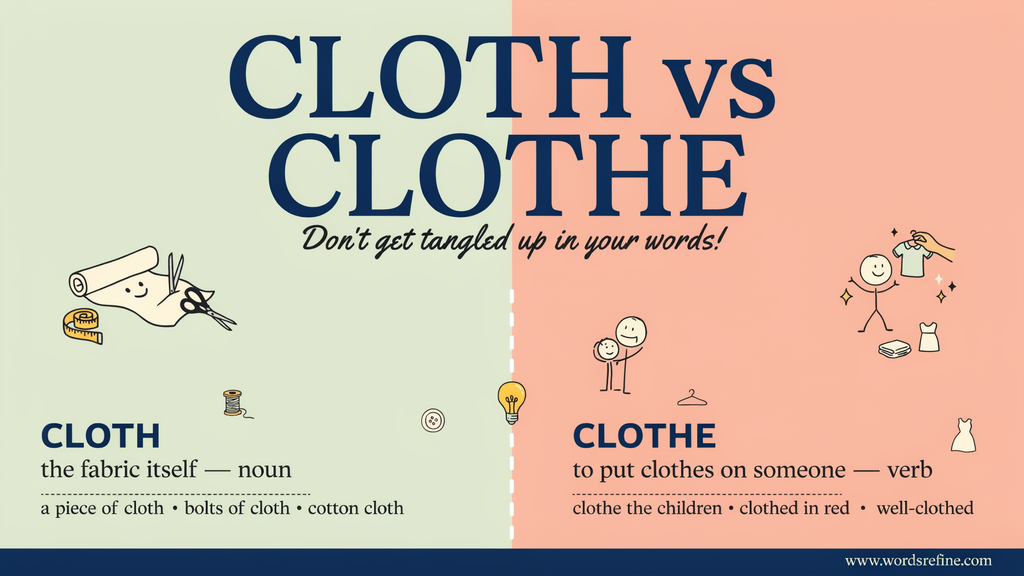
Cloth is a noun that refers to fabric or material used for making garments, cleaning, and other purposes. Clothe is a verb that means to dress someone or provide them with clothing.
For example, you might say, “She bought cotton cloth to make a dress.” However, if a charity provides winter garments to children, you could say, “The charity helps clothe children in need.”
The related words have different meanings, too. Clothes refers to garments people wear, cloths means separate pieces of fabric, and clothing refers to garments as a general category.
Understanding these differences makes it easier to choose the correct word in everyday conversation, school assignments, professional writing, and other situations.
What Does Cloth Mean?
Cloth refers to a flexible material made from fibers or yarns. People use it to make clothes, curtains, towels, table coverings, cleaning products, and many other items.
Cotton cloth, for example, is commonly used for shirts and bedsheets. Wool cloth is often used for coats and blankets, while linen cloth is popular for lightweight garments and household textiles. Meanwhile, microfiber cloth is useful for cleaning because it can trap dust and fine particles.
Although cloth is closely associated with clothing, it isn’t limited to materials used for garments. A cleaning cloth might never become part of an outfit, yet it is still cloth.
Learn the difference between tricky grammar more words
favour vs Favor Meaning Differences Spelling and Examples ?
Cloth Definition and Meaning in English
The word cloth is primarily a noun. It generally describes material made by weaving, knitting, or bonding fibers together.
The exact properties of cloth depend on the fibers and the manufacturing process. Some materials feel soft and lightweight, while others are thick, rough, or durable. These differences determine whether a particular cloth is suitable for sewing a shirt, making curtains, or cleaning a surface.
For instance, a tailor might choose silk cloth for an elegant dress because of its smooth texture. In contrast, someone making work uniforms might select a durable cotton blend that can withstand frequent washing.
Cloth can also refer to material in a broader sense. When someone says, “We need more cloth for the project,” the word refers to the material rather than finished garments.
Cloth as a Noun
In everyday English, cloth is primarily a noun. Depending on the context, it can be countable or uncountable.
When you refer to material in general, cloth is usually uncountable. For example, you might say, “The tailor needs more cloth,” or “This cloth feels softer than the other material.”
However, cloth can also be countable when you mean separate pieces or different types of material. In that case, the plural form is cloths.
For example, a sewing shop might sell several decorative cloths, or a cleaner might keep different cloths for washing windows and wiping counters.
The distinction depends on how you use the word. If you mean material in general, cloth is usually appropriate. If you mean separate pieces of fabric, cloths may be the better choice.
How to Use Cloth in a Sentence
The easiest way to understand cloth is to see how it works in different situations.
A person might wipe a kitchen counter with a damp cloth. A tailor might purchase cotton cloth to make uniforms. Similarly, an artist might stretch cloth over a frame before beginning a painting.
In each example, cloth identifies a material or an item made from that material.
Consider another situation. Suppose you are sewing curtains for your living room. You might say, “I bought a piece of cloth for the curtains.” The word works because you are referring to the material you plan to use.
On the other hand, if you are describing the finished curtains, you would probably use a different word, such as fabric, curtains, or material, depending on the sentence.
Here are a few more examples:
“The cleaner used a soft cloth to remove the dust.”
“She bought enough cloth to make a new dress.”
“The tailor arranged the cloths according to their colors.”
“We need a clean cloth to cover the bowl.”
Notice that the word refers to fabric in every example, even though the material serves a different purpose each time.
Learn the difference between confusing word pairs
Capital vs Capitol Which One Is Correct?
What Does Clothe Mean?
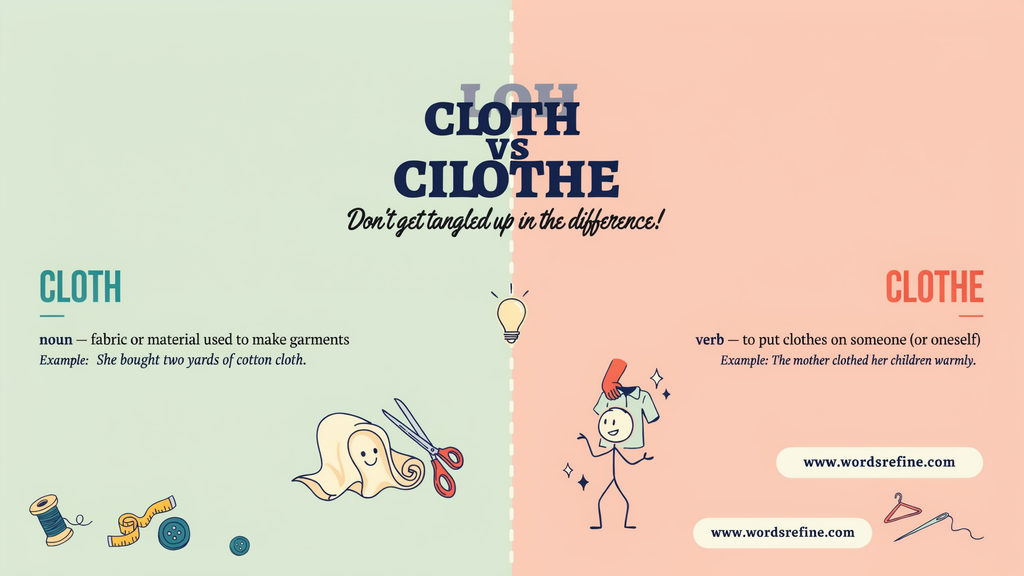
Clothe means to dress someone or provide them with garments. Unlike cloth, which names a material, clothe describes an action.
Parents clothe their children, charities clothe families in need, and relief organizations may help clothe people who have lost their belongings in a disaster.
The word often appears in discussions about basic needs, community support, and charitable work. For example, an organization might provide food, shelter, and clothing to families affected by a flood. You could also say that the organization works to feed and clothe those families.
Although clothe is correct, it can sound more formal than dress in everyday conversation. Someone might naturally say, “I need to dress the baby,” rather than “I need to clothe the baby.”
Both expressions can be correct. However, dress often emphasizes putting garments on someone, while clothe can emphasize supplying clothing or meeting a person’s clothing needs.
Clothe Definition and Verb Meaning
Clothe is a verb that describes dressing someone or supplying them with garments. It is generally a transitive verb, meaning it commonly takes a direct object.
Consider the sentence, “The charity clothes the children.” The charity performs the action, and the children receive it.
Similarly, you might say, “The parents clothed their baby in warm layers,” or “The organization helps clothe families after the flood.”
The word can also appear in professional and creative contexts. A theater company might hire a costume designer to clothe the performers according to their roles. In another setting, a school might provide uniforms to clothe students appropriately.
In each case, clothe describes an action involving garments rather than the material used to make them.
Clothe as a Verb Forms and Usage
Like other English verbs, clothe changes form depending on the tense and sentence structure.
The base form is clothe. In the present tense, you use clothes with a third-person singular subject, as in “She clothes the dolls before displaying them.” The past tense and past participle are clothed, while clothing is the present participle and can also function as a gerund.
For example, “The organization clothed hundreds of families last winter” uses the past tense. Meanwhile, “The volunteers are clothing families affected by the storm” describes an action in progress.
One detail often causes confusion: clothes can be either a plural noun or a verb form.
In the sentence “The store sells affordable clothes,” the word refers to garments. However, in “The mother clothes her children warmly,” it is a verb.
The surrounding words make the difference clear. Once you understand the sentence, you can usually identify the correct meaning without difficulty.
How to Use Clothe in a Sentence
Clothe works best when you are describing the act of dressing someone or providing garments.
For example, a charity might work to clothe children who lack suitable winter clothing. Parents might clothe their babies according to the weather, while a relief team might help feed and clothe families who have lost their homes.
The word also appears in sentences about entertainment and fashion. A costume designer, for instance, might clothe each actor according to the character’s background and personality.
Consider these examples:
“The organization helps clothe families who need warm winter garments.”
“The parents clothed their children in coats before leaving home.”
“The theater company hired a designer to clothe the performers.”
“Volunteers are working to clothe children affected by the disaster.”
Each sentence describes an action. That’s the main clue that clothe is the right word.
Cloth vs Clothe Key Differences
The main difference between cloth vs clothe involves meaning and grammatical function. Cloth is a noun that identifies material, while clothe is a verb that describes an action.
| Feature | Cloth | Clothe |
|---|---|---|
| Grammatical role | Primarily a noun | Verb |
| Meaning | Fabric or material | To dress someone or provide garments |
| Common uses | Sewing, cleaning, manufacturing | Dressing people, supplying clothing |
| Example | She bought cloth for curtains. | The charity helps clothe children. |
| Related forms | Cloths | Clothes, clothed, clothing |
| Final th sound | Usually unvoiced | Usually voiced |
A simple way to remember the difference is to ask yourself what you are describing.
If you mean the material used to make something, choose cloth. If you mean the action of dressing someone or providing garments, choose clothe.
For example, a clothing company purchases cloth to manufacture shirts. A charity may then help clothe people who need those shirts. The words describe different stages of the same process, so replacing one with the other would change the sentence’s meaning.
Learn the difference between often confused words
Vender vs Vendor Which one Is Correct?
What Is the Difference?
Cloth vs clothes are closely related, but they don’t mean the same thing. Cloth refers to material, whereas clothes refers to garments worn on the body.
For example, a tailor might buy blue cloth to make a jacket. Once the jacket is finished, it becomes one of the garments a person can wear.
This distinction is important because people sometimes use cloth when they mean clothes, particularly when writing quickly.
Imagine someone saying, “I packed my cloth for the trip.” The sentence might make sense if they packed a piece of fabric for sewing or cleaning. However, if they mean shirts, trousers, and other garments, the natural sentence is “I packed my clothes for the trip.”
The context determines which word is appropriate.
Cloths vs Clothes
The difference between cloths and clothes is particularly confusing because both words are plural, but they refer to different things.
Cloths means separate pieces or types of fabric. Clothes means garments people wear.
For example, a cleaner might use three cloths to wash the windows. Meanwhile, a traveler might pack three changes of clothes for a weekend away.
The words can sound similar in some accents, which makes them harder to distinguish in conversation. Nevertheless, their meanings remain different.
Consider these examples:
“The kitchen drawer contains several cleaning cloths.”
“She folded her clean clothes after doing the laundry.”
“The shop displayed patterned cloths for sewing projects.”
“He donated winter clothes to the local shelter.”
In the first and third sentences, cloths refers to pieces of fabric. In the other two, clothes refers to garments.
Although cloths is a correct word, you will usually encounter it in discussions about cleaning supplies, sewing, fabric samples, and textiles. Clothes is far more common in everyday conversations about getting dressed, shopping, or doing laundry.
Cloth vs Clothing Understanding the Difference
The difference between cloth and clothing depends on whether you mean a material or a category of garments.
Cloth usually refers to material itself. Clothing refers to items people wear, such as shirts, trousers, dresses, coats, and uniforms.
For example, a manufacturer might purchase cotton cloth and turn it into clothing for a retail store.
The words also differ grammatically. Cloth can be countable or uncountable, depending on how it is used. Clothing is generally an uncountable noun when it refers to garments collectively.
You would normally say, “The factory needs more cloth,” or “The store sells affordable clothing.”
You wouldn’t usually say “three clothings” to refer to three garments. Instead, use “three items of clothing,” “three garments,” or “three pieces of clothing.”
Cloth vs Fabric
Cloth and fabric often mean the same thing in everyday English. Both can describe material made from fibers or yarns, particularly when the material is used for sewing, garments, or household products.
However, fabric is especially common in fashion, manufacturing, and design. It can describe material made through weaving, knitting, bonding, or other processes. Cloth often refers to a piece or type of material, including material used for cleaning or household purposes.
For example, a designer might select lightweight fabric for a summer dress. Meanwhile, someone repairing a table covering might look for a suitable piece of cloth.
These are general tendencies rather than strict rules. In many situations, either word is acceptable.
Cloth vs Textile
The word textile is common in manufacturing, scientific discussions, and the broader textile industry. It can refer to fibers, yarns, fabrics, and related products.
Cloth generally refers to material made from fibers or yarns, particularly when it is ready for use in clothing, cleaning, or other applications.
For instance, cotton fibers can be spun into yarn, which can then be woven or knitted into cloth. That cloth might eventually become a shirt, curtain, towel, or cleaning product.
Although the words overlap, they aren’t always interchangeable. In a technical discussion about the textile industry, textile may be the more suitable term because it covers a broader category of materials and products.
Cloth Clothes and Clothe Understanding the Differences
When you compare cloth, clothes, and clothe, the main challenge is remembering that each word performs a different grammatical job.
Cloth identifies a material. Clothes refers to garments. Clothe describes the action of dressing someone or providing garments. Clothing, meanwhile, refers to garments as a general category.
Think about how a shirt is made. First, a manufacturer selects cloth. Next, a tailor or factory turns that material into clothes. Finally, a store sells the finished garments, and a parent might help clothe a child in one of those shirts.
The words are related, but their endings don’t simply represent different versions of the same word.
Cloths adds another distinction. It refers to separate pieces or types of fabric rather than garments worn on the body.
Once you understand these differences, you can choose the correct word by focusing on the meaning of the sentence instead of the spelling alone.
Learn the difference between confusing word pairs
Teams vs Teams Meaning Differences Accounts and Features ?
Why Do People Confuse Cloth vs Clothe?
English contains many commonly confused words that look or sound alike. Cloth vs clothe are a good example because they share most of their letters and have related meanings.
Their similar spelling is one reason people mix them up. Both words begin with the same letters and end in th. The final e in clothe may seem unimportant, but it helps distinguish the word’s pronunciation and spelling.
Their meanings also overlap in everyday contexts. Cloth is often used to make clothes, while clothe describes providing those clothes to someone. Since both words relate to garments, it is easy to choose the wrong one when writing quickly.
The related words clothes and cloths add another layer of confusion. One refers to garments, while the other refers to pieces of fabric. In some accents, they may sound very similar, so paying attention to the context becomes especially important.
For example, writing “The organization helps cloth families in need” creates a grammatical problem because the sentence needs a verb. The correct version is “The organization helps clothe families in need.”
Similarly, “She used a clothe to wipe the table” should be “She used a cloth to wipe the table.”
The good news is that these mistakes are easy to correct once you understand the role each word plays.
Learn the difference between basic English word mistakes
Peak vs Pique Differences Examples and Correct Usage ?
How to Remember Cloth vs Clothe
You don’t need to memorize a complicated grammar rule to use cloth vs clothe correctly. Instead, remember one simple distinction: cloth is a thing, while clothe is an action.
Imagine a tailor working at a sewing table. The material spread across the table is cloth. When the tailor finishes a garment and someone wears it, that person is wearing clothes.
Now imagine a charity distributing winter coats to families. The charity helps clothe those families by providing garments they can wear.
This simple sequence connects the words to their meanings.
You can also use a replacement test. If you can replace the word with fabric without changing the intended meaning, cloth is probably correct. If you can replace it with dress someone or provide clothing, clothe is likely the better choice.
For example, consider the sentence, “The organization helps ___ children in need.”
Replacing the blank with fabric doesn’t make sense. However, replacing it with dress does. Therefore, clothe is the appropriate word.
This method works well because it focuses on meaning rather than spelling. Once you become familiar with the distinction, choosing the correct word will feel natural.
Common Mistakes With Cloth vs Clothe
Even experienced writers sometimes confuse these words. The easiest way to avoid mistakes is to understand why a particular word doesn’t fit the sentence.
Using Clothe When You Mean Cloth
Incorrect: She used a clothe to wipe the kitchen counter.
Correct: She used a cloth to wipe the kitchen counter.
The sentence refers to a cleaning material, so it needs the noun cloth.
Using Cloth When You Mean Clothe
Incorrect: The organization helps cloth families in need.
Correct: The organization helps clothe families in need.
The organization provides garments or helps people obtain them. Therefore, the sentence needs the verb clothe.
Confusing Cloths and Clothes
Suppose someone writes, “He packed clean cloths for his vacation.”
The sentence isn’t necessarily incorrect. It could mean that he packed cleaning cloths or pieces of fabric for a sewing project. However, if he means shirts, trousers, and other garments, clothes is the correct word.
The revised sentence would be, “He packed clean clothes for his vacation.”
The intended meaning determines which word you should use.
Using Cloth Instead of Clothing
Incorrect: The shelter collected warm cloth for families during the cold weather.
This sentence could be correct if the shelter collected fabric to make garments. However, if people donated finished coats, sweaters, and other items to wear, clothing would be more appropriate.
Correct: The shelter collected warm clothing for families during the cold weather.
This small change makes the intended meaning clearer.
Treating Clothe as a Noun
Incorrect: The store sells clothe by the yard.
Correct: The store sells cloth by the yard.
In standard modern English, clothe is a verb. It isn’t the ordinary noun for fabric or garments.
Cloth vs Clothe in a Real World Example
Imagine a community organization preparing for winter. It wants to help families who need warm garments, so volunteers organize donations, purchase sewing supplies, and distribute finished items.
The sewing team purchases wool cloth to make coats. Volunteers collect clothes from local residents and sort the donated clothing by size. They also prepare clean cloths for the sewing stations. Finally, the team works to clothe children and adults before the cold weather arrives.
Each word has a specific role.
Cloth identifies the wool material used to make the coats. Clothes refers to the donated garments, while clothing describes those garments as a general category. Cloths refers to separate pieces of fabric used at the sewing stations. Finally, clothe describes the action of providing garments to people who need them.
This example shows why the words cannot be substituted freely. They describe different parts of the same project, and each one adds a specific detail.
The same distinction applies in everyday situations. A tailor purchases cloth, a clothing store sells garments, and a charity may help clothe families. Once you recognize these different roles, the correct word becomes much easier to choose.
Cloth vs Clothe Pronunciation
Cloth vs clothe differ in pronunciation as well as spelling. The most noticeable difference occurs in the final th sound.
In English, the letters th can represent two different sounds. One is unvoiced, as in think. The other is voiced, as in this.
Learn the difference between often confused words
Traveled vs Travelled Which one Is Correct in English?
Cloth Pronunciation in English
In many American English accents, cloth ends with an unvoiced th sound, represented by the International Phonetic Alphabet symbol /θ/. The vowel varies by accent, so you may hear a pronunciation closer to “klawth” or “klahth.”
To practice, say think and pay attention to the final sound. Then use that same unvoiced sound at the end of cloth.
The goal is to notice the difference in how the sound is produced rather than rely entirely on an approximate spelling.
Clothe Pronunciation in English
Clothe usually ends with a voiced th sound, represented by /ð/. You can hear the same sound in words such as this and mother.
To practice, say this and notice the vibration in your throat. Then use that voiced sound at the end of clothe.
Both cloth vs clothe are normally pronounced as one syllable. The final consonant distinguishes them, although their vowel sounds may vary depending on the speaker’s accent.
Cloths vs Clothes Pronunciation
Cloths and clothes can be particularly confusing because they sound similar in many accents. Some speakers pronounce them almost identically, while others make the distinction more noticeable.
Nevertheless, their meanings and spellings remain different.
Cloths refers to separate pieces of fabric, such as cleaning cloths. Clothes refers to garments, such as shirts, pants, dresses, and coats.
If you’re unsure which word someone means in conversation, the surrounding sentence usually provides the answer. For example, someone discussing laundry probably means clothes, while someone discussing cleaning supplies may mean cloths.
Why Are Cloth vs Clothe Pronounced Differently?
The final e in clothe is associated with a different spelling and pronunciation pattern. It doesn’t create another syllable. Instead, the final consonant changes from the unvoiced sound in cloth to the voiced sound in clothe.
Although the difference may seem small, it helps distinguish the two words when speaking. Learning their pronunciation alongside their meanings can also make their spelling easier to remember.
Learn the difference between basic English word mistakes
Absence vs Absense Correct Spelling Meaning and Usage ?
Cloth vs Clothe in American and British English
The basic meanings of cloth vs clothe remain the same in American and British English. Both varieties use cloth for material and clothe for the act of dressing someone or providing clothing.
Their standard spellings also remain the same. Unlike words such as color and colour, cloth vs clothe don’t have separate American and British spelling variants.
Pronunciation, however, can vary between regions and individual speakers. The vowel in cloth differs across American accents, and British accents also show variation. Similarly, the pronunciation of cloths and clothes may overlap more in some accents than in others.
Regardless of the accent, the essential distinction remains unchanged. Cloth refers to material, clothe is a verb, clothes are garments, cloths are separate pieces of fabric, and clothing refers to garments as a general category.
Cloth vs Clothe in Professional and Academic Writing
Correct word choice matters in professional writing because a small spelling difference can change the meaning of a sentence.
In a clothing company’s report, cloth might refer to purchased material, while clothing describes the finished products the company sells. In a charity’s report, clothe might describe an effort to supply garments to people in need.
The same distinction applies to manufacturing instructions, academic assignments, product descriptions, and sewing guides.
For example, a manufacturing report might explain that a factory purchases cotton cloth for shirt production. A retailer might describe its products as affordable clothing for children. Meanwhile, a community organization might report that it helped clothe families affected by flooding.
In cleaning instructions, cloth would be appropriate in a sentence such as, “Use a soft cloth to remove dust from the surface.”
Grammar checkers can identify some spelling and grammatical errors. However, they cannot always determine the intended meaning from a single word. A sentence may contain a correctly spelled word that still doesn’t fit its context.
For that reason, always consider the whole sentence. Ask yourself whether you mean material, garments, or the action of providing clothing. This quick check can help you avoid mistakes and make your writing clearer.
Learn the difference between more words people mix up
Councillor vs Counsellor Difference Spelling and Usage ?
Cloth vs Clothe Practice Session
- She bought some cotton ______ to make a summer dress.
- The charity works hard to ______ families in need.
- I washed my ______ before putting them back in the closet.
- The cleaner used two soft ______ to wipe the windows.
- The store sells affordable winter ______ for children.
- We need a clean ______ to wipe the kitchen counter.
- The organization helped ______ hundreds of families after the flood.
- He packed his ______ before leaving for the trip.
- The tailor selected a beautiful piece of ______ for the wedding dress.
- The volunteers collected warm ______ for people living in shelters.
- My mother uses a damp ______ to clean the table.
- The charity hopes to feed and ______ children who need support.
- The sewing shop sells different types of cotton and silk ______.
- She folded her clean ______ and placed them in the drawer.
- The company produces high-quality ______ for people .
- The tailor needs more ______ to finish the uniforms.
- The volunteers helped ______ the children in warm coats.
- Please keep the cleaning ______ separate from the kitchen towels.
- He donated his old ______ to a local shelter.
- The designer chose soft ______ for the curtains.
- The organization provides food and ______ to families experiencing hardship.
- She used a clean ______ to polish the glass.
- The parents carefully ______ their baby before taking him outside.
- The shop displayed several decorative ______ for customers to choose from.
- The relief team worked to ______ families who had lost their belongings.
Answers
- cloth
- clothe
- clothes
- cloths
- clothing
- cloth
- clothe
- clothes
- cloth
- clothing
- cloth
- clothe
- cloths
- clothes
- clothing
- cloth
- clothe
- cloths
- clothes
- cloth
- clothing
- cloth
- clothed
- cloths
- clothe
Here’s a trusted source for clear more words Comparison:
FAQs
Is it spelled cloths or clothes?
Both spellings are correct, but they have different meanings. “Cloths” refers to separate pieces of fabric, often used for cleaning or sewing. “Clothes” refers to garments that people wear, such as shirts, pants, and jackets.
What is the difference between cloth vs clothe?
“Cloth” is a noun that refers to fabric or material. “Clothe” is a verb that means to dress someone or provide them with clothing. For example, a tailor cuts cloth to make garments, while a charity helps clothe families in need.
Why does God say not to mix fabrics?
In Leviticus 19:19 and Deuteronomy 22:11, the Bible gives instructions against wearing garments made from certain mixed fabrics, specifically wool and linen together. Interpretations vary among religious traditions. Some understand these rules as part of ancient Israel’s ceremonial laws, while others explore their symbolic or spiritual significance.
Is a towel considered cloth?
Yes, a towel is a type of cloth because it is made from fabric, usually cotton or another absorbent material. However, people generally call it a towel because of its specific purpose: drying the body, hands, or other surfaces.
What does the phrase “dirty rag” mean?
A “dirty rag” usually means a piece of fabric that is unclean, worn out, or used for wiping spills and dirt. Figuratively, it can also be an insulting expression for something or someone considered worthless or badly treated. Its meaning depends on the context.
Is it washcloths or wash clothes?
“Washcloths” is the correct spelling for small pieces of fabric used to wash the face or body. “Wash clothes” means to clean garments, as in “I need to wash clothes this afternoon.” The two expressions sound similar but have different meanings and uses.
What is another word for clothe?
Depending on the context, alternatives to “clothe” include “dress,” “outfit,” “garb,” and “attire.” For example, “The organization helps clothe children” can be rewritten as “The organization helps dress children.” In formal writing, “provide with clothing” may be more precise.
What is a cloth called?
A piece of cloth may be called a piece of fabric, a textile, a rag, or a wipe, depending on its material and purpose. “Fabric” is common when discussing material for sewing, while “rag” often describes an old or discarded piece of cloth used for cleaning.
What is cloth slang for?
“Cloth” does not have one universally recognized slang meaning in American English. In some expressions, words related to cloth or fabric appear figuratively, such as “cut from the same cloth,” which means that two people share similar qualities or characteristics. The intended meaning depends on the phrase and context.
Learn the difference between everyday English mistakes
skepticism vs scepticism Meaning Spelling and Correct Usage
Conclusion
The difference between cloth vs clothe may seem small, but one extra letter can change the meaning of your sentence. Cloth is a material, while clothe means to dress someone or provide them with clothing. Clothes are the garments you wear, and cloths are separate pieces of fabric. Once you understand these differences, choosing the correct word becomes much easier.
Remember, grammar doesn’t have to feel like a complicated sewing project. Think of it this way: you use cloth to make clothes, and you clothe someone by giving them something to wear. Simple, right? With a little practice, you’ll avoid these common mistakes and write with greater confidence. Just don’t confuse a washcloth with your clothes unless you want your laundry day to become a fashion disaster!

Diora AJS she is an experienced blogger and passionate English language enthusiast at Words Refine. With a keen eye for language and a love for clear communication, she writes practical content about grammar, word meanings, usage, and commonly confused terms. Her goal is to make English easier to understand through clear explanations and relatable examples, helping readers write accurately and communicate with confidence.