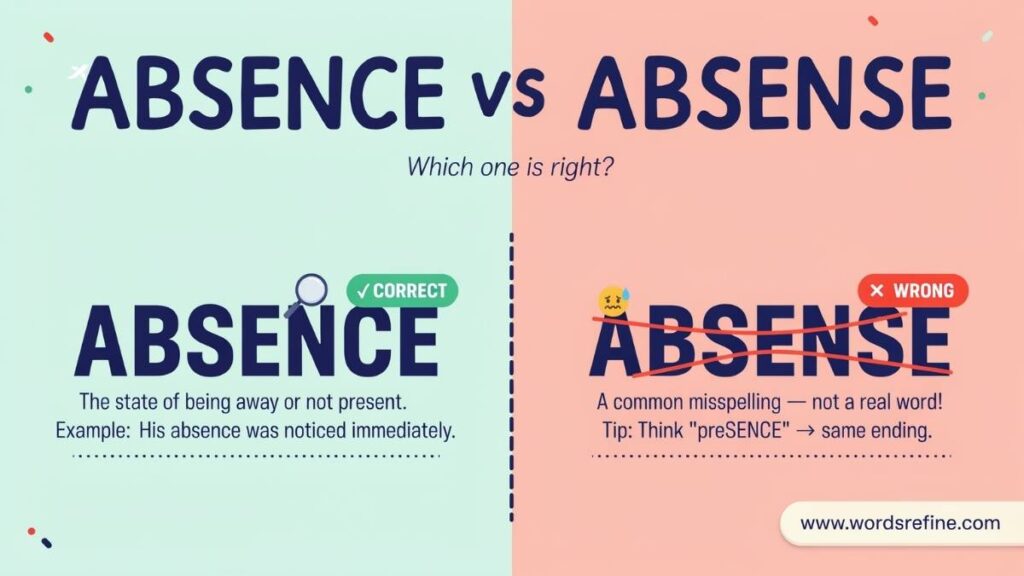
English spelling can be confusing when a word sounds different from how it looks. The difference between absence vs absense ften causes this kind of confusion. Although “absense” might seem correct based on pronunciation, it’s a misspelling. The only correct spelling is “absence.”
The mistake usually occurs because the letter c in “absence” sounds like s. This makes it tempting to write the word the way it sounds. However, connecting “absence” with the word “absent” can help you remember the correct spelling.
“Absence” means the state of being away or the lack of something. For example, you might refer to an employee’s absence from work, a student’s absence from school, or the absence of reliable evidence in a case.
Once you understand the word’s spelling, meaning, and usage, avoiding this common error becomes much easier. Whether you’re writing a school assignment, sending a professional email, or preparing a report, always choose “absence” to keep your writing accurate and polished.
Absense vs Absence Quick Answer
The correct spelling is absence.
Absense is incorrect. It usually appears when someone writes the word according to how it sounds rather than how it is conventionally spelled.
| Word | Correct? | Meaning |
|---|---|---|
| absence | Yes | The state of being away or not present |
| absense | No | A misspelling of absence |
For example:
Her absence from the meeting was noticeable.
The spelling absense would be incorrect in that sentence.
The confusion is understandable. When you say Absence vs Absense aloud, the final sound can make an s seem like the obvious choice. English doesn’t always make spelling that cooperative, though. Sometimes you have to remember the written form rather than rely entirely on pronunciation.
So, if you’re wondering whether it is absence or absense, choose absence.
What Does Absence Mean?
Absence means the state of being away, missing, or not present.
The word can describe a person who isn’t somewhere they are expected to be. It can also describe something that doesn’t exist, isn’t available, or is missing from a particular situation.
For example:
The student’s absence was noticed immediately.
Here, absence refers to the student not being present.
Now consider this sentence:
The absence of evidence made the claim difficult to prove.
In this case, nobody is physically missing. Instead, evidence is lacking.
That second use is important because absence has a broader meaning than simply “being away.”
It can refer to a missing person, missing object, missing quality, missing resource, or missing condition. The surrounding context tells you exactly what is absent.
Is Absense a Word?
If you’ve ever searched for “is absense a word,” the short answer is no, not in the standard sense intended here.
Absense is generally a misspelling of absence. It isn’t the accepted spelling of the noun that means the state of being away or the lack of something.
For example, this sentence is correct:
His absence from work caused a scheduling problem.
This version isn’t:
His absense from work caused a scheduling problem.
The reader will probably understand the second sentence, but the spelling is still incorrect.
Therefore, if you’re writing an essay, email, report, application, or other formal text, use absence.
Learn the difference between confusing more English words
Ingenuine vs Ungenuine Which One Is Correct ?
Is Absence a Word?
Yes. Absence is a standard English noun.
It has been used in English for centuries and appears in both everyday and formal writing.
You might see it when people talk about school attendance, workplace attendance, meetings, relationships, evidence, resources, or missing qualities.
For example:
Her absence from class was unusual.
The absence of clear instructions created confusion.
We noticed his absence as soon as the meeting began.
In each case, absence functions as a noun. It names the condition of someone or something not being present.
Absence Spelling Why Is There a C?
This is where the confusion usually begins.
If you hear an s sound near the end of absence, why does the spelling contain c?
The simple answer is that English spelling doesn’t always match pronunciation letter for letter. The word follows the established spelling absence, with an ending that uses c rather than s.
A useful way to remember it is to connect absence with absent.
Think of these two forms together:
absent → absence
That connection gives you a visual reminder of the c.
Another helpful comparison is presence and absence. Both words refer to whether someone or something is there.
presence and absence
Seeing the two words together can make the spelling pattern easier to remember.
How to Spell Absence Correctly
If you’re wondering how to spell absence, write it this way:
absence
The letters are:
a-b-s-e-n-c-e
The most useful spelling connection is absent → absence.
For example:
He was absent yesterday.
His absence was unexpected.
The adjective absent describes the person or thing. The noun absence names the condition.
That small connection can help prevent the common spelling mistake absense.
Learn the difference between commonly mixed-up more words
Cadaver vs Corpse Which One Is Correct ?
Why Do People Spell Absence as Absense?
Pronunciation is the main reason this mistake feels so natural.
When people hear a word before they see it written, they often build a spelling from its sounds. That works reasonably well for some English words. Unfortunately, it doesn’t work perfectly for all of them.
Absence contains a sound that can make the ending seem as though it should use s. As a result, someone who knows the word mainly from conversation may write absense without realizing the spelling is wrong.
This is especially common among English learners because English has many words whose pronunciation doesn’t provide a perfect guide to their spelling.
For that reason, memorizing the written form of commonly misspelled words can be more reliable than trying to spell them phonetically.
Absence vs Absent Understanding the Difference
Absence and absent are closely related, but they don’t serve the same grammatical purpose.
Absent is generally an adjective. It describes someone or something that isn’t present.
Absence vs Absense is a noun. It names the state or condition of not being present.
Compare these sentences:
Daniel was absent from class.
Daniel’s absence from class was recorded.
The first sentence describes Daniel.
The second sentence refers to his nonattendance.
Here’s another example:
The manager was absent from the meeting.
The manager’s absence was unexpected.
The meaning stays connected, but the grammatical role changes.
| Word | Grammatical role | Example |
|---|---|---|
| absent | Adjective | The employee was absent. |
| absence | Noun | The employee’s absence was noted. |
Once you understand this difference, many sentences become easier to construct correctly.
Absence From School
Absence from school means that a student isn’t present at school when attendance is expected.
A student might miss school because of illness, a family emergency, an appointment, travel, or another reason permitted by the school’s policies.
For example:
Her absence from school was excused because she was sick.
You might also see phrases such as temporary absence, prolonged absence, excused absence, or unexplained absence.
The exact rules for recording attendance vary between schools, so the reason for an absence depends on the situation.
The important language point is straightforward: absence describes the student’s nonattendance.
Absence From Work
Absence from work refers to an employee not being at work when they are expected to be there.
For example:
His absence from work lasted two days.
Or:
She informed her manager about her absence from work.
Workplace writing often uses this expression when discussing attendance, leave, scheduling, or staffing.
A temporary absence means someone is away for a limited period. A prolonged absence suggests that the person has been away for a longer time.
An unexplained absence means that the person didn’t provide an expected reason or explanation for not being present.
Again, the exact meaning depends on context.
Learn the difference between tricky grammar more words
Enflamed vs Inflamed Which One Is Correct ?
Absence of Something
Absence doesn’t always involve a person.
It can also describe something that is missing.
The most common structure is absence of followed by a noun.
For example:
The absence of reliable information made the decision difficult.
The absence of sunlight affected the plants.
The absence of clear instructions caused delays.
The absence of evidence weakened the argument.
In these sentences, absence means a lack or nonpresence.
This use is particularly common in formal writing because it allows writers to describe something that should be present but isn’t.
Absence vs Presence
Presence is one of the clearest opposites of absence.
If presence means that someone or something is there, absence means that they aren’t.
Consider the contrast:
Her presence made everyone feel comfortable.
Her absence was immediately noticed.
The words frequently appear together because they describe opposite conditions.
| Absence | Presence |
|---|---|
| Not being present | Being present |
| Missing | There |
| Nonattendance | Attendance |
| Lack of something | Existence or availability |
The distinction is simple, but it becomes useful in many types of writing.
For example, a report might discuss the presence or absence of evidence. A teacher might record the presence or absence of a student. A doctor might discuss the presence or absence of certain symptoms.
Common Uses of Absence
The word appears in several common sentence patterns.
When you talk about a person being away from a place, absence from is usually appropriate.
His absence from work was unexpected.
Her absence from the meeting caused a delay.
When you talk about something that is missing, absence of is usually appropriate.
The absence of evidence raised concerns.
The absence of funding delayed the project.
You can also use a possessive construction:
We noticed Sarah’s absence.
His absence affected the team.
Their absence changed the atmosphere.
Learning these patterns is more useful than memorizing a long list of isolated examples.
Absence Sentence Examples
Seeing the word in different contexts makes its meaning much easier to understand.
The teacher recorded the student’s absence.
His absence from work surprised his colleagues.
She apologized for her absence from the meeting.
The absence of clear instructions caused confusion.
The team struggled during the captain’s absence.
The report mentioned the absence of reliable evidence.
Her prolonged absence worried her friends.
The temporary absence of staff created a scheduling problem.
We noticed his absence as soon as the event began.
The absence of rainfall affected the crops.
These examples show why context matters. In some sentences, absence describes a person’s nonattendance. In others, it describes something that is lacking.
Learn the difference between confusing word pairs
Suffix vs Postfix Which One Is Correct?
Absence vs Absense Meaning
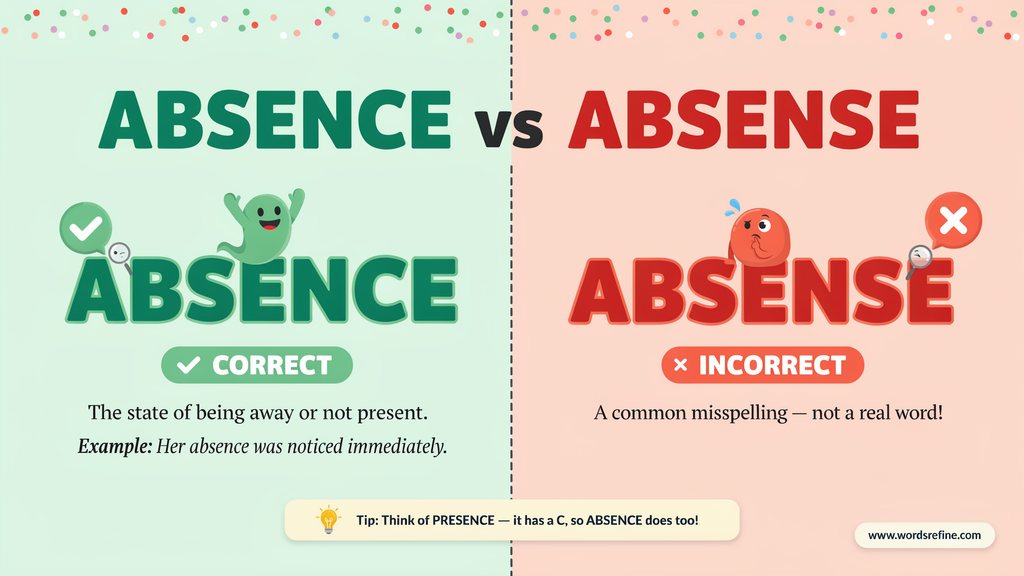
The difference between absence and absense meaning is not a comparison between two legitimate definitions.
Absence has a recognized meaning.
Absense is simply the incorrect spelling of that word.
| Form | Status | Meaning |
|---|---|---|
| absence | Correct | The state of being absent or the lack of something |
| absense | Incorrect | Misspelling of absence |
So, if you’re asking about the absence or absense meaning, the intended meaning is almost certainly the meaning of absence.
The same applies when someone searches for absense or absence meaning or absence or absense meaning. The correct form remains absence.
Absence Synonyms and Related Words
Depending on the context, several words can express an idea similar to absence.
Lack refers to something that isn’t available or isn’t present.
Shortage usually suggests that there isn’t enough of something.
Nonattendance focuses on someone not attending a place or event.
Nonpresence emphasizes that someone or something isn’t present.
Unavailability suggests that something can’t be obtained, used, or accessed.
Omission means that something has been left out.
Deficiency suggests that something is insufficient in amount or quality.
These words overlap with absence, but they aren’t always interchangeable.
For example:
The absence of water made the area difficult to inhabit.
This emphasizes that water isn’t present.
The water shortage affected the entire region.
This emphasizes that there isn’t enough water.
The two ideas are related, but they aren’t identical.
Absence as a Noun
Grammar plays an important role in understanding this word.
Absence is a noun because it names a condition or state.
For example:
His absence was unexpected.
The subject of the sentence is his absence.
You can also use it after determiners and possessive forms:
an absence
the absence
her absence
their absence
the absence of evidence
This grammatical behavior helps distinguish absence from absent.
Compare:
She was absent.
Here, absent describes she.
Her absence was noticed.
Here, absence names the condition.
A Simple Way to Remember the Spelling
The easiest memory trick is to connect the noun with the adjective.
Remember:
absent → absence
You can also pair absence with presence:
presence ↔ absence
Both words use the same general ending pattern.
If you tend to write absense, pause for a second and think of absent. Then write absence.
That small mental connection is often enough to stop the mistake before it reaches the page.
Learn the difference between often confused words
Trebled vs Tripled Which One Is Correct?
Common Mistakes With Absence
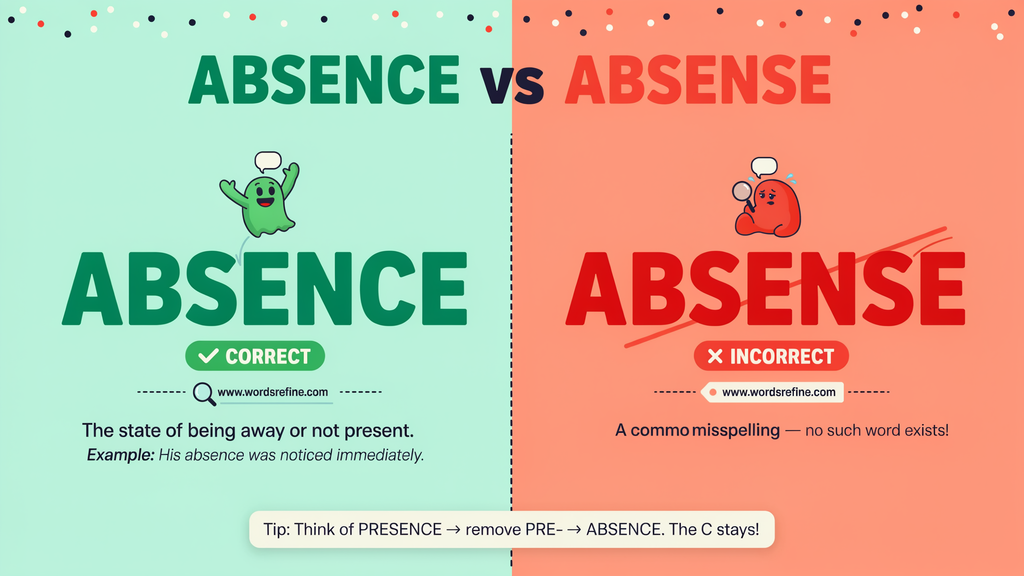
The most obvious mistake is replacing the c with s.
Incorrect:
His absense was unexpected.
Correct:
His absence was unexpected.
Another common problem is confusing absence with absent.
Incorrect:
She was absence from school.
Correct:
She was absent from school.
You can also say:
Her absence from school was unexpected.
The first sentence needs the adjective absent. The second needs the noun absence.
Another issue involves prepositions.
His absence from work was unusual.
Here, from identifies the place or activity he wasn’t present for.
The absence of evidence created doubt.
Here, of identifies what was missing.
Keeping those patterns in mind will make your writing sound much more natural.
Learn the difference between often confused words
Hierarchical vs Hierarchal Which One Is Correct?
Is Absence Spelled Differently in American and British English?
No. The standard spelling is absence in both American English and British English.
Unlike words such as color and colour or center and centre, absence doesn’t normally change spelling between the two major varieties of English.
So whether you’re writing an American business email, a British academic paper, or a general English sentence, the correct form is:
absence
Not:
absense
The spelling remains the same.
Absence Pronunciation and Spelling
Pronunciation explains part of the confusion.
The word is commonly pronounced with the stress on the first syllable. Its ending contains an s sound, which can make the spelling absense seem reasonable.
However, pronunciation and spelling don’t always match perfectly in English.
That is why it’s useful to remember the written relationship:
absent → absence
Instead of asking only how the word sounds, remember how it looks.
This approach works especially well for commonly misspelled words whose pronunciation can mislead you.
A Practical Example of the Spelling Problem
Imagine a student writing an essay about school attendance.
The student wants to write:
The student’s absence from school affected his grades.
The student knows the word and pronounces it correctly. However, because they haven’t encountered it often in writing, they type:
The student’s absense from school affected his grades.
The meaning remains clear, but the spelling is wrong.
This example shows why spelling knowledge and vocabulary knowledge aren’t exactly the same thing. Someone can understand a word perfectly while still struggling to spell it.
The solution is repeated exposure to the correct written form.
Once you regularly see absence in books, articles, schoolwork, and professional writing, the spelling begins to feel natural.
Learn the difference between basic English word mistakes
Siked vs Psyched Which One Is Correct?
Absense vs Absence A Quick Comparison
| Question | Answer |
|---|---|
| Which spelling is correct? | Absence |
| Is absense correct? | No |
| Is absence a word? | Yes |
| What part of speech is absence? | Noun |
| What does absence mean? | Being away, not present, or lacking something |
| What is the related adjective? | Absent |
| What is a common antonym? | Presence |
| Is the spelling different in American English? | No |
| Is the spelling different in British English? | No |
| Why is absense common? | The pronunciation can encourage the wrong spelling |
Absense vs Absence Which Spelling Is Correct?
The correct spelling is absence.
Absense is incorrect. It usually appears when someone writes the word according to how it sounds rather than how it is conventionally spelled.
| Word | Correct? | Meaning |
|---|---|---|
| absence | Yes | The state of being away or not present |
| absense | No | A misspelling of absence |
For example:
Her absence from the meeting was noticeable.
The spelling absense would be incorrect in that sentence.
The confusion is understandable. When you say absence aloud, the final sound can make an s seem like the obvious choice. English doesn’t always make spelling that cooperative, though. Sometimes you have to remember the written form rather than rely entirely on pronunciation.
So, if you’re wondering whether it is absence vs absense choose absence.
What Does Absence Mean?
Absence means the state of being away, missing, or not present.
The word can describe a person who isn’t somewhere they are expected to be. It can also describe something that doesn’t exist, isn’t available, or is missing from a particular situation.
For example:
The student’s absence was noticed immediately.
Here, absence refers to the student not being present.
Now consider this sentence:
The absence of evidence made the claim difficult to prove.
In this case, nobody is physically missing. Instead, evidence is lacking.
That second use is important because absence has a broader meaning than simply “being away.”
It can refer to a missing person, missing object, missing quality, missing resource, or missing condition. The surrounding context tells you exactly what is absent.
Is Absense a Word?
If you’ve ever searched for “is absense a word,” the short answer is no, not in the standard sense intended here.
Absense is generally a misspelling of absence. It isn’t the accepted spelling of the noun that means the state of being away or the lack of something.
For example, this sentence is correct:
His absence from work caused a scheduling problem.
This version isn’t:
His absense from work caused a scheduling problem.
The reader will probably understand the second sentence, but the spelling is still incorrect.
Therefore, if you’re writing an essay, email, report, application, or other formal text, use absence.
Is Absence a Word?
Yes. Absence is a standard English noun.
It has been used in English for centuries and appears in both everyday and formal writing.
You might see it when people talk about school attendance, workplace attendance, meetings, relationships, evidence, resources, or missing qualities.
For example:
Her absence from class was unusual.
The absence of clear instructions created confusion.
We noticed his absence as soon as the meeting began.
In each case, absence functions as a noun. It names the condition of someone or something not being present.
Learn the difference between commonly misused words
Ambassador vs Embassador Which Spelling Is Correct?
Absence Spelling Why Is There a C?
This is where the confusion usually begins.
If you hear an s sound near the end of absence, why does the spelling contain c?
The simple answer is that English spelling doesn’t always match pronunciation letter for letter. The word follows the established spelling absence, with an ending that uses c rather than s.
A useful way to remember it is to connect absence with absent.
Think of these two forms together:
absent → absence
That connection gives you a visual reminder of the c.
Another helpful comparison is presence and absence. Both words refer to whether someone or something is there.
presence and absence
Seeing the two words together can make the spelling pattern easier to remember.
How to Spell Absence Correctly
If you’re wondering how to spell absence, write it this way:
absence
The letters are:
a-b-s-e-n-c-e
The most useful spelling connection is absent → absence.
For example:
He was absent yesterday.
His absence was unexpected.
The adjective absent describes the person or thing. The noun absence names the condition.
That small connection can help prevent the common spelling mistake absense.
Why Do People Spell Absence as Absense?
Pronunciation is the main reason this mistake feels so natural.
When people hear a word before they see it written, they often build a spelling from its sounds. That works reasonably well for some English words. Unfortunately, it doesn’t work perfectly for all of them.
Absence vs Absense contains a sound that can make the ending seem as though it should use s. As a result, someone who knows the word mainly from conversation may write absense without realizing the spelling is wrong.
This is especially common among English learners because English has many words whose pronunciation doesn’t provide a perfect guide to their spelling.
For that reason, memorizing the written form of commonly misspelled words can be more reliable than trying to spell them phonetically.
Learn the difference between everyday English mistakes
Simular vs Similar Which One Is Correct?
Absence vs Absent Understanding the Difference
Absence vs absent are closely related, but they don’t serve the same grammatical purpose.
Absent is generally an adjective. It describes someone or something that isn’t present.
Absence is a noun. It names the state or condition of not being present.
Compare these sentences:
Daniel was absent from class.
Daniel’s absence from class was recorded.
The first sentence describes Daniel.
The second sentence refers to his nonattendance.
Here’s another example:
The manager was absent from the meeting.
The manager’s absence was unexpected.
The meaning stays connected, but the grammatical role changes.
| Word | Grammatical role | Example |
|---|---|---|
| absent | Adjective | The employee was absent. |
| absence | Noun | The employee’s absence was noted. |
Once you understand this difference, many sentences become easier to construct correctly.
Absence From School
Absence from school means that a student isn’t present at school when attendance is expected.
A student might miss school because of illness, a family emergency, an appointment, travel, or another reason permitted by the school’s policies.
For example:
Her absence from school was excused because she was sick.
You might also see phrases such as temporary absence, prolonged absence, excused absence, or unexplained absence.
The exact rules for recording attendance vary between schools, so the reason for an absence depends on the situation.
The important language point is straightforward: absence describes the student’s nonattendance.
Absence From Work
Absence from work refers to an employee not being at work when they are expected to be there.
For example:
His absence from work lasted two days.
Or:
She informed her manager about her absence from work.
Workplace writing often uses this expression when discussing attendance, leave, scheduling, or staffing.
A temporary absence means someone is away for a limited period. A prolonged absence suggests that the person has been away for a longer time.
An unexplained absence means that the person didn’t provide an expected reason or explanation for not being present.
Again, the exact meaning depends on context.
Absence of Something
Absence doesn’t always involve a person.
It can also describe something that is missing.
The most common structure is absence of followed by a noun.
For example:
The absence of reliable information made the decision difficult.
The absence of sunlight affected the plants.
The absence of clear instructions caused delays.
The absence of evidence weakened the argument.
In these sentences, absence means a lack or nonpresence.
This use is particularly common in formal writing because it allows writers to describe something that should be present but isn’t.
Absence vs Presence
Presence is one of the clearest opposites of absence.
If presence means that someone or something is there, absence means that they aren’t.
Consider the contrast:
Her presence made everyone feel comfortable.
Her absence was immediately noticed.
The words frequently appear together because they describe opposite conditions.
| Absence | Presence |
|---|---|
| Not being present | Being present |
| Missing | There |
| Nonattendance | Attendance |
| Lack of something | Existence or availability |
The distinction is simple, but it becomes useful in many types of writing.
For example, a report might discuss the presence or absence of evidence. A teacher might record the presence or absence of a student. A doctor might discuss the presence or absence of certain symptoms.
Common Uses of Absence
The word appears in several common sentence patterns.
When you talk about a person being away from a place, absence from is usually appropriate.
His absence from work was unexpected.
Her absence from the meeting caused a delay.
When you talk about something that is missing, absence of is usually appropriate.
The absence of evidence raised concerns.
The absence of funding delayed the project.
You can also use a possessive construction:
We noticed Sarah’s absence.
His absence affected the team.
Their absence changed the atmosphere.
Learning these patterns is more useful than memorizing a long list of isolated examples.
Absence Sentence Examples
Seeing the word in different contexts makes its meaning much easier to understand.
The teacher recorded the student’s absence.
His absence from work surprised his colleagues.
She apologized for her absence from the meeting.
The absence of clear instructions caused confusion.
The team struggled during the captain’s absence.
The report mentioned the absence of reliable evidence.
Her prolonged absence worried her friends.
The temporary absence of staff created a scheduling problem.
We noticed his absence as soon as the event began.
The absence of rainfall affected the crops.
These examples show why context matters. In some sentences, absence describes a person’s nonattendance. In others, it describes something that is lacking.
Absence vs Absense Meaning
The difference between absence and absense meaning is not a comparison between two legitimate definitions.
Absence has a recognized meaning.
Absense is simply the incorrect spelling of that word.
| Form | Status | Meaning |
|---|---|---|
| absence | Correct | The state of being absent or the lack of something |
| absense | Incorrect | Misspelling of absence |
So, if you’re asking about the absence or absense meaning, the intended meaning is almost certainly the meaning of absence.
The same applies when someone searches for absense or absence meaning or absence or absense meaning. The correct form remains absence.
Learn the difference between more words people mix up
Loosing vs Losing Which Is Correct? Meaning, Spelling, and Usage
Absence Synonyms and Related Words
Depending on the context, several words can express an idea similar to absence.
Lack refers to something that isn’t available or isn’t present.
Shortage usually suggests that there isn’t enough of something.
Nonattendance focuses on someone not attending a place or event.
Nonpresence emphasizes that someone or something isn’t present.
Unavailability suggests that something can’t be obtained, used, or accessed.
Omission means that something has been left out.
Deficiency suggests that something is insufficient in amount or quality.
These words overlap with absence, but they aren’t always interchangeable.
For example:
The absence of water made the area difficult to inhabit.
This emphasizes that water isn’t present.
The water shortage affected the entire region.
This emphasizes that there isn’t enough water.
The two ideas are related, but they aren’t identical.
Absence as a Noun
Grammar plays an important role in understanding this word.
Absence is a noun because it names a condition or state.
For example:
His absence was unexpected.
The subject of the sentence is his absence.
You can also use it after determiners and possessive forms:
an absence
the absence
her absence
their absence
the absence of evidence
This grammatical behavior helps distinguish absence from absent.
Compare:
She was absent.
Here, absent describes she.
Her absence was noticed.
Here, absence names the condition.
A Simple Way to Remember the Spelling
The easiest memory trick is to connect the noun with the adjective.
Remember:
absent → absence
You can also pair absence with presence:
presence ↔ absence
Both words use the same general ending pattern.
If you tend to write absense, pause for a second and think of absent. Then write absence.
That small mental connection is often enough to stop the mistake before it reaches the page.
Common Mistakes With Absence
The most obvious mistake is replacing the c with s.
Incorrect:
His absense was unexpected.
Correct:
His absence was unexpected.
Another common problem is confusing absence with absent.
Incorrect:
She was absence from school.
Correct:
She was absent from school.
You can also say:
Her absence from school was unexpected.
The first sentence needs the adjective absent. The second needs the noun absence.
Another issue involves prepositions.
His absence from work was unusual.
Here, from identifies the place or activity he wasn’t present for.
The absence of evidence created doubt.
Here, of identifies what was missing.
Keeping those patterns in mind will make your writing sound much more natural.
Is Absence Spelled Differently in American and British English?
No. The standard spelling is absence in both American English and British English.
Unlike words such as color and colour or center and centre, absence doesn’t normally change spelling between the two major varieties of English.
So whether you’re writing an American business email, a British academic paper, or a general English sentence, the correct form is:
absence
Not:
absense
The spelling remains the same.
Absence Pronunciation and Spelling
Pronunciation explains part of the confusion.
The word is commonly pronounced with the stress on the first syllable. Its ending contains an s sound, which can make the spelling absense seem reasonable.
However, pronunciation and spelling don’t always match perfectly in English.
That is why it’s useful to remember the written relationship:
absent → absence
Instead of asking only how the word sounds, remember how it looks.
This approach works especially well for commonly misspelled words whose pronunciation can mislead you.
A Practical Example of the Spelling Problem
Imagine a student writing an essay about school attendance.
The student wants to write:
The student’s absence from school affected his grades.
The student knows the word and pronounces it correctly. However, because they haven’t encountered it often in writing, they type:
The student’s absense from school affected his grades.
The meaning remains clear, but the spelling is wrong.
This example shows why spelling knowledge and vocabulary knowledge aren’t exactly the same thing. Someone can understand a word perfectly while still struggling to spell it.
The solution is repeated exposure to the correct written form.
Once you regularly see absence in books, articles, schoolwork, and professional writing, the spelling begins to feel natural.
Absense vs Absence A Quick Comparison
| Question | Answer |
|---|---|
| Which spelling is correct? | Absence |
| Is absense correct? | No |
| Is absence a word? | Yes |
| What part of speech is absence? | Noun |
| What does absence mean? | Being away, not present, or lacking something |
| What is the related adjective? | Absent |
| What is a common antonym? | Presence |
| Is the spelling different in American English? | No |
| Is the spelling different in British English? | No |
| Why is absense common? | The pronunciation can encourage the wrong spelling |
Learn the difference between commonly misused words
Labelled vs Labeled Which one Is Correct?
Practice Session Absence vs Absense
- Her ________ from school was caused by illness.
- The teacher noticed his ________ during the important meeting.
- The company struggled during the manager’s prolonged ________.
- Everyone missed her cheerful presence during her ________.
- The investigation revealed an ________ of reliable evidence.
- His frequent ________ from work began to concern his supervisor.
- The student explained the reason for his ________ from class.
- The ________ of clear instructions caused unnecessary confusion.
- Everyone noticed the coach’s ________ from the training session.
- The doctor recorded the patient’s ________ from the appointment.
- The room felt uncomfortable because of the ________ of natural light.
- Her unexpected ________ surprised everyone at the event.
- The manager apologized for his ________ at the meeting.
- The ________ of warning signs made the problem difficult to detect.
- The school contacted his parents because of his repeated ________.
- Everyone felt the teacher’s ________ after she retired.
- His ________ from the office lasted for three days.
- Prolonged ________ from work can affect an employee’s performance.
- The ________ of communication created several problems.
- She explained the reason for her ________ from the event.
- The team struggled in the ________ of its captain.
- The ________ of fresh air made the room feel stuffy.
- The employee’s unexplained ________ concerned his supervisor.
- The teacher recorded the student’s ________ from the classroom.
- The ________ of important information weakened the report.
Answers
- Absence
- Absence
- Absence
- Absence
- Absence
- Absence
- Absence
- Absence
- Absence
- Absence
- Absence
- Absence
- Absence
- Absence
- Absence
- Absence
- Absence
- Absence
- Absence
- Absence
- Absence
- Absence
- Absence
- Absence
- Absence
Here’s a trusted source for clear more words Comparison:
FAQs
What is the correct spelling absence vs absense?
The correct spelling is “absence.” “Absense” is a misspelling. The word “absence” refers to the state of being away, not being present, or lacking something.
Why is absence spelled with a c?
“Absence” follows the spelling pattern found in words ending in “-ence.” Although the c can sound like an s in pronunciation, the standard spelling uses c: a-b-s-e-n-c-e.
Is absense a word?
No. “Absense” is not the standard English spelling. If you mean the state of being away or not present, use “absence.”
How do you spell absence correctly?
Spell it as “absence”: A-B-S-E-N-C-E. A useful memory trick is to connect it with “absent.” When someone is absent, their absence is the state of not being present.
What does absence mean?
“Absence” means the state of being away or not present. It can also describe a lack of something. For example, “Her absence was noticed immediately” refers to someone being away, while “the absence of evidence” refers to something that is missing.
What is the difference between absent vs absence?
“Absent” usually functions as an adjective, while “absence” is a noun. You can say, “The student is absent,” but you would say, “The student’s absence was recorded.”
Is “absence from school” correct?
Yes. “Absence from school” is a standard expression used when a student does not attend school. For example, “His absence from school lasted two days.”
Is “absence from work” correct?
Yes. “Absence from work” is grammatically correct and refers to a period when an employee does not attend work. For example, “Her absence from work was approved by her manager.”
What is the difference between “absence of” and “absence from”?
“Absence from” usually refers to not being present at a place, event, or activity. “Absence of” refers to something that is missing or lacking. For example, “His absence from class was unexpected” describes nonattendance, while “the absence of evidence” describes a lack of evidence.
What is the opposite of absence?
The most direct opposite of “absence” is “presence.” “Absence” means not being present, while “presence” means being present or available.
Can absence refer to something other than a person?
Yes. “Absence” can describe the lack or nonexistence of something. For example, “The absence of rain affected the crops” means that rain was lacking.
Final Thoughts
English spelling can be tricky, especially when a word sounds different from the way it looks. The confusion between absence vs absense is a common example. Although “absense” may seem correct, it is a spelling mistake. The correct spelling of absence uses a c instead of an s.
Fortunately, learning how to spell absence correctly is simple. Connect “absence” with “absent.” When someone is absent, their absence means they are not present. The absence meaning can also refer to something missing, such as the absence of evidence, information, or support.
In everyday English, phrases such as “absence from school,” “absence from work,” and “absence of evidence” demonstrate the word’s correct usage. Understanding the difference between absence and absense will help you recognize this common spelling error and write with confidence.
Remember, when choosing between absense vs absence always use “absence.” After all, you don’t want a missing letter to create another spelling mistake!

Diora AJS she is an experienced blogger and passionate English language enthusiast at Words Refine. With a keen eye for language and a love for clear communication, she writes practical content about grammar, word meanings, usage, and commonly confused terms. Her goal is to make English easier to understand through clear explanations and relatable examples, helping readers write accurately and communicate with confidence.