English can make the smallest spelling differences surprisingly tricky. Want vs wont vs won’t are a great example. They look nearly identical, yet each word has a different meaning and grammatical role. Want expresses a desire or need, wont describes a customary habit, and won’t means will not. The apostrophe in won’t may be tiny, but it changes everything. If these words have ever made you stop and wonder which one belongs in your sentence, you’re not alone. This guide to want vs wont explains their meanings, differences, pronunciation, and correct usage with clear examples. By the end, you well have an easy way to tell them apart and write with confidence.
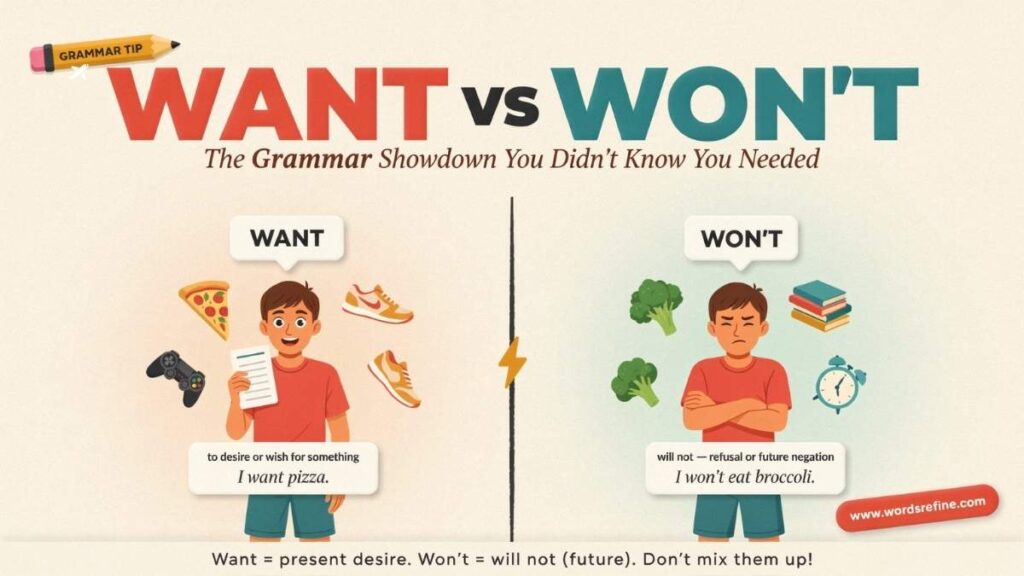
Want vs Wont Quick Answer
The easiest way to understand want, wont, and won’t is to focus on what each word means rather than how similar the spellings look.
| Word | Meaning | Grammatical Role | Example |
|---|---|---|---|
| Want | Desire, wish, or need | Verb or noun | I want a new book. |
| Wont | Habit or customary behavior; accustomed | Noun or adjective | As is his wont, he arrived early. |
| Won’t | Will not | Contraction | I won’t be late. |
In other words, want connects with desire. Wont connects with habit. Won’t connects with will not.
That distinction answers the basic question about the difference between want and won’t. They aren’t alternative spellings. They have different meanings and different grammatical functions.
A useful way to check yourself is to replace the word with a simpler expression.
1f desire or wish makes sense, use want.
2If habit or usual behavior makes sense, use wont.
3If will not makes sense, use won’t.
For example:
I want to learn Spanish.
Here, want expresses a desire.
I won’t learn Spanish this year.
Here, won’t means will not.
As is his wont, he studies late at night.
Here, wont refers to his usual habit.
What Does Want Mean?
The most common meaning of want involves desire. When you want something, you have a wish, preference, or need for it.
A simple want definition is to have a desire for something or to feel that you need something.
For example:
I want a cup of coffee.
She wants a new job.
They want more time.
We want to visit California.
In each sentence, want tells us what someone desires or prefers.
Want as a Verb
Want as a verb is extremely common in everyday English. You can use it with a noun, an infinitive, or another person followed by an infinitive.
For example:
I want some water.
He wants a better opportunity.
She wants to travel.
They want to leave early.
I want you to listen carefully.
The pattern want + to + verb appears constantly in spoken and written English.
For instance:
I want to learn.
She wants to improve.
We want to help.
They want to stay.
Because of this pattern, learners sometimes confuse want to with won’t.
I want to go means I desire to go.
I won’t go means I will not go.
Those two sentences may look similar at first glance, but their meanings point in completely opposite directions.
Want as a Noun
Although want usually works as a verb, it can also function as a noun.
As a noun, want can mean lack, shortage, or need.
For example:
The family lived in want for many years.
The project failed for want of proper planning.
In the second sentence, for want of means because of a lack of.
This use sounds more formal than the everyday use of want. In ordinary conversation, speakers usually choose words such as lack, need, or shortage instead.
Therefore, when you ask what does want mean, context matters. Most of the time, it refers to desire or need. In formal writing, however, it can also describe a lack.
What Does Wont Mean?
Wont is a real English word, but it is much less common than want and won’t.
The word wont generally refers to a person’s usual habit, customary behavior, or regular practice. It can also work as an adjective meaning accustomed to something.
For example:
As is her wont, she arrived early.
This means that arriving early was her usual habit.
Another example is:
As was his wont, the professor reviewed his notes before class.
In simpler modern English, you could say:
As usual, the professor reviewed his notes before class.
The meaning remains similar, but the second version sounds more natural in everyday conversation.
Wont as a Noun
Wont as a noun refers to a customary habit or usual behavior.
It often appears in the expression as is someone’s wont.
For example:
As is his wont, David checked every detail twice.
The sentence tells us that checking details was something David usually did.
Similarly:
As was her wont, Maria arrived before everyone else.
Again, the sentence focuses on a repeated habit rather than a desire.
This is the main difference between wont and want. Want describes what someone desires. and Wont describes what someone habitually does.
Wont as an Adjective
The Wont can also work as an adjective meaning accustomed or used to something.
This use often appears with to.
For example:
He was wont to rise before dawn.
This means:
He was accustomed to rising before dawn.
Another example:
She was wont to question every assumption.
In contemporary everyday English, a writer might replace that sentence with:
She was accustomed to questioning every assumption.
The word wont remains correct, but it has a formal or literary flavor.
Learn the difference between basic English word mistakes
Councillor vs Counsellor Difference Spelling and Usage ?
What Does Won’t Mean?
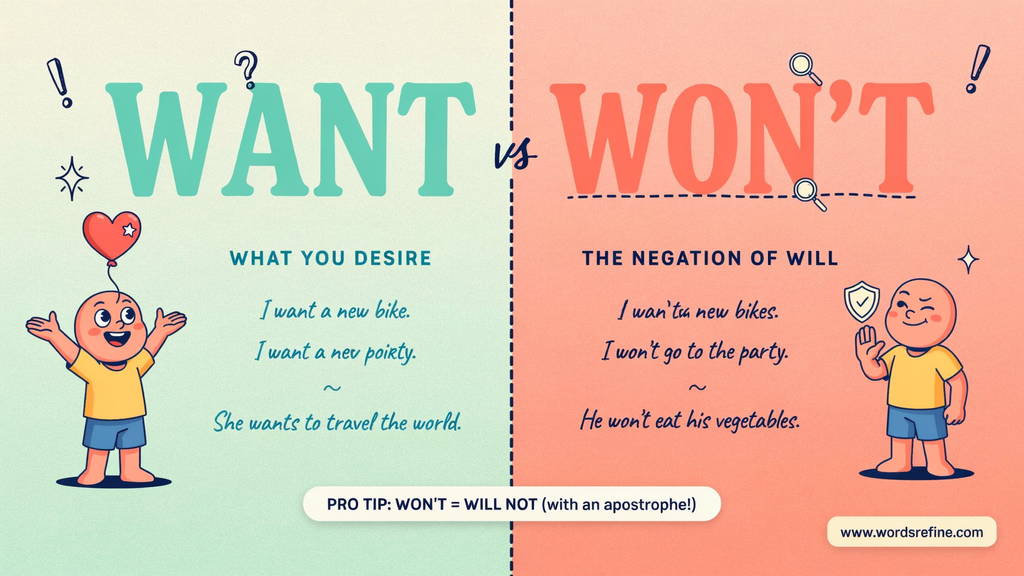
Won’t is the contraction of will not.
That makes its basic meaning straightforward.
I will not go.
I won’t go.
The second sentence simply uses the contracted form.
Won’t can express a future negative action, refusal, unwillingness, or the failure of something to work as expected.
For example:
I won’t forget.
She won’t answer the phone.
They won’t attend the meeting.
The car won’t start.
In the final example, the car obviously doesn’t have feelings or intentions. Instead, won’t describes the fact that the car refuses or fails to start.
Won’t as a Contraction
Won’t is a contraction, while wont is not.
This distinction is important because contractions often contain apostrophes.
For example:
Do not becomes don’t.
Cannot becomes can’t.
They are becomes they’re.
Will not becomes won’t.
Therefore, if you are asking what won’t is short for, the answer is will not.
The apostrophe in won’t signals that two words have been combined into a shorter form.
Learn the difference between confusing more English words
Labelled vs Labeled Which one Is Correct?
Want vs Won’t A Crucial Difference
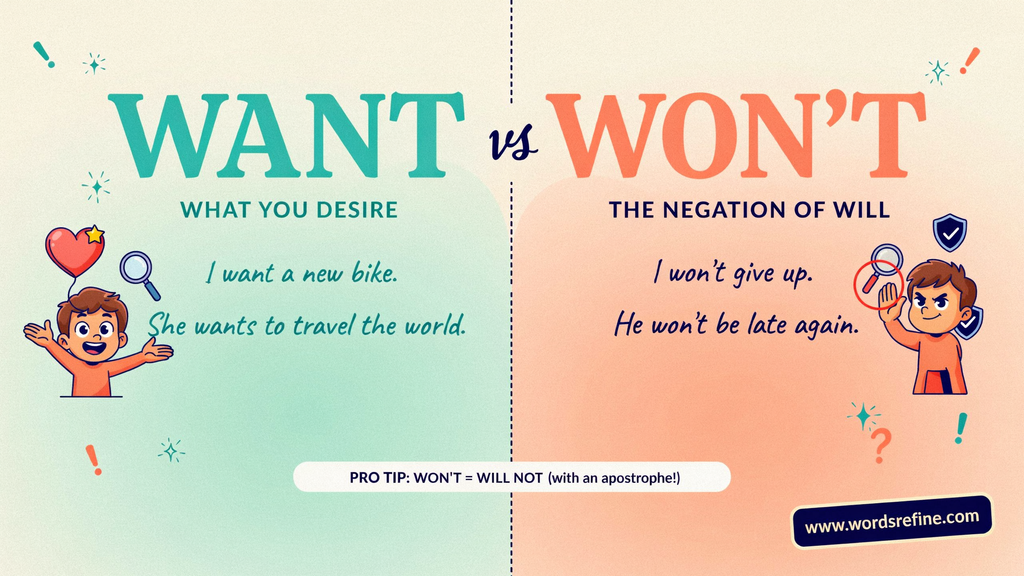
The difference between want vs won’t becomes especially clear when you place them in similar sentences.
I want to help.
I won’t help.
The first sentence expresses a desire to help. The second says the speaker will not help.
Likewise:
She wants to come.
She won’t come.
Again, the first sentence expresses desire. The second expresses refusal or a negative future action.
This distinction is one of the most useful things to remember when deciding when to use want and when to use won’t.
Want to and Won’t
Want to is followed by a verb and expresses a desire or intention.
For example:
I want to leave.
He wants to study.
They want to participate.
Won’t is followed directly by the base form of a verb.
For example:
I won’t leave.
He won’t study.
They won’t participate.
Notice the structure.
Want to leave.
Won’t leave.
Want to study.
Won’t study.
The difference may look small, but the meaning changes dramatically.
Want vs Wont Grammar
Understanding the grammar behind these words makes the spelling much easier.
Want can function as a verb or noun.
Wont can function as a noun or adjective.
Won’t is a contraction of the modal construction will not.
Here is a simple comparison:
| Word | Main Grammatical Function | Main Meaning |
|---|---|---|
| Want | Verb or noun | Desire, need, or lack |
| Wont | Noun or adjective | Habit, custom, or accustomed |
| Won’t | Contraction | Will not |
want vs wont behaves like an ordinary lexical verb.
For example:
I want coffee.
She wants to leave.
Wont behaves differently.
As a noun:
It was his wont to arrive early.
As an adjective:
He was wont to complain.
Won’t behaves as the negative form of will.
For example:
I won’t go.
She won’t agree.
They won’t wait.
Therefore, want vs wont grammar isn’t simply a matter of spelling. The words belong to different grammatical categories and communicate different ideas.
Learn the difference between commonly mixed-up more words
Vaccum Vs Vacuum Which One Is Correct and Why It Matters ?
Why Do People Confuse Want, Wont, and Won’t?
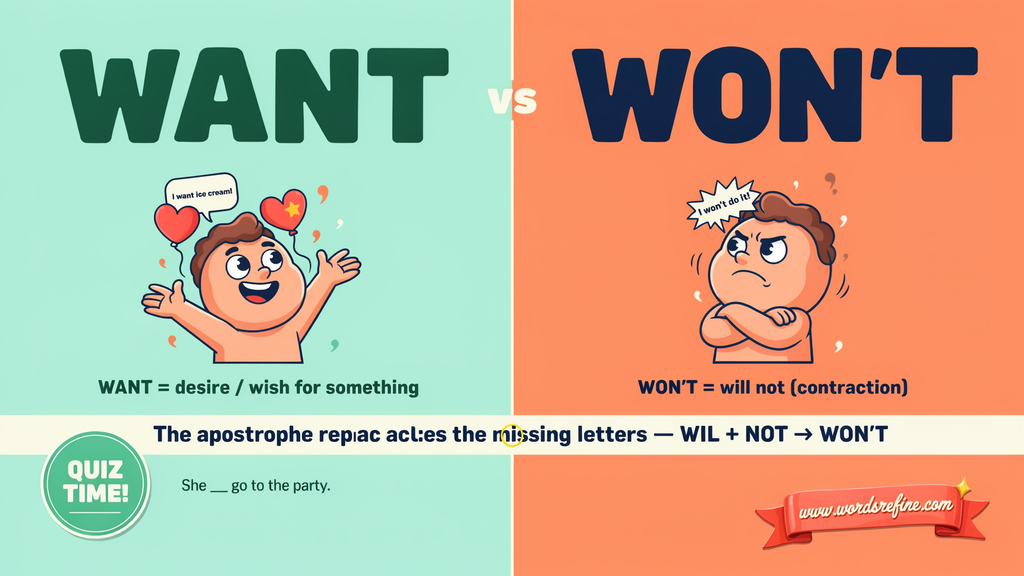
The confusion usually starts with appearance.
Want vs won’t are common words, while wont is much less familiar. Because wont rarely appears in everyday conversation, readers may assume it is simply a spelling mistake.
However, it is a legitimate word.
The Missing Apostrophe
The apostrophe in won’t matters.
Compare:
I won’t go.
I wont go.
The first sentence means:
I will not go.
The second sentence does not correctly express that meaning.
Wont is a separate word associated with habit or customary behavior.
This is why punctuation can affect meaning. An apostrophe may look tiny, but in a sentence it can do a lot of work.
Similar Spelling Creates Confusion
Want and won’t look similar because both begin with w and contain the letters a, n, or o in familiar patterns.
Wont and won’t look even more alike because the only visible difference is the apostrophe.
As a result, these words often become confused in quick typing, text messages, informal writing, and language learning.
Context usually helps the reader understand what the writer intended. Still, using the correct form makes the sentence clearer and more professional.
Want vs Wont Pronunciation
Pronunciation creates another layer of confusion.
In standard US English, want and won’t have different vowel sounds. Wont generally sounds similar to won’t for many American speakers.
The pronunciation difference becomes easier to notice when you place the words in complete sentences.
For example:
I want to go.
I won’t go.
The first sentence uses want to express desire. The second uses won’t to express refusal or a future negative action.
Accent can affect the exact pronunciation of want. However, the spelling and grammatical distinction remain the same.
Want vs Won’t Pronunciation Difference
When learning the want vs won’t pronunciation difference, focus on the vowel rather than trying to memorize the spelling alone.
Want generally has the vowel sound associated with the pronunciation of /wɑnt/ in standard US English.
Won’t generally contains the /oʊ/ sound heard in words such as boat and home.
Wont is generally pronounced similarly to won’t in modern US English.
This means the difference between wont vs won’t may not be obvious from sound alone. Context becomes particularly important.
For learners, listening to the words inside complete sentences can help more than repeating them in isolation.
Learn the difference between tricky grammar more words
Effort vs Affort Which One Is Correct and How to Use It?
The Simple Rule for Choosing Want, Wont, vs Won’t
The easiest rule is to connect each word with one central idea.
When to Use Want
Use want when you mean desire, wish, preference, or need.
For example:
I want some water.
She wants a new position.
They want to travel.
He wants to learn another language.
Think of want as desire or wish.
When to Use Wont
Use wont when you mean habit, custom, usual behavior, or being accustomed to something.
For example:
As is his wont, he arrived early.
She was wont to read before breakfast.
Think of wont as in the habit of or accustomed to.
When to Use Won’t
Use won’t when you mean will not.
For example:
I won’t forget.
She won’t attend.
They won’t agree.
Think of won’t as will not.
This simple three-part distinction makes the correct word much easier to choose.
Common Mistakes With Want, Wont, vs Won’t
The most common mistake with “want,” “wont,” vs “won’t” is using them interchangeably. Although their spellings look similar, their meanings are quite different. “Want” expresses a desire, “won’t” is short for “will not,” and “wont” describes a customary habit or behavior. The word “wont” is correct but uncommon in modern everyday English.
For example, “I want a new book” expresses a desire, while “I won’t buy that book” means the speaker will not buy it. Similarly, “He followed his wonted routine” means he followed his usual routine. To avoid confusion, remember that “want” is about desire, “won’t” expresses refusal or a future negative action, and “wont” relates to habit. Paying attention to the apostrophe in “won’t” can also help you choose the correct word.
Using Wont Instead of Won’t
Incorrect:
I wont be late.
Correct:
I won’t be late.
The intended meaning is will not, so the contraction needs an apostrophe.
Using Want Instead of Won’t
Incorrect:
I want go home.
If the intended meaning is that the speaker will not go home, the correct sentence is:
I won’t go home.
However, if the speaker means that they desire to go home, then the correct sentence is:
I want to go home.
The important difference is not simply want versus won’t. The structure also changes.
Assuming Wont Means Want
Wont does not mean want.
Compare:
I want to read every night.
I am wont to read every night.
The first sentence expresses a desire.
The second describes an established habit.
The second sentence also sounds more formal and less conversational.
Assuming Wont Means Will Not
Wont does not mean will not.
Won’t means will not.
Wont refers to habit or customary behavior.
This is perhaps the most important spelling distinction in the entire comparison.
Want vs Wont Sentence Examples
Seeing the words side by side makes their differences much easier to remember.
| Sentence | Meaning |
|---|---|
| I want some water. | I desire water. |
| I won’t drink the water. | I will not drink it. |
| As is his wont, he arrived early. | Arriving early is his usual habit. |
| She wants to study. | She desires to study. |
| She won’t study tonight. | She will not study tonight. |
| He was wont to complain. | He was accustomed to complaining. |
These examples demonstrate the difference between desire, habit, and refusal.
They also show why context matters when dealing with commonly confused words.
Learn the difference between confusing word pairs
Octopus vs Octopi Which Plural Is Correct and Why?
Want vs Won’t in Everyday Conversation
In everyday American English, want and won’t appear constantly.
You might hear:
I want some coffee.
Do you want to come with us?
I won’t be there tomorrow.
She won’t answer the phone.
They won’t change their minds.
Wont, however, appears much less often.
You may encounter it in formal writing:
As is his wont, the director reviewed every document.
That sentence is correct, but most people would probably say:
As usual, the director reviewed every document.
The simpler version sounds more natural in casual conversation.
Therefore, although wont remains part of standard English vocabulary, you don’t need to force it into ordinary writing. Use it when its formal or literary tone fits the context.
Want vs Wont in Formal Writing
Wont can work particularly well in formal, historical, or literary writing when the writer wants to describe a recurring habit.
For example:
As was her wont, the researcher examined the evidence carefully.
The word gives the sentence a traditional tone.
However, clear writing doesn’t become better simply because it uses an uncommon word. If habit or usually communicates the idea more naturally, those choices may serve the reader better.
For example:
As usual, the researcher examined the evidence carefully.
Both sentences are correct. The second simply sounds more direct.
The same principle applies to professional writing. Choose the word that expresses the intended meaning clearly rather than choosing an unfamiliar word merely because it sounds formal.
Want vs Wont in American and British English
The distinction between want, wont, vs won’t remains consistent across American and British English.
Want means desire or need.
Wont refers to customary behavior or being accustomed to something.
Won’t means will not.
The main difference involves how frequently people use wont.
In contemporary everyday English, especially casual conversation, wont is relatively uncommon. It appears more often in formal, literary, or traditional writing.
Want and won’t, by contrast, are extremely common in ordinary speech and writing.
Therefore, regional English doesn’t fundamentally change the difference between these words.
Is Wont a Word in English?
Yes. Wont is a genuine English word.
However, it isn’t an alternative spelling of won’t.
It also isn’t another spelling of want.
The three words have separate meanings.
Want means desire or need.
Wont means habit, custom, or accustomed.
Won’t means will not.
If you encounter wont in a sentence such as “As is his wont,” don’t automatically assume the writer made a typo. Instead, look at the context.
Is Wont a Contraction?
No.
Wont is not a contraction.
Won’t is a contraction of will not.
That distinction is easy to remember when you look at the apostrophe.
The apostrophe appears in won’t because the word represents a shortened form.
Wont has no apostrophe because it is an independent word.
Learn the difference between often confused words
Sublet vs Sublease Which One Is Correct ?
How to Remember the Difference
When these three words start looking like linguistic twins, reduce them to three simple ideas.
Want means desire.
Wont means habit.
Won’t means will not.
For example:
I want to exercise.
This expresses desire.
As is her wont, she exercises before breakfast.
This describes a habit.
She won’t exercise today.
This means she will not exercise today.
The context does most of the work.
If you’re still unsure, ask yourself one question:
Am I talking about something someone desires, something someone usually does, or something someone will not do?
The answer will usually point you to the correct word.
Learn the difference between basic English word mistakes
Drily vs Dryly Which One Is Correct?
Quick Comparison of Want, Wont vs Won’t
| Feature | Want | Wont | Won’t |
|---|---|---|---|
| Meaning | Desire, wish, or need | Habit or customary behavior | Will not |
| Part of speech | Verb or noun | Noun or adjective | Contraction |
| Apostrophe | No | No | Yes |
| Everyday use | Very common | Uncommon | Very common |
| Formal use | Common | More common | Common |
| Example | I want to leave. | As is his wont, he left early. | I won’t leave. |
The table gives you the basic distinction at a glance. However, the best way to remember the words is still to connect them with their meanings.
Learn the difference between commonly misused words
Weighed vs Weighted Which One Is Correct ?
Practice Session want vs wont
Choose the correct word from want, wants, wont, or won’t to complete each sentence.
- I ______ to learn how to play the guitar.
- She ______ be at the office tomorrow.
- As is his ______, he arrived before everyone else.
- They ______ to buy a new house next year.
- He ______ answer the phone because he is busy.
- As was her ______, she checked the report twice.
- We ______ to finish the project today.
- The old car ______ start this morning.
- I ______ a glass of water, please.
- He was ______ to stay up late reading.
- She ______ to visit her family this weekend.
- They ______ agree to the new proposal.
- As is his ______, he drank coffee before starting work.
- I ______ forget what you told me.
- Do you ______ to come with us?
- The manager ______ approve the request.
- As was her ______, she arrived early for the meeting.
- He ______ more time to complete the assignment.
- She was ______ to question every decision.
- We ______ leave until everyone arrives.
- I ______ to improve my English writing.
- The computer ______ turn on.
- As is their ______, they reviewed everything carefully.
- He ______ to become a doctor.
- She ______ give up, even after several failures.
Answer Session
- want
- won’t
- wont
- want
- won’t
- wont
- want
- won’t
- want
- wont
- wants
- won’t
- wont
- won’t
- want
- won’t
- wont
- wants
- wont
- won’t
- want
- won’t
- wont
- wants
- won’t
Here’s a trusted source for clear more words Comparison:
FAQs
What is the main difference between want, wont, and won’t?
Want expresses a desire or need. Wont refers to a person’s usual habit or customary behavior. Won’t is the contraction of will not and expresses refusal, unwillingness, or a future action that will not happen.
Can wont be used in everyday conversation?
Wont is grammatically correct, but it sounds formal or literary in modern English. You’ll usually see it in expressions such as “as is her wont,” which means “as is her usual habit.”
Does wont have an apostrophe?
No. Wont and won’t are different words. Wont means a habit or customary behavior, while won’t is the contraction of will not. The apostrophe in won’t helps distinguish the two.
Can want and won’t sound similar when spoken?
They can sound somewhat similar in quick speech, especially to English learners. However, their vowel sounds differ in standard pronunciation. Context also makes the intended word much easier to identify.
Can wont describe a person’s personality?
Yes. Wont can describe a person’s established habits or typical behavior. For example, “As was his wont, he remained calm during the argument” describes something he regularly did.
Is wont still commonly used in modern English?
Wont remains a valid English word, but it’s uncommon in casual conversation. Modern speakers generally use words such as habit, tendency, or usual practice instead.
Can won’t refer to a person’s refusal?
Yes. Won’t can show that someone refuses or is unwilling to do something. For example, “She won’t apologize” can mean that she refuses to apologize.
Can won’t describe something that refuses to work?
Yes. English speakers often use won’t for objects that fail to function as expected. For example, “My laptop won’t turn on” means the laptop refuses or fails to turn on.
Can want be followed by an infinitive?
Yes. Want commonly appears before to plus the base form of a verb. For example, “I want to improve my writing” uses want correctly.
Can want be followed by a noun?
Yes. Want can directly take a noun when you express a desire for something. For example, “I want a cup of coffee” uses want before a noun.
What does “as is his wont” mean?
“As is his wont” means “as is his usual habit” or “as he normally does.” It’s a formal expression that often appears in literary or polished writing.
Can won’t describe a future event?
Yes. Won’t can indicate that something will not happen in the future. For example, “The store won’t open until nine” means the store will remain closed until that time.
How can you quickly tell whether to use wont or won’t?
Look for the meaning. If the sentence refers to a habit or customary behavior, use wont. If it means will not, use won’t. The apostrophe is the easiest visual clue.
Can want and won’t appear in the same sentence?
Yes. They can express contrasting ideas. For example, “I want to help, but I won’t interfere unless you ask me.”
Is wont interchangeable with habit?
Not always. Wont can mean habit or customary behavior, but it often appears in formal expressions. In ordinary conversation, habit usually sounds more natural.
Why is wont easy to confuse with won’t?
The two words look almost identical, and the apostrophe is easy to overlook when reading quickly. Their meanings, however, are completely different. One refers to habitual behavior, while the other means will not.
Learn the difference between everyday English mistakes
Annual vs Anual Which one Is Correct?
Conclusion
want vs wont prove that English doesn’t need many letters to cause plenty of confusion. Want tells you about a desire or need, wont describes a usual habit, and won’t means will not. The apostrophe in won’t may look small, but it completely changes the word’s job.
The easiest way to remember them is to focus on meaning rather than appearance. and If you desire something, use want. If you’re talking about something someone habitually does, use wont. If you mean will not, choose won’t.
Once you get the difference, sentences like “I want to stay,” “I won’t stay,” and “as is his wont” become much easier to handle. So, don’t let these look-alike words trip you up. A little attention to meaning and one very important apostrophe can keep your writing clear, accurate, and confusion-free.

Diora AJS she is an experienced blogger and passionate English language enthusiast at Words Refine. With a keen eye for language and a love for clear communication, she writes practical content about grammar, word meanings, usage, and commonly confused terms. Her goal is to make English easier to understand through clear explanations and relatable examples, helping readers write accurately and communicate with confidence.