

Confused by sublet vs sublease? You are not the only one. These terms are often used interchangeably, which can make rental agreements more confusing than they need to be. Both involve an existing tenant renting a property, or part of it, to someone else. However, sublet usually describes the act of renting out the property, while sublease often refers to the agreement that sets out the terms of that arrangement. Once you understand this small distinction, the terminology becomes much easier to follow. In this guide, you well learn what sublet vs sublease mean, how they work, how they differ, and how to use each term correctly.
Sublet vs Sublease The Quick Answer
The easiest way to understand the difference sublet vs sublease is to look at the people involved.
A landlord owns or manages the rental property. The original tenant signs the primary lease with that landlord. If the original tenant later rents all or part of the property to someone else, that new occupant becomes a subtenant.
The basic relationship looks like this:
Landlord → Original tenant → Subtenant
The first relationship comes from the primary lease. The second comes from the sublease.
For example, imagine that Sarah rents an apartment for one year. After six months, she needs to move temporarily for work. Instead of leaving the apartment empty, she finds another person to live there for the remaining four months.
Sarah might say:
“I plan to sublet my apartment while I’m away.”
The written agreement between Sarah and the new occupant may be called a sublease agreement.
Therefore, sublet vs sublease are not necessarily two completely different types of housing arrangements. Instead, they often describe the same basic situation from different angles.
What Does Sublet Mean?
The sublet meaning becomes easier to understand when you think about an action.
To sublet means to rent all or part of a property to another person while the original tenant still has a lease connected to that property.
For example:
“I need to sublet my apartment while I work in another state.”
Here, sublet describes what the tenant plans to do.
A tenant might sublet:
- An entire apartment.
- A bedroom in a shared apartment.
- A house.
- An office.
- Part of a commercial property.
The arrangement can be temporary. In fact, temporary absence is one of the common reasons tenants consider subletting.
A college student might leave town during summer break. Someone may accept a temporary job in another city. A tenant might spend several months caring for a family member elsewhere. In each case, subletting can provide a way to use the rental property without simply abandoning the lease.
However, the tenant cannot assume that they automatically have permission to do so. The original lease and applicable law still matter.
Learn the difference between confusing more English words
Drily vs Dryly Which One Is Correct?
What Does Sublease Mean?
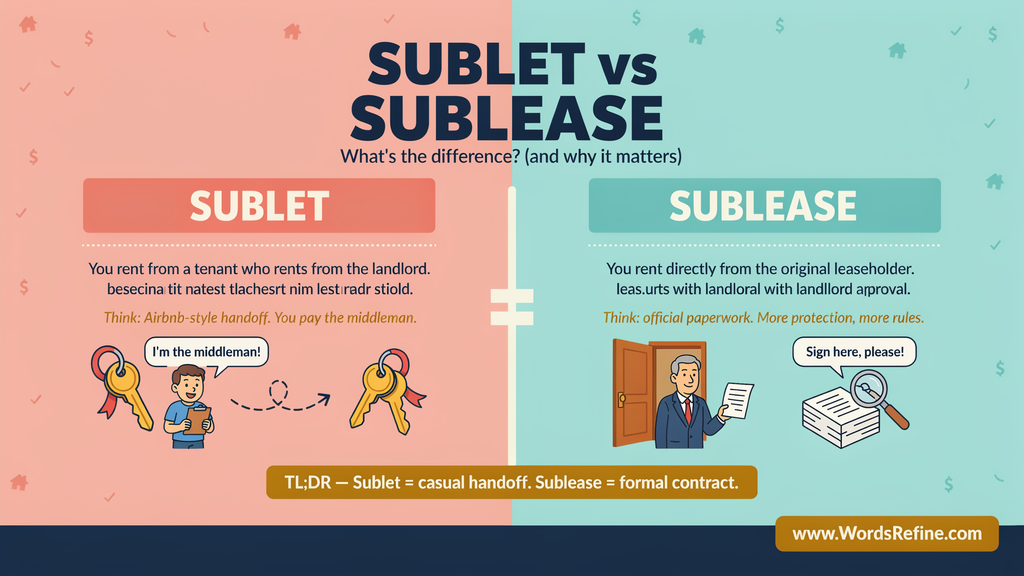
The sublease meaning focuses more on the rental arrangement created between the original tenant and the new occupant.
A sublease is generally a secondary rental agreement. The original tenant becomes the sublessor, while the new occupant becomes the subtenant or sublessee.
For example:
“Michael signed a six-month sublease for the apartment.”
Here, the focus is on the agreement itself.
A sublease agreement commonly explains important details such as:
- The names of the original tenant and subtenant.
- The address of the rental property.
- The beginning and ending dates.
- The monthly rent.
- The security deposit.
- Responsibility for utilities.
- Rules concerning guests, pets, smoking, or other activities.
- Responsibility for damage.
- Move-in and move-out conditions.
- Any requirements imposed by the original lease.
Because the sublease operates underneath the original lease, the two documents should not contradict each other.
For instance, if the primary lease prohibits pets, the original tenant should not casually promise the subtenant that a pet is allowed.
Sublet vs Sublease The Main Difference
The sublet vs. sublease difference is mostly about emphasis.
Sublet commonly describes the act of renting out the property.
Sublease commonly describes the secondary rental arrangement or the written agreement governing it.
Consider these two sentences:
“I want to sublet my apartment.”
“I signed a sublease for my apartment.”
Both sentences describe a related situation. However, the first emphasizes the action, while the second emphasizes the agreement.
That distinction explains why you may hear both terms in the same conversation.
Still, English doesn’t always follow perfectly neat boundaries. People frequently use sublet as a noun, especially when talking about temporary housing.
For example:
“I found a summer sublet near campus.”
In that sentence, sublet refers to the temporary rental opportunity itself.
Consequently, treating the words as completely unrelated terms can create more confusion than it solves.
What Is a Sublet?
A sublet is generally a rental arrangement in which an existing tenant rents all or part of their leased property to another person.
Suppose James rents a two-bedroom apartment. He leaves town for three months and allows another person to occupy the apartment during that period.
James is still the original tenant. The person living there is the subtenant.
The arrangement may involve the entire apartment or only part of it.
For example, James could remain in one bedroom while renting the second bedroom to another person. In that case, the arrangement is still connected to his original tenancy.
However, the exact legal classification can depend on the lease and local law. That’s particularly important when the agreement involves shared housing, commercial property, or unusual occupancy arrangements.
What Is a Sublease?
A sublease is the secondary rental arrangement between the original tenant and the subtenant.
Imagine that Emma has eight months remaining on her apartment lease. She plans to move temporarily and allows David to occupy the apartment for five of those months.
Emma and David can create a written sublease that explains their arrangement.
The original lease still establishes Emma’s relationship with the landlord. The sublease establishes the relationship between Emma and David.
That difference is crucial.
David isn’t necessarily becoming the landlord’s new tenant simply because he moves into the apartment. Instead, his rights generally come through the sublease created by Emma.
How Does a Sublease Work?
A sublease usually involves three parties with different roles.
The landlord owns or controls the rental property.
The original tenant holds the primary lease.
The subtenant rents from the original tenant.
For example, suppose Maria signs a twelve-month lease with her landlord. Six months later, she accepts a temporary job in another state.
She finds Daniel to occupy the apartment for the remaining four months.
The arrangement can be understood this way:
Landlord → Maria through the primary lease
Maria → Daniel through the sublease
Daniel’s arrangement with Maria doesn’t automatically erase Maria’s original obligations.
This is one of the most important things to understand about subleasing. The original tenant may continue to have financial and legal responsibilities under the primary lease.
Therefore, if the subtenant stops paying rent to the original tenant, the original tenant may still have obligations to the landlord.
The exact consequences depend on the agreements and applicable law.
Who Pays Rent in a Sublease?
The answer depends on the terms of the arrangement, but the subtenant commonly pays rent to the original tenant.
For example, suppose the original tenant owes the landlord $1,800 each month. The subtenant may pay the original tenant $1,800 according to the sublease.
The original tenant then remains responsible for paying the landlord according to the primary lease.
The arrangement could also involve a different rent amount. Perhaps the original tenant pays $1,800 but charges the subtenant $1,700. Alternatively, the subtenant could pay more if the arrangement and applicable rules permit it.
The important point is that the payment structure should be clearly stated in writing.
A good agreement should identify:
- The amount of monthly rent.
- The payment deadline.
- The person receiving payment.
- The accepted payment method.
- Any late-payment terms.
- The security deposit.
- Responsibility for utilities and other expenses.
Clear terms can prevent a surprisingly large number of disputes.
Learn the difference between tricky grammar more words
Weighed vs Weighted Which One Is Correct ?
Lease vs Sublease What Is the Difference?
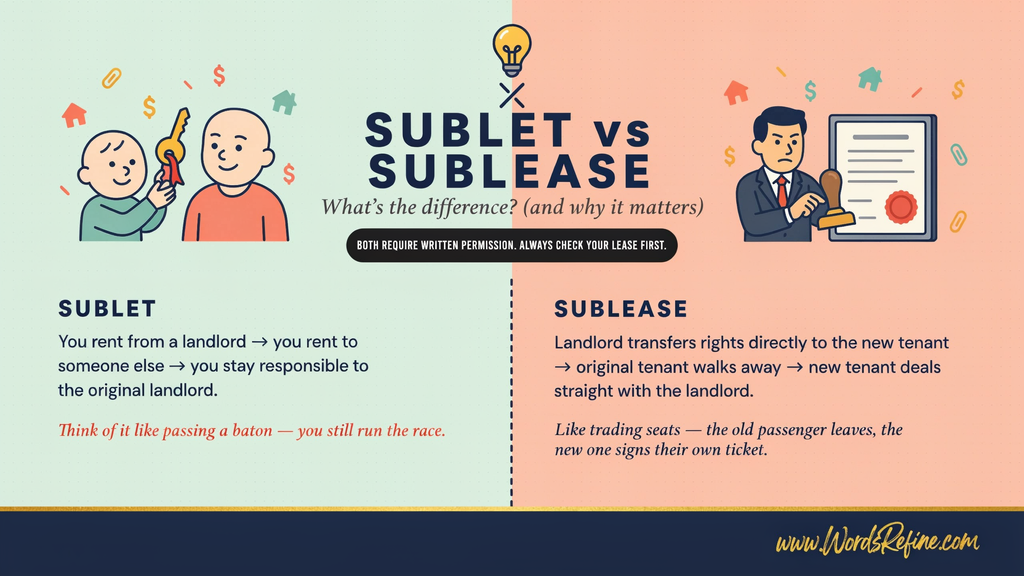
The lease vs sublease distinction comes down to the relationship each agreement creates.
A lease normally establishes the primary relationship between the landlord and tenant.
A sublease generally establishes a secondary relationship between the original tenant and subtenant.
For example:
Landlord → Tenant = Lease
Tenant → Subtenant = Sublease
The original tenant therefore occupies a unique position. The tenant has responsibilities to the landlord while also having responsibilities to the subtenant under the secondary agreement.
That can make subleasing more complicated than ordinary renting.
A subtenant should understand that they aren’t necessarily entering into the same type of relationship as someone who rents directly from the property owner.
At the same time, the original tenant should understand that bringing another person into the property doesn’t automatically remove the original tenant’s obligations.
Why the Difference Matters
The sublease vs lease distinction becomes particularly important when something goes wrong.
Suppose a tenant signs a twelve-month lease and then subleases the apartment for four months.
The four-month sublease generally doesn’t erase the remaining eight months of the original lease.
If the subtenant damages the property or violates an important lease rule, the original tenant may still have responsibilities toward the landlord.
Likewise, if the subtenant refuses to leave at the end of the agreed rental period, the situation can become complicated.
For that reason, the original tenant should never treat a sublease as a casual handoff of the apartment.
It is a separate rental arrangement that needs careful attention.
Sublet vs Sublease vs Lease
The difference becomes clearer when the three terms are placed side by side.
| Term | What it usually describes | Main relationship |
|---|---|---|
| Lease | Primary rental contract | Landlord and tenant |
| Sublease | Secondary rental agreement | Original tenant and subtenant |
| Sublet | Act or arrangement of renting out leased property | Original tenant and subtenant |
The word lease generally sits at the beginning of the rental chain.
The word sublet vs sublease describes a later arrangement created by the existing tenant.
Sublet, meanwhile, commonly describes the act of creating or participating in that secondary arrangement.
Sublet vs Rent Why Aren’t They the Same?
Rent is a broad term. It can describe the payment made for occupying property or the general act of obtaining property for temporary use.
Subletting is more specific because another tenant already holds the primary rental agreement.
Consider the difference.
In an ordinary rental:
Landlord → New tenant
In a sublease:
Landlord → Original tenant → Subtenant
That extra relationship is what makes subleasing different from simply renting a property directly from the owner.
The subtenant generally doesn’t replace the landlord’s relationship with the original tenant. Instead, another layer exists beneath the primary lease.
Learn the difference between confusing word pairs
Annual vs Anual Which one Is Correct?
Sublease vs Assignment A Major Difference
Sublease vs assignment is another comparison worth understanding because the two arrangements can produce very different results.
A sublease generally leaves the original tenant connected to the primary lease.
An assignment generally involves transferring the tenant’s entire remaining interest in the lease to another person.
Imagine that a tenant has six months left on a lease.
With a sublease, the tenant might rent the apartment to someone else for four months and then return.
With an assignment, the tenant may transfer the remaining lease interest to another person and leave permanently.
The difference is therefore more than vocabulary.
A sublease usually creates another layer of occupancy. An assignment generally transfers the tenant’s lease interest.
Because assignment rules vary by jurisdiction and contract, tenants should review the actual lease before deciding which arrangement applies.
Can You Sublet an Apartment?
You may be able to sublet an apartment, but you shouldn’t assume that every rental agreement allows it.
First, read the primary lease carefully.
Look for language involving:
- Subletting.
- Subleasing.
- Assignment.
- Additional occupants.
- Written consent.
- Landlord approval.
- Restrictions on transferring possession.
- Procedures for requesting permission.
Some leases prohibit subletting. Others permit it only after the landlord provides written consent.
In some jurisdictions, laws may also give tenants specific rights or impose specific procedures.
Therefore, the answer to “Can I sublet my apartment?” depends on more than the fact that you are the tenant.
The property location, lease terms, and applicable law all matter.
Is Subletting Legal?
The question “Is subletting legal?” doesn’t have one answer that applies everywhere.
Subletting laws vary by jurisdiction. In addition, the lease may impose restrictions that affect what a tenant can do.
For that reason, don’t rely on a simple statement such as “subletting is always legal” or “subletting is illegal.”
Instead, check the actual rules governing the rental.
A tenant should consider:
- The original lease.
- State law.
- Local housing regulations.
- Building rules incorporated into the lease.
- Any required landlord approval.
- Any required written notice.
- Restrictions concerning occupancy.
This approach is much safer because rental laws aren’t identical across the country.
Learn the difference between often confused words
Instinctually vs Instinctively Which One Is Correct ?
Do You Need Landlord Permission to Sublet?
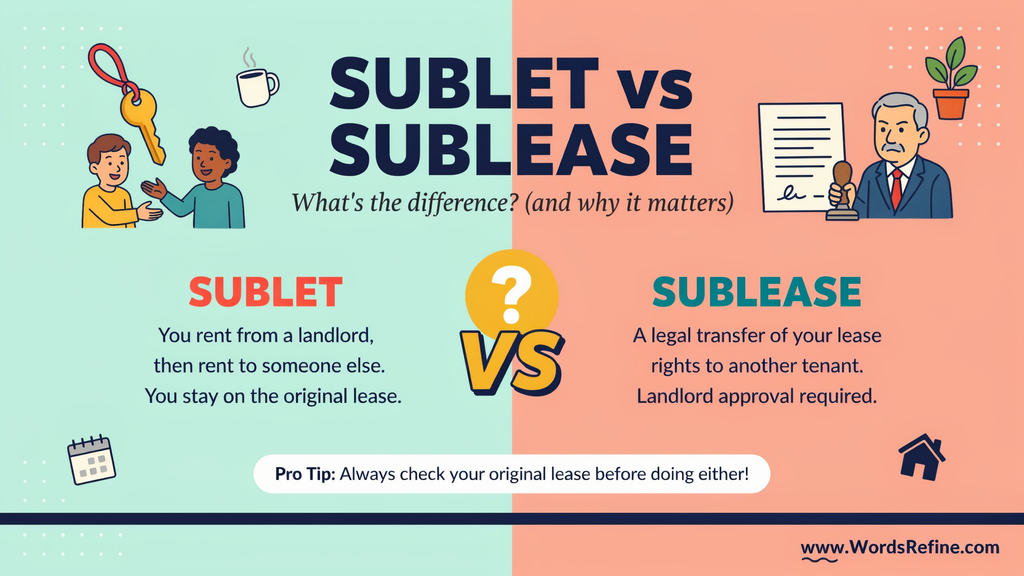
Whether you need landlord permission to sublet depends on the circumstances.
Some leases require the landlord’s prior written consent. Others contain different procedures. Certain laws can also limit how a landlord may respond to a request.
If your lease requires written approval, get that approval before allowing the subtenant to move in.
A written record can help establish what the landlord actually agreed to.
For example, instead of relying on a casual conversation, keep a copy of the landlord’s written response.
That way, everyone has a clear record of the permission and any conditions attached to it.
What Is a Sublease Agreement?
A sublease agreement is a written contract between the original tenant and the subtenant.
It should explain the practical details of the arrangement so that both parties know what they have agreed to.
A useful agreement can address:
- Names of the parties.
- Property address.
- Rental period.
- Monthly rent.
- Security deposit.
- Utility payments.
- Maintenance responsibilities.
- Property rules.
- Guest policies.
- Pet restrictions.
- Damage responsibilities.
- Move-in condition.
- Move-out requirements.
- Procedures for ending the arrangement.
The agreement should also acknowledge the primary lease when appropriate.
For instance, the subtenant should understand that certain rules from the original lease may still apply to the property.
What Is a Sublet Agreement?
The phrase sublet agreement is commonly used to describe a written agreement for a sublet.
In formal writing, sublease agreement is often clearer because it identifies the secondary rental contract.
Still, both expressions can appear in ordinary conversation.
The name matters less than the substance.
A written agreement should clearly establish who is renting the property, how long they may stay, how much they must pay, and what responsibilities each party has.
Without those details, even a friendly rental arrangement can become difficult once a disagreement appears.
How to Sublease an Apartment
If you’re wondering how to sublease an apartment, start with the existing lease.
Don’t begin by finding a subtenant and handing over the keys. That can create problems before the arrangement has even started.
Check the Original Lease
Read the sections dealing with subletting, assignment, occupants, and landlord approval.
Pay close attention to requirements for written consent.
Check the Applicable Rules
Rental laws can differ by state and locality. Confirm the rules that apply to the property.
Request Permission When Required
If landlord approval is required, make the request in writing and keep the response.
Find a Suitable Subtenant
Consider whether the person can meet the financial obligations and follow the property’s rules.
Create a Written Agreement
Prepare a sublease that clearly states the rental period, rent, deposit, utilities, responsibilities, and other important terms.
Compare the Two Agreements
Read the primary lease alongside the sublease.
The secondary agreement should not casually promise something that the original lease prohibits.
Document the Property
Take photographs and make written notes about the condition of the apartment before the subtenant moves in.
Keep Payment Records
Save records of rent payments, deposits, repairs, and important communications.
These simple steps can make the subleasing process far easier to manage.
How to Sublet an Apartment Responsibly
Knowing how to sublet an apartment is only part of the process. Doing it responsibly requires attention to the original tenant’s continuing obligations.
Consider this example.
A Temporary Work Assignment
Alex signs a one-year lease for an apartment.
Six months later, Alex receives a four-month work assignment in another state. Alex doesn’t want to give up the apartment because the work assignment is temporary.
Instead, Alex considers a sublet.
Before moving away, Alex:
- Reviews the original lease.
- Checks the rules governing subletting.
- Requests landlord approval if necessary.
- Finds a suitable subtenant.
- Creates a written sublease agreement.
- Records the apartment’s condition.
- Explains the building’s rules.
- Establishes a clear rent-payment schedule.
- Keeps copies of all important documents.
The subtenant then moves into the apartment for four months.
Alex remains connected to the primary lease. The subtenant’s rights come through the secondary arrangement.
This example shows why subletting isn’t simply a matter of handing someone your keys.
Learn the difference between basic English word mistakes
Ingenuine vs Ungenuine Which One Is Correct ?
What Happens if a Subtenant Does Not Pay Rent?
This is one of the biggest risks for an original tenant.
Suppose the subtenant agrees to pay $1,800 each month but stops making payments.
The original tenant may still owe the landlord under the primary lease.
That means the original tenant could face a financial problem even though another person occupies the apartment.
The exact legal remedies depend on the sublease, the primary lease, and local law. However, the basic risk remains important.
Before creating a sublease, the original tenant should understand that the subtenant’s failure to pay doesn’t necessarily cancel the original tenant’s obligations to the landlord.
That is why careful screening, clear payment terms, and written records matter.
Common Mistakes With Sublet vs Sublease
One common mistake is assuming that sublet vs sublease always mean exactly the same thing. Although they are closely related, sublet often describes the act of renting a property to someone else, while sublease usually refers to the secondary rental agreement.
Another mistake is forgetting that the original tenant may still have responsibilities under the primary lease. A sublease does not automatically erase the original tenant’s obligations to the landlord.
It’s also easy to assume that every tenant can sublet freely. However, the original lease may require landlord approval or place restrictions on subletting. Checking the lease before making an arrangement can prevent unnecessary confusion and costly problems.
Assuming the Original Lease Disappears
A sublease generally doesn’t erase the primary lease.
The original tenant should continue to understand the obligations created by that lease.
Assuming Every Landlord Allows Subletting
Not every lease permits subletting without conditions.
Some require written consent. Others may impose additional requirements.
Treating a Subtenant Like a Direct Tenant of the Landlord
The subtenant usually enters the property through the original tenant rather than through a new primary lease with the landlord.
That distinction can affect responsibilities and communication.
Ignoring the Written Agreement
A verbal promise can become difficult to prove.
A written sublease gives both sides a clearer record of the arrangement.
Forgetting About Property Damage
The original tenant should think carefully about responsibility for damage.
Documenting the property’s condition before occupancy can help reduce disagreements later.
Confusing Sublease With Assignment
A sublease generally leaves the original tenant connected to the primary lease.
An assignment generally transfers the tenant’s entire lease interest.
The two should not be treated as identical.
Learn the difference between commonly misused words
Cadaver vs Corpse Which One Is Correct ?
Subletting vs Subleasing Is There a Difference?
The phrase subletting vs subleasing can make the distinction sound bigger than it really is.
In everyday English, the two terms frequently overlap.
Subletting generally describes the process of renting out property that the tenant already leases.
Subleasing often refers to the secondary rental arrangement created through that process.
Therefore, when someone asks, “What is the difference between subletting and subleasing?” the most useful answer is that the distinction often involves usage and emphasis rather than two completely separate housing practices.
However, formal legal documents can use these terms more precisely. That’s why the wording in a particular lease or statute deserves attention.
Which Word Should You Use?
If you’re talking casually about renting your apartment to another person, sublet usually sounds natural.
For example:
“I want to sublet my apartment for the summer.”
If you’re referring to the formal agreement, sublease often works better.
For example:
“The tenant signed a sublease agreement with the new occupant.”
This doesn’t mean one word is always correct while the other is always wrong.
Instead, choose the word that matches what you’re describing.
1Use sublet when the focus is on the act.
2Use sublease when the focus is on the secondary rental agreement.
3Use subtenant when you’re talking about the person who rents from the original tenant.
4Use lease when you’re referring to the primary rental contract.
Sublet vs Sublease in Everyday Writing
The best word can depend on the sentence.
Consider these examples:
“I plan to sublet my apartment while I’m abroad.”
Here, sublet describes an action.
“I signed a sublease for the apartment.”
Here, sublease identifies the agreement.
“The subtenant will move in next month.”
Here, subtenant identifies the person.
“My lease ends in December.”
Here, lease refers to the primary rental contract.
Once you understand the roles, the vocabulary becomes much easier to manage.
Sublet vs Sublease A Simple Comparison
| Term | Meaning | Example |
|---|---|---|
| Sublet | To rent out leased property to another person | “I plan to sublet my apartment.” |
| Sublease | A secondary rental arrangement or agreement | “I signed a sublease.” |
| Subtenant | Person who rents from the original tenant | “The subtenant moves in tomorrow.” |
| Sublessor | Original tenant who creates the sublease | “The sublessor remains connected to the primary lease.” |
| Sublessee | Person receiving rights under the sublease | “The sublessee must follow the agreement.” |
| Lease | Primary rental contract | “The tenant signed a one-year lease.” |
| Assignment | Transfer of the tenant’s lease interest | “The tenant assigned the remaining lease term.” |
Learn the difference between everyday English mistakes
Ironic vs Unironic Meaning, Differences, and Correct Usage
Practice Session sublet vs sublease
- A ______ is the original rental agreement between the property owner and the tenant.
- When a tenant rents their apartment to another person while remaining responsible under the original lease, they may ______ the apartment.
- A person who rents a property from the original tenant is called a ______.
- The property owner who rents the property to the original tenant is the ______.
- A ______ is a secondary rental agreement between the original tenant and another occupant.
- The original ______ usually remains responsible for the terms of the primary lease.
- The word ______ often describes the act of renting a leased property to another person.
- The word ______ can refer to the secondary rental arrangement created between the original tenant and the new occupant.
- A sublease generally does not completely replace the original ______.
- If a tenant permanently transfers their entire interest in a lease, the arrangement may be called an ______.
- Before arranging a sublet, a tenant should check the terms of their ______.
- A person who moves into an apartment under a sublease is commonly called a ______.
- A written ______ can explain the rent, dates, responsibilities, and other terms of the secondary rental arrangement.
- The original tenant may still have a rent ______ to the landlord after subleasing the property.
- If the landlord must approve the arrangement, the tenant should obtain written ______ before the subtenant moves in.
- Subletting and subleasing are closely related because both involve a ______ tenant and a new occupant.
- A ______ transfers the tenant’s lease interest instead of creating a temporary secondary rental arrangement.
- If you rent only one bedroom in your leased apartment to another person, you may be ______ part of the property.
- If the original tenant creates a separate rental contract with the new occupant, that contract is a ______ agreement.
- The person who rents directly from the property owner under the primary lease is the original ______.
- A sublease usually creates a rental relationship between the original tenant and the ______.
- Before accepting a subtenant, the original tenant should consider the person’s ability to pay ______.
- A sublease should clearly state when the rental ______ begins and ends.
- If a tenant transfers the entire lease to another person and no longer remains the tenant under the agreement, this is generally an ______ rather than a sublease.
- The simplest way to remember the difference is that sublet often emphasizes the ______, while sublease emphasizes the secondary rental agreement.
Answers
- Lease
- Sublet
- Subtenant
- Landlord
- Sublease
- Tenant
- Sublet
- Sublease
- Lease
- Assignment
- Lease
- Subtenant
- Sublease
- Obligation
- Permission
- Original
- Assignment
- Subletting
- Sublease
- Tenant
- Subtenant
- Rent
- Term
- Assignment
- Action
Here’s a trusted source for clear more words Comparison:
FAQs
How can you protect yourself when subletting?
Protect yourself by checking your lease first, getting the landlord’s approval in writing when required, screening the subtenant, and using a written sublease agreement. Clearly state the rent, security deposit, dates, responsibilities, and rules. Keep copies of payments and important communications as well.
Is subleasing risky?
Subleasing can involve financial and legal risks, especially if the subtenant damages the property, fails to pay rent, or violates the original lease. In a typical sublease, the original tenant remains responsible to the landlord under the primary lease. That’s why written permission, careful screening, and a clear sublease agreement matter.
What should I ask for when subletting?
Before accepting a subtenant, you may want to ask for identification, proof of income, rental history, references, and permission to conduct any lawful screening required by your local rules. You should also discuss the intended move-in and move-out dates, rent amount, utilities, deposits, and house rules.
Can you make money from subleasing?
You may be able to charge a subtenant rent, but whether you can charge more than your own rent depends on the lease, applicable law, and any restrictions on subletting. A sublease should not be treated as an automatic way to make a profit.
How much can I charge for a sublet?
The amount you can charge depends on your original lease, local law, the terms of the sublease, and what costs you are responsible for. Before setting the price, check whether your lease or applicable law limits sublet charges or requires the landlord’s approval.
What happens if a subtenant does not pay rent?
The original tenant may still have to pay the landlord because the primary lease generally remains between the landlord and the original tenant. The original tenant can then have rights or remedies under the sublease against the subtenant, depending on the written agreement and applicable law.
How do you evict a tenant who is subletting?
The process depends on whether the subletting violates the lease or applicable law and on the legal relationship between the landlord, original tenant, and subtenant. A landlord generally must follow the required notice and court procedures rather than simply removing someone from the property. For example, Florida law provides specific procedures for terminating a rental agreement and removing tenants after certain breaches.
Can I report subletting anonymously?
Whether you can make an anonymous report depends on the landlord, property manager, housing authority, or other organization receiving the complaint. If you report an unauthorized sublet, provide factual information rather than assumptions, and understand that anonymity may not always be guaranteed.
Is there a penalty for subletting?
There is no single penalty that applies to every sublet. The consequences can depend on the lease, the type of violation, and local law. An unauthorized sublet could potentially lead to lease enforcement, termination proceedings, financial liability, or other consequences. For that reason, check the lease and obtain written approval when required.
Can a landlord refuse a sublet?
A landlord’s ability to refuse a sublet depends on the lease and applicable law. Some rental agreements prohibit subletting without prior written consent, while certain jurisdictions place limits on when a landlord may refuse. The safest approach is to check the specific lease provision and local rules before making an arrangement.
Does a sublease replace the original lease?
Usually, no. A sublease generally creates a separate agreement between the original tenant and the subtenant while the original lease between the landlord and original tenant continues. The original tenant commonly remains responsible for obligations under that primary lease.
Can you sublet an apartment without telling the landlord?
You should not assume that you can. Many leases require the landlord’s prior written consent before a tenant sublets. Whether consent is legally required, and whether a landlord can refuse it, varies by lease and jurisdiction.
Learn the difference between more words people mix up
Enflamed vs Inflamed Which One Is Correct ?
Conclusion
Understanding the difference between sublet vs sublease becomes much easier when you focus on how each term is used. Sublet commonly refers to the act of renting a property to another person, while sublease usually describes the secondary rental agreement created between the original tenant and the new occupant.
Although the terms are closely related and are often used interchangeably in everyday conversation, the distinction matters in formal rental situations. The original lease generally remains in effect, and the original tenant may continue to have responsibilities to the landlord.
So, before you sublet an apartment or enter into a sublease, review your lease carefully and check the applicable rules. Knowing the terminology is useful, but understanding your responsibilities is even more important. After all, a few clear words in a rental agreement can prevent a lot of confusion later.

Diora AJS she is an experienced blogger and passionate English language enthusiast at Words Refine. With a keen eye for language and a love for clear communication, she writes practical content about grammar, word meanings, usage, and commonly confused terms. Her goal is to make English easier to understand through clear explanations and relatable examples, helping readers write accurately and communicate with confidence.