
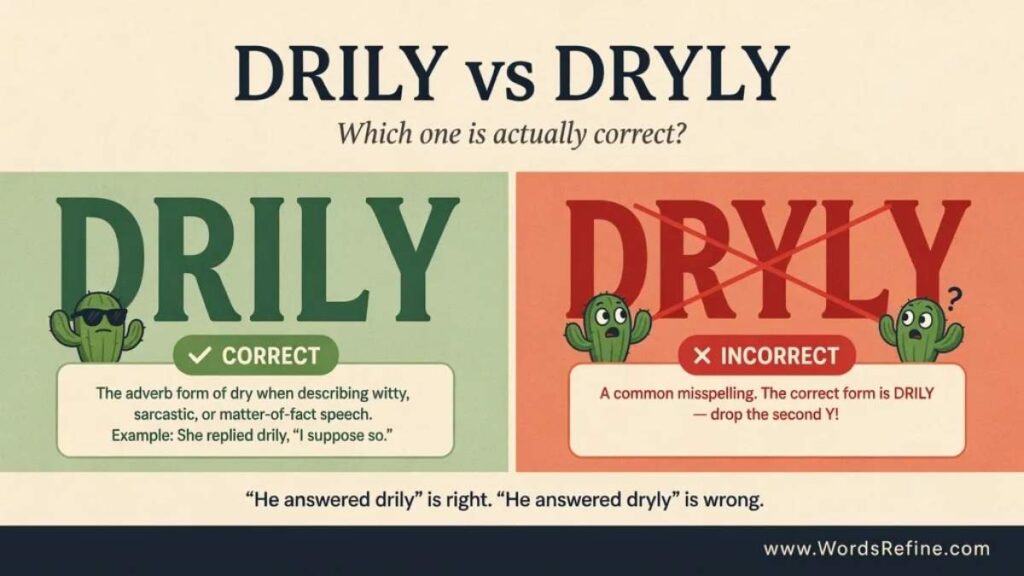
Drily vs dryly can turn a simple sentence into a surprisingly serious spelling puzzle. If you have ever stared at these two words and wondered which one belongs on the page, you are certainly not alone. Both spellings are correct, which makes the confusion even more interesting. They generally share the same meaning and can describe a restrained, matter of fact, or subtly humorous way of speaking. However, regional preferences can influence which form feels more natural. In American English, dryly is often more familiar, while drily remains perfectly acceptable. So before you let one little letter dry out your confidence, let’s clear up the confusion once and for all.
The Simple Answer
Both drily and dryly are correct.
They are adverbs formed from the adjective dry, and they generally carry the same meaning. Both can describe a restrained manner of speaking, understated humor, a detached response, or a lack of emotional expression.
For example, consider this sentence:
She replied dryly, “That went well.”
The word dryly suggests that her statement probably doesn’t mean exactly what it appears to mean. Perhaps something went terribly wrong. Instead of openly complaining, she makes an understated comment.
The same sentence works with drily:
She replied drily, “That went well.”
The basic meaning remains unchanged.
Therefore, if you’ve been wondering whether drily or dryly is the correct spelling, the answer is that both are established forms.
What Does Drily Mean?
Drily is an adverb that describes something done in a dry, restrained, unemotional, or understated manner.
It often appears when someone says something amusing without sounding particularly amused. The humor comes from the words and situation rather than an exaggerated delivery.
For example:
He looked at the broken printer and said drily, “Exactly what we needed today.”
The sentence has a humorous edge because the speaker clearly doesn’t consider the broken printer a welcome development. However, instead of expressing frustration dramatically, he responds in a controlled way.
Drily can also describe a matter-of-fact manner that isn’t necessarily humorous.
She drily explained what had happened.
Here, the word suggests a restrained or emotionally distant manner.
Interestingly, the word can also be used in a literal physical sense. Someone might cough drily, for example, meaning the cough lacks moisture. Context determines which sense the reader understands.
What Does Dryly Mean?
Dryly carries essentially the same meaning.
It can describe a person’s manner of speaking, writing, responding, or behaving when that manner feels restrained, unemotional, understated, or quietly humorous.
Consider this example:
“Of course the computer stopped working five minutes before the presentation,” he said dryly.
The speaker isn’t necessarily laughing. In fact, the delivery may be completely expressionless. The humor comes from the situation and the understatement.
Dryly can also describe an unemotional response:
She dryly described the situation without showing any surprise.
In this sentence, the focus isn’t necessarily on humor. Instead, the word highlights the speaker’s controlled and detached manner.
That flexibility is important because dryly does not automatically mean sarcastically. It can suggest irony or humor, but it can also simply describe a restrained way of communicating.
Learn the difference between confusing more English words
Tomatoes vs Tomatos Which one Is Correct?
Drily vs Dryly What Is the Difference?
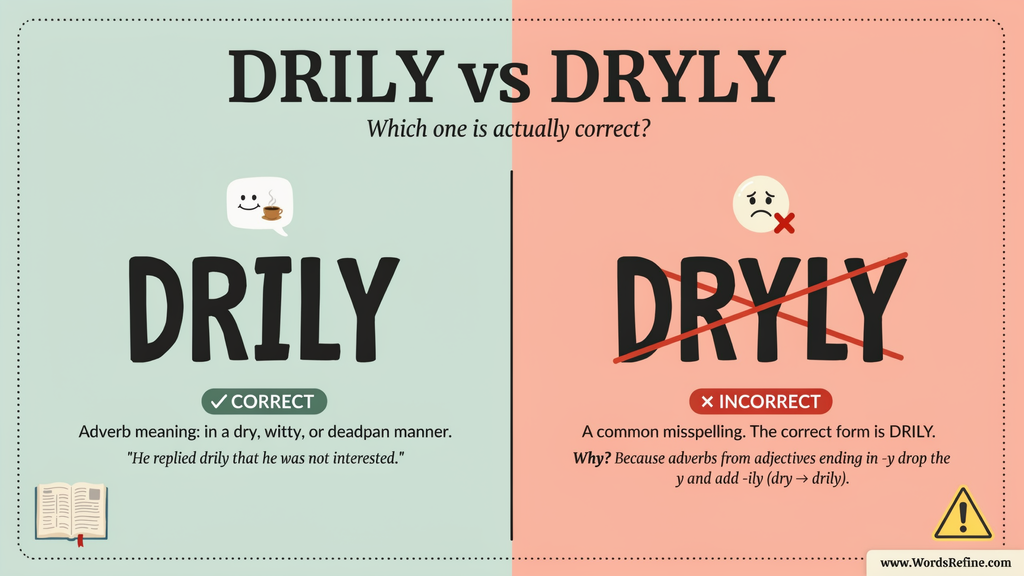
The main difference between drily vs dryly is spelling rather than meaning.
Both forms function as adverbs. and Both come from dry. Both can describe dry humor, an unemotional response, understated wit, or a matter-of-fact manner.
The pronunciation is also essentially the same.
This means that changing one spelling to the other usually does not change the meaning of the sentence.
Compare these examples:
She answered drily.
She answered dryly.
There is no meaningful difference in what the two sentences communicate. The writer has simply chosen a different spelling.
This is one of those situations where English gives you more than one accepted path. It happens in many areas of the language, particularly when regional usage and historical spelling patterns overlap.
Why Are There Two Spellings?
The two spellings exist partly because English spelling doesn’t always follow one perfectly consistent pattern.
At first glance, drily may seem more logical because many adjectives ending in y change that y to i when they become adverbs.
For example:
Happy becomes happily.
Easy becomes easily.
Angry becomes angrily.
Noisy becomes noisily.
Following that pattern, dry could logically become drily.
However, English also contains established adverbs that retain the y before ly. Dryly is one of them.
Other examples include shyly, slyly, and wryly.
As a result, both drily and dryly developed as accepted forms.
There’s no need to treat the spelling as a battle between right and wrong. English has simply allowed both forms to survive.
Drily vs Dryly in American English
For American English, dryly is often the more familiar spelling.
That doesn’t make drily incorrect in the United States. It simply means that many American readers are likely to encounter dryly more often.
For example:
“He really knows how to brighten a Monday,” she said dryly.
That spelling feels natural in modern US English.
If you’re writing an article, story, email, or other material for an American audience, dryly is therefore a practical choice.
However, there’s no reason to assume that drily is a spelling mistake. It remains an established form.
The important point is to understand the distinction between preference and correctness. A preferred spelling isn’t necessarily the only correct spelling.
Drily vs Dryly in British English
British English also uses both forms, although drily has a particularly strong association with British usage.
That said, dryly appears in British writing as well. Therefore, it would be too simplistic to say that British writers must use drily while American writers must use dryly.
Language doesn’t divide itself into perfectly sealed boxes.
A British writer can use dryly. An American writer can use drily. Neither choice automatically creates a grammatical error.
Regional preference can influence which spelling feels more natural, but both forms remain recognizable English.
Learn the difference between commonly mixed-up more words
Inquiries vs Queries What’s the Difference ?
Drily vs Dryly Spelling Which Should You Choose?
1.If you are writing in US English, dryly is a sensible choice for most general writing.
2.If you are following a publication’s house style, use whichever spelling that style prefers.
3.If you are writing in British English, drily may feel more traditional, although dryly is still acceptable.
Most importantly, be consistent.
If you choose dryly, continue using dryly throughout the same piece. If you choose drily, there’s no need to switch back and forth simply because both spellings are available.
Consistency makes writing look deliberate.
How to Use Drily in a Sentence
Drily often works naturally with verbs that describe speech.
For example:
“She’s certainly optimistic,” he said drily.
The sentence suggests that the speaker may not share the enthusiasm.
Another example is:
She drily observed that the meeting had lasted twice as long as expected.
Here, the word gives the observation a restrained tone.
You can also use it with actions:
He smiled drily and walked away.
The smile probably isn’t warm or enthusiastic. Instead, it suggests a controlled reaction.
How to Use Dryly in a Sentence
Dryly works in exactly the same kinds of contexts.
For example:
“Nothing could possibly go wrong,” she said dryly.
The humor comes from the obvious contrast between the statement and the situation.
Another example is:
He dryly pointed out that nobody had remembered to bring the keys.
The word suggests that he makes the observation without much emotional excitement.
You can also use dryly in a more literal context:
He coughed dryly after breathing in the dust.
Here, there is no humor at all. The word refers to the physical nature of the cough.
That example is a useful reminder that context matters more than the spelling.
Dry Humor and the Meaning of Dryly
One reason people become confused about this word is its close relationship with dry humor.
Dry humor is usually understated. The speaker may say something funny with a completely serious expression, leaving the listener to recognize the joke without any obvious signal.
For example:
“Excellent. Another software update,” Mark said dryly.
The humor comes from the contrast between the positive word excellent and the speaker’s likely frustration.
This style is often called deadpan humor because the speaker delivers the line without showing much emotion.
However, dry humor and sarcasm aren’t exactly the same thing.
Dryly Does Not Always Mean Sarcastically
Sarcasm often involves saying something that means the opposite of the literal words, especially to mock or criticize someone or something.
Dry humor can use sarcasm, but it doesn’t have to.
Consider this:
“That was an interesting choice,” she said dryly.
The speaker might be making a sarcastic comment. However, the word dryly itself doesn’t guarantee sarcasm.
Now compare it with:
“That was an interesting choice,” she said sarcastically.
The second sentence makes the speaker’s mocking intention much clearer.
Therefore, dryly describes a manner or tone, while sarcastically says more about the speaker’s communicative intention.
That distinction can make a big difference in carefully written prose.
Learn the difference between tricky grammar more words
Lend vs Lent What’s the Difference and When to Use Each?
Common Mistakes With Drily vs Dryly
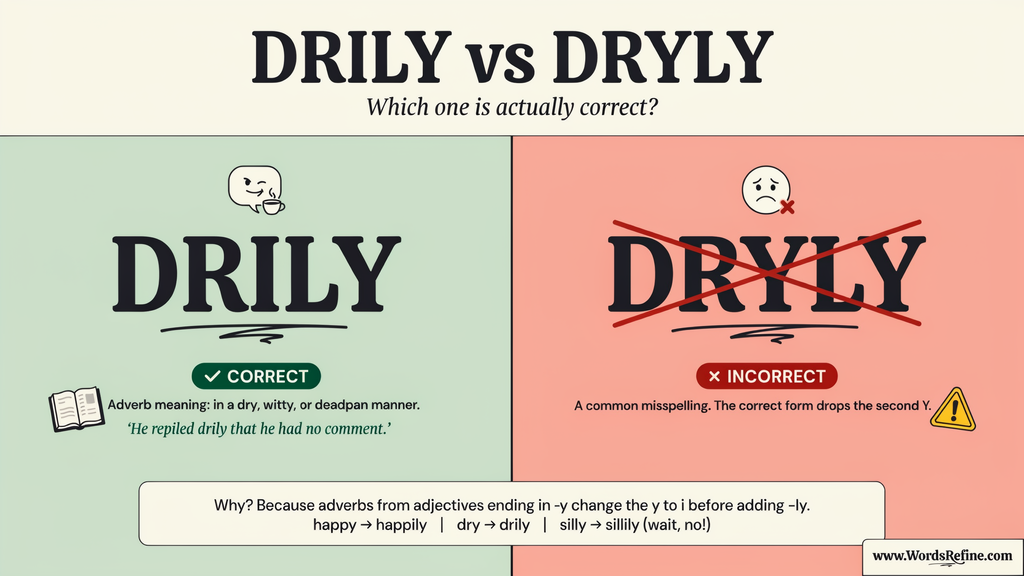
One common mistake is assuming that drily is simply a misspelling of dryly.
It isn’t.
Drily is an established word. It appears in dictionaries and published English, so correcting every instance of it to dryly would be unnecessary.
Another mistake is assuming that dryly is wrong because the adjective dry ends in y.
English spelling doesn’t always work that neatly. Dryly is also a standard form.
A third mistake is believing that the two spellings have different meanings.
In ordinary usage, they don’t. The difference is mainly spelling and regional preference.
Another common mistake is treating dryly as a complete synonym for sarcastically. As discussed earlier, dry humor can be subtle and restrained without being openly sarcastic.
Finally, writers sometimes use dryly when they actually mean dully.
Those words can overlap in some contexts, but they aren’t identical.
If someone says something dully, the delivery may lack energy or interest. If someone says something dryly, the delivery may be controlled, ironic, understated, or quietly humorous.
Drily vs Dryly A Closer Look at Tone
Small adverbs can dramatically change the way readers understand dialogue.
Consider the sentence:
“I finished the report,” she said.
This simply tells us what she said.
Now change the adverb:
“I finished the report,” she said excitedly.
The reader expects enthusiasm.
“I finished the report,” she said sadly.
The reader expects disappointment.
“I finished the report,” she said dryly.
The reader may suspect irony, understatement, or emotional restraint.
“I finished the report,” she said sarcastically.
Now the reader is much more likely to interpret the statement as mockery or contradiction.
This is why word choice matters. An adverb can quietly guide the reader toward a particular interpretation without adding a long explanation.
Drily vs Dryly Can Describe More Than Humor
Although people often encounter these words in discussions of humor, their use isn’t limited to jokes.
They can describe a detached manner of speaking.
For example:
The witness dryly described the argument without showing any emotion.
They can also describe a restrained response:
He drily acknowledged the criticism and continued working.
In both examples, the focus is on manner rather than comedy.
That broader meaning makes the words useful in journalism, fiction, essays, reviews, and everyday writing.
A Practical Comparison
| Situation | Natural choice |
|---|---|
| Understated joke | Dryly or drily |
| Deadpan response | Dryly or drily |
| Matter-of-fact comment | Dryly or drily |
| Unemotional observation | Dryly or drily |
| Literal lack of moisture | Dryly or drily |
| General US English | Dryly is often preferred |
| Traditional British usage | Drily is often preferred |
| Formal writing | Either, depending on style |
| Dialogue | Either |
| Academic or analytical prose | Either, when the intended tone calls for it |
The table shows the central point: there is no major difference in grammatical function.
A Simple Case Study
Imagine that a team has spent three hours preparing for a presentation. When the meeting finally begins, the projector stops working.
One employee looks at the blank screen and says:
“Perfect timing.”
If the employee says this dryly, the reader understands that the words are understated humor. The employee probably means that the timing is terrible.
Now imagine the same person says:
“Perfect timing,” with an enormous grin and an exaggerated voice.
The meaning becomes more obviously humorous.
Finally, imagine the person says it sarcastically with obvious frustration.
The statement may now sound sharper and more critical.
The wording remains the same. The delivery changes the interpretation.
That’s exactly why words such as dryly and drily are useful. They give readers a clue about the manner behind the words.
Learn the difference between confusing word pairs
Socialise vs Socialize Which one Is Correct ?
Drily vs Dryly in Professional Writing
Both forms can appear in professional writing, although writers should use them thoughtfully.
For example:
The report dryly noted that the deadline had already passed.
This sentence suggests a restrained or slightly ironic tone.
However, if the writer simply wants to report the fact, this may be clearer:
The report noted that the deadline had already passed.
The second version removes the implied attitude.
This distinction matters in professional and academic writing because tone can affect how readers interpret information.
If humor or understatement is intentional, dryly can be effective. If the goal is complete neutrality, a simpler verb may work better.
Drily vs Dryly in Fiction and Dialogue
Fiction provides one of the clearest uses for these words.
A character might say:
“Wonderful. The roof is leaking again,” she said dryly.
The word immediately gives the reader information about the character’s delivery.
Without the adverb, the reader has to infer the tone from the surrounding scene.
However, writers shouldn’t rely on adverbs for every piece of dialogue. Strong dialogue often communicates tone through word choice, action, context, and character behavior.
For example:
She stared at the ceiling as water dripped onto the floor.
“Wonderful. The roof is leaking again.”
The physical detail already tells the reader how the line should sound.
In that case, adding dryly may be unnecessary.
Good writing gives readers enough information to understand the tone without constantly explaining it.
Drily vs Dryly Related Words
Several words can express ideas that overlap with dryly and drily.
Matter-of-factly emphasizes straightforward communication without emotional decoration.
Wryly often suggests clever or ironic humor.
Deadpan describes an intentionally expressionless or serious delivery, especially when something is funny.
Unemotionally emphasizes a lack of visible feeling.
Coolly can suggest emotional control or detachment.
Sarcastically suggests mocking or ironic intent.
These words aren’t interchangeable in every sentence.
For example, someone can speak matter-of-factly without being funny. Someone can speak dryly without being sarcastic. Someone can speak sarcastically without sounding particularly dry.
Choosing the right word depends on the exact tone you want the reader to hear.
Learn the difference between everyday English mistakes
Copyright vs Copywrite Which One Is Correct?
Drily Pronunciation and Dryly Pronunciation
Drily and dryly are generally pronounced the same way.
The pronunciation begins with the sound found in dry and ends with the usual sound associated with ly.
The spelling therefore changes without creating a meaningful difference in pronunciation.
This is another reason the two forms can be confusing when encountered in writing. A reader may hear the same word but later see a different spelling.
There is no need to pronounce one dramatically differently from the other.
Is Drily Correct English?
Yes.
Drily is correct English and remains an accepted spelling.
It isn’t an informal shortcut or a careless version of dryly. It has established dictionary recognition and appears in published writing.
Therefore, if you write:
He responded drily.
You have not made a spelling error.
Is Dryly Correct English?
Yes.
Dryly is also correct English.
In fact, it is often the more familiar choice for American readers. It clearly preserves the connection between the adverb and the adjective dry.
Therefore:
He responded dryly.
is completely standard.
The choice between the two forms is not a matter of grammatical correctness.
Learn the difference between often confused words
Dreamt vs Dreamed Which One Is Correct?
Should You Use Drily vs Dryly?
For US English, dryly is generally the safest practical choice when you want the form most familiar to a broad American audience.
However, there is no need to avoid drily if it fits your preferred style.
1.If you are writing for a British publication, drily may feel more natural.
2.If you are writing for a specific organization, follow its established style.
3.If there is no style guide, simply choose one form and remain consistent.
That approach is clearer than treating the spelling as a strict right-or-wrong question.
When to Use Drily vs Dryly
Use either form when you want to describe understated humor, a controlled response, an unemotional manner, or a matter-of-fact tone.
Choose dryly when writing for a general US English audience and you want the spelling most readers are likely to recognize immediately.
Choose drily when it fits the regional or stylistic preference of your writing.
Most importantly, don’t switch between the two forms randomly within the same article, story, or document.
Consistency makes your writing feel polished.
Learn the difference between basic English word mistakes
Mobil vs Mobile Which one Is Correct?
Practice Session Drily vs Dryly
- “That went exactly as planned,” she said ________.
- He ________ commented that the meeting had lasted longer than expected.
- “Wonderful, another delay,” Mark said ________.
- She responded ________ to the unexpected criticism.
- “I’m sure nothing else will go wrong,” he remarked ________.
- The actor delivered the humorous line ________.
- She ________ observed that nobody had brought the documents.
- “What a pleasant surprise,” he said ________.
- He smiled ________ after hearing the excuse.
- The manager ________ pointed out that the deadline had already passed.
- “Of course the printer stopped working today,” she said ________.
- He answered the question ________ without showing much emotion.
- The character ________ remarked that the situation was becoming ridiculous.
- “That was a brilliant idea,” she said ________.
- He ________ acknowledged the obvious mistake.
- She delivered the joke ________, leaving the audience to catch the humor.
- “Another meeting? Just what I needed,” he said ________.
- The writer ________ described the disappointing result.
- He ________ replied that the problem was hardly surprising.
- “Everything is going perfectly,” she said ________ as the lights went out.
- The journalist ________ noted the contradiction in the statement.
- She ________ remarked that the plan had a few minor problems.
- He gave a ________ humorous response to the awkward question.
- The character ________ commented on the absurd situation.
- “Well, this is going to be easy,” he said ________.
Answers
- dryly
- drily
- dryly
- drily
- dryly
- drily
- dryly
- drily
- dryly
- drily
- dryly
- drily
- dryly
- drily
- dryly
- drily
- dryly
- drily
- dryly
- drily
- dryly
- drily
- dryly
- drily
- dryly
Here’s a trusted source for clear more words Comparison:
FAQs
Is drily a correct English word?
Yes. Drily is a correct and established English adverb. It describes something said or done in a restrained, matter-of-fact, unemotional, or subtly humorous way.
Is dryly a correct English word?
Yes. Dryly is also a standard English word. It has the same basic meaning as drily and is especially familiar in American English.
Are drily and dryly the same word?
They are different spellings of the same adverbial form. In ordinary usage, both describe a similar tone or manner, so the meaning usually stays the same.
Which spelling is preferred in American English?
Dryly is generally the more familiar spelling in American English. However, drily is still correct, so using it does not make your writing grammatically or spelling-wise incorrect.
Which spelling is preferred in British English?
Drily is commonly used in British English, although dryly also appears in British writing. Neither spelling is automatically wrong based solely on regional usage.
Can drily describe humor?
Yes. Drily can describe understated or deadpan humor. It often suggests that someone delivers a funny or ironic remark without showing much emotion.
Does dryly always imply sarcasm?
No. Dryly describes the manner or tone of a statement, while sarcasm usually involves mockery or saying something that contrasts with the speaker’s intended meaning. A person can speak dryly without being sarcastic.
Can dryly describe something other than speech?
Yes. Dryly can describe an action, response, or manner of behavior. The exact meaning depends on the context, but it often suggests emotional restraint or a lack of enthusiasm.
Should you use drily or dryly in formal writing?
Either spelling can work in formal writing. The best choice depends on your audience, regional preference, and the style guide you are following. Most importantly, use the same spelling consistently throughout your writing.
Does changing drily to dryly change the meaning?
No. In normal usage, changing drily to dryly does not change the meaning. Both forms can describe a restrained, understated, or quietly humorous manner.
Conclusion
The confusion between drily vs dryly is enough to make even a confident writer pause for a second. Fortunately, the mystery is much smaller than it looks. Both spellings are correct, and both can describe a restrained, matter of fact or subtly humorous tone. The main difference comes down to spelling preference and regional usage.
For American English, dryly is often the more familiar choice, while drily remains perfectly acceptable. Whichever form you choose, consistency is the key. So, the next time someone delivers a perfectly straight faced joke, you’ll know exactly how to describe it. No dry spell in grammar knowledge required.

Diora AJS she is an experienced blogger and passionate English language enthusiast at Words Refine. With a keen eye for language and a love for clear communication, she writes practical content about grammar, word meanings, usage, and commonly confused terms. Her goal is to make English easier to understand through clear explanations and relatable examples, helping readers write accurately and communicate with confidence.