
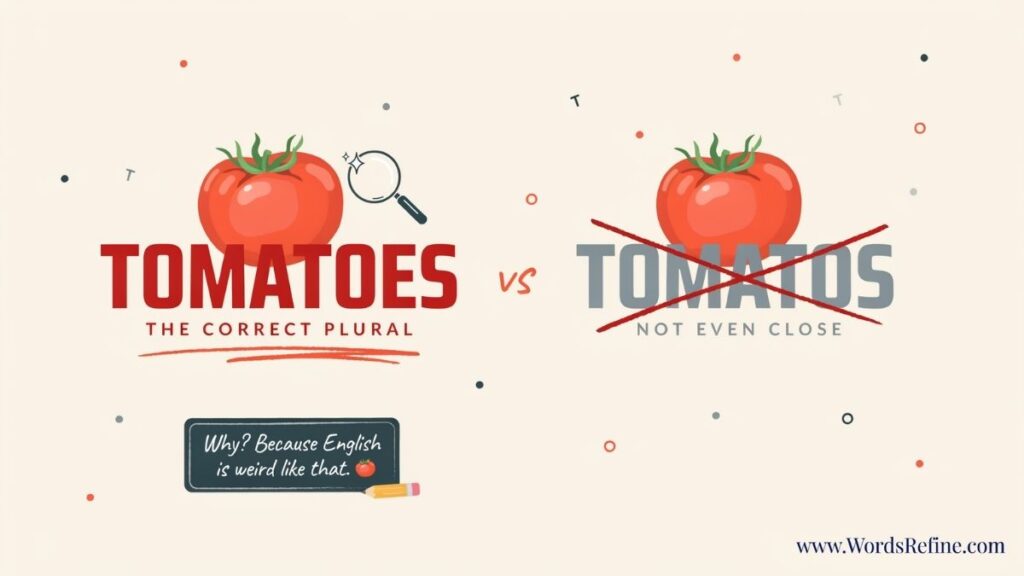
Have you ever typed tomatoes vs tomatos and then stopped to wonder, “Wait, which one is right?” It’s an easy mistake to make. English plural rules can be surprisingly tricky, especially when a word ends in o. You might expect tomato to become tomatos, but English has other plans. The correct plural is tomatoes, with an -es ending. That small difference matters in everyday writing, from recipes and grocery lists to school assignments and professional content. In this guide, you’ll discover why tomatoes is correct, why tomatos is a misspelling, and a simple way to remember the spelling so you won’t second-guess it again.
Tomatoes vs Tomatos The Quick Answer
The correct spelling is tomatoes.
Tomato is the singular form. Tomatoes is the plural form. Tomatos is not the standard English spelling.
Here is the basic distinction:
| Singular | Plural | Correct form |
|---|---|---|
| tomato | tomatoes | Yes |
| tomato | tomatos | No |
| potato | potatoes | Yes |
| potato | potatos | No |
For example:
- I bought one tomato.
- I bought five tomatoes.
- The tomato is sitting on the counter.
- The tomatoes are sitting on the counter.
The important change occurs at the end of the word. When tomato becomes plural, you add es rather than simply adding s.
Therefore:
tomato → tomatoes
Not:
tomato → tomatos
That small e is easy to overlook. However, it makes the difference between the standard spelling and a common misspelling.
Tomato vs Tomatoes Understanding the Difference
Before looking at the spelling rule, it helps to understand how tomato vs tomatoes function in a sentence.
Tomato is singular. You use it when you are talking about one tomato.
For example:
- She sliced a tomato for the sandwich.
- I planted one tomato in the garden.
- There is a tomato beside the cutting board.
- The recipe requires one tomato.
Tomatoes is plural. You use it when you are talking about two or more tomatoes.
For example:
- She sliced three tomatoes for the salad.
- I planted six tomatoes in the garden.
- There are several tomatoes on the counter.
- The recipe requires four tomatoes.
The distinction becomes particularly important when a number appears before the noun.
One tomato is correct.
Two tomatoes is correct.
Ten tomatoes is correct.
Two tomato is incorrect when you are referring to two individual tomatoes.
In other words, the number and noun need to agree. Once you see that pattern, choosing between tomato vs tomatoes becomes much easier.
Lend vs Lent What’s the Difference and When to Use Each?
What Does Tomato Mean?
Tomato is a noun that refers to the familiar edible fruit of the tomato plant. People commonly use tomatoes in salads, sauces, soups, sandwiches, stews, and many other dishes.
The word can refer to the fruit itself or to the plant that produces it, depending on the context.
For example:
- The tomato is ripe.
- The tomato plant needs plenty of sunlight.
- We added tomato to the sauce.
- She bought a basket of tomatoes.
When you talk about more than one individual fruit, you use tomatoes.
For example:
- The tomatoes are ripe.
- The farmer harvested hundreds of tomatoes.
- We washed the tomatoes before cutting them.
- These tomatoes have a deep red color.
So, the meaning itself doesn’t change dramatically when the word becomes plural. The spelling changes because the noun now refers to more than one.
Why Is Tomato Spelled Tomatoes in the Plural?
This is where English spelling gets a little less predictable.
Many English nouns form their plural by adding s.
For example:
- book → books
- chair → chairs
- apple → apples
- garden → gardens
- table → tables
Because of this common pattern, someone might naturally assume that tomato becomes tomatos.
That assumption seems reasonable.
Unfortunately, English has other plans.
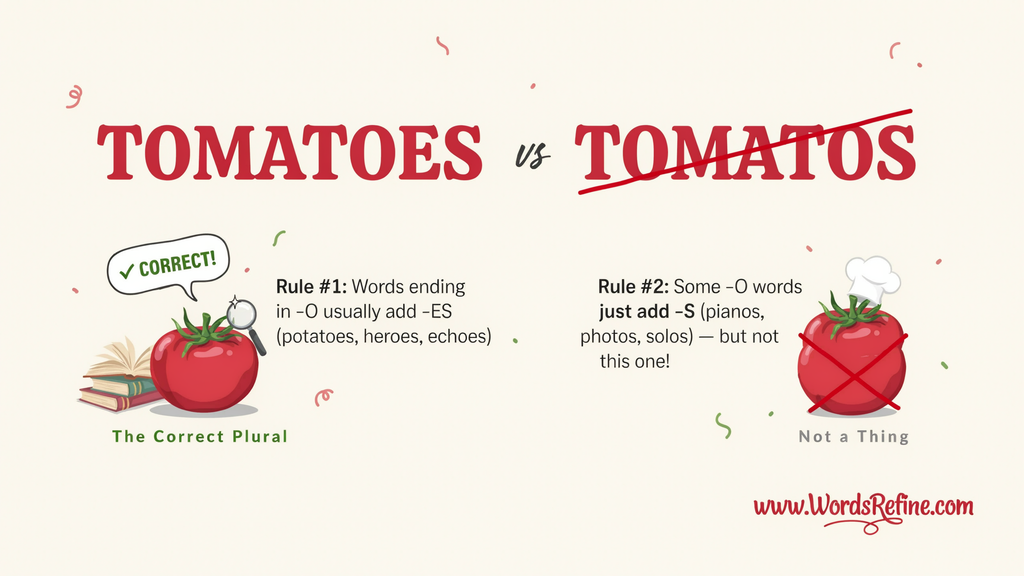
Some nouns ending in o traditionally form their plurals with es. Tomato belongs to this group.
The standard form is:
tomato → tomatoes
Similarly:
potato → potatoes
hero → heroes
echo → echoes
veto → vetoes
However, not every noun ending in o follows this pattern.
For example:
photo → photos
piano → pianos
radio → radios
video → videos
studio → studios
Therefore, you shouldn’t assume that every word ending in o needs es. Instead, learn the standard plural form of the individual word.
The Spelling Rule Explained
The easiest way to understand the tomato spelling pattern is to look at the ending.
The singular word is tomato.
To make the standard plural, add es:
tomato + es = tomatoes
The final letters become oes.
That gives you tomatoes rather than tomatos.
This pattern also appears in potato:
potato + es = potatoes
The two words make an excellent pair because they follow the same plural pattern.
If you’re unsure whether to write tomatos or tomatoes, think of the familiar phrase:
tomatoes and potatoes
That simple association can help you remember the extra e.
Still, don’t treat this as a rule for every noun ending in o. English spelling has developed over centuries, so several plural patterns exist side by side.
A Simple Comparison
The difference becomes clearer when the forms are placed next to each other.
| Word | Meaning | Standard English? |
|---|---|---|
| tomato | One tomato | Yes |
| tomatoes | More than one tomato | Yes |
| tomatos | Intended as the plural of tomato | No |
Consider these examples:
- I need one tomato.
- I need two tomatoes.
- We picked several tomatoes.
- The tomatoes are ready to eat.
Now compare them with the incorrect form:
I need two tomatos.
The meaning is easy to understand. Nevertheless, the spelling is not standard.
That distinction matters in formal writing. A spelling mistake can still be understandable, but it remains a mistake.
Socialise vs Socialize Which one Is Correct ?
Why Do People Write Tomatos?
The spelling tomatos is easy to understand as a mistake because it follows a pattern that works for many other English nouns.
When people learn that most regular plurals take s, they may apply that pattern automatically.
For example:
car → cars
house → houses
book → books
tomato → tomatos
The first three work. The last one doesn’t.
There is also another source of confusion. Several familiar words ending in o do take s when they become plural.
For example:
- photo → photos
- piano → pianos
- radio → radios
- video → videos
- studio → studios
Therefore, someone who knows these words may reasonably expect tomato to behave in the same way.
English spelling, however, isn’t always perfectly consistent.
The best solution isn’t to memorize a giant list of rules. Instead, remember common word pairs that follow the same pattern.
Tomato becomes tomatoes.
Potato becomes potatoes.
Hero becomes heroes.
Echo becomes echoes.
Once those forms become familiar, the spelling starts to feel natural.
Instalments vs Installments Which one Is Correct?
How to Spell Tomatoes Correctly
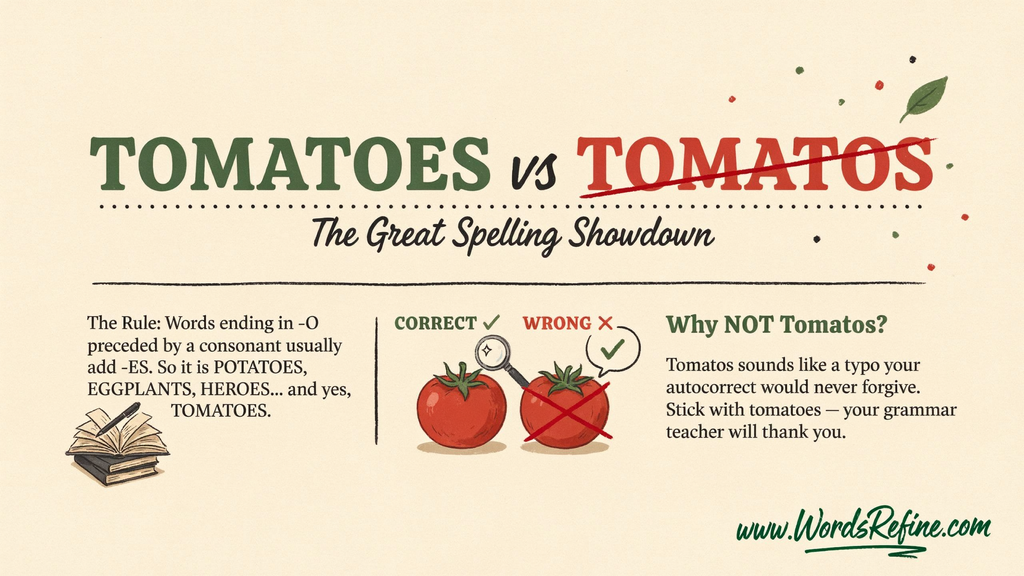
If you often hesitate over the word, break it into two parts.
Start with:
tomato
Then add:
es
The result is:
tomatoes
You can also remember the ending visually:
tomat + oes
The final e is important.
Writing tomatos leaves it out.
Writing tomatoes keeps the standard plural ending.
A useful memory sentence is:
- I bought tomatoes and potatoes.
Both words end with oes in their plural forms.
That makes them easier to remember as a pair.
Common Mistakes With Tomato Plurals
The spelling mistake is not the only problem people make with tomato. Number and verb agreement can cause trouble too.
Using Tomatos Instead of Tomatoes
Incorrect:
I bought three tomatos.
Correct:
I bought three tomatoes.
The word needs its standard plural spelling.
Using Tomato After a Plural Number
Incorrect:
She bought five tomato.
Correct:
She bought five tomatoes.
Because five refers to more than one, the plural noun is required.
Using Tomatoes After One
Incorrect:
There is one tomatoes on the table.
Correct:
There is one tomato on the table.
The word one requires the singular form.
Using the Wrong Verb
Incorrect:
The tomatoes is fresh.
Correct:
The tomatoes are fresh.
Because tomatoes is plural, it normally takes the plural verb are.
These mistakes show that spelling and grammar often work together. Knowing the correct word isn’t enough if the rest of the sentence doesn’t agree with it.
Tomato Grammar in Everyday Sentences
The word tomato behaves like a normal count noun when you refer to individual fruits.
You can use numbers with it:
- one tomato
- two tomatoes
- three tomatoes
- ten tomatoes
You can also use words such as several, many, few, and these:
- several tomatoes
- many tomatoes
- a few tomatoes
- these tomatoes
- those tomatoes
The singular and plural forms also affect nearby words.
Compare:
This tomato is ripe.
These tomatoes are ripe.
That tomato looks fresh.
Those tomatoes look fresh.
Notice how several parts of the sentence change.
The singular sentence uses this, tomato, and is.
The plural sentence uses these, tomatoes, and are.
This kind of agreement helps readers understand exactly how many items you mean.
Learn the difference between tricky grammar more words
Copyright vs Copywrite Which One Is Correct?
Tomatoes in Real Sentences
Seeing the correct form in natural situations can make the spelling easier to remember.
Cooking
- Chop the tomatoes and add them to the sauce.
- The recipe calls for four tomatoes.
- The tomatoes should cook until they become soft.
- Add the tomatoes after the onions turn golden.
Gardening
- The tomato plant has started producing fruit.
- We grew several tomatoes in the backyard.
- The tomatoes need regular watering.
- These tomatoes should be ready to harvest soon.
Grocery Shopping
- Please buy six tomatoes.
- The store has fresh tomatoes today.
- These tomatoes look better than the ones we bought yesterday.
- We need two tomatoes for dinner.
Everyday Conversation
- I don’t like tomatoes in my sandwich.
- Those tomatoes taste surprisingly sweet.
- We have plenty of tomatoes at home.
- Could you wash the tomatoes before dinner?
These examples show that the correct plural form works naturally across many different contexts.
Tomatoes vs Tomatos See the Mistake and Fix It
A quick correction exercise can make the difference easier to remember.
Incorrect:
The farmer picked fifty tomatos.
Correct:
The farmer picked fifty tomatoes.
Incorrect:
I need one tomatoes.
Correct:
I need one tomato.
Incorrect:
She bought three tomato from the market.
Correct:
She bought three tomatoes from the market.
Incorrect:
The tomatoes is ready.
Correct:
The tomatoes are ready.
Incorrect:
These tomatos are fresh.
Correct:
These tomatoes are fresh.
The pattern becomes obvious after a few examples. When the noun refers to more than one tomato, use tomatoes.
Why the Two Words Are Easy to Confuse
Tomato and potato are often mentioned together because their plural forms follow the same spelling pattern.
| Singular | Plural |
|---|---|
| tomato | tomatoes |
| potato | potatoes |
That makes potato a useful memory aid.
If you know that potatoes is correct, you can use it to remember tomatoes.
For example:
- I baked three potatoes.
- I sliced three tomatoes.
- The potatoes are ready.
- The tomatoes are ready.
The same ending appears in both plural forms.
It is also worth remembering the common mistakes:
potatos is incorrect.
tomatos is incorrect.
potatoes is correct.
tomatoes is correct.
This is a useful example of how English spelling patterns can help you even when the wider rule has exceptions.
Is Tomato an Irregular Plural?
A common question is whether tomato counts as an irregular noun.
Strictly speaking, tomatoes is not an irregular plural like children, men, or mice.
Those nouns change their form in unusual ways:
child → children
man → men
mouse → mice
Tomato simply uses the plural ending es:
tomato → tomatoes
Therefore, it is better to describe tomatoes as the standard plural form of tomato rather than call it an irregular plural.
The unusual part is that English doesn’t use one single plural pattern for every noun ending in o.
Learn the difference between tricky grammar more words
Dreamt vs Dreamed Which One Is Correct?
Nouns Ending in O Why the Rule Isn’t Always the Same
The wider spelling issue involves plural nouns ending in o.
Some take es:
- tomato → tomatoes
- potato → potatoes
- hero → heroes
- echo → echoes
- veto → vetoes
Others take s:
- photo → photos
- piano → pianos
- radio → radios
- video → videos
- memo → memos
This variation is one reason English learners sometimes struggle with these words.
There isn’t a reliable rule that says every noun ending in o must take es. Word history, pronunciation, usage, and established spelling conventions all play a role.
Consequently, the safest approach is to learn commonly used forms individually.
For tomato, the form to remember is simple:
tomato → tomatoes
Learn the difference between commonly mixed-up more words
Mobil vs Mobile Which one Is Correct?
Tomatoes in British and American English
The spelling does not change between British and American English.
Both use tomatoes as the standard plural of tomato.
The pronunciation of tomato can differ between accents, though. American and British speakers may pronounce the singular word differently. The famous expression “tomatoes vs tomatos ” even makes a joke out of this pronunciation difference.
However, pronunciation isn’t the same thing as spelling.
Whether the word is pronounced with one regional variation or another, the standard written plural remains tomatoes.
So if the question is tomatoes vs tomatos in English, the answer remains the same.
If the question is tomatoes vs tomatos UK, the answer also remains the same.
Use tomatoes.
Is Tomatos Correct?
No.
If the intended word is the plural of tomato, the standard spelling is tomatoes.
Tomatos may appear in informal writing, online comments, messages, social media posts, or other places where someone has simply made a spelling mistake. The reader can usually understand what the writer meant.
However, that doesn’t make the spelling correct.
In professional or academic writing, the distinction matters even more. A small spelling error can distract readers and make otherwise polished writing look careless.
Therefore, use:
tomato for one.
tomatoes for more than one.
Avoid tomatos in standard English writing.
How to Remember Tomatoes
A simple memory trick can save you from repeatedly checking the spelling.
Think about the pair:
tomatoes and potatoes
Both take es.
You can also remember the phrase:
One tomato, two tomatoes.
Say it aloud a few times. The plural ending becomes much more familiar.
Another useful comparison is:
hero → heroes
tomato → tomatoes
potato → potatoes
These examples can help reinforce the spelling pattern.
Just remember that the pattern isn’t universal. You wouldn’t write photoes or pianoes. Those words use photos and pianos.
So the goal isn’t to create a complicated rule. It’s simply to recognize that tomato is one of the common nouns that takes es in its plural form.
Learn the difference between confusing more English words
Fiancé vs Fiancée What’s the Difference and which is Correctly?
Why Correct Spelling Matters
A single spelling mistake rarely makes a sentence impossible to understand. Still, correct spelling improves clarity and credibility.
Consider a restaurant menu that says:
Fresh tomatos with basil
The customer will understand it. Yet tomatoes looks more polished and professional.
The same applies to a recipe, school assignment, gardening guide, business document, or website.
Correct spelling helps readers focus on the message rather than noticing avoidable errors.
More importantly, learning one spelling pattern can help with other words. Once you understand why tomatoes uses es, you can recognize similar forms more easily.
Quick Guide to Tomato vs Tomatoes
| Question | Answer |
|---|---|
| What is the singular form? | tomato |
| What is the plural of tomato? | tomatoes |
| Is tomatos correct? | No |
| How do you spell the plural? | tomatoes |
| Does tomato become tomatoes? | Yes |
| Does potato become potatoes? | Yes |
| Does British English use tomatoes? | Yes |
| Does American English use tomatoes? | Yes |
| Does pronunciation change the spelling? | No |
| Is tomatoes a plural noun? | Yes |
The most important pattern is:
tomatoes vs tomatos
Once that is familiar, the spelling becomes much less troublesome.
Practice Session Tomatoes vs Tomatos
- I bought three ________ from the farmers market.
- She sliced one fresh ________ for the sandwich.
- The ________ in our garden are beginning to ripen.
- We need two more ________ to make the sauce.
- There is a ripe ________ sitting on the kitchen counter.
- The farmer harvested hundreds of ________ this morning.
- Please wash the ________ before you chop them.
- He planted one ________ beside the peppers.
- These ________ have a rich, sweet flavor.
- The recipe calls for one large ________.
- We picked five ________ from the garden yesterday.
- That ________ looks perfectly ripe.
- The children helped gather the ________ from the plants.
- She added chopped ________ to the salad.
- They bought four fresh ________ at the market.
- There was only one ________ left in the basket.
- The ________ are ready to be added to the soup.
- We need several ________ for tonight’s dinner.
- My brother accidentally dropped a ________ on the floor.
- The gardener grew six healthy ________ this season.
- Which spelling is correct: tomatos or tomatoes? Write the correct word: ________.
- Write the correct plural form of tomato: ________.
- Complete the sentence: “I bought two ________ for the recipe.”
- Complete the sentence: “One ________ is enough for this dish.”
- Choose the correct word: “The ________ are fresh and juicy.”
Answers
- tomatoes
- tomato
- tomatoes
- tomatoes
- tomato
- tomatoes
- tomatoes
- tomato
- tomatoes
- tomato
- tomatoes
- tomato
- tomatoes
- tomatoes
- tomatoes
- tomato
- tomatoes
- tomatoes
- tomato
- tomatoes
- tomatoes
- tomatoes
- tomatoes
- tomato
- tomatoes
Here’s a trusted source for clear word meanings:
FAQs
What is the correct plural of tomato?
The correct plural of tomato is tomatoes. The word changes from tomato to tomatoes when you’re referring to more than one.
Is “tomatos” a correct spelling?
No. “Tomatos” is a common spelling mistake. The standard and correct plural spelling is tomatoes.
Why is tomato spelled “tomatoes” in the plural?
Tomato takes the plural ending -es, giving you tomatoes. This spelling follows a common pattern found in some English nouns that end in o.
Why do people write “tomatos” instead of “tomatoes”?
The mistake usually happens because many English nouns form their plurals by adding -s. It’s easy to assume that tomato becomes tomatos. However, standard English uses tomatoes.
Is “tomatoes” spelled correctly?
Yes. Tomatoes is the correct spelling when referring to more than one tomato.
How do you spell tomatoes?
Tomatoes is spelled T-O-M-A-T-O-E-S. The important detail is the -es ending.
What is the singular form of tomatoes?
The singular form is tomato. For example, “I bought one tomato” is singular, while “I bought three tomatoes” is plural.
Do you add “s” or “es” to tomato?
You add -es. The correct plural is tomato → tomatoes, not tomato → tomatos.
Is tomato an irregular plural?
Tomato isn’t an irregular plural like child → children or mouse → mice. It follows a regular English plural spelling pattern in which -es is added to form tomatoes.
Why is it tomatoes and not tomatos?
The standard plural spelling of tomato uses -es. Therefore, tomatoes is correct, while tomatos is considered a misspelling.
Is “tomatoes” the same in American and British English?
Yes. American and British English both use tomatoes as the standard plural spelling. The spelling doesn’t change between the two varieties.
Is “tomatos” ever correct in standard English?
No. Tomatos may appear as a spelling error, but it isn’t the standard plural form of tomato. In normal English writing, use tomatoes.
How can you remember the spelling of tomatoes?
A simple way to remember it is to pair tomato with potato. Just as potato becomes potatoes, tomato becomes tomatoes. Both use -es in their standard plural forms.
Why do some nouns ending in “o” take “-es”?
English doesn’t use one single plural rule for every noun ending in o. Some words take -es, while others take only -s. For example, tomato becomes tomatoes, while photo becomes photos.
What is the difference between tomato vs tomatoes?
Tomato is the singular form and refers to one. Tomatoes is the plural form and refers to two or more. The distinction is simply one versus more than one.
Is “tomatoes” a plural noun?
Yes. Tomatoes is the plural noun for tomato. It refers to more than one tomato.
What is the correct tomato plural form in English?
The correct tomato plural form is tomatoes. Adding -es creates the standard plural spelling.
Can you use “tomatos” in formal writing?
No. In formal, academic, professional, and standard everyday writing, tomatoes is the appropriate form. Tomatos should be corrected.
Why is “tomatoes” sometimes difficult to spell?
The ending can cause confusion because English has several different plural patterns for nouns ending in o. Since some words take -s and others take -es, writers may incorrectly apply the simpler form tomatos.
Which is correct tomatoes vs tomatos?
Tomatoes is correct. Tomatos is a common misspelling and should not be used as the standard plural of tomato.
Conclusion
The tomatoes vs tomatos confusion may seem minor, but one missing letter can turn a polished sentence into a spelling stumble. The correct plural is tomatoes, while tomatos is a common misspelling.
The rule is simple: one tomato, two tomatoes. The ending -es is part of the correct plural spelling. Although English has several nouns ending in o with different plural patterns, tomato is one word worth remembering.
So, the next time you write about a salad, pasta sauce, or a basket of fresh produce, choose tomatoes vs tomatos . Your spelling will be correct, your writing will look polished, and tomatos can finally leave the page in peace. After all, sometimes mastering English grammar comes down to remembering just two little letters: -es.

Diora AJS she is an experienced blogger and passionate English language enthusiast at Words Refine. With a keen eye for language and a love for clear communication, she writes practical content about grammar, word meanings, usage, and commonly confused terms. Her goal is to make English easier to understand through clear explanations and relatable examples, helping readers write accurately and communicate with confidence.