

Have you ever paused before writing fiancé vs fiancée and wondered which tiny letter could possibly cause so much confusion? You are not alone. These two words look nearly identical, sound almost the same, and differ by just one extra e, yet that small letter traditionally changes who the word describes. If you are discussing an engaged man, fiancé is the usual choice; for an engaged woman, fiancée is traditionally correct. Fortunately, the rule is easier than it first appears. In this guide, you will learn the meaning, spelling, pronunciation, and correct usage of fiancé or fiancée, along with clear examples to help you remember the difference.
Fiancé vs Fiancée The Quick Answer
When deciding between fiancé and fiancée, first identify the person you are describing.
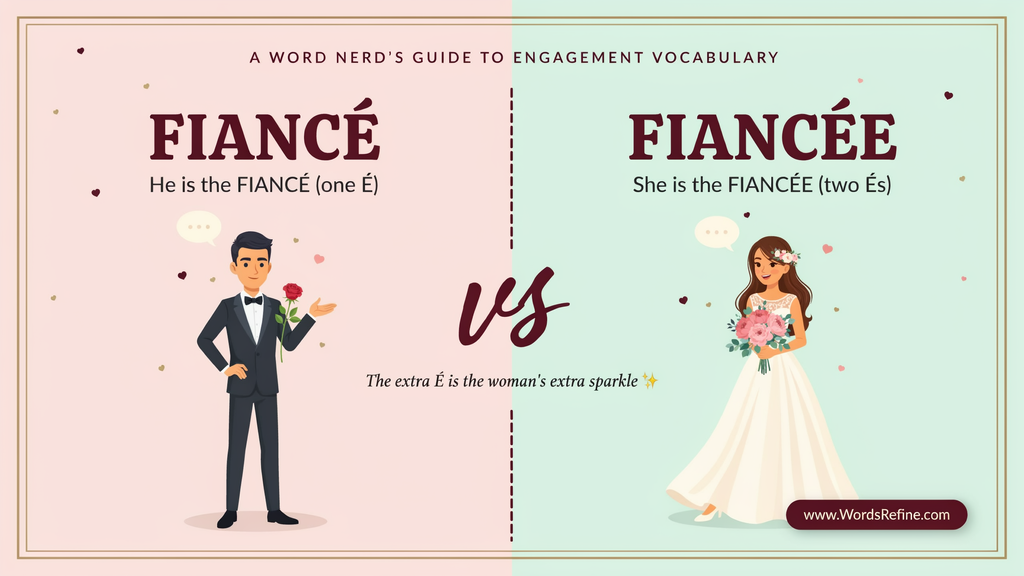
Fiancé refers traditionally to a man who is engaged to be married.
Fiancée refers traditionally to a woman who is engaged to be married.
Both words describe someone who has agreed or promised to marry another person.
Fiancé ends with one final e, written as fiancé.
Fiancée ends with two e’s, written as fiancée.
In ordinary English pronunciation, the two words are generally pronounced the same.
Consider this simple example:
“Sarah is getting married to her fiancé.”
Here, fiancé refers to Sarah’s male partner.
Now look at the opposite situation:
“James is getting married to his fiancée.”
Here, fiancée refers to James’s female partner.
The relationship is the same in both sentences. Only the person being described changes.
What Is a Fiancé?
A fiancé is a man who is engaged to be married. The word describes his relationship status rather than simply his role as a romantic partner.
For example, if two people are dating, the man can be called a boyfriend. Once they become engaged, he can traditionally be called a fiancé.
This distinction matters because boyfriend and fiancé don’t mean exactly the same thing.
Consider these examples:
- “Daniel is my boyfriend.”
- “Daniel is my fiancé.”
The first sentence tells us that Daniel is a romantic partner. The second tells us that Daniel is engaged to be married to the person speaking.
Therefore, the word fiancé carries a more specific meaning. It tells the reader that an engagement has taken place.
You can use fiancé in many different sentence structures:
“Her fiancé works in Boston.”
“My fiancé and I are planning our wedding.”
“She introduced her fiancé to her family.”
“Her fiancé helped choose the wedding venue.”
In every case, the word refers to an engaged man.
Learn the difference between commonly mixed-up more words
Vender vs Vendor Which one Is Correct?
What Is a Fiancée?
A fiancée is a woman who is engaged to be married. It is traditionally the feminine form of fiancé.
Just as boyfriend can describe a male romantic partner before an engagement, girlfriend can describe a female romantic partner. After an engagement, the traditional term becomes fiancée.
For example:
“Maria is my girlfriend.”
“Maria is my fiancée.”
The first sentence describes a romantic relationship. The second indicates that Maria is engaged to be married.
You can use fiancée in sentences such as:
“His fiancée works at a local hospital.”
“My fiancée and I are choosing the invitations.”
“He introduced his fiancée to his friends.”
“Her fiancée helped organize the reception.”
Again, the important detail is the person’s gender in the traditional usage of the word.
Fiancé vs Fiancée What Is the Difference?
The difference between fiancé and fiancée is surprisingly small in spelling but clear in traditional meaning.
Fiancé is the masculine form, while fiancée is the feminine form.
| Word | Traditional use | Meaning |
|---|---|---|
| Fiancé | Man | A man engaged to be married |
| Fiancée | Woman | A woman engaged to be married |
For example:
“Emma’s fiancé proposed during their vacation.”
Emma’s partner is a man, so fiancé is appropriate.
“John’s fiancée is choosing the flowers.”
John’s partner is a woman, so fiancée is appropriate.
Therefore, when you’re trying to remember the distinction, don’t focus only on the spelling. Focus on the person the word describes.
Why Does Fiancée Have Two E’s?
The reason for the different endings comes from French.
English borrowed fiancé and fiancée from French, where the forms reflect grammatical gender. French traditionally distinguishes between masculine and feminine forms in many words.
The masculine form is fiancé.
The feminine form is fiancée.
That explains why the feminine version has an additional e.
For English speakers, this can seem unusual because English doesn’t generally mark nouns this way. However, English has kept the traditional distinction in these French-derived words.
A useful way to remember it is:
Fiancé has one final e.
Fiancée has two final e’s.
The form with the additional e is traditionally feminine.
The memory trick isn’t a universal English grammar rule. It simply helps you remember this particular pair.
The spelling difference becomes much easier when you look at the endings.
Learn the difference between confusing more English words
Lay vs Lie Difference and which is correct?
Fiancé vs Fiancée Spelling Difference
The Fiancé is written:
fiancé
Fiancée is written:
fiancée
The most noticeable difference is the additional e in fiancée.
The accent mark can also cause confusion. Both traditional forms use an acute accent over the final e.
If you’re wondering how to spell fiancé, remember the shorter ending:
fiancé
If you’re wondering how to spell fiancée, remember the additional e:
fiancée
A quick comparison can help:
| Form | Ending | Traditional meaning |
|---|---|---|
| fiancé | é | Engaged man |
| fiancée | ée | Engaged woman |
Once you notice the final letters, the spelling becomes much easier to recognize.
Fiance vs Fiancee Without Accent Marks

You may often see these words written as fiance vs fiancee without accent marks. This happens frequently in casual online writing, text messages, emails, and situations where a keyboard makes accented characters inconvenient.
The traditional spellings are fiancé and fiancée.
However, English sometimes removes diacritical marks from borrowed words, especially in informal writing. Therefore, seeing fiance instead of fiancé doesn’t necessarily mean the writer doesn’t understand the word.
For polished writing, the accented forms are usually the better choice:
fiancé
fiancée
The important point is that the absence of the accent doesn’t change the relationship being described.
For example, these sentences communicate essentially the same meaning:
“My fiance is visiting tonight.”
“My fiancé is visiting tonight.”
The second version follows the traditional spelling.
Learn the difference between tricky grammar more words
Any time vs anytime meaning Difference with Examples ?
Fiancé vs Fiancée Pronunciation
Spelling isn’t much help when you hear these words spoken.
In English, fiancé and fiancée are generally pronounced the same way. A simple pronunciation guide is approximately “fee-ahn-SAY.”
The exact sound can vary slightly depending on the speaker’s accent, but the spelling difference usually doesn’t create a noticeable pronunciation difference.
That means you can’t normally hear whether someone means fiancé or fiancée.
You have to rely on the sentence or the written form.
For example, if someone says:
“My fiancé is coming tonight.”
You may need additional context to know whether the speaker is referring to a man or a woman.
This makes the pair particularly interesting. The spelling preserves a traditional gender distinction, while spoken English usually doesn’t make that distinction audible.
Is My Boyfriend My Fiancé?
Not necessarily.
A boyfriend is a male romantic partner. A fiancé is traditionally a male partner who is engaged to be married.
The difference is engagement.
For example:
“Alex is my boyfriend.”
This tells us that Alex is the speaker’s romantic partner, but it doesn’t tell us that they’re engaged.
“My boyfriend Alex proposed to me, and now he’s my fiancé.”
Now the relationship has moved from dating to engagement.
The same idea applies to the feminine form.
Learn the difference between tricky grammar more words
Whoever vs Whomever How to Use Each Word Correctly?
Is My Girlfriend My Fiancée?
Again, not automatically.
A girlfriend is a female romantic partner. A fiancée is traditionally a woman who is engaged to be married.
For example:
“Lisa is my girlfriend.”
This sentence doesn’t indicate an engagement.
However:
“Lisa accepted my proposal, so she’s now my fiancée.”
Now the word fiancée is appropriate because the couple is engaged.
Therefore, the terms boyfriend and girlfriend don’t automatically become fiancé and fiancée. The change in vocabulary reflects a change in relationship status.
Fiancé vs Husband and Fiancée vs Wife
The words also help distinguish engagement from marriage.
Traditionally, the relationship terms progress like this:
- Boyfriend → fiancé → husband
- Girlfriend → fiancée → wife
The middle stage represents engagement.
For example:
Before engagement:
“Daniel is my boyfriend.”
After engagement:
“Daniel is my fiancé.”
After marriage:
“Daniel is my husband.”
Likewise:
Before engagement:
“Emma is my girlfriend.”
After engagement:
“Emma is my fiancée.”
After marriage:
“Emma is my wife.”
These terms aren’t interchangeable because they describe different relationship stages.
Someone can be a romantic partner without being engaged. Someone can be engaged without being married. Once the wedding takes place, husband or wife traditionally replaces fiancé or fiancée.
When to Use Fiancé and Fiancée
Using these words correctly doesn’t require complicated grammar.
The main thing to remember is what each noun represents.
1. Use fiancé for an engaged man.
2.Use fiancée for an engaged woman.
3.Use boyfriend or girlfriend when describing a romantic partner who isn’t engaged, if that is the intended meaning.
4.Use husband or wife after marriage when those traditional terms apply.
5.Use the accented forms in polished writing when you want to preserve the traditional spelling.
The words usually function as nouns.
For example:
“Her fiancé arrived early.”
Here, fiancé is the subject.
“She invited her fiancé.”
Here, fiancé is the object.
“His fiancée called this morning.”
Here, fiancée is the subject.
“He thanked his fiancée.”
Here, fiancée is the object.
The possessive word doesn’t determine which form you need. The person being described does.
Learn the difference between often confused words
Loose vs Lose Difference and which is Correctly?
His Fiancé vs Fiancée?

This is another common source of confusion.
The correct choice depends on the gender of the person who is engaged, not on the word his.
For example:
“His fiancée is arriving soon.”
Here, his tells us that the engaged person belongs in relation to a man. The actual partner is a woman, so fiancée is correct.
Now consider:
“His fiancé is arriving soon.”
Here, the engaged person is a man.
The same principle applies to her:
“Her fiancé is arriving soon.”
The fiancé is a man.
“Her fiancée is arriving soon.”
The fiancée is a woman.
The possessive pronoun and the gender of the fiancé or fiancée are two different things.
Fiancé vs Fiancée Examples in Sentences
Context makes the distinction much easier to understand.
| Sentence | Correct form | Reason |
|---|---|---|
| “Her fiancé called this morning.” | fiancé | Her partner is a man. |
| “His fiancée called this morning.” | fiancée | His partner is a woman. |
| “My fiancé and I chose the venue.” | fiancé | The speaker’s partner is a man. |
| “My fiancée and I chose the venue.” | fiancée | The speaker’s partner is a woman. |
| “She introduced her fiancé.” | fiancé | She is introducing an engaged man. |
| “He introduced his fiancée.” | fiancée | He is introducing an engaged woman. |
These examples show why context matters more than memorizing isolated spellings.
Learn the difference between basic English word mistakes
Choose vs Chose Difference and which one is Correct?
Common Fiancé vs Fiancée Mistakes
These words cause a few predictable mistakes. Fortunately, each one has a simple solution.
Using fiancée for a man
Incorrect:
“Her fiancée is a doctor.”
If the partner is a man, the traditional form is fiancé.
Correct:
“Her fiancé is a doctor.”
Using fiancé for a woman
Incorrect:
“His fiancé is planning the reception.”
If the partner is a woman, the traditional form is fiancée.
Correct:
“His fiancée is planning the reception.”
Calling a boyfriend a fiancé too early
A romantic relationship doesn’t automatically mean engagement.
If two people are dating, boyfriend or girlfriend may be appropriate. Fiancé and fiancée indicate an engagement.
Learn the difference between misused words
Capital vs Capitol Which One Is Correct?
Assuming pronunciation tells you the spelling
It doesn’t.
Because the two forms are generally pronounced alike in English, listening alone won’t reliably tell you which spelling to use.
Forgetting the extra e
This is probably the most common spelling problem.
Remember:
fiancé → one final e
fiancée → two final e’s
The extra e belongs to the traditional feminine form.
Can a Man Be Called a Fiancée?
Traditionally, no.
A man who is engaged to be married is called a fiancé.
For example:
“He is my fiancé.”
The form fiancée is traditionally feminine.
However, English usage can sometimes be less rigid than traditional rules. Some speakers use fiancé as a broader term rather than maintaining the masculine and feminine distinction. Even so, if you’re following the conventional distinction taught in English vocabulary, fiancé is the appropriate term for an engaged man.
Can a Woman Be Called a Fiancé?
Traditionally, a woman is called a fiancée.
For example:
“She is my fiancée.”
The form fiancé is traditionally masculine.
Some modern English speakers may use fiancé more generally, particularly because English often moves away from gender-specific vocabulary. Nevertheless, fiancée remains the established traditional feminine form and is the clearest choice when you want to preserve the distinction.
Why Are Fiancé vs Fiancée So Easy to Confuse?
The confusion isn’t surprising.
First, the words look nearly identical. Only one extra letter separates the two traditional forms.
Second, they generally sound the same in English. That means pronunciation doesn’t provide much help.
Third, their French origin gives them spelling patterns that aren’t immediately obvious to many English learners.
Finally, the accent mark can distract writers from the more important distinction. Someone may remember that the word contains é but still forget whether it should end in é or ée.
In other words, the problem isn’t that the rule is difficult. The problem is that the words are almost identical in appearance and sound.
Learn the difference between everyday English mistakes
Further vs Farther The Simple Difference and Each Correctly?
Fiancé vs Fiancée in Everyday Writing
You’ll encounter these words in many settings.
For example, people commonly use them when discussing:
- Wedding planning
- Engagement announcements
- Family introductions
- Wedding invitations
- Relationship updates
- Personal biographies
- Conversations about future spouses
- Marriage plans
Here are a few natural examples:
“My fiancé and I are looking at venues.”
“Her fiancée is helping with the guest list.”
“I met his fiancée last weekend.”
“My fiancé ordered the invitations.”
“Her fiancée is traveling for work.”
The words fit naturally into both casual and formal contexts.
A Simple Way to Remember the Difference
When the two spellings start looking like alphabet soup, use one simple question:
Who are you describing?
If the answer is a man, use fiancé.
If the answer is a woman, use fiancée.
Then check the spelling.
- Man → fiancé
- Woman → fiancée
The extra e in fiancée can serve as your visual reminder.
For example:
“Her fiancé is Mark.”
Mark is a man, so fiancé is correct.
“His fiancée is Sarah.”
Sarah is a woman, so fiancée is correct.
You can also remember the pair by thinking of the final letters:
fiancé → é
fiancée → ée
That tiny difference is enough to keep the two words apart.
Learn the difference between more words people mix up
Discrete vs Discreet What the Difference and which is Correctly?
Fiancé vs Fiancée Grammar Rules at a Glance
The entire distinction can be reduced to a few practical points.
| Question | Answer |
|---|---|
| What does fiancé mean? | A man engaged to be married |
| What does fiancée mean? | A woman engaged to be married |
| Is fiancé traditionally male or female? | Male |
| Is fiancée traditionally male or female? | Female |
| What is the male form? | fiancé |
| What is the female form? | fiancée |
| Do they refer to engaged people? | Yes |
| Are they normally pronounced differently in English? | No |
| Does fiancée contain an extra e? | Yes |
| Does fiancé contain one final e? | Yes |
| Can boyfriend mean the same thing as fiancé? | No |
| Can girlfriend mean the same thing as fiancée? | No |
| What does a fiancé traditionally become after marriage? | Husband |
| What does a fiancée traditionally become after marriage? |
Practice session Fiancé vs Fiancée
- Sarah introduced her ________ to her family at dinner.
- Mark is getting married next summer, and his ________ is helping him plan the wedding.
- Emma’s ________ surprised her with a beautiful engagement ring.
- Daniel told everyone that his ________ had already chosen their wedding date.
- My sister’s ________ works as a teacher.
- James is excited because his ________ will move in with him after the wedding.
- Lisa and her ________ are busy planning their wedding ceremony.
- Tom’s ________ helped him choose his wedding suit.
- Maria said that her ________ proposed during a weekend trip.
- David introduced his ________ to his coworkers at the office party.
- Anna’s ________ is from Chicago but grew up in Texas.
- Robert said that his ________ loves planning weddings.
- My brother’s ________ is looking for a photographer for their wedding.
- Julia proudly showed us a picture of her ________.
- Michael’s ________ will become his wife after the wedding.
- Emily said that her ________ forgot to order the wedding invitations.
- The groom-to-be thanked his ________ for helping with the wedding preparations.
- Olivia’s ________ gave her a bouquet of flowers before the ceremony.
- Jack and his ________ are discussing their honeymoon plans.
- Sophia’s ________ asked her parents for their blessing.
- My cousin is excited because her ________ will soon become her husband.
- William said that his ________ had already bought her wedding dress.
- The woman introduced her ________ to her friends at the party.
- The man introduced his ________ to his friends at the engagement party.
- After getting engaged, Rachel stopped calling her boyfriend her boyfriend and started calling him her ________.
Answers
- fiancée
- fiancée
- fiancé
- fiancée
- fiancé
- fiancée
- fiancé
- fiancée
- fiancé
- fiancée
- fiancé
- fiancée
- fiancée
- fiancé
- fiancée
- fiancé
- fiancée
- fiancé
- fiancée
- fiancé
- fiancé
- fiancée
- fiancé
- fiancée
- fiancé
Here’s a trusted source for clear word meanings:
FAQs
What is the simplest way to remember fiancé and fiancée?
Remember the extra e in fiancée. Traditionally, fiancé refers to an engaged man, while fiancée refers to an engaged woman.
Does fiancé refer only to a man?
Traditionally, yes. Fiancé is the standard masculine form for a person who is engaged to be married. Fiancée is the traditional feminine form.
Does fiancée refer only to a woman?
Traditionally, yes. Fiancée refers to a woman who is engaged to be married. The extra e reflects the traditional feminine form borrowed from French.
Can fiancé be used for any gender?
In some modern English usage, fiancé can be used more broadly as a gender-neutral term. However, if you want to make the traditional distinction clear, use fiancé for a man and fiancée for a woman.
Is fiancé a noun?
Yes. Fiancé is a noun because it names a person who is engaged to be married. For example, “My fiancé called this morning.”
Is fiancée a noun?
Yes. Fiancée is also a noun. It refers to a woman who is engaged to be married. For example, “Her fiancée is helping with the wedding plans.”
Why does fiancée have two e’s?
Fiancée has two e’s at the end because it follows the traditional feminine form of the French word. Fiancé is the masculine form, while fiancée is the feminine form.
Are fiancé and fiancée pronounced the same way?
Generally, yes. In English, the two words are usually pronounced alike. Their main difference is their spelling and traditional grammatical use.
What are the plural forms of fiancé and fiancée?
The plural forms are fiancés and fiancées. Traditionally, fiancés refers to engaged men, while fiancées refers to engaged women.
What is the spelling difference between fiancé and fiancée?
Fiancé ends with é, while fiancée ends with ée. That extra e is the key spelling difference between the two traditional forms.
When does a boyfriend become a fiancé?
A boyfriend becomes a fiancé when he becomes formally engaged to be married. Being in a serious relationship alone does not make someone a fiancé.
When does a girlfriend become a fiancée?
A girlfriend becomes a fiancée when she becomes formally engaged to be married. The term describes an engagement rather than simply a romantic relationship.
Should fiancé and fiancée be capitalized?
Normally, no. Both words are lowercase unless they begin a sentence or appear in a context that requires capitalization.
Is “fiance” without an accent mark correct?
“Fiance” is commonly seen in informal writing, especially when people do not use accent marks. However, fiancé is the traditional spelling and is preferable in careful writing.
Is “fiancee” without accent marks correct?
Fianсee may appear in casual writing, but fiancée is the traditional spelling. In formal or polished writing, use the accented form.
What is the difference between an engaged person and a fiancé or fiancée?
Engaged person is a general expression that can describe anyone who has agreed to marry. Fiancé and fiancée are specific relationship terms traditionally used for an engaged man and an engaged woman.
Can someone be a fiancé without having a wedding date?
Yes. A person can be a fiancé or fiancée even when the couple has not chosen a wedding date. The term refers to the engagement itself, not the timing of the wedding.
Does an engagement automatically make someone a fiancé or fiancée?
If two people are formally engaged to marry, each person can traditionally refer to the other as a fiancé or fiancée. The appropriate form depends on the gender of the person being described.
Which is correct: “my fiancé” or “my fiancée”?
Both can be correct. Use my fiancé for an engaged man and my fiancée for an engaged woman. The word my does not determine which form you should use.
Which is correct: “his fiancé” or “his fiancée”?
Both can be correct. His fiancé traditionally refers to an engaged man, while his fiancée traditionally refers to an engaged woman. The pronoun his does not determine the spelling.
Which is correct: “her fiancé” or “her fiancée”?
Both can be correct. Her fiancé traditionally refers to an engaged man, while her fiancée traditionally refers to an engaged woman. The person’s gender determines the traditional form.
What can I say instead of fiancé or fiancée?
Depending on the context, you can say engaged partner, future spouse, future husband, future wife, or person I am engaged to. However, these expressions may sound more general than fiancé or fiancée.
Does fiancé mean husband?
No. A fiancé is someone who is engaged to be married. A husband is someone who is already married. The relationship status changes after the wedding.
Does fiancée mean wife?
No. A fiancée is a woman who is engaged to be married. A wife is a woman who is already married.
What do you call a fiancé after marriage?
After the wedding, a fiancé traditionally becomes a husband. Likewise, a fiancée traditionally becomes a wife.
Why are fiancé and fiancée so easy to confuse?
They look almost identical and are generally pronounced the same way in English. The extra e in fiancée is easy to overlook, even though it traditionally distinguishes the feminine form from the masculine form.
Are fiancé and fiancée originally English words?
No. Both words come from French. English adopted the terms while retaining the traditional masculine and feminine spelling distinction.
Is the difference between fiancé and fiancée important in everyday English?
It depends on the context. Many speakers understand both forms easily, but using fiancé for an engaged man and fiancée for an engaged woman follows the traditional distinction and makes your writing precise.
Conclusion
Fiancé vs fiancée may look almost identical, but that tiny extra e is doing more work than it seems. Traditionally, fiancé refers to a man who is engaged to be married, while fiancée refers to a woman who is engaged to be married. In short, one final e means fiancé, while two final e’s mean fiancée.
Fortunately, pronunciation is not another trap. Both words are generally pronounced the same way in English, so the real challenge is remembering the spelling. Once you connect the extra e with the traditional feminine form, the difference becomes much easier to remember.
So, whether you are writing a wedding invitation, introducing your future spouse, or simply trying to avoid an awkward grammar mistake, you can confidently choose the right word. After all, engagements can be complicated enough. Your grammar does not need to propose a problem, too.

Diora AJS she is an experienced blogger and passionate English language enthusiast at Words Refine. With a keen eye for language and a love for clear communication, she writes practical content about grammar, word meanings, usage, and commonly confused terms. Her goal is to make English easier to understand through clear explanations and relatable examples, helping readers write accurately and communicate with confidence.