
Have you ever stopped mid sentence and wondered whether it should be “any time” vs “anytime”? You are not alone. That tiny space may seem insignificant, yet English grammar has a funny way of making small details surprisingly confusing. Both forms are correct, but they serve different grammatical purposes. Understanding the difference between “any time” and “anytime” can help you avoid common writing mistakes and choose the right form with confidence. In this guide, you well discover what each form means, when to use it, and how it works in everyday sentences. By the end, this seemingly tricky pair will feel much easier to handle.
Any Time vs Anytime The Quick Answer
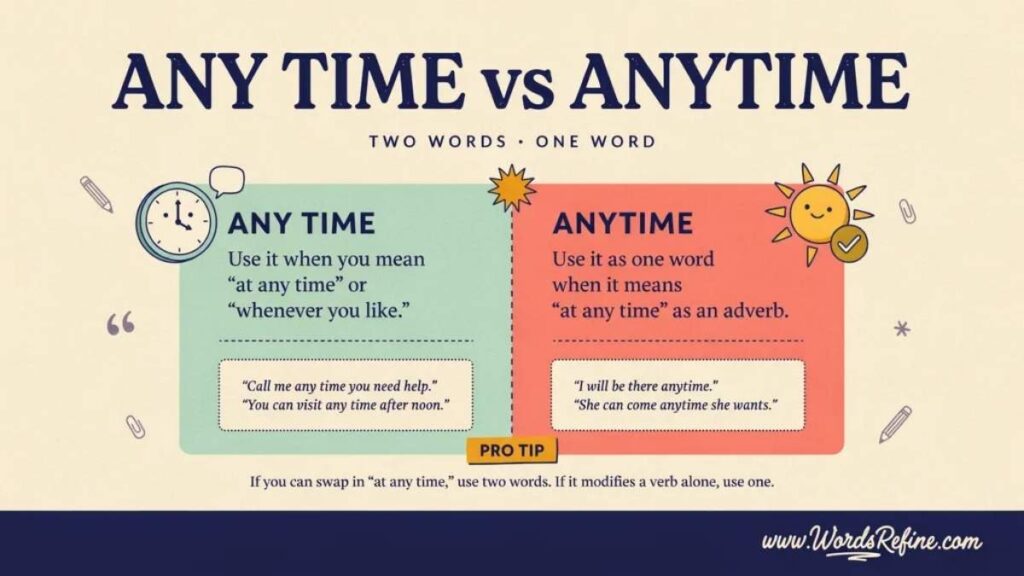
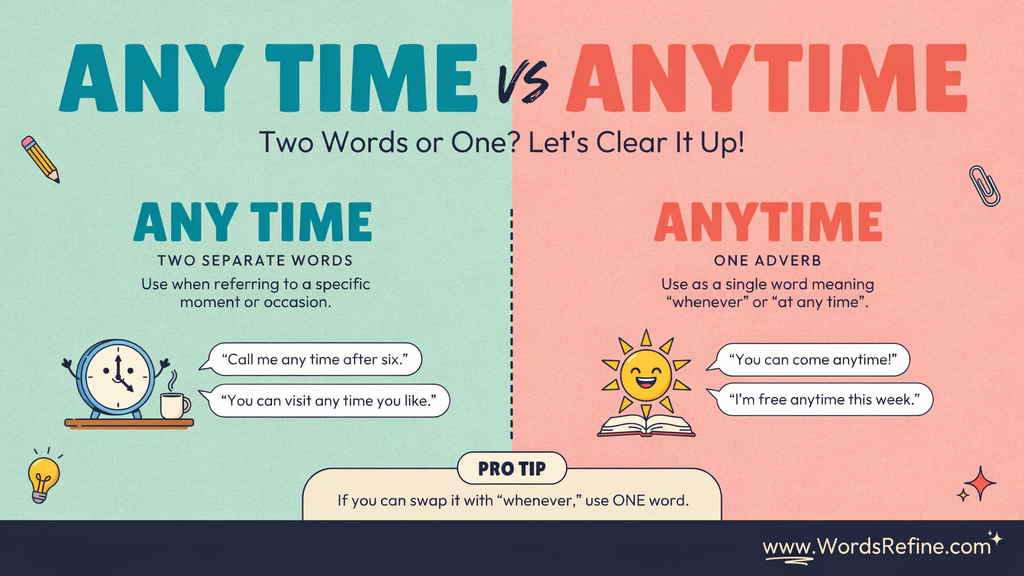
The simplest rule is that anytime is generally used as an adverb, while any time is used as a noun phrase.
Consider these examples:
Call me anytime.
Do you have any time to talk?*You can contact me at any time.
Call me any time after 2 PM
In the first sentence, anytime means “whenever.” It tells us when the person can call.
In the second sentence, any time refers to an amount of available time.
The third sentence uses the standard expression at any time.
Finally, the fourth sentence refers to an unspecified time within a particular range. The phrase after 2 PM gives that time a boundary.
Therefore, when asking “is it anytime or any time?” the answer depends on the grammatical role of the expression.
What Is the Difference Between Anytime vs Any Time?

The difference between anytime and any time becomes clearer when you look at the parts of speech.
Anytime is generally an adverb. It describes when something can happen.
For example:
You can visit anytime.
Here, anytime tells us when the person can visit. It means “whenever you want.”
Any time, on the other hand, contains the noun time. The word any modifies that noun.
For example:
Do you have any time to help me?
Here, the speaker asks whether the other person has an available amount or period of time.
This gives you a useful way to remember the distinction:
- Anytime usually means whenever or at any time.
- Any time refers to an amount, period, or point of time.
- At any time is the standard construction after the preposition at.
- Any time is often preferred when another phrase specifies the time, such as after 2 PM or before lunch.
Although these patterns are reliable, English usage can overlap. For example, both “Call me anytime” and “Call me any time” may be understood in everyday writing. However, the one-word form is especially natural when it functions clearly as an adverb.
Learn the difference between commonly mixed-up more words
Vender vs Vendor Which one Is Correct?
Anytime Meaning and Definition
The basic anytime meaning is “at any time” or “whenever.”
When you say:
You can call me anytime.
you mean:
You can call me whenever you want.
The word doesn’t identify a particular hour or date. Instead, it leaves the timing open.
This makes anytime useful in conversations about invitations, availability, assistance, and repeated possibilities.
For example:
You can email me anytime.
Feel free to ask anytime.
Come over anytime.
We can leave anytime.
Call me anytime if you need help.
In each example, anytime describes when an action may take place.
Anytime as an Adverb
As an adverb, anytime usually modifies a verb or an entire clause.
Consider this sentence:
Sarah can start anytime.
The word anytime answers the question “When can Sarah start?”
The answer is “anytime.”
Likewise:
You can contact the office anytime.
The word describes when the action of contacting the office can occur.
This is why understanding grammatical function is more useful than simply memorizing whether the word should have a space.
Learn the difference between tricky grammar more words
Whoever vs Whomever How to Use Each Word Correctly?
Any Time Meaning and Definition
The phrase any time has a different grammatical structure because time remains a noun.
For example:
I don’t have any time today.
Here, time means an amount of available time. The sentence doesn’t mean “I don’t have whenever today.” Instead, it means that the speaker has no available time.
The same idea appears in:
- Do you have any time to talk?
- I don’t have any time this morning.
- She needs any time she can get.
- We don’t have any time to waste.
- Is there any time available this afternoon?
In each sentence, time functions as a noun.
Therefore, any time meaning an amount of time is one of the clearest situations in which you should use the two-word form.
When to Use Anytime
When should I use anytime?
Use anytime when it works as an adverb and means “whenever” or “at any time.”
For example:
Call me anytime.
This means:
Call me whenever you want.
Similarly:
Visit us anytime.
means:
Visit us whenever you want.
The same pattern works in many everyday sentences.
Text me anytime.
Email me anytime.
Ask me anytime.
Stop by anytime.
You can leave anytime.
Feel free to call anytime.
We can discuss it anytime.
These sentences all describe when an action can happen.
Learn the difference between often confused words
Capital vs Capitol Which One Is Correct?
How to Know When to Use Anytime

There is a simple test that can help.
Try replacing anytime with whenever.
For example:
Call me anytime.
becomes:
Call me whenever you want.
The meaning remains clear.
Try another:
Visit anytime.
becomes:
Visit whenever you want.
Again, the meaning works.
This “whenever” test is a useful way to remember how to use anytime correctly.
Learn the difference between basic English word mistakes
Lay vs Lie Difference and which is correct?
When to Use Any Time
When should I use any time?
Use any time when time functions as a noun and refers to an amount, period, or possible point in time.
For example:
Do you have any time to talk?
Here, the speaker wants to know whether the person has some available time.
Another example is:
I don’t have any time today.
The phrase any time refers to an amount of available time.
This structure commonly appears in questions, negative statements, and sentences involving the amount of time someone has.
Do you have any time tomorrow?
don’t have any time this afternoon.
We need any time we can get.She didn’t have any time to prepare.
Do you have any time after lunch?
He spent any time he had studying.
When time represents a quantity or period, the two-word form usually makes the grammatical structure clear.
Any Time vs Anytime With “At”
One of the most useful rules involves the preposition at.
The standard expression is:
at any time
For example:
You can cancel the service at any time.
Please contact us at any time if you need assistance.
The meeting may end at any time.
The construction is straightforward:
at + any time
Here, any time functions as a noun phrase inside a prepositional phrase.
For that reason, “at anytime” should generally be avoided in careful standard English.
Instead, write:
Please call us at any time.
rather than:
Please call us at anytime.
This is one of the most practical any time grammar rules to remember.
Any Time vs Anytime After 2 PM
The phrase “any time after 2 PM” causes plenty of confusion.
Consider:
Call me any time after 2 PM.
This sentence means that the person can call at any point after 2 PM.
The two-word form works well because after 2 PM identifies the range in which the possible time occurs.
Compare the following:
Call me anytime.
This simply means “Call me whenever you want.”
Now compare:
Call me any time after 2 PM.
The second sentence gives the reader a clear time boundary.
The same pattern appears in phrases such as:
- any time after work
- any time before noon
- any time during the week
- any time this afternoon
- any time next month
- any time after lunch
So, when writing a sentence such as “anytime after 2 PM,” the two-word form is generally the clearer standard choice:
any time after 2 PM
Anytime After Work vs Any Time After Work?
Both expressions can appear in everyday writing, especially because speakers often treat the meaning casually.
For example:
Call me anytime after work.
is common and easy to understand.
However:
Call me any time after work.
makes the noun time more visible and is a safer choice in carefully edited writing.
The difference is subtle because the meaning is nearly identical. Still, when another phrase follows time and establishes a range, the two-word form provides greater grammatical clarity.
This is particularly useful in schedules, workplace messages, instructions, and formal correspondence.
“Call Me Anytime” vs “Call Me Any Time”?
Both forms can be encountered in English, but “Call me anytime” is a particularly natural construction when anytime functions as an adverb.
For example:
Call me anytime if you need help.
The word anytime means “whenever you need help.”
However, the two-word form can also occur:
Call me any time you need help.
Here, the construction can be understood as a time expression connected to the following clause.
The important point is that you shouldn’t assume that one spelling is always correct.
Instead, look at the sentence structure.
If anytime means whenever, the one-word form is often the most natural choice.
If time clearly functions as a noun, use any time.
Learn the difference between misused words
Further vs Farther The Simple Difference and Each Correctly?
“I Am Available Anytime” vs “Any Time”?
The sentence “I am available anytime” is grammatically acceptable.
It means that the speaker is available whenever needed.
For example:
I am available anytime this week.
However, if a preposition appears before the expression, use the two-word form:
I am available at any time.
If the sentence gives a specific range, the two-word form is also a strong choice:
I am available any time after 2 PM.
These three sentences look similar, but their structures differ.
1.I am available anytime.
2.I am available at any time.
3.I am available any time after 2 PM.
The first uses the adverb anytime.
The second uses the prepositional phrase at any time.
The third uses any time as a noun phrase followed by a phrase that defines the available range.
“Please Call Me Anytime” vs “Please Call Me at Any Time”
Both sentences communicate essentially the same idea:
Please call me anytime.
Please call me at any time.
The first sounds more relaxed and conversational.
The second sounds slightly more formal and deliberate.
For a text message to a friend, “Please call me anytime” sounds perfectly natural.
For a formal instruction, “Please call me at any time” may fit the tone better.
Neither sentence needs unnecessary complication. The context determines which expression sounds most appropriate.
Any Time or Anytime After “Thank You”
Another common question is whether to write anytime or any time after someone says thank you.
A very natural response is:
Anytime!
For example:
“Thank you for helping me.”
“Anytime!”
In this situation, anytime means something close to “whenever you need help again.”
It is a friendly and familiar response in everyday American English.
You can also say:
You’re welcome.
or:
You’re welcome anytime.
The second sentence has a slightly different structure. It can mean that someone is welcome whenever they want to visit or return.
For example:
You’re welcome anytime.
This can mean:
You’re welcome whenever you want to come back.
By contrast:
You’re welcome at any time.
has a more formal tone.
Anytime in Formal Writing
Is anytime correct in formal writing?
Yes. Anytime is a legitimate English word, and its use isn’t automatically informal or incorrect.
For example:
Customers can contact the support team anytime.
This sentence is grammatically acceptable.
However, formal writing often favors precise constructions. In a policy or official notice, you might see:
Customers may contact the support team at any time.
The second version can sound more deliberate and formal.
Therefore, don’t treat “anytime” as a forbidden word in professional writing. Instead, consider the tone and grammatical structure of the sentence.
Anytime in Informal Writing
In informal writing, anytime is especially common.
You might write:
Call me anytime.
Come over anytime.
Text me anytime.
Ask me anytime.
Thanks! Anytime!
Feel free to message me anytime.
These sentences sound natural because the word fits the relaxed tone.
Formal and informal writing don’t always require different grammar. Often, they simply favor different levels of formality.
Common Mistakes with Any Time and Anytime
These two forms create several common writing mistakes.
Writing “At Anytime”
A frequent error is:
Contact me at anytime.
The standard form is:
Contact me at any time.
The phrase follows the normal structure of a preposition followed by a noun phrase.
Using “Anytime” for an Amount of Time
Another common mistake is:
I don’t have anytime today.
The preferred form is:
I don’t have any time today.
Here, the speaker means that they don’t have an available amount of time.
Likewise:
Do you have any time?
is correct when asking about available time.
Assuming Anytime Always Replaces Any Time
The one-word form cannot replace the two-word form in every sentence.
For example:
I don’t have any time.
is different from:
I don’t have anytime.
The first sentence clearly treats time as a noun.
The second doesn’t work naturally in standard English for that meaning.
The lesson is simple: spelling follows grammatical function.
Anytime vs Any Time A Practical Comparison
| Feature | Anytime | Any time |
|---|---|---|
| Number of words | One | Two |
| Typical role | Adverb | Noun phrase |
| Main meaning | Whenever; at any time | An unspecified amount, period, or point of time |
| Example | Call me anytime. | Do you have any time? |
| After “at” | Usually avoid | At any time |
| With a time range | Less preferred | Any time after 2 PM |
| Common response to thanks | Anytime! | Less common |
| Informal use | Very common | Also common |
| Formal use | Acceptable when grammatically appropriate | Often useful for precision |
The table shows why the question isn’t simply about spelling. The real issue is how the expression functions in the sentence.
Anytime vs Any Time Examples
Here are some clear examples that show how the two forms work.
Call me anytime.
Do you have any time to talk?
You can visit anytime.
I don’t have any time today.
Please contact me at any time.
Call me any time after 2 PM.
Feel free to email me anytime.
Is there any time available tomorrow?
You can ask questions anytime.
We don’t have any time to waste.
Notice how the meaning changes depending on the structure.
In “Call me anytime,” the word describes when the action can happen.
In “Do you have any time?” the phrase refers to available time.
That small distinction solves most cases of confusion.
Any Time vs Anytime Formal and Informal Usage
Choosing between these forms can sometimes depend on context as well as grammar.
In a casual conversation, you might say:
Come anytime.
In a formal notice, you might write:
Visitors may arrive at any time.
The second sentence sounds more official, but that doesn’t mean the first is grammatically wrong.
Similarly:
Feel free to contact me anytime.
works well in an everyday professional email.
A policy might instead say:
Customers may contact the company at any time.
Therefore, formal writing doesn’t have a blanket rule that bans anytime. The correct usage depends on the sentence.
Any Time vs Anytime Synonyms and Alternatives
Sometimes another expression can make your sentence even clearer.
Depending on the context, alternatives to anytime include:
- whenever
- at any time
- at any moment
- whenever convenient
- whenever you want
- whenever you need
For example:
Call me anytime.
can become:
Call me whenever you need me.
Similarly:
Contact us at any time.
can sometimes become:
Contact us whenever convenient.
However, these alternatives aren’t always interchangeable.
For example:
Do you have any time today?
cannot naturally become:
Do you have whenever today?
That’s because any time in the first sentence functions as a noun phrase.
How to Use Anytime Correctly
If you’re unsure how to use anytime correctly, begin by identifying what the word means in your sentence.
Ask whether it means “whenever.”
If it does, anytime will often be the right choice.
For example:
You can call anytime.
The word can easily be understood as:
You can call whenever you want.
Another helpful clue is that anytime often appears near a verb:
Visit anytime.
Ask anytime.
Call anytime.
Email anytime.
This isn’t an absolute rule, but it is a useful pattern.
How to Use Any Time Correctly
When learning how to use any time correctly, look for situations in which time remains a noun.
Ask whether the sentence refers to an amount, period, or possible point in time.
For example:
Do you have any time this afternoon?
The speaker wants to know whether there is an available period.
Another useful pattern occurs when a phrase specifies the time:
any time after lunch
any time before noon
any time during the week
Also remember the standard prepositional construction:
at any time
These patterns make the correct usage much easier to recognize.
Learn the difference between more words people mix up
Choose vs Chose Difference and which one is Correct?
A Simple Way to Remember the Difference
If the two forms still look like grammatical twins wearing different shirts, use this simple test.
First, ask whether you can replace the expression with “whenever.”
If yes, anytime is often appropriate.
Call me anytime.
→ Call me whenever you want.
Second, ask whether time means an amount or period.
If yes, use any time.
I don’t have any time.
Third, check whether a preposition such as at directly introduces the expression.
If so, use:
at any time
Finally, look for a phrase that defines the time range.
For example:
any time after 2 PM
any time before lunch
These situations favor the two-word form.
Practice Session Any Time vs Anytime
- You can call me ________ if you need help.
- I don’t have ________ to finish my homework tonight.
- Please feel free to visit us ________.
- Do you have ________ to discuss the project?
- You can email me ________ if you have any questions.
- We can meet ________ after 3 PM.
- She hasn’t had ________ to relax lately.
- ________ you need help, just let me know.
- He said I could visit him ________ I wanted.
- Do you have ________ available this afternoon?
- You can leave ________ after the meeting.
- I don’t have ________ for another appointment today.
- ________ you feel tired, take a short break.
- You’re welcome to call me ________.
- We haven’t spent ________ together recently.
- Call me ________ you arrive home.
- Is there ________ when we can talk privately?
- You can submit the form ________ before Friday.
- I didn’t have ________ to prepare for the exam.
- ________ you’re ready, we can start.
- Please contact us at ________.
- She can work ________ during the evening.
- We need to find ________ to discuss this matter.
- You can ask questions ________ you’re confused.
- I don’t want to waste ________ arguing about something so small.
Answers
- You can call me anytime if you need help.
- I don’t have any time to finish my homework tonight.
- Please feel free to visit us anytime.
- Do you have any time to discuss the project?
- You can email me anytime if you have any questions.
- We can meet any time after 3 PM.
- She hasn’t had any time to relax lately.
- Anytime you need help, just let me know.
- He said I could visit him anytime I wanted.
- Do you have any time available this afternoon?
- You can leave anytime after the meeting.
- I don’t have any time for another appointment today.
- Anytime you feel tired, take a short break.
- You’re welcome to call me anytime.
- We haven’t spent any time together recently.
- Call me anytime you arrive home.
- Is there any time when we can talk privately?
- You can submit the form anytime before Friday.
- I didn’t have any time to prepare for the exam.
- Anytime you’re ready, we can start.
- Please contact us at any time.
- She can work anytime during the evening.
- We need to find any time to discuss this matter.
- You can ask questions anytime you’re confused.
- I don’t want to waste any time arguing about something so small.
Here’s a trusted source for clear word meanings:
FAQs
Is it “any time” or “anytime”?
Both forms are correct, but they serve different grammatical purposes. “Anytime” is generally an adverb meaning “whenever” or “at any time.” “Any time” is a noun phrase that refers to a period, amount, or point in time.
Is “any time” grammatically correct?
Yes. “Any time” is grammatically correct when “time” functions as a noun. For example, “I don’t have any time today” refers to an amount of available time.
Is “anytime” grammatically correct?
Yes. “Anytime” is a standard one-word adverb. It commonly means “whenever” or “at any time.” For example, “You can call me anytime” means you can call whenever you need to.
When should I use “anytime” instead of “any time”?
Use “anytime” when it means “whenever.” A simple test is to replace “anytime” with “whenever.” If the sentence still makes sense, the one-word form is usually appropriate.
For example: “Anytime you need help, call me.”
When should I use “any time” instead of “anytime”?
Use “any time” when “time” functions as a noun and refers to an amount, period, or point in time.
For example: “I don’t have any time to waste.”
Is it “anytime soon” or “any time soon”?
“Anytime soon” is the usual spelling when the phrase means “at any time in the near future.”
For example: “Do you think the package will arrive anytime soon?”
Is “any time tomorrow” or “anytime tomorrow” correct?
“Any time tomorrow” is a clear choice when you mean any point during tomorrow.
For example: “You can call me any time tomorrow.”
Is “any time after 5” or “anytime after 5” correct?
“Any time after 5” is generally the clearer choice when you’re referring to any point after 5 o’clock.
For example: “We can meet any time after 5.”
Is “I can meet anytime” or “I can meet any time” correct?
“I can meet anytime” is natural and widely used because “anytime” functions as an adverb meaning “whenever.”
For example: “I can meet anytime this afternoon.”
“Any time” can also be grammatical when “time” is being treated as a noun, but the one-word form is usually more natural in this sentence.
Is “free anytime” or “free any time” correct?
“Free anytime” is natural when you mean “available whenever.”
For example: “I’m free anytime this afternoon.”
However, “any time” is correct when “time” functions as a noun, as in “I’m free at any time.”
What does “any time” mean?
“Any time” means any point, period, or amount of time without identifying a specific one.
For example: “You can visit at any time” means there’s no particular time restriction.
What does “anytime now” mean?
“Anytime now” means something is expected to happen very soon or at any moment.
For example: “The bus should arrive anytime now.”
When someone says “thank you,” should you say “anytime” or “any time”?
“Anytime” is the common one-word response. It means “you’re welcome” or “I’d be happy to help again.”
For example:
“Thanks for helping me.”
“Anytime!”
What does “anytime” mean?
“Anytime” generally means “whenever” or “at any time.” It indicates that there’s no specific restriction on when something can happen.
For example: “You can contact me anytime.”
How do you use “anytime” correctly?
Use “anytime” when it functions as an adverb meaning “whenever” or “at any time.” It can also introduce a clause that expresses a repeated or unrestricted time.
For example: “Anytime you need assistance, let me know.”
Can “anytime” mean “whenever”?
Yes. “Anytime” can mean “whenever.”
For example: “Anytime you’re ready, we can begin.”
This has essentially the same meaning as “Whenever you’re ready, we can begin.”
Can “anytime” be used in formal writing?
Yes. “Anytime” is a standard English word, so it isn’t automatically incorrect in formal writing. However, “at any time” may sound more formal or precise in certain contexts.
For example, a formal notice might say, “You may contact the office at any time.”
What is the easiest way to remember “anytime” vs. “any time”?
Use the “whenever” test. If “whenever” can replace “anytime” without changing the meaning, the one-word form is usually correct.
If “time” refers to an amount, period, or point in time, use “any time.”
For example:
“Call me anytime.” → “Call me whenever you want.”
“I don’t have any time.” → “Time” is a noun referring to an amount.
Why is “any time” written as two words?
“Any time” is written as two words when “any” modifies the noun “time.”
For example, in “I don’t have any time,” “any” describes the amount of “time” available.
What is a better word for “anytime”?
The best alternative depends on the sentence. You could use “whenever,” “at any time,” “at any moment,” or “whenever needed.”
For example:
“Call me anytime” can become “Call me whenever you need me.”
“Contact us anytime” can become “Contact us at any time.”
Conclusion
The difference between “any time” vs “anytime” may seem like nothing more than a tiny space, but in grammar, even a small space can have a big job. The good news is that choosing the correct form is much easier once you understand how each one works.
Use “anytime” when you mean “whenever,” as in “Call me anytime.” On the other hand, use “any time” when “time” functions as a noun and refers to an amount, period, or point in time, as in “I don’t have any time today.” In phrases such as “at any time,” the two-word form is also the standard choice.
When you’re unsure, use the simple “whenever” test. If “whenever” fits naturally, “anytime” is usually the right choice. If you’re talking about time itself, keep the words separate.
So, don’t let one tiny space turn into a full-blown grammar mystery. Once you know the difference, choosing between “anytime” and “any time” becomes simple, natural, and much less confusing.

Diora AJS she is an experienced blogger and passionate English language enthusiast at Words Refine. With a keen eye for language and a love for clear communication, she writes practical content about grammar, word meanings, usage, and commonly confused terms. Her goal is to make English easier to understand through clear explanations and relatable examples, helping readers write accurately and communicate with confidence.