
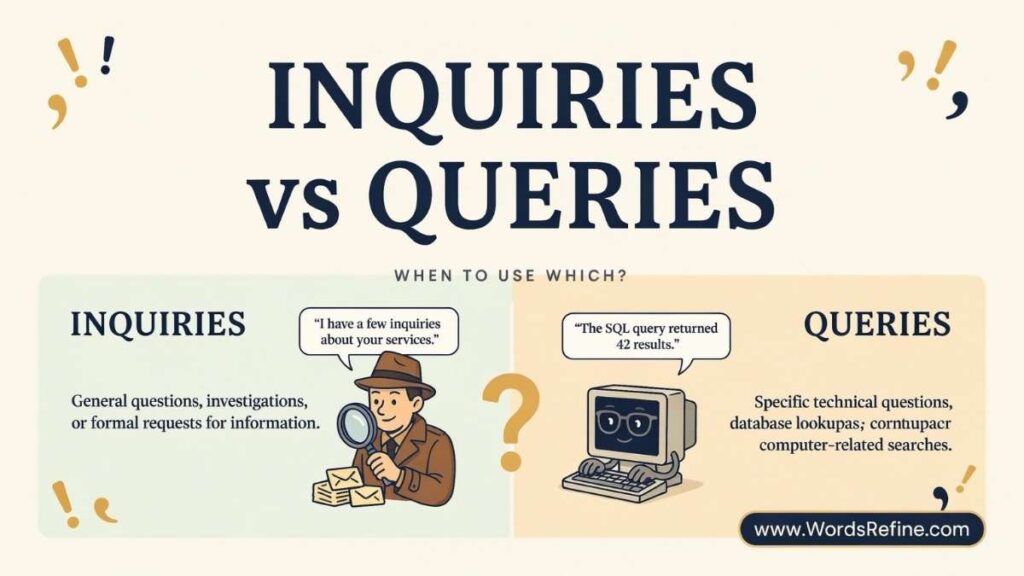
Have you ever written a simple question and suddenly wondered whether it should be called an inquiry or a query? You’re not alone. The difference between inquiries vs queries can be surprisingly confusing because both words can refer to questions vs requests for information. However, they often appear in slightly different contexts. An inquiry can describe a request for information or a formal investigation, while a query usually refers to a specific question, concern, or request for clarification. In technology, query also has a special role in searches and databases. Understanding the distinction helps you write with greater accuracy, confidence, and clarity without turning every question into a grammar investigation.
Inquiry vs Query The Quick Answer
The simplest way to understand the difference is to consider what you are trying to communicate.
An inquiry usually focuses on obtaining information or examining a matter. For example, a customer may make an inquiry about a product, while a government body may conduct an inquiry into an incident.
A query usually focuses on a particular question, concern, or request for clarification. For example, an employee may have a query about an invoice, or a user may enter a query into a search engine.
Both words can describe a request for information, so they sometimes work interchangeably. However, their meanings separate when the context becomes more specific.
| Word | Common meaning | Typical use | Example |
|---|---|---|---|
| Inquiry | A request for information | Business, customer service, general communication | I sent an inquiry about the course. |
| Inquiry | An investigation | Official or formal matters | The committee opened an inquiry. |
| Query | A specific question | Business, customer service, editing | I have a query about the invoice. |
| Query | A search or database request | Technology | The database processed the query. |
Therefore, neither word is simply “correct” while the other is wrong. The better choice depends on what you mean.
What Does Inquiry Mean?
The word inquiry refers to the act of seeking information or examining something carefully.
In ordinary communication, an inquiry is often a request for information. You might contact a company to ask about its services, send a university a question about admission, or contact a store about the availability of a product.
For example:
- I sent an inquiry about the membership plans.
- The company received several inquiries from potential customers.
- She made an inquiry about the application process.
- We received an inquiry regarding delivery times.
In each sentence, the person wants information.
However, inquiry has a second meaning that makes the word particularly useful in formal contexts. It can refer to an organized investigation into an event, complaint, decision, or problem.
For example:
- The committee launched an inquiry into the accident.
- The agency conducted an inquiry into the complaint.
- The organization began an inquiry after several concerns were reported.
Here, inquiry means much more than asking a simple question. It suggests a process of examining facts and determining what happened.
Inquiry as a Request for Information
When someone makes an inquiry, they usually want an answer or additional information.
A customer might ask about a return policy. A student might ask about tuition. A potential employee might ask about an open position. A business might ask another company about partnership opportunities.
All of these situations involve information seeking.
For example:
I made an inquiry about the company’s training program.
The sentence doesn’t suggest that an investigation has started. It simply says that someone asked for information.
This use explains why phrases such as customer inquiry, business inquiry, service inquiry, and information request are common in professional communication.
Inquiry as a Formal Investigation
The investigative meaning is where inquiry becomes noticeably different from query.
Suppose a company discovers that a serious mistake occurred in one of its departments. Management might launch an inquiry to determine what happened, who was involved, and what should happen next.
Likewise, an official body might conduct an inquiry into an accident or public concern.
An investigation can involve several stages:
- Gathering relevant information.
- Reviewing documents and records.
- Speaking with people involved.
- Examining evidence.
- Identifying what happened.
- Reaching findings or recommendations.
A single question does not normally constitute this kind of inquiry. It is a broader process.
That distinction is important because query does not usually carry the same meaning. A query can question something, but it does not normally describe a formal investigation.
Learn the difference between confusing more English words
Lend vs Lent What’s the Difference and When to Use Each?
What Does Query Mean?
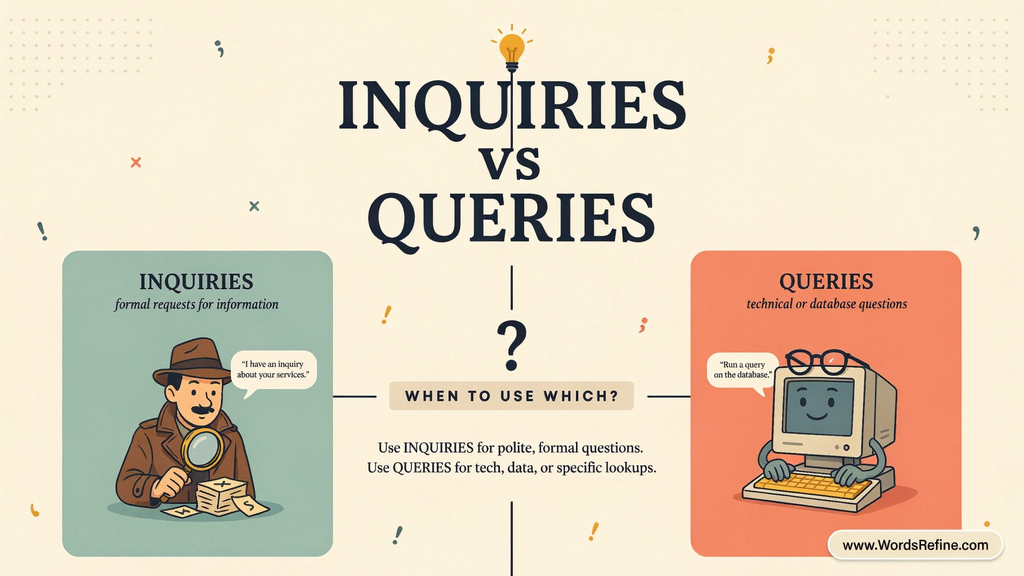
A query is generally a question, doubt, or request for clarification.
For example:
- I have a query about my bill.
- The editor raised a query about the figures.
- The customer submitted a query about the delivery.
- She sent a query regarding the contract.
In each case, the person has a particular point they want answered or clarified.
The word also has a technical meaning. A search query is a request entered into a search engine, while a database query asks a database to retrieve or work with specific information.
Consequently, query has a wider range of modern uses than it might first appear to have.
Query as a Noun
When query acts as a noun, it refers to the question or request itself.
For example:
I have a query about the payment schedule.
The query is the question about the payment schedule.
Similarly:
The editor sent three queries about the article.
The editor has identified three specific points that require answers or clarification.
This use appears frequently in business, publishing, customer support, administration, and technical communication.
Query as a Verb
Query can also function as a verb.
When you query something, you question it, ask about it, or express doubt about it.
For example:
The manager queried the figures in the report.
This means the manager questioned whether the figures were correct.
Another example is:
The editor queried the author’s explanation.
The editor raised a question about the explanation.
This distinction is useful because inquiry is primarily used as a noun in ordinary modern English, while query works naturally as both a noun and a verb.
Learn the difference between commonly mixed-up more words
Socialise vs Socialize Which one Is Correct ?
Inquiries vs Queries What Do They Really Mean?
The two words overlap because both involve information seeking. However, they often differ in emphasis.
An inquiry tends to suggest a broader request for information or an investigation. A Inquiries vs queries tends to suggest a particular question, doubt, or clarification.
Consider these two sentences:
I sent an inquiry about the company’s services.
I sent a query about the price listed on the website.
The first sentence suggests a general request for information. The second points toward one particular issue.
Neither sentence is automatically more correct than the other. The context determines the natural choice.
A useful way to remember the distinction is this:
An inquiry often asks, “Can you give me information about this?”
A query often asks, “Can you clarify this particular point?”
That is not an absolute grammar rule. English has plenty of overlap. Still, it provides a practical guide for everyday writing.
Difference Between Inquiries vs Queries
The difference between inquiries vs queries becomes clearer when you compare their most common functions.
| Situation | Inquiry | Query |
|---|---|---|
| Asking for general information | Very common | Possible |
| Asking a specific question | Possible | Very common |
| Requesting clarification | Possible | Very common |
| Formal investigation | Very common | Rare |
| Customer service | Very common | Very common |
| Business communication | Very common | Very common |
| Search engines | Uncommon | Standard |
| Databases | Uncommon | Standard |
| Questioning information | Possible | Very common |
| Research or investigation | Very common | Possible |
The most important distinction appears at the edges.
An official investigation is generally an inquiry.
A request sent to a database is generally a query.
Between those two extremes, there is considerable overlap.
Are Inquiries vs Queries Interchangeable?
Sometimes they are.
For example, a company might say:
We welcome customer inquiries.
Another company might say:
We welcome customer queries.
Both sentences communicate that customers can contact the company with questions or requests for information.
However, replacing one word with the other can sometimes change the tone or meaning.
Consider:
The government launched an inquiry into the incident.
Changing this to:
The government launched a query into the incident.
would sound unnatural because query does not normally describe an official investigation.
Now consider:
The search engine processed the query.
Replacing query with inquiry would also sound wrong in standard technical usage.
Therefore, the answer to “Can inquiry and query be used interchangeably?” is sometimes, but not always.
Instalments vs Installments Which one Is Correct?
Inquiry vs Query in Business Communication
Business writing uses both words frequently.
An inquiry often appears when someone wants information about a company, product, service, partnership, or opportunity.
For example:
We received a business inquiry from a potential client.
The potential client may want to know about prices, services, availability, or terms.
A query, on the other hand, can highlight a particular issue.
For example:
The accounting department raised a query about the invoice.
The department isn’t asking generally about the company’s services. It has noticed one specific point that needs clarification.
This difference may seem small, but it can make professional writing more precise.
Business Inquiries
Business inquiries often involve an initial request for information.
Common examples include:
- Asking about product prices.
- Asking whether a service is available.
- Requesting information about a partnership.
- Asking about delivery options.
- Requesting details about a course or program.
- Asking about contract terms.
- Requesting information about employment opportunities.
For example:
We received an inquiry from a company interested in our consulting services.
The word inquiry works well because the communication involves a broader request for information.
Business Queries
A business query often focuses on a particular matter.
For example:
The client submitted a query about the charges on the invoice.
Or:
The manager had a query about the figures in the report.
The person has a focused question rather than a broad request.
That makes query particularly useful when a specific detail needs attention.
Learn the difference between more words people mix up
Dreamt vs Dreamed Which One Is Correct?
Inquiries vs Queries in Email
The choice between inquiries vs queries in email often depends on the purpose of the message.
If you’re contacting a company to learn about its services, inquiry is a natural choice.
For example:
I am writing to make an inquiry about your training programs.
If you’re asking about one specific issue, query may work better.
For example:
I have a query regarding the amount shown on my invoice.
However, there’s another option that often sounds even more natural: question.
For example:
I have a question about the amount shown on my invoice.
In everyday American business writing, simple language often works best. You don’t need a formal word simply because you’re writing a professional email.
The best sentence is usually the one that communicates the idea clearly without making the reader work for it.
Is “For Any Inquiries” Correct?
Yes, “for any inquiries” is grammatically correct.
For example:
For any inquiries, please contact our customer service team.
You can also write:
Please contact us with any inquiries.
Both forms are natural in professional communication.
However, “questions” may sound warmer and more direct:
If you have any questions, please contact us.
That version is especially useful when writing for a general audience.
There is no grammar rule saying that inquiry must replace question in formal writing. In fact, using a familiar word can make a message easier to understand.
Is “For Any Queries” Correct?
Yes, “for any queries” is also correct.
For example:
Please contact the support team for any queries regarding your account.
You might also see:
If you have any queries, please contact us.
The expression is especially common in professional, administrative, and technical settings.
Still, American readers may find “If you have any questions” more conversational.
So the choice depends partly on tone. Inquiry vs query can sound more formal, while question is usually more straightforward.
Inquiry vs Query in Customer Service
Customer service teams deal with both inquiries vs queries every day.
A customer inquiry may involve a broad request:
Do you offer international shipping?
That customer wants information about a service.
A customer query may concern a particular problem:
Why was I charged twice for the same order?
That customer has a focused question about a specific transaction.
Of course, companies can describe both situations as customer inquiries vs customer queries. The terms overlap enough that either may appear in customer-service systems.
Still, query often sounds particularly natural when support teams organize individual issues that need answers.
For example:
- A customer submits a support query.
- The support representative reviews the query.
- The representative investigates the issue.
- The company sends a response.
Meanwhile, a website may have a general “business inquiries” section for potential customers or partners.
Inquiry vs Query in Technical Support
Technical support gives query another important advantage.
A user may submit a technical query about software, hardware, account access, or system behavior.
For example:
The technician responded to my query about the software error.
The question concerns one specific technical problem.
At the same time, a company might refer to all incoming requests as customer inquiries.
Therefore, both words remain useful.
The difference is mostly one of emphasis. Inquiry can describe the broader information request, while query often highlights the individual question that needs an answer.
Learn the difference between more words people mix up
Mobil vs Mobile Which one Is Correct?
Query in Technology
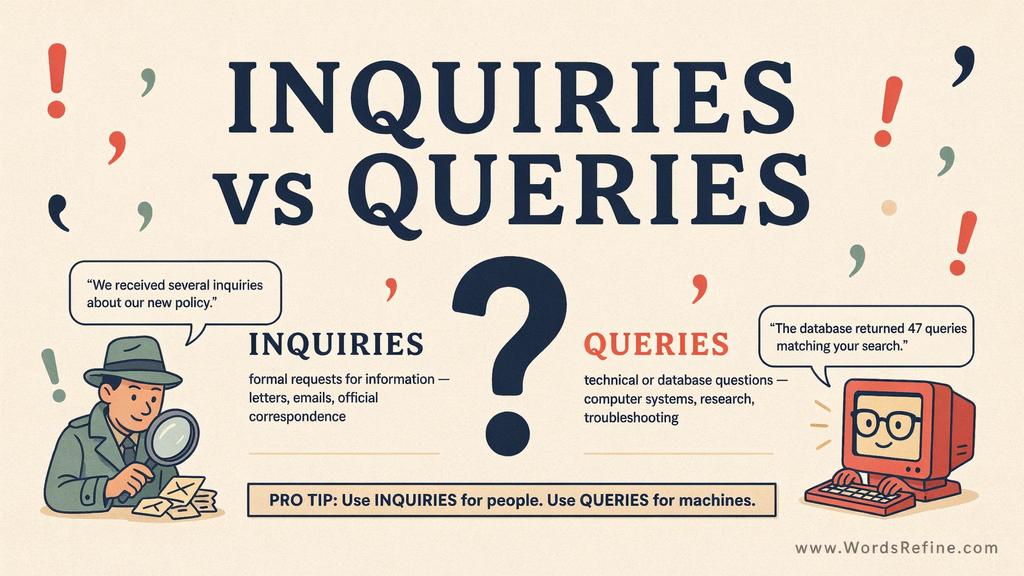
Technology provides one of the clearest examples of why query and inquiry cannot always replace one another.
A search query is the phrase or request entered into a search engine.
For example, someone might type:
best grammar books for students
into a search engine.
That phrase is a search query.
Likewise, a database query is a request made to a database to retrieve particular information.
A system might use a query to find:
- Customers who placed an order during a certain period.
- Products below a particular price.
- Employees assigned to a particular department.
- Records that match certain conditions.
In these contexts, query is the established technical term.
Calling a database request an inquiry would usually sound unusual because technical language has settled on query.
Inquiry vs Enquiry in American and British English
Another source of confusion is the spelling inquiry versus enquiry.
American English generally uses inquiry for both an information request and an investigation.
For example:
I sent an inquiry about the course.
And:
The committee conducted an inquiry into the matter.
British English uses both inquiry and enquiry.
Traditionally, British English has often used enquiry for a general request for information and inquiry for a formal investigation.
For example:
I made an enquiry about the train schedule.
But:
The government launched an inquiry into the incident.
That distinction can be useful, although real-world British usage isn’t perfectly rigid. You may encounter inquiry in situations where enquiry would traditionally have been used.
The important point is that enquiry is not an incorrect spelling. It is an established British English form.
Inquiry and Enquiry Difference
The traditional distinction can be summarized simply.
- Enquiry often refers to a general request for information in British English.
- Inquiry can refer to a formal investigation in British English.
- American English generally uses inquiry for both meanings.
- Modern British usage does not always follow the traditional distinction strictly.
Therefore, if you’re writing for an American audience, inquiry is usually the safest form.
Learn the difference between tricky grammar more words
Fiancé vs Fiancée What’s the Difference and which is Correctly?
Common Mistakes With Inquiry and Query
These words create several common mistakes, particularly when writers assume that similar meanings make them perfect substitutes.
Assuming They Mean Exactly the Same Thing
The first mistake is treating inquiry and query as complete synonyms.
They overlap, but they have different uses.
A formal investigation is normally an inquiry.
A search-engine request is normally a query.
Keeping those two distinctions in mind prevents many awkward sentences.
Assuming Inquiry Always Means an Investigation
Inquiry does not always mean an official investigation.
For example:
I sent an inquiry about the job opening.
This simply means that someone requested information.
No detective work is required.
Assuming Query Only Belongs to Technology
Query has been used for ordinary questions as well as technical requests.
For example:
The customer had a query about the warranty.
There is no database involved.
The customer simply has a specific question.
Using Inquiry vs Enquiry Without Considering Audience
If you’re writing for an American audience, inquiry is the standard spelling.
If you’re writing for a British audience, both inquiry and enquiry may appear depending on meaning, style, and regional preference.
Knowing your audience helps you make the right choice.
Learn the difference between commonly mixed-up more words
Any time vs anytime meaning Difference with Examples ?
The Plural of Inquiry and Query
1.The plural forms of these words can cause another small spelling problem.
2.The plural of inquiry is inquiries.
3.The plural of query is queries.
For example:
- The company received one inquiry.
- The company received several inquiries.
- The customer submitted one query.
- The support team answered several queries.
Both words change their final y to ies.
This pattern is common in English when a noun ends in a consonant followed by y.
Therefore:
inquiry → inquiries
query → queries
Inquiries Pronunciation
Inquiries is commonly pronounced approximately as “in-KWIR-eez.”
The singular inquiry is approximately “in-KWIR-ee.”
The pronunciation may vary slightly depending on accent, but the stressed middle syllable remains easy to recognize.
Queries Pronunciation
Queries is commonly pronounced approximately as “KWEER-eez.”
The singular query is commonly pronounced “KWEER-ee.”
Although the spelling can look more complicated than the pronunciation, both words are fairly straightforward once you’ve heard them used naturally.
Inquiry in a Sentence
Seeing inquiry in context makes its meaning easier to understand.
- The customer made an inquiry about the return policy.
- We received an inquiry from a potential business partner.
- She sent an inquiry regarding the admission requirements.
- The company responded to every customer inquiry.
- The committee opened an inquiry into the incident.
- The police conducted an inquiry after receiving the complaint.
- His inquiry focused on the cost of the service.
The first four examples involve requests for information. The final three have a more investigative or formal sense.
Query in a Sentence
Query also changes slightly according to context.
- I have a query about my invoice.
- The customer sent a query regarding the delivery date.
- The editor raised a query about the statistic.
- The manager queried the accuracy of the report.
- The search engine processed the query.
- The database query returned the requested records.
- The technician answered my query about the software.
These examples demonstrate why query is particularly useful for specific questions and technical requests.
Learn the difference between often confused words
Choose vs Chose Difference and which one is Correct?
Inquiry vs Query Real-World Examples
The easiest way to understand the distinction is to imagine ordinary situations.
A Customer Asking About a Product
I sent an inquiry asking whether the laptop is available.
The customer wants information before making a decision.
A Customer Questioning a Charge
I have a query about the extra charge on my bill.
The customer has identified a particular issue.
An Official Investigation
The authorities opened an inquiry into the accident.
This describes an investigation rather than a simple question.
A Search Engine
The search engine returned results for the query.
This is technical language, so query is the natural choice.
A Database
The database query found 250 matching records.
Again, query is the established term.
These examples show the query and inquiry difference more clearly than a definition alone.
Inquiry, Query, Question, and Request
Sometimes the best word isn’t inquiry or query at all.
English gives you several options, and each one highlights something slightly different.
| Word | Main focus | Example |
|---|---|---|
| Question | Something asked to receive an answer | I have a question about the policy. |
| Inquiry | Seeking information or investigating | We received an inquiry about the program. |
| Query | A specific question, doubt, or technical request | I have a query about the figures. |
| Request | Asking for something to be provided or done | I submitted a request for a refund. |
Consider the difference between these sentences:
I have a question about your refund policy.
This is simple and conversational.
I have an inquiry about your refund policy.
This sounds more formal and information-focused.
I have a query about your refund policy.
This can suggest that you have a particular point that needs clarification.
I submitted a request for a refund.
Now you’re asking the company to take an action rather than simply provide information.
The distinctions are subtle, but they help you choose words with greater precision.
Learn the difference between often confused words
Lay vs Lie Difference and which is correct?
How to Use Inquiry Correctly
If you’re unsure how to use inquiry, start by asking what the sentence describes.
Use inquiry when someone seeks information about a subject.
For example:
I made an inquiry about the available courses.
Use inquiry when describing an investigation.
For example:
The committee conducted an inquiry into the complaint.
Certain combinations also sound particularly natural.
“Inquiry about” commonly introduces the subject of an information request.
She made an inquiry about the position.
“Inquiry into” commonly introduces the subject of an investigation.
The agency launched an inquiry into the incident.
Remembering these patterns makes your writing sound more natural without forcing you to memorize complicated grammar rules.
How to Use Query Correctly
Query works especially well when you’re referring to a particular question or point of uncertainty.
For example:
I have a query about the contract.
It also works as a verb:
The accountant queried the figures.
And it is the standard term for many technical requests:
The application sent a query to the database.
Therefore, query is especially flexible in professional and technical settings.
Learn the difference between commonly g confusing ord pairs
Further vs Farther The Simple Difference and Each Correctly?
A Simple Way to Choose Between Inquiry vs Query
When you’re stuck between the two words, stop and identify the purpose of the communication.
Ask yourself these questions:
- Am I requesting general information?
- Am I asking about one specific point?
- Am I referring to an investigation?
- Am I talking about a search engine or database?
- Would the simpler word question sound more natural?
1.If you’re making a general information request, inquiry is often a strong choice.
2.If you’re asking about a particular issue, query may fit better.
3.If you’re describing an investigation, inquiry is the clear choice.
4.If you’re discussing a search engine or database, query is the standard term.
5.If you’re writing an ordinary message and neither sounds necessary, question may be the most natural option.
A Practical Comparison for Everyday Writing
Here is a quick way to apply the distinction.
| What you mean | Natural choice |
|---|---|
| “I want information about this service.” | Inquiry |
| “I have one specific issue to clarify.” | Query |
| “The organization is investigating the matter.” | Inquiry |
| “I searched for information online.” | Search query |
| “The computer requested information from the database.” | Database query |
| “I simply want an answer.” | Question |
| “I want someone to do something.” | Request |
This approach keeps your writing clear without pretending that English always follows strict boundaries.
Practice session Inquiries vs Queries
- I sent an __________ to the university asking about its admission requirements.
- The customer had a __________ about an unexpected charge on the invoice.
- The company received several __________ from customers who wanted more information about the new service.
- The support team answered all the customer __________ before the end of the day.
- The committee launched an __________ into the cause of the accident.
- Please contact us if you have any __________ about our products or services.
- The accountant raised a __________ about an unusual figure in the financial report.
- The company received hundreds of customer __________ after announcing the new service.
- The search engine processed the user’s __________ and displayed relevant results.
- The database returned the requested records after processing the __________.
- She made an __________ about the cost and schedule of the training program.
- The editor sent the writer several __________ about unclear information in the article.
- The company is responding to business __________ from potential clients interested in its services.
- I have a __________ about the delivery date listed on my order.
- The government ordered an official __________ into the matter.
- If you have any __________ about your account, please contact customer support.
- The researcher began an __________ into the causes of the problem.
- The technician answered my __________ about the software error.
- The customer service department handles product __________ every day.
- The manager __________ the accuracy of several figures in the report.
- The police conducted an __________ after receiving a complaint about the incident.
- The search system uses the user’s __________ to find relevant information.
- We received an __________ from a company interested in working with us.
- The employee submitted several __________ about the new workplace policy.
- Before submitting the form, make sure your __________ has been answered clearly.
Answers
- Inquiry
- Query
- Inquiries
- Queries
- Inquiry
- Inquiries
- Query
- Inquiries
- Query
- Query
- Inquiry
- Queries
- Inquiries
- Query
- Inquiry
- Inquiries
- Inquiry
- Query
- Inquiries
- Queried
- Inquiry
- Query
- Inquiry
- Queries
- Query
Here’s a trusted source for clear word meanings:
FAQs
What is the difference between a query and an inquiry?
A query usually refers to a specific question, doubt, or request for clarification. An inquiry can refer to a request for information or a more detailed or formal investigation. However, the two words can overlap in everyday and professional communication.
Does inquiries mean questions?
Yes. Inquiries can mean questions or requests for information. For example, “We received several inquiries about the course” means that people contacted the organization to ask for information.
What does queries mean?
Queries is the plural form of query. It generally means questions, requests for clarification, or requests for specific information. In technology, queries can also refer to searches or requests sent to a database.
What is the plural of query?
The plural of query is queries. The final y changes to ies because query ends with a consonant followed by y.
What is the plural of inquiry?
The plural of inquiry is inquiries. For example, “The company received several inquiries about its services.”
Is queries spelled correctly?
Yes, queries is the correct plural spelling of query. “Querys” is incorrect.
Can I say “I have a query”?
Yes. “I have a query” is grammatically correct and means that you have a question or need clarification about something. It is especially common in professional, customer-service, and British English contexts.
How do you use query in a sentence?
You can write, “I have a query about my latest bill.” Here, query means a specific question or concern that needs an answer.
How do you use queries in a sentence?
For example, “The support team answered several customer queries this morning.” In this sentence, queries refers to multiple questions from customers.
What is an example of an inquiry?
An example is, “She sent an inquiry about the cost of the training program.” Here, inquiry means a request for more information.
What are some examples of inquiries?
Common examples include business inquiries, customer inquiries, media inquiries, research inquiries, and inquiries about prices, services, admissions, or availability.
Is a question the same as a query?
Not always. Question is the broader and more conversational term. A query is usually a particular question, concern, or request for clarification. In many situations, however, either word can communicate a similar idea.
What is another word for query?
Depending on the context, alternatives include question, request, concern, issue, or request for clarification. The best synonym depends on what the person is asking.
What is another word for inquiry?
Possible alternatives include question, request, investigation, examination, or request for information. Inquiry can have different meanings, so the correct synonym depends on the context.
Which is correct, inquiries vs enquiries?
Both spellings are correct, but usage varies. Inquiry is the standard spelling in American English. British English uses both inquiry and enquiry, with enquiry often used for ordinary requests for information and inquiry sometimes preferred for formal investigations. In modern usage, that distinction is not always strict.
Are inquiries vs queries interchangeable?
Sometimes, but not always. Both can describe requests for information, especially in business or customer service. However, inquiry can also mean an investigation, while query often suggests a specific question or concern.
Should I use inquiry vs query in an email?
Either can be correct. Use inquiry when making a general request for information, such as asking about a service. Query often works better when you have a specific question about a detail, charge, policy, or problem.
What is the difference between inquiries vs queries in customer service?
A customer inquiry often involves a general request for information, such as asking about prices or services. A customer query may concern a specific issue, such as an incorrect charge. In practice, businesses often use the terms interchangeably.
What does inquiry mean in business?
In business, an inquiry is usually a request for information about a company, product, service, price, partnership, or opportunity. For example, a potential client might send a business inquiry about available services.
When should I use query instead of inquiry?
Use query when you want to emphasize a specific question, doubt, or point requiring clarification. Query is also the established term for searches and database requests in technology.
What is the easiest way to remember inquiry vs query?
Think of inquiry as seeking information or investigating something. Think of query as asking a particular question or questioning a specific point. The meanings overlap, but this simple distinction works well in most situations.
Conclusion
Inquiries vs queries may seem almost interchangeable, and in many situations, they are. Still, understanding their usual differences can help you choose the clearer word. An inquiry can mean a request for information or a formal investigation. A query generally refers to a specific question, concern, or request for clarification. In technology, query also describes a request made to a search engine or database.
The best approach is simple: let the context guide you. Use inquiry when you’re seeking information or referring to an investigation. Use query when you’re asking about a particular point or looking for specific information. Once you understand that distinction, there’s no need to turn your sentence into a full-blown grammar investigation. Choose the word that fits your meaning, and your writing will sound clear, confident, and natural.

Diora AJS she is an experienced blogger and passionate English language enthusiast at Words Refine. With a keen eye for language and a love for clear communication, she writes practical content about grammar, word meanings, usage, and commonly confused terms. Her goal is to make English easier to understand through clear explanations and relatable examples, helping readers write accurately and communicate with confidence.