
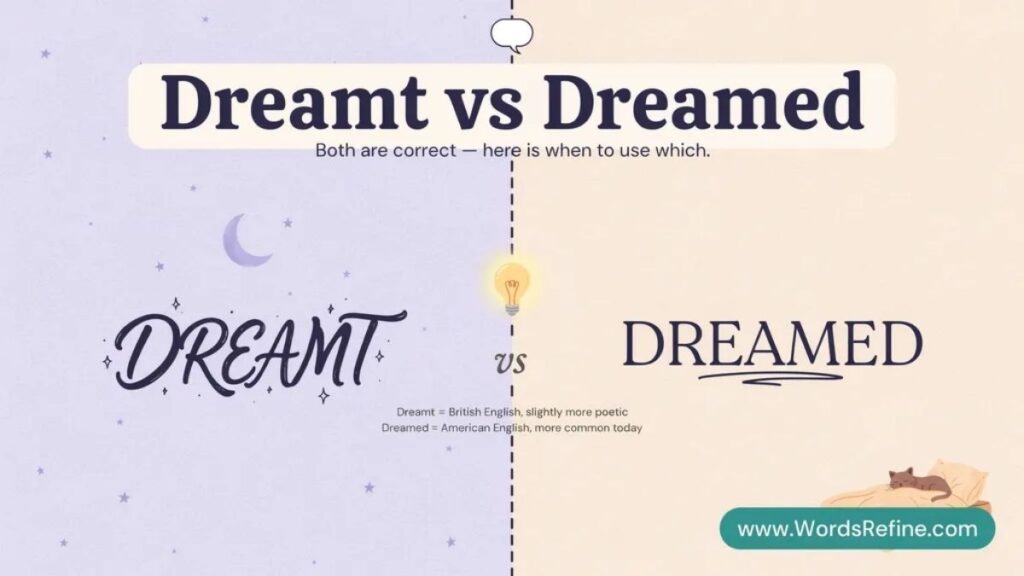
Have you ever written “I dreamed about it last night” and suddenly wondered, “Should I have written dreamt instead?” You’re not alone. Dreamt vs dreamed can confuse even careful writers because both forms look different but are grammatically correct. The real difference is not about choosing the right or wrong word. Instead, it mainly depends on regional preference and writing style. Dreamed is generally more common in American English, while dreamt is especially common in British English. In this guide, you well learn the dreamt vs dreamed difference, understand when to use each form, and explore clear examples that make the choice simple. No grammar nightmare needed!
Dreamt vs Dreamed Quick Answer
Dreamt and dreamed are both correct past-tense and past-participle forms of the verb dream.
For example:
I dreamed about my childhood home last night.
I dreamt about my childhood home last night.
Both sentences mean that the person experienced a dream while sleeping.
The same thing applies when dream refers to a hope or ambition:
She dreamed of becoming a doctor.
She dreamt of becoming a doctor.
Again, the meaning stays essentially the same.
The difference is mainly one of usage. Dreamed is more common in American English, while dreamt is particularly common in British English.
Here is a quick comparison:
| Form | Grammatical role | Meaning | Common preference |
|---|---|---|---|
| Dream | Base form | To experience a dream or imagine something | All varieties |
| Dreams | Present tense, third-person singular | Experiences or imagines | All varieties |
| Dreamed | Past tense and past participle | Experienced or imagined | Especially common in American English |
| Dreamt | Past tense and past participle | Experienced or imagined | Especially common in British English |
| Dreaming | Present participle | Experiencing or imagining | All varieties |
Therefore, if you’re wondering which is correct, dreamt or dreamed, there’s no need to choose based on grammar alone. Both are standard forms.
Dreamt vs Dreamed What’s the Difference?
The difference between dreamt and dreamed becomes much clearer when you look at how English forms the past tense.
Dreamed follows a familiar pattern. It takes the standard -ed ending used by thousands of English verbs.
For example:
Walk becomes walked.
Talk becomes talked.
Play becomes played.
Dream becomes dreamed.
Dreamt follows a different pattern. Instead of adding -ed, it ends in -t.
This type of variation isn’t unique to dream. English has several verbs with both an -ed form and a shorter -t form.
For example:
Burn can become burned or burnt.
Learn can become learned or learnt.
Spell can become spelled or spelt.
Dream can become dreamed or dreamt.
These alternative forms developed through the long history of English. Some became more common in particular regions, while others remained familiar across different varieties of the language.
Most importantly, dreamt isn’t a misspelling of dreamed. It is an established English word.
The meaning usually doesn’t change either. If someone says, “I dreamed about the ocean,” and another person says, “I dreamt about the ocean,” both people are talking about having a dream about the ocean.
Learn the difference between similar English words the easy way
Vender vs Vendor Which one Is Correct?
Dreamt Meaning and How to Use It
The meaning of dreamt is simply the past meaning of dream. It can describe something that happened while sleeping, or it can describe a hope, ambition, or imagined possibility.
When dreamt refers to sleep, it describes a mental experience during a dream.
For example:
I dreamt about my old school last night.
She dreamt that she was flying.
He dreamt about his childhood friends.
However, dreamt can also describe an ambition.
Consider these examples:
She dreamt of becoming a doctor.
He dreamt of owning a small bookstore.
They had always dreamt of traveling around the world.
In these sentences, the word doesn’t refer to sleep. Instead, it describes something someone wanted or hoped to achieve.
The expression dreamt of often works naturally when discussing ambitions, wishes, and goals.
For example, “She dreamt of becoming a writer” means that becoming a writer was an important ambition for her.
The word dreamt can also appear with about.
For example:
“I dreamt about my future.”
Depending on the context, this could describe either an actual sleeping dream or thoughts about what the future might be like.
Dreamed Meaning and How to Use It
The Dreamed has the same basic meanings as dreamt. It can refer to sleeping dreams, ambitions, wishes, or imagined situations.
For example:
- I dreamed about my grandparents last night.
- She dreamed that she was walking through a forest.
- He dreamed of becoming a professional athlete.
- They dreamed of building a home near the ocean.
As you can see, dreamed works naturally in both literal and figurative contexts.
In American English, this form often feels especially natural because the regular -ed ending is widely used.
That doesn’t mean dreamed is exclusively American, though. British speakers and writers can use it too.
Likewise, dreamt isn’t restricted to British English.
Dreamt vs Dreamed in American and British English
Regional usage explains much of the confusion surrounding these two forms.
American English generally favors dreamed. If you’re writing for an American audience, you’ll often find sentences such as:
“I dreamed about my old house.”
“She dreamed of becoming a teacher.”
“They dreamed that they had won the competition.”
These sentences sound completely natural in American English.
British English, meanwhile, commonly uses dreamt.
For example:
“I dreamt about my old house.”
“She dreamt of becoming a teacher.”
“They dreamt that they had won the competition.”
However, British speakers can also use dreamed. The form isn’t incorrect or unusual enough to cause concern.
Likewise, American speakers can use dreamt. It may sound somewhat less common to some Americans, but it remains a valid English word.
The important lesson is that regional differences describe patterns of preference. They don’t create strict grammar rules.
Learn the difference between more words people mix up
Whoever vs Whomever How to Use Each Word Correctly?
Dreamt vs Dreamed in American English
When writing in American English, dreamed is generally the safer and more familiar choice.
For example:
“I dreamed about you last night.”
“She dreamed of visiting Italy.”
“He dreamed that he could fly.”
However, using dreamt in American English isn’t grammatically wrong.
Dreamt vs Dreamed in British English
When writing in British English, dreamt is a very familiar form.
For example:
“I dreamt about you last night.”
“She dreamt of becoming a musician.”
“He dreamt that he was back at school.”
Nevertheless, dreamed is also correct in British English.
Australian and New Zealand English
Australian English and New Zealand English can use both forms as well. Usage may vary between speakers and writing styles.
Consequently, it’s better to think of dreamed and dreamt as alternative forms rather than assigning each one to a single country.
Is Dreamt a Word?
Yes, dreamt is a real and standard English word.
This question often comes from people who are more familiar with dreamed. Since dreamt doesn’t use the familiar -ed ending, it can look strange at first.
There is nothing unusual or incorrect about it, though.
Dreamt functions as both the past tense and past participle of dream.
For example:
- I dreamt about the beach.
- She had dreamt about that moment for years.
- We have dreamt of visiting that country.
The same grammatical structures work with dreamed:
- I dreamed about the beach.
- She had dreamed about that moment for years.
- We have dreamed of visiting that country.
So, if you see dreamt in a book, article, conversation, or formal document, there’s no reason to assume someone made a spelling mistake.
Learn the difference between everyday English mistakes
Lay vs Lie Difference and which is correct?
Dreamt vs Dreamed Grammar How the Forms Work
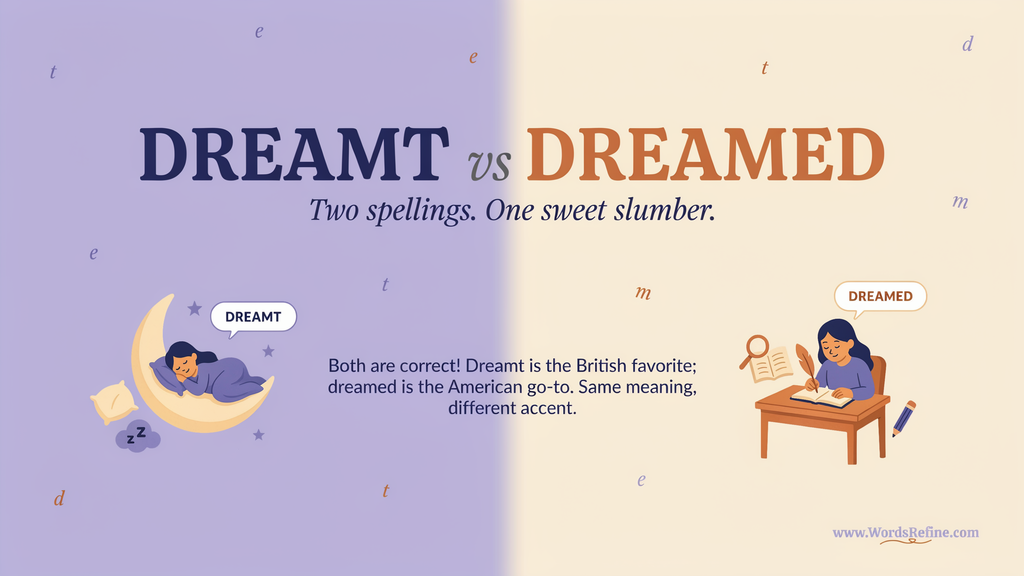
The grammar behind these two forms is quite simple.
Both dreamed and dreamt can act as the simple past.
For example:
“I dreamed about it last night.”
“I dreamt about it last night.”
Both describe an event that happened in the past.
Both forms can also act as past participles.
For example:
“I have dreamed about this many times.”
“I have dreamt about this many times.”
The same applies to the past perfect:
“She had dreamed of becoming a singer.”
“She had dreamt of becoming a singer.”
Therefore, the past tense of dream can be dreamed or dreamt. The past participle of dream can also be dreamed or dreamt.
Dream Verb Forms and Conjugation
The complete verb forms of dream are easy to learn once the two past forms are understood.
| Verb form | Example |
|---|---|
| Base form | I dream about traveling. |
| Third-person singular | She dreams about traveling. |
| Present participle | She is dreaming about traveling. |
| Past tense | She dreamed about traveling. |
| Past tense | She dreamt about traveling. |
| Past participle | She has dreamed about traveling. |
| Past participle | She has dreamt about traveling. |
This means the main forms are:
- Dream
- Dreams
- Dreaming
- Dreamed
- Dreamt
There isn’t a complicated conjugation rule hiding behind the two past forms. Once you remember that both dreamed and dreamt are accepted, the rest falls into place.
“I Dreamed vs Dreamt of You” Which Is Correct?
Both “I dreamed of you” and “I dreamt of you” are grammatically correct.
For example:
“I dreamed of you last night.”
“I dreamt of you last night.”
Both can describe an actual dream during sleep.
However, context can change the meaning of dream of.
Consider this sentence:
“I dreamed of becoming a doctor.”
Here, the person isn’t saying that they literally dreamed about becoming a doctor while asleep. The sentence usually means that becoming a doctor was a strong ambition.
The same applies to:
“I dreamt of becoming a doctor.”
So, whether you use dreamed or dreamt, the surrounding words help the reader understand what you mean.
Learn the difference between misused words
Loose vs Lose Difference and which is Correctly?
Dreamed of vs Dreamt of?

Dreamed of and dreamt of are both correct.
The expression is especially common when discussing hopes, ambitions, and goals.
For example:
- She dreamed of owning her own business.
- He dreamt of becoming a pilot.
- They dreamed of living near the sea.
- We had dreamt of taking that trip for years.
The phrase can also describe something that once seemed impossible.
For example:
“I never dreamed of meeting someone like her.”
“I never dreamt of meeting someone like her.”
Both sentences can express surprise or disbelief.
The difference between the two versions comes down to the form of the verb rather than the meaning of the sentence.
Dreamed About vs Dreamt About?
Both dreamed about and dreamt about are correct.
Dream about often introduces the subject or content of a dream.
For example:
“I dreamed about my childhood home.”
“I dreamt about my childhood home.”
The phrase can also appear with a verb ending in -ing:
“She dreamed about traveling around the world.”
“He dreamt about starting his own business.”
The choice between dream of and dream about can sometimes create a small difference in meaning.
Dream of frequently works well for ambitions:
“She dreamed of becoming a doctor.”
Dream about often works naturally for the content of a sleeping dream:
“She dreamed about her old school.”
Even so, English doesn’t always draw a strict line between these expressions. Context matters more than a rigid grammar rule.
Learn the difference between basic English word mistakes
Capital vs Capitol Which One Is Correct?
Common Mistakes With Dreamt vs Dreamed
Although the two forms are straightforward, several mistakes appear frequently.
Mistaking dreamt for an error
Some writers assume that dreamed is the only correct form.
That’s incorrect.
Dreamt is a standard English form.
Assuming dreamed is only American
Dreamed is common in American English, but British English can use it too.
Therefore, calling dreamed “American only” gives an unnecessarily narrow picture of English usage.
Assuming dreamt is only British
Dreamt is strongly associated with British English, but Americans can use it as well.
The word remains correct regardless of the speaker’s location.
Using the past form after did
This is a more important grammar mistake.
After did, use the base form dream.
Correct:
“Did you dream about me?”
Incorrect:
“Did you dreamed about me?”
Also incorrect:
“Did you dreamt about me?”
Why? Because did already carries the past tense. The following verb returns to its base form.
The same rule applies to other verbs:
“Did you go?”
Not “Did you went?”
Once you understand that pattern, this mistake becomes much easier to avoid.
Learn the difference between often confused words
Discrete vs Discreet What the Difference and which is Correctly?
Dreamt vs Dreamed Examples in Everyday English
Looking at real sentence patterns makes the distinction much easier to remember.
| Situation | Dreamed | Dreamt |
|---|---|---|
| Sleeping dream | I dreamed about the ocean. | I dreamt about the ocean. |
| Ambition | She dreamed of becoming a doctor. | She dreamt of becoming a doctor. |
| Unexpected event | I never dreamed this would happen. | I never dreamt this would happen. |
| Imagined situation | He dreamed that he was flying. | He dreamt that he was flying. |
| Present perfect | They have dreamed of success. | They have dreamt of success. |
| Past perfect | She had dreamed of leaving. | She had dreamt of leaving. |
The pattern is remarkably consistent. Changing dreamed to dreamt usually doesn’t change the meaning.
Learn the difference between confusing more English words
Fiancé vs Fiancée What’s the Difference and which is Correctly?
Dreamed in a sentence
Here are a few natural examples:
- I dreamed about my grandparents last night.
- She dreamed of opening a bakery.
- He dreamed that he was flying over the city.
- They had dreamed of living near the mountains.
- I never dreamed we’d meet again.
Dreamt in a sentence
The same ideas can be expressed with dreamt:
- I dreamt about my grandparents last night.
- She dreamt of opening a bakery.
- He dreamt that he was flying over the city.
- They had dreamt of living near the mountains.
- I never dreamt we’d meet again.
Nothing mysterious happens when the spelling changes. The grammar and meaning remain essentially the same.
Learn the difference between commonly mixed-up more words
Choose vs Chose Difference and which one is Correct?
A Simple Example of Regional Preference
Imagine two people describing the same experience.
An American writer might say:
“Last night, I dreamed about my childhood home.”
A British writer might say:
“Last night, I dreamt about my childhood home.”
Both sentences are natural. Neither writer has made a grammar mistake.
Now imagine an American novelist using dreamt because it fits the rhythm of a particular passage. That choice can work perfectly well.
Likewise, a British journalist can use dreamed without breaking any grammar rule.
This is why regional preference should be viewed as a guide rather than a restriction.
Which Form Should You Use?
If you’re unsure which form to choose, think about your audience first.
The When writing in American English, dreamed is usually the most natural default.
When writing in British English, dreamt is often a natural choice, although dreamed remains correct.
When writing creatively, either form can work. Sometimes the shorter form dreamt gives a sentence a slightly different rhythm. In other cases, dreamed may flow more naturally.
The most important thing is consistency.
If a document generally follows American English conventions, using dreamed throughout may make the writing feel more consistent.
If the document follows British English conventions, dreamt may be the better fit.
There is no need to treat one as correct and the other as incorrect.
Is Dreamt More Literary Than Dreamed?
Some readers associate dreamt with literary or poetic writing.
That impression isn’t completely surprising. The shorter form appears frequently in literature, particularly in British writing, and its compact sound can give a sentence a distinctive rhythm.
However, dreamt isn’t automatically literary.
Someone might say:
“I dreamt about my breakfast.”
That’s hardly the opening line of an epic novel.
Similarly, dreamed isn’t automatically plain or informal.
A sentence such as:
“She dreamed of a world where everyone lived in peace.”
can sound perfectly literary.
Therefore, the idea that dreamt is always more sophisticated than dreamed shouldn’t be treated as a grammar rule.
The better choice depends on the context, audience, and voice of the writing.
Why Is Dreamt Spelled With a T?
The spelling dreamt comes from older patterns of English verb formation.
English didn’t always form past-tense verbs simply by adding -ed. Over time, many verbs developed shorter forms ending in -t.
That history helps explain forms such as:
- Burn → burnt
- Learn → learnt
- Spell → spelt
- Dream → dreamt
Some varieties of English continued to favor these shorter forms, while other varieties increasingly favored the regular -ed forms.
As a result, modern English sometimes gives us two accepted options.
Dreamed developed as the regular-looking form. Dreamt survived as an alternative form.
So, why is dreamt spelled with a t? Because English preserved an older past-tense pattern alongside the newer regular -ed pattern.
Language, as usual, didn’t bother making things perfectly tidy.
Dreamed vs Dreamt Pronunciation
The pronunciation of the two forms is fairly straightforward.
Dreamed is normally pronounced as one syllable, roughly sounding like “dreemd.”
Dreamt is also normally one syllable and sounds roughly like “dremt.”
The spelling makes the difference look larger than it sounds.
For everyday conversation, pronunciation usually isn’t the difficult part. The bigger question is deciding which written form best suits your audience and style.
Learn the difference between tricky grammar more words
Any time vs anytime meaning Difference with Examples ?
A Practical Guide for Writers
When choosing between dreamed and dreamt, use the following simple approach.
- Identify your variety of English. If you’re writing primarily in American English, dreamed is generally the more familiar choice.
- Consider your audience. If your readers mainly use British English, dreamt may sound more natural.
- Check the surrounding text. Consistency matters more than choosing one form as supposedly “better.”
- Think about tone. In some contexts, dreamt may create a slightly more traditional or literary feel.
- Remember that both are correct. Don’t change a grammatically correct sentence simply because it uses the less familiar form.
This approach works better than trying to memorize a rigid rule that says one form belongs to one country and the other belongs somewhere else.
Dreamt vs Dreamed Quick Reference
| Question | Answer |
|---|---|
| Is dreamt a word? | Yes. |
| Is dreamed correct? | Yes. |
| Is dreamt correct? | Yes. |
| What is the past tense of dream? | Dreamed or dreamt. |
| What is the past participle of dream? | Dreamed or dreamt. |
| Are dreamed and dreamt interchangeable? | Generally, yes. |
| Which is more common in American English? | Dreamed. |
| Which is especially common in British English? | Dreamt. |
| Can Americans use dreamt? | Yes. |
| Can British speakers use dreamed? | Yes. |
| Do the two forms normally have different meanings? | No. |
| Can both follow have or had? | Yes. |
| Can both be used with dream of? | Yes. |
| Can both be used with dream about? | Yes. |
Practice Session Dreamt vs Dreamed
- I ______ about traveling around the world last night.
- She ______ of becoming a doctor when she was a child.
- We ______ that we were flying over the ocean.
- He ______ about his old school yesterday.
- They ______ of living in a quiet village.
- I have ______ about this moment many times.
- She ______ that she was walking through a beautiful forest.
- Have you ever ______ of winning a major competition?
- He ______ about meeting his favorite actor.
- We ______ of buying a house near the beach.
- Last night, I ______ that I could speak another language.
- She has always ______ of becoming a writer.
- They ______ about their future careers during dinner.
- I ______ of visiting London when I was younger.
- He ______ that he was back in his childhood home.
- Have you ______ about this place before?
- She ______ of flying without an airplane.
- We ______ that we had discovered a hidden treasure.
- I have ______ about starting my own business.
- He ______ of becoming a professional musician.
- She ______ about the strange dream all morning.
- They had ______ of building a home in the countryside.
- I ______ that I was swimming with dolphins.
- He has ______ of this opportunity for years.
- We ______ about taking a long trip together.
Answers
- dreamed / dreamt
- dreamed / dreamt
- dreamed / dreamt
- dreamed / dreamt
- dreamed / dreamt
- dreamed / dreamt
- dreamed / dreamt
- dreamed / dreamt
- dreamed / dreamt
- dreamed / dreamt
- dreamed / dreamt
- dreamed / dreamt
- dreamed / dreamt
- dreamed / dreamt
- dreamed / dreamt
- dreamed / dreamt
- dreamed / dreamt
- dreamed / dreamt
- dreamed / dreamt
- dreamed / dreamt
- dreamed / dreamt
- dreamed / dreamt
- dreamed / dreamt
- dreamed / dreamt
- dreamed / dreamt
Here’s a trusted source for clear word meanings:
FAQs
Is dreamt a word?
Yes, dreamt is a correct English word. It is an accepted past-tense and past-participle form of dream. It has the same basic meaning as dreamed and is particularly common in British English.
Is dreamed correct?
Yes, dreamed is also correct. It is the regular past-tense and past-participle form of dream and is especially common in American English. For example, “I dreamed about my childhood home last night.”
Which is correct dreamt or dreamed?
Both dreamt and dreamed are correct. They are two accepted forms of the verb dream. Your choice usually depends on regional preference, audience, and personal style.
What is the difference between dreamt and dreamed?
The main difference is usage rather than meaning. Dreamed is generally more common in American English, while dreamt is especially common in British English. Both forms can describe a dream during sleep or a hope for the future.
Are dreamt and dreamed interchangeable?
Yes, in most situations, dreamt and dreamed are interchangeable. For example, “She dreamed of becoming a writer” and “She dreamt of becoming a writer” mean the same thing.
What is the past tense of dream?
The past tense of dream can be either dreamed or dreamt. For example:
- I dreamed about you last night.
- I dreamt about you last night.
Both sentences are grammatically correct.
What is the past participle of dream?
The past participle of dream can also be dreamed or dreamt. Both forms can follow have, has, or had.
For example:
- I have dreamed about this for years.
- I have dreamt about this for years.
Do Americans say dreamed or dreamt?
Americans use both forms, but dreamed is generally more common in American English. Dreamt is still correct and widely understood in the United States, although it may sound less common to some American readers.
Do British people use dreamt or dreamed?
British speakers use both forms. However, dreamt is especially common in British English, while dreamed is also standard and perfectly acceptable.
Is dreamt British English?
Dreamt is particularly common in British English, but it isn’t exclusive to Britain. American, Australian, New Zealand, and other English speakers can use it as well.
Is dreamed American English?
Dreamed is especially common in American English, but it isn’t limited to the United States. British speakers can use dreamed too, and the form is grammatically correct in British English.
Can you use dreamt in American English?
Yes. Dreamt is correct in American English, although dreamed is generally more common. If you’re writing for an American audience, dreamed may sound more familiar to many readers.
Can you use dreamed in British English?
Yes. Dreamed is completely acceptable in British English. Although dreamt may be more common in some contexts, British speakers can use either form.
How do you pronounce dreamt?
Dreamt is pronounced as a single syllable, roughly like “dremt.” The final sound is similar to the ending in words such as “tempt.” Pronunciation can vary slightly depending on the speaker’s accent.
How do you use dreamt in a sentence?
Use dreamt as the past tense or past participle of dream.
For example:
- I dreamt about walking through a forest last night.
- She has dreamt of becoming a writer since childhood.
How do you use dreamed in a sentence?
Use dreamed as the past tense or past participle of dream.
For example:
- I dreamed about my old school last night.
- He has dreamed of traveling around the world for years.
Is it “I dreamt of you” or “I dreamed of you”?
Both are correct. “I dreamt of you” and “I dreamed of you” have the same basic meaning. Dreamt may be more common in British English, while dreamed is generally more common in American English.
Should I use “dreamed of” or “dreamt of”?
Both “dreamed of” and “dreamt of” are correct. Use either form depending on your regional preference and writing style.
For example:
- I dreamed of becoming a teacher.
- I dreamt of becoming a teacher.
Should I use “dreamed about” or “dreamt about”?
Both forms are correct. “Dreamed about” and “dreamt about” can describe experiencing a particular dream or dreaming about someone or something.
For example:
- I dreamed about you last night.
- I dreamt about you last night.
Is “I have dreamed” or “I have dreamt” correct?
Both are correct. In these sentences, dreamed and dreamt are past participles.
For example:
- I have dreamed of this moment for years.
- I have dreamt of this moment for years.
Why is dreamt spelled with a t?
Dreamt is an established alternative form of dreamed. English has several verbs that can take a shorter -t ending in the past tense or past participle, such as slept, kept, and felt. Therefore, dreamt isn’t a misspelling of dreamed.
Is “dreamed or dreamt” a grammar or spelling issue?
It is mainly a question of verb form and regional preference. Both dreamed and dreamt are standard English forms, so neither should be treated as an incorrect spelling.
Which form should I use: dreamt or dreamed?
Choose the form that suits your audience and style. If you’re writing for an American audience, dreamed is generally the more familiar choice. If you’re using British English, dreamt may sound more natural. However, both forms are correct.
Is dreamt more literary than dreamed?
Dreamt can sometimes sound slightly more traditional or literary, particularly to readers who are more accustomed to American English. However, it isn’t automatically more formal. Both dreamed and dreamt can appear in everyday speech and writing.
Can dreamt and dreamed be used with have and had?
Yes. Both forms can be used as past participles after have, has, and had.
For example:
- I have dreamed about it many times.
- I have dreamt about it many times.
- She had dreamed of success.
- She had dreamt of success.
All four sentences are grammatically correct.
Conclusion
The dreamt vs dreamed question is hardly something worth losing sleep over. Both forms are correct, and both can be used as the past tense and past participle of dream. The main difference is regional preference: dreamed is generally more common in American English, while dreamt is especially common in British English and other varieties.
So, whether you write, “I dreamed about you last night” or “I dreamt about you last night,” your grammar is perfectly fine. If you’re writing for a specific audience, however, choosing the form that is more familiar to that audience can make your writing sound more natural.
Ultimately, there’s no grammar nightmare here. Remember that dreamed and dreamt share the same meaning, choose the form that suits your style, and move on to more important things like figuring out why your dreams are always so strange.

Diora AJS she is an experienced blogger and passionate English language enthusiast at Words Refine. With a keen eye for language and a love for clear communication, she writes practical content about grammar, word meanings, usage, and commonly confused terms. Her goal is to make English easier to understand through clear explanations and relatable examples, helping readers write accurately and communicate with confidence.