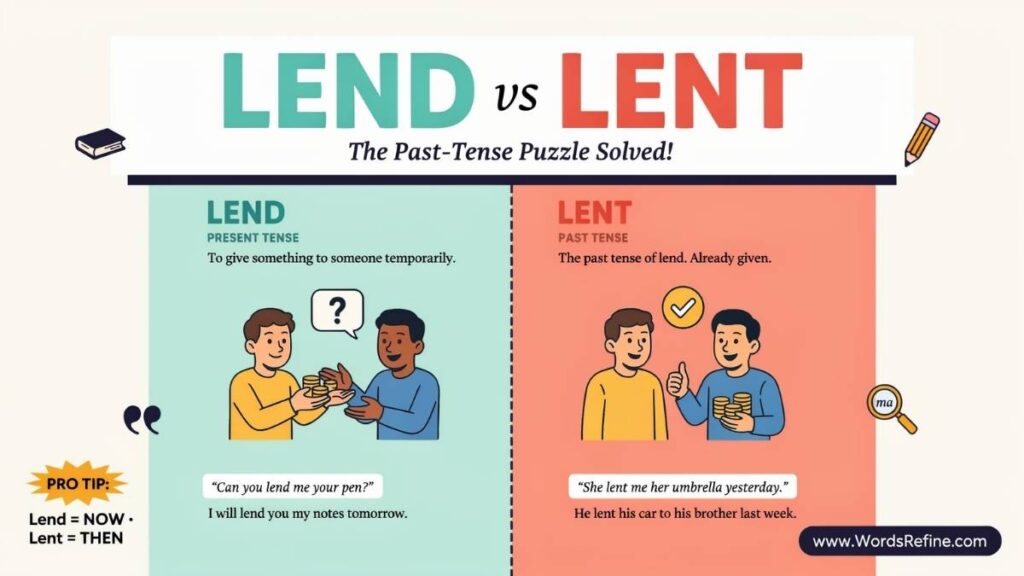
Have you ever paused while writing and wondered whether to use lend vs lent? You’re not alone. These forms belong to the same verb, but each has a specific grammatical role. Choosing the wrong one can make an otherwise polished sentence sound awkward and turn a simple rule into a surprisingly stubborn grammar puzzle. Fortunately, understanding lend vs lent is easier than it appears. Lend is the base form, while lent serves as both the simple past and past participle. Once you recognize this pattern, the confusion quickly fades. Let’s look at how these forms work, where common mistakes occur, and how to use them correctly and confidently in everyday English.
What Does Lend Mean?
Lend means to give someone something temporarily with the expectation that they will return it. The thing you lend might be a book, a pen, a car, money, or even your time and support.
For example:
- “Can you lend me your pen?”
- “I often lend books to my friends.”
- “The bank lends money to customers.”
- “She will lend me her car tomorrow.”
- “He always lends a hand when someone needs help.”
In each example, lend describes an action that happens now, happens regularly, or may happen later.
The important idea is temporary use. When you lend something, you don’t normally give it away permanently. You allow another person to use it and expect them to return it.
Lend as a Verb
Lend is an irregular verb. That means it doesn’t form its past tense by simply adding -ed.
Its main forms are:
| Verb form | Correct form | Example |
|---|---|---|
| Base form | lend | “Please lend me your notes.” |
| Present tense | lend / lends | “I lend books.” / “She lends books.” |
| Simple past | lent | “I lent him my book.” |
| Past participle | lent | “I have lent him my book.” |
| Present participle | lending | “She is lending me her car.” |
Therefore, the basic pattern to remember is lend, lent, lent.
That pattern is much more useful than trying to guess the past form every time you write.
What Does Lent Mean?
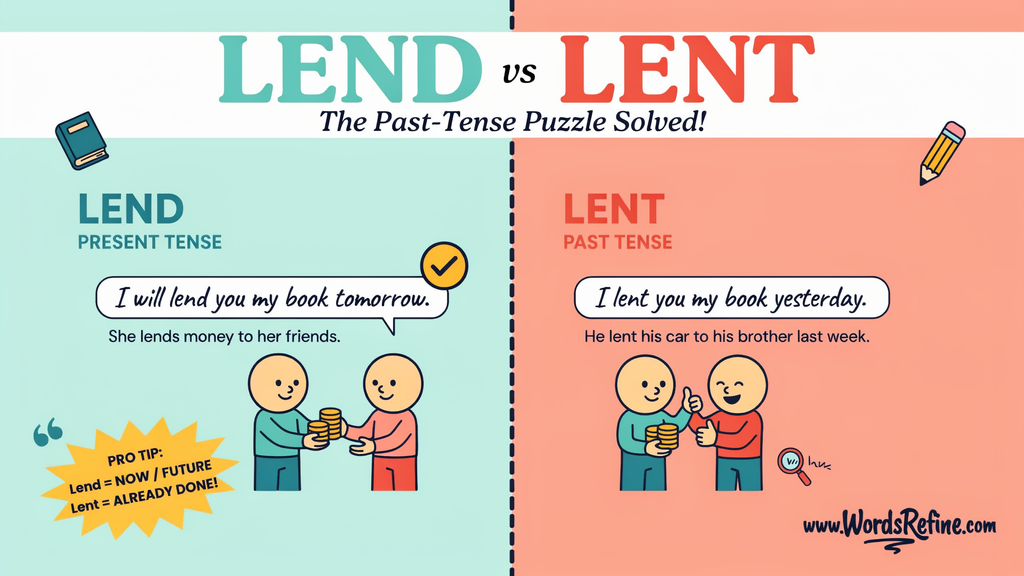
Lent is the simple past form of lend. It also works as the past participle.
Use lent when the lending happened in the past or when a perfect tense requires the past participle.
Consider these examples:
- “I lent Sarah my umbrella yesterday.”
- “He lent me $20 last week.”
- “They lent their car to a friend.”
- “She lent me her textbook during the semester.”
- “We have lent them equipment before.”
The first four examples describe completed actions. The final sentence uses lent after have because the sentence uses the present perfect tense.
For that reason, you can think of the distinction this way: lend usually points to the present or future, while lent points to the past or appears in a perfect-tense construction.
Lend vs Lent The Main Difference
The difference between lend vs lent is mainly grammatical rather than a completely different meaning.
Both words describe the act of giving something temporarily. The difference lies in the form of the verb and the role it plays in the sentence.
| Word | Grammatical role | Common use | Example |
|---|---|---|---|
| Lend | Base form | Present, requests, commands, future, and modal constructions | “Can you lend me your pen?” |
| Lends | Present form | Used with he, she, or it | “She lends me books.” |
| Lent | Simple past | Completed past actions | “She lent me a book yesterday.” |
| Lent | Past participle | Used with have, has, or had | “She has lent me several books.” |
| Lending | Present participle | Continuous forms | “She is lending me a book.” |
So, when someone asks what the difference between lend vs lent is, the easiest answer is this:
Lend is the base form. Lent is the past form and past participle.
Learn the difference between confusing more English words
Lay vs Lie Difference and which is correct?
Lend vs Lent Grammar How Tense Changes the Word
Verb tense tells readers when an action takes place. With lend, the change is particularly easy to see because the past form doesn’t use -ed.
Present Tense Lend
Use lend for present actions, regular habits, requests, and general situations.
For example:
- “I lend my books to classmates.”
- “We lend equipment to employees.”
- “Banks lend money to customers.”
When the subject is he, she, or it, the form changes to lends.
- “She lends me her notes.”
- “He lends his car to his brother.”
This is a normal present-tense verb change.
Simple Past Tense Lent
Use lent when an action has already happened.
For example:
- “I lent her my jacket yesterday.”
- “He lent me his car last weekend.”
- “They lent us some money during the trip.”
Words such as yesterday, last week, earlier, and last month often make the past meaning clear.
Future Tense Will Lend
When the action will happen later, use lend after will.
For example:
- “I will lend you my notes tomorrow.”
- “She will lend us the equipment.”
- “They will lend him the money.”
You should not say “I will lent you my notes.”
After will, English uses the base form of the verb. Therefore, the correct construction is will lend.
Modal Verbs Can Lend, Could Lend, Should Lend
The same rule applies after modal verbs such as can, could, may, might, and should.
For example:
- “Can you lend me a pen?”
- “Could you lend me your notes?”
- “I might lend him my car.”
- “She should lend them the equipment.”
You wouldn’t normally say “Can you lent me a pen?” because can requires the base form lend.
This simple rule can save you from several common grammar mistakes.
When Should You Use Lend vs Lent?
When you’re deciding whether to use lend vs lent, first look at the timing of the action.
If the action happens now, happens regularly, or will happen later, lend is usually the right choice.
If the action already happened, lent is generally correct.
Here is a quick way to check:
- Present action: “I lend my books to friends.”
- Regular action: “She lends money to her sister.”
- Future action: “I will lend you my car.”
- Request: “Could you lend me your pen?”
- Past action: “I lent him my book yesterday.”
- Present perfect: “I have lent her my notes.”
- Past perfect: “I had lent him the money.”
Therefore, when you’re unsure, ask yourself whether the action is happening now, will happen later, or already happened. That question often solves the problem immediately.
Learn the difference between more words people mix up
Capital vs Capitol Which One Is Correct?
Lend Verb Forms Lend, Lent, Lent
The three main forms of lend are simple:
lend → lent → lent
The first form is the base form. The second is the simple past. The third is the past participle.
| Form | Verb | Example |
|---|---|---|
| Base form | lend | “I want to lend you my book.” |
| Simple past | lent | “I lent you my book yesterday.” |
| Past participle | lent | “I have lent you my book.” |
The repetition of lent in the last two forms can actually make the verb easier to learn.
Once you remember lend, lent, lent, you don’t have to wonder whether the past participle changes again.
It doesn’t.
Is Lent the Past Tense of Lend?
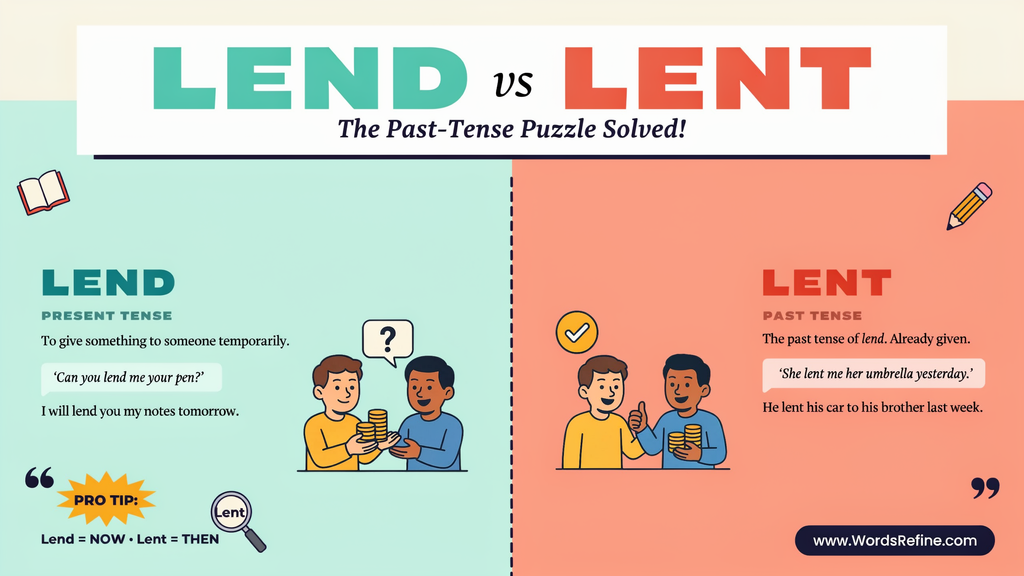
Yes. Lent is the past tense of lend.
For example:
“I lend my car to my brother.”
This describes a present or regular action.
“I lent my car to my brother yesterday.”
This describes a completed action in the past.
The same basic action takes place in both sentences. Only the timing changes.
Lent is also the past participle, which is why you can say:
- “I have lent him my car.”
- “She has lent me her notes.”
- “They had lent us their equipment.”
So, if you are asking whether lent is correct grammar, the answer is definitely yes.
Is Lended a Word?
This question comes up because many English verbs form their past tense with -ed.
For example:
- walk → walked
- clean → cleaned
- open → opened
- work → worked
However, lend is an irregular verb. Its past form is lent, not lended.
You may occasionally encounter lended in nonstandard writing or unusual historical or dialectal usage. However, it isn’t the standard form you should use in normal modern English.
Therefore, if you’re deciding between lended or lent, choose lent.
The standard pattern is:
lend → lent → lent
Not:
lend → lended → lended
Why Is Lended Incorrect?
The easiest explanation is that English has many irregular verbs whose past forms don’t follow the usual -ed pattern.
For example:
- send → sent
- spend → spent
- keep → kept
- feel → felt
- lend → lent
You wouldn’t normally write “I sended the email.” In the same way, standard English uses “I lent him the money,” not “I lended him the money.”
This isn’t a rule you need to overthink. It’s simply part of the verb’s standard conjugation.
Learn the difference between everyday English mistakes
Further vs Farther The Simple Difference and Each Correctly?
Lend Someone Something Grammar
There are two common sentence patterns with lend.
The first is:
lend + person + thing
For example:
- “Lend me your pen.”
- “She lent me her jacket.”
- “He will lend his brother the car.”
The person receiving the item comes directly after the verb.
The second pattern is:
lend + thing + to + person
For example:
- “Lend your pen to me.”
- “She lent her jacket to me.”
- “He will lend the car to his brother.”
Both structures are grammatically correct.
In everyday conversation, the first pattern often sounds more natural when the recipient is short and familiar.
For example, “Can you lend me your charger?” sounds very natural.
However, “Can you lend your charger to your brother?” works just as well when the sentence needs more emphasis on the object or recipient.
Lend Me vs Lent Me?
The choice between lend me and lent me depends on the timing and structure of the sentence.
Use lend me for a request, present situation, or future action.
For example:
- “Can you lend me your phone?”
- “Please lend me your notes.”
- “Will you lend me some money?”
Use lent me when describing something that already happened.
For example:
- “She lent me her phone yesterday.”
- “He lent me $50 last week.”
- “They lent me their car during the trip.”
Therefore, both forms can be correct. The surrounding sentence tells you which one belongs there.
Lend vs Lent Examples in Everyday English
Everyday situations make the difference easier to remember because you can connect each form with a real action.
Lending Money
Present:
“I sometimes lend money to my brother.”
Past:
“I lent my brother $50 last Friday.”
Future:
“I will lend him the money tomorrow.”
Perfect:
“I have lent him money several times.”
Lending a Book
Present:
“She often lends me her books.”
Past:
“She lent me her favorite novel last month.”
Future:
“She will lend me another book next week.”
Perfect:
“She has lent me several novels.”
Lending a Car
Present:
“My father rarely lends me his car.”
Past:
“He lent me his car last Saturday.”
Future:
“He will lend me the car tomorrow.”
Perfect:
“He has lent me his car before.”
These examples show how the same action can move through different verb forms depending on when it occurs.
Lend a Hand and Lend Support
Lend doesn’t always involve something you can physically pick up.
You can also lend a hand, lend support, lend assistance, or lend credibility to an idea.
For example:
- “Can you lend me a hand?”
- “She lent a hand during the move.”
- “They will lend their support to the project.”
- “The new evidence lends support to the theory.”
In these expressions, lend carries the broader idea of providing something useful.
So, although you might first learn lend through examples involving books, money, or pens, the verb has a much wider range of uses.
Learn the difference between misused words
Discrete vs Discreet What the Difference and which is Correctly?
Lend vs Borrow A Different Kind of Confusion
Lend and borrow often appear together because they describe the same exchange from opposite sides.
When you lend something, you give it temporarily.
When you borrow something, you receive it temporarily.
Imagine that Alex gives Jordan a book.
Alex can say:
“I lent Jordan my book.”
Jordan can say:
“I borrowed Alex’s book.”
Both sentences describe the same event. The perspective changes.
| Verb | Meaning | Example |
|---|---|---|
| Lend | Give something temporarily | “I lent her my book.” |
| Borrow | Receive something temporarily | “I borrowed her book.” |
A useful memory trick is simple:
The lender gives.
The borrower receives.
Once you picture the direction of the item, these two commonly confused words become much easier to separate.
Are They the Same?
Loan and lend overlap in meaning, but they don’t always appear in the same grammatical situations.
Loan is commonly used as a noun when talking about money or something provided temporarily.
For example:
“I took out a loan from the bank.”
In American English, loan can also function as a verb.
For example:
“The bank loaned him the money.”
Lend is also common in financial contexts:
“The bank lent him the money.”
Both sentences can be correct.
However, loan isn’t simply a replacement for lend in every situation. If someone asks for your pen, the natural sentence is:
“Can you lend me your pen?”
You wouldn’t normally use loan in that everyday request.
Common Mistakes With Lend vs Lent
Several errors appear again and again because writers apply the wrong verb form.
“I Lend You Money Yesterday”
The word yesterday clearly places the action in the past.
Incorrect:
“I lend you money yesterday.”
Correct:
“I lent you money yesterday.”
“I Lended Him My Car”
The standard past form isn’t lended.
Incorrect:
“I lended him my car.”
Correct:
“I lent him my car.”
“I Have Lend You My Book”
After have, you need the past participle.
Incorrect:
“I have lend you my book.”
Correct:
“I have lent you my book.”
“Can You Lent Me Your Pen?”
After can, use the base form.
Incorrect:
“Can you lent me your pen?”
Correct:
“Can you lend me your pen?”
“I Will Lent It Tomorrow”
After will, use lend.
Incorrect:
“I will lent it tomorrow.”
Correct:
“I will lend it tomorrow.”
Each mistake comes from using the wrong form for the grammatical structure. Once you understand the pattern, these errors become much easier to catch.
Learn the difference between misused words
Choose vs Chose Difference and which one is Correct?
A Real-Life Example of Lend vs Lent
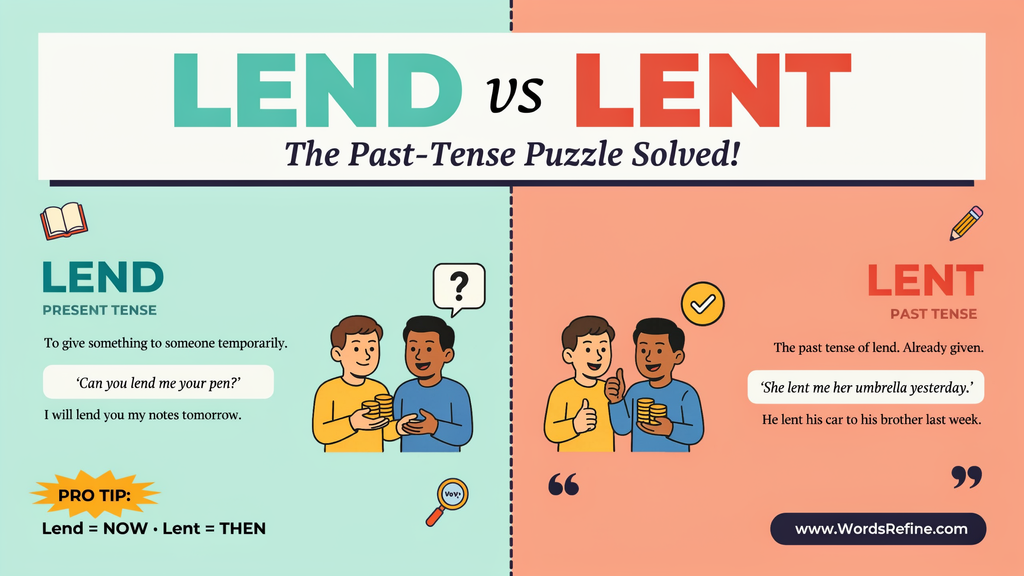
Consider a student named Maya who needs notes before an exam.
On Monday, Maya asks her classmate:
“Can you lend me your biology notes?”
Her friend agrees.
Later, Maya tells another student:
“Sam lent me his notes.”
A week later, Maya says:
“I will lend the notes to you when I’m finished.”
After returning them, she might explain:
“Sam has lent me several textbooks this semester.”
The situation hasn’t changed much. Maya needs temporary access to study materials.
What changes is the grammar.
The first sentence uses lend because Maya is making a request. The second uses lent because the action already happened. The third uses lend because the action will happen later. The fourth uses lent because has requires the past participle.
That is the practical lesson behind the entire distinction.
How to Use Lend in a Sentence
Use lend when you are describing a present situation, regular habit, request, command, possibility, or future action.
Here are several useful patterns:
- “Can you lend me your charger?”
- “She lends books to her classmates.”
- “I will lend you my notes tomorrow.”
- “He might lend us his truck.”
- “Please lend your calculator to anyone who needs it.”
Notice how the base form appears after modal verbs and will.
The form doesn’t become lent simply because the sentence talks about an action involving temporary possession.
The verb form depends on the grammar.
How to Use Lent in a Sentence
Use lent when the action happened in the past or when a perfect construction requires the past participle.
Examples include:
- “I lent my friend a book yesterday.”
- “She lent me her umbrella last week.”
- “We have lent them equipment before.”
- “He had lent the money before the meeting.”
- “They lent us their car during the trip.”
In each case, lent fits because the grammar calls for either the simple past or past participle.
Lend Present, Past, and Future Tense
A quick tense comparison can make the pattern much easier to remember.
| Time | Correct form | Example |
|---|---|---|
| Present | lend / lends | “I lend books.” |
| Simple past | lent | “I lent a book.” |
| Future | will lend | “I will lend a book.” |
| Present perfect | have/has lent | “I have lent a book.” |
| Past perfect | had lent | “I had lent a book.” |
| Continuous | am/is/are lending | “I am lending a book.” |
The most important sequence remains lend, lent, lent.
However, remember that English sentences can contain auxiliary verbs that change how the main verb behaves.
For example:
1.I will lend.”
2.I can lend.”
3.I have lent.”
4.I am lending.”
Each sentence follows its own grammatical structure.
Learn the difference between misused words
Fiancé vs Fiancée What’s the Difference and which is Correctly?
A Quick Test Lend vs Lent?
When you’re unsure which form to use, try this simple test.
- If the action happens regularly or now, consider lend.
- If you’re making a request, use lend.
- If the action will happen later, use lend after will.
- If a modal verb such as can or could comes before the verb, use lend.
- If the action happened yesterday, last week, or earlier, use lent.
- If the sentence contains have, has, or had and needs the past participle, use lent.
- If you’re tempted to write lended, stop and use lent instead.
For example:
“Could you ___ me your notes?”
The answer is lend because could takes the base form.
“She ___ me her notes yesterday.”
The answer is lent because the action happened in the past.
“I have ___ her my notes.”
The answer is lent because have requires the past participle.
Quick Reference
| Question | Answer |
|---|---|
| What is the base form? | lend |
| What is the present form? | lend / lends |
| What is the past tense? | lent |
| What is the past participle? | lent |
| Is lend an irregular verb? | Yes |
| Is lended the standard past form? | No |
| Can you say will lend? | Yes |
| Can you say can lend? | Yes |
| Can you say have lent? | Yes |
| Can you say have lended? | No in standard English |
| What does lend mean? | To give something temporarily with an expectation of return |
| What does borrow mean? | To receive something temporarily |
| What is the basic verb pattern? | lend → lent → lent |
Practice Session Lend vs Lent
- Could you ______ me your pen for a few minutes?
- I ______ my brother some money yesterday.
- She often ______ her books to her classmates.
- We will ______ you the equipment tomorrow.
- He ______ me his car last weekend.
- Could you ______ me a hand with these boxes?
- They have ______ their house to a family friend.
- I don’t usually ______ my clothes to other people.
- Sarah ______ me her laptop when mine stopped working.
- Can you ______ me your notes after class?
- The bank ______ the company a large amount of money.
- I will ______ you my umbrella if it starts raining.
- He has ______ his bicycle to his neighbor.
- Please ______ me your dictionary for a moment.
- We ______ some chairs to our neighbors for the party.
- She rarely ______ money to people she doesn’t know.
- They had ______ us their camera before they left.
- Could you ______ me your charger until mine is fully charged?
- I ______ him my favorite book two weeks ago.
- The teacher often ______ books to students who need them.
- I can ______ you some money until Friday.
- She ______ her car to her sister yesterday.
- Have you ever ______ your phone to someone?
- He promised to ______ me his notes before the exam.
- We ______ our camping equipment to our friends last summer.
Answers
Check your answers below. Notice how the surrounding words help determine whether lend vs lent is correct.
- Could you lend me your pen for a few minutes?
- I lent my brother some money yesterday.
- She often lends her books to her classmates.
- We will lend you the equipment tomorrow.
- He lent me his car last weekend.
- Could you lend me a hand with these boxes?
- They have lent their house to a family friend.
- I don’t usually lend my clothes to other people.
- Sarah lent me her laptop when mine stopped working.
- Can you lend me your notes after class?
- The bank lent the company a large amount of money.
- I will lend you my umbrella if it starts raining.
- He has lent his bicycle to his neighbor.
- Please lend me your dictionary for a moment.
- We lent some chairs to our neighbors for the party.
- She rarely lends money to people she doesn’t know.
- They had lent us their camera before they left.
- Could you lend me your charger until mine is fully charged?
- I lent him my favorite book two weeks ago.
- The teacher often lends books to students who need them.
- I can lend you some money until Friday.
- She lent her car to her sister yesterday.
- Have you ever lent your phone to someone?
- He promised to lend me his notes before the exam.
- We lent our camping equipment to our friends last summer.
Here’s a trusted source for clear word meanings:
FAQs
Which is correct: “loaned” vs “lent”?
Both “loaned” and “lent” can be correct. “Lent” is the past tense and past participle of “lend,” while “loaned” is the past tense of “loan” when it is used as a verb. For example, “I lent him my car” and “The bank loaned her the money” are both correct.
What does “lent” mean when talking about money?
When talking about money, “lent” means giving money to someone temporarily with the expectation that they will repay it. For example, “I lent my friend $50” means you gave your friend $50 and expect to get it back.
What is another word for “lend”?
“Loan” is the closest common alternative to “lend.” Depending on the context, you might also use phrases such as “give temporarily” or “advance.” However, these alternatives aren’t always interchangeable with “lend.”
What is a synonym for “lend”?
Common synonyms for “lend” include “loan,” “advance,” and “provide temporarily.” The most suitable synonym depends on the context. In everyday conversations, “lend” is often the most natural choice.
What are the three forms of “lend”?
The three main forms of “lend” are lend, lent, and lent. “Lend” is the base form, “lent” is the simple past, and “lent” is also the past participle.
For example: “I lend,” “I lent,” and “I have lent.”
What does “lend” mean in the Bible?
In the Bible, “lend” generally means to give something to another person temporarily, often with the expectation that it will be returned. Depending on the passage and translation, lending may refer to money, possessions, generosity, or helping others.
Should I say “borrow” or “lend”?
Use “lend” when you give something temporarily to another person. Use “borrow” when you receive something temporarily from someone else.
For example, “Can you lend me your pen?” means you are asking someone to give you their pen temporarily. “Can I borrow your pen?” describes the same situation from the receiver’s perspective.
Is it correct to say “lend me your pen”?
Yes, “lend me your pen” is grammatically correct. It means you are asking someone to give you their pen temporarily.
You can also say, “Could you lend me your pen?” or “Can you lend me your pen?”
Can I say “borrow” or “lend” your book?
Both can be correct, but they describe the action from different perspectives. Say “Can I borrow your book?” when you are receiving the book. Say “Can you lend me your book?” when you are asking the other person to give it to you temporarily.
Can I borrow money or lend money?
Both expressions are correct, but they describe opposite sides of the transaction. If you receive money temporarily and plan to repay it, you borrow money. If you give money to someone temporarily and expect repayment, you lend money.
For example, “I borrowed $100 from Maria” and “Maria lent me $100.”
Will you please lend me some money?
Yes, “Will you please lend me some money?” is grammatically correct. It means you are asking someone to give you money temporarily with the expectation that you will repay it.
A more natural and polite version is “Could you please lend me some money?”
How do I lend someone money?
To lend someone money means to give them money temporarily with the expectation that they will repay you. You can say, “I lent my brother $200.”
You can also use the structure “lend something to someone,” as in “I lent $200 to my brother.”
What does “lend lent” mean?
“Lend” and “lent” are different forms of the same verb. “Lend” is the base form, while “lent” is both the simple past and past participle.
The verb forms are:
lend → lent → lent
For example, “I will lend you my car,” “I lent you my car yesterday,” and “I have lent you my car before.”
Is it “lent me” vs “loaned me”?
Both can be correct. “Lent me” is the form of the verb “lend,” while “loaned me” uses “loan” as a verb.
For example, “She lent me her laptop” is correct. “The bank loaned me the money” is also correct.
Is “lended” correct?
No. “Lended” is not the standard past tense or past participle of “lend” in modern standard English. The correct form is “lent.”
Say “I lent him my book,” not “I lended him my book.”
The correct pattern is:
lend → lent → lent
Conclusion
The difference between lend vs lent may seem like a tiny grammar detail, but using the wrong form can make an otherwise clear sentence sound awkward. The good news is that once you understand the pattern, there’s very little to remember.
Use lend as the base form for present situations, requests, future actions, and after modal verbs such as can, could, and will. Use lent for completed past actions and after have, has, or had.
The simplest pattern is:
lend → lent → lent
One more mistake deserves a quick warning: lended. It might look logical, but standard English uses lent instead. Not every verb gets to enjoy a neat -ed ending, and lend is one of those irregular verbs that refuses to play by that particular rule.
It’s also important to keep lend and borrow separate. You lend something when you give it to someone temporarily. You borrow something when you receive it temporarily. Once you understand who is giving and who is receiving, the confusion becomes much easier to avoid.
So, the next time you hesitate between lend vs lent, check the tense, look at the helping verb, and remember the three-part pattern. With lend → lent → lent firmly in mind, this common grammar mix-up can finally be crossed off your list of language headaches.

Diora AJS she is an experienced blogger and passionate English language enthusiast at Words Refine. With a keen eye for language and a love for clear communication, she writes practical content about grammar, word meanings, usage, and commonly confused terms. Her goal is to make English easier to understand through clear explanations and relatable examples, helping readers write accurately and communicate with confidence.