
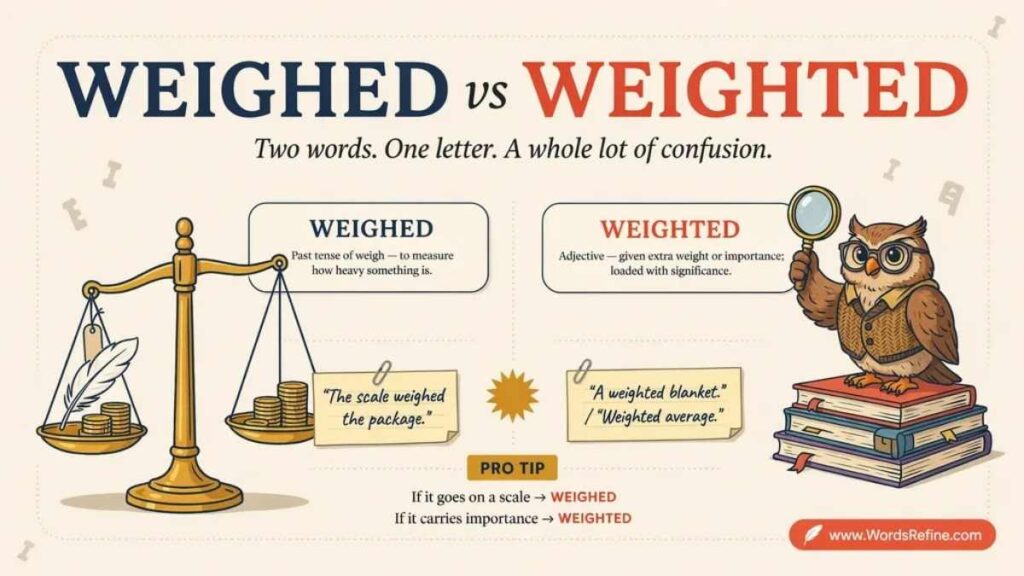
Weighed vs weighted may look almost identical, but these words carry different meanings and serve different purposes in English. Weighed usually refers to measuring something or carefully considering an idea, option, or decision. Weighted, however, often describes something made heavier or given greater importance, influence, or value. Because the words sound similar, it’s easy to mix them up, especially in sentences involving measurements, choices, grades, or statistics. Fortunately, the difference is straightforward once you understand the context. This guide explains weighed vs weighted with clear definitions, practical examples, common mistakes, and simple rules to help you choose the correct word confidently every time.
Weighed vs weighted Quick Answer
Weighed is the past tense and past participle of weigh. It can mean that someone measured how heavy something was. It can also mean that someone carefully considered something before making a decision.
For example, you might say, “The clerk weighed the package before shipping it.” You could also say, “She weighed the advantages and disadvantages before accepting the offer.”
Weighted comes from the verb weight. It can describe something that has been given additional physical weight or something that has been assigned greater importance or influence.
For example, “The athlete trained with a weighted vest.” In another context, you might say, “The final exam was weighted more heavily than the homework.”
Therefore, if you are wondering whether it should be weighed or weighted, the sentence’s meaning determines the answer.
What Does Weighed Mean?
The word weighed comes from the verb weigh. In its most familiar sense, it refers to measuring weight.
When you place an object on a scale to determine how heavy it is, you weigh it. Once that action has already happened, you use weighed.
For example, “The package was weighed before it was shipped.” The sentence tells us that someone measured the package’s weight.
You can use weighed with almost anything that can be measured by weight. A person can be weighed at a doctor’s office. A suitcase can be weighed at an airport. Ingredients can be weighed while cooking. A parcel can be weighed before delivery.
The word can also describe the weight of something rather than the act of measuring it. For example, “The suitcase weighed 40 pounds.” In this sentence, weighed tells us the suitcase had a particular weight.
There is another important meaning, though. Weigh can also mean to consider something carefully. In that sense, weighed has nothing to do with a physical scale.
For example, “She weighed her options before making a decision.” She did not place her choices on a scale. Instead, she carefully considered them.
Similarly, someone might weigh the risks, weigh the evidence, or weigh the pros and cons before choosing what to do.
So, the meaning of weighed depends on context. It can refer to physical measurement or careful consideration.
What Does Weighted Mean?
Weighted comes from the verb weight. It usually means that something has been given weight, importance, influence, or value.
The word can have a physical meaning. A weighted object has additional weight or has been designed with weight distributed in a particular way.
For example, a weighted ball contains additional weight. A weighted vest adds resistance during exercise. A weighted blanket is heavier than a standard blanket because it contains material designed to add weight.
However, weighted often appears in mathematical, statistical, academic, and professional contexts.
A weighted average, for example, doesn’t treat every number equally. Some values have more influence on the final result than others.
Likewise, a weighted score gives certain criteria more influence than other criteria. If a company gives experience more importance than another hiring factor, its evaluation system may be weighted toward experience.
This is why the word weighted often appears alongside terms such as score, average, data, value, criteria, importance, and calculation.
Learn the difference between confusing more English words
Enflamed vs Inflamed Which One Is Correct ?
The Difference Between Weighed vs Weighted
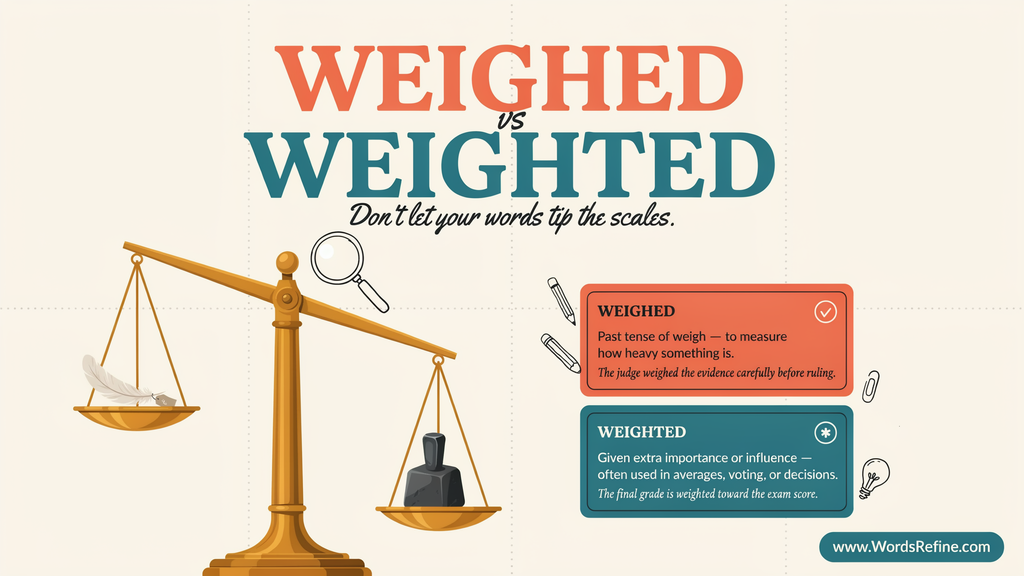
The easiest way to understand the difference between weighed vs weighted is to focus on what happens to the weight.
Weighed usually describes measuring something or carefully considering something.
Weighted usually describes giving something weight or giving it greater importance or influence.
Consider these two sentences:
“The technician weighed the sample.”
“The calculation used a weighted value.”
In the first sentence, the technician measured the sample’s weight. In the second, the calculation gave the value a particular level of influence.
The distinction becomes even clearer in decision-making.
“She weighed the options before accepting the job.”
“The company weighted experience more heavily than education.”
In the first sentence, she carefully considered several choices. In the second, the company assigned greater importance to one factor.
That is the basic difference between weighed and weighted.
Weigh vs Weight Understanding the Root Words
To understand why these forms differ, it helps to look at weigh and weight.
Weigh is primarily a verb. It can mean to measure something’s weight, to have a particular weight, or to consider something carefully.
For example, you can weigh a package, weigh ingredients, weigh a person, or weigh the pros and cons of a decision.
Weight is primarily a noun. It refers to how heavy something is or, in a figurative sense, the importance or influence that something carries.
For example, “The weight of the package is 15 pounds.” You can also say, “Her opinion carries considerable weight.”
Weight can also function as a verb. When used as a verb, it can mean to assign weight or importance to something. Its past form is weighted.
This explains the difference between weigh and weight and why their past forms aren’t interchangeable.
Weigh becomes weighed.
Weight becomes weighted.
Once you understand those basic forms, the spelling becomes much easier to remember.
Weighed as the Past Tense of Weigh
If you’re asking whether weighed is the past tense of weigh, the answer is yes.
The basic forms are straightforward. The present form is weigh. The third-person singular form is weighs. The past tense and past participle are weighed. The present participle is weighing.
For example, you can say, “I weigh the ingredients every morning.” If the action happened yesterday, you would say, “I weighed the ingredients yesterday.”
The same pattern applies when weigh means consider.
“I weigh my options carefully.”
“I weighed my options carefully.”
The meaning changes slightly depending on the context, but the verb form remains the same.
Learn the difference between commonly mixed-up more words
Trebled vs Tripled Which One Is Correct?
Weighted as the Past Tense of Weight
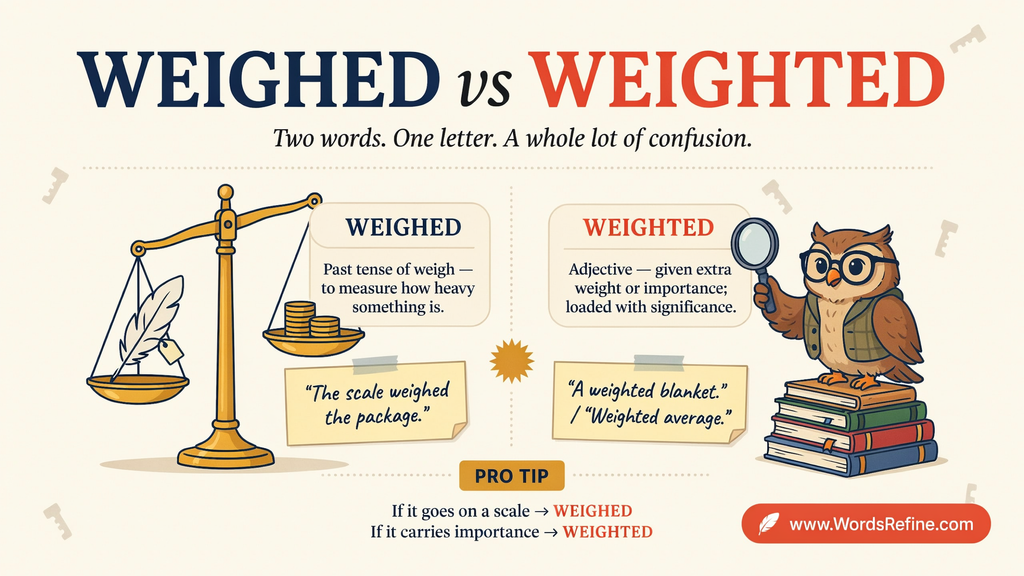
The Weighted is the past tense and past participle of the verb weight.
This verb is less common in ordinary conversation than weigh, yet it appears regularly in technical, mathematical, statistical, and professional writing.
For example, “The system weighted each category according to its importance.”
Here, weighted describes an action. The system assigned different levels of influence to the categories.
The word can also work as an adjective. Consider the phrase “weighted average.” In that expression, weighted describes the type of average.
The same applies to phrases such as weighted score, weighted data, weighted value, and weighted criteria.
Weighed vs Weighted in Everyday Situations
Everyday situations provide some of the clearest examples of the distinction.
Imagine that you are sending a package. You place the box on a scale to find out how heavy it is. and You have weighed the package.
The You would not normally say that you “weighted” the package unless you mean that you deliberately added or assigned weight to it.
Cooking works in much the same way. If a recipe calls for 200 grams of flour, you might weigh the flour before adding it to the mixing bowl.
Fitness provides another useful comparison. An athlete may be weighed to track body weight, yet that same athlete may train with a weighted vest.
The athlete is weighed. The vest is weighted.
That small change in wording completely changes the meaning.
When Talking About Decisions
The word weighed becomes especially interesting when it moves away from physical measurement.
English often uses weight as a metaphor for importance. Because of that, weigh can describe the process of thinking carefully about something.
Suppose you are deciding whether to move to another city. You might weigh the salary, housing costs, commute, family needs, and career opportunities before making your choice.
You could say, “She weighed the advantages and disadvantages before accepting the position.”
Here, weighed means carefully considered.
Weighted works differently.
Imagine that an employer uses a scoring system in which relevant experience counts for 40 percent of the final evaluation. Education might count for 30 percent, communication skills for 20 percent, and certifications for 10 percent.
In that system, experience has been given greater weight.
You could therefore say, “The company weighted experience more heavily than certifications.”
The person weighs the options. The system weights the factors.
That distinction is useful because both words can appear in the same discussion while serving completely different purposes.
Learn the difference between tricky grammar more words
Hierarchical vs Hierarchal Which One Is Correct?
Weighed vs Weighted Average
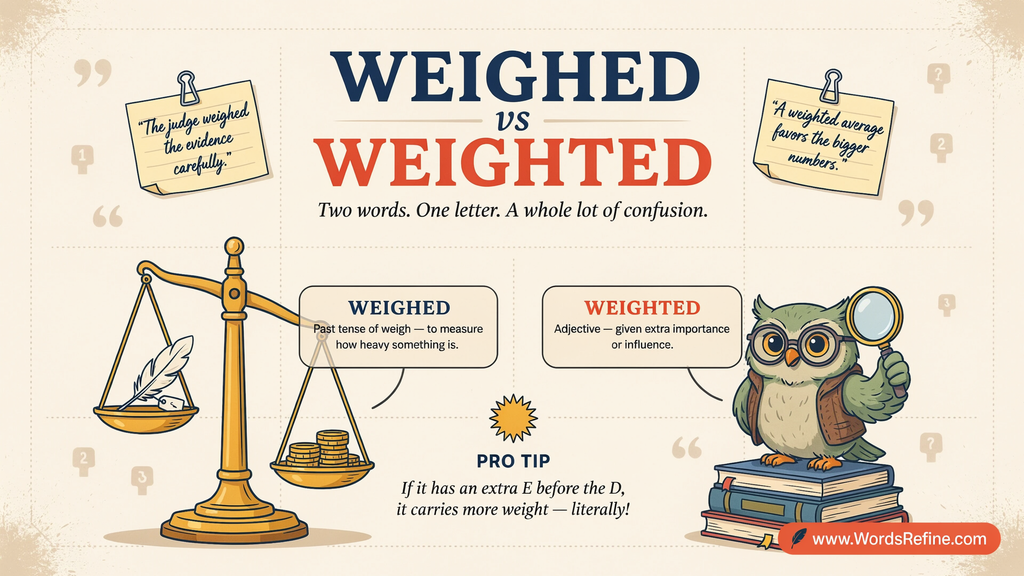
One particularly common point of confusion involves the phrase weighted average.
The standard term is weighted average, not weighed average.
A weighted average gives different values different levels of influence.
Imagine that a student’s final grade consists of homework worth 20 percent, a midterm worth 30 percent, and a final exam worth 50 percent.
Suppose the student earns 90 percent on homework, 80 percent on the midterm, and 70 percent on the final exam.
The final result is calculated by multiplying each score by its assigned percentage:
90 × 0.20 = 18
80 × 0.30 = 24
70 × 0.50 = 35
Adding those values produces a final weighted average of 77 percent.
The final exam has more influence because it carries a larger weight.
A regular average would treat all three scores equally. A weighted average does not.
This is why weighted appears so often in statistics, education, economics, research, and data analysis.
Weighted Scores and Weighted Data
Weighted scores work on the same basic principle.
Suppose a company evaluates applicants using several factors. Technical ability might account for 40 percent of the total score. Experience might account for 30 percent. Communication skills might account for 20 percent. Certifications might account for the remaining 10 percent.
Each factor contributes to the final result, but not equally.
The scoring system therefore uses weighting.
The same concept applies to weighted data. In statistics, researchers may assign different weights to observations depending on the design of a study or the population they want their results to represent.
The important point is that weighting changes the influence of a value. It doesn’t simply measure how heavy something is.
Therefore, if you see terms such as weighted data, weighted score, weighted value, or weighted importance, think about influence rather than simple measurement.
Weighted Objects and Physical Weight
Weighted doesn’t always belong to mathematics.
It can describe ordinary physical objects too.
A weighted object contains or receives additional weight. and A weighted ball, for example, is designed to be heavier than a standard ball of a similar type.
A weighted vest adds resistance to exercise. and A weighted blanket contains distributed material that increases its overall weight.
Now compare that with a measurement:
“The package was weighed before delivery.”
The package itself isn’t necessarily weighted. Someone simply measured its weight.
This distinction is subtle but important.
Weighted describes what something has or has been given.
Weighed describes what someone did to determine its weight.
Learn the difference between confusing word pairs
Taylored vs Tailored Which One Is Correct?
Common Mistakes With Weighed vs Weighted
One common mistake is using weighted when the intended meaning is measurement.
For example, “The technician weighted the sample to determine its mass” is usually incorrect if the technician simply placed the sample on a scale.
The natural sentence is, “The technician weighed the sample to determine its mass.”
Another common mistake involves scoring systems.
Someone might write, “The final exam was weighed at 50 percent of the grade.” In standard usage, weighted is the appropriate word because the exam has been assigned a particular influence in the calculation.
A third mistake involves confusing weigh with weight.
For example, “What does the package weight?” is incorrect in standard English when asking about its heaviness.
The natural question is, “What does the package weigh?”
You could also ask, “What is the package’s weight?”
The first uses weigh as a verb. The second uses weight as a noun.
Finally, some writers assume that weighed and weighted are interchangeable because both relate to weight. They aren’t. Their meanings overlap in theme, but they describe different actions and relationships.
A Real-World Example Shipping a Package
Consider a small business preparing an order for a customer.
An employee places the box on a scale. The display shows that the package weighs eight pounds.
At this stage, the employee has weighed the package.
The shipping company may then calculate the delivery price using package weight, dimensions, destination, and other factors. If the company’s formula gives package weight greater influence than another factor, the calculation could use weighted criteria.
So the same shipping process can involve both words.
The package is weighed because its physical weight must be measured.
The pricing factors may be weighted because some factors receive greater influence in the calculation.
The difference becomes obvious once you look at what each word describes.
A Real-World Example Student Grades
Now imagine a course where homework accounts for 20 percent of the final grade, the midterm accounts for 30 percent, and the final exam accounts for 50 percent.
The teacher might explain that the final exam has been weighted more heavily than homework.
Nothing is being measured on a physical scale. Instead, the grading system gives the final exam greater influence.
However, a student might later weigh the advantages and disadvantages of taking an optional extra-credit assignment.
In that sentence, weighed means carefully considered.
The two words can therefore appear in the same educational setting without being interchangeable.
A Real-World Example Making a Difficult Choice
Suppose someone receives two job offers.
One position offers a higher salary. The other offers a shorter commute and more flexible hours.
Before choosing, the person might weigh the salary, commute, schedule, benefits, and long-term opportunities.
That means the person carefully considers the factors.
Now suppose the employer uses a decision model that gives salary a 50 percent influence and flexibility a 20 percent influence.
The model has weighted the factors differently.
This gives you a useful mental picture:
A person weighs options.
A system weights factors.
Weighed Sentence Examples
The package was weighed before it left the warehouse.
The chef weighed the flour before mixing the dough.
The veterinarian weighed the puppy during the examination.
The technician weighed the sample on a laboratory scale.
The airline employee weighed the suitcase before issuing the boarding pass.
She weighed the risks before accepting the offer.
The committee weighed the evidence carefully.
He weighed the pros and cons before making his choice.
They weighed several options before selecting a supplier.
The manager weighed the possible consequences of the decision.
Each sentence uses weighed because the word refers either to measurement or careful consideration.
Weighted Sentence Examples
The course uses a weighted average to calculate final grades.
The final exam carries a weighted score of 50 percent.
The research team used weighted data in its analysis.
The company weighted experience more heavily than certifications.
The scoring model assigned a greater weighted value to accuracy.
The athlete trained with a weighted vest.
The child used a weighted blanket.
The system weighted customer satisfaction more heavily than response time.
Each criterion was weighted according to its importance.
The final result reflects the weighted importance of several factors.
In each case, weighted involves added physical weight or assigned influence.
Weighed Adjective or Verb?
The question of whether weighed is an adjective or verb can seem confusing because English past participles sometimes behave like adjectives.
In the sentence “The technician weighed the sample,” weighed is clearly a verb. It describes an action performed by the technician.
In “The sample has been weighed,” weighed is the past participle of weigh and forms part of the verb phrase.
Depending on the sentence structure, a past participle can also take on an adjective-like role. However, for everyday grammar, the most useful point is that weighed comes from the verb weigh and functions as its past tense and past participle.
That is the form you need when describing something that someone measured or carefully considered in the past.
Weighted Adjective or Verb?
Weighted can also function as both a verb and an adjective.
In the sentence “The company weighted experience more heavily,” weighted is a verb because it describes an action.
In “The company used a weighted scoring system,” weighted describes the noun scoring system. Here, it functions adjectivally.
This distinction is common in English. The same word can change its grammatical role depending on how it functions in a sentence.
The surrounding words usually make the role clear.
Learn the difference between often confused words
Siked vs Psyched Which One Is Correct?
Weighed vs Weighted Pronunciation
The Weighed and weighted also differ in pronunciation.
Weighed is pronounced as one syllable. Weighted has two syllables.
That extra syllable makes weighted easy to distinguish when spoken clearly.
The pronunciation reflects the different word formations as well.
Weigh becomes weighed.
Weight becomes weighted.
Although the words are related, their endings don’t work in exactly the same way because they come from different base words.
When learning these forms, it helps to connect pronunciation with meaning rather than memorizing the spelling alone.
How to Choose the Correct Word
When you’re unsure whether to use weighed or weighted, start with the meaning rather than the spelling.
1If someone placed an object on a scale to measure how heavy it was, choose weighed.
2If someone carefully considered evidence, risks, choices, or possibilities, choose weighed.
3If something received additional physical weight, choose weighted.
4If a calculation, scoring system, or decision-making process gives something greater influence or importance, choose weighted.
For example, “The box was weighed” describes measurement.
“The score was weighted toward experience” describes assigned influence.
“She weighed her options” describes careful consideration.
“He trained with a weighted vest” describes added physical weight.
Once you ask what the word is actually doing, the correct form usually becomes obvious.
Which One Is Correct?
Both are correct words. Neither is universally better than the other.
The correct choice depends on the meaning of the sentence.
Use weighed when you mean measured or carefully considered.
Use weighted when you mean given physical weight, importance, influence, or value.
This distinction applies across everyday English, professional writing, academic work, statistics, mathematics, business, fitness, cooking, shipping, and many other areas.
Therefore, if you’re asking, “Is it weighed or weighted?” don’t simply look at which spelling seems familiar. Ask what you want the word to communicate.
If you’re talking about a scale, measurement, or careful consideration, weighed will usually fit.
If you’re talking about a scoring system, weighted average, weighted data, added weight, or greater importance, weighted will usually fit.
Learn the difference between basic English word mistakes
Ambassador vs Embassador Which Spelling Is Correct?
Practice Session Weighed vs Weighted
- The baker ______ the flour before adding it to the mixing bowl.
- The research team ______ each factor according to its importance.
- She ______ the pros and cons before accepting the offer.
- The package was ______ at the post office before it was shipped.
- The final grade is ______ more heavily toward the exam.
- He carefully ______ the risks before making his decision.
- The scientist ______ the samples to record their exact mass.
- The survey results were ______ according to the size of each group.
- The athlete was ______ before the competition.
- The teacher used a ______ grading system in which exams counted more than homework.
- We ______ the ingredients carefully to follow the recipe.
- The committee ______ several factors before reaching its decision.
- The data was ______ to account for differences between the groups.
- The technician ______ the equipment before placing it in the shipping box.
- She ______ all the possible consequences before responding.
- The scoring system is ______ toward accuracy rather than speed.
- The veterinarian ______ the puppy during its examination.
- The analyst used a ______ average to give greater importance to recent results.
- They ______ the luggage before checking in at the airport.
- The judge ______ the evidence carefully before reaching a conclusion.
- The results were ______ according to the number of participants in each category.
- The mechanic ______ the replacement part to make sure it met the required specification.
- He ______ his options before choosing which apartment to rent.
- The survey used ______ responses to give larger groups an appropriate influence on the results.
- Before calculating the total, the researcher ______ each sample separately.
Answers
- weighed
- weighted
- weighed
- weighed
- weighted
- weighed
- weighed
- weighted
- weighed
- weighted
- weighed
- weighed
- weighted
- weighed
- weighed
- weighted
- weighed
- weighted
- weighed
- weighed
- weighted
- weighed
- weighed
- weighted
- weighed
Here’s a trusted source for clear more words Comparison:
FAQs
Can “weighed” describe a decision?
Yes. “Weighed” can describe carefully considering a decision, choice, risk, or possibility before reaching a conclusion.
Can “weighted” describe importance?
Yes. “Weighted” can indicate that something has been given greater importance, influence, or value than other factors.
Is “weighted” derived from the word “weight”?
Yes. “Weighted” comes from the noun “weight” and can refer to physical heaviness or the amount of influence assigned to something.
Can “weighed” have a meaning beyond physical measurement?
Yes. “Weighed” can also mean carefully considering information, options, consequences, or evidence before making a decision.
What does “weighted toward” mean?
“Weighted toward” means that something has been arranged or adjusted so that one side, factor, or option has more influence than the others.
What does “weighted equally” mean?
“Weighted equally” means that each item or factor receives the same level of importance or influence in a calculation, comparison, or evaluation.
Can “weighted” mean “biased”?
Sometimes. In certain contexts, “weighted” can describe something that favors one side or outcome. However, weighting is not necessarily unfair. In statistics and mathematics, weights are often assigned deliberately for valid analytical reasons.
Is a weighted average always better than a regular average?
No. A weighted average is useful when different values deserve different levels of influence. When every value should count equally, a regular arithmetic mean is generally appropriate.
Can a person and a decision both be “weighed”?
Yes, but the meanings are different. A person can be weighed to determine physical weight, while a decision can be weighed when someone carefully considers its possible results.
Does “weighted” always mean physically heavier?
No. “Weighted” can describe physical heaviness, but it can also refer to importance, influence, statistical calculations, scores, or other situations where different factors receive different levels of weight.
What is the difference between “weighing” vs “weighting”?
“Weighing” usually means measuring weight or carefully considering something. “Weighting” means assigning different levels of importance or influence to particular factors, values, or categories.
Can “weighed” vs “weighted” be used interchangeably?
No. Although both words relate to the concept of weight, they have different meanings. “Weighed” generally refers to measuring or considering, while “weighted” usually refers to making something heavier or giving it greater influence or importance.
Conclusion
The difference between weighed vs weighted may seem small, but that extra “t” can carry a surprisingly heavy load. Weighed is used when you measure something or carefully consider an idea, decision, or option. Weighted, on the other hand, usually means something has been made heavier or given greater importance or influence.
Once you connect weighed with measuring or considering and weighted with adding weight or influence, the confusion becomes much easier to avoid. So, before you let these two words tip the scales in your sentence, pause and check what you actually mean. A quick look at the context can keep your writing accurate, clear, and pleasantly free of unnecessary grammatical weight.

Diora AJS she is an experienced blogger and passionate English language enthusiast at Words Refine. With a keen eye for language and a love for clear communication, she writes practical content about grammar, word meanings, usage, and commonly confused terms. Her goal is to make English easier to understand through clear explanations and relatable examples, helping readers write accurately and communicate with confidence.