

Words can sometimes look so similar that they seem to have copied each other’s homework. Hierarchical vs hierarchal is one of those confusing word pairs. Both terms exist, and both relate to hierarchy, but they aren’t equally common in modern English. So, which one should you use when describing levels of authority, ranks, categories, or organizational structure? That small spelling difference can make your sentence sound polished or unexpectedly awkward. In this guide, you well learn the meaning, spelling, usage, pronunciation, and practical differences between hierarchical and hierarchal. By the end, you’ll know which word fits your sentence and why one appears far more often in everyday writing.
Hierarchical vs Hierarchal Quick Answer
Both hierarchical and hierarchal are words. They are adjectives related to a hierarchy, which is a system arranged according to levels, ranks, authority, or importance.
However, hierarchical is by far the more familiar and widely used form in modern English.
Use hierarchical when you want to describe something arranged in levels or ranks.
For example:
The company has a highly hierarchical management structure.
Hierarchal can also describe something connected with a hierarchy, but it is much less common. It may sound unusual to many readers, especially in ordinary professional or academic writing.
So, when you’re wondering hierarchical or hierarchal which is correct, the practical answer is simple: hierarchical is usually the better choice.
What Does “Hierarchical” Mean?
The word hierarchical is an adjective that describes something organized into different levels, ranks, or degrees of authority.
Think of a ladder.
The person standing on the top rung has a different position from someone standing near the bottom. Each rung represents a different level. That basic idea helps explain what hierarchical means.
A hierarchical system can involve:
Levels of authority
Levels of importance
Ranks within an organization
Categories within a classification system
Different levels of power or responsibility
A chain of command
A structure in which one group or category sits above another
Hierarchical Definition
A simple hierarchical definition is:
Hierarchical means arranged in a system of levels, ranks, or degrees of importance or authority.
The word comes from hierarchy, which refers to an organized system in which people, groups, or things are ranked according to position, importance, authority, or status.
For example:
The hospital has a hierarchical structure with several levels of management.
The sentence tells you that the hospital isn’t organized as one giant group where everyone has the same role. Instead, different positions exist at different levels.
A department manager may supervise several employees. A director may supervise managers. An executive may oversee directors.
That’s a hierarchical organization.
What Does Hierarchical Mean in English?
In modern English, hierarchical generally means that something follows a system of ranks or levels.
You can use it when discussing organizations, social groups, computer systems, classifications, government structures, businesses, and many other subjects.
For example:
The company uses a hierarchical management system.
Here, hierarchical describes the way authority is organized.
Another example:
The software uses a hierarchical database.
In this case, the information is arranged in levels, often resembling a tree structure.
The meaning stays connected to the same central idea: one level relates to another level within an organized structure.
What Is a Hierarchy?
Before understanding hierarchical, it helps to understand the noun hierarchy.
A hierarchy is a system in which people, groups, objects, or ideas are arranged according to rank, authority, importance, or position.
Imagine a company.
At the top might be the chief executive. Under that person might be senior executives. Below them might be department managers. Employees may appear at another level.
That structure represents a hierarchy of authority.
A simple visual representation might look like this:
Chief Executive
      ↓
Senior Management
      ↓
Department Managers
      ↓
Team Leaders
      ↓
Employees
Each level has a different position within the organizational structure.
That is why you’ll often see expressions such as organizational hierarchy, management hierarchy, social hierarchy, and hierarchical structure.
Learn the difference between confusing more English words
Instalments vs Installments Which one Is Correct?
Hierarchy Meaning vs Hierarchical Meaning
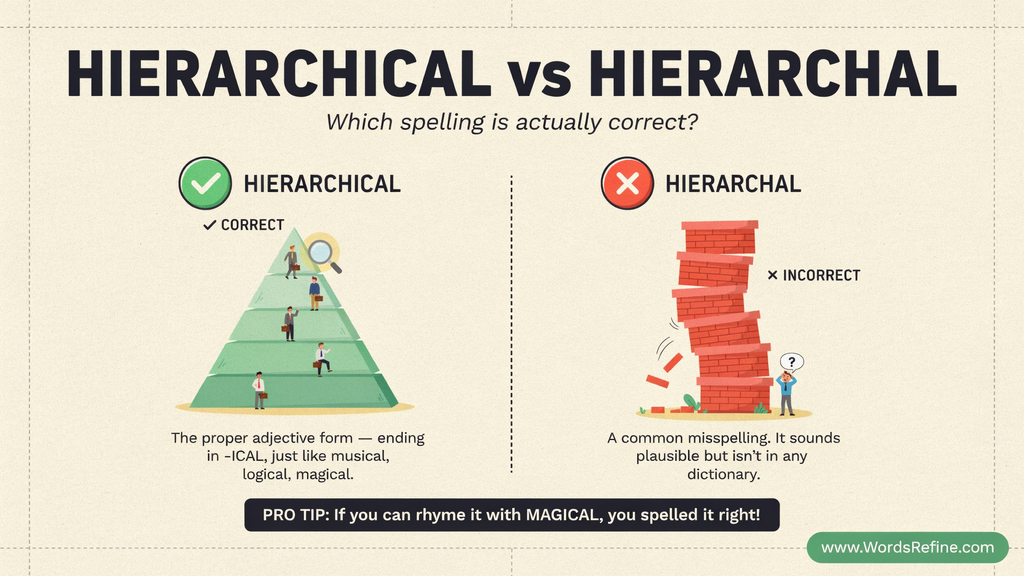
The words hierarchy and hierarchical are closely connected, but they aren’t interchangeable.
Hierarchy is a noun. It names the system itself.
The company has a strict hierarchy.
Hierarchical is an adjective. It describes something related to that system.
The company has a strict hierarchical structure.
A useful way to remember this is:
Hierarchy = the system
Hierarchical = describes the system
You wouldn’t normally say:
The company has a strict hierarchy structure.
Instead, you’d say:
The company has a strict hierarchical structure.
The adjective hierarchical modifies the noun structure.
What Does “Hierarchal” Mean?
Now we reach the word that causes most of the confusion.
Hierarchal is a legitimate English adjective. It relates to a hierarchy vs a hierarch.
So, if you’re asking is hierarchal a word, the answer is yes.
The problem isn’t that hierarchal is automatically wrong. The bigger issue is that it is considerably less common than hierarchical.
That difference matters because common usage affects how natural a word sounds.
For many readers, hierarchical feels familiar immediately.
Hierarchal may cause a brief pause.
A reader might wonder whether it is a spelling mistake, even though it can be used correctly.
Hierarchal Definition
A simple hierarchal definition is:
Hierarchal means relating to a hierarchy or a system of ranks and levels.
For example:
The organization maintained a strict hierarchal system.
The sentence is understandable, and hierarchal is being used as an adjective related to the organization’s hierarchy.
However, most modern readers are more accustomed to:
The organization maintained a strict hierarchical system.
Both communicate essentially the same basic idea, but the second version is much more familiar.
Hierarchical vs Hierarchal Meaning The Main Difference
The central difference between hierarchical vs hierarchal isn’t usually the basic meaning.
Both words connect to the idea of a hierarchy.
The bigger difference is usage and familiarity.
Hierarchical is the standard, widely recognized choice in modern English.
Hierarchal is a valid but less common variant.
That means you shouldn’t automatically treat hierarchal as a spelling error. At the same time, you shouldn’t choose it simply because it’s shorter.
For most writing situations, especially when you’re writing for a broad audience, hierarchical will sound more natural.
Consider these two sentences:
The organization has a hierarchical structure.
The organization has a hierarchal structure.
The second sentence isn’t necessarily meaningless or grammatically impossible. However, the first sentence is much more likely to sound natural to a modern English reader.
Learn the difference between commonly mixed-up more words
Copyright vs Copywrite Which One Is Correct?
Which One Is Correct?
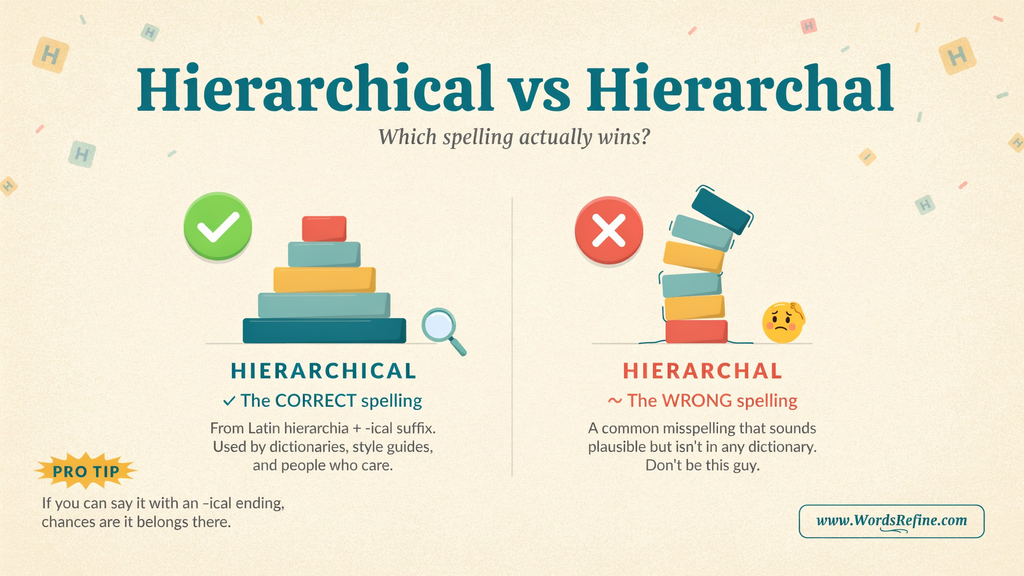
If you’re searching for hierarchical vs hierarchal which is correct, here’s the practical rule:
Hierarchical is the preferred and more common form. Hierarchal is also a recognized word, but it is much less common.
This distinction is important.
Calling hierarchal simply “wrong” oversimplifies the issue. English contains many words with less common variants. A word can be legitimate without being the form most writers would normally choose.
Think of it like clothing.
Both shirts may fit, but one may be the style everyone recognizes immediately. In the same way, both adjectives can relate to a hierarchy, but hierarchical is the form most readers expect.
If you’re writing an essay, business document, research paper, report, website, or professional email, hierarchical is generally the safer choice.
Hierarchical Spelling vs Hierarchal Spelling
The spelling difference is easy to spot once you know what you’re looking for.
Hierarchical contains -ical at the end.
Hierarchal ends with -al.
So you have:
hierarchy → hierarchical
and
hierarchy → hierarchal
The longer word may look intimidating at first, but its connection to hierarchy makes it easier to remember.
A common mistake is to assume that the shorter form must be the simpler or more correct form. English doesn’t work that way.
Words don’t become more correct simply because they lose a few letters.
Why Do People Confuse Hierarchical and Hierarchal?
The confusion is understandable.
1Both words begin with hierarch-. 2Both relate to hierarchy. 3Both function as adjectives.4 Both can describe something connected with ranks or levels.
The endings create the real difference.
Hierarchical has the ending -ical.
Hierarchal has the ending -al.
Another reason for the confusion is pronunciation.
When people hear the words rather than see them written, the difference can be easy to overlook. That’s especially true in fast conversation.
There’s also a pattern in English that makes the shorter form look tempting. Writers sometimes assume that if a noun ends in a particular way, simply adding -al must create the adjective.
English enjoys breaking rules like that.
For example, you might recognize:
nation → national
But that doesn’t mean every noun forms its adjective in exactly the same way.
With hierarchy, both hierarchical and hierarchal exist, but they don’t have the same level of common usage.
Hierarchical Usage in Everyday English
You’ll encounter hierarchical in many areas of modern English.
1In business writing, it often describes management structures.
The company operates through a hierarchical management system.
2In education, it can describe levels of authority or organization.
The school follows a hierarchical administrative structure.
3In technology, it can describe information arranged in nested levels.
The application stores information in a hierarchical database.
4In biology and classification, it can describe categories organized into levels.
Scientists use a hierarchical classification system to organize related groups.
5In social discussions, it can describe ranked relationships between groups.
The study examined hierarchical relationships within the community.
Notice the common thread.
In every example, hierarchical describes something organized according to levels, ranks, categories, or authority.
Hierarchal Usage Is It Ever Appropriate?
Yes.
Because hierarchal is a recognized word, there are situations where you may encounter or use it.
For example:
The researchers examined the hierarchal relationships within the group.
Or:
The system reflected a traditional hierarchal structure.
However, the question isn’t simply whether the word can be used. Good word choice also considers how familiar the word is to your audience.
If your readers expect modern standard English, hierarchical will usually be the clearer choice.
That doesn’t make hierarchal useless. It simply means that hierarchal usage is less common.
When clarity matters, the familiar word usually wins.
Learn the difference between tricky grammar more words
Dreamt vs Dreamed Which One Is Correct?
Hierarchical Examples
Here are several natural hierarchical examples:
The company has a hierarchical organizational structure.
The military follows a clearly defined hierarchy of authority.
The software organizes files in a hierarchical system.
The school has a hierarchical management structure.
The database uses a hierarchical model to organize information.
The organization has several levels of leadership.
The classification follows a hierarchical order.
These examples show how flexible hierarchical can be.
It can describe people, organizations, information, categories, authority, and systems.
Hierarchal Examples
Although less common, hierarchal examples can also be grammatically meaningful.
The study explored hierarchal relationships among social groups.
The organization developed a hierarchal system of authority.
The researchers examined the hierarchal structure of the institution.
The traditional society maintained a hierarchal ranking system.
These sentences use hierarchal as an adjective related to hierarchy.
Still, if you replaced hierarchal with hierarchical, the sentences would generally sound more familiar to modern readers.
For example:
The study explored hierarchical relationships among social groups.
That version is more conventional.
Which Should You Use?
When you’re choosing between hierarchical or hierarchal, consider your audience and purpose.
1For everyday writing, hierarchical is usually the better choice.
2For professional writing, hierarchical is generally more natural.
3For academic writing, hierarchical is widely understood and commonly used.
4For technical writing, hierarchical is especially common in phrases such as hierarchical database, hierarchical model, and hierarchical system.
Hierarchal can still be correct when used appropriately, but it is less familiar.
So if you’re staring at the screen wondering which word to type, don’t let the shorter spelling trick you.
Choose hierarchical in most situations.
Hierarchical vs Hierarchal in Professional Writing
Professional writing depends heavily on clarity.
When a manager writes a report, when a researcher prepares a paper, or when a technical writer explains a system, readers shouldn’t have to stop and decode unusual wording.
That’s one reason hierarchical is often the practical choice.
Consider this sentence:
The company uses a hierarchical organizational structure.
Most readers immediately understand the general idea.
Now compare:
The company uses a hierarchal organizational structure.
The meaning remains understandable, but some readers may find the wording less familiar.
In professional communication, familiar language reduces unnecessary friction.
You want your reader thinking about your message, not wondering whether you accidentally invented a word.
That makes hierarchical a strong default for professional and academic contexts.
The important point is not that hierarchal is forbidden. It isn’t. The point is that hierarchical is the more common and recognizable form.
When your goal is clear communication, common usage matters.
Hierarchical Structure A Simple Explanation
A hierarchical structure organizes people, information, objects, or categories into different levels. Each level has a particular relationship with the levels above or below it.
Think of a pyramid. The top represents one level, while the layers underneath represent additional levels. The number of levels can vary, but the basic idea remains the same: things are arranged according to rank, authority, importance, category, or another organizing principle.
For example, a company might have executives at the top, managers in the middle, and employees at lower levels. This arrangement creates a clear hierarchical organization.
A simple structure might look like this:
Chief Executive
      ↓
Senior Managers
      ↓
Department Managers
      ↓
Team Leaders
      ↓
Employees
Each position has a different level of responsibility and authority. That makes the structure hierarchical.
Hierarchical Organization
A hierarchical organization divides responsibilities and authority across different levels.
In a traditional business hierarchy, senior leaders make broad decisions while managers and team leaders handle specific responsibilities. Employees then carry out tasks within their assigned roles.
For example:
The company uses a hierarchical organization with several levels of management.
Here, hierarchical describes how the organization is structured.
A hierarchy doesn’t always have to involve people. Information, categories, files, and concepts can also be arranged hierarchically.
For instance:
Animal
   ↓
Mammal
   ↓
Carnivore
   ↓
Canine
   ↓
Dog
Each category fits inside a broader category. This is another example of a hierarchical structure.
Hierarchical Systems in Technology
The word hierarchical appears frequently in technology because computers often organize information into levels.
A hierarchical system places related information into parent-and-child relationships.
Imagine folders on your computer.
Documents
   ↓
Work
   ↓
Projects
   ↓
Grammar Articles
   ↓
Drafts
The main folder contains a smaller folder. That folder contains another folder. The pattern continues downward.
This is a hierarchical system because each item occupies a particular level within the structure.
Hierarchical Database Meaning
A hierarchical database organizes data in a tree-like structure.
One record can act as a parent while other records exist beneath it as children.
For example:
Company
   ↓
Departments
   ↓
Teams
   ↓
Employees
The structure makes relationships between different levels easy to understand.
The term hierarchical database is well established in technical English. You are much more likely to encounter this phrase than hierarchal database.
That difference illustrates an important point about hierarchical vs hierarchal: both words relate to hierarchy, but hierarchical appears far more often in established technical terminology.
Learn the difference between more words people mix up
Mobil vs Mobile Which one Is Correct?
Hierarchical Model Meaning
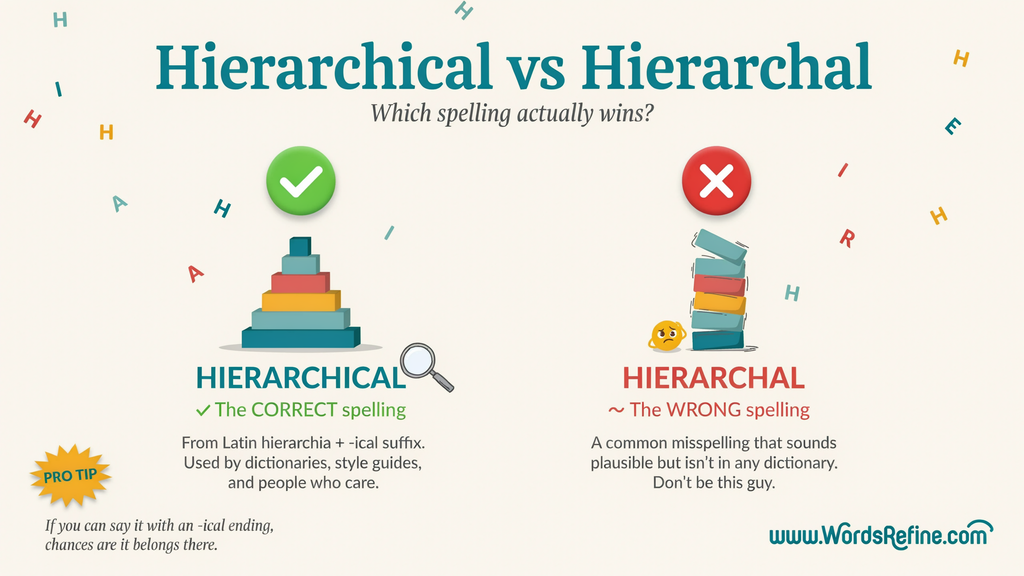
A hierarchical model represents information in levels.
The structure usually begins with a central or top-level element. Related elements then branch downward into smaller groups.
You can picture it like a family tree.
Organization
├── Marketing
│   ├── Content
│   └── Advertising
├── Sales
│   ├── Retail
│   └── Business
└── Finance
    ├── Accounting
    └── Budgeting
This kind of tree-like structure helps show which elements belong to which larger group.
Hierarchical models appear in databases, information systems, organizational charts, classification systems, and other technical fields.
Hierarchical Organization vs Flat Organization
A hierarchical organization and a flat organization arrange authority differently.
In a hierarchical organization, several levels of management may separate employees from senior leadership.
For example:
CEO
 ↓
Director
 ↓
Manager
 ↓
Supervisor
 ↓
Employee
A flat organization has fewer management levels.
It might look more like this:
CEO
 ↓
Teams
 ↓
Employees
Neither structure automatically tells you whether an organization will succeed. The important point is the structural difference.
A hierarchical organization emphasizes levels, authority, and reporting relationships. A flatter organization reduces the number of layers between employees and senior decision-makers.
This distinction is useful when you see the phrase hierarchical management.
Hierarchical Management Meaning
Hierarchical management refers to a management system in which authority is distributed across different levels.
Senior leaders generally hold broader decision-making responsibilities. Managers oversee specific departments or teams. Supervisors may handle day-to-day operations.
For example:
The company uses hierarchical management to define responsibility at each level.
The word hierarchical works naturally here because the management structure contains different levels of authority.
You could technically encounter hierarchal management, but it is much less common. In professional writing, hierarchical management is the more familiar expression.
Hierarchical Relationship Meaning
A hierarchical relationship exists when two people, groups, categories, or objects occupy different levels within a system.
For example, a manager and an employee may have a hierarchical relationship because the manager has greater formal authority.
The same concept can apply outside the workplace.
In a classification system, a broad category can have a hierarchical relationship with a more specific category.
For example:
Vehicle → Car → Sedan
A vehicle is a broader category. A sedan is a more specific category within that structure.
The relationship between the categories is hierarchical because they occupy different levels.
Hierarchical Order Meaning
Hierarchical order refers to an arrangement based on levels, rank, importance, or authority.
For example:
The organization follows a clear hierarchical order.
This means positions are arranged according to their place within the overall system.
You may also see hierarchical order in classification systems, social structures, management systems, and technical models.
The key idea is always the same: different elements occupy different levels within an organized system.
Hierarchical vs Hierarchal in Formal Writing
Formal writing requires careful word choice because unfamiliar wording can distract readers.
When writing an academic paper, business report, research article, or professional document, hierarchical is generally the more recognizable form.
For example:
The researchers analyzed the hierarchical structure of the organization.
This sentence sounds natural and professional.
You could also write:
The researchers analyzed the hierarchal structure of the organization.
The second version can be understood, but hierarchal is less common. Some readers may even wonder whether it is a spelling mistake.
That doesn’t make the word automatically incorrect. It simply makes hierarchical the safer choice when clarity and familiarity matter.
Hierarchical vs Hierarchal in American English
In American English, hierarchical is the form most readers are likely to recognize and expect.
You’ll find it in professional writing, academic texts, business discussions, technology, organizational studies, and everyday explanations of systems arranged by levels.
Hierarchal also exists in English, but it appears less frequently.
So if you’re writing for an American audience and wondering hierarchical or hierarchal which is correct, hierarchical is usually the natural choice.
For example:
The company has a hierarchical structure.
This sounds straightforward to an American English reader.
The same is true when describing a:
1hierarchical organization
2hierarchical system
3hierarchical model
4hierarchical database
5hierarchical relationship
These established expressions strongly favor hierarchical.
Hierarchical vs Hierarchal in British English
British English also uses hierarchical extensively.
The basic distinction doesn’t disappear simply because the variety of English changes.
British writers may encounter hierarchal, but hierarchical remains the more familiar form in modern usage.
That means the answer to hierarchical vs hierarchal in British English is broadly similar to the answer in American English.
The major difference between American and British English often involves spelling choices such as color/colour or organize/organise. The choice between hierarchical and hierarchal isn’t generally one of those standard American-versus-British spelling differences.
In other words, don’t assume that hierarchal is the British version of hierarchical. It isn’t simply a US-versus-UK spelling distinction.
Learn the difference between often confused words
Fiancé vs Fiancée What’s the Difference and which is Correctly?
Hierarchical vs Hierarchal Pronunciation
Pronunciation can add another layer of confusion.
Hierarchical is commonly pronounced with several syllables, roughly like:
hy-uh-RAR-ki-kul
Hierarchal is commonly pronounced roughly like:
hy-uh-RAR-kul
Actual pronunciation can vary by speaker and accent.
The important point is that both words are connected to hierarchy, but the endings differ.
When you’re listening to someone speak quickly, those endings may not sound dramatically different. That’s one reason writers sometimes hesitate when they later have to spell the word.
If you’re unsure, remember the more common form:
hierarchy → hierarchical
That connection makes the spelling easier to recall.
Hierarchical Synonym
If you need a hierarchical synonym, the best choice depends on the sentence.
Possible alternatives include:
ranked
tiered
graded
ordered
structured
layered
organized by rank
arranged by level
However, these words aren’t perfect replacements in every situation.
For example, tiered emphasizes levels or layers, while ranked emphasizes position or status.
Consider:
The company has a hierarchical management structure.
You could write:
The company has a tiered management structure.
That changes the emphasis slightly.
Likewise:
The data is organized hierarchically.
could become:
The data is organized in levels.
The second version is simpler, but it doesn’t always carry exactly the same technical meaning.
Hierarchal Synonym
Because hierarchal has essentially the same core connection to hierarchy, many of its possible synonyms overlap with those of hierarchical.
Depending on context, you might use:
ranked
tiered
ordered
structured
layered
graded
Still, replacing the word with a synonym isn’t always necessary.
If your sentence naturally calls for the adjective hierarchical, using the familiar word is often clearer than searching for a fancy substitute.
Good writing isn’t a contest to see how many unusual words can fit into one paragraph. Sometimes the simplest accurate word does the job perfectly.
Common Mistakes With Hierarchical vs Hierarchal
The most common mistake is treating hierarchal as if it were always a spelling error.
It isn’t.
Hierarchal is a recognized word. Its main limitation is that it is much less common than hierarchical.
Another mistake is assuming that the shorter word must be better.
Shorter isn’t automatically clearer. In this case, hierarchical is longer, yet it is the form most readers recognize.
A third mistake is using hierarchical for anything that is simply organized.
Not every organized system is hierarchical.
For example:
I organized my desk.
This doesn’t necessarily describe a hierarchy.
You could arrange books alphabetically without creating a system of rank or authority. You could organize files by date without placing one category above another.
A structure becomes hierarchical when its organization involves levels, ranks, categories, authority, importance, or nested relationships.
Hierarchical Does Not Simply Mean Organized
This distinction matters.
Something can be organized without being hierarchical.
Imagine a grocery list:
Milk
Bread
Eggs
Apples
Rice
The list is organized, but there is no obvious ranking system.
Now imagine:
Food
 ↓
Dairy
 ↓
Milk
Here, the items occupy different levels within a classification system.
That’s hierarchical organization.
So when using hierarchical, ask yourself one simple question:
Are there levels, ranks, categories, or relationships between higher and lower positions?
If the answer is yes, hierarchical may be the right word.
If the answer is no, another adjective such as organized, structured, or ordered may be more accurate.
Hierarchical Word Family
Understanding related words can make hierarchical spelling easier to remember.
The main word family includes:
hierarchy — a system of ranks or levels
hierarchical — arranged according to a hierarchy
hierarchal — relating to a hierarchy
hierarch — a person of high rank within a hierarchy, especially in a religious context
Once you recognize the connection between these words, the spelling becomes less mysterious.
The important relationship is:
hierarchy → hierarchical
That is the form you’re most likely to need in modern professional, academic, and technical English.
How to Use Hierarchical in a Sentence
The word hierarchical works naturally before nouns that describe systems, relationships, structures, and organizations.
For example:
The company has a hierarchical structure.
The software uses a hierarchical database.
The organization follows a hierarchical management system.
The researchers examined hierarchical relationships between the groups.
The information is arranged in a hierarchical order.
You can also use hierarchical after a linking verb:
The organization is highly hierarchical.
The management system is hierarchical.
In each case, the word describes a system based on levels or ranks.
How to Use Hierarchal in a Sentence
Because hierarchal is less common, you may want to use it carefully.
For example:
The researchers examined the hierarchal structure of the institution.
The society developed a strict hierarchal system.
The study explored hierarchal relationships between social groups.
These sentences are understandable because hierarchal functions as an adjective related to hierarchy.
However, if you’re writing for a general audience, replacing hierarchal with hierarchical will usually make the sentence sound more familiar.
For example:
The researchers examined the hierarchical structure of the institution.
That version is the more conventional choice.
Learn the difference between basic English word mistakes
Any time vs anytime meaning Difference with Examples ?
Is Hierarchical vs Hierarchal Correct?
Both forms can be found in English, but they don’t have equal levels of common usage.
Hierarchical is the widely familiar form.
Hierarchal is a less common variant.
So, if you’re asking is hierarchical or hierarchal correct, the answer depends on what you mean by “correct.”
If you mean “Which word is most commonly used in modern English?” the answer is hierarchical.
If you mean “Is hierarchal a real English word?” the answer is also yes.
The safest practical rule is simple:
Use hierarchical unless you have a specific reason to use hierarchal.
That approach keeps your writing familiar, clear, and easy to understand.
Hierarchical vs Hierarchal Quick Comparison
| Feature | Hierarchical | Hierarchal |
|---|---|---|
| Part of speech | Adjective | Adjective |
| Related noun | Hierarchy | Hierarchy |
| Basic meaning | Related to or arranged in a hierarchy | Related to a hierarchy |
| Common in modern English | Yes | Less common |
| Used in professional writing | Very common | Less common |
| Used in technical terms | Very common | Uncommon |
| Can describe levels or ranks | Yes | Yes |
| Usually the safer choice | Yes | Not usually |
The table reveals the main point: the words are closely related in meaning, but hierarchical is the form you’ll generally want in modern writing.
A Simple Rule to Remember
If you constantly forget whether to use hierarchical vs hierarchal, connect the word to its noun.
Think:
Hierarchy → hierarchical
The familiar adjective keeps most of the word hierarchy intact before adding -ical.
When you see a phrase such as hierarchical structure, hierarchical system, or hierarchical organization, the spelling should start feeling automatic.
You don’t need to memorize a complicated grammar rule.
Just remember that hierarchical is the standard choice you’ll encounter most often.
Hierarchical vs Hierarchal in Real-World Situations
The difference between hierarchical vs hierarchal becomes much easier to understand when you see these words in real situations.
Imagine a company with several levels of leadership. The chief executive oversees senior managers. Senior managers oversee department managers. Department managers supervise team leaders, while team leaders work with employees.
That structure is clearly hierarchical because authority moves through different levels.
You might write:
The company has a hierarchical management structure.
The word hierarchical tells the reader that the organization has several levels of authority.
Now imagine a software system that stores information through parent-and-child relationships. A main category contains smaller categories, which contain even more specific categories.
That system can also be described as hierarchical.
The application uses a hierarchical database to organize customer information.
The same concept appears in classification systems.
The researchers created a hierarchical classification of the species.
In each example, something is arranged according to levels or relationships.
Case Study A Company’s Hierarchical Structure
Consider a fictional company called Northstar Media.
The company has a chief executive at the top. Below the chief executive are several directors. Each director manages a department. Managers supervise individual teams, while employees handle day-to-day tasks.
The structure could look like this:
Chief Executive
       ↓
Directors
       ↓
Department Managers
       ↓
Team Leaders
       ↓
Employees
This is a hierarchical organization.
The structure establishes different levels of responsibility. A team leader doesn’t normally have the same authority as a director. Likewise, an employee may report to a team leader rather than directly to the chief executive.
The company could describe this as a hierarchical management system.
Using hierarchal instead wouldn’t necessarily make the sentence impossible to understand. However, hierarchical is the more familiar choice:
Northstar Media uses a hierarchical management structure.
That wording immediately communicates the intended meaning.
Case Study A Hierarchical Classification System
Hierarchical structures aren’t limited to businesses.
Consider a library.
Books may be grouped by broad subjects. Those subjects can then be divided into smaller categories. The smaller categories may contain even more specific topics.
For example:
Science
   ↓
Biology
   ↓
Zoology
   ↓
Mammals
   ↓
Marine Mammals
Each level becomes more specific.
This is a hierarchical classification system because broader categories contain narrower categories.
The same pattern appears in digital folders, website navigation, scientific classification, organizational charts, and information systems.
Whenever information moves from broad categories toward more specific ones, the word hierarchical may be appropriate.
Hierarchical Systems and Tree Structures
A tree structure is another useful way to understand hierarchical organization.
Despite the name, you don’t need an actual tree.
The term comes from the way a tree has a trunk that branches into larger limbs and then smaller branches.
A hierarchical system works in a similar way:
Main Category
├── Category A
│   ├── Subcategory A1
│   └── Subcategory A2
├── Category B
│   ├── Subcategory B1
│   └── Subcategory B2
└── Category C
    ├── Subcategory C1
    └── Subcategory C2
The main category sits at a higher level. Smaller categories branch beneath it.
This is why terms such as hierarchical model, hierarchical system, and hierarchical database are common in technical English.
The structure isn’t random. Each element has a specific relationship with another element.
When Should You Use Hierarchal?
The short answer is that you can use hierarchal when it accurately describes something related to a hierarchy.
However, you should consider whether your audience will find the word natural.
If you’re writing a highly specialized text where hierarchal already appears as established terminology, there may be little reason to replace it.
In general writing, though, hierarchical is more familiar.
For example:
The organization has a hierarchal structure.
This sentence can be understood.
However:
The organization has a hierarchical structure.
sounds more natural to most modern readers.
That makes hierarchical the practical default.
Learn the difference between everyday English mistakes
Choose vs Chose Difference and which one is Correct?
Why Is Hierarchical More Common Than Hierarchal?
The answer largely comes down to established usage.
Hierarchical has become the standard form across many areas of modern English. You see it repeatedly in phrases such as hierarchical structure, hierarchical organization, hierarchical system, hierarchical database, hierarchical model, hierarchical relationship, and hierarchical order.
Because these phrases are widely recognized, readers are already familiar with the adjective.
Hierarchal exists, but it doesn’t appear with the same frequency.
Language isn’t always perfectly symmetrical. Two words can share a meaning while one becomes much more common over time.
That’s what has happened here.
Is Hierarchal a Correct Word?
Yes, hierarchal is a word.
It is an adjective associated with a hierarchy or hierarch.
However, being a legitimate word doesn’t automatically make it the best choice in every sentence.
English contains many uncommon words that are grammatically valid but aren’t the first choice for everyday communication.
The same principle applies here.
If you write:
The organization has a hierarchal structure.
Your reader can understand the sentence.
If you write:
The organization has a hierarchical structure.
The wording will usually feel more familiar.
So the useful distinction is simple:
Correct doesn’t always mean common.
That idea explains much of the confusion surrounding hierarchical vs hierarchal.
Is Hierarchical the Correct Word?
Yes. Hierarchical is a standard adjective formed from hierarchy. It describes something arranged according to levels, ranks, importance, authority, or categories.
For example:
The company has a hierarchical structure.
The information follows a hierarchical order.
The database uses a hierarchical model.
The organization has a hierarchical management system.
These are natural examples of standard usage.
If you’re unsure which spelling to use in an article, report, essay, or business document, hierarchical is the reliable choice.
Common Sentence Mistakes
Writers sometimes use hierarchical when they simply mean “organized.”
For example:
I created a hierarchical list of my weekend tasks.
This sentence isn’t necessarily wrong, but the word may be unnecessary if the tasks aren’t actually ranked or divided into levels.
A simpler sentence might be:
I created an organized list of my weekend tasks.
Now consider a different example:
The company has a hierarchical chain of command.
Here, hierarchical makes sense because the chain of command contains different levels of authority.
Another mistake is spelling the word as hierarchial.
The correct spelling is:
hierarchical
Not:
hierarchial
The middle letters can trip people up because the word is long and the pronunciation doesn’t always make every letter obvious.
A useful memory trick is to connect it directly to hierarchy:
hierarchy → hierarchical
Hierarchical vs Hierarchal vs Hierarchy
These three words are related, but they have different grammatical roles.
Hierarchy is a noun.
The company has a clear hierarchy.
Hierarchical is an adjective.
The company has a hierarchical structure.
Hierarchal is also an adjective.
The company has a hierarchal structure.
The first two forms are especially useful to remember because they appear frequently in modern English.
You can think of them this way:
Hierarchy names the system.
Hierarchical describes the system.
Hierarchal can also describe the system, but it is much less common.
Which Is Better for Academic Writing?
Academic writing rewards clarity and precision.
When you’re writing a research paper or academic article, hierarchical is generally the more familiar choice.
For example:
The researchers examined the hierarchical relationships among the participants.
This sentence clearly indicates that the researchers studied relationships involving different levels or positions.
Another example is:
The study used a hierarchical classification model.
Again, the word fits naturally because the model contains different levels.
Although hierarchal may appear in academic material, its lower frequency means that hierarchical will usually be easier for a broad academic audience to recognize.
If your goal is straightforward communication, familiar terminology is usually helpful.
Which Is Better for Business Writing?
Business writing often deals with management, authority, departments, reporting relationships, and organizational structure.
Those topics naturally involve hierarchy.
That’s why hierarchical appears frequently in business language.
For example:
The company is moving away from a traditional hierarchical structure.
The new management system reduces the number of hierarchical levels.
Employees work within a hierarchical chain of command.
These sentences all describe different levels of authority within an organization.
Using hierarchical makes the meaning immediately clear.
Hierarchical Structure in Everyday Life
You don’t need to work for a corporation or study computer science to encounter hierarchical structures.
A family may have different generations.
A school may have teachers, department heads, principals, and administrators.
A sports organization may have a league, divisions, teams, coaches, and players.
A website may have a homepage, categories, subcategories, and individual pages.
A computer may store files inside folders, subfolders, and additional folders.
All of these can involve different types of levels or relationships.
That’s why hierarchical is such a useful word. It can describe many kinds of organized systems.
A Quick Test for Choosing Hierarchical
When you’re unsure whether hierarchical fits your sentence, ask yourself whether the subject involves levels.
Does one position have more authority than another?
Does one category contain another?
Are items arranged from broad to specific?
Are there higher and lower levels?
Does the system have parent-and-child relationships?
If the answer is yes, hierarchical may be the right adjective.
For example:
The company has five levels of management.
You could describe that structure as:
The company has a hierarchical management system.
But if you simply sorted five unrelated documents alphabetically, calling the arrangement hierarchical wouldn’t necessarily make sense.
The word isn’t just a fancy replacement for organized.
It describes a particular kind of organization.
The Easiest Way to Remember the Difference
Here’s the simplest memory trick:
Hierarchy → hierarchical
When you see the noun hierarchy, think of the adjective hierarchical.
The ending -ical is the one you’ll encounter most often.
You can also remember this sentence:
A hierarchical system has different levels.
Both ideas connect naturally. A hierarchy has levels, and something hierarchical is arranged around those levels.
Once that connection sticks, the spelling becomes much easier.
Learn the difference between more words people mix up
Discrete vs Discreet What the Difference and which is Correctly?
Practice Session Hierarchical vs Hierarchal
- The company has a __________ management structure with several levels of authority.
- The software uses a __________ database to organize information.
- The researchers studied the __________ relationships between different social groups.
- The organization follows a clearly defined __________ order.
- The school has a __________ administrative structure.
- The website uses a __________ system to organize its categories and subcategories.
- The manager explained the company’s __________ chain of command to the new employees.
- The researchers examined the __________ classification of the species.
- The organization moved away from its traditional __________ structure.
- The database stores information in a __________ model.
- The company has a strict __________ system in which employees report to different levels of management.
- The study explored __________ relationships within the organization.
- The information is arranged in a __________ structure, moving from broad categories to specific ones.
- The department operates under a __________ management system.
- The researchers created a __________ model to represent the different levels of classification.
- The organization has a highly __________ structure with several layers of leadership.
- The computer stores files in a __________ folder structure.
- The report describes the company’s __________ organization.
- The system uses a __________ arrangement in which each category contains smaller categories.
- The researchers analyzed the __________ structure of the institution.
- The company reduced the number of __________ levels between employees and senior executives.
- The textbook explains how a __________ system can organize information into different levels.
- The organization has a __________ relationship between senior managers and junior employees.
- The researchers investigated the __________ ranking of the groups.
- When describing a system arranged into levels, __________ is usually the more common word in modern English.
Answers
- Hierarchical
- Hierarchical
- Hierarchical
- Hierarchical
- Hierarchical
- Hierarchical
- Hierarchical
- Hierarchical
- Hierarchical
- Hierarchical
- Hierarchical
- Hierarchical
- Hierarchical
- Hierarchical
- Hierarchical
- Hierarchical
- Hierarchical
- Hierarchical
- Hierarchical
- Hierarchical
- Hierarchical
- Hierarchical
- Hierarchical
- Hierarchical
- Hierarchical
Here’s a trusted source for clear word meanings:
FAQs
What is a five-level hierarchy in a company?
A five-level company hierarchy can include the chief executive, senior executives, department managers, team leaders, and employees. The exact titles vary by organization, but the structure represents five different levels of authority and responsibility.
What is another word for hierarchical?
Depending on the context, alternatives to hierarchical include ranked, tiered, layered, ordered, and graded. The best choice depends on whether you’re describing authority, classification, importance, or levels.
How do you pronounce hierarchal?
Hierarchal is generally pronounced with the stress on the first major part of the word, with the ending sounding like “-kul.” Pronunciation can vary slightly depending on the speaker’s accent.
What is the opposite of hierarchical?
The opposite of a hierarchical arrangement can be described as flat, non-hierarchical, equal-level, or decentralized, depending on the context. A flat structure, for example, has fewer levels of authority.
What’s a better word for hierarchy?
There isn’t one universal replacement for hierarchy. Depending on the context, you might use ranking system, chain of command, organizational structure, order of authority, or tiered structure.
What did Jesus say about hierarchy?
In the Gospels, Jesus challenged the idea that greatness should be based on status or dominance. He taught that leadership should involve service and humility, particularly when discussing how his followers should relate to one another.
What is a good example of hierarchy?
A company’s chain of command is a straightforward example of hierarchy. A chief executive may oversee senior leaders, who oversee managers, who supervise team leaders and employees. Each level has a different position within the organization.
What are the three levels of hierarchy?
There isn’t one universal three-level hierarchy. A simple organizational example could include senior management, middle management, and employees. Different organizations may divide their hierarchy into more or fewer levels.
What is the top of a hierarchy called?
The highest position in a hierarchy can be called the top level, highest rank, senior level, or apex, depending on the context. In a company, it may be occupied by a chief executive or another senior leader.
Who is higher in a hierarchy?
The person or group at a higher level generally has greater authority, responsibility, status, or importance within that particular hierarchy. However, what counts as “higher” depends on the system being discussed.
What is the opposite of a hierarchy?
The opposite of a hierarchy can be described as an equal-level structure or non-hierarchical structure. In organizations, a flat structure is a common example because it reduces the number of authority levels.
What does hierarchy mean in simple words?
A hierarchy is a way of arranging people, things, or ideas into levels. Some positions or categories are placed above or below others according to authority, importance, rank, or classification.
What does the word hierarchic mean?
Hierarchic is an adjective meaning related to or arranged according to a hierarchy. It has a meaning similar to hierarchical, although hierarchical is generally more familiar in modern English.
What is a dendrogram?
A dendrogram is a tree-like diagram used to show relationships or groupings between items. It is commonly associated with hierarchical clustering, where related items are progressively grouped into larger clusters.
What is the difference between hierarchical and patriarchal?
Hierarchical describes a system organized into levels, ranks, or positions. Patriarchal describes a social or organizational system in which men, particularly fathers or male leaders, hold dominant authority. A system can be hierarchical without being patriarchal.
What are the four types of clustering?
Four commonly discussed clustering approaches are hierarchical clustering, k-means clustering, density-based clustering, and model-based clustering. Different fields may classify clustering methods differently, so there isn’t one universal list of exactly four types.
What are the main types of hierarchy?
Common forms include organizational hierarchy, social hierarchy, administrative hierarchy, classification hierarchy, and taxonomic hierarchy. The type depends on what is being arranged into levels.
What are some other words for hierarchy?
Depending on the context, alternatives include ranking, order, chain of command, pecking order, tiered structure, authority structure, and organizational structure. These terms aren’t always exact synonyms.
What is a good sentence for hierarchy?
A natural example is: “The company’s hierarchy clearly defines who reports to each manager.” Here, hierarchy refers to the organization’s levels of authority and reporting relationships.
What is hierarchical thinking?
Hierarchical thinking means organizing information, ideas, priorities, or categories according to levels of importance or broader and narrower relationships. For example, you might place a main goal at the top and divide it into smaller objectives beneath it.
Can a hierarchy have equal positions?
Yes. A hierarchy can contain multiple positions at the same level. For example, several department managers may have equal authority while reporting to the same senior executive.
Is every ranking system hierarchical?
Not necessarily. A ranking system may simply list items from highest to lowest. A hierarchical system usually involves relationships between levels, categories, authority, or nested groups.
What is a hierarchical chart?
A hierarchical chart visually represents levels within a system. An organizational chart is a common example because it shows how different positions relate to one another.
What is a non-hierarchical structure?
A non-hierarchical structure minimizes or removes formal levels of authority. People may have more equal roles, shared decision-making responsibilities, or greater independence.
Why is hierarchical commonly used in technical language?
Technical fields often organize information into levels, categories, parent-child relationships, or nested structures. Terms such as hierarchical database, hierarchical model, and hierarchical clustering describe these arrangements precisely.
Conclusion
The hierarchical vs. hierarchal confusion is a classic case of two words looking like twins while behaving slightly differently. Both are real adjectives, but hierarchical is the standard and much more common choice in modern English. It’s the word you’ll usually want for describing systems, organizations, relationships, structures, or anything arranged in levels or ranks.
Hierarchal isn’t necessarily wrong, but it’s far less common and can sound unusual to many readers. Unless you’re working with a specific source or specialized context that uses it, hierarchical is the safer choice.
Think of it this way: if your words had a workplace hierarchy, hierarchical would probably be sitting in the corner office. Remember the levels, choose the standard spelling, and your writing won’t have to climb the corporate ladder just to make sense.

Diora AJS she is an experienced blogger and passionate English language enthusiast at Words Refine. With a keen eye for language and a love for clear communication, she writes practical content about grammar, word meanings, usage, and commonly confused terms. Her goal is to make English easier to understand through clear explanations and relatable examples, helping readers write accurately and communicate with confidence.