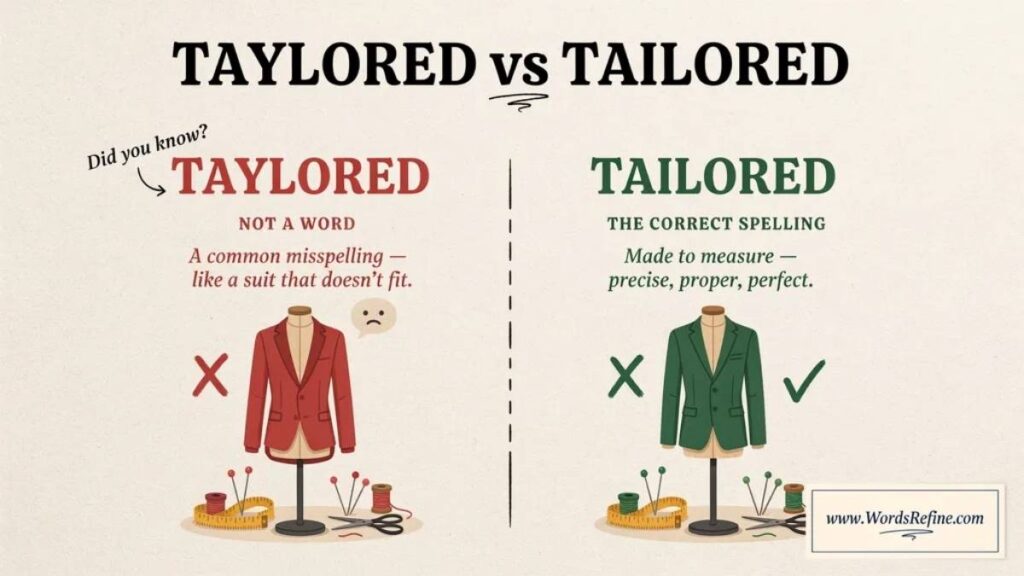
Have you ever written a word, looked at it twice, and suddenly wondered whether you spelled it correctly? If you are searching for taylored vs tailored you are not alone. These spellings look remarkably similar, but only one is correct in standard English. Tailored is the correct spelling, while taylored is a common misspelling. You well see tailored used for clothing, business services, education, and anything carefully adapted to specific needs. In this guide, we’ll clear up the confusion, explain why “taylored” can look so convincing, and show you how to use “tailored” correctly. Don’t let one sneaky letter ruin an otherwise perfectly tailored sentence!
Taylored vs Tailored Quick Answer
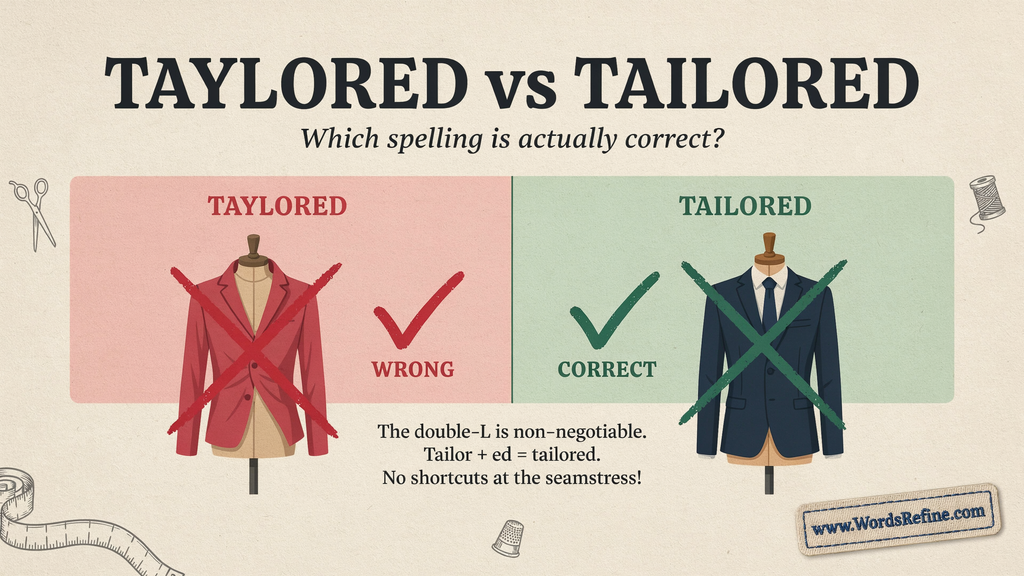
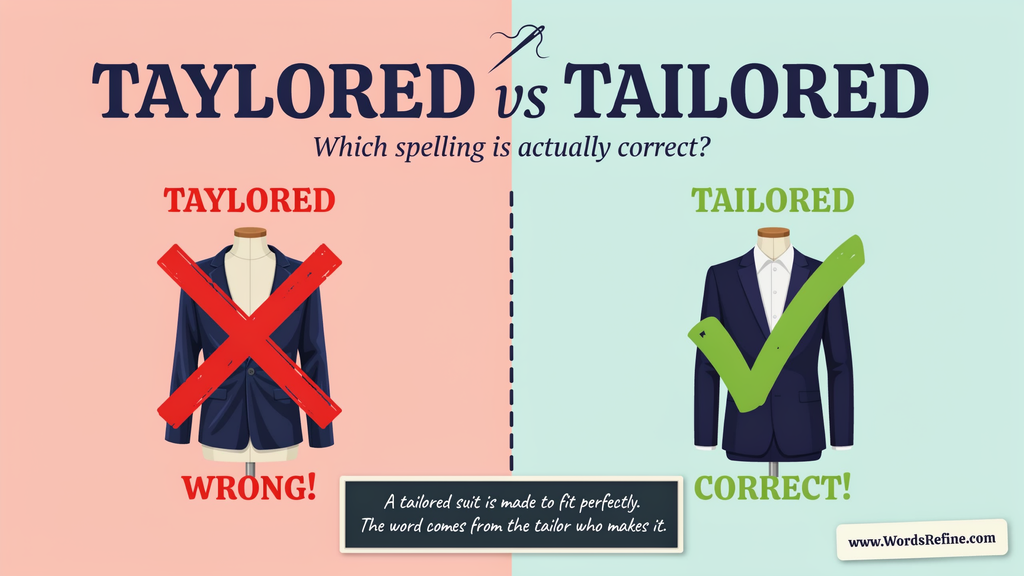
Tailored is the correct standard spelling.
Taylored is generally incorrect when you mean “customized,” “adapted,” or “fitted.”
| Word | Standard use | Meaning |
|---|---|---|
| Tailored | Yes | Adjusted, fitted, adapted, or customized |
| Taylored | No, in standard English | Usually a misspelling of tailored |
| Tailor | Yes | A clothing professional; also a verb meaning to adapt |
| Taylor | Yes | Usually a personal name or surname |
| Tailer | Yes, but with a different meaning | A person or thing that tails or follows |
For example:
The company created a tailored training program for new employees.
Not:
The company created a taylored training program for new employees.
The easiest spelling rule is:
tailor → tailored
The word keeps its original spelling when you add -ed.
What Does “Tailored” Mean?
The tailored definition has a literal meaning connected to clothing and a broader meaning connected to customization.
In clothing, tailored describes something that has been made, cut, or adjusted to fit a person’s body more precisely. A tailored suit, for example, is shaped to create a specific fit rather than simply being worn exactly as it came from the manufacturer.
The word also has a much wider meaning.
If something is tailored to a person, group, situation, or purpose, it has been adjusted to suit that particular need.
For example:
The teacher created a tailored lesson plan.
The company offers tailored services.
She wore a tailored jacket.
The consultant developed a tailored strategy.
The program was tailored to beginners.
In every example, the central idea remains the same: something has been made or adjusted to fit a particular need.
That meaning connects directly to the physical work of a tailor. A tailor adjusts fabric so a garment fits a person’s body. English later extended that idea to plans, services, education, business strategies, and other things that can be adapted.
Is “Taylored” a Word?
If you’re asking, “Is taylored a word?”, the answer depends on what you mean.
Taylored is not the standard spelling of the word formed from tailor. When you mean customized, fitted, or adapted, the standard form is tailored.
You may occasionally see Taylored used as part of a business name, brand name, product name, or other proper name. A company can intentionally choose an unusual spelling for branding. That doesn’t make taylored the standard English spelling of the verb tailor.
The confusion often comes from the name Taylor.
Compare these sentences:
Taylor called this morning.
The designer tailored the suit.
The first uses a proper name. The second uses a word related to clothing and customization.
This distinction becomes especially important because Taylor and tailor are pronounced alike in standard English. Your ears won’t necessarily warn you that you’ve chosen the wrong spelling.
Why Do People Spell “Tailored” vs “Taylored”?
The mistake makes sense once you look at the words closely.
Taylor is a familiar name. You see it frequently in names, books, advertisements, social media, and everyday conversation. Because the spelling is so familiar, your brain may automatically connect the sound of tailor with Taylor.
Pronunciation creates another problem.
When someone says- taylored vs tailored, the sound is very close to Taylor. If you’ve mostly heard the word instead of seeing it written, taylored can seem perfectly reasonable.
English spelling, however, doesn’t always follow pronunciation in a neat way.
That’s why the safest approach is to remember the word family:
tailor → tailored → tailoring
Not:
taylor → taylored → tayloring
The second pattern may look familiar because of the name Taylor, but it isn’t the standard spelling of the English word.
Learn the difference between confusing more English words
Ambassador vs Embassador Which Spelling Is Correct?
How to Spell Tailored Correctly
If you’re wondering how to spell tailored correctly, start with the base word tailor.
Add -ed:
tailor + ed = tailored
The same spelling appears throughout the word family.
| Word form | Correct spelling | Example |
|---|---|---|
| Base verb | tailor | We tailor the program. |
| Third-person singular | tailors | She tailors suits. |
| Past tense | tailored | He tailored the jacket. |
| Past participle | tailored | The service was tailored to clients. |
| Present participle | tailoring | They are tailoring the course. |
Change block type or style
Move Table block from position 52 up to position 51
Move Table block from position 52 down to position 53
Change alignment
Change text alignment
Displays more block tools
This pattern also explains why tayloring is incorrect when you mean the activity of adapting or altering something.
Use:
The company specializes in tailoring its services.
Not:
The company specializes in tayloring its services.
A useful memory trick is simple: keep “tailor” intact.
If the base word contains tail, the related forms do too.
Is Tailored a Verb?
Yes, although there’s a useful grammatical detail to understand.
Tailor is the base verb. Tailored is its past-tense and past-participle form. The same word can also function as an adjective.
Consider:
The designer tailored the jacket.
Here, tailored describes an action. It is the past-tense form of the verb tailor.
Now compare:
She wore a tailored jacket.
Here, tailored describes the jacket, so it functions as an adjective.
This distinction explains why you can see tailored in several different sentence structures.
Tailor as a Verb
The tailor verb means to adjust or adapt something so that it suits a particular person, purpose, or situation.
For example:
We tailor each lesson to the student’s level.
The designer tailored the dress for the client.
The company tailors its services to small businesses.
The clothing meaning is the original idea, but modern English uses the verb much more broadly.
You can tailor a suit. You can also tailor a résumé, lesson, marketing campaign, service, or business strategy.
The common thread is adjustment for a specific purpose.
Learn the difference between commonly mixed-up more words
Simular vs Similar Which One Is Correct?
Tailor Meaning and Definition
The basic tailor meaning relates to clothing.
A tailor is a person who makes, alters, repairs, or adjusts clothing. Tailors often work with garments such as suits, jackets, trousers, shirts, dresses, and other structured pieces of apparel.
The word can also function as a verb.
For example:
I took my jacket to the tailor.
Here, tailor is a noun.
The designer will tailor the jacket to fit you.
Here, tailor is a verb.
That small grammatical difference helps explain how we arrive at tailored.
The word family works like this:
tailor → tailored → tailoring
Once you understand that relationship, the spelling becomes much easier to remember.
Tailor Meaning in Business
The tailor meaning in business usually refers to adapting something to suit a particular customer, organization, market, or purpose.
For example:
The agency tailored its marketing strategy to local customers.
The consultant created a tailored solution for the company.
The software can be tailored to meet specific business requirements.
Business writing frequently uses phrases such as tailored solution, tailored service, taylored vs tailored,strategy, tailored approach, tailored recommendation, tailored training, tailored experience, and tailored plan.
These expressions don’t mean that someone literally used scissors and thread.
Instead, they borrow the original tailoring idea as a metaphor. Just as a tailor adjusts clothing to fit a person, a business can adjust a product or service to fit a customer’s needs.
For example, a generic training course might teach the same material to everyone. A tailored training program could change the examples, difficulty, pace, or exercises for a particular group.
That’s the broader modern meaning of tailored.
Tailor Meaning in Education
The tailor meaning in education follows the same principle.
When teachers or training providers tailor instruction, they adapt the material, activities, examples, or pace to suit particular learners.
For example:
The teacher tailored the lesson to students who were struggling with fractions.
The school created a tailored program for advanced learners.
The training course was tailored to new employees.
Tailoring education can involve adjusting the difficulty of lessons, changing the pace of instruction, selecting more suitable examples, providing additional practice, changing learning activities, modifying training objectives, or offering different types of support.
The word doesn’t automatically mean one-on-one education. It simply means that the instruction has been adapted to suit particular needs.
Tailor vs Taylor Two Words That Sound the Same
The tailor vs taylor question is common because the two words are normally pronounced alike.
The difference is mainly spelling and meaning.
Tailor is the ordinary English word connected with clothing and customization.
Taylor is usually a person’s name.
For example:
The tailor altered my suit.
Taylor sent an email.
Capitalization often provides a clue because taylored vs tailored is normally capitalized as a proper name. However, context remains important.
This is why replacing tailor with Taylor can create an entirely different sentence.
Consider:
We will tailor the course to your needs.
This means the course will be adapted.
Now imagine:
We will Taylor the course to your needs.
Unless Taylor is someone’s name and the sentence has a very unusual context, this is simply the wrong word.
Learn the difference between commonly g confusing ord pairs
Loosing vs Losing Which Is Correct? Meaning, Spelling, and Usage
Taylor vs Tailor Pronunciation
The Taylor vs tailor pronunciation comparison can be surprisingly confusing because the two words generally sound the same.
For tailor pronunciation, standard American English uses a pronunciation represented approximately as /ˈteɪ.lɚ/.
That means pronunciation won’t reliably tell you whether you’re thinking of Taylor or tailor.
This is also why searching how to pronounce tailor doesn’t solve the spelling problem by itself.
You can pronounce the word correctly and still spell it incorrectly.
Think about it this way: your ears know the sound, but your eyes need to remember the spelling.
So when you’re writing about clothing or customization, check the word visually:
tailor
Not:
taylor
The same distinction carries into tailored:
tailored
Not:
taylored
Which One Is Correct?
Another common search is tailor vs tailer.
The answer depends on what you mean.
If you’re talking about a person who makes or alters clothing, the correct word is tailor.
I took my trousers to the tailor.
If you write:
I took my trousers to the tailer.
you’ve used a different word.
The spelling difference is only one letter, but the meaning changes completely.
So, if you’re asking tailor or tailer which is correct, remember the context:
Clothing professional → tailor
The word tailer isn’t an alternative spelling of tailor.
Tailor vs Taylor to Your Needs
The phrase tailor vs taylor to your needs often appears when people aren’t sure which spelling belongs in the verb phrase.
The correct expression is:
tailor to your needs
For example:
We can tailor the program to your needs.
Here, tailor means to adjust or customize something.
You can also use the past form:
The program was tailored to your needs.
Both sentences communicate the same basic idea, but they use different verb forms.
The phrase tailored to your needs is especially common in business, education, customer service, and professional communication.
Tailored to Your Needs What Does It Mean?
Tailored to your needs means adjusted or designed to suit your particular requirements.
For example:
The consultant created a plan tailored to your needs.
The plan may have been adjusted based on factors such as goals, experience, budget, preferences, or circumstances.
Similarly:
This course is tailored to beginners.
That means the course was designed or adapted with beginners in mind.
The phrase doesn’t necessarily mean that every detail is completely unique. It simply tells you that the relevant features have been adapted to fit a particular need or audience.
Learn the difference between often confused words
Inclusivity vs Inclusiveness Which One Is Correct?
Tailored Clothing and Custom Fitting
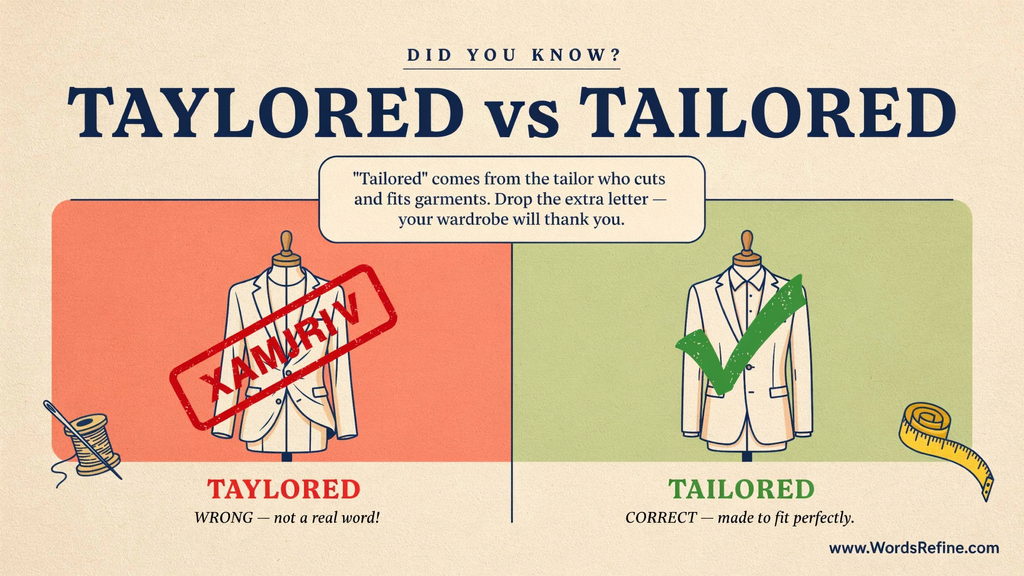
The original meaning of tailored becomes especially clear when you look at clothing.
taylored vs tailored clothing is designed or adjusted to create a more specific fit. A professional tailor may work with body measurements, garment construction, fabric, stitching, and patterns to improve how a garment sits on the wearer.
Common tailoring work includes sleeve adjustments, trouser hemming, waist adjustments, jacket alterations, shoulder adjustments, garment reshaping, and clothing repairs.
Custom fitting is especially useful because people’s bodies don’t all match standard clothing measurements.
Two people can wear the same general size while having different shoulder widths, sleeve lengths, waist measurements, or body proportions.
A professional tailor can account for those differences.
That is where precision fitting becomes important. Tailoring isn’t simply about making clothing smaller or larger. A skilled professional must consider the garment’s construction, seams, fabric, lining, pattern, and available allowance before deciding how to alter it.
Tailored vs Tailor Made
The Tailored vs tailor-made often overlap, but they aren’t identical in every context.
Tailored generally emphasizes adaptation or adjustment for a particular person or purpose.
taylored vs tailored-made often emphasizes something specifically made for that person or purpose.
For example:
The company provides tailored training for new managers.
This suggests the training has been adapted to their needs.
Now compare:
He ordered a tailor-made suit.
This emphasizes a suit specifically made for him.
Both expressions communicate suitability, but tailor-made clothing usually carries a stronger sense of individual creation.
The Rule to Remember
If you’re still asking taylored vs tailored, use this simple rule:
If the word comes from tailor, keep the “i”: tailor → tailored.
That rule also solves related spelling questions:
tailor, not taylor
tailored, not taylored
tailoring, not tayloring
The name Taylor is separate.
Once you remember that distinction, this spelling trap becomes much easier to avoid.
What Is a Tailor’s Job?
If you’re wondering what is a tailor job, the answer goes beyond simply sewing clothes.
A tailor makes, alters, repairs, or adjusts garments to improve their fit and appearance. Depending on their specialty, they may work with suits, jackets, trousers, shirts, dresses, uniforms, costumes, or other types of clothing.
A typical tailor’s job may include taking body measurements, working with patterns, cutting fabric, stitching pieces together, fitting garments, making alterations, and repairing clothing.
Tailoring also requires patience and attention to detail. A small change in the wrong place can affect the way an entire garment fits.
For custom clothing, the process often begins with measurements and a conversation about the customer’s preferences. The tailor may then create or adjust a pattern, construct the garment, and make further changes after a fitting.
So, tailoring isn’t simply about sewing two pieces of fabric together. It combines sewing skills, garment construction, measurement, design, and precision fitting.
What Does a Tailor Do to a Suit?
A tailor can make many adjustments to a suit, depending on its design and construction.
Common alterations include shortening sleeves, adjusting trouser length, taking in the waist, modifying certain seams, and improving the overall shape of the jacket or trousers.
For example:
If a jacket fits well around the chest but the sleeves are too long, a tailor may shorten the sleeves without replacing the entire jacket.
Likewise, trousers that fit properly through the legs may only need a waist adjustment or a simple hem.
The goal isn’t merely to make a suit tighter or smaller. A skilled tailor aims to create a balanced fit while preserving the garment’s original structure.
What’s the Difference?
The tailor vs seamstress question can be confusing because the two roles overlap in modern clothing work.
Traditionally, a tailor is associated with making, altering, or fitting structured garments such as suits, jackets, trousers, and coats.
A seamstress traditionally refers to a woman who sews clothing or other textile items. The term is often associated with dressmaking and general sewing.
However, these roles aren’t separated by a strict rule today.
A tailor may sew dresses, while a seamstress may perform detailed alterations. A dressmaker may also create custom clothing from patterns and measurements.
The actual work matters more than the title.
If you’re hiring someone to alter a garment, ask whether they have experience with the specific type of clothing and alteration you need.
Tailor and Seamstress Difference
The difference between a tailor and a seamstress is mainly traditional rather than absolute.
A tailor often focuses on garment fitting, alterations, repairs, and structured clothing.
A seamstress traditionally focuses on sewing and dressmaking.
For example:
Someone who specializes in adjusting men’s suits may describe themselves as a tailor.
Someone who specializes in creating or altering dresses may use the term seamstress or dressmaker.
That doesn’t mean one professional can’t do the other’s work.
Modern sewing professionals often have overlapping skills. Some can handle everything from basic repairs to advanced custom clothing.
What Is Bespoke Tailoring?
Bespoke tailoring refers to highly customized clothing made for an individual client.
The process may involve detailed body measurements, fabric selection, pattern development, fittings, and several adjustments.
Bespoke tailoring is especially associated with suits and formal wear, although the concept can apply to other garments.
The important idea is individual customization.
For example:
A client may select the fabric, buttons, lining, pocket style, lapel shape, and other details.
The garment is then constructed around that person’s measurements and preferences.
Bespoke tailoring generally involves more individual customization than buying ready-to-wear clothing and having a few alterations made.
Learn the difference between basic English word mistakes
Labelled vs Labeled Which one Is Correct?
Custom Tailoring vs Regular Sewing
Custom tailoring and regular sewing are related, but they aren’t identical.
Sewing is the process of joining fabric or other materials with stitches. Tailoring is a specialized form of clothing work that can involve sewing, fitting, alterations, pattern drafting, and garment construction.
Someone can be an excellent sewer without working as a tailor.
For example, a person might sew curtains, cushions, quilts, costumes, or home-decor projects. That doesn’t automatically make them a professional tailor.
Tailoring usually requires additional knowledge of body measurements, garment structure, fabric behavior, patterns, and fit.
In simple terms, sewing is a technique, while tailoring is a specialized clothing profession that often uses sewing as one of its main techniques.
Tailor-Made Clothing Meaning
The tailor-made clothing meaning is clothing specifically created or adjusted for a particular person.
For example:
He ordered a tailor-made suit for the wedding.
The suit is intended to fit his measurements and preferences instead of simply following a standard size.
The expression can also have a figurative meaning.
For example:
This training program is tailor-made for beginners.
Nobody is actually cutting fabric in this sentence. The phrase means that the program is especially suitable for beginners.
That’s a useful reminder that English often takes physical ideas and gives them broader meanings.
Tailored Suit Meaning
A tailored suit is a suit that has been made or adjusted to provide a more precise fit.
The term doesn’t always mean that the suit was constructed completely from scratch.
A person can buy a ready-made suit and have a tailor adjust the sleeves, trousers, waist, or other areas. Those alterations can give the suit a more tailored fit.
For example:
I bought a standard suit and had it tailored before the wedding.
Here, tailored means professionally adjusted to fit the wearer better.
Tailored vs Customized
Tailored and customized are closely related, but they can emphasize slightly different ideas.
Customized usually means modified according to particular preferences or requirements.
Tailored often emphasizes that something has been adapted to suit a specific person, group, situation, or purpose.
For example:
The software was customized for the client.
The training program was tailored to the employees’ needs.
Both sentences describe adaptation. However, tailored often highlights suitability.
The distinction becomes even clearer with clothing.
A customized garment may include a person’s preferred color, fabric, buttons, or design features. A tailored garment often emphasizes fit and construction.
The meanings can overlap, so context determines which word sounds most natural.
Tailoring in Business
The word tailored appears frequently in business communication.
Companies may tailor products, services, marketing campaigns, customer experiences, training programs, or communication to particular audiences.
For example:
The company tailored its marketing campaign to small businesses.
The company didn’t necessarily create an entirely different campaign for every customer. Instead, it adapted its approach to suit a specific audience.
You may also see phrases such as tailored solution, tailored service, tailored strategy, tailored approach, and tailored experience.
All of these expressions carry the same basic idea: something has been adjusted to fit a particular need or purpose.
Tailoring in Education
The meaning of tailored also extends naturally into education.
Teachers and instructors may tailor lessons according to students’ experience, ability, goals, or learning needs.
For example:
The instructor tailored the workshop for new employees.
A tailored lesson might use simpler explanations for beginners or more challenging exercises for advanced students.
The word doesn’t guarantee a particular teaching method. It simply means the material has been adapted for a particular group or purpose.
That’s why tailor meaning in education is closely connected to the idea of adjustment.
Common Taylored vs Tailored Mistakes
The most common spelling mistake is replacing tailored vs taylored.
For example:
The company offers taylored services.
The correct sentence is:
The company offers tailored services.
The same mistake can happen with the base verb.
Incorrect:
We will taylor the program.
Correct:
We will tailor the program.
It can also appear in the present participle.
Incorrect:
They are tayloring the course.
Correct:
They are tailoring the course.
These mistakes usually happen because Taylor is a familiar name and taylored vs tailored, has the same basic pronunciation.
The easiest solution is to remember the word family:
tailor → tailored → tailoring
Real Sentence Corrections
Seeing the words in context can make the difference easier to remember.
Incorrect:
The designer taylored the dress for the customer.
Correct:
The designer tailored the dress for the customer.
Incorrect:
We can taylor the package to your requirements.
Correct:
We can tailor the package to your requirements.
Incorrect:
The school created a taylored learning program.
Correct:
The school created a tailored learning program.
Incorrect:
The consultant is tayloring the strategy for the client.
Correct:
The consultant is tailoring the strategy for the client.
Incorrect:
I visited a taylor to alter my jacket.
Correct:
I visited a tailor to alter my jacket.
Notice the pattern. The problem isn’t limited to taylored. Once Taylor gets mixed up with tailor, the error can appear throughout the entire word family.
British vs American English
You might wonder whether taylored is accepted in British English while tailored is preferred in American English.
It isn’t.
Tailored is the standard spelling in both British and American English.
This isn’t a spelling difference like colour and color or travelled and traveled.
Whether you’re writing for an American audience or a British audience, use tailor, tailored, and tailoring.
The pronunciation may vary slightly across accents, but the standard spelling remains the same.
Tailoring Profession and Skills
Professional tailoring involves much more than basic stitching.
A tailor may need to understand body measurements, fabric behavior, garment construction, pattern drafting, fitting, pressing, repairs, and clothing alterations.
Precision matters because clothing has to work with the human body. Fabric bends, folds, stretches, and moves as a person walks or sits.
A tailor must therefore consider how different parts of a garment affect one another.
For example, changing the shoulder area of a jacket can affect the position of the sleeves. Adjusting the waist of trousers can change how they sit around the hips.
This is why experienced tailoring requires both technical knowledge and practical judgment.
Tailoring Apprenticeship and Training
People entering the tailoring profession can develop their skills through vocational programs, apprenticeships, formal education, or hands-on experience.
An apprenticeship can provide practical experience with fabrics, measurements, patterns, garment construction, fittings, alterations, and repairs.
Experience becomes especially important when a garment requires complicated changes.
A tailor may need to inspect how the garment was constructed, determine where an alteration can be made, and predict how that change will affect the rest of the garment.
That kind of judgment develops through practice.
Tailor Shop vs Alterations Shop
A tailor shop may offer custom clothing, garment alterations, repairs, fittings, or several of these services.
An alterations shop generally focuses on modifying clothing that already exists.
Change block type or style
Move Paragraph block from position 365 up to position 364
Move Paragraph block from position 365 down to position 366
Change alignment
Change text alignment
Displays more block tools
For example, an alterations shop might shorten trousers, adjust a jacket, change a dress’s fit, or modify a waistband.
A custom tailoring business may instead specialize in creating garments from the beginning.
However, the names aren’t universal. A shop called a tailor shop may offer alterations, while an alterations shop may employ professionals with advanced tailoring skills.
If you need a specific service, ask whether the shop handles that type of garment and alteration.
Learn the difference between everyday English mistakes
Flyer vs Flier Which one Is Correct?
How to Remember Tailored Spelling
If taylored vs tailored still causes trouble, connect the word to its base form.
Think:
tailor → tailored → tailoring
The spelling stays connected to tailor.
Now keep Taylor in a separate mental category.
Taylor is usually a name.
Tailor relates to clothing or the act of adapting something.
Tailored means adapted, adjusted, or fitted.
This simple distinction can prevent several spelling mistakes at once.
When you’re unsure, ask yourself:`
Am I talking about Taylor the name, or tailor the word?
If you mean adapting something to suit a person or purpose, use tailor.
Practice Session taylored vs tailored
- The designer created a __________ suit for the client.
- “Taylored” is a common spelling __________ of “tailored.”
- The company offers __________ solutions for small businesses.
- A __________ adjusts, repairs, or makes clothing to fit a person.
- The school developed a program __________ to the needs of adult learners.
- She bought a beautifully __________ jacket for the interview.
- The consultant __________ the training program to each department.
- A __________ suit is made or adjusted to fit the wearer precisely.
- The correct spelling is __________, not “taylored.”
- The manager wanted a __________ approach to employee training.
- A person who makes or alters clothing professionally can be called a __________.
- The teacher created a __________ lesson for students with different learning needs.
- The tailor __________ the jacket around the customer’s shoulders.
- The company provides services __________ to individual customer requirements.
- “Tailored” can function as both an adjective and a form of the verb __________.
- The phrase “tailored to your needs” means something has been __________ for your specific requirements.
- She visited a tailor to have her trousers __________.
- A __________ program can help students learn at their own pace.
- The advertisement offered a __________ marketing strategy for each business.
- Which spelling is correct: “taylored” or __________?
- The designer used precise measurements to create __________ clothing.
- The business __________ its services to meet changing customer demands.
- The word “tailored” comes from the noun __________.
- He ordered a __________ suit for his wedding.
- If you mean something specially adapted to a person’s needs, the correct word is __________.
Answers
- tailored
- mistake
- tailored
- tailor
- tailored
- tailored
- tailored
- tailored
- tailored
- tailored
- tailor
- tailored
- tailored
- tailored
- tailor
- customized
- altered
- tailored
- tailored
- tailored
- tailored
- tailored
- tailor
- tailored
- tailored
Here’s a trusted source for clear word meanings:
FAQs
What is a fancy word for sewing?
A more formal term for sewing is needlework. Depending on the type of work, you might also hear dressmaking, stitching, seamwork, or garment construction. Tailoring is more specific because it involves making, fitting, altering, or repairing clothing.
What is the female name for tailor?
Traditionally, a woman who makes or alters clothing may be called a seamstress. However, tailor is also a gender-neutral term and can describe a clothing professional of any gender. Dressmaker is another appropriate term for someone who specializes in making dresses and similar garments.
What is a tailor called in England?
A clothing professional who makes, alters, or fits garments is called a tailor in England. The term doesn’t change simply because the person works in England.
What can tailors not do?
Tailors can’t always perform every possible clothing alteration. Some garments have limited seam allowance, complex construction, delicate fabrics, or design features that make certain changes difficult or impractical. A tailor may also advise against an alteration if it could damage the garment or produce an uneven result.
What is the 3-3-3 rule for clothes?
The 3-3-3 rule is a minimalist wardrobe guideline that generally involves choosing three tops, three bottoms, and three pairs of shoes to create several different outfits. It isn’t a professional tailoring rule. Instead, it’s a simple approach to reducing the number of clothing items you need.
Why is tailoring clothes so expensive?
Tailoring can be expensive because it requires skilled labor, accurate measurements, specialized equipment, careful fitting, and time. The price also depends on the garment’s fabric, construction, complexity, and the type of alteration required. Detailed custom work generally takes more time than a simple adjustment.
What is a high-end tailor called?
A high-end tailor may be called a bespoke tailor or master tailor, depending on the type of work and level of expertise. A bespoke tailor typically creates highly customized garments based on an individual client’s measurements and preferences.
Why did tailors sit cross-legged?
Historically, some tailors worked while sitting cross-legged because it provided a practical position for handling fabric and sewing by hand. Before modern worktables and industrial sewing equipment became common, many traditional tailoring practices involved working close to the floor or from a low seated position.
How long is tailoring school?
Tailoring training can last anywhere from several weeks to several years, depending on the program. Short courses may teach basic sewing and alterations, while vocational programs and apprenticeships can provide more extensive training in garment construction, fitting, pattern work, and professional tailoring.
Is sewing a feminine hobby?
No. Sewing isn’t inherently feminine. People of all genders can enjoy sewing, embroidery, quilting, garment construction, and tailoring. The idea that sewing is exclusively a feminine hobby comes from historical social traditions rather than from the activity itself.
What do you call someone who loves sewing?
A person who loves sewing can be called a sewing enthusiast. Depending on their skills and type of work, they might also use terms such as sewist, sewer, seamstress, dressmaker, or tailor. These terms aren’t always interchangeable because each can describe a different type of sewing work.
What do you call a female who sews?
Traditionally, a woman who sews may be called a seamstress. Other terms include sewist, dressmaker, and tailor, depending on the type of work she performs. Seamstress specifically emphasizes sewing, while tailor can include fitting, alterations, repairs, and custom garment work.
How many inches can a tailor take off a waist?
There isn’t a universal number of inches that a tailor can remove from a waistband. The amount depends on the garment’s construction, seams, darts, pockets, waistband design, and available fabric. A tailor should inspect the garment before deciding how much can be safely altered without affecting its shape.
Can I just cut jeans to hem them?
Yes, you can cut jeans to shorten them, but simply cutting off the original hem may change their appearance. If you want to keep the original factory-style hem, a tailor can use an alteration method that preserves it while shortening the jeans.
Is it better for jeans to be tight or loose?
Jeans should fit comfortably while allowing you to move normally. The ideal fit depends on the style and your preference. Jeans that are too tight can restrict movement, while very loose jeans may not provide the intended shape. A good fit should let you sit, walk, and move without discomfort.
Conclusion
When it comes to taylored vs tailored, there’s really no need to let one extra letter tailor your confusion. Tailored is the correct spelling, while taylored is a common misspelling. The word comes from tailor, which can refer to both a clothing professional and the act of adapting something to fit particular needs.
So, whether you’re talking about a tailored suit, a tailored lesson, or a tailored business strategy, stick with tailored. Think of it this way: a tailor carefully adjusts clothing to make it fit just right, and the word tailored deserves the same careful treatment. Give that sneaky “y” the day off, and your spelling will fit perfectly every time.

Diora AJS she is an experienced blogger and passionate English language enthusiast at Words Refine. With a keen eye for language and a love for clear communication, she writes practical content about grammar, word meanings, usage, and commonly confused terms. Her goal is to make English easier to understand through clear explanations and relatable examples, helping readers write accurately and communicate with confidence.