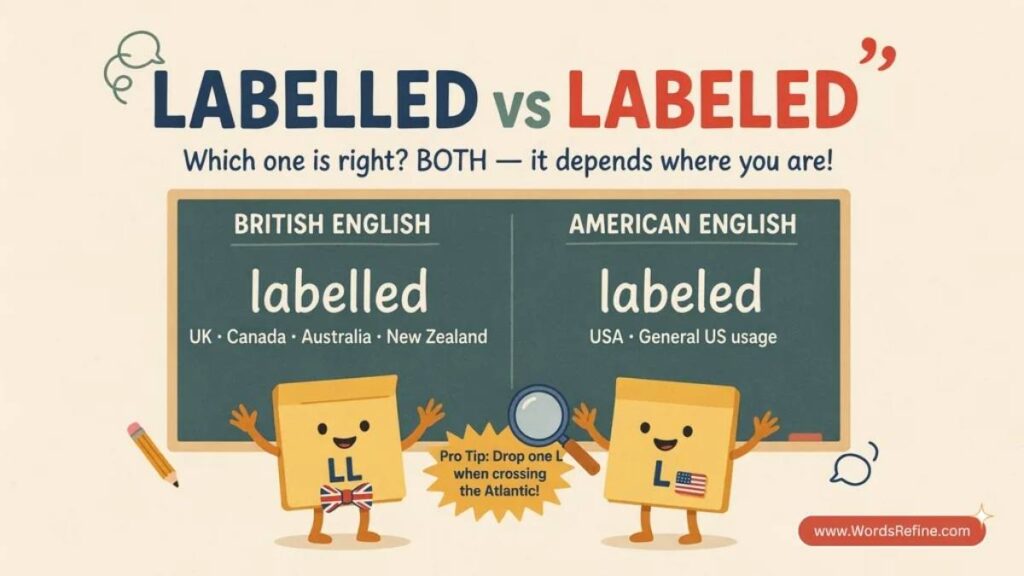
Have you ever stared at labelled vs labeled and wondered whether one extra “l” is causing a spelling emergency? Don’t worry, your grammar hasn’t gone off the rails. Both spellings are correct, but English likes to keep things interesting by changing its rules across regions. American English uses labeled, while British English uses labelled. The same difference appears in labeling and labelling. Although the spelling changes, the meaning and pronunciation remain the same. In this guide, you’ll learn the difference between labeled and labelled, discover when to use each form, and finally put this tiny spelling mystery to rest without reaching for the red pen.
Labelled vs Labeled Quick Answer
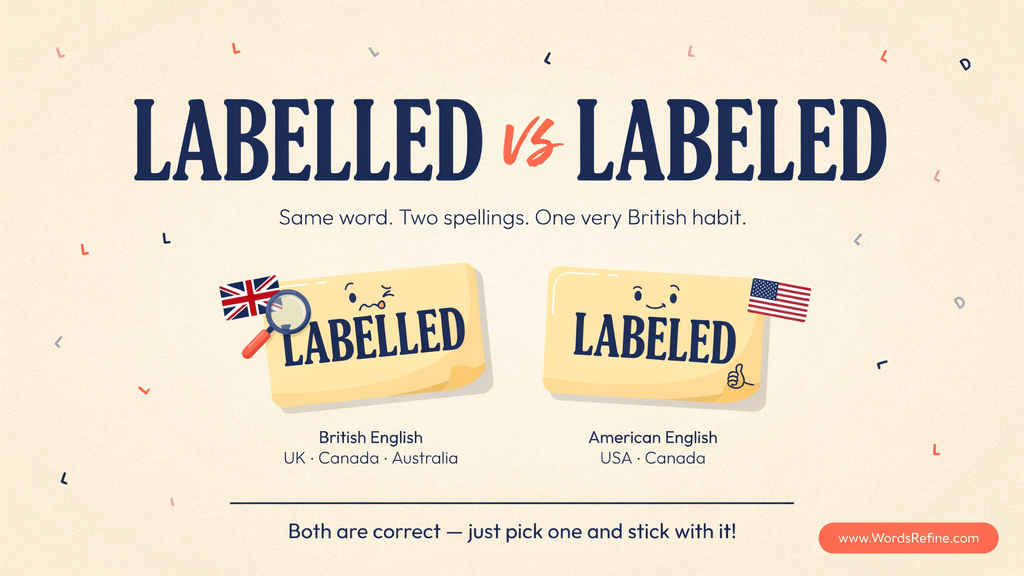
Both labeled vs labelled are correct spellings. The difference comes from regional English spelling conventions rather than meaning or grammar. Labeled is the standard spelling in American English, while labelled is the standard spelling in British English. Australian and New Zealand English also commonly use labelled.
For example, an American writer might say, “The boxes were labeled by category.” A British writer would normally write, “The boxes were labelled by category.” Both sentences mean exactly the same thing.
So, when you see labeled vs labelled, don’t assume one is a spelling mistake. The choice usually depends on the variety of English you’re using and the audience you’re writing for.
What Does Labeled Mean?
Labeled is the American English spelling of the past tense and past participle of the verb label. To label something means to attach information to it, identify it, give it a category, or describe it in a particular way.
For example, you might label a box before moving to a new home. You could write “Kitchen” on the outside so you know where the box belongs. Similarly, a teacher might label parts of a diagram so students can identify each part easily.
Here are a few examples of labeled in American English:
The teacher labeled each part of the diagram.
The company labeled the products with their prices.
She labeled the folders according to their contents.
The scientist labeled each sample before beginning the experiment.
The word can also describe how someone or something has been characterized. For example, “The article labeled the decision a major mistake” means that the article described or characterized the decision as a major mistake.
The labeled meaning therefore depends slightly on context, but the central idea remains the same: something has been identified, marked, classified, or described.
What Does Labelled Mean?
Labelled has the same meaning as labeled. The only difference is the spelling. Labelled is the standard British English form.
For example, British English would normally use:
The teacher labelled each part of the diagram.
The company labelled the products with their prices.
She labelled the folders according to their contents.
The researcher labelled every sample carefully.
In each example, labelled functions in exactly the same way as labeled in American English. The pronunciation and meaning do not change simply because an extra l appears in the spelling.
The labelled definition is therefore straightforward. It is the past tense or past participle of label, meaning to mark, identify, classify, or describe something.
Labelled vs Labeled Difference
The main labelled or labeled difference is regional spelling. American English uses labeled, while British English uses labelled.
The base word remains label in both varieties. The difference appears when the word takes endings such as -ed and -ing.
American English uses labeled and labeling.
British English uses labelled and labelling.
For example, an American writer might say, “The diagram is clearly labeled.” A British writer would normally write, “The diagram is clearly labelled.” Neither sentence changes the meaning.
The same pattern appears in related forms. If you choose labeled, you will normally also use labeling. If you choose labelled, you will normally use labelling.
This matters because spelling consistency makes your writing look polished. Mixing American and British forms in the same document can make your spelling appear accidental, especially in academic, professional, or technical writing.
Learn the difference between confusing more English words
Flyer vs Flier Which one Is Correct?
Why Does Labeled Have One L?
If you’re wondering why labeled has one l in American English, the answer lies in American spelling conventions.
American English generally writes this form as label + ed = labeled. The same convention gives labeling rather than labelling.
That creates the familiar American English forms labeled, labeling, and labeled product. The spelling may look unusual if you’re more familiar with British English, but it is completely standard in American writing.
For example, an American company might write:
The products were labeled before shipment.
The packages are labeled with tracking information.
The technician is labeling the equipment.
The important point is that labeled one L is not an error in American English. It is the standard American spelling.
Why Does Labelled Have Two Ls?
British English uses labelled vs labelling. The extra l follows the spelling convention used in British English for this word.
For example:
The boxes were labelled clearly.
The teacher labelled the diagram.
The staff are labelling the new products.
This is why you may encounter labelled double L in British books, websites, school materials, newspapers, and professional documents.
You’ll also see similar regional differences in words such as travelled/traveled, cancelled/canceled, and modelled/modeled. However, spelling patterns can vary from word to word, so it’s better to learn the standard form of each word rather than assume every verb follows exactly the same rule.
The key point is simple: labelled is the standard British spelling, while labeled is the standard American spelling.
Label Past Tense Labeled vs Labelled?
The past tense of label can be written as either labeled or labelled, depending on the variety of English.
In American English, the label past tense spelling is labeled.
In British English, the label past tense spelling is labelled.
For example, American English uses, “She labeled the containers yesterday.” British English uses, “She labelled the containers yesterday.”
Both forms describe an action that happened in the past.
The same distinction applies when the word works as a past participle. For example, “The package was labeled correctly” is standard American English, while “The package was labelled correctly” is standard British English.
So, if you’re trying to remember the labeled or labelled spelling, focus on your audience. For US English, choose labeled. For UK English, choose labelled. Once you choose one spelling, keep the same pattern throughout your writing.
Labelled vs Labeled Spelling in American and British English
The labelled or labeled spelling depends on which variety of English you’re using. In American English, labeled is the standard form. In British English, labelled is the standard form. Both spellings are correct within their respective varieties, so the question of labelled or labeled which is correct doesn’t have a single answer.
If you’re writing for a US audience, use labeled. For example, “The files were labeled according to their subject.” If your audience uses British English, write “The files were labelled according to their subject.” The meaning stays exactly the same.
This regional difference also applies to the related present participle. American English uses labeling, while British English uses labelling. Therefore, labeled and labeling usually appear together in American writing, while labelled and labelling usually appear together in British writing.
American English vs British English Why the Difference Exists
English has developed different spelling conventions in different regions over many centuries. As English spread across countries, writers, dictionaries, publishers, and style guides gradually established regional preferences. That’s why modern English contains many spelling variations that look different but carry the same meaning.
The difference between labeled vs labelled is one example. American English commonly uses color instead of British colour, center instead of centre, and traveled instead of travelled. Similarly, American English uses labeled, while British English uses labelled.
These differences don’t mean that one variety follows the rules while the other ignores them. They reflect different American English spelling and British English spelling conventions.
For writers, the practical lesson is simple. Choose the spelling that matches your intended audience and follow it consistently. A spelling checker set to the wrong variety can also flag a perfectly acceptable word, so always check your language settings before assuming that something is incorrect.
Labeling vs Labelling Which Is Correct?
The same spelling difference appears when label takes the -ing ending. American English uses labeling, while British English uses labelling.
For example, American English uses the sentence, “The employee is labeling the packages.” British English would normally write, “The employee is labelling the packages.”
Both forms are grammatically correct. The difference is regional rather than grammatical.
This means that if you choose labeled in an American English article, you should normally use labeling as well. If you choose labelled for British English, labelling is the matching form.
Understanding labeling vs labelling can help you avoid an easy mistake. Writers sometimes use labeled in one paragraph and labelling in another without realizing that they have mixed spelling systems. The reader can still understand the meaning, but consistent spelling creates a cleaner and more professional impression.
Label vs Labeled vs Labelled
The word label can function as both a noun and a verb. As a noun, a label is a piece of information attached to something. A clothing tag, a product sticker, or the name printed on a file can all serve as labels.
For example, “The label on the bottle lists the ingredients.” Here, label is a noun because it refers to the information attached to the bottle.
As a verb, label means to attach a label, identify something, assign it to a category, or describe it in a particular way. For example, “Please label the boxes before moving them.” Here, label describes an action.
When you put the verb into the past tense, you get labeled in American English and labelled in British English.
For example, American English uses, “She labeled the folders.” British English uses, “She labelled the folders.”
The base word doesn’t change. Only the spelling of the past form changes according to regional convention.
Learn the difference between commonly mixed-up more words
Loose vs Lose Difference and which is Correctly?
Label Spelling in US and UK English
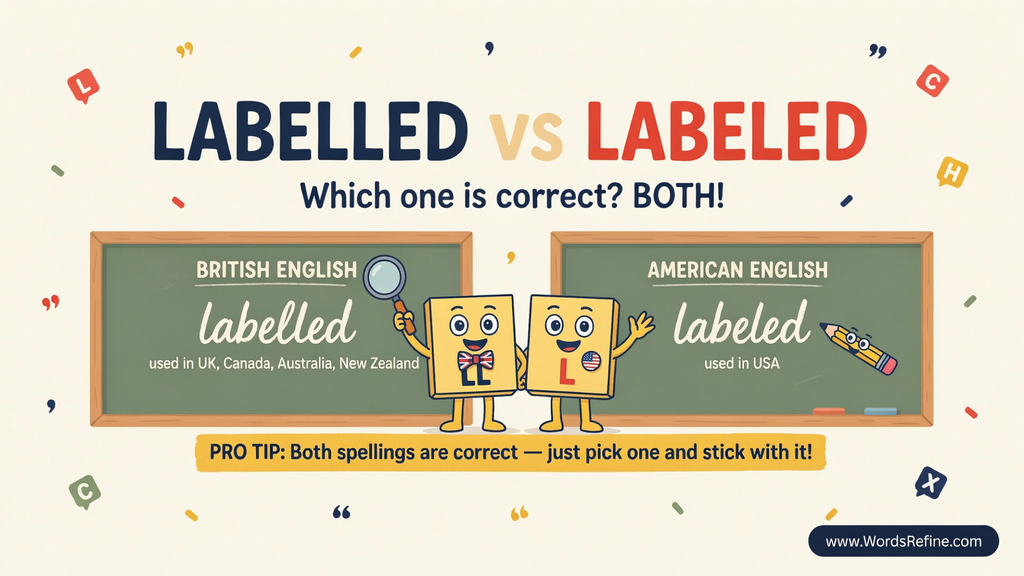
The basic label spelling remains the same in both American and British English. The difference appears when you add certain endings.
American English uses label, labeled, and labeling. British English uses label, labelled, and labelling.
This makes the pattern easy to remember. The base word label stays unchanged. American English generally keeps one l in labeled and labeling, while British English uses two l’s in labelled and labelling.
For example, an American instruction might say, “Label the container before labeling the contents.” A British instruction might say, “Label the container before labelling the contents.”
The difference is visible, but the meaning remains identical.
Labelled vs Labeled in Different English-Speaking Countries
American English clearly favors labeled and labeling. These forms are standard in US newspapers, textbooks, business documents, websites, and everyday writing.
British English normally uses labelled and labelling. These spellings appear throughout UK academic writing, professional documents, publications, and general communication.
Australian English and New Zealand English generally follow British-style spelling for this word, so labelled and labelling are common choices.
Canadian English can show variation because Canadian spelling has influences from both British and American English. You may encounter both forms depending on the publication, institution, or style guide being followed. For formal writing, the safest approach is to follow the spelling standard required by your organization or publication.
This is why there isn’t one universal answer to is it labeled or labelled. The correct choice depends on the English variety and the context.
Labeled and Labelled Examples
Seeing the two forms side by side makes the difference much easier to understand. Consider the sentence, “The diagram was labeled correctly.” In American English, this spelling is standard. In British English, the equivalent sentence would be, “The diagram was labelled correctly.”
Another example is, “The boxes were labeled by room.” British English would write, “The boxes were labelled by room.”
You can also see the difference with the present participle. American English uses, “The assistant is labeling the files.” British English uses, “The assistant is labelling the files.”
In every case, the meaning remains unchanged. The spelling changes because the regional convention changes.
Common Mistakes With Labeled vs Labelled
One common mistake is assuming that labelled is always wrong because American English uses labeled. That isn’t true. Labelled is a standard British English spelling.
The opposite mistake happens when writers assume that labeled is incorrect because they learned British English. It isn’t. Labeled is the standard American English form.
Another problem occurs when writers mix the two systems in the same document. For example, using labeled in one section and labelling in another creates an unnecessary spelling inconsistency. Unless you’re intentionally comparing regional varieties, choose one spelling system and stick with it.
A useful way to avoid this problem is to check your document’s language setting. If you’re writing in American English, set your spelling checker to US English. If you’re writing in British English, select UK English. This prevents your grammar or spelling tool from treating regional differences as mistakes.
Labeled vs Labelled Pronunciation
The good news is that you don’t need to learn two different pronunciations. Labeled and labelled are generally pronounced the same way.
The extra l in labelled changes the spelling, not the basic pronunciation. Both forms have two syllables and are pronounced approximately like “LAY-buhld.”
This makes the difference particularly easy to miss in conversation. You might hear someone say the word and have no idea whether they would spell it labeled or labelled.
The distinction becomes visible when you write it down. That’s why understanding regional spelling conventions matters when you’re preparing articles, essays, reports, emails, or other written content.
Labeled vs Labelled in Formal Writing
In formal writing, the most important rule is consistency. Neither spelling is automatically more formal than the other. Your choice should depend on the English variety expected by your readers or the requirements of the organization you’re writing for.
If you’re preparing an academic paper for an American institution, labeled is normally the appropriate choice. If you’re writing for a British institution, labelled is normally expected.
The same principle applies to business writing. A US company may use labeled and labeling throughout its documentation, while a UK company may use labelled and labelling.
International organizations sometimes establish their own style guides. In that situation, follow the organization’s preferred spelling rather than switching between regional forms.
The goal isn’t to find a spelling that looks more sophisticated. The goal is to use the appropriate standard and maintain spelling consistency from beginning to end.
How to Choose Between Labeled vs Labelled
Choosing between labeled vs labelled becomes easy once you know who will read your writing. The spelling isn’t about choosing the “better” form. Instead, it’s about matching the regional English standard your audience expects.
If you’re writing for readers in the United States, use labeled. For example, “The chart was labeled with clear headings.” If you’re writing for readers in the United Kingdom, use labelled: “The chart was labelled with clear headings.”
For Australian and New Zealand audiences, labelled is also commonly used. If you’re writing for an international audience, check the style guide for the organization or publication. When there isn’t a specific requirement, choose one variety of English and use it consistently throughout the document.
Learn the difference between tricky grammar more words
Cancell vs Cancel Which one Is Correct?
Should I Use Labeled vs Labelled?
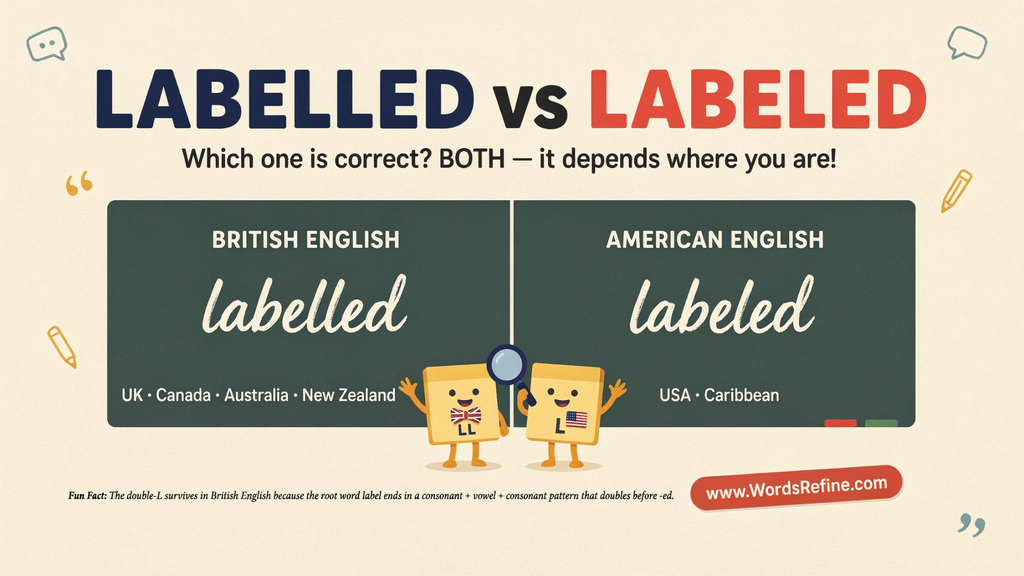
If you’re still wondering should I use labeled or labelled, start by identifying your target audience. American readers will normally expect labeled, while British readers will normally expect labelled.
For example, a US product manual might say, “All buttons are clearly labeled.” A UK product manual could say, “All buttons are clearly labelled.”
Both sentences are correct. The important thing is to avoid switching between the two forms without a reason.
Consistency becomes especially important in long documents. Imagine reading a 50-page report that uses labeled in one chapter and labelled in another. Nothing becomes grammatically incorrect, but the inconsistent spelling can make the document look as though different sections came from different sources.
Labeled vs Labelled in Academic Writing
Academic writing often follows strict spelling and style requirements. Before choosing between labeled and labelled, check the rules of your school, university, journal, or publisher.
American academic writing generally uses labeled and labeling. British academic writing generally uses labelled and labelling.
This difference can appear frequently in research papers because writers often describe diagrams, charts, samples, figures, and experimental materials. For example, an American researcher might write, “Each sample was labeled with a unique number.” A British researcher might write, “Each sample was labelled with a unique number.”
The grammar remains unchanged. Only the spelling reflects the regional standard.
Labeled vs Labelled in Business Writing
Business documents also benefit from consistent spelling. Product descriptions, instructions, reports, presentations, emails, packaging, and internal documents should normally follow the spelling conventions of the intended market.
A US company might write, “Each package must be labeled before shipping.” A British company could write, “Each package must be labelled before shipping.”
If a company operates in several countries, it may maintain separate versions of its materials. The American version can use labeled, while the British version can use labelled.
However, if one document targets a broad international audience, consistency matters more than trying to use every regional variation. Choose the style that matches the organization’s established writing style or style guide.
Labeled vs Labelled in Technical and Scientific Writing
Technical and scientific writing often uses label as both a noun and a verb. Researchers may label samples, diagrams, figures, data sets, equipment, or experimental groups.
For example, an American laboratory report might state, “The researchers labeled each sample before analysis.” A British report might use, “The researchers labelled each sample before analysis.”
The same principle applies to diagrams. An American textbook might say, “The image is clearly labeled.” A British textbook might say, “The image is clearly labelled.”
Because technical documents often contain repeated terms, even a small spelling difference can appear dozens of times. Choosing the correct regional form at the beginning can therefore prevent a lot of unnecessary editing later.
Labelled vs Labeled in Everyday Writing
You’ll encounter both spellings in everyday writing. People label storage boxes, folders, photographs, containers, files, clothing, food, and countless other things.
An American writer might say, “I labeled the boxes before moving.” A British writer might say, “I labelled the boxes before moving.”
The meaning is identical. In both sentences, the writer marked the boxes so their contents or purpose could be identified.
You may also use the word when describing people or ideas. For example, “The article labeled him a pioneer” means the article described or characterized him as a pioneer. British English would normally use labelled in the same sentence.
Labeled vs Labelled Grammar Rules
From a grammar perspective, labeled and labelled are forms of the same verb. The base verb is label. Its past tense and past participle forms vary according to regional spelling conventions.
American English uses label, labeled, labeling. British English uses label, labelled, labelling.
The past tense describes an action that happened in the past. For example, “She labeled the folders yesterday.” The past participle can appear with auxiliary verbs or in passive constructions. For example, “The folders were labeled correctly.”
The British equivalents are “She labelled the folders yesterday” and “The folders were labelled correctly.”
The grammar doesn’t change when the spelling changes. The word still performs the same grammatical function in the sentence.
Labelled vs Labeled Sentence Examples
Understanding labelled or labeled sentence examples becomes easier when you compare the forms directly.
In American English, you might write, “The teacher labeled each section of the diagram.” In British English, you would normally write, “The teacher labelled each section of the diagram.”
Another American example is, “The files were labeled by date.” The British version is, “The files were labelled by date.”
For present actions, American English uses, “She is labeling the containers.” British English uses, “She is labelling the containers.”
For adjectives, you may see sentences such as, “The labeled diagram was easy to understand” in American English and “The labelled diagram was easy to understand” in British English.
These examples show the central rule clearly: the meaning, pronunciation, and grammatical role remain the same while the spelling changes.
Learn the difference between commonly g confusing ord pairs
Vender vs Vendor Which one Is Correct?
Is Labelled Accepted in American English?
Labelled may be understood by American readers, but labeled is the standard American spelling. If you’re writing specifically for a US audience, labeled is the natural choice.
Using labelled in an American context won’t usually prevent readers from understanding your meaning. However, a US-focused grammar or spelling checker may flag it because the software expects American English conventions.
That doesn’t mean the British spelling is inherently wrong. It simply means the document and the spelling checker may be using different regional standards.
Is Labeled Accepted in British English?
British readers will generally understand labeled, but labelled is the standard British spelling. If your document follows British English conventions, use labelled and labelling.
You may occasionally see American spellings in British publications, especially in international companies, software, online platforms, or content created for a global audience. Even so, traditional British spelling uses the double l in labelled.
The important distinction is between being understandable and following the expected standard. A word can be immediately understandable while still being less appropriate for a particular regional style.
Labeled vs Labelled Grammar Checker
A grammar or spelling checker can make this distinction easier to manage, but only if its language setting matches your writing.
If your document uses American English, select US English so the checker recognizes labeled and labeling as the expected forms. If you’re writing in British English, select UK English so labelled and labelling fit the selected spelling standard.
This matters because spelling software doesn’t always identify regional variation correctly when the wrong language setting is active. A British English document checked under US English may flag labelled, while an American English document checked under UK English may question labeled.
Before changing a word simply because your software highlights it, check which English variety your document is supposed to follow.
Labeled vs Labelled in Formal and Professional Documents
Professional writing requires more than correct grammar. It also requires consistency. Whether you’re preparing a report, instruction manual, academic paper, website, or business document, your spelling should follow one clear standard.
Suppose a US company writes, “All products are labeled clearly.” Later, the same document says, “The staff are labelling the new products.” The reader can understand both sentences, but the document now contains two regional spelling systems.
A better approach is to choose the appropriate variety before you begin editing. For American English, use labeled and labeling. For British English, use labelled and labelling.
This small decision can save time during proofreading and help your writing appear deliberate rather than inconsistent.
Why Spelling Consistency Matters
Spelling consistency might seem like a tiny detail, but small details add up in professional writing. When readers see consistent spelling throughout a document, they can focus on the information instead of noticing unnecessary variations.
This becomes even more important when you publish content for a specific country. A US audience generally expects American spelling, while a UK audience generally expects British spelling.
Think of your spelling system as the document’s house style. Once you choose it, stick with it. Labeled and labelled can both be correct, but switching between them without purpose can make your writing look untidy.
The simplest rule is also the most useful: use labeled for American English and labelled for British English, then keep your spelling consistent.
Learn the difference between often confused words
Any time vs anytime meaning Difference with Examples ?
Practice Session Labeled vs Labelled
Test your understanding of labeled vs labelled by choosing the correct spelling for each sentence. Remember that American English normally uses labeled and labeling, while British English normally uses labelled and labelling.
- The teacher ________ each part of the diagram. (American English)
- The boxes were carefully ________ before they were moved. (British English)
- She ________ all the folders with their correct names. (American English)
- The bottles were clearly ________ with safety instructions. (British English)
- The technician is ________ the equipment now. (American English)
- The assistant is ________ the samples for the experiment. (British English)
- The researcher ________ every test tube before starting the experiment. (American English)
- The researcher ________ every test tube before starting the experiment. (British English)
- The packages were ________ with the customers’ addresses. (American English)
- The packages were ________ with the customers’ addresses. (British English)
- The company is ________ its new products for shipment. (American English)
- The company is ________ its new products for shipment. (British English)
- The map was clearly ________ with the names of major cities. (American English)
- The map was clearly ________ with the names of major cities. (British English)
- The teacher ________ the diagram so students could understand it easily. (American English)
- The teacher ________ the diagram so students could understand it easily. (British English)
- The storage containers were ________ according to their contents. (American English)
- The storage containers were ________ according to their contents. (British English)
- The employee is ________ each file with a reference number. (American English)
- The employee is ________ each file with a reference number. (British English)
- The scientist ________ the samples before placing them in storage. (American English)
- The scientist ________ the samples before placing them in storage. (British English)
- The chart was properly ________ so that every section was easy to identify. (American English)
- The chart was properly ________ so that every section was easy to identify. (British English)
- The staff finished ________ the products before the store opened. (British English)
Answers
labelling
labeled
labelled
labeled
labelled
labeling
labelling
labeled
labelled
labeled
labelled
labeling
labelling
labeled
labelled
labeled
labelled
labeled
labelled
labeling
labelling
labeled
labelled
labeled
labelled
Here’s a trusted source for clear word meanings:
FAQs
How do you spell the past tense of label?
The past tense of label is spelled labeled in American English and labelled in British English. Both forms are correct within their respective spelling systems.
Is labeled the American spelling of label?
Yes. Labeled is the standard American English spelling of the past tense and past participle of label. American English also uses labeling with one l.
Is labelled the British spelling of label?
Yes. Labelled is the standard British English spelling. British English also commonly uses labelling with two l’s.
Do labeled and labelled have the same pronunciation?
Yes. Labeled and labelled are generally pronounced the same way. The extra l in the British spelling does not create a different pronunciation.
Can I use labelled in an American English document?
You can use it and American readers will generally understand it, but labeled is the standard form for American English. For US-focused writing, using the American spelling keeps the document consistent.
Can I use labeled in British English?
British readers will understand labeled, but labelled is the conventional British English spelling. If you are following British English, use labelled throughout your document.
Why does American English use labeled instead of labelled?
American English developed its own spelling conventions over time. For this word, the standard American form is labeled, while British English retains the double l in labelled.
Why does British English use labelled instead of labeled?
British English follows a spelling convention that gives labelled and labelling. This is a regional spelling difference rather than a difference in meaning or grammar.
Is labeling or labelling the correct spelling?
Both spellings are correct depending on the English variety. Labeling is standard in American English, while labelling is standard in British English.
Does the spelling of label change in the present tense?
No. The base verb is label in both American and British English. The regional difference appears in forms such as labeled/labelled and labeling/labelling.
What is the past participle of label?
The past participle is labeled in American English and labelled in British English. For example, American English uses “The package was labeled correctly,” while British English uses “The package was labelled correctly.”
Can labeled and labelled appear in the same document?
They can appear together when you are specifically discussing American and British spelling. However, if the document follows one English variety, it’s better to use one form consistently.
Which form should a US writer choose?
A US writer should normally choose labeled. The matching present participle is labeling.
Which form should a UK writer choose?
A UK writer should normally choose labelled. The matching present participle is labelling.
Do Australian writers use labeled or labelled?
Australian English commonly follows the British-style spelling labelled and labelling. However, individual publications and style guides can establish their own preferences.
Do New Zealand writers use labeled or labelled?
New Zealand English commonly uses labelled and labelling. When writing for a specific publication or organization, follow its preferred style guide.
Does Canadian English use labeled or labelled?
Canadian English can use both labeled and labelled because Canadian spelling reflects influences from both British and American English. The preferred form can depend on the publication, institution, or style guide.
Is label pronounced differently from labeled?
Yes. Label is normally pronounced with two syllables, while labeled and labelled add the past-tense ending. The spelling difference between labeled and labelled does not normally change their pronunciation.
What is the easiest way to remember labeled and labelled?
Think of the regional pair: US English = labeled and labeling, while UK English = labelled and labelling. Remembering these forms together makes the spelling pattern easier to recall.
Conclusion
The labelled vs labeled debate looks like a spelling mystery at first, but the solution is surprisingly simple. Labeled is the standard American English spelling, while labelled is the standard British English form. Both words have the same meaning, pronunciation, and grammatical function. The extra l isn’t causing grammatical drama; it’s simply following a regional spelling convention.
When you’re writing, think about your audience before choosing your spelling. If you’re writing for US readers, use labeled and labeling. For UK, Australian, or New Zealand readers, labelled and labelling are generally the appropriate choices. Most importantly, stay consistent. After all, your writing needs clear labels, not a spelling identity crisis!

Diora AJS she is an experienced blogger and passionate English language enthusiast at Words Refine. With a keen eye for language and a love for clear communication, she writes practical content about grammar, word meanings, usage, and commonly confused terms. Her goal is to make English easier to understand through clear explanations and relatable examples, helping readers write accurately and communicate with confidence.