
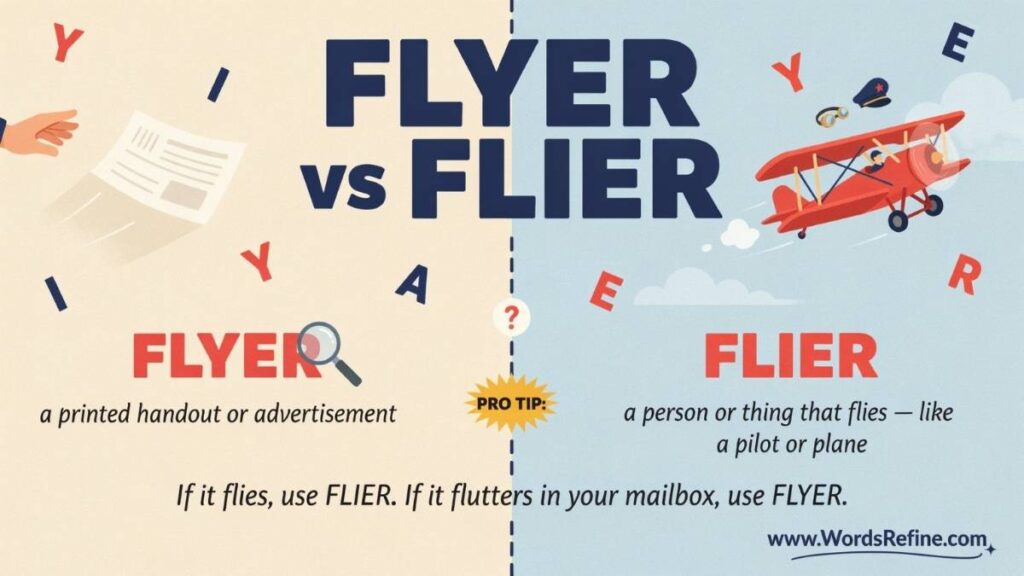
Have you ever typed flyer vs flier and suddenly wondered whether your spelling had taken off in the wrong direction? You’re not alone. This small spelling difference causes plenty of confusion because both words are correct and can sometimes have the same meaning. However, context usually helps you make the right choice. A flyer commonly refers to a printed or digital advertisement, while flier often describes someone who flies, particularly a frequent air traveler. In this guide, you’ll learn the difference between flyer and flier, discover when to use each spelling, and explore simple examples that will help you write with confidence.
Flyer vs Flier Quick Answer
Flyer vs flier are both accepted English spellings. The choice usually depends on what you mean, the context, and the style preferred by the publication or organization.
When flyer means a small advertisement or promotional sheet, it is the more familiar choice in American English.
For example:
The restaurant printed a flyer for its weekend special.
When flier refers to someone who travels by plane, the spelling is also common.
For example:
She is a frequent flier who travels several times a month.
However, flyer can also refer to a person or thing that flies. Likewise, flier can refer to promotional material. Therefore, the distinction isn’t an absolute grammatical rule.
A simple way to remember the common pattern is this: flyer often appears in advertising, while flier frequently appears when discussing people or things that fly.
What Does Flyer Mean?
The meaning of flyer depends on the sentence.
Most commonly, a flyer is a small piece of paper or digital material created to provide information or promote something. Businesses, schools, restaurants, organizations, and event planners use flyers to attract attention and communicate important details quickly.
For example:
The bookstore created a flyer announcing its weekend sale.
The concert flyer included the date, location, and ticket information.
The school distributed flyers about the upcoming event.
A flyer can be printed and handed directly to people. It can also exist as a digital document shared through email, social media, websites, or messaging platforms.
A flyer might promote a product, service, business, event, sale, fundraiser, or community activity. Because it usually contains information in a compact format, it needs to communicate its main message quickly.
The word can also have another meaning. A flyer may describe a person or thing that flies.
For example:
The eagle is an impressive flyer.
Here, flyer doesn’t mean an advertisement. It describes something that flies.
What Does Flier Mean?
Flier also has several meanings.
One common meaning refers to a person who flies, particularly someone who travels by airplane.
For example:
He is a frequent flier because his job requires regular international travel.
Flier can also describe something that flies.
For example:
The hawk is a graceful flier.
In addition, flier can refer to an aircraft or another flying object when the context calls for it.
However, flier isn’t limited to aviation. The word can also refer to promotional material. Therefore, saying that flier always means an airline passenger would be too restrictive.
The meaning comes from the surrounding sentence.
Learn the difference between everyday English mistakes
Lay vs Lie Difference and which is correct?
Flyer vs Flier What’s the Difference?
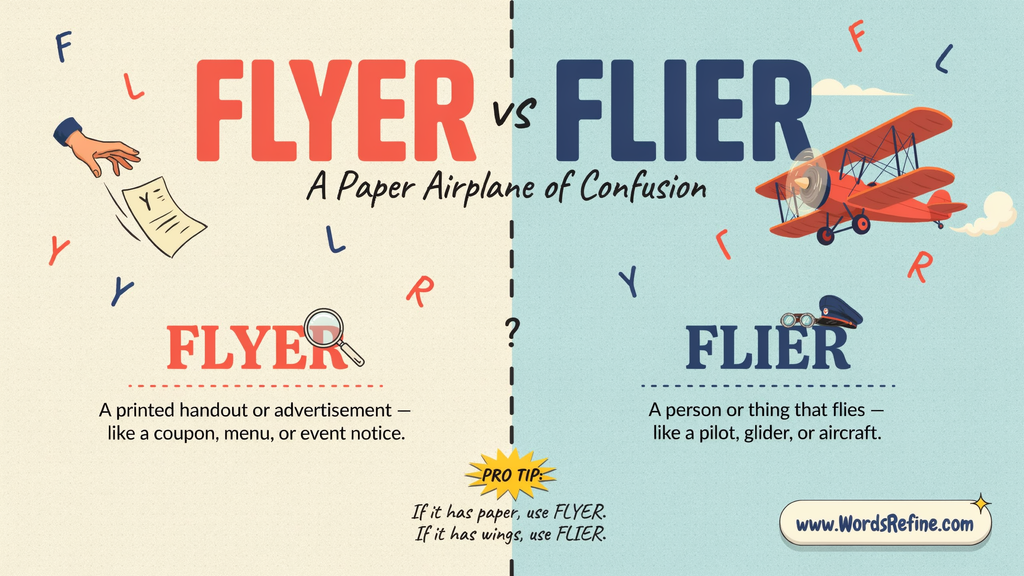
The difference between flyer vs flier is mainly a matter of spelling preference and context. The two words share several meanings, so there isn’t a strict rule separating them.
Flyer is especially common when referring to advertising material.
For example:
The business distributed a flyer advertising its new service.
The community center posted an event flyer.
The restaurant created a promotional flyer for its new menu.
Flier is particularly familiar when referring to someone who flies.
For example:
She became a regular flier after starting her new job.
The eagle is a powerful flier.
Even so, you may encounter flyer in those sentences as well.
For instance:
She became a regular flyer after starting her new job.
That sentence isn’t automatically wrong. It simply uses the alternative spelling.
Consequently, the difference between flier and flyer shouldn’t be treated as a rigid rule. Instead, think of the two forms as closely related spellings whose preferred use often depends on context.
Are Flyer vs Flier the Same?
Flyer and flier overlap in meaning, but they aren’t identical in every situation.
Both words can describe a person or thing that flies. Both can also refer to promotional material.
The difference becomes clearer when you look at common combinations.
A business will usually create a flyer to advertise a sale. Meanwhile, someone who regularly travels by airplane may be called a frequent flier.
However, frequent flyer is also widely used.
Therefore, the words can sometimes be used interchangeably without changing the basic meaning.
The safest approach is to consider what you’re trying to say rather than assuming one spelling is always correct.
Why Are There Two Spellings?
English contains many words with alternative spellings. Flyer and flier developed as related forms from the verb fly, and both spellings became established through usage.
Language doesn’t always develop according to one perfectly consistent formula. Different writers and communities may favor different spellings, and sometimes both forms remain in common use.
That is what happened with flyer and flier.
Consequently, seeing flier in a sentence doesn’t mean the writer made a spelling mistake. Likewise, seeing flyer doesn’t automatically mean the writer is referring to an advertisement.
The surrounding words provide the necessary clue.
When Should You Use Flyer?
When you’re referring to a promotional sheet, flyer is usually the most natural choice in American English.
You might use it when talking about a business flyer, event flyer, advertising flyer, or marketing flyer.
For example:
The company printed flyers for its new product.
We handed out flyers outside the theater.
The restaurant designed a flyer for its lunch promotion.
The school posted a flyer about the upcoming fundraiser.
Flyer can refer to either printed or digital material. Therefore, the word doesn’t require an actual piece of paper.
For example:
The organization shared a digital flyer on social media.
In that sentence, flyer still refers to promotional or informational material even though nobody printed it.
Learn the difference between often confused words
Whoever vs Whomever How to Use Each Word Correctly?
When Should You Use Flier?
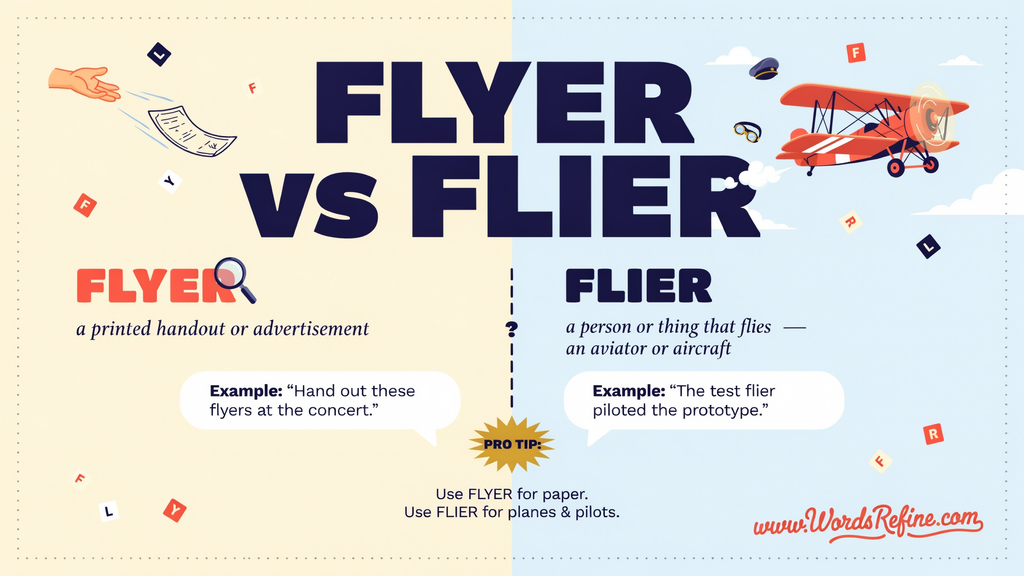
Flier is a natural choice when you want to describe a person or thing that flies.
For example:
She is an experienced flier.
The eagle is a skilled flier.
He became a frequent flier because his work requires constant travel.
Flier is especially familiar in expressions related to air travel.
However, flyer can also appear in the same contexts. Therefore, choosing flier doesn’t mean that flyer would necessarily be incorrect.
The important point is consistency. If you choose flier for a particular document or publication, continue using that spelling unless there is a specific reason to change it.
Flyer Advertisement or Flier Advertisement?
When referring to promotional material, flyer is a common choice in American English.
For example:
The store created a flyer advertisement for its holiday sale.
The company distributed promotional flyers throughout the neighborhood.
A flyer can advertise almost anything. It might promote a restaurant, product, service, event, class, sale, or community program.
You may also see flier used in this context.
For example:
The organization distributed fliers at the community center.
That spelling is not automatically incorrect. It simply reflects an alternative usage.
Therefore, both advertising flyer and advertising flier can appear in English. Flyer is generally the more familiar form for many American readers.
Flyer, Leaflet, Pamphlet, and Handout
These words are related, but they don’t always mean exactly the same thing.
A flyer is usually short and designed to attract attention or provide basic information.
A leaflet is also a small printed sheet, often used for information or publicity.
A pamphlet is generally more detailed and may consist of several pages.
A handout is something given directly to people, often for educational or informational purposes.
A handbill is a printed sheet distributed publicly, usually for advertising or publicity.
For example, a restaurant might distribute a flyer announcing a discount. A health organization might provide a pamphlet explaining a service. A teacher might give students a handout containing instructions.
Choosing the right term depends on the material’s purpose and format.
Frequent Flyer vs Frequent Flier?
Both frequent flyer and frequent flier are used.
A frequent flyer or frequent flier is someone who regularly travels by airplane.
For example:
My sister is a frequent flyer because she travels for work.
My sister is a frequent flier because she travels for work.
Both sentences communicate the same basic idea.
The spelling you encounter may depend on the organization, publication, or style guide.
The phrase frequent flyer is particularly familiar in American English, especially in discussions of airline travel and loyalty programs. Nevertheless, frequent flier remains an established form.
The same principle applies to related expressions such as frequent flyer miles and frequent flier miles.
Learn the difference between commonly mixed-up more words
Vender vs Vendor Which one Is Correct?
Take a Flyer or Take a Flier?
The expressions take a flyer and take a flier have another meaning entirely.
Here, the phrase means to take a chance or accept a risk.
For example:
The investor decided to take a flyer on the new company.
The investor decided to take a flier on the new company.
Neither sentence refers to an advertisement or an airplane passenger.
Instead, the speaker means that the investor decided to take a chance on something uncertain.
You may also hear this expression when someone tries an unusual idea or makes a risky decision.
For example:
We decided to take a flyer on the new restaurant.
The phrase is a good reminder that context matters. The same spelling can have different meanings depending on the words around it.
High Flyer or High Flier?
High flyer and high flier are also used as alternative forms.
These expressions can describe someone who is highly successful, ambitious, or prominent.
For example:
She quickly became a high flyer in the technology industry.
You may also see:
She quickly became a high flier in the technology industry.
Both forms can be found in English.
The closed forms highflyer and highflier may also appear, although usage varies. When writing for a particular publication, it’s best to follow its preferred style.
Flyers vs Fliers Which Plural Is Correct?
The plural of flyer is flyers.
The plural of flier is fliers.
For example:
The business printed several flyers.
The airline rewards frequent fliers.
This difference is simple to remember because each plural keeps the spelling of its singular form.
Flyer becomes flyers.
Flier becomes fliers.
Both plural forms are correct.
If you’re writing about promotional material and choose flyer, use flyers throughout the same piece of writing.
Likewise, if you choose flier, use fliers when making it plural.
Flyer vs Flier in American English
American English commonly uses flyer for promotional material.
You will often see phrases such as event flyer, business flyer, promotional flyer, and advertising flyer.
For example:
The business created an event flyer for its grand opening.
At the same time, American English also recognizes flier as a standard spelling.
Frequent flier is a familiar example.
Consequently, it would be inaccurate to claim that American English allows only flyer or only flier.
Both forms have a place in American usage.
Flyer vs Flier in British English
British English also uses both spellings.
However, usage can vary between publications, organizations, and individual writers. British writers may also use leaflet where American writers might naturally use flyer.
For example, a small piece of promotional material might be called a leaflet in Britain.
That doesn’t make flyer incorrect. It simply reflects differences in common vocabulary.
Therefore, British English and American English shouldn’t be reduced to a simple flyer-versus-flier rule. Both spellings occur in both varieties.
Learn the difference between tricky grammar more word
Waving vs Waiving Which One Is Correct ?
Common Mistakes With Flyer and Flier
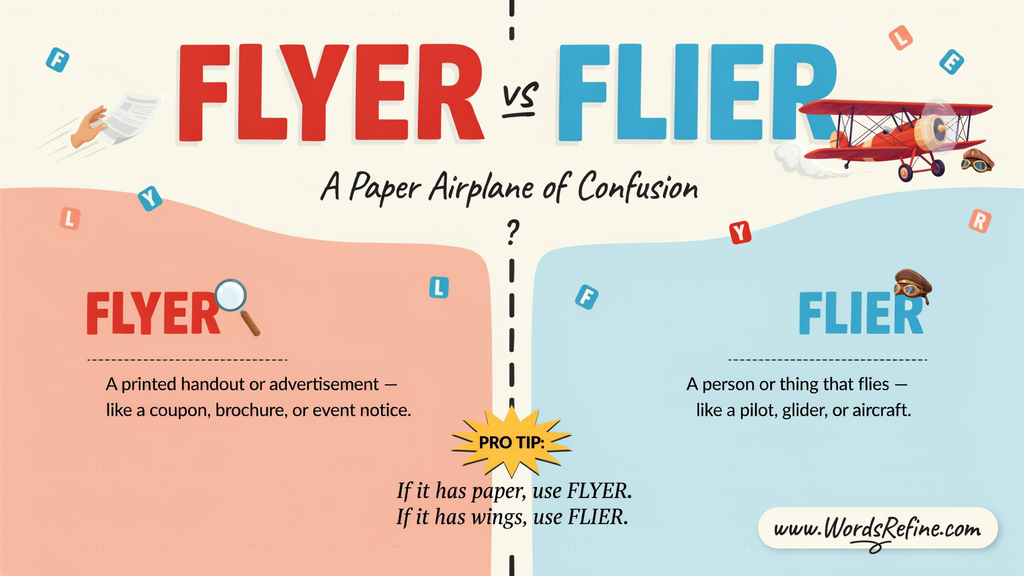
One of the biggest mistakes is assuming that flier is always wrong.
It isn’t.
Flier is an accepted spelling with established meanings.
Another mistake is assuming that flyer can only describe an advertisement.
It can also refer to a person or thing that flies.
A third mistake involves mixing singular and plural forms.
If you write flyer, the plural is flyers.
If you write flier, the plural is fliers.
Another common problem occurs when writers switch between spellings without a reason. Although both forms are correct, consistency makes writing easier to read.
Finally, writers sometimes ignore the style preferences of a particular publication or organization. If a style guide specifies one form, follow it consistently.
Which One Should You Use?
If you’re writing about an advertisement or promotional sheet in American English, flyer is usually the straightforward choice.
For example:
The company distributed a flyer promoting its new service.
If you’re describing someone who flies, especially in an expression such as frequent flier, flier is a natural option.
For example:
He is a frequent flier.
However, flyer is also accepted in this context.
Therefore, the decision isn’t always about right versus wrong. Instead, it often comes down to meaning, common usage, and style preference.
If you’re writing professionally, consistency is more important than switching between the two forms simply to avoid repetition.
A Simple Comparison
| Feature | Flyer | Flier |
|---|---|---|
| Accepted spelling | Yes | Yes |
| Promotional material | Very common | Also used |
| Person who flies | Used | Used |
| Thing that flies | Used | Used |
| Airline passenger | Used | Used |
| Frequent traveler expression | Frequent flyer | Frequent flier |
| Risk-taking expression | Take a flyer | Take a flier |
| Plural | Flyers | Fliers |
| American English | Common | Established alternative |
| British English | Used | Used |
The table shows why there isn’t a single spelling that works in every situation. Both forms have legitimate uses.
Is Flyer vs Flier Correct?
If the question is, “Is flyer vs flier correct?” the answer is simple: both are correct.
The better question is which spelling fits the context.
When you mean a promotional piece of material, flyer is generally the familiar choice in American English.
When you mean a person or thing that flies, flier is often used. Nevertheless, flyer can also work.
For expressions such as frequent flyer, frequent flier, take a flyer, and take a flier, both forms can appear.
So, don’t assume that one spelling is a mistake simply because another writer chose the alternative.
How to Remember Flyer vs Flier
A simple memory trick can help.
Think of flyer when you picture a promotional sheet being handed to someone.
For example:
The store printed a flyer for its sale.
Think of flier when you picture someone traveling through the air.
For example:
She is a frequent flier.
This trick won’t cover every possible use because English doesn’t follow such tidy rules. Still, it can help you make a quick decision when you’re writing.
If you’re still unsure, look at the surrounding words. They usually reveal the intended meaning.
Learn the difference between confusing more English words
Wisp vs Whisp Which One Is Correct?
Practice session Flyer vs Flier
Choose the correct word or plural form: flyer, flier, flyers, vs fliers.
- The restaurant handed out a ______ advertising its new lunch menu.
- Sarah is a frequent ______ because she travels often for work.
- The school created an ______ for its upcoming sports event.
- The eagle is an excellent ______.
- We printed 500 ______ to promote the charity fundraiser.
- The airline offers special rewards to frequent ______.
- The company designed a promotional ______ for its new product.
- The pilot is an experienced ______.
- Please distribute these ______ around the neighborhood.
- My brother has become a frequent ______ since starting his new job.
- The concert ______ included the date, time, venue, and ticket information.
- The hawk is a powerful ______ with impressive control in the air.
- The business created a digital ______ for its weekend sale.
- Several frequent ______ gathered in the airport lounge.
- The store used an advertising ______ to attract new customers.
- The bird is a graceful ______ that can travel long distances.
- The volunteers passed out ______ at the community center.
- She became a regular ______ after taking an international job.
- The marketing team prepared an event ______ for social media.
- The aircraft proved to be a capable ______ during its test flights.
- The theater printed colorful ______ to promote its new show.
- He is a frequent ______ who knows most airport routines by heart.
- The company placed a promotional ______ near the entrance.
- The hawk is one of the most skilled ______ in the area.
- The community group distributed ______ to announce its upcoming fundraiser.
Answers
- Flyer
- Flier
- Flyer
- Flier
- Flyers
- Fliers
- Flyer
- Flier
- Flyers
- Flier
- Flyer
- Flier
- Flyer
- Fliers
- Flyer
- Flier
- Flyers
- Flier
- Flyer
- Flier
- Flyers
- Flier
- Flyer
- Fliers
- Flyers
Here’s a trusted source for clear word meanings:
FAQs
When should you use “flyer” instead of “flier”?
Use “flyer” when you mean a printed or digital piece of promotional material. For example, a business might create a flyer to advertise a sale, event, product, or service.
When does “flier” refer to a person?
“Flier” can refer to a person who flies, particularly someone who travels by airplane. For example, “Maria is a frequent flier because she travels for work.”
Can “flyer” also describe a person who flies?
Yes. “Flyer” can describe a person or thing that flies. Although “flier” is common in some contexts, especially “frequent flier,” the two spellings can overlap in meaning.
What does “flyer” mean in advertising?
In advertising, a flyer is a short promotional piece designed to share information and attract attention. It might promote a business, product, service, event, sale, or special offer.
Why is “frequent flier” commonly spelled with “flier”?
“Frequent flier” traditionally refers to someone who travels by airplane regularly. The spelling “flier” is especially established in this expression, although “frequent flyer” is also widely used.
Can a flyer be digital instead of printed?
Yes. A flyer can be printed on paper or created digitally. Digital flyers are commonly shared through websites, email, social media, and messaging platforms.
What should you include on a flyer?
A useful flyer should present its main message quickly. Depending on its purpose, it may include a headline, essential details, an image, contact information, a date, a location, a price, and a clear call to action.
What is the difference between a handbill and a flyer?
A handbill is a small printed sheet used to provide information or promote something. It can serve a purpose similar to a flyer, although “flyer” is the more common general term for promotional material.
Is “flyer” ever used outside advertising?
Yes. “Flyer” can also refer to a person or thing that flies. It also appears in expressions such as “high flyer” and “take a flyer,” where it has a different meaning.
What does “take a flyer” mean?
“Take a flyer” means to take a chance on something, particularly when the outcome is uncertain. For example, an investor might take a flyer on a new business.
What does “high flyer” mean?
A “high flyer” is a person who is very successful, ambitious, or prominent, especially in a career or business setting. “High flier” is also an accepted spelling.
Are “flyers” and “fliers” both correct plurals?
Yes. “Flyers” is the plural of “flyer,” while “fliers” is the plural of “flier.” Both are correct when used consistently with their singular forms.
Does changing “flyer” to “flier” always change the meaning?
No. The meaning doesn’t always change. In many situations, “flyer” and “flier” are alternative spellings. However, particular expressions and contexts may favor one spelling over the other.
Which spelling is common for business promotions?
“Flyer” is a common choice for business promotions. You might see phrases such as “promotional flyer,” “event flyer,” “business flyer,” or “advertising flyer.”
Can a flyer contain several pages?
A flyer is usually a single sheet or a relatively simple promotional document. However, people sometimes use the term loosely for longer promotional material. A multi-page document may be better described as a brochure or booklet.
How is a flyer different from a brochure?
A flyer usually delivers information quickly and is often a single sheet. A brochure generally provides more detailed information and may have multiple panels or pages. The two terms can overlap in casual use.
Can schools and organizations use flyers?
Yes. Schools, charities, community groups, and other organizations often use flyers to announce events, fundraisers, meetings, activities, and public programs.
Are flyers still useful for advertising?
Yes. Flyers can still be useful when they reach the right audience in the right place. Their value depends on factors such as the message, design, distribution method, audience, and offer.
How can you choose between “flyer” and “flier”?
First, consider the meaning and context. For a promotional sheet, “flyer” is a natural and widely recognized choice. For a person who flies, “flier” is common, particularly in “frequent flier.” When both forms are acceptable, choose one and use it consistently.
Conclusion
The flyer vs flier debate may involve only one little letter, but that letter can certainly make writers stop and think. Fortunately, the choice is easier once you understand the context.
Use “flyer” when you mean promotional material, such as an event flyer, business flyer, or advertising flyer. Use “flier” when referring to someone who flies, particularly in the familiar expression “frequent flier.” However, these spellings can overlap, and both may be correct depending on the context.
So, before you let this spelling pair send your grammar into a tailspin, simply ask what you mean. Are you promoting something, or are you talking about someone who flies? Make the meaning clear, choose the appropriate spelling, and keep your writing consistent. With that simple trick, flyer vs. flier won’t have to fly circles around your grammar anymore.

Diora AJS she is an experienced blogger and passionate English language enthusiast at Words Refine. With a keen eye for language and a love for clear communication, she writes practical content about grammar, word meanings, usage, and commonly confused terms. Her goal is to make English easier to understand through clear explanations and relatable examples, helping readers write accurately and communicate with confidence.