
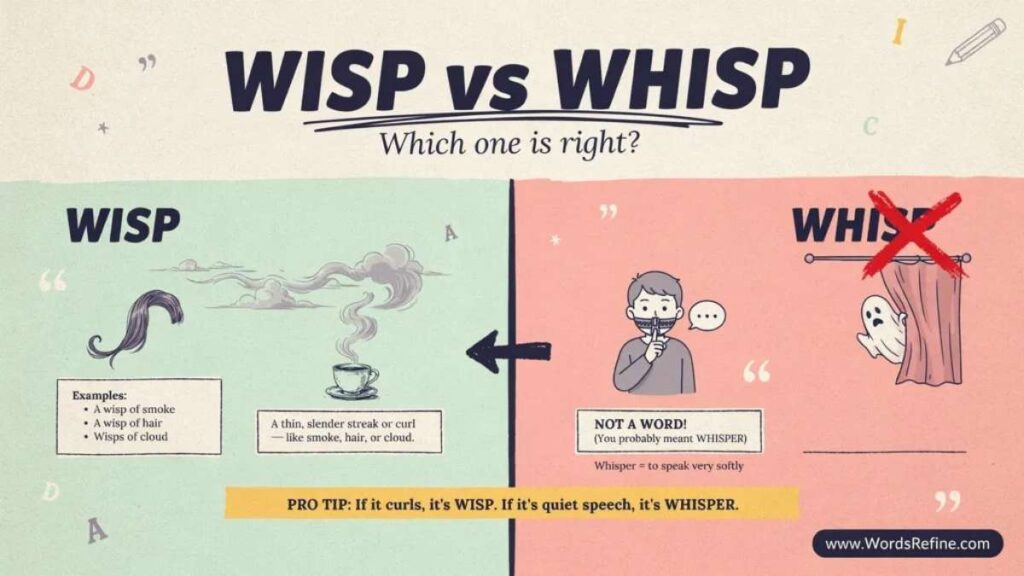
Have you ever wondered whether wisp vs whisp is the correct spelling? This small spelling confusion is easy to understand once you know how the word works in English. The correct modern spelling is wisp, which can describe a thin strand, small tuft, or faint trace of something, such as hair, smoke, or mist. Although whisp may look tempting, especially because words like “whisper” contain an h, it is generally not the standard spelling today. In this guide, you’ll learn the meaning, definition, pronunciation, usage, and common sentence examples of wisp. You well also discover why whisp causes confusion and how to avoid this mistake confidently.
quick answer
The correct spelling is wisp, without the h.
If you’re asking, “wisp vs whisp which is correct?” the answer is wisp in standard English. Although whisp may occasionally appear in historical, unusual, or informal material, it isn’t the spelling you should normally use when writing in contemporary English.
Consider these examples:
- A wisp of smoke rose from the chimney.
- A wisp of hair fell across her forehead.
- Wisps of mist floated above the lake.
In each example, wisp refers to something small, thin, light, or faint.
The spelling whisp may look convincing at first. After all, English has words such as whisper, whistle, and white. However, those words don’t determine how wisp should be spelled.
There is no h in wisp.
That small detail is the entire spelling difference, but it makes a big difference when you want your writing to follow standard English usage.
What Does Wisp Mean?
The meaning of wisp is fairly simple once you picture the kind of thing it describes. A wisp is usually a small, thin, or delicate amount of something.
For example, imagine a little curl of smoke rising from a candle. 1.It isn’t a thick cloud. 2.It isn’t a solid mass. 3.It is light, narrow, and drifting. That is exactly the kind of thing you can call a wisp.
The word can describe several things, including:
- A thin strand or lock, especially of hair.
- A small tuft or bundle of something such as hay or grass.
- A thin or faint streak of smoke, mist, vapor, or cloud.
- A small or barely noticeable amount of something.
- A figurative trace of an idea, feeling, hope, or doubt.
For example:
A wisp of smoke curled into the evening air.
Here, wisp describes the thin and delicate appearance of the smoke.
Similarly:
A wisp of hair rested against her cheek.
In this sentence, wisp describes a small, thin lock of hair.
The central idea remains the same. Something described as a wisp tends to look slight, narrow, delicate, or faint.
Wisp as a Noun
Wisp is most commonly used as a noun. In this form, it identifies a small strand, tuft, trace, or amount of something.
One of the most familiar structures is “a wisp of” followed by a noun.
For example:
- A wisp of smoke drifted through the open window.
- A wisp of hair escaped from her braid.
- A wisp of mist hovered above the water.
- A wisp of vapor disappeared into the cold air.
- A wisp of hay clung to the horse’s mane.
Notice how the word creates a visual image. Instead of simply saying “a small amount of smoke,” the phrase “a wisp of smoke” gives the reader a stronger sense of something thin and drifting.
The plural form is wisps.
For example:
Wisps of fog covered the road.
Here, wisps suggests several separate, thin patches of fog.
Wisp Meaning a Small Strand or Tuft
When wisp describes hair, grass, straw, or a similar material, it often means a small strand, lock, or tuft.
For example:
A wisp of hair fell over her eyes.
The phrase doesn’t necessarily refer to one single hair. It can describe a small, loose section of hair that looks thin or delicate.
Likewise:
A wisp of straw was caught in the farmer’s coat.
The idea is that only a small amount of straw is present.
In this sense, wisp overlaps with words such as strand, tuft, and lock. However, each word creates a slightly different image.
A strand usually emphasizes one long, thin piece. A tuft suggests a small bunch. A lock often refers to a section of hair. Wisp, meanwhile, tends to suggest something light, loose, thin, or delicate.
Learn the difference between confusing more English words
Dreamt vs Dreamed Which One Is Correct?
Wisp Meaning a Faint Trace
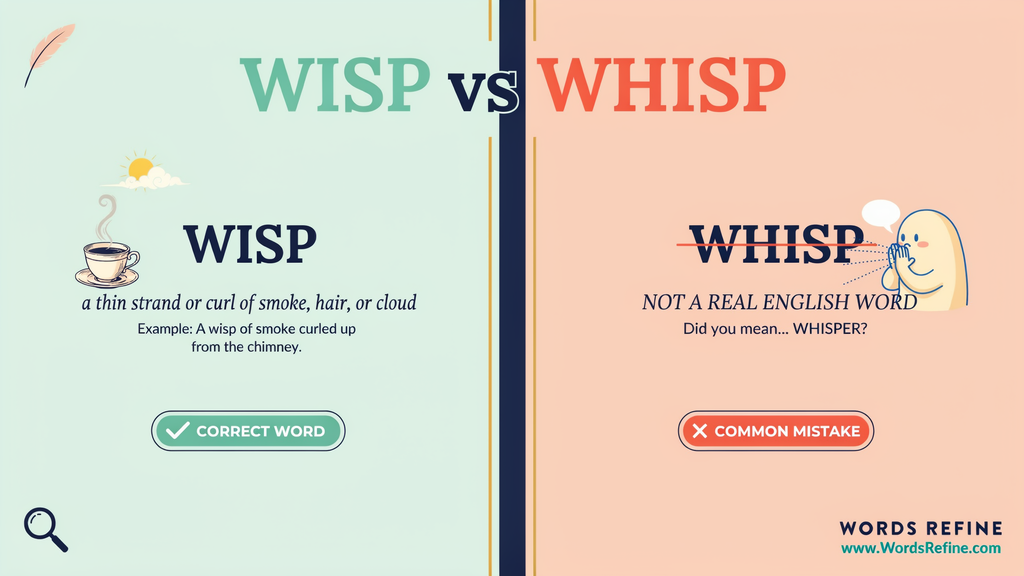
The Wisp can also describe something that appears only faintly.
This use is particularly common with smoke, mist, vapor, and clouds.
For example:
A wisp of mist lingered over the river.
The sentence suggests that only a small, thin amount of mist remained.
Similarly:
A wisp of smoke rose from the dying fire.
The smoke isn’t thick or heavy. Instead, it appears as a narrow, delicate trail.
This quality makes wisp especially useful in descriptive writing. It allows you to show the reader what something looks like rather than simply telling them that there is a small amount of it.
Wisp Meaning a Small Amount
Wisp can also have a figurative meaning. In these cases, it describes a small or faint amount of something that isn’t necessarily physical.
For example:
There wasn’t a wisp of doubt in her voice.
Doubt cannot literally form a strand or tuft. However, the phrase works because it compares a tiny trace of doubt to something barely visible.
You might also encounter expressions such as:
- A wisp of hope remained.
- A wisp of an idea came to him.
- There wasn’t a wisp of evidence against her.
- A wisp of fear crossed his face.
These expressions all suggest something slight, faint, or barely present.
What Does Whisp Mean?
The question of whisp meaning requires a little more care.
When people search for the meaning of whisp, they are often looking for the word wisp but have encountered or typed the spelling with an h.
In standard modern English, wisp is the normal spelling.
Whisp can appear in historical sources, unusual references, names, or other specialized contexts. However, those appearances don’t make it the standard spelling for everyday English.
Therefore, if you want to describe a thin strand of hair or a faint trail of smoke, use wisp.
For example:
Correct: A wisp of smoke rose into the air.
Not standard: A whisp of smoke rose into the air.
The intended meaning remains understandable in the second sentence, but the spelling isn’t the usual standard form.
Is Whisp a Word in English?
The answer depends on what you mean by “word.”
You may find whisp recorded in older material or unusual contexts. English has a long history of spelling variation, and older texts sometimes used forms that aren’t common today.
However, that doesn’t mean you should treat whisp as an ordinary modern alternative to wisp.
If you’re writing a school assignment, article, email, report, or other standard English text, wisp is the safer and correct choice.
So, when someone asks, “Is whisp a correct word?” the practical answer is that whisp should not be used as a replacement for the standard word wisp.
Wisp vs Whisp What’s the Difference?
The difference between wisp and whisp is mainly spelling and standard usage.
Wisp is the established modern English spelling. Whisp is generally a nonstandard spelling when someone intends to use the ordinary word wisp.
For example:
Correct:
A wisp of smoke drifted above the fire.
Incorrect in standard usage:
A whisp of smoke drifted above the fire.
This isn’t a situation like color and colour, where two spellings are accepted in different varieties of English. Wisp is the normal spelling in both American and British English.
Therefore, you don’t need to remember two regional versions. You simply need to remember one standard spelling: wisp.
Learn the difference between commonly mixed-up more words
Mobil vs Mobile Which one Is Correct?
Why Do People Spell Wisp as Whisp?
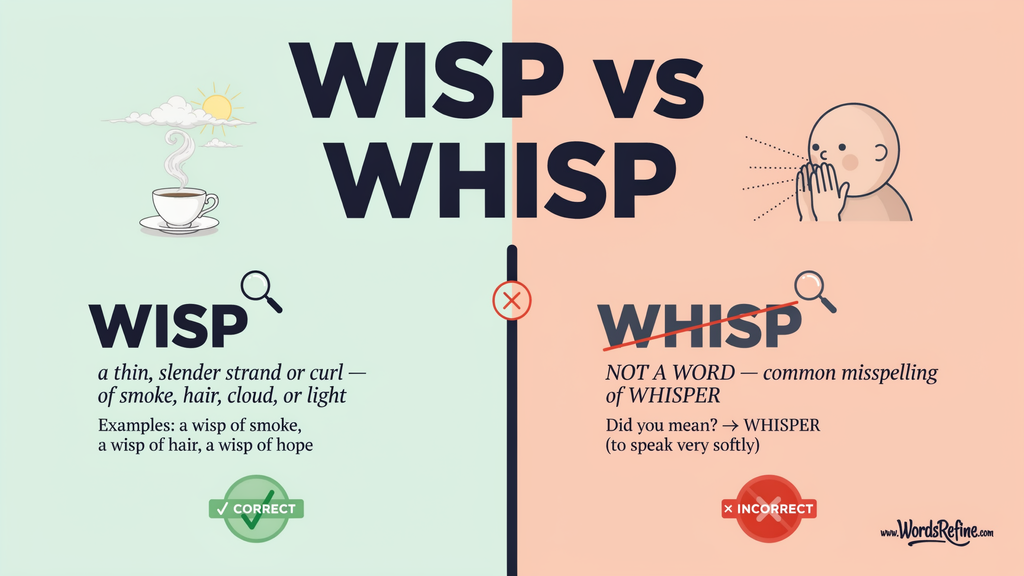
There is a fairly understandable reason for this spelling confusion.
English contains many common words beginning with wh. Words such as whisper, whistle, where, when, and white are familiar to most readers.
Because wisp has a similar light, breathy feel to words such as whisper, some people may instinctively add an h.
However, spelling isn’t always predictable from sound or association.
Think of it this way: your brain recognizes a familiar pattern and tries to complete it. Sometimes it completes the pattern correctly. Sometimes it adds a letter that doesn’t belong.
That is likely one reason whisp can look surprisingly convincing.
Unfortunately, English doesn’t always play fair when it comes to spelling.
The Simple Rule for Remembering Wisp vs Whisp
The easiest way to remember the correct spelling is to connect wisp with wispy.
The relationship is easy to see:
wisp → wispy
Both words begin with w-i-s-p.
For example:
She had wispy hair around her face.
From there, it becomes easier to remember:
A wisp of hair.
A wisp of smoke.
A wispy cloud.
None of these words needs an h.
A simple memory sentence can help:
A wisp is wispy.
That little connection can prevent the extra h from sneaking into your writing.
Common Mistakes With Wisp vs Whisp
The most common mistake is simply adding h to the beginning of wisp.
For example:
Incorrect: A whisp of smoke floated across the room.
Correct: A wisp of smoke floated across the room.
Another common mistake involves assuming that whisp might be a British spelling.
It isn’t. American and British English both normally use wisp.
A third mistake occurs when writers confuse wisp with wispy.
Wisp is generally a noun:
A wisp of hair fell across her face.
Wispy is an adjective:
Her hair looked wispy.
The words are related, but they serve different grammatical purposes.
Finally, some writers assume that finding a rare spelling in an old source automatically makes it a modern spelling variant. That isn’t necessarily true. Historical English contains many forms that have disappeared from standard usage.
Learn the difference between tricky grammar more words
Fiancé vs Fiancée What’s the Difference and which is Correctly?
Wisp vs Whisp in a Sentence
Seeing the words in context makes the difference much easier to remember.
Wisp of Hair
A wisp of hair escaped from her ponytail.
Here, wisp describes a small, thin section of hair.
Wisp of Smoke
A wisp of smoke rose from the chimney.
The word suggests a narrow and faint trail.
Wisp of Mist
A wisp of mist hovered above the lake.
The mist appears in a light, thin patch.
Wisp of Vapor
A wisp of vapor disappeared into the cool air.
The word emphasizes how slight and fleeting the vapor is.
Wisp of Hay
A wisp of hay stuck to his jacket.
Here, wisp refers to a small amount of hay.
Wisp of Cloud
A wisp of cloud drifted across the blue sky.
The phrase creates an image of a thin, delicate cloud.
Wisp of Hope
A wisp of hope remained after the long search.
This is a figurative use because hope isn’t physically visible.
Wisp vs Similar Words
Although wisp has a distinct meaning, several other words can describe things that are small, thin, or delicate. However, they aren’t always interchangeable.
Wisp vs Strand
A strand usually refers to one long, thin piece of something.
For example:
A strand of hair rested on the pillow.
Wisp can refer to a small, delicate lock or portion.
A wisp of hair rested on her shoulder.
The first expression focuses more on the individual strand. The second creates a softer image of something thin and loose.
Wisp vs Tuft
Tuft generally means a small bunch or cluster of something.
For example:
A tuft of grass grew between the stones.
Wisp usually creates a lighter and thinner image.
A wisp of grass moved in the breeze.
The distinction isn’t absolute, but the words often produce different visual impressions.
Wisp vs Lock
Lock commonly refers to a section of hair.
A lock of hair fell over her shoulder.
A wisp of hair suggests something smaller, finer, or more delicate.
Wisp vs Trace
Trace means a very small amount or indication of something.
For example:
There was a trace of smoke in the room.
There was a wisp of smoke near the ceiling.
Both sentences describe a small amount, but wisp gives the reader a more visual image of thin smoke drifting through the room.
Learn the difference between often confused words
Any time vs anytime meaning Difference with Examples ?
Wisp Synonyms and Related Words
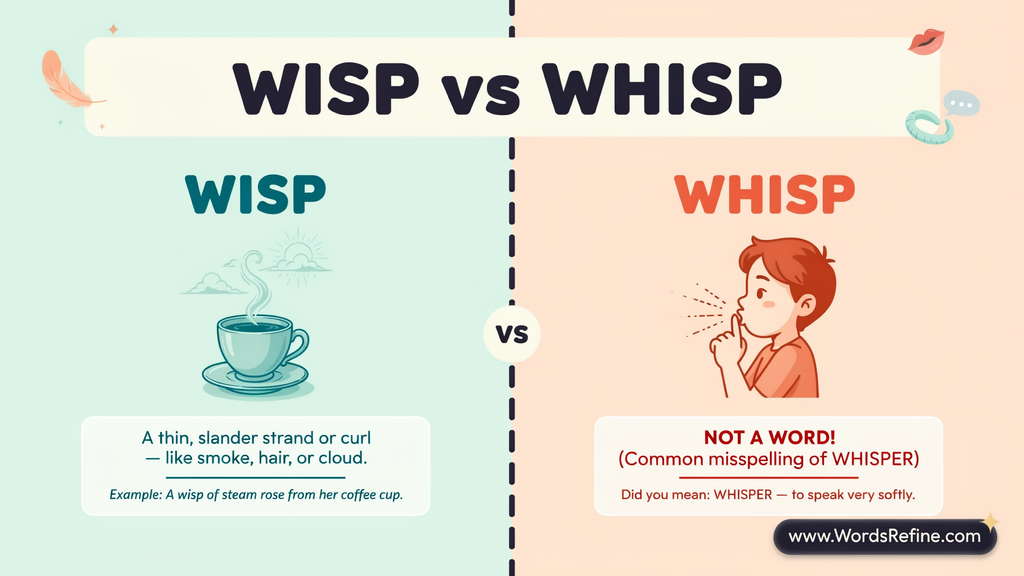
The best wisp synonym depends on the context.
Some related words include strand, tuft, lock, thread, tendril, trace, streak, shred, fragment, and small amount.
However, replacing wisp with one of these words isn’t always a perfect swap.
For example, a tendril usually suggests something long and curling. A tuft suggests a small bunch. A trace focuses on a tiny amount or indication.
Wisp combines several ideas. It can suggest something small, thin, faint, loose, and delicate at the same time.
That combination is what gives the word its particular character.
Wisp as a Verb
Wisp is primarily encountered as a noun. The noun form is by far the most useful one for everyday writing.
For example:
A wisp of smoke drifted through the window.
The word identifies the small, thin amount of smoke.
Because the verb use is uncommon, writers should avoid forcing it into a sentence simply to make their writing seem more sophisticated. Clear and familiar wording usually works better.
In most situations, noun constructions such as “a wisp of smoke” or “a wisp of hair” will sound natural to readers.
Wisp in Figurative Writing
Wisp can add a surprisingly delicate quality to figurative language.
Consider this sentence:
A wisp of hope remained.
The writer could simply say:
A little hope remained.
However, wisp creates a different feeling. It suggests that the hope is fragile and barely visible, almost like a thin thread floating in the air.
Similarly:
Not a wisp of doubt crossed her mind.
This creates a stronger image than simply saying:
She had no doubt.
The figurative use works because readers already associate a wisp with something faint and slight.
Is Wisp a Word?
Yes. Wisp is a standard English word with established meanings and grammatical uses.
It is primarily a noun and appears in everyday descriptions as well as literary writing.
For example:
A wisp of smoke rose from the fire.
Wisps of fog covered the field.
A wisp of hair fell across her face.
The word can also appear in figurative expressions such as “a wisp of hope.”
So, if you’re asking whether wisp is an English word, the answer is definitely yes.
Is Whisp a Correct Spelling?
If you’re using whisp to mean the ordinary English word wisp, it isn’t the standard spelling.
The correct spelling is wisp.
The spelling whisp may occur in historical or unusual sources, but that doesn’t make it the preferred form for modern standard writing.
Therefore, if you’re writing something formal or simply want to use the correct word, choose wisp.
This applies to professional documents, academic assignments, articles, emails, creative writing, and everyday communication.
Learn the difference between everyday English mistakes
Discrete vs Discreet What the Difference and which is Correctly?
Wisp in Professional and Academic Writing
Wisp can appear in formal writing when the context calls for a descriptive word.
For example:
A wisp of smoke was visible above the structure.
That sentence can work perfectly well in a report if the observation is relevant.
However, technical writing often requires exact measurements. In such situations, terms such as trace, concentration, quantity, or a specific measurement may provide more precision.
The important point is that wisp isn’t an inherently informal word. Its suitability depends on the context.
Good writing isn’t about choosing the fanciest word available. It is about choosing the word that communicates the intended meaning accurately.
Wisp Slang and Informal Meanings
People sometimes search for wisp slang vs wisp meaning in slang because words can develop specialized meanings in online communities, games, fandoms, and social groups.
However, wisp doesn’t have one universal slang definition that replaces its standard meaning.
In ordinary English, the word still refers to something thin, small, faint, or delicate.
If a particular community gives wisp a special meaning, that interpretation depends on the context. It shouldn’t be confused with the standard dictionary definition.
The same applies to searches for whisp slang or whisp meaning in slang. A specialized use doesn’t automatically make whisp the standard spelling of wisp.
Wisp Bible Meaning
Searches for wisp Bible meaning or wisp Bible may suggest that the word has a special religious definition. However, there isn’t a separate standard biblical spelling that changes wisp into whisp.
If wisp appears in a particular translation or religious text, its meaning should be understood from the surrounding passage and the wording of that translation.
The spelling issue remains simple: when referring to the standard English word, use wisp.
Historical texts can contain spelling variations, but those variations shouldn’t automatically be copied into modern English.
A Simple Case Study One Extra Letter
Imagine someone describing a small trail of smoke rising from a campfire.
They write:
A wisp of smoke rose above the fire.
That’s correct.
Now suppose they add an h:
A whisp of smoke rose above the fire.
The reader can still understand the sentence. The meaning hasn’t suddenly disappeared. However, the spelling is no longer the standard form.
This small example shows why spelling matters even when the intended meaning remains obvious.
A misspelled word can be understandable and still need correction.
How to Remember Wisp vs Whisp
When you’re unsure whether to write wisp vs whisp, remember one word: wispy.
If you can spell wispy, you already know the spelling pattern for wisp.
Think about a wispy cloud floating across a blue sky.
Then connect the words:
Wisp.
Wispy.
No h.
It’s a simple trick, but simple tricks are often the ones that actually stick.
Learn the difference between more words people mix up
Further vs Farther The Simple Difference and Each Correctly?
Quick Comparison Wisp vs Whisp
| Question | Answer |
|---|---|
| Which spelling is correct? | Wisp |
| Does wisp contain an h? | No |
| Is wisp a standard English word? | Yes |
| What does wisp mean? | A thin strand, small tuft, faint trace, or small amount |
| What is a common phrase? | A wisp of smoke |
| Can wisp describe hair? | Yes |
| Can wisp describe mist? | Yes |
| Is wisp used in American English? | Yes |
| Is wisp used in British English? | Yes |
| Is whisp the standard alternative spelling? | No |
| What related adjective helps remember the spelling? | Wispy |
Practice Session Wisp vs Whisp
Test your understanding of the difference between wisp vs whisp. Fill in each blank with the correct word.
- A thin ______ of smoke curled upward from the candle.
- She tucked a loose ______ of hair behind her ear.
- A delicate ______ of mist hovered above the lake.
- The breeze carried a ______ of smoke across the field.
- A small ______ of hay was stuck to his jacket.
- We could see a faint ______ of cloud in the distance.
- One ______ of hair had escaped from her ponytail.
- A ______ of steam rose from the hot cup of tea.
- There wasn’t a ______ of evidence to support his claim.
- A cold ______ of air slipped through the open window.
- The chimney released a ______ of gray smoke into the sky.
- She noticed a ______ of fog moving across the valley.
- The child had a tiny ______ of straw in his hair.
- A ______ of white vapor disappeared into the morning air.
- The writer described a ______ of silver hair shining in the sunlight.
- Which spelling is standard in modern English: ______ or whisp?
- If you want to describe a thin strand of hair, you would use the word ______.
- The photographer captured a ______ of mist rising above the water.
- The candle produced a faint ______ of smoke before going out.
- There was only a ______ of hope that the missing item would be found.
- A ______ of grass clung to the bottom of his shoe.
- When writing formally, the correct spelling is ______.
- The painter added a delicate ______ of white to the edge of the cloud.
- If you’re wondering how to spell the word without an h, the answer is ______.
- In standard English, you should normally choose ______ rather than “whisp.”
Answers
- wisp
- wisp
- wisp
- wisp
- wisp
- wisp
- wisp
- wisp
- wisp
- wisp
- wisp
- wisp
- wisp
- wisp
- wisp
- wisp
- wisp
- wisp
- wisp
- wisp
- wisp
- wisp
- wisp
- wisp
- wisp
Here’s a trusted source for clear word meanings:
FAQs
How do you spell wisp correctly?
The correct standard spelling is wisp. It refers to a thin strand, small tuft, or faint trace of something, such as hair, smoke, mist, or hay.
Is whisp an incorrect spelling of wisp?
In standard modern English, whisp is generally not the spelling you should use when you mean wisp. For everyday, academic, and professional writing, choose wisp.
What is the difference between wisp vs whisp?
The difference is mainly in standard spelling and usage. Wisp is the established modern English word. Whisp may appear in rare or historical sources, but it isn’t the usual spelling in contemporary English.
What does wisp mean in English?
Wisp means a thin strand, small tuft, or faint trace of something. For example, you can have a wisp of smoke, a wisp of hair, or a wisp of mist.
How do you use wisp in a sentence?
Use wisp when you want to describe something thin, light, small, or faint. For example: “A wisp of smoke drifted through the open window.”
What is a wisp of hair?
A wisp of hair is a small, thin strand or tuft of hair, usually one that has separated from the rest. A loose strand falling across your forehead can be described as a wisp of hair.
What is a wisp of smoke?
A wisp of smoke is a thin or faint stream of smoke. The phrase often creates an image of smoke gently curling or drifting through the air.
What is a wisp of mist?
A wisp of mist is a small, thin patch of mist that appears lightly over an area. You might notice wisps of mist floating above a lake or moving through a valley.
Can wisp describe a small amount of something?
Yes. Wisp can describe a small or faint amount of something when it has a thin, light, or delicate appearance. The surrounding context determines exactly what the word describes.
What is the plural of wisp?
The plural of wisp is wisps. For example: “Several wisps of smoke rose from the chimney.”
Is wisp a noun or a verb?
Wisp is primarily a noun in modern English. It commonly refers to a thin strand, small tuft, or faint trace of something.
What are some common phrases with wisp?
Common expressions include a wisp of hair, a wisp of smoke, a wisp of mist, a wisp of cloud, and a wisp of hay. Each phrase describes something thin, delicate, or faint.
What is the adjective related to wisp?
The related adjective is wispy. It describes something thin, light, delicate, or made up of wisps. For example, you might describe someone’s hair as wispy or clouds as wispy.
How is wisp pronounced?
Wisp is pronounced as a single syllable, roughly like “wisp.” The spelling does not contain an h, so adding one can create unnecessary confusion between wisp and whisp.
Can wisp describe a person?
Yes. In descriptive or figurative language, wisp can refer to someone who is very thin, slight, or delicate. However, this use is less common than expressions such as “a wisp of hair” or “a wisp of smoke.”
What are some synonyms for wisp?
Depending on the context, synonyms for wisp include strand, tuft, trace, thread, streak, tendril, and sliver. However, these words aren’t always interchangeable, so the context matters.
Can wisp describe clouds?
Yes. Wisp can describe a small, thin piece of cloud, particularly when it looks light, delicate, or separated from a larger cloud formation.
Can wisp describe things other than hair and smoke?
Yes. Wisp can describe many thin, light, or faint things. Besides hair and smoke, it can refer to mist, vapor, hay, grass, clouds, or other small strands and traces.
Conclusion
The difference between “wisp” vs “whisp” may be only one letter, but that little h can cause plenty of spelling confusion. In standard modern English, “wisp” is the correct spelling. It describes something thin, light, or faint, such as a wisp of smoke, a wisp of hair, or a wisp of mist.
“Whisp” can look convincing, especially because “whisper” has an h. However, the two words aren’t spelled the same way. When you mean a thin strand, small tuft, or faint trace, stick with “wisp.”
So, the next time you hesitate, remember the simple rule: wisp needs no h. One tiny letter saved, one spelling mistake avoided, and one grammar headache officially dismissed.

Diora AJS she is an experienced blogger and passionate English language enthusiast at Words Refine. With a keen eye for language and a love for clear communication, she writes practical content about grammar, word meanings, usage, and commonly confused terms. Her goal is to make English easier to understand through clear explanations and relatable examples, helping readers write accurately and communicate with confidence.