Have you ever written a familiar word and suddenly wondered, “Wait, does that really look right?” If so, you are not alone. The confusion over cancell vs cancel is a small spelling trap that catches many writers off guard. Fortunately, the answer is simple: cancel is the correct base form, while cancell is not standard English spelling. Things get a little more interesting with canceled, cancelled, canceling, and cancelling, where regional spelling differences come into play. This guide clears up the confusion, explains the rules behind each form, and shows you how to use them correctly, so that one extra L doesn’t derail your writing.
quick answer
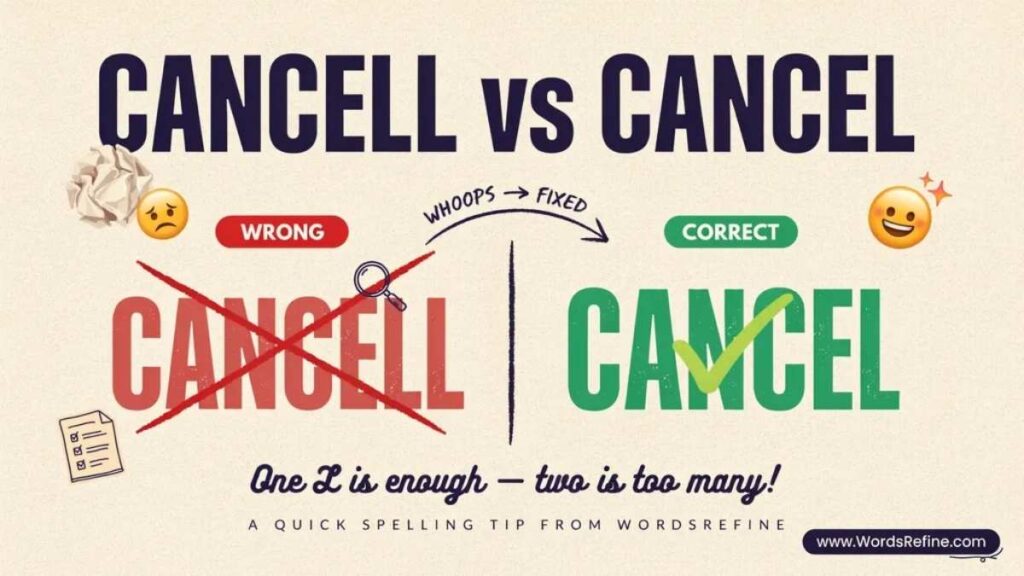
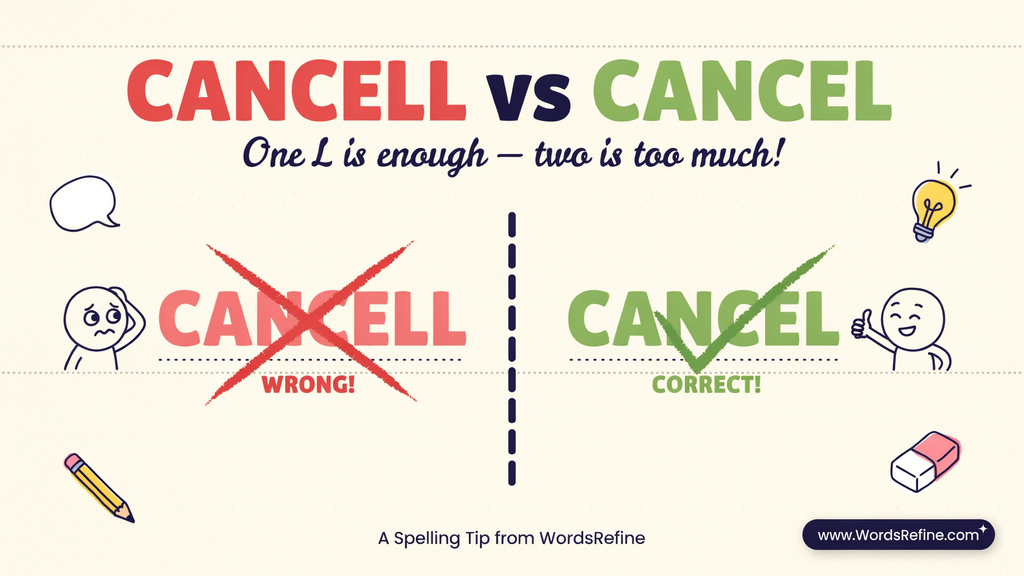
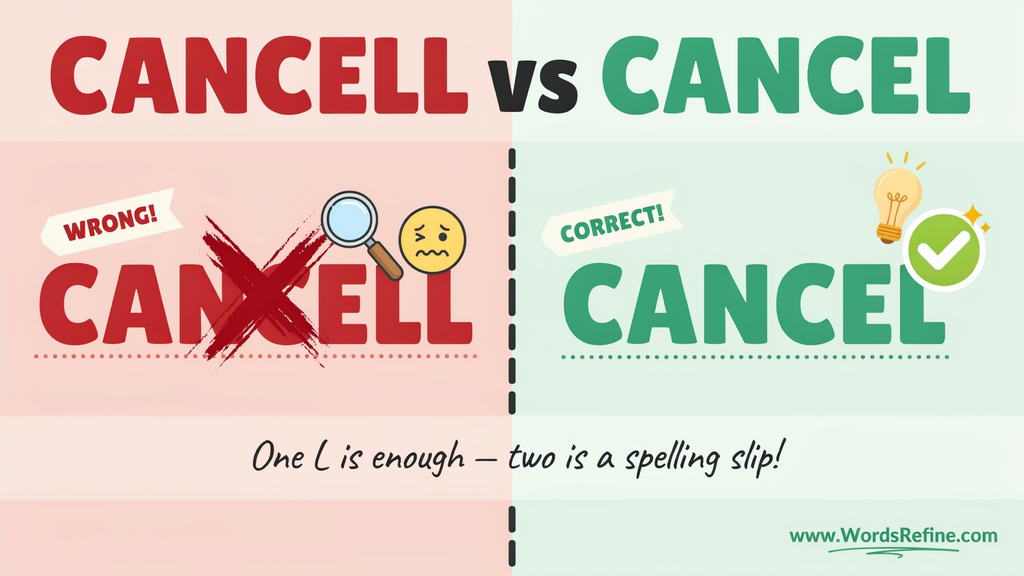
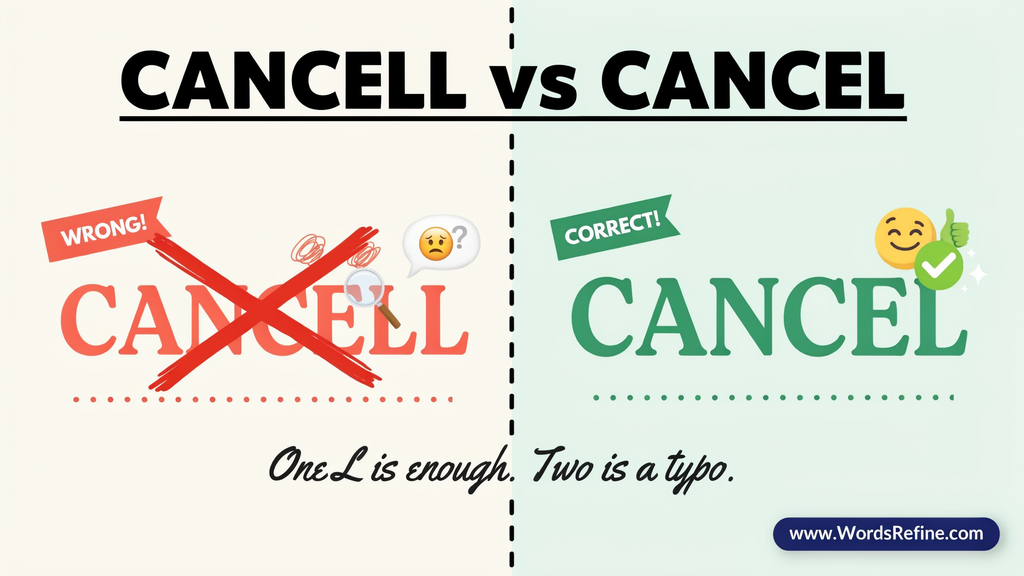
When choosing between cancell vs cancel, use cancel.
Cancel is the standard base form of the verb. It means to stop something that was planned, arranged, ordered, or scheduled. You can cancel a meeting, cancel an appointment, cancel a reservation, cancel an order, or cancel a subscription.
For example:
Please cancel my appointment.
We need to cancel the meeting.
They decided to cancel the concert.
I want to cancel my subscription.
She had to cancel the reservation.
Now compare those sentences with the incorrect form:
Please cancell my appointment.
We need to cancell the meeting.
She wants to cancell her order.
The problem is the extra L. Cancell is not the standard English spelling of the verb.
Interestingly, the mistake makes sense at first glance. If you have seen cancelled or cancelling many times, your brain may naturally assume that cancel must contain two Ls. English spelling, however, doesn’t always make things that convenient.
The base form is cancel.
What Does Cancel Mean?
The cancel meaning is fairly broad because the verb appears in many everyday situations.
At its simplest, cancel means to decide that something planned or arranged will not happen. It can also mean to stop a service, order, subscription, agreement, or other arrangement.
For example:
The organizers canceled the event.
Here, the event had been planned but will no longer take place.
You can also cancel something that you have personally arranged:
I need to cancel my appointment.
In this case, the appointment was scheduled, but you no longer want or need to attend it.
The verb can also refer to commercial arrangements:
The customer called to cancel the order.
Similarly, you can cancel a subscription when you want to stop receiving a service.
She decided to cancel her subscription.
Cancel can also mean to offset one thing against another.
For example:
The extra income canceled out the additional expenses.
In this use, cancel doesn’t mean that something was called off. Instead, one effect balances or removes the effect of another.
Cancel as a Verb
Cancel is a verb because it describes an action.
You can use it in different forms depending on the tense and sentence structure.
The base form is cancel.
The third-person singular present form is cancels.
The past form can be canceled or cancelled.
The present participle can be canceling or cancelling.
The noun form is cancellation.
Consider how these forms work together:
1.She cancels the meeting every Monday.
2.She canceled the meeting yesterday.
3.She has canceled the meeting.
4.She is canceling the meeting.
The meeting caused a cancellation.
The word changes according to its grammatical role, but the base form remains cancel.
Learn the difference between confusing more English words
Instalments vs Installments Which one Is Correct?
Cancell vs Cancel Side-by-Side Comparison
| Word | Correct? | Use | Example |
|---|---|---|---|
| cancel | Yes | Base verb | Please cancel the meeting. |
| cancell | No | Incorrect spelling | Please cancell the meeting. |
| canceled | Yes | Common American English past form | They canceled the event. |
| cancelled | Yes | Common British English past form | They cancelled the event. |
| canceling | Yes | Common American English -ing form | She is canceling the order. |
| cancelling | Yes | Common British English -ing form | She is cancelling the order. |
| cancellation | Yes | Noun | The cancellation surprised everyone. |
The important detail is easy to miss. The fact that some forms contain two Ls doesn’t mean the base word does.
That is the heart of the cancell vs cancel confusion.
Why Do People Mix Up Cancell vs Cancel?
The main reason is the spelling of related forms.
Imagine that you have learned the word cancel. Later, you see cancell vs cancel in a British English article. You notice the double L.
Then you encounter cancelling.
Again, two Ls.
Your brain may make a quick connection:
cancelled → cancell → cancel
Unfortunately, that shortcut leads to the wrong spelling.
The correct pattern is:
cancel → cancelled
not:
cancell → cancelled
The same applies to the American forms:
cancel → canceled
and:
cancel → canceling
The difference becomes even more interesting when you look at cancellation. The noun has two Ls even in American English.
So you can have:
cancel
canceled
canceling
cancellation
There is no requirement for every related word to look exactly alike.
English spelling is full of these little surprises. Once you recognize the pattern, though, it stops being a problem.
Learn the difference between commonly mixed-up more words
Compair vs Compare Which One Is Correct?
The Simple Rule to Remember Cancel
Here’s the easiest rule to keep in mind:
The base form is always cancel.
It doesn’t matter whether you’re writing American English or British English. The base verb remains the same.
American English generally uses:
cancel
canceled
canceling
British English generally uses:
cancel
cancelled
cancelling
Notice something important: neither variety uses cancell as the base form.
That’s the easiest way to settle the question of is cancell correct.
It isn’t.
A Quick Spelling Pattern
Think of the word family this way:
| Form | American English | British English |
|---|---|---|
| Base form | cancel | cancel |
| Present form | cancels | cancels |
| Past form | canceled | cancelled |
| Past participle | canceled | cancelled |
| Present participle | canceling | cancelling |
| Noun | cancellation | cancellation |
This pattern is much easier to remember than trying to guess the spelling every time you type the word.
Cancel Spelling How to Spell Cancel Correctly
If you are wondering how to spell cancel, the answer is:
C-A-N-C-E-L
There is one L.
The correct spelling of cancel does not change between American and British English.
This is worth remembering because many regional spelling differences exist in English. For example, words such as color and colour or organize and organise may vary by region.
Cancel isn’t one of those words at its base level.
Both American and British English use cancel.
The difference appears when certain endings are added.
So if you ask, “Does cancel have one L or two?” the answer is simple:
Cancel has one L.
Cancell Spelling Why Is It Incorrect?
The cancell spelling is incorrect when you intend to use the ordinary English verb meaning to stop, call off, or end something.
For example:
Incorrect: Please cancell the reservation.
Correct: Please cancel the reservation.
Incorrect: I want to cancell my subscription.
Correct: I want to cancel my subscription.
Incorrect: They decided to cancell the meeting.
Correct: They decided to cancel the meeting.
The extra L isn’t needed.
You may see two Ls in cancelled, cancelling, or cancellation, but those spellings don’t turn the base form into cancell.
That distinction is particularly important when you’re writing quickly. A familiar-looking word can slip through your fingers before you notice the typo.
Is Cancell a Word?
If you’re asking is cancell a word in standard modern English, the practical answer is no when you mean the ordinary verb cancel.
Standard dictionaries list cancel as the verb.
For everyday writing, use cancel.
If you’re writing an email, report, article, school assignment, business notice, or professional message, writing cancell will normally be treated as a misspelling.
The easiest correction is simply to remove the extra L.
Cancel vs Cancell A Grammar Check
The cancel vs cancell issue is mainly a spelling problem rather than a complicated grammar problem.
Consider this sentence:
I decided to cancel the meeting.
After to, English uses the base form of the verb.
That means cancel is correct.
You wouldn’t write:
I decided to canceled the meeting.
You also wouldn’t write:
I decided to cancell the meeting.
The correct sentence is:
I decided to cancel the meeting.
The same rule applies to many similar sentences:
She plans to cancel the order.
They want to cancel the reservation.
We need to cancel the event.
He agreed to cancel the appointment.
The word remains in its base form after to.
Cancel Past Tense Canceled vs Cancelled?
The cancel past tense is where the spelling becomes more interesting.
Both canceled and cancelled are correct.
The difference usually comes down to regional spelling.
American English generally uses canceled.
British English generally uses cancelled.
For example:
American English:
The airline canceled the flight.
British English:
The airline cancelled the flight.
The meaning is exactly the same.
Neither form means something different. The difference is simply the spelling convention used by the writer or publication.
Canceled Meaning
The canceled meaning is the past form of cancel.
It tells the reader that something was stopped or called off.
For example:
The company canceled the meeting.
The meeting had been planned, but it did not take place as scheduled.
You can use canceled with many different nouns:
The airline canceled the flight.
The school canceled classes.
The restaurant canceled the reservation.
The company canceled the order.
The organizers canceled the event.
Cancelled Meaning
The cancelled meaning is essentially the same.
The difference is the spelling used in British English and other varieties that commonly follow that convention.
For example:
The airline cancelled the flight.
The school cancelled classes.
The company cancelled the order.
The organizers cancelled the event.
So, when someone asks whether canceled or cancelled is correct, the answer isn’t simply “one is right and the other is wrong.”
Both are established spellings.
The important question is which variety of English you’re following.
Canceled vs Cancelled What’s the Difference?
The canceled vs cancelled distinction is mainly regional.
American English generally favors canceled with one L.
British English generally favors cancelled with two Ls.
This difference appears in several forms of the verb.
| American English | British English |
|---|---|
| canceled | cancelled |
| canceling | cancelling |
However, the base form remains the same:
cancel
That small detail solves most of the confusion.
If you’re writing for an American audience, canceled will usually look more natural.
If you’re writing for a British audience, cancelled will usually fit better.
Neither choice changes the meaning.
Cancel Past Tense Spelling in American English
The cancel past tense spelling in American English is generally canceled.
For example:
The manager canceled the appointment.
The airline canceled the flight.
The store canceled the order.
The event was canceled because of the weather.
American English also commonly uses canceling.
For example:
The manager is canceling the appointment.
The customer is canceling the subscription.
The company is canceling the event.
This creates a straightforward pattern:
cancel → canceled → canceling
If you’re writing in US English, this is the spelling pattern to follow.
Cancel Past Tense Spelling in British English
The cancel past tense spelling in British English is generally cancelled.
For example:
The manager cancelled the appointment.
The airline cancelled the flight.
The store cancelled the order.
The event was cancelled because of the weather.
British English also generally uses cancelling.
For example:
The manager is cancelling the appointment.
The customer is cancelling the subscription.
The company is cancelling the event.
The pattern becomes:
cancel → cancelled → cancelling
Again, the base word doesn’t change.
It remains cancel.
Canceled vs Cancelled AP Style
If you’re following AP style, use canceled with one L.
AP style also uses canceling with one L.
For example:
The company canceled the event.
The manager is canceling the meeting.
There is an interesting spelling detail here. The noun cancellation still contains two Ls.
So you can correctly write:
The company canceled the event after several complaints about the cancellation.
That may look strange at first. It is correct.
The Associated Press has specifically noted the distinction between canceled and cancellations. This is a useful reminder that related word forms don’t always follow one simple visual pattern.
Canceled vs Cancelled in Professional Writing
If you’re writing for a US publication that follows AP style, use canceled and canceling.
If you’re following British English conventions, use cancelled and cancelling.
More importantly, stay consistent.
A professional document should not randomly switch between regional spelling styles unless there is a specific reason for doing so.
Consistency makes writing look deliberate and polished.
Learn the difference between tricky grammar more words
Tomatoes vs Tomatos Which one Is Correct?
Canceling vs Cancelling Which Is Correct?
Both forms are correct.
American English generally uses canceling.
British English generally uses cancelling.
For example:
She is canceling her appointment.
She is cancelling her appointment.
The sentences have the same meaning.
The only difference is the spelling convention.
This is another reason people sometimes write cancell. They see cancelling and think the base must contain the double L.
But the correct relationship is:
cancel → cancelling
not:
cancell → cancelling
That extra L appears when the ending is added under the British spelling convention. It doesn’t belong in the base word.
Common Mistakes With Cancell vs Cancel
Adding an Extra L to the Base Form
This is the most common mistake.
Incorrect:
Please cancell the appointment.
Correct:
Please cancel the appointment.
The base form takes one L.
Using Canceled After Will
After will, use the base form.
Incorrect:
I will canceled the meeting.
Correct:
I will cancel the meeting.
The same rule applies to other modal verbs:
We should cancel the event.
They might cancel the order.
You can cancel the reservation.
He may cancel the appointment.
In each case, the base form follows the modal verb.
Using Canceled After To
The infinitive uses the base form.
Incorrect:
She wants to canceled the subscription.
Correct:
She wants to cancel the subscription.
Incorrect:
They decided to cancell the event.
Correct:
They decided to cancel the event.
Once again, the base form does the job.
Confusing Cancelled With Cancell
Seeing cancelled does not mean that cancell is a word.
Correct:
The event was cancelled.
Incorrect:
We need to cancell the event.
The first sentence uses the past form.
The second needs the base form.
That’s why the spelling changes.
Learn the difference between often confused words
Inquiries vs Queries What’s the Difference ?
Real-World Examples Cancel Used Correctly
The word cancel appears in countless everyday situations.
Cancel an Appointment
I need to cancel my appointment for Thursday.
Please call the office if you need to cancel an appointment.
She canceled her appointment yesterday.
Cancel a Meeting
The manager decided to cancel the meeting.
We may need to cancel the meeting if the client can’t attend.
The meeting was canceled because of a scheduling problem.
Cancel a Reservation
We had to cancel our hotel reservation.
The customer canceled the restaurant reservation.
Please contact the hotel if you need to cancel your reservation.
Cancel an Order
I want to cancel my order before it ships.
The customer canceled the order after finding a better price.
The store canceled the order because the item was unavailable.
Cancel a Subscription
She decided to cancel her subscription.
You can cancel the service according to its terms.
He is canceling his subscription before the next billing cycle.
Cancel an Event
The organizers canceled the event because of severe weather.
The concert was canceled after the venue developed a safety problem.
These examples show why cancel is such a flexible verb. It works naturally with appointments, plans, events, services, purchases, and arrangements.
Learn the difference between basic English word mistakes
Lend vs Lent What’s the Difference and When to Use Each?
Cancel vs Call Off Are They the Same?
In many situations, cancel and call off have similar meanings.
For example:
We canceled the meeting.
We called off the meeting.
Both sentences mean that the meeting will not happen.
However, call off tends to sound more conversational. Cancel works comfortably in everyday conversation as well as professional and formal writing.
There is also an important difference between cancel and postpone.
If you postpone something, you move it to a later time.
If you cancel something, you stop the planned arrangement.
Compare these sentences:
The meeting was postponed until Friday.
The meeting was canceled.
In the first sentence, the meeting will probably happen later.
In the second, the meeting will not happen as planned.
That difference can matter a lot in real communication. A customer who hears “postponed” expects another date. A customer who hears “canceled” knows the arrangement has ended.
Cancel and Cancellation
Cancel is a verb.
Cancellation is a noun.
That distinction becomes clear in these examples:
We had to cancel the flight.
The cancellation caused several problems.
She canceled the appointment.
The appointment cancellation surprised the client.
The first word describes an action. The second names the event or result of that action.
Interestingly, cancellation contains two Ls.
That’s true even though cancel has one L.
This is another spelling pattern worth remembering rather than trying to force every related word into the same shape.
American English, British English, Canadian English, and Australian English
The spelling of cancel shows how English can vary across regions without changing the underlying meaning.
American English generally prefers:
canceled
canceling
British English generally prefers:
cancelled
cancelling
Canadian English can show influence from both British and American conventions. Usage can vary by publication, institution, and style guide.
Australian English generally follows British-style spelling in many situations and commonly uses cancelled and cancelling.
Therefore, there isn’t a single rule saying that everyone who speaks English must use one version.
The important thing is to know your audience.
1.If you’re writing for an American publication, canceled is usually the natural choice.
2.If you’re writing for a British publication, cancelled is usually more appropriate.
3.If you’re writing for an organization with a house style, follow that style.
What Dictionaries Say About Cancel
Standard English dictionaries recognize cancel as the ordinary verb.
The word has several established meanings, including stopping an arranged activity, ending an order or service, and offsetting one thing against another.
Dictionary entries also show the regional forms canceled and cancelled.
This supports a simple conclusion:
The correct base form is cancel.
Cancell is not an alternative American or British spelling of that base form.
When in doubt, checking a reputable dictionary is usually much better than trusting the spelling that simply “looks right.” English has plenty of words that look as though they should be spelled one way but aren’t.
Quick Grammar and Spelling Check
| Sentence | Correct Form |
|---|---|
| Please ___ the meeting. | cancel |
| They ___ the meeting yesterday. US | canceled |
| They ___ the meeting yesterday. UK | cancelled |
| She is ___ the meeting. US | canceling |
| She is ___ the meeting. UK | cancelling |
| The ___ surprised everyone. | cancellation |
| I want to ___ the order. | cancel |
| We decided to ___ our plans. | cancel |
If you can identify the tense and the type of word you need, the correct form becomes much easier to choose.
Cancell vs Cancel Quick Recap
The cancell vs cancel question has a surprisingly simple answer.
Cancel is the correct base spelling.
Cancell is an incorrect spelling when you mean the ordinary English verb.
Canceled and cancelled are both correct past forms.
American English generally uses canceled.
British English generally uses cancelled.
American English generally uses canceling.
British English generally uses cancelling.
Cancellation commonly uses two Ls.
The easiest pattern to remember is:
cancel → canceled or cancelled → canceling or cancelling → cancellation
Most importantly, don’t let cancelled trick you into adding an extra L to cancel.
Learn the difference between everyday English mistakes
Socialise vs Socialize Which one Is Correct ?
Practice session Cancell vs Cancel
Fill in each blank with the correct word or form: cancel, cancell, canceled, cancelled, canceling, cancelling, or cancellation.
- Please ______ my appointment for Friday afternoon.
- The airline ______ the flight because of severe weather.
- We had to ______ the meeting at the last minute.
- She is thinking about ______ her gym membership.
- The hotel confirmed the ______ of our reservation.
- The manager decided to ______ the order after the customer changed their mind.
- The concert was ______ because the singer became ill.
- I need to ______ my subscription before the next payment is processed.
- The company announced the ______ of the event.
- They are ______ the outdoor ceremony because of heavy rain.
- Please ______ the booking if you can no longer attend.
- The restaurant ______ our reservation after we failed to arrive.
- He wants to ______ the interview and reschedule it for next week.
- The school sent an email about the ______ of tomorrow’s class.
- The customer called to ______ the delivery.
- We received a message saying that the flight had been ______.
- She apologized for ______ the appointment without enough notice.
- The team decided to ______ the project because it was too expensive.
- The sudden ______ of the match disappointed many fans.
- I had to ______ my plans after an unexpected problem came up.
- The company is ______ several services that are no longer available.
- The meeting was ______ shortly before it was scheduled to begin.
- There is no need to ______ the entire event. We can simply change the location.
- The website allows customers to request a ______ of their orders.
- Remember that the base form is spelled ______, not “cancell.”
Answers
- cancel
- canceled
- cancel
- canceling
- cancellation
- cancel
- canceled
- cancel
- cancellation
- cancelling
- cancel
- canceled
- cancel
- cancellation
- cancel
- cancelled
- canceling
- cancel
- cancellation
- cancel
- cancelling
- canceled
- cancel
- cancellation
- cancel
Here’s a trusted source for clear word meanings:
FAQs
Does cancelling have one or two L’s?
“Cancelling” is spelled with two L’s. It is the standard British English spelling of the present participle of “cancel.” American English usually uses “canceling” with one L.
Which is correct cancelation or cancellation?
“Cancellation” is the standard spelling. It contains two L’s before the “ation” ending. “Cancelation” is much less common and is generally not the preferred spelling in standard English.
What is the British spelling of cancelled?
“Cancelled” is the British English spelling. It uses two L’s. For example: “The meeting was cancelled because the manager was unavailable.”
Is it canceled vs cancelled in Merriam-Webster?
Merriam-Webster recognizes both “canceled” vs “cancelled.” “Canceled” is the usual American English spelling, while “cancelled” is commonly associated with British English.
What does cancellation mean?
“Cancellation” means the act of stopping, calling off, or ending something that was previously planned or arranged. For example, the cancellation of a flight means the flight will not take place as scheduled.
What is a polite word for cancel?
Depending on the situation, polite alternatives include “call off,” “withdraw,” “postpone,” “reschedule,” or “discontinue.” However, these words don’t always mean exactly the same thing. “Reschedule,” for example, means moving something to another time rather than ending it completely.
What does cancel mean in Gen Z?
In Gen Z usage, “cancel” can also mean publicly rejecting, boycotting, or withdrawing support from a person, brand, or public figure because of something considered offensive or unacceptable. This meaning is different from simply cancelling an appointment or event.
What is the difference between cancel vs cancle in American English?
“Cancel” is the correct spelling. “Cancle” is a misspelling and isn’t a standard English word. The correct form has the letters “cel” in the middle: “cancel.”
How do you say cancel in a professional way?
In professional writing, “cancel” is already appropriate and clear. Depending on the context, you can also use phrases such as “cancel the meeting,” “withdraw the request,” “discontinue the service,” or “reschedule the appointment.”
Is cancelled spelled with two L’s or one?
“Cancelled” is spelled with two L’s. This spelling is commonly used in British English. American English generally uses “canceled” with one L.
How do you use cancel in a sentence?
“Cancel” is commonly used as a verb when something planned or arranged will no longer happen. For example: “Please cancel my appointment for Friday.”
Why are there two ways to spell cancelled?
The difference comes from regional spelling conventions. American English generally prefers “canceled” with one L, while British English generally uses “cancelled” with two L’s. Both forms are accepted in their respective varieties of English.
What are the synonyms for canceled?
Depending on the context, synonyms for “canceled” include “called off,” “scrapped,” “abandoned,” “withdrawn,” “terminated,” or “discontinued.” The best choice depends on what has been canceled.
Is cancelling spelled correctly?
Yes. “Cancelling” is correctly spelled with two L’s in British English. American English generally spells it “canceling” with one L.
How is cancelled spelled in America?
In American English, the usual spelling is “canceled,” with one L. For example: “The flight was canceled because of bad weather.”
When did the spelling of cancelled change?
The spelling did not simply change at one specific point. American and British English developed different spelling conventions over time. American English commonly simplified certain doubled consonants, which is why “canceled” became the usual American form while “cancelled” remained standard in British English.
Is the spelling canceled vs cancelled correct?
Both “canceled” and “cancelled” are correct. “Canceled” is the usual American English form, while “cancelled” is the usual British English form. The important point is to use the spelling that matches the variety of English you’re writing in.
Conclusion
English spelling has a funny way of making familiar words feel complicated. “Cancell vs cancel” is one of those small spelling traps that can make you pause before hitting send. Fortunately, the rule is simple: cancel is the correct base form, while cancell is not a standard English spelling.
The confusion usually comes from related forms. American English generally uses canceled vs canceling with one L, while British English commonly uses cancelled and cancelling with two. Cancellation keeps two Ls in both varieties.
Once you recognize the pattern, choosing the right form becomes easy. Use cancel when you need the base verb, and follow your preferred variety of English for the other forms. That way, you can leave the unnecessary L behind and keep your writing clear, accurate, and confidently spelled.

Diora AJS she is an experienced blogger and passionate English language enthusiast at Words Refine. With a keen eye for language and a love for clear communication, she writes practical content about grammar, word meanings, usage, and commonly confused terms. Her goal is to make English easier to understand through clear explanations and relatable examples, helping readers write accurately and communicate with confidence.