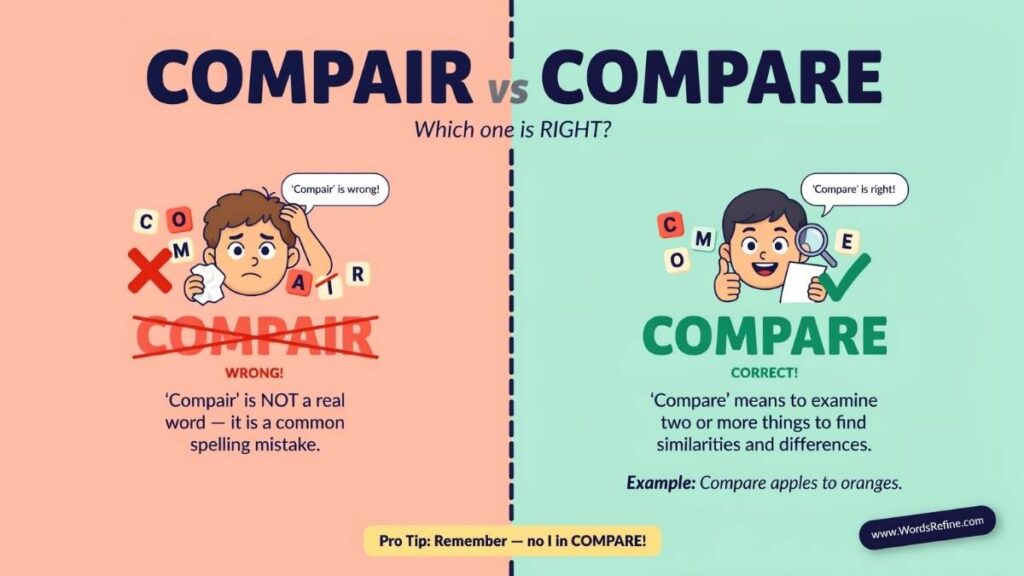
Have you ever typed “compair” and then paused, wondering if your keyboard had invented a new word? You are not alone. The compair vs compare confusion is surprisingly common because the two forms sound similar and differ by just one letter. However, when you mean to examine two or more things to find their similarities or differences, compare is the correct spelling. Compair is a misspelling, not a standard English alternative. Understanding this small distinction can prevent an unnecessary spelling error in everyday, academic, and professional writing. In this guide, you’ll learn what compare means, how to use it correctly, why compair causes confusion, and how to remember the correct spelling with confidence.
Compair vs Compare The Quick Answer
The correct spelling is compare.
Compare is a standard English verb. It means to examine two or more people, things, ideas, or situations to see how they are similar or different.
compair vs compare , on the other hand, is generally a misspelling when someone intends to use the verb compare.
The difference becomes clear in these examples:
Correct: “Let’s compare the two phones.”
Incorrect: “Let’s compair the two phones.”
The second sentence is easy to understand. Nevertheless, the spelling is still incorrect in standard English.
This is not a case of American English using one spelling while British English uses another. Both varieties use compare.
Therefore, when considering the correct spelling of compare, there is one form to remember:
Compare.
What Does Compare Mean?
To understand the spelling, it helps to understand the word itself.
Compare means to examine two or more things in relation to each other. You might look at their similarities, differences, qualities, advantages, disadvantages, size, price, performance, or other features.
For example:
“We compared the prices before buying the laptop.”
“The teacher asked students to compare the two poems.”
“She compared several hotels before booking a room.”
“The report compares the performance of three different companies.”
In each sentence, the person is placing things side by side mentally or practically and examining them.
Importantly, compare doesn’t mean that you must find only differences. A comparison can reveal similarities as well.
For instance, if you compare two smartphones, you might notice that both have excellent cameras. You might also discover that one has a longer battery life.
That is the basic meaning of compare: examining things in relation to each other.
Learn the difference between confusing more English words
Loose vs Lose Difference and which is Correctly?
Compair vs Compare Meaning Is There a Difference?
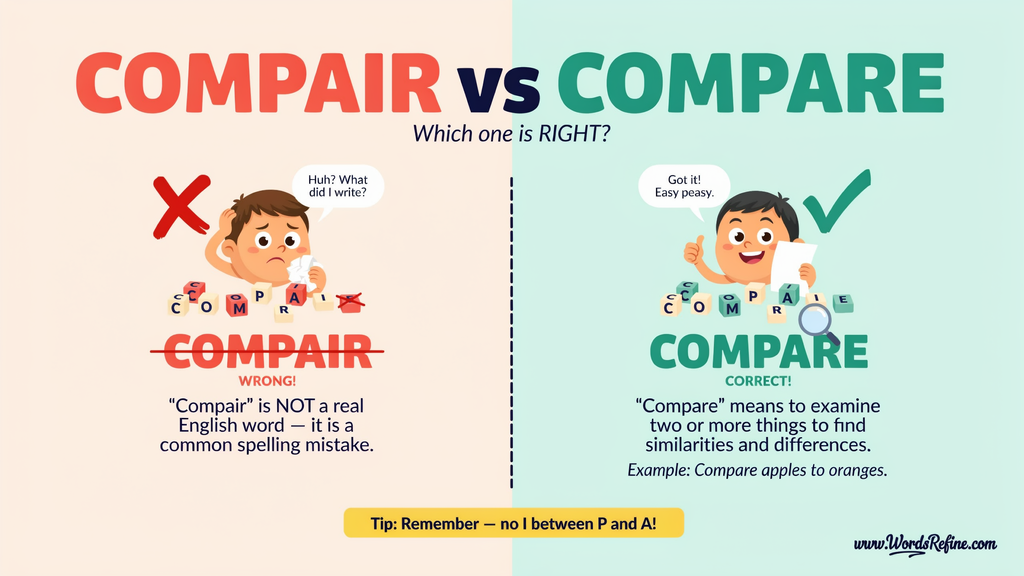
If you’re searching for the difference in meaning between compair vs compare, there’s an important point to clear up.
These aren’t two standard English words with separate meanings.
Compare has a recognized meaning and grammatical function. Compair is generally a misspelling when used in place of compare.
For example:
The manager will compare the two proposals.”
The manager will compair the two proposals.”
Both sentences communicate the intended idea, but only the first uses the standard spelling.
So, the real compair vs compare difference is usually a matter of spelling rather than meaning.
However, you may occasionally encounter “Compair” as a proper name. A company, organization, product, or other entity can choose a particular spelling for its name. That specialized use doesn’t make compair an alternative spelling of the ordinary English verb.
Why Do People Write “Compair” Instead of “Compare”?
The mistake usually comes from pronunciation.
When people hear a word rather than see it written, they sometimes spell it according to the sounds they recognize. Compare creates exactly this kind of temptation.
The ending can remind people of the word pair. Since you often compair vs compare two things, the brain may make a quick connection:
Compare + pair = compair.
It sounds reasonable for a moment. Unfortunately, English spelling doesn’t always follow that kind of logic.
Compare is spelled with “are,” not “air.”
That small difference is enough to create the entire spelling problem.
This is also a useful reminder about English vocabulary. Pronunciation can help you learn a word, but it doesn’t always tell you exactly how to spell it.
Why Is Compare Spelled With “E”?
If you’re wondering why compare has an “e” rather than an “i” in the final part, the simplest answer is that compare is the established standard spelling of the English word.
It belongs to a larger family of related words, including:
Compare
Compared
Comparing
Comparison
Comparable
Comparative
Comparatively
Notice the shared “compar” pattern.
Learning related forms can make spelling easier because you stop treating every word as an isolated item. Instead, you recognize a familiar spelling family.
For example, once you know comparison, comparing, and compared, “compair” starts to look much less convincing.
How to Spell Compare Correctly
If you’re asking how to spell compare, remember the letters:
C-O-M-P-A-R-E
The important part is the ending.
Compare ends with “are.”
Compair ends with “air.”
That gives you a simple way to check yourself.
When you mean the verb that describes examining similarities and differences, use compare.
You can also remember the word by breaking it into a familiar pattern:
Com + pare = compare.
This isn’t a complete explanation of the word’s historical development, but it works well as a practical spelling reminder.
Another useful trick is to connect compare with its related forms. Think of compare, comparison, and comparing as members of the same spelling family.
Learn the difference between more words people mix up
Capital vs Capitol Which One Is Correct?
Compare vs Compair Grammar and Word Usage
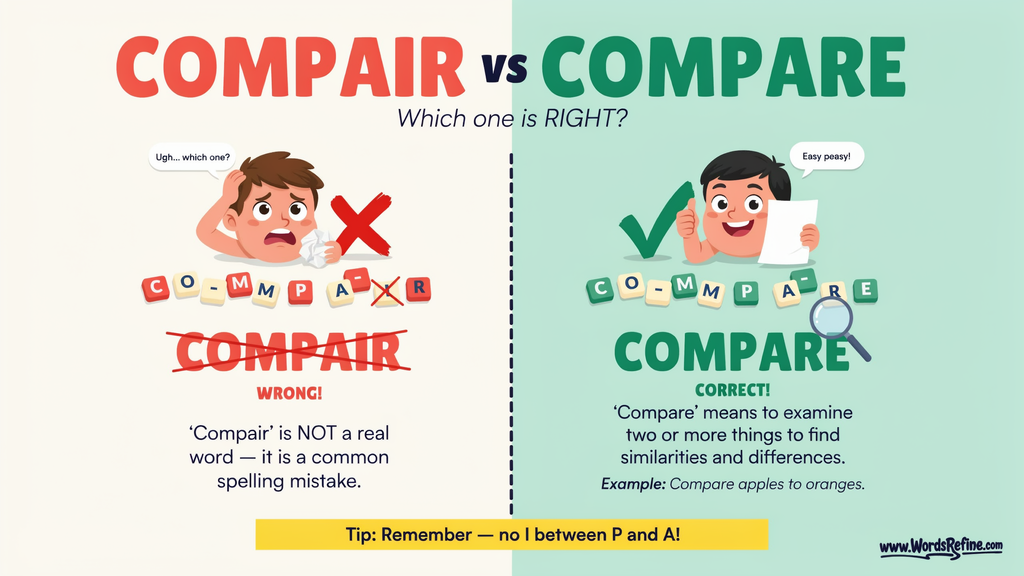
When it comes to grammar, compare is the standard verb.
It can describe an action performed by a person, group, organization, researcher, student, or anyone else examining things side by side.
Consider these examples:
“I compare prices before making a purchase.”
“She compares different products carefully.”
“We compared the two reports yesterday.”
“They are comparing several options.”
“The researchers compared the results.”
The form changes depending on the tense and grammatical structure, but the spelling family stays recognizable.
Here are the most common forms:
| Form | Example |
|---|---|
| Compare | We compare the options. |
| Compares | She compares the prices. |
| Compared | They compared the results. |
| Comparing | He is comparing the products. |
| Comparison | The comparison revealed several differences. |
Therefore, when discussing compare versus compair grammar, remember that compare is the standard verb.
How to Use Compare in a Sentence
Knowing the definition is helpful, but seeing the word in real sentences makes the usage much clearer.
Here are several natural examples:
“Let’s compare the prices before we order.”
“The teacher asked the students to compare the two characters.”
“I compared three laptops before choosing one.”
“The report compares this year’s results with previous results.”
“You should compare the ingredients before buying either product.”
“The two designs are difficult to compare.”
“She compared the new model with the older version.”
“The researchers are comparing data from different groups.”
Notice that compare works in everyday conversations as easily as it works in formal writing.
You can compare prices at a store, compare two movies with friends, compare historical events in an essay, or compare business proposals at work.
The word is remarkably flexible.
Compare Two Things or More Than Two Things?
A common misunderstanding is that compare applies only to two things.
That isn’t true.
You can compare two things, but you can also compare three, four, ten, or even hundreds of things.
For example:
Compare these two phones.”
“Compare the three available plans.”
“The researchers compared data from five different groups.”
“The website compares dozens of products.”
The number of things doesn’t change the spelling or basic meaning of compare.
In other words, the word isn’t tied to a pair.
That distinction also helps explain why “compair” is such an unreliable spelling. The act of comparing isn’t limited to pairs.
Learn the difference between everyday English mistakes
Discrete vs Discreet What the Difference and which is Correctly?
Compare With vs Compare To
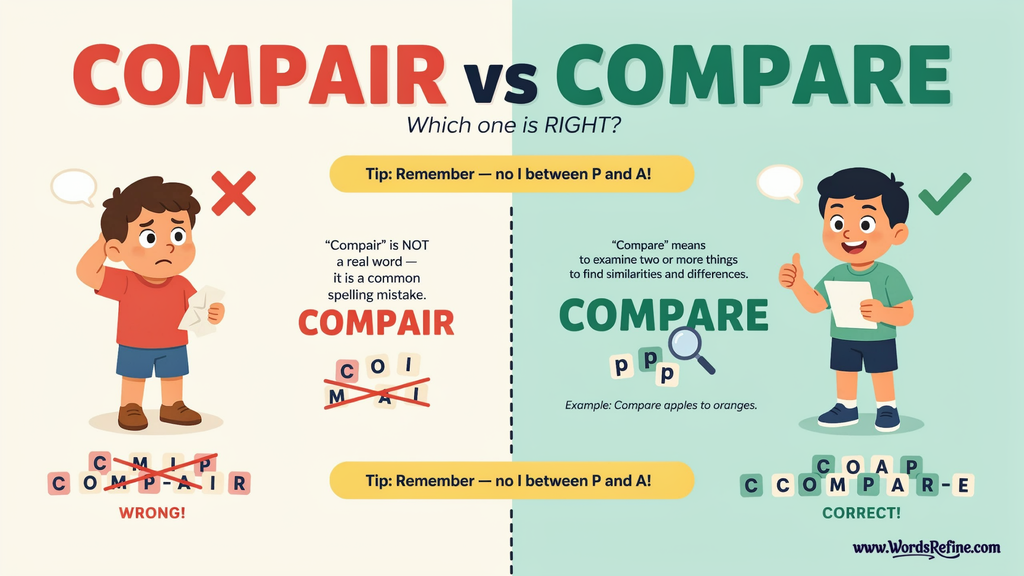
One of the more interesting questions about compare involves the expressions compare with and compare to.
Both forms are used in English. However, they can carry slightly different shades of meaning depending on context.
Compare With
Compare with often emphasizes examining two or more things to identify similarities and differences.
For example:
“Compare this year’s sales with last year’s sales.”
The teacher asked us to compare the two stories.”
“Compare the new version with the original.”
“The researchers compared the results with earlier findings.”
The focus here tends to be analytical.
You’re putting things side by side and examining them.
Compare To
Compare to often appears when one thing is likened to another.
For example:
“The poet compared the moon to a silver coin.”
“She compared his voice to a trumpet.”
“The new product has been compared to a more expensive model.”
Here, the comparison can focus more strongly on resemblance or similarity.
However, the distinction isn’t an absolute grammar rule. English speakers use both constructions in a range of contexts.
The important thing is to understand the intended relationship rather than memorizing an overly strict rule.
Compare and Contrast What’s the Difference?
Compare and contrast often appear together, especially in school assignments.
Although the two words are related, they aren’t identical.
Compare means to examine things in relation to each other. That examination can include both similarities and differences.
Contrast focuses more specifically on differences.
For example:
“Compare the two novels.”
This instruction may require you to discuss their characters, themes, settings, writing styles, similarities, and differences.
“Contrast the two novels.”
This instruction places greater emphasis on how the novels differ.
That’s why teachers often say “compare and contrast.” The phrase asks you to consider the full relationship between the subjects.
You’re essentially asking two questions:
What do they have in common?
How are they different?
Learn the difference between basic English word mistakes
Choose vs Chose Difference and which one is Correct?
Compair vs Compare Spelling Common Mistakes
The compair vs compare spelling problem is easy to fix once you recognize why it happens.
Writing “Compair” Because It Sounds Right
This is probably the most common mistake.
Incorrect:
“We need to compair the results.”
Correct:
“We need to compare the results.”
The pronunciation may tempt you toward “air,” but the spelling uses “are.”
Connecting Compare With Pair
Another mistake occurs when writers associate compare with the word pair.
It’s true that people often compare a pair of things. Nevertheless, the word compare doesn’t contain the spelling of pair.
You can compare:
Two shoes
Three cars
Five restaurants
Several reports
Hundreds of research results
The word remains compare every time.
Assuming Pronunciation Determines Spelling
English has many spelling patterns that don’t perfectly match pronunciation.
Therefore, listening to a word can’t always tell you which letters to write.
Compare is one example of this broader spelling challenge.
Relying Completely on Spellcheck
Spellcheck is useful, but it shouldn’t become your only line of defense.
A spelling checker may identify “compair” as an error. However, understanding the correct form helps you catch the mistake before software does.
Good writing combines proofreading with a solid understanding of English spelling and word usage.
Compare in Everyday English
Compare appears in countless everyday situations.
Imagine that you’re shopping for a new phone. You might compare prices, screen sizes, cameras, battery life, storage, and other features.
You could say:
“I’m going to compare these three phones before I decide.”
The At a restaurant, you might compare two dishes.
At work, you might compare two proposals.
At school, you might compare two characters in a novel.
During travel planning, you might compare hotel prices and locations.
The word works because comparison is a basic part of decision-making.
Whenever you examine several options before reaching a conclusion, you’re likely making a comparison.
Learn the difference between often confused words
Dreamt vs Dreamed Which One Is Correct?
Compare in Academic Writing
Academic writing frequently uses compare because researchers and students often examine subjects in relation to one another.
For example:
The essay compares two different interpretations of the novel.”
“The study compares results from two groups.”
“Students were asked to compare the economic conditions of the two periods.”
“The researchers compared the findings with earlier studies.”
In academic writing, compare can help create a clear analytical structure.
Rather than simply describing one subject and then another, the writer examines their relationship.
That makes the discussion more meaningful.
For instance, instead of writing two disconnected paragraphs about two theories, an essay might compare their assumptions, evidence, strengths, and limitations.
Compare in Professional Writing
Professional communication also relies heavily on comparisons.
A manager might compare sales figures. A customer might compare prices. An analyst might compare performance. A business owner might compare suppliers.
For example:
“The purchasing team compared the three proposals before selecting a supplier.”
The sentence is direct and professional.
Now imagine replacing compare with the misspelled form:
“The purchasing team compaired the three proposals.”
The meaning remains understandable, but the spelling distracts from the message.
In formal communication, small errors can make otherwise strong writing look rushed.
That’s why knowing the correct spelling of compare matters.
A Practical Example Comparing Laptops
Suppose you’re choosing between three laptops.
| Feature | Laptop A | Laptop B | Laptop C |
|---|---|---|---|
| Price | $700 | $850 | $1,000 |
| Storage | 512 GB | 1 TB | 1 TB |
| Memory | 16 GB | 16 GB | 32 GB |
| Battery life | 10 hours | 12 hours | 14 hours |
Before making a decision, you might say:
“I want to compare these three laptops.”
You could then examine their prices, storage, memory, and battery life.
Perhaps Laptop A offers the lowest price. Laptop C may provide better performance. Laptop B could offer the best balance.
The comparison doesn’t automatically tell you which laptop everyone should buy. Instead, it gives you information that helps you decide.
That is an important part of the compare definition.
Compare means examining things in relation to one another. It doesn’t necessarily mean declaring a winner.
Learn the difference between tricky grammar more words
Copyright vs Copywrite Which One Is Correct?
Compare as a Verb and Comparison as a Noun
Another useful way to understand compare is to look at its related noun, comparison.
Compare is the action.
Comparison refers to the act or result of examining things in relation to each other.
For example:
“We need to compare the prices.”
Here, compare is the verb.
“The comparison showed a significant difference in price.”
Here, comparison is the noun.
The same word family also gives us forms such as comparable and comparative.
This connection makes vocabulary easier to understand because the words share a common spelling pattern and meaning.
Compare Pronunciation How Do You Pronounce Compare?
If you’re wondering how to pronounce compare, the word has two syllables, with the main stress on the second syllable.
In standard US English, it is commonly represented as /kəmˈper/.
The first syllable is relatively weak, while the second receives the main emphasis.
That pronunciation may help explain the spelling confusion. The sound at the end can encourage someone to write “air” instead of “are.”
However, pronunciation should not be used as a direct spelling guide.
Think of it this way: the ear hears a sound, while the eyes recognize a spelling pattern.
You need both skills to write confidently.
What About Compair Pronunciation?
Because compair isn’t the standard spelling of the verb, there’s no separate pronunciation that needs to be learned as an alternative form of compare.
When someone writes “compair” but clearly means compare, the intended pronunciation is usually obvious.
The issue is simply the spelling.
So if you’re searching for compair pronunciation, the more useful goal is to learn the standard pronunciation and spelling of compare.
Synonyms for Compare
Depending on the context, several words can express ideas related to compare.
These include:
Examine
Contrast
Evaluate
Assess
Match
Weigh
Measure
Relate
Consider
Likening
However, these words aren’t interchangeable in every sentence.
For example, compare and evaluate have related meanings, but evaluate usually involves judging quality, value, or effectiveness.
Similarly, contrast focuses more strongly on differences.
Likewise, liken means to describe one thing as similar to another.
Therefore, choosing a synonym requires attention to context.
Learn the difference between commonly mixed-up more words
Instalments vs Installments Which one Is Correct?
Is Compair a Real Word?
The question “is compair a word?” needs a little context.
As the standard English verb meaning “to examine similarities and differences,” compair is not the correct spelling.
You may encounter “Compair” as a proper name or in the name of an organization, product, or business. Names can follow their own spelling choices.
That doesn’t mean you should use compair in ordinary English sentences.
If you mean the verb, write compare.
For example:
“Please compare the two documents.”
Not:
“Please compair the two documents.”
Is Compair a Typo?
In ordinary written English, compair is usually a typo or spelling mistake when the writer intends compare.
The error can happen because the writer remembers the pronunciation but not the spelling.
This type of mistake is common in English because the language contains many words whose pronunciation doesn’t provide a perfect spelling map.
The best solution is to recognize the correct spelling pattern and practice using it.
How Can You Remember How to Spell Compare?
If compare keeps causing trouble, use a simple memory strategy.
First, remember that compare ends with “are.”
Second, connect it with related words such as comparison, comparing, and compared.
Third, remember that the word pair doesn’t control the spelling.
A useful mental sentence is:
“I compare things, even when I compare a pair.”
It sounds a little playful, but that’s the point. Memorable phrases are easier to recall than dry spelling rules.
You can also write the word several times in different sentences:
- “I compare prices.”
- “She compares products.”
- “We compared the results.”
- “They are comparing options.”
- “The comparison was useful.”
Seeing the word in context strengthens both spelling and vocabulary.
Learn the difference between confusing more English words
Socialise vs Socialize Which one Is Correct ?
Compair vs Compare Quick Reference
| Question | Answer |
|---|---|
| What is the correct spelling of compare? | Compare |
| Is compair correct? | Not as the standard spelling of the verb compare. |
| What does compare mean? | To examine two or more things for similarities or differences. |
| Is compair a common spelling mistake? | Yes, it can occur as a misspelling of compare. |
| Can you compare more than two things? | Yes. |
| What is the noun form of compare? | Comparison |
| What is the past tense? | Compared |
| What is the -ing form? | Comparing |
| Can you use compare with? | Yes. |
| Can you use compare to? | Yes. |
| Is compare spelled differently in American and British English? | No. Compare is the standard spelling in both. |
| How do you pronounce compare? | In US English, commonly /kəmˈper/. |
Practice Session
- Before buying a new laptop, you should ______ its features with those of other models.
- The teacher asked the students to ______ the two characters and explain how they differ.
- We ______ several hotel prices before choosing where to stay.
- When you ______ the two proposals carefully, their differences become clear.
- It is difficult to ______ these two paintings because they were created in very different styles.
- The two smartphones are ______ in both price and performance.
- She is ______ the ingredients listed on the two food packages.
- The report ______ this year’s sales with the company’s previous results.
- You shouldn’t ______ your progress with someone else’s.
- The manager made a detailed ______ of the two candidates before making a decision.
- After ______ the available options, he chose the most practical one.
- The article draws a useful ______ between traditional and modern teaching methods.
- We can ______ the results of this experiment with those of the earlier test.
- The hiring manager ______ several applicants before selecting the final candidate.
- It is helpful to ______ the advantages and disadvantages of each choice.
- Although the two houses look similar, they are not easy to ______ because their layouts are different.
- The student wrote a clear ______ of the two novels.
- When ______ different products, consider their quality, price, and durability.
- The new phone is ______ to the previous model in several important ways.
- The professor asked the class to ______ the two theories and explain their main differences.
- I ______ the two phone plans and discovered that one offered better value.
- There is very little to ______ between the two restaurants because both provide excellent service.
- She spent the afternoon ______ different insurance policies.
- The writer ______ the two books by examining their characters, themes, and writing styles.
- A careful ______ of the two products shows that they share many of the same features.
Answers
- compare
- compare
- compared
- compare
- compare
- comparable
- comparing
- compared
- compare
- comparison
- comparing
- comparison
- compare
- compared
- compare
- compare
- comparison
- comparing
- comparable
- compare
- compared
- compare
- comparing
- compared
- comparison
Here’s a trusted source for clear word meanings:
FAQs
Is “compair” a word?
No. “Compair” is generally not a standard English word when you mean to examine two or more things. It is usually a misspelling of “compare.”
Why do people spell “compare” as “compair”?
People often write “compair” because compare and pair sound somewhat similar. The pronunciation can make the spelling confusing, especially when you are writing quickly.
Is “compair” ever correct in English?
In ordinary English writing, no. If you mean the verb that describes examining two or more things, use “compare.” “Compair” should not replace it.
What is the correct spelling of “compare”?
The correct spelling is compare: C-O-M-P-A-R-E. For example, “Always compare the prices before you buy.”
What does “compare” mean?
“Compare” means to examine two or more people, things, or ideas to identify their similarities, differences, or relative qualities.
Can “compair” be used in a sentence?
Not when you intend to use the standard English verb “compare.” The correct sentence is, “We need to compare the two options,” not “We need to compair the two options.”
Is “compair” a common spelling mistake?
Yes. “Compair” can appear as a spelling mistake because the sound of compare may lead writers toward the spelling “compair.” However, standard written English uses compare.
How can you remember the spelling of “compare”?
A simple trick is to remember the ending: compare ends in “pare,” not “pair.” Think of “compare” as containing “pare,” and you’ll be less likely to write “compair.”
What is the difference between “compare” vs “comparison”?
“Compare” is a verb, while “comparison” is a noun. You compare two products, but you make a comparison between them.
Can you compare more than two things?
Yes. You can compare two or more things. For example, you can compare several smartphones based on their price, features, and performance.
Does “compare” mean the same as “contrast”?
Not exactly. “Compare” can involve both similarities and differences, while “contrast” focuses mainly on differences between things.
What are some synonyms for “compare”?
Depending on the context, possible synonyms include evaluate, examine, assess, contrast, match, and weigh. However, each word can have a slightly different meaning, so “compare” may be the most precise choice in some sentences.
What is the difference between “compare with” and “compare to”?
Both expressions are correct, but they can emphasize different ideas. “Compare with” often focuses on examining similarities and differences, while “compare to” can emphasize a similarity or analogy. In everyday English, however, the two expressions can overlap.
Which is correct “compare to” or “compare with”?
Both are correct. Choose the preposition that best fits your meaning. Use “compare with” when you are examining two things side by side, and “compare to” when you are drawing an analogy or pointing out a resemblance.
What is the noun form of “compare”?
The main noun form is “comparison.” For example, “The comparison between the two products was useful.”
What is the adjective form related to “compare”?
“Comparable” is a common adjective related to “compare.” It means similar enough to be compared. For example, “The two cars offer comparable performance.”
What is the difference between “compare” vs“compair” in meaning?
There is no standard meaning difference because “compair” is generally a misspelling of “compare.” “Compare” is the correct word when you mean to examine similarities or differences.
How do you use “compare” correctly?
Use “compare” when you want to examine two or more things. For example, “Compare the two offers before making a decision.” You can also use forms such as “compared,” “comparing,” and “comparison” depending on the sentence.
What is an easy way to avoid the “compair” spelling mistake?
Remember that the correct word is compare, with an “e” at the end. If you associate the ending “-pare” with the word, you can avoid confusing it with “pair.”
Is “compare” only used for physical objects?
No. You can compare physical objects, people, ideas, opinions, experiences, prices, performances, plans, and many other things. For example, “The researchers compared the two theories.”
What does “compare vs contrast” mean?
“Compare and contrast” means to examine two or more subjects by discussing both what they have in common and how they differ. This phrase is especially common in academic writing.
What are the common forms of “compare”?
The main forms are compare, compares, compared, and comparing. The related noun is comparison, while comparable is a related adjective.
Is “compare” a verb or a noun?
“Compare” is primarily a verb. It describes the action of examining two or more things. For example, “We need to compare the prices.”
Why is “compare” spelled with an “e”?
The standard spelling is compare, ending in “ pare.” Although its pronunciation may make “compair” seem logical, English spelling does not always follow pronunciation exactly. Therefore, compare is the form you should use in standard written English.
Conclusion
The compair vs compare confusion may be a small spelling trap, but it can still make perfectly good writing stumble. Fortunately, the solution is simple. When you mean to examine two or more things for their similarities and differences, compare is the correct spelling. Compair is a misspelling and should not be used in standard English.
So, before you compare two products, ideas, plans, or opinions, remember one useful detail: compare ends with “-pare,” not “-pair.” That tiny spelling clue can save you from a surprisingly common mistake.
Once you get the pattern right, there’s no need to overthink it. Compare your options, compare your ideas, and compare your choices but leave compair out of the comparison. Your writing will be clearer, more accurate, and much less likely to have a spelling plot twist.

Diora AJS she is an experienced blogger and passionate English language enthusiast at Words Refine. With a keen eye for language and a love for clear communication, she writes practical content about grammar, word meanings, usage, and commonly confused terms. Her goal is to make English easier to understand through clear explanations and relatable examples, helping readers write accurately and communicate with confidence.