Ever paused over reoccurrence vs recurrence when something happens again? You’re certainly not alone. These two words look remarkably similar, which is enough to make even confident writers second-guess themselves. Although both are correct English words, they can carry slightly different emphasis. Recurrence commonly refers to something returning, repeating, or developing into a pattern, while reoccurrence often highlights another occurrence of a specific event, problem, or incident. That small distinction can make a big difference in clear writing. In this guide, you’ll discover their meanings, differences, correct usage, examples, and an easy way to remember which word belongs in your sentence.
Reoccurrence vs Recurrence The Quick Answer
The easiest way to understand recurrence vs reoccurrence is to look at the main idea each word emphasizes.
| Word | Basic Meaning | Main Emphasis | Example |
|---|---|---|---|
| Recurrence | Something happens again or returns | Return, repetition, or a recurring pattern | “The recurrence of the problem concerned the team.” |
| Reoccurrence | Something occurs again | Another occurrence | “The reoccurrence of the error delayed the project.” |
Both words can describe something happening again.
However, recurrence is often the more natural choice when you are discussing a recurring problem, repeated incidents, or a pattern that returns. It is also an established term in medical writing.
For example:
“The recurrence of the problem caused further delays.”
This sentence can describe a problem that has returned and may continue to return.
Now consider:
“The reoccurrence of the problem caused further delays.”
This sentence is also understandable. It places slightly more attention on the fact that the problem occurred again.
The difference isn’t always dramatic. In many situations, the two words overlap.
Reoccurrence vs Recurrence Which Is Correct?
If you’re wondering reoccurrence or recurrence which is correct, both can be correct.
Recurrence is a standard English word, but reoccurrence isn’t a spelling mistake either. Both words have legitimate meanings and uses.
The real question is which word fits the context better.
Change block type or style
Move Paragraph block from position 16 up to position 15
Move Paragraph block from position 16 down to position 17
Change alignment
Change text alignment
Displays more block tools
What Does Recurrence Mean?
The recurrence meaning centers on something happening again or returning.
The recurrence definition can be understood as the act or instance of something recurring. Its related verb is recur, which means to happen again or repeatedly.
For example:
“The same problem recurred after the update.”
The noun form becomes:
“The recurrence of the same problem caused concern.”
The word can describe many situations, including:
- A problem returning
- An event happening again
- A condition returning
- A pattern appearing again
- A behavior happening repeatedly
- A theme appearing throughout a work
- A technical fault returning
- A medical condition returning
The important idea is return or repetition.
A recurrence doesn’t necessarily have to happen at perfectly regular intervals. Something can recur once, several times, occasionally, or according to a recognizable pattern.
Does Recurrence Mean Happening Repeatedly?
Yes, it can.
Recurrence can describe something happening again or repeatedly. The surrounding context determines whether the writer means one return or a series of repeated occurrences.
Consider these examples:
“The recurrence of the error surprised the developer.”
This could describe the error appearing again.
“The recurrence of the error became a monthly problem.”
Here, the context clearly suggests repeated incidents.
“Researchers studied the recurrence of the behavior.”
This suggests that the behavior appeared again or repeatedly.
Therefore, recurrence can cover both a return and repeated occurrence. Context tells the reader which meaning matters most.
Learn the difference between confusing more English words
Choose vs Chose Difference and which one is Correct?
What Does Reoccurrence Mean?
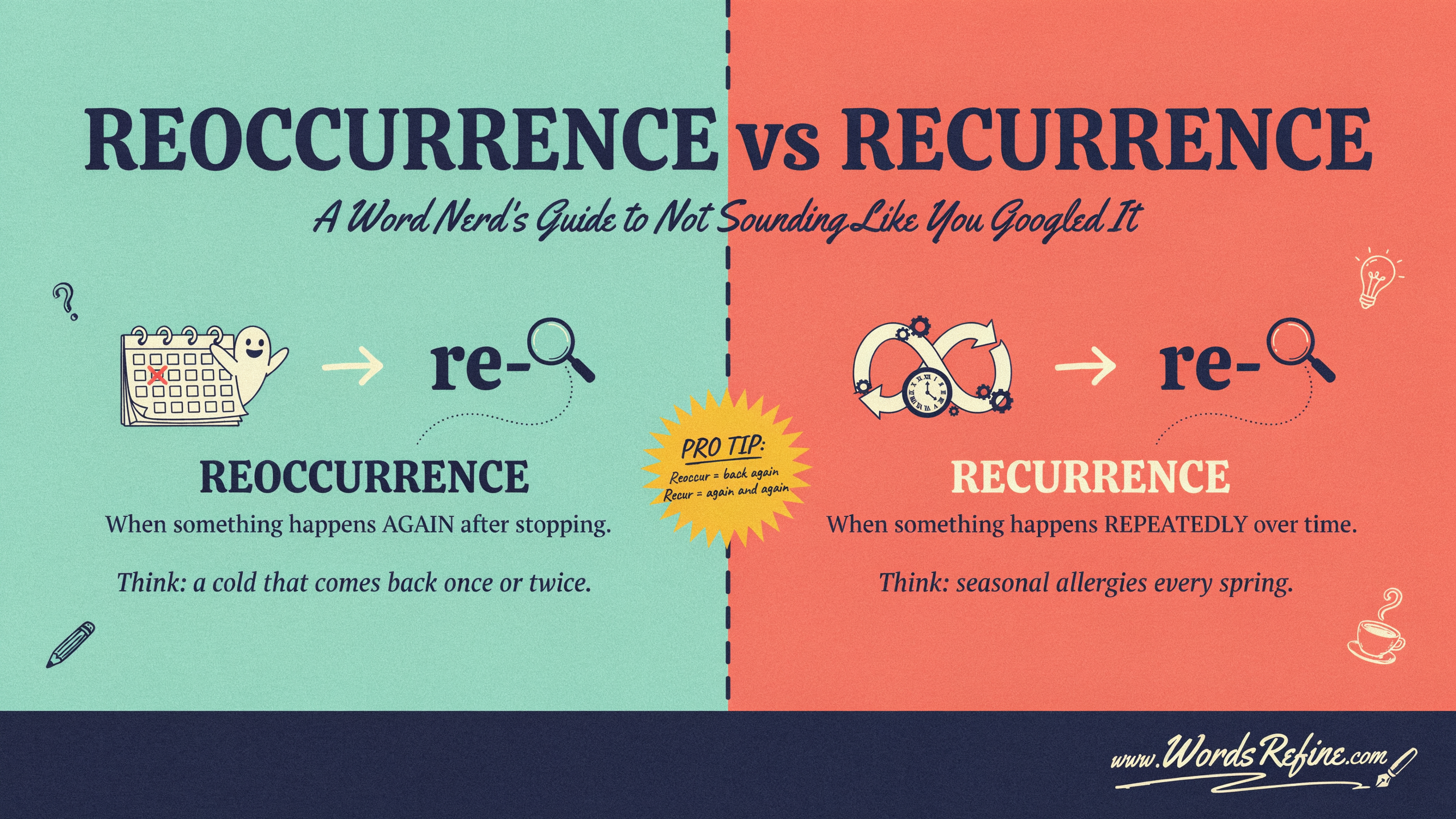
The reoccurrence meaning is closely connected to the verb reoccur.
The reoccurrence definition can be understood as another occurrence of something that happened before.
The structure makes the meaning relatively easy to understand:
re- + occurrence = another occurrence
For example:
“The reoccurrence of the software error forced the team to investigate.”
The sentence emphasizes that the error occurred again.
Change block type or style
Move Paragraph block from position 54 up to position 53
Move Paragraph block from position 54 down to position 55
Change alignment
Change text alignment
Displays more block tools
Here are some natural reoccurrence examples:
- “The reoccurrence of the same error delayed production.”
- “The team created safeguards to prevent the reoccurrence of the problem.”
- “The reoccurrence of the complaint prompted an internal review.”
- “The manager investigated the cause of the reoccurrence.”
- “The reoccurrence of the incident raised new concerns.”
These examples show why reoccurrence shouldn’t automatically be marked as incorrect.
Is Reoccurrence a Word?
Yes.
If you’re asking is reoccurrence a word, the answer is straightforward: reoccurrence is a real English word.
It is related to reoccur, which means to occur again.
However, there’s an important difference between saying that a word exists and saying that it is the best choice for every sentence.
English contains many words with overlapping meanings. Writers choose among them based on context, convention, clarity, and tone.
Recurrence vs Reoccurrence The Key Difference
The central recurrence and reoccurrence difference comes down to emphasis.
Recurrence often highlights a return, repetition, or recurring pattern.
Reoccurrence highlights another occurrence.
A simple way to remember the distinction is:
Recurrence suggests that something returns or happens again, often as part of a pattern.
Reoccurrence emphasizes that something occurs again.
The distinction isn’t an absolute grammar rule. The meanings overlap considerably.
For example, imagine a website repeatedly crashes.
You could write:
“The recurrence of the website crashes affected customers.”
This presents the crashes as a recurring problem.
You could also write:
“The reoccurrence of the website crash required another investigation.”
This version puts more focus on the fact that the crash happened again.
Recurrence vs Reoccurrence at a Glance
| Situation | Possible Choice | Reason |
|---|---|---|
| A problem keeps returning | Recurrence | Highlights a recurring issue |
| A pattern appears again | Recurrence | Emphasizes repetition or return |
| A disease returns | Recurrence | Established medical usage |
| An incident happens again | Reoccurrence | Can emphasize another occurrence |
| An error happens again | Either may work | Context determines emphasis |
| An event repeats regularly | Recurrence | Fits a recurring pattern |
This is why reoccurrence vs recurrence shouldn’t be treated as a simple “wrong versus right” question.
Why Are Recurrence vs Reoccurrence So Easy to Confuse?
The confusion makes sense because both words describe something happening again.
1.Both are nouns.2. Both are connected to verbs that describe repeated or renewed events.3. Both contain the idea of returning or occurring again.
The spelling creates another trap.
Reoccurrence looks as though it simply combines re- with occurrence. That can make it tempting to assume that it must be the correct form whenever something occurs again.
English doesn’t always work that neatly.
Words develop through history and usage. A form can become firmly established even when another form appears more logical at first glance.
Recurrence comes from recur, which carries the idea of returning or happening again.
Reoccurrence comes from reoccur, which makes the “occur again” idea more obvious.
Because both forms are established, they naturally create an area of overlap.
That overlap explains why recurrence or reoccurrence grammar can seem confusing even to experienced writers.
Learn the difference between commonly mixed-up more words
Any time vs anytime meaning Difference with Examples ?
When Should You Use Recurrence?
Choose recurrence when you are describing something that returns, happens again, or appears as a repeated pattern.
It works particularly well for a recurring problem, recurring issue, repeated behavior, or established pattern.
Recurrence for Repeated Problems
Imagine a company keeps receiving the same customer complaint.
A natural sentence would be:
“The recurrence of the complaint suggested that the company had not addressed the underlying issue.”
The word works well because the complaint has returned and may continue to return.
Other examples include:
- “The recurrence of technical failures affected productivity.”
- “The recurrence of the software bug required further testing.”
- “The recurrence of customer complaints prompted a policy review.”
- “The recurrence of equipment failures increased maintenance costs.”
Recurrence for Patterns
Recurrence also works well when something appears according to a repeated or recognizable pattern.
For example:
“Researchers observed a recurrence of the same behavior during later trials.”
The behavior appeared again, so recurrence fits naturally.
Another example is:
“The recurrence of the seasonal event attracts thousands of visitors.”
Here, the event returns as part of a predictable cycle.
Recurrence in Formal Writing
In formal writing, recurrence appears in many established expressions, including:
- recurrence rate
- risk of recurrence
- recurrence of symptoms
- recurrence of disease
- recurrence of a problem
- recurrent condition
- recurring issue
These expressions are common in medical, academic, scientific, and professional communication.
Learn the difference between tricky grammar more words
Fiancé vs Fiancée What’s the Difference and which is Correctly?
When Should You Use Reoccurrence?
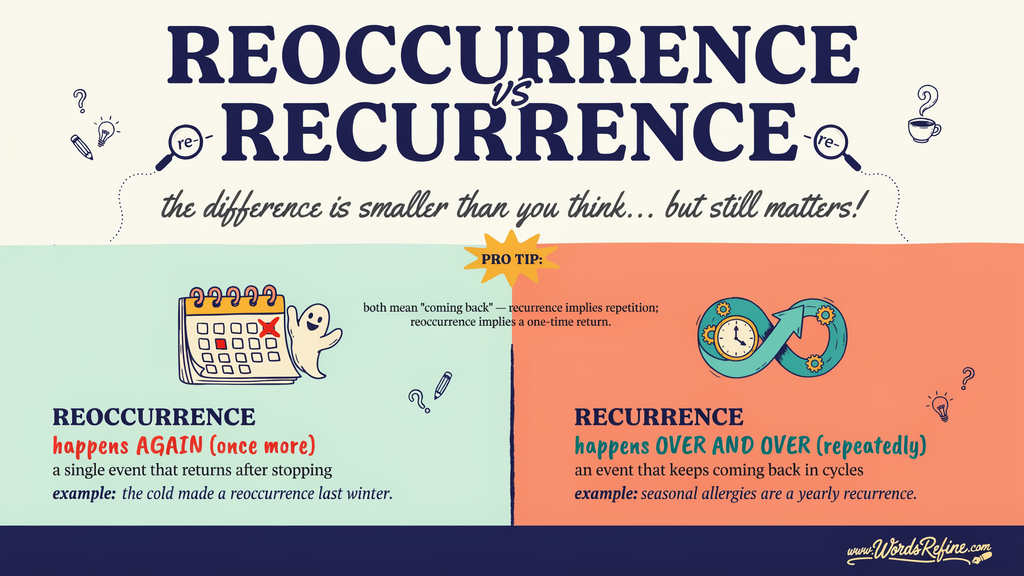
Reoccurrence can work when you want to emphasize that something has occurred again.
For example:
“The reoccurrence of the error showed that the original solution had not worked.”
The focus falls on the error occurring again.
You can also use it when discussing another incident:
“The reoccurrence of the complaint surprised the manager.”
The sentence emphasizes another occurrence without necessarily suggesting a long-running pattern.
Reoccurrence in Professional Writing
You may encounter expressions such as:
- prevent reoccurrence
- prevent a reoccurrence
- avoid reoccurrence
- investigate the reoccurrence
- address the cause of reoccurrence
For example:
“The company changed its procedures to prevent a reoccurrence of the error.”
This sentence is grammatically understandable.
However, you could also write:
“The company changed its procedures to prevent a recurrence of the error.”
Both sentences communicate the basic idea.
The second may sound more conventional when the error is being treated as a recurring problem.
That’s an important point in recurrence vs reoccurrence usage: a longer word doesn’t automatically make a sentence more precise or professional.
Recurrence vs Reoccurrence in Everyday English
In everyday English, the two words can overlap considerably.
Suppose a neighbor’s car alarm goes off for the second time.
You might say:
“The recurrence of the alarm was annoying.”
You could also say:
“The reoccurrence of the alarm was annoying.”
Both sentences are understandable.
However, ordinary conversation often uses simpler wording:
“The alarm went off again.”
That sentence is perfectly clear.
Good writing doesn’t require a sophisticated noun every time something happens again. Sometimes again, return, or repeat expresses the idea more naturally.
The same principle applies to professional communication. If a simpler expression gives readers the exact meaning they need, there is no advantage in making the sentence heavier.
Recurrence vs Reoccurrence in Professional Writing
Professional writing should make the meaning clear without unnecessary complexity.
Suppose a manufacturing company experiences the same equipment failure every few weeks.
A report might state:
“The recurrence of equipment failures indicates an unresolved maintenance issue.”
This works because the failures have become a recurring problem.
Now imagine that technicians repaired one machine and the same machine failed again:
“The reoccurrence of the equipment failure required another inspection.”
Here, the writer emphasizes another occurrence.
The timeline makes the distinction easier to see:
Failure → Repair → Failure Again
This situation can be described as a reoccurrence.
Now imagine:
Failure → Repair → Failure → Repair → Failure
The idea of recurrence becomes increasingly natural because the problem has developed into a recurring pattern.
This isn’t an unbreakable grammar rule. It is a useful way to understand the difference in em
Recurrence vs Reoccurrence in Academic Writing
Academic writing rewards precision rather than unnecessarily complicated vocabulary.
When researchers study how a phenomenon returns or repeats, recurrence often fits naturally.
For example:
“The study examined the recurrence of the behavior across multiple trials.”
The sentence describes a repeated pattern.
Another example:
“Researchers recorded the recurrence of the observed phenomenon.”
Again, the focus is on something appearing after it appeared previously.
If the researcher specifically wants to emphasize another occurrence, reoccurrence can work:
“The reoccurrence of the phenomenon during the second experiment prompted additional analysis.”
The choice depends on the exact idea the research is trying to communicate.
Recurrence vs Reoccurrence in Medical Terminology
Medical terminology provides one of the clearest examples of why context matters.
In medicine, recurrence is a well-established term for a condition returning after treatment, improvement, or a period when it was not detectable.
Cancer is a common example.
Medical professionals commonly use expressions such as:
- cancer recurrence
- disease recurrence
- recurrence of symptoms
- recurrence rate
- risk of recurrence
- recurrent disease
For example:
“The patient was monitored for signs of recurrence.”
In this context, recurrence is the established technical term.
Recurrence vs Reoccurrence Cancer Meaning
If you’re searching for recurrence or reoccurrence cancer meaning, the distinction becomes particularly important.
In medical writing, recurrence generally refers to cancer returning after treatment or after a period when it could not be detected.
Cancer recurrence may be described as:
- Local recurrence — cancer returns at or near its original location.
- Regional recurrence — cancer returns in nearby tissues or lymph nodes.
- Distant recurrence — cancer returns in another part of the body.
The word reoccurrence can still be understood in ordinary English because it means something occurs again. However, recurrence is the established term in cancer terminology.
Recurrence vs Relapse
1.Recurrence and relapse can overlap in everyday conversation, but they aren’t always identical in medical usage.
2.Recurrence broadly refers to a disease or condition returning.
Relapse generally refers to the return or worsening of a disease or its symptoms after a period of improvement.
For example:
“The disease went into remission but later returned.”
Depending on the disease and medical context, professionals may use specific terminology to describe that return.
The key lesson is simple: don’t replace an established medical term with a general synonym just because the words appear similar.
Learn the difference between commonly g confusing ord pairs
Mobil vs Mobile Which one Is Correct?
Common Mistakes With Recurrence vs Reoccurrence
Several mistakes appear repeatedly when writers compare these words.
Treating Reoccurrence as a Misspelling
Reoccurrence is not simply a misspelling of recurrence.
Both are legitimate words.
Assuming Recurrence Always Means Many Repetitions
A recurrence can describe something happening again without requiring dozens of repetitions.
The context determines whether the event is a single return or part of an ongoing pattern.
Assuming Reoccurrence Is Always More Precise
The extra re- in reoccurrence doesn’t automatically make it more precise.
If the sentence describes an ongoing recurring problem, recurrence may be the clearer choice.
Assuming the Longer Word Is More Formal
More letters don’t equal more formality.
Reoccurrence is longer than recurrence, but length alone doesn’t make it more sophisticated or professional.
Ignoring Context
This is perhaps the biggest mistake.
Instead of asking only:
“Which word is correct?”
ask:
“What exactly does this sentence need to emphasize?”
That question often makes the choice much easier.
Learn the difference between often confused words
Recurrence Examples in Sentences
These recurrence examples show how the word works in different situations:
- “The recurrence of the software bug delayed the release.”
- “The doctor discussed the risk of recurrence.”
- “The recurrence of the storm caused additional flooding.”
- “Researchers examined the recurrence of the behavior.”
- “The recurrence of customer complaints prompted an investigation.”
- “The recurrence of the theme gives the novel a strong sense of unity.”
- “The company introduced new procedures to reduce the recurrence of errors.”
In each example, the central idea involves returning, repeating, or happening again.
Reoccurrence Examples in Sentences
These reoccurrence examples place greater emphasis on another occurrence:
- “The reoccurrence of the error forced another system check.”
- “The team wanted to prevent a reoccurrence of the incident.”
- “The reoccurrence of the same complaint surprised the manager.”
- “The report examined the cause of the reoccurrence.”
- “The reoccurrence of the problem showed that the original fix was incomplete.”
These sentences demonstrate that reoccurrence is a valid word, even though recurrence may be more conventional in some settings.
Recurrence vs Reoccurrence Spelling
The recurrence or reoccurrence spelling difference becomes easier to understand when you look at their related word families.
| Verb | Noun | Related Form |
|---|---|---|
| recur | recurrence | recurrent / recurring |
| reoccur | reoccurrence | reoccurring |
One common mistake is assuming that recurrence should contain the word occur.
It doesn’t.
Recurrence comes from recur.
Reoccurrence comes from reoccur.
Therefore, don’t try to spell one word by modifying the other.
Is Recurrence a Word?
Yes.
If you’re wondering is recurrence a word, the answer is simple: recurrence is a standard English noun.
Its related forms include:
- recur — verb
- recurrence — noun
- recurrent — adjective
- recurring — adjective or participle
For example:
“The problem recurred.”
“The recurrence of the problem was costly.”
“The company experienced a recurrent issue.”
“The issue keeps recurring.”
These words belong to the same word family, but each serves a different grammatical function.
Learn the difference between basic English word mistakes
Dreamt vs Dreamed Which One Is Correct?
What Is the Difference Between Recur vs Reoccur?
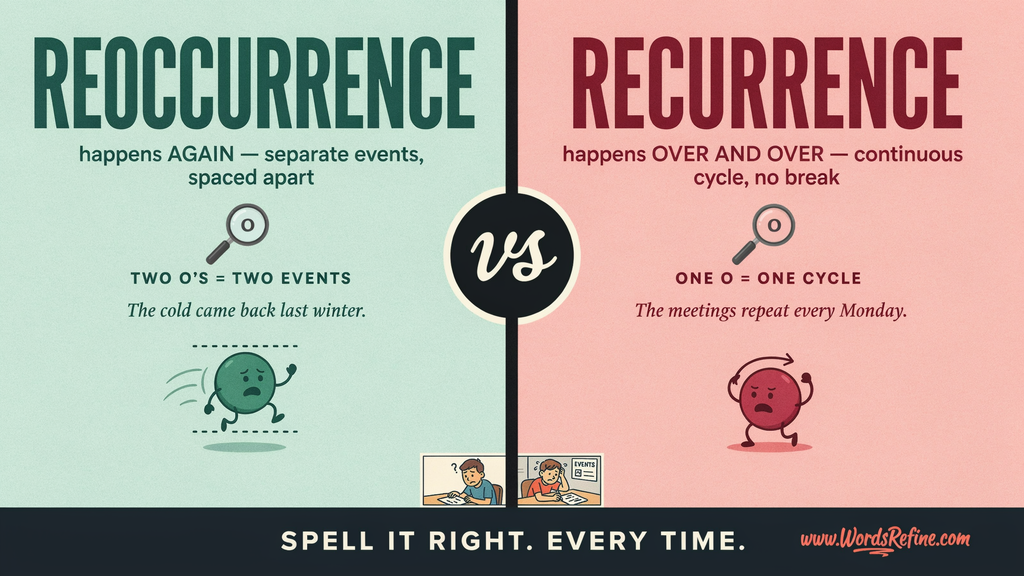
The recur vs reoccur distinction closely resembles the difference between recurrence and reoccurrence.
Recur means to happen again or repeatedly.
Reoccur means to occur again.
The two verbs overlap in meaning.
For example:
“The problem keeps recurring.”
and:
“The problem keeps reoccurring.”
Both sentences communicate that the problem happens again.
However, recur is strongly established in expressions involving repeated patterns and returning situations.
Examples include:
- recurring theme
- recurring problem
- recurring illness
- recurring symptoms
- recurrent costs
- recurrent condition
This established usage explains why recurrence often feels more natural than reoccurrence in formal contexts.
Recurrence vs Reoccurrence Correct Usage A Simple Rule
When you’re deciding between these words, focus on the meaning rather than the spelling.
Choose recurrence when
- Something returns.
- Something happens repeatedly.
- A problem keeps coming back.
- A pattern appears again.
- You’re discussing a recurring condition.
- You’re using established medical terminology.
- You’re writing about a recurring issue in a professional context.
Choose reoccurrence when
- You want to emphasize another occurrence.
- Something occurred again after an earlier occurrence.
- The sentence specifically focuses on the fact that an event happened again.
If neither word sounds natural, use a simpler alternative.
For example:
“The problem happened again.”
Sometimes that’s all the sentence needs.
Recurrence vs Reoccurrence Usage in Different Contexts
The best way to understand recurrence and reoccurrence is to look at how they work in real sentences. Although the two words overlap, certain contexts naturally favor one over the other.
The surrounding words often provide the clue. If you are describing a pattern, a returning problem, a repeated event, or a condition that comes back, recurrence usually fits well. If you simply want to point out that something happened again, reoccurrence can work.
Recurrence in Everyday Situations
You can use recurrence when something returns or happens repeatedly.
For example:
- The recurrence of traffic problems made the commute frustrating.
- The team investigated the recurrence of software errors.
- The recurrence of the same argument caused tension.
- Researchers studied the recurrence of the behavior.
- The recurrence of delays affected the entire schedule.
In each sentence, the focus goes beyond a single isolated event. The reader gets the sense that something has returned or developed into a repeated pattern.
That is why recurrence works particularly well with words such as problem, pattern, issue, symptom, condition, event, and behavior.
Reoccurrence in Everyday Situations
Reoccurrence can describe another occurrence of something that happened before.
For example:
- The reoccurrence of the error surprised the technician.
- The manager wanted to prevent the reoccurrence of the incident.
- The reoccurrence of the noise disturbed the residents.
- The software update reduced the chance of reoccurrence.
- The team discussed how to prevent a reoccurrence.
Here, the emphasis can fall on the fact that the event happened again.
However, this does not mean you must use reoccurrence whenever something happens exactly twice. English does not divide these words into such rigid categories.
Context still matters.
Learn the difference between everyday English mistakes
Instalments vs Installments Which one Is Correct?
Recurrence vs Reoccurrence in Technical Writing
Technical writing often deals with faults, failures, errors, defects, and repeated processes. In this setting, precise word choice matters because a small difference can affect how readers understand a report.
Consider a machine that fails during testing.
If the machine fails, gets repaired, and then fails again, you could describe the second failure as a reoccurrence of the problem.
However, if the machine continues to fail during several testing cycles, recurrence may better describe the broader pattern.
For example:
The repair prevented the immediate reoccurrence of the fault.
This sentence focuses on the fault happening again.
Compare it with:
Engineers investigated the recurrence of the fault across multiple testing cycles.
Here, recurrence highlights a repeated pattern.
The distinction is subtle, but it can make technical writing more precise.
Recurrence vs Reoccurrence in Professional Writing
Professional communication often uses these words when discussing errors, complaints, incidents, delays, or operational problems.
You might see phrases such as:
- recurrence of the issue
- recurrence of the problem
- recurrence of errors
- recurrence of complaints
- prevent reoccurrence
- prevent a reoccurrence
- investigate the recurrence
- investigate the reoccurrence
- reduce the risk of recurrence
- reduce the risk of reoccurrence
Both forms can appear in professional writing.
Still, recurrence often sounds more established when you are discussing an ongoing or repeated issue.
For example:
The company introduced new procedures to reduce the recurrence of customer complaints.
The sentence suggests that complaints have become a recurring issue.
Meanwhile:
The company introduced new procedures to prevent the reoccurrence of the incident.
This wording focuses more directly on the incident happening again.
Notice that neither sentence needs unnecessarily complicated language. Good professional writing does not become better simply because the vocabulary becomes longer.
Recurrence vs Reoccurrence in Academic Writing
Academic writing requires careful word choice because researchers often describe patterns, repeated observations, recurring themes, or events that appear more than once.
Recurrence is especially useful when discussing a pattern.
For example:
The study identified a recurrence of similar behavioral patterns across the sample.
Another example:
Researchers observed the recurrence of the same theme throughout the interviews.
In both cases, recurrence suggests something that appears again as part of a broader pattern.
Reoccurrence can also appear in academic writing when the writer wants to emphasize another occurrence.
For example:
The researchers examined the factors that contributed to the reoccurrence of the event.
The important point is not to choose the longer word simply because it sounds more academic. Academic writing values accuracy, not unnecessarily complicated vocabulary.
If recurrence communicates your meaning clearly, there is usually no reason to replace it with the longer reoccurrence.
Recurrence vs Reoccurrence in Medical Writing
Medical writing provides one of the clearest examples of why recurrence is important.
Healthcare professionals commonly use recurrence when discussing a disease, condition, symptom, or medical problem that returns after improving or disappearing.
Common expressions include:
- disease recurrence
- cancer recurrence
- recurrence of symptoms
- recurrence of infection
- recurrence rate
- risk of recurrence
- recurrent disease
- recurrent symptoms
- recurrent condition
For example:
The patient was monitored for signs of recurrence.
Or:
The treatment reduced the risk of disease recurrence.
The word recurrence works naturally because the focus lies on a condition returning.
Recurrence vs Reoccurrence in Cancer Terminology
When discussing cancer, recurrence is the established term for cancer returning after a period in which it had disappeared or was no longer detectable.
You may encounter phrases such as:
- cancer recurrence
- tumor recurrence
- local recurrence
- regional recurrence
- distant recurrence
- recurrence after treatment
For example:
The patient underwent regular follow-up examinations to monitor for cancer recurrence.
In this context, reoccurrence would generally sound less natural than recurrence because recurrence is the established medical term.
This illustrates an important principle: vocabulary depends not only on dictionary definitions but also on established usage within a particular field.
Recurrence vs Relapse
The Recurrence and relapse are related, but they are not always interchangeable.
Recurrence generally describes a condition returning after a period of improvement, absence, or control.
Relapse often describes a return or worsening of a condition after a period of improvement. The exact distinction can depend on the medical or technical context.
For example:
The patient experienced a recurrence of symptoms after several months.
You might also see:
The patient experienced a relapse after initially responding to treatment.
These terms can overlap in ordinary discussion, but specialized fields may use them differently.
Therefore, if you are writing for a medical audience, follow the terminology used in the relevant clinical context rather than treating recurrence and relapse as automatic synonyms.
Are They the Same?
Recurrence and repetition are closely related, but they do not always communicate exactly the same idea.
Repetition usually emphasizes that something happens or appears again.
Recurrence often carries the additional idea of something returning, especially after an interval or as part of a pattern.
Compare these sentences:
The repetition of the phrase made the speech memorable.
The recurrence of the problem concerned the management team.
The first sentence focuses on something being repeated.
The second focuses on a problem returning.
You can think of repetition as emphasizing the act of doing or appearing again, while recurrence often emphasizes return or repeated appearance over time.
Learn the difference between more words people mix up
Socialise vs Socialize Which one Is Correct ?
Does Recurrence Mean Happening Repeatedly?
Yes, recurrence can describe something that happens repeatedly.
However, it does not always require a large number of repetitions.
For example:
The recurrence of the error suggested a deeper problem.
This could refer to an error that appeared again after an earlier occurrence.
The context determines whether the word refers to one return or a continuing pattern.
That flexibility explains why recurrence works in both simple and technical situations.
Does Reoccurrence Mean Happening Again?
Yes. Reoccurrence means another occurrence or the act of occurring again.
The word comes from reoccur, which combines the prefix re- with occur.
For example:
The reoccurrence of the warning message indicated that the problem had not been resolved.
The sentence tells you that the warning appeared again.
However, reoccurrence does not automatically imply that something will continue happening over and over. It can simply point to another occurrence.
That distinction can help you decide between the two words.
Is Reoccurrence a Misspelling?
No. Reoccurrence is a real English word.
The confusion exists because recurrence is much more established in many contexts, especially formal and specialized writing.
As a result, writers sometimes see reoccurrence and assume someone accidentally added “re” to recurrence.
That assumption is understandable, but it is not accurate.
The two words are connected to different verbs:
recur → recurrence
reoccur → reoccurrence
Both formations are legitimate.
The bigger question is not whether reoccurrence exists. The better question is whether it is the most natural word for your particular sentence.
Common Mistakes With Recurrence and Reoccurrence
Writers commonly make several mistakes when choosing between these words.
Treating Reoccurrence as Incorrect
Some writers assume recurrence is correct and reoccurrence is always wrong.
That is too simple.
Reoccurrence is a valid word. It simply has a narrower or less established feel in some contexts.
Assuming Recurrence Always Means Many Repetitions
Recurrence can describe repeated events, but it can also describe something returning after a previous occurrence.
You do not need numerous repetitions before recurrence becomes appropriate.
Assuming Reoccurrence Is Always More Precise
Adding “re” does not automatically make a word more specific.
Reoccurrence can emphasize another occurrence, but recurrence can also clearly communicate that something happened again.
Choose based on meaning and established usage rather than word length.
Thinking Longer Words Sound More Professional
This is one of the oldest traps in formal writing.
A longer word is not automatically a better word.
For example:
We took steps to prevent the problem from happening again.
That sentence is perfectly clear.
You could write:
We took steps to prevent the reoccurrence of the problem.
That version sounds more formal, but it is not necessarily better.
Clear writing should help readers understand your point quickly. It should not make them reach for a dictionary simply to admire your vocabulary.
Learn the difference between tricky English words with easy explanations
Lend vs Lent What’s the Difference and When to Use Each?
How to Choose Between Recurrence and Reoccurrence
When you are stuck between the two, look at what you are trying to emphasize.
Use recurrence when you are talking about:
- something returning
- a repeated problem
- a recurring condition
- a recurring pattern
- repeated symptoms
- repeated behavior
- a pattern across time
- formal or technical descriptions of repeated events
Use reoccurrence when you want to emphasize:
- another occurrence
- an event happening again
- the return of a particular incident
- preventing the same incident from happening again
If both seem possible, choose the word that sounds most natural in the surrounding sentence.
For many formal contexts, recurrence will be the more established choice.
Recurrence vs Reoccurrence Sentence Comparison
Seeing the words side by side makes the difference easier to understand.
| Context | Recurrence | Reoccurrence |
|---|---|---|
| Medical condition returns | The recurrence of symptoms required further monitoring. | Less natural in this context. |
| Repeated technical fault | Engineers investigated the recurrence of the fault. | Engineers investigated the reoccurrence of the fault. |
| Another isolated incident | Less natural | The reoccurrence of the incident raised concerns. |
| Repeated pattern | The recurrence of the pattern was significant. | Less natural. |
| Preventing an event from happening again | Possible | The reoccurrence of the event was prevented. |
| Academic discussion | The study examined the recurrence of the behavior. | Possible when emphasizing another occurrence. |
The table shows why there is no single mechanical rule that works in every sentence.
Instead, think about the relationship between the event and its previous occurrence.
Recurrence vs Reoccurrence Grammar Rules
Neither word requires a special grammatical structure. Both function primarily as nouns.
You can use them as the subject or object of a sentence.
For example:
Recurrence remains a concern for the researchers.
Here, recurrence acts as the subject.
You can also use the word after “of”:
The recurrence of the problem caused delays.
Likewise:
The reoccurrence of the error caused delays.
Both structures are grammatically sound.
The main challenge involves word choice, not grammar.
Recurrence vs Reoccurrence Synonyms
Depending on your sentence, several alternatives may communicate the idea more naturally.
Possible synonyms or related expressions include:
- return
- repetition
- repeated occurrence
- renewal
- resurgence
- comeback
- happening again
- repeated appearance
- recurring pattern
However, these words are not perfect substitutes in every context.
For example, “return” may work well in ordinary language:
The return of the problem caused concern.
“Recurrence” may sound more appropriate in a formal or technical context:
The recurrence of the problem caused concern.
Similarly, “resurgence” often suggests an increase or renewed strength, so you should not use it as a blanket replacement for recurrence.
Recurrence vs Reoccurrence in British and American English
Neither recurrence nor reoccurrence belongs exclusively to British or American English.
Both forms can occur in English on both sides of the Atlantic.
The more important issue is usage and context.
You may find recurrence especially common in formal, medical, academic, and technical writing regardless of whether the writer follows American or British English conventions.
Reoccurrence also appears in English-language writing, particularly when writers want to emphasize another occurrence.
Therefore, you generally do not need to choose between these words based solely on whether your audience uses American or British English.
Instead, focus on the meaning you need to communicate.
A Simple Memory Trick
If you want a quick way to remember the distinction, think of the verbs first.
Recur → recurrence
Reoccur → reoccurrence
Then remember the practical emphasis:
Recurrence = return or recurring pattern
Reoccurrence = another occurrence
This is not an absolute grammar law. English usage contains overlap, and real sentences do not always fit neatly into two categories.
Still, the distinction gives you a useful starting point when you are unsure.
Which One Should You Use?
If your sentence describes something that returns, repeats, or forms a recurring pattern, recurrence is usually the natural choice.
If you specifically want to describe another occurrence of an event, reoccurrence can work.
For example:
The recurrence of the issue affected production.
This suggests that the issue has returned or repeated.
Meanwhile:
The reoccurrence of the incident prompted an investigation.
This emphasizes the incident occurring again.
Sometimes, however, the clearest option is neither.
Instead of writing:
The recurrence of the problem was observed by the team.
You could simply write:
The team observed the problem again.
The second sentence is shorter, more direct, and easier to read.
Good writing is not about choosing the fanciest available noun. It is about choosing the clearest expression that accurately conveys your meaning.
Learn the difference between more words people mix up
Inquiries vs Queries What’s the Difference ?
Practice Session Recurrence vs Reoccurrence
Choose recurrence vs reoccurrence to complete each sentence. Read the context carefully because both words can mean that something happens again, but they can emphasize slightly different ideas.
The doctor monitored the patient for a possible ________ of symptoms.
The company changed its procedures to prevent the ________ of the incident.
Researchers observed the ________ of the same pattern throughout the study.
The technician investigated the ________ of the software error.
The patient was worried about the ________ of the disease.
The manager wanted to prevent the ________ of the mistake.
The researchers examined the ________ of similar themes in the interviews.
Engineers investigated the ________ of the mechanical problem during testing.
The treatment helped reduce the risk of disease ________.
The team responded quickly after the ________ of the equipment failure.
The researchers recorded the ________ of the behavior over several months.
The company reviewed its safety procedures after the ________ of the same complaint.
The doctor discussed the possibility of cancer ________.
The technician documented every ________ of the system failure.
The organization introduced new measures to reduce the ________ of similar problems.
The study revealed a clear ________ of the same linguistic pattern.
The engineers repaired the machine to prevent the ________ of the fault.
Researchers analyzed the ________ of the phenomenon over time.
The patient returned for follow-up testing because of a possible ________ of symptoms.
The manager investigated the ________ of an error that had already been corrected.
The report examined the ________ of customer complaints during the year.
The new safety measures were designed to prevent the ________ of the incident.
The researchers documented several ________ of the same behavior.
The hospital monitored the patient for signs of cancer ________.
The repeated failures suggested a pattern of ________ rather than an isolated event.
Answers
The doctor monitored the patient for a possible recurrence of symptoms.
The company changed its procedures to prevent the reoccurrence of the incident.
Researchers observed the recurrence of the same pattern throughout the study.
The technician investigated the reoccurrence of the software error.
The patient was worried about the recurrence of the disease.
The manager wanted to prevent the reoccurrence of the mistake.
The researchers examined the recurrence of similar themes in the interviews.
Engineers investigated the recurrence of the mechanical problem during testing.
The treatment helped reduce the risk of disease recurrence.
The team responded quickly after the reoccurrence of the equipment failure.
The researchers recorded the recurrence of the behavior over several months.
The company reviewed its safety procedures after the reoccurrence of the same complaint.
The doctor discussed the possibility of cancer recurrence.
The technician documented every reoccurrence of the system failure.
The organization introduced new measures to reduce the recurrence of similar problems.
The study revealed a clear recurrence of the same linguistic pattern.
The engineers repaired the machine to prevent the reoccurrence of the fault.
Researchers analyzed the recurrence of the phenomenon over time.
The patient returned for follow-up testing because of a possible recurrence of symptoms.
The manager investigated the reoccurrence of an error that had already been corrected.
The report examined the recurrence of customer complaints during the year.
The new safety measures were designed to prevent the reoccurrence of the incident.
The researchers documented several recurrences of the same behavior.
The hospital monitored the patient for signs of cancer recurrence.
The repeated failures suggested a pattern of recurrence rather than an isolated event.
Here’s a trusted source for clear word meanings:
FAQs
Can recurrence happen after a long period of time?
Yes. Recurrence can describe something that happens again after a short or long period. The time gap doesn’t determine whether recurrence is the correct word.
Can reoccurrence happen more than once?
Yes. Reoccurrence can describe something happening again, even if it happens multiple times. The word doesn’t limit the event to exactly one additional occurrence.
Does recurrence always suggest a pattern?
Not necessarily. Recurrence can describe a single return as well as repeated events that form a pattern. The surrounding context determines the intended meaning.
Can recurrence describe something positive?
Yes. Recurrence can describe positive or neutral events, patterns, ideas, traditions, or experiences that return or appear repeatedly.
Can reoccurrence describe a positive event?
Yes. Reoccurrence isn’t limited to problems or negative events. It can describe any event that occurs again when the context calls for that wording.
Does reoccurrence imply that something was unexpected?
No. Reoccurrence simply means that something occurs again. It doesn’t automatically indicate that the event was unexpected, unusual, or unwanted.
Can recurrence describe a recurring event?
Yes. Recurrence can describe an event that returns or happens repeatedly, particularly when the repeated event forms a recognizable pattern.
Can reoccurrence describe a recurring event?
Yes. Reoccurrence can describe an event that happens again, although recurrence may sound more natural when you’re emphasizing an ongoing or repeated pattern.
Can recurrence describe a problem that keeps returning?
Yes. Recurrence is commonly used when a problem, condition, symptom, or issue returns after it has previously occurred or been resolved.
Can reoccurrence be used after “prevent”?
Yes. Phrases such as “prevent reoccurrence” and “prevent a reoccurrence” are grammatically possible when referring to stopping an event from happening again.
What verb is related to recurrence?
The verb related to recurrence is “recur.” It means to happen again, return, or appear repeatedly.
What verb is related to reoccurrence?
The verb related to reoccurrence is “reoccur.” It means to occur again.
Is “recurrent” related to “recurrence”?
Yes. “Recurrent” is an adjective related to “recurrence.” It describes something that returns or happens repeatedly, such as a recurrent problem or recurrent symptoms.
Is “reoccurring” related to “reoccurrence”?
Yes. “Reoccurring” is related to “reoccurrence” and describes something that occurs again. Its suitability depends on the context and the style of writing.
Can recurrence describe a pattern in literature?
Yes. Recurrence can describe a theme, image, symbol, phrase, or idea that appears repeatedly in a literary work.
Can recurrence be used in scientific writing?
Yes. Recurrence is useful in scientific writing when describing repeated observations, events, patterns, or phenomena that return over time.
Can reoccurrence be used in scientific writing?
Yes. Reoccurrence can be used in scientific writing when the focus is on an event occurring again. However, recurrence may be more natural when describing an established repeated pattern.
Does recurrence only describe physical events?
No. Recurrence can describe abstract things as well, including ideas, emotions, themes, patterns, symptoms, and behaviors.
Can recurrence describe an emotion?
Yes. Recurrence can describe an emotion or feeling that returns repeatedly, such as the recurrence of anxiety, excitement, or nostalgia.
Can reoccurrence describe a thought or feeling?
Yes. Reoccurrence can describe a thought, feeling, or mental experience that occurs again, although another expression may sometimes sound more natural depending on the sentence.
Can “recurrence” be used with “rate”?
Yes. “Recurrence rate” is a standard phrase used to describe how frequently something returns or happens again, particularly in medical and scientific contexts.
Can “reoccurrence” be used with “rate”?
It can be grammatically possible, but “recurrence rate” is generally the more established expression when discussing the frequency of something returning.
What should you say when an event happens once more?
You can say that the event “occurred again” or “happened again.” You can also use “reoccurrence” when emphasizing another occurrence, depending on the context.
How can you avoid confusing recurrence and reoccurrence?
Focus on the intended meaning rather than the spelling. Use recurrence when emphasizing return, repetition, or a recurring pattern, and consider reoccurrence when emphasizing another occurrence of an event.
Conclusion
Choosing vs reoccurrence and recurrence doesn’t have to feel like a grammar puzzle with missing pieces. Both words are correct, and both describe something happening again. The key is understanding what you want to emphasize.
Use recurrence when something returns, repeats, or develops into a pattern. It’s especially common in medical, academic, technical, and professional writing. Use reoccurrence when you want to emphasize another occurrence of a particular event, problem, or incident.
When you’re unsure, don’t let the extra letters in reoccurrence intimidate you. Focus on the context. If “happened again” sounds clearer, use it. Good writing isn’t about choosing the longest word; it’s about choosing the word that communicates your meaning accurately.
So, when recurrence and reoccurrence meet again, remember the simple distinction: recurrence often highlights a return or recurring pattern, while reoccurrence emphasizes another occurrence. Once you understand that difference, this confusing pair becomes far less confusing and your grammar can finally stop making a mountain out of a repeated occurrence.

Diora AJS she is an experienced blogger and passionate English language enthusiast at Words Refine. With a keen eye for language and a love for clear communication, she writes practical content about grammar, word meanings, usage, and commonly confused terms. Her goal is to make English easier to understand through clear explanations and relatable examples, helping readers write accurately and communicate with confidence.