
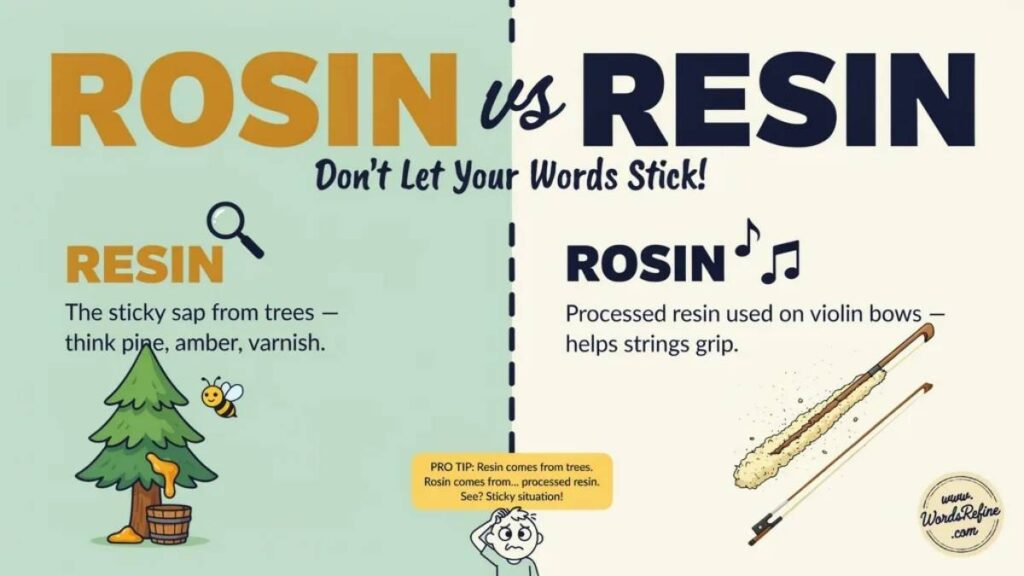
Ever hesitated over rosin vs resin? You’re not alone. These words look and sound remarkably similar, yet they describe different things. One small letter can turn a violin essential into a sticky substance produced by trees, proving that even tiny spelling differences can cause big confusion. Rosin is a specific processed material commonly used on violin bows, while resin is a broader term for natural and synthetic substances. The distinction becomes even more interesting in discussions of cannabis concentrates, where rosin and resin refer to different products and extraction methods. Understanding the difference between rosin and resin helps you choose the right word and write with confidence.
Rosin vs Resin quick answer
The simplest distinction is this: resin is the broader term, while rosin refers to a particular solid material produced by processing certain resins.
Resin can occur naturally in plants. For example, trees can produce sticky resin that helps protect damaged areas. Resin can also be manufactured synthetically for industrial and commercial purposes.
Rosin, traditionally called colophony, is produced by processing resinous material and removing volatile components. It is typically a hard, brittle solid at room temperature.
Therefore, although the words are related, you shouldn’t automatically use one in place of the other.
What Does Rosin Mean?
Rosin is a solid substance traditionally obtained from pine and other resin-producing trees. It is commonly associated with processed tree resin.
Because rosin has useful friction and adhesive properties, it has several practical applications. For example, musicians use rosin on bows for string instruments. It helps create the friction needed between the bow hair and strings.
Rosin also appears in some industrial processes, adhesives, printing applications, and soldering products.
The word has a long history of practical use, but its meaning has expanded in modern conversations. In particular, cannabis terminology now uses rosin to describe a type of concentrate made without chemical solvents.
That additional meaning is one reason the rosin or resin question can become surprisingly complicated.
What Does Resin Mean?
Resin is a much broader word.
Natural resin is produced by various plants, especially trees. It can be sticky, viscous, or semi-solid when produced naturally. Plant resins can contain different organic compounds that serve protective functions.
Synthetic resin, on the other hand, is manufactured through chemical processes. It is widely used in products and materials such as adhesives, coatings, plastics, composites, and casting materials.
For example, epoxy resin is a synthetic material used in construction, crafts, electronics, flooring, coatings, and many other applications.
So, when you see the word resin, you need to consider the context. It could refer to a natural plant substance, an industrial material, or a cannabis concentrate.
Rosin vs Resin Side-by-Side Comparison
| Feature | Rosin | Resin |
|---|---|---|
| Basic meaning | A processed solid resinous material | A broad term for natural or synthetic resinous substances |
| Common natural source | Pine and other resin-producing plants | Various plants and trees |
| Typical form | Usually solid and brittle | Can be sticky, liquid, semi-solid, or solid |
| Musical use | Commonly used for violin and other string-instrument bows | Not normally used for bow friction |
| Industrial use | Adhesives, soldering, printing, and other applications | Adhesives, coatings, plastics, composites, and more |
| Cannabis meaning | A solventless concentrate | A broader term that can refer to resin-derived cannabis concentrates |
| Relationship | A specific processed material | A broader category |
This comparison explains why resin vs rosin isn’t simply a spelling question. Both are legitimate words, but their meanings and applications differ.
Is Rosin a Type of Resin?
The answer depends on how broadly you use the word resin.
In traditional material terminology, rosin is closely related to natural resin because it is produced by processing resinous material. However, rosin has its own established meaning and properties.
Think of it this way: resin is the larger family, while rosin is a specific member with its own identity.
That distinction matters because calling every resin “rosin” would be inaccurate. Likewise, calling violin rosin simply “resin” may make your meaning less precise.
Why Do People Confuse Rosin vs Resin?
The confusion is understandable because the words are only one letter apart.
They’re also connected in meaning. Rosin is derived from resinous material, so the similarity isn’t a coincidence.
However, context usually gives you the answer.
If you’re talking about a violin bow, the correct term is generally rosin. If you’re discussing epoxy, fiberglass, adhesives, or natural substances produced by trees, resin is usually the appropriate word.
Cannabis terminology adds another layer because both rosin and resin are used as names for different concentrate types.
Therefore, the spelling alone won’t solve every situation. You need to look at what the word describes.
When Should You Use Rosin?
Use rosin when you’re referring to the specific solid substance traditionally made from resinous plant material or to a product specifically called rosin.
One of the most familiar examples is musical-instrument rosin.
Rosin for Violin and Other String Instruments
If you play the violin, viola, cello, or another bowed string instrument, you’ve probably encountered rosin.
A small amount is applied to the bow hair. This increases friction between the bow and the strings, helping the bow produce sound.
That’s why “violin rosin” is the standard term.
You may occasionally hear someone call it violin resin, but rosin is the established term for the bow product.
So, if you’re writing instructions about a violin bow, say “apply rosin to the bow hair,” rather than “apply resin.”
Rosin in Soldering and Industry
Rosin also has industrial uses.
For example, rosin-based materials have been used as flux components in soldering. Flux helps remove oxides and improve the soldering process.
Rosin can also appear in adhesives, coatings, printing materials, and other industrial products.
Therefore, rosin isn’t limited to music. Its useful physical and chemical properties have made it valuable in several fields.
Learn the difference between confusing more English words
Wisp vs Whisp Which One Is Correct?
When Should You Use Resin?
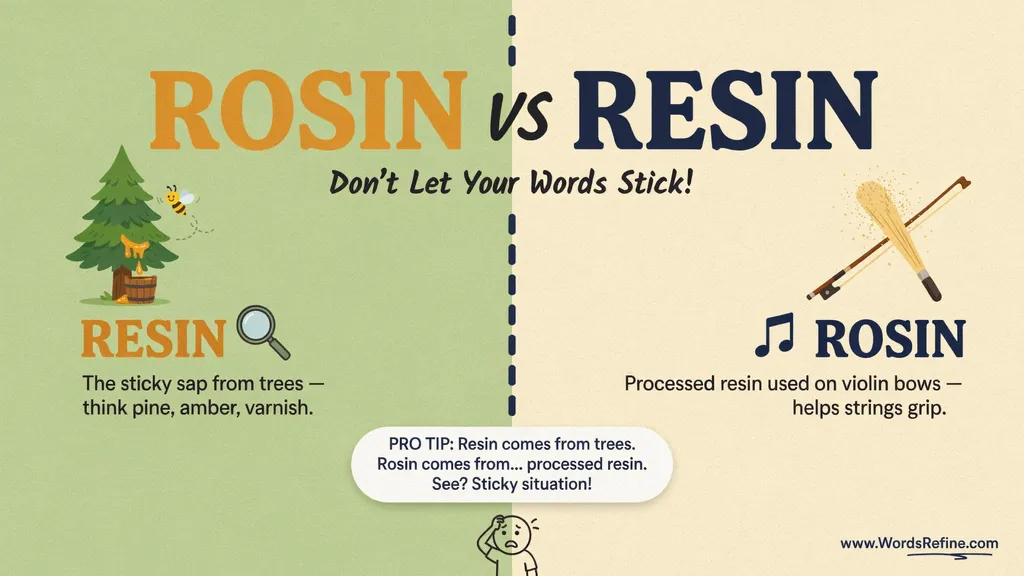
Use resin when you’re referring to a natural or synthetic resinous substance.
For example, you might discuss tree resin, epoxy resin, casting resin, or synthetic resin.
Natural Resin
Natural resin comes from plants and trees.
When certain trees are damaged, they can release resinous substances that help protect the affected area. These materials can have distinctive textures, aromas, and chemical compositions.
Natural resins have been used for centuries in products such as varnishes, adhesives, incense, and other materials.
Synthetic Resin
Synthetic resins are manufactured rather than collected directly from trees.
Epoxy resin is one familiar example. Other resin systems are used in coatings, adhesives, composite materials, electrical components, and manufacturing.
Consequently, resin is a very broad material term. Its exact properties depend on the particular type of resin being discussed.
Rosin vs Resin for a Violin?
For a violin bow, use rosin.
This is one of the easiest situations to remember.
A violin bow needs friction against the strings. Bow rosin provides that friction and helps the instrument produce sound.
For example:
Correct: “I need to buy more violin rosin.”
Less precise: “I need to buy more violin resin.”
The second phrase may be understood, but it isn’t the standard term for the bow product.
So, when the violin appears, rosin should usually come to mind.
Learn the difference between commonly mixed-up more words
Cancell vs Cancel Which one Is Correct?
Rosin vs Resin in Cannabis Terminology
Cannabis concentrates create a completely different use of these words.
In this context, rosin and resin can refer to different types of cannabis concentrates. The distinction generally concerns how the concentrate is produced.
Rosin is associated with solventless extraction. Resin concentrates can be produced through solvent-based extraction methods.
However, product quality cannot be determined simply by choosing one word over the other. Potency, purity, flavor, aroma, cannabinoid profile, terpene profile, production standards, and laboratory testing can all vary between products.
Therefore, asking “rosin or resin which is better?” doesn’t have one universal answer.
The more useful question is what characteristics matter to you and what the product’s laboratory results and labeling show.
What Is Rosin?
In cannabis terminology, rosin is a concentrate produced through a solventless extraction process involving heat and pressure.
The process works with the resin-rich trichomes found on cannabis plant material. Unlike solvent-based extraction, solventless rosin production does not rely on chemical solvents such as butane or propane to separate the desired compounds.
Because of this, the term solventless rosin is commonly used.
There are different forms of rosin, and the starting material can affect the final product. Cured cannabis and fresh-frozen cannabis can lead to different products and characteristics.
What Is Live Rosin?
Live rosin is a cannabis concentrate made from fresh-frozen cannabis rather than traditionally dried and cured material.
The term “live” refers to the condition of the starting plant material. Fresh freezing helps preserve compounds present in the plant before the extraction process.
Live rosin is still produced using a solventless approach involving heat and pressure.
Because terpene preservation is an important consideration, live rosin is often associated with strong flavor and aroma profiles. However, individual products can vary considerably.
What Is Resin?
In cannabis discussions, resin can refer to the sticky, trichome-rich material found on cannabis flowers. The term can also refer to concentrates produced through extraction.
Live resin is a specific type of cannabis concentrate made using fresh-frozen plant material and solvent-based extraction technology.
Depending on the production method, solvents such as hydrocarbons can be involved. Commercial production uses controlled systems designed for this purpose.
The important point is that cannabis resin terminology is not the same as the traditional material-science meaning of resin.
Context matters.
What Is Live Resin?
Live resin is a cannabis concentrate made from fresh-frozen cannabis using solvent-based extraction.
The fresh-frozen starting material is intended to help preserve volatile compounds, including terpenes.
Live resin and live rosin therefore share one important feature: both can begin with fresh-frozen cannabis.
The major distinction is the extraction method.
Live rosin uses a solventless extraction process involving heat and pressure. Live resin generally uses solvent-based extraction.
That difference is central to any live rosin vs live resin comparison.
Live Resin vs Rosin What’s the Difference?
The biggest difference between live resin and rosin is how the concentrate is extracted.
Rosin is associated with solventless extraction. Live resin is associated with solvent-based extraction.
Both can contain cannabinoids and terpenes, and both can have strong flavor and aroma. However, their final characteristics depend on many factors, including the starting material, extraction technology, processing, storage, and product formulation.
| Feature | Rosin | Live Resin |
|---|---|---|
| Starting material | May use cured or fresh-frozen cannabis | Typically fresh-frozen cannabis |
| Extraction approach | Solventless | Solvent-based |
| Main extraction concept | Heat and pressure | Chemical solvent extraction |
| Terpene preservation | Can be high depending on processing | Can be high because fresh-frozen material is used |
| Residual solvent concern | No extraction solvents are used | Proper processing and testing matter |
| Typical price | Often higher | Often lower than comparable rosin products |
| Product quality | Depends on material and processing | Depends on material, processing, and testing |
So, the rosin vs resin comparison isn’t simply about which product is “stronger” or “better.” It’s about production method and product characteristics.
Learn the difference between tricky grammar more words
Performing vs Preforming Which One Is Correct?
Rosin vs Resin Potency Which Is Stronger?
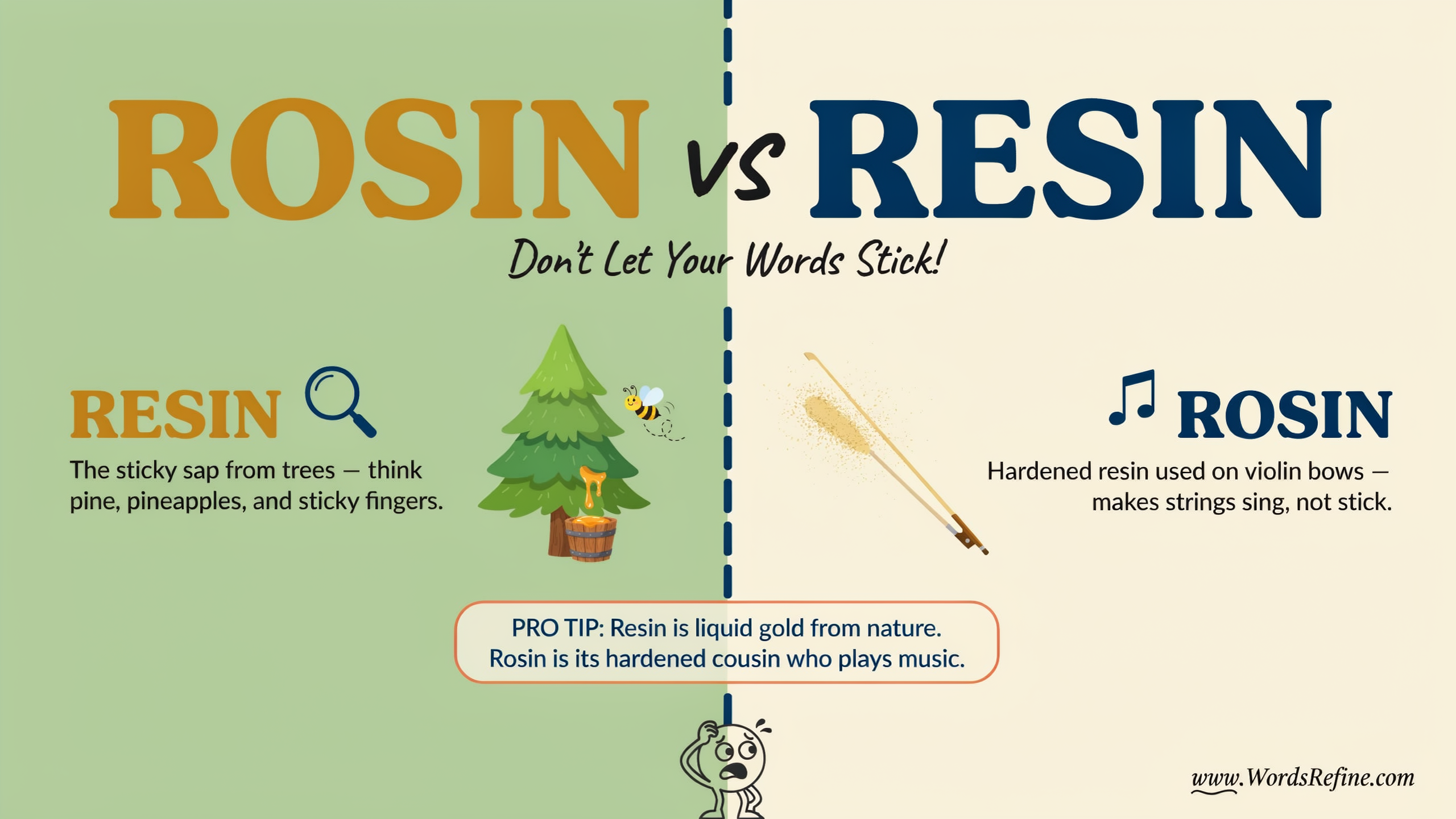
There isn’t a universal potency winner.
Both rosin and resin products can contain substantial amounts of cannabinoids. However, potency varies by product.
The most reliable way to compare potency is to examine the laboratory-tested cannabinoid content of the specific products.
For cannabis concentrates, THC concentration is only one part of the picture. The terpene profile and other cannabinoids may also affect the overall characteristics of a product.
Therefore, claims that rosin is always stronger than resin, or that resin is always stronger than rosin, are too broad.
Rosin vs Resin Flavor Difference
Flavor is another area where people often make sweeping claims.
Both rosin and resin can have pronounced flavor and aroma because both can retain terpene compounds.
Fresh-frozen starting material is particularly important in discussions of live cannabis concentrates because freezing shortly after harvest can help preserve volatile plant compounds.
Nevertheless, flavor depends on the cannabis variety, handling, extraction method, storage, and processing.
As a result, rosin vs resin flavor differences can be noticeable, but you shouldn’t assume that every rosin product will taste better than every resin product.
Rosin vs Resin Purity
Purity can mean different things, so it’s important to define the term.
If you mean the absence of extraction solvents, solventless rosin has a straightforward distinction: its extraction process does not use chemical solvents.
For solvent-based resin products, professional processing and laboratory testing are important for determining whether residual solvents remain within applicable safety limits.
Therefore, rosin vs resin purity should be evaluated using actual laboratory results rather than assumptions based only on the product name.
Rosin vs Resin Safety
Safety depends on more than the word printed on a package.
For cannabis concentrates, reputable production, proper testing, contamination controls, and accurate labeling are important considerations.
With solvent-based extraction, residual solvents are one laboratory testing concern. With any concentrate, contaminants and inaccurate labeling can also matter.
Additionally, cannabis products can contain high levels of THC, which can produce significant psychoactive effects.
So, when considering rosin vs resin safety, look at the specific product, its testing information, and applicable regulations rather than assuming that one category is automatically risk-free.
Rosin vs Resin Price
Rosin is often more expensive than resin.
One reason is production cost. Solventless extraction can require specialized equipment and careful processing, while yields and production efficiency can differ from solvent-based methods.
Live rosin can also require high-quality fresh-frozen starting material and additional processing.
However, prices vary widely depending on the market, product quality, brand, formulation, and packaging.
Therefore, the answer to “why is rosin more expensive than resin?” generally comes down to production costs, starting material, processing, yield, and market positioning.
Rosin vs Resin Quality
Quality isn’t determined by the name alone.
A high-quality concentrate should be evaluated according to relevant factors such as:
Product testing
Cannabinoid content
Terpene profile
Contaminant screening
Residual solvent results where applicable
Starting material
Manufacturing standards
Storage and handling
Product consistency
Consequently, a rosin vs resin quality comparison should focus on measurable product information instead of treating either category as automatically superior.
Rosin vs Resin Wax
Wax is another concentrate term that can cause confusion.
Wax generally describes the consistency or texture of a concentrate rather than identifying one specific extraction method.
Rosin can have different consistencies depending on processing and storage. Resin products can also have different textures.
Therefore, rosin vs resin wax is not a simple three-way comparison. “Wax” describes a type of physical consistency, while “rosin” and “resin” can describe material or extraction categories depending on context.
Rosin vs Resin vs Distillate
Distillate is another cannabis concentrate category.
Distillation involves additional refinement designed to isolate and concentrate particular compounds. Because of that additional processing, distillate can have a different cannabinoid and terpene profile from less-refined concentrates.
Rosin and resin, meanwhile, are generally discussed in terms of their extraction methods and preservation of plant compounds.
In simple terms:
Rosin is associated with solventless extraction.
Resin can refer to resinous cannabis material or solvent-extracted concentrates.
Distillate is a highly refined cannabis concentrate.
These categories shouldn’t be treated as interchangeable.
Learn the difference between commonly g confusing ord pairs
Tomatoes vs Tomatos Which one Is Correct?
Common Mistakes With Rosin vs Resin
Because the words are so similar, several mistakes appear regularly.
Calling Violin Rosin “Resin”
Incorrect: “Put resin on your violin bow.”
Better: “Put rosin on your violin bow.”
The standard term for bow treatment is rosin.
Using Rosin for Every Natural Tree Substance
Incorrect: “The tree released rosin after the bark was damaged.”
Better: “The tree released resin after the bark was damaged.”
The naturally produced sticky substance is generally called resin. Rosin is the processed material.
Treating Cannabis Rosin vs Resin as Identical
Rosin and resin can refer to different cannabis concentrate categories.
Rosin is associated with solventless extraction, while many resin concentrates involve solvent-based extraction.
Assuming One Is Always Stronger
Neither term guarantees a specific potency.
Always look at the actual product information and laboratory results when comparing cannabis concentrates.
Rosin vs Resin Common Sentence Examples
Here are some practical examples that make the distinction easier to remember.
1.Correct: “The violinist applied rosin to the bow.”
2.Correct: “The pine tree produced resin.”
3.Correct: “The manufacturer uses epoxy resin.”
4.Correct: “The product is made with solventless rosin extraction.”
5.Correct: “The laboratory tested the cannabis resin for contaminants.”
Incorrect: “The violinist applied resin to the bow.”
Incorrect: “The tree produced rosin.”
The context provides the clue. If you’re talking about a bow, think rosin. If you’re talking about a tree or synthetic material, think resin.
Learn the difference between commonly g confusing ord pairs
Inquiries vs Queries What’s the Difference ?
Does American or British English Change Rosin to Resin?
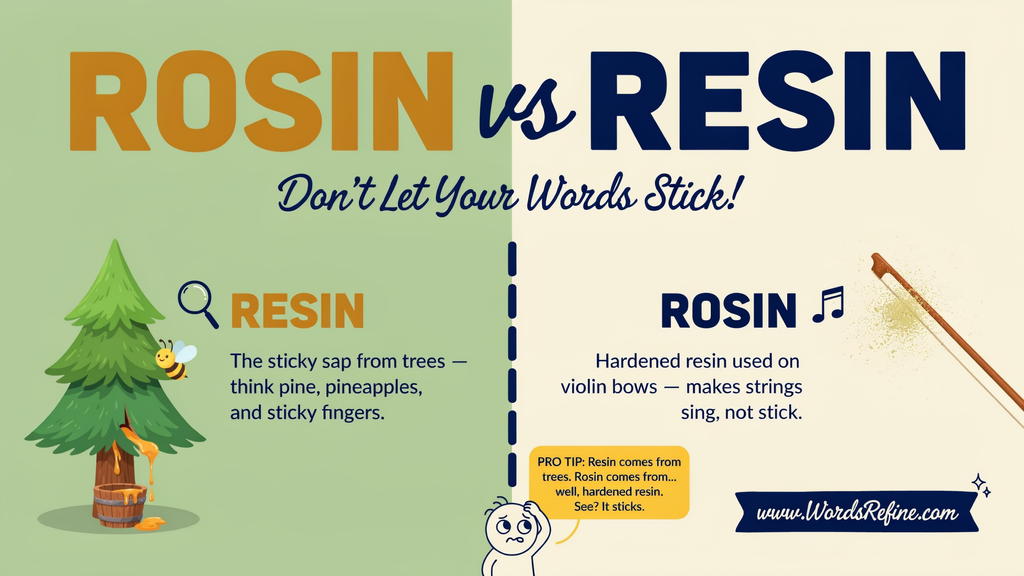
No.
The distinction between rosin and resin is not simply an American-versus-British spelling difference.
Both forms are established words in English, and their meanings remain distinct.
Therefore, changing from American English to British English doesn’t turn rosin into resin.
The important issue is meaning, not regional spelling.
How to Remember Rosin vs Resin
A simple memory trick can help.
Think of rosin as the specific solid material.
Think of resin as the broader category.
1.For musical instruments, remember the phrase “bow rosin.”
2.For trees, remember “tree resin.”
3.For synthetic materials, remember “epoxy resin.”
4.For cannabis concentrates, pay attention to the extraction terminology because rosin and resin can describe different production methods.
Once you connect each word with its common context, the confusion becomes much easier to avoid.
Rosin vs Resin in Professional Writing
Precision matters in professional writing.
If you’re writing about music, manufacturing, chemistry, materials, or cannabis products, choosing the correct term prevents unnecessary confusion.
For example, a technical document discussing epoxy should use resin. A guide for violin players should use rosin. A discussion of cannabis concentrates should clearly distinguish between rosin and resin extraction methods.
Moreover, professional writing should avoid broad claims that aren’t supported by evidence.
Instead of writing that “rosin is always purer,” explain what you mean by purity and refer to relevant testing.
Instead of saying “resin is stronger,” provide actual laboratory measurements if potency is the issue.
Clear terminology makes technical writing easier to understand and more trustworthy.
Quick Reference
Remember these basic rules:
Rosin is a specific processed resinous material.
Resin is a broader term covering natural and synthetic materials.
Violin bows use rosin.
Trees naturally produce resin.
Epoxy products contain resin.
In cannabis terminology, rosin is associated with solventless extraction.
Live rosin uses fresh-frozen cannabis and a solventless process.
Live resin uses fresh-frozen cannabis and generally involves solvent-based extraction.
Potency, flavor, purity, safety, and quality depend on the specific product and production process.
Learn the difference between often confused words
Lend vs Lent What’s the Difference and When to Use Each?
Practice Session Rosin vs Resin
Test your understanding of rosin vs resin by completing each sentence with the correct word.
- A violinist applies ______ to the bow hair to create the necessary friction with the strings.
- Pine trees naturally produce ______ as a protective substance.
- Epoxy ______ is commonly used in adhesives, coatings, and composite materials.
- The musician bought a new block of violin ______.
- The sticky substance that comes from some trees is called ______.
- In traditional material terminology, ______ is a processed solid material related to natural resin.
- The manufacturer used synthetic ______ to create a durable coating.
- The violin bow needs ______ to produce a clear sound.
- Natural tree ______ can be sticky and aromatic.
- In cannabis terminology, ______ is associated with solventless extraction.
- Live ______ is generally produced from fresh-frozen cannabis using solvent-based extraction.
- Live ______ is made from fresh-frozen cannabis through a solventless process.
- The term “solventless ______” is commonly used for cannabis rosin.
- The correct term for the material applied to a violin bow is ______.
- A damaged tree may release ______ from its bark.
- Synthetic ______ is widely used in industrial and commercial products.
- When discussing cannabis concentrates, rosin and ______ should not automatically be treated as the same thing.
- A company that makes epoxy products would normally refer to its material as ______, not rosin.
- A violin teacher told the student to apply a small amount of ______ to the bow.
- The extraction method helps distinguish cannabis ______ from cannabis rosin.
- Fresh-frozen cannabis can be used to produce live ______ as well as live rosin.
- The word ______ is broader because it can refer to both natural and synthetic materials.
- In traditional usage, ______ is usually a hard, brittle substance at room temperature.
- If you are talking about a violin bow, ______ is the appropriate word.
- If you are describing the sticky material naturally produced by a pine tree, ______ is the appropriate word.
Answers
- Rosin
- Resin
- Resin
- Rosin
- Resin
- Rosin
- Resin
- Rosin
- Resin
- Rosin
- Resin
- Rosin
- Rosin
- Rosin
- Resin
- Resin
- Resin
- Resin
- Rosin
- Resin
- Resin
- Resin
- Rosin
- Rosin
- Resin
Here’s a trusted source for clear word meanings:
FAQs
Is rosin the same as resin?
No. Rosin and resin are related but distinct terms. Resin is a broad term for natural or synthetic resinous substances, while rosin is a specific solid material traditionally produced by processing resinous material.
Why is rosin used on violin bows?
Rosin increases friction between the bow hair and the strings. This friction helps the bow grip the strings and produce sound.
Can resin be used instead of rosin on a violin bow?
Rosin is the standard material used for violin bows. Ordinary tree resin or synthetic resin is not a substitute for properly formulated bow rosin.
Is rosin a natural material?
Traditional rosin is derived from resinous plant material, particularly material associated with pine trees. However, commercial rosin products can vary in their formulation and processing.
What is rosin used for besides musical instruments?
Rosin has applications in areas such as adhesives, soldering materials, coatings, printing, and other industrial processes.
What is natural resin?
Natural resin is a resinous substance produced by plants, particularly trees. It can help protect damaged plant tissue and may have adhesive or aromatic properties.
What is synthetic resin used for?
Synthetic resin is used in many products and manufacturing applications, including adhesives, coatings, plastics, composites, and casting materials.
Why do people confuse rosin and resin?
The words are closely related in spelling and meaning. Rosin is also historically connected to resinous plant materials, while both terms appear in technical and cannabis-related discussions.
Is rosin always made from pine?
No. Traditional rosin is strongly associated with pine and other resin-producing plants, but the term can cover rosin derived from different resinous materials.
What is solventless rosin?
Solventless rosin is a cannabis concentrate produced without chemical extraction solvents. Its production uses physical methods involving heat and pressure to separate resin-rich material from cannabis.
Does rosin contain solvents?
Cannabis rosin is made through a solventless extraction process, so chemical extraction solvents such as butane or propane aren’t used to produce the rosin itself.
What makes live rosin different from regular rosin?
Live rosin is made from fresh-frozen cannabis, while traditional cannabis rosin can be made from dried and cured material. The starting material can affect the resulting terpene and cannabinoid profile.
What makes live resin different from regular resin?
Live resin is a cannabis concentrate generally made from fresh-frozen cannabis using solvent-based extraction. The word “live” refers to the fresh-frozen starting material.
Can rosin and resin have different terpene profiles?
Yes. Their terpene profiles can differ because the starting material, extraction method, processing, and storage conditions can all influence terpene preservation.
How should you compare rosin and resin quality?
Compare specific product information rather than relying on the name alone. Laboratory testing, cannabinoid content, terpene profile, contaminant screening, production standards, and consistency can all be relevant.
Is rosin more expensive than resin?
Rosin is often more expensive than comparable resin products. Production costs, starting material, equipment, processing, and extraction yield can all contribute to the price difference.
Is “resin” the correct word for tree sap?
Not always. Tree sap and tree resin are different substances. Sap primarily transports water and nutrients through a plant, while resin is a separate protective substance produced by certain plants and trees.
Is rosin the correct word for tree resin?
Usually not. Fresh resin produced naturally by a tree is generally called resin. Rosin refers to a processed solid material rather than the original sticky tree secretion.
Are rosin and resin different in consistency?
They can be. Traditional rosin is generally a hard,
Conclusion
Rosin vs resin may look like they’re one letter away from starting a family argument, but they have different jobs. Rosin is the specific word you’ll want for violin bows and certain processed materials, while resin is the broader term used for natural tree substances and synthetic materials such as epoxy. In cannabis terminology, the distinction becomes even more important because rosin and resin can refer to concentrates made through different extraction methods.
So, when you’re unsure, don’t let that sneaky “o” or “e” fool you. Think about the context first. Is it a violin bow? Choose rosin. Is it a tree or epoxy? Choose resin. Once you connect each word with its proper use, the rosin or resin confusion becomes much easier to handle and your sentence will sound a lot more polished, too.

Diora AJS she is an experienced blogger and passionate English language enthusiast at Words Refine. With a keen eye for language and a love for clear communication, she writes practical content about grammar, word meanings, usage, and commonly confused terms. Her goal is to make English easier to understand through clear explanations and relatable examples, helping readers write accurately and communicate with confidence.