
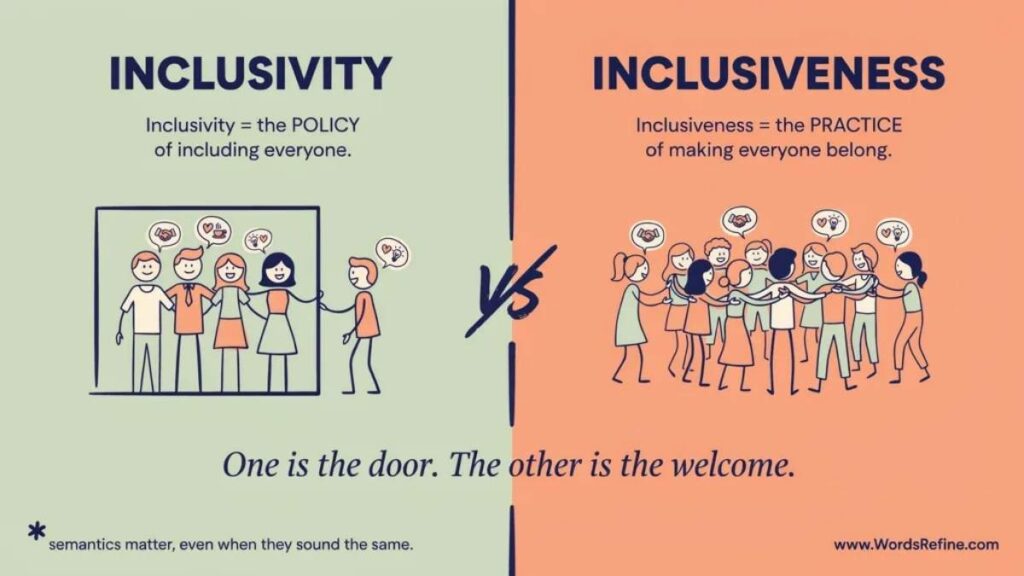
Ever stared at the words inclusivity vs inclusiveness and wondered whether English was playing another vocabulary prank? You’re not alone. Both words look almost identical, share the same root, and describe ideas connected to welcoming and including people. So, what’s the actual difference? While inclusivity often focuses on the practice, principle, or effort of including people, inclusiveness can emphasize the quality or degree of being inclusive. However, the two terms overlap in many situations and are often used interchangeably. In this guide, you’ll learn their meanings, differences, common usage, and examples. By the end, choosing the right word should feel much easier, not like a grammar guessing game.
Inclusivity vs Inclusiveness Quick Answer
The difference between inclusivity vs inclusiveness is mainly about emphasis. Neither word is simply the “correct” version while the other is wrong.
Inclusivity commonly refers to an approach, principle, practice, or commitment to including people.
Inclusiveness commonly refers to the quality, state, or degree of being inclusive.
Consider these two sentences:
“The company is committed to inclusivity.”
This sentence focuses on the company’s commitment and approach.
Now compare it with:
“The inclusiveness of the company’s workplace encourages participation.”
Here, inclusiveness describes a quality of the workplace.
Both sentences deal with the same broad idea. The difference lies in what the writer wants to emphasize.
Inclusivity vs Inclusiveness Difference at a Glance
| Word | Main emphasis | Example |
|---|---|---|
| Inclusivity | Principle, practice, goal, or commitment | “The school promotes inclusivity.” |
| Inclusiveness | Quality, state, or degree of being inclusive | “The inclusiveness of the school benefits students.” |
This distinction isn’t an absolute grammar rule. English speakers often use the two nouns in overlapping ways.
That means the answer to “What is the difference between inclusivity and inclusiveness?” isn’t simply “one is right and one is wrong.”
Instead, think about what your sentence is trying to describe.
Inclusivity Meaning
The inclusivity meaning centers on the idea of deliberately including people and reducing unnecessary barriers to participation.
A practical inclusivity definition is:
Inclusivity is the quality, principle, or practice of including people and giving them meaningful opportunities to participate.
The word frequently appears in conversations about:
- Workplace inclusion
- Education
- Accessibility
- Diversity
- Social inclusion
- Equal opportunity
- Community programs
- Inclusive policies
- Product design
- Organizational culture
For example:
“The organization is improving inclusivity through accessible recruitment practices.”
The sentence presents inclusivity as something the organization is actively working toward.
Inclusivity in Practice
Imagine a company that wants to make its hiring process more inclusive.
The It might review job descriptions for unnecessary requirements. It could improve accessibility on its careers website. It might provide reasonable accommodations during interviews and make application instructions easier to understand.
Those actions demonstrate inclusive practices.
The company could therefore say:
“We are promoting inclusivity in our recruitment process.”
Here, inclusivity fits naturally because the sentence focuses on an intentional effort or goal.
This is one reason the word appears frequently alongside phrases such as promoting inclusivity, improving inclusivity, and fostering inclusion
Inclusiveness Meaning
The inclusiveness meaning focuses more directly on the quality or state of being inclusive.
A practical inclusiveness definition is:
Inclusiveness is the quality, state, or degree to which a person, group, system, environment, or organization includes and welcomes people.
For example:
“The inclusiveness of the workplace helped employees feel comfortable sharing their ideas.”
Here, the writer isn’t naming a particular initiative. Instead, inclusiveness describes a characteristic of the workplace.
The word can describe:
- A workplace
- A classroom
- A community
- A group
- A program
- A policy
- An organization
- A social environment
- A public service
- A discussion
Inclusiveness as a Quality
Consider a community center that provides accessible facilities, welcomes people from different backgrounds, offers flexible activities, and encourages broad participation.
You might describe the center by saying:
“The center is known for its inclusiveness.”
The sentence focuses on the center’s character.
You could also say:
“The inclusiveness of the center encourages greater community participation.”
Again, the emphasis falls on the quality of being inclusive.
Learn the difference between confusing more English words
Flyer vs Flier Which one Is Correct?
Why Do They Overlap?
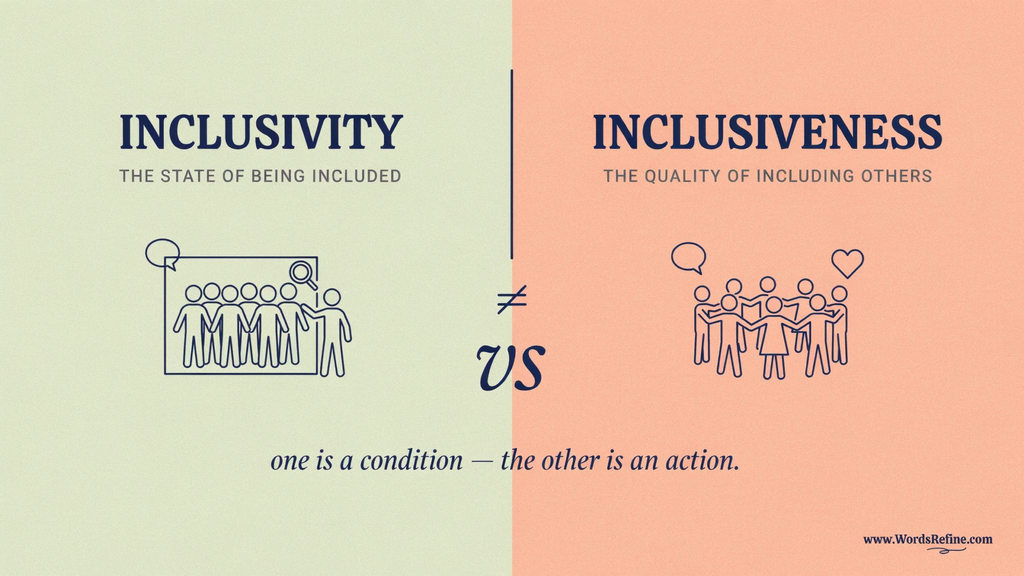
The confusion becomes easier to understand when you look at how English forms nouns.
Both words come from the adjective inclusive.
The related forms include:
- Include — verb
- Inclusion — noun
- Inclusive — adjective
- Inclusivity — noun
- Inclusiveness — noun
The suffix -ity can form nouns that describe qualities or states. The suffix -ness can do something similar.
For example:
- Active → activity
- Kind → kindness
- Inclusive → inclusivity
- Inclusive → inclusiveness
Because both -ity and -ness can create nouns referring to qualities, some overlap is completely natural.
That’s why trying to force a huge difference between the two words can create more confusion than clarity.
Are Inclusivity vs Inclusiveness Interchangeable?
The phrase inclusivity and inclusiveness used interchangeably reflects how the words often behave in ordinary English.
In many sentences, either noun can communicate essentially the same general idea.
For example:
“The organization values inclusivity.”
and
“The organization values inclusiveness.”
Both sentences tell the reader that the organization values an approach that includes and welcomes people.
However, the surrounding words can make one choice sound more natural.
Compare:
“The company launched an inclusivity initiative.”
with:
“The inclusiveness of the company’s culture has improved.”
The first sentence focuses on an intentional effort.
The second focuses on the resulting quality of the culture.
That distinction is useful when you want your writing to sound precise rather than repetitive.
When to Use Inclusivity
Knowing when to use inclusivity becomes easier when you look for language involving goals, practices, principles, and deliberate efforts.
Use Inclusivity for Goals
The university is describing a goal.
Use Inclusivity for Policies and Strategies
“The organization developed an inclusivity strategy for its community programs.”
The word works because the sentence discusses an intentional approach.
Use Inclusivity for Active Efforts
“The company is promoting inclusivity through accessible hiring practices.”
The sentence describes something the company is actively doing.
Use Inclusivity for Design Principles
“Inclusivity influenced the design of the new public website.”
Here, inclusivity represents a principle that shaped the design process.
When to Use Inclusiveness
The question of when to use inclusiveness has a slightly different answer.
Use inclusiveness when you want to describe a quality, characteristic, state, or degree of being inclusive.
Describe an Environment
“The inclusiveness of the classroom encouraged students to participate.”
The classroom possesses a particular quality.
Describe a Group
“The group’s inclusiveness made new members feel welcome.”
Again, the focus is on a characteristic.
Describe a Program
“Researchers evaluated the inclusiveness of the education program.”
The researchers are examining how inclusive the program is.
Describe a Culture
“The inclusiveness of the workplace culture influenced employee participation.”
The word describes the nature of the culture rather than an individual initiative.
Learn the difference between commonly mixed-up more words
Rosin vs Resin Which One Is Correct and What’s the Difference?
Inclusivity vs Inclusiveness in a Sentence
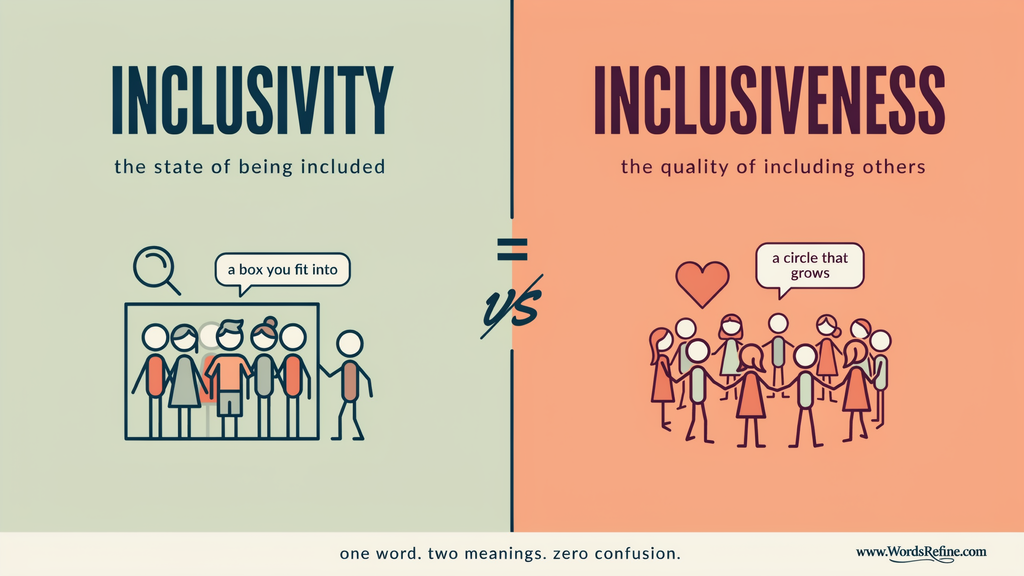
Looking at inclusivity vs inclusiveness in a sentence is one of the quickest ways to understand the distinction.
Inclusivity Examples
“The school is working to improve inclusivity.”
“The company promotes inclusivity through accessible hiring.”
“Inclusivity is central to the organization’s community strategy.”
“The designers considered inclusivity when developing the product.”
Inclusiveness Examples
“The inclusiveness of the school encouraged broader participation.”
“The workplace is recognized for its inclusiveness.”
“Researchers examined the inclusiveness of the program.”
“The group’s inclusiveness helped create a welcoming environment.”
The pattern becomes clearer when you compare the verbs.
Promote, improve, support, encourage, develop, and prioritize often work naturally with inclusivity.
Describe, evaluate, examine, measure, and recognize can work naturally with inclusiveness when the sentence focuses on a characteristic.
This isn’t a strict grammatical formula. It’s simply a useful guide for natural word choice.
Inclusivity vs Inclusiveness in Different Contexts
The easiest way to understand inclusivity vs inclusiveness usage is to see how both words work in real situations. Their meanings overlap, but the focus can change depending on the context.
Inclusivity vs Inclusiveness in the Workplace
Workplace writing often uses both terms when discussing diversity, accessibility, belonging, and equal opportunities.
For example:
“The company promotes inclusivity through flexible hiring practices.”
Here, inclusivity refers to an active effort or organizational goal.
Now compare it with:
“The inclusiveness of the workplace helps employees feel valued.”
This sentence describes a quality of the workplace.
Both sentences make sense. The first focuses on what the company is doing. The second focuses on what the workplace is like.
You might also see:
“The organization has introduced new policies to support inclusivity.”
“The inclusiveness of the organization is reflected in its workplace culture.”
This distinction can make professional writing more precise without forcing an artificial difference between the two words.
Inclusivity vs Inclusiveness in Education
Schools, colleges, and universities often discuss inclusive education, accessibility, participation, and equal opportunities.
For example:
“The school is developing new programs to promote inclusivity.”
The sentence focuses on an intentional effort.
Compare it with:
“The inclusiveness of the classroom encouraged more students to participate.”
Here, inclusiveness describes the quality of the classroom environment.
Both words can appear naturally in educational writing.
You could write:
“The university considers inclusivity when developing student services.”
Or:
“The inclusiveness of the student services makes them accessible to a wider range of learners.”
The first sentence highlights a principle. The second describes a characteristic or outcome.
Inclusivity vs Inclusiveness in Technology and Design
Technology provides another useful example.
A designer might say:
“Inclusivity should guide the development of the new application.”
This sentence presents inclusivity as a design principle.
The designer could also say:
“The inclusiveness of the application was evaluated before its release.”
Now the focus is on how inclusive the finished product is.
This distinction becomes especially useful when discussing accessibility and inclusion.
For example:
“The team considered inclusivity when designing the website.”
and:
“The team evaluated the inclusiveness of the website.”
The first describes the thinking behind the design. The second describes an assessment of the finished design.
Neither sentence requires complicated grammar. Context does most of the work.
Inclusivity vs Inclusiveness in Communities
Community discussions also use both nouns naturally.
For example:
“The community center is promoting inclusivity through new programs.”
The center is taking action.
Meanwhile:
“The inclusiveness of the community center makes visitors feel welcome.”
The second sentence describes the center’s quality.
You can use the same pattern when discussing public services, cultural groups, social organizations, and community events.
Inclusivity vs Inclusiveness in Formal Writing
If you’re writing an essay, report, academic paper, or professional document, both words are acceptable.
The important question isn’t whether one sounds more formal. Instead, consider what you want the noun to express.
Use inclusivity when discussing:
- Goals
- Principles
- Strategies
- Policies
- Initiatives
- Practices
- Organizational commitments
- Efforts to remove barriers
Use inclusiveness when discussing:
- Qualities
- Characteristics
- Environments
- Cultures
- Groups
- Programs
- The degree of inclusion
For example:
“The institution has developed an inclusivity policy.”
This focuses on a formal approach.
“The inclusiveness of the institution’s environment encourages participation.”
This focuses on the quality of that environment.
In formal writing, consistency matters more than trying to make one word sound more sophisticated than the other.
Inclusivity vs Inclusiveness in an Essay
If you’re wondering about inclusivity vs inclusiveness in an essay, start with the sentence rather than the word.
Suppose you’re discussing a university’s efforts to create equal opportunities.
You could write:
“The university has increased its focus on inclusivity.”
That works because you’re discussing an institutional priority.
If you’re evaluating the university’s environment, you could write:
“The inclusiveness of the university’s environment supports a wider range of students.”
That works because you’re describing a characteristic.
You don’t need to use both words simply to prove that you know them. One clear word is better than two unnecessary ones.
Learn the difference between basic English word mistakes
Inquiries vs Queries What’s the Difference ?
Common Mistakes With Inclusivity vs Inclusiveness
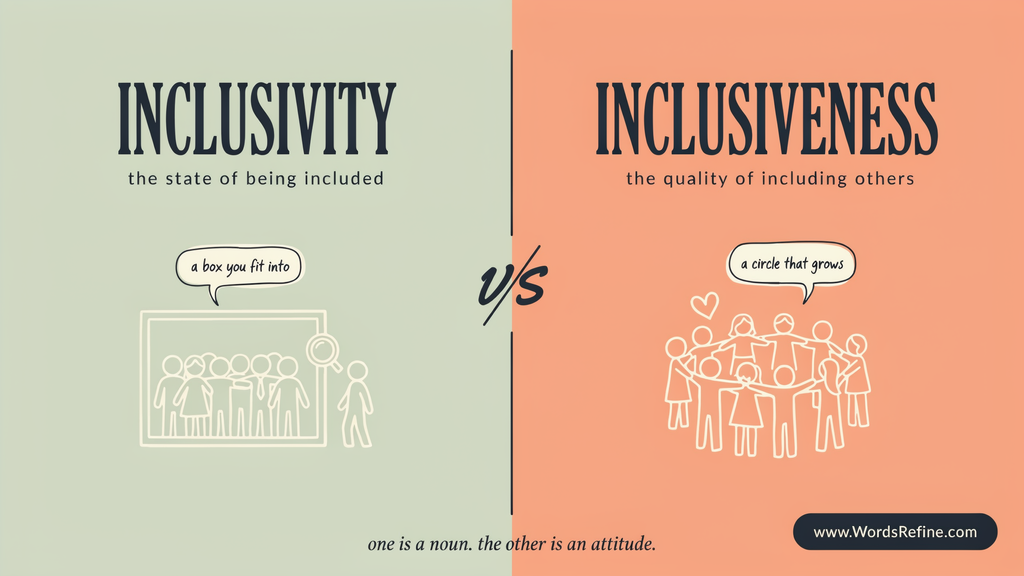
Even though these words become easier to understand with practice, several mistakes appear repeatedly.
Treating One Word as Incorrect
One of the biggest mistakes is assuming that inclusivity or inclusiveness must be wrong.
Both are legitimate nouns.
The choice depends on context and style.
So if someone tells you that inclusiveness is incorrect because inclusivity is the “real” word, or says the opposite, don’t let the grammar alarm start flashing.
Both forms are established English words.
Creating a Difference That English Doesn’t Require
Another mistake is treating the two words as if they always describe completely different concepts.
They don’t.
In many contexts, they can be substituted without changing the central meaning.
For example:
“The organization values inclusivity.”
and:
“The organization values inclusiveness.”
Both communicate that the organization values including and welcoming people.
Trying to invent a dramatic distinction where none exists can make your writing sound unnatural.
Using Them as Adjectives
Inclusivity and inclusiveness are nouns.
The adjective is inclusive.
For example:
“The organization created an inclusive culture.”
Not:
“The organization created an inclusivity culture.”
You can use inclusivity as the noun:
“The organization promotes inclusivity.”
You can then use inclusive as the adjective:
“The organization promotes an inclusive culture.”
Knowing the noun and adjective forms helps prevent a common grammar mistake.
Confusing Inclusivity With Inclusion
Inclusivity and inclusion are closely related, but they aren’t identical in every sentence.
Inclusion generally refers to the act, process, or result of including people.
Inclusivity often emphasizes the quality, principle, or practice of being inclusive.
For example:
“The program promotes inclusion.”
This focuses on the process or act of including people.
“The program promotes inclusivity.”
This emphasizes the broader principle or practice.
The meanings overlap, but the emphasis can change.
Inclusivity, Inclusiveness, and Inclusive
These three words become easier to understand when you identify their grammatical roles.
Inclusive
Inclusive is an adjective.
It describes a person, group, environment, policy, or practice.
“The company created an inclusive workplace.”
Inclusivity
Inclusivity is a noun.
It refers to the quality, principle, or practice of including people.
“The company promotes inclusivity.”
Inclusiveness
Inclusiveness is also a noun.
It refers to the quality, state, or degree of being inclusive.
“The inclusiveness of the workplace impressed new employees.”
A simple way to remember the difference is this:
Difference Between Inclusive vs Inclusivity
The difference between inclusive vs inclusivity is mainly grammatical.
Inclusive functions as an adjective.
Inclusivity functions as a noun.
Compare:
“The school has an inclusive environment.”
with:
“The school values inclusivity.”
In the first sentence, inclusive describes environment.
In the second sentence, inclusivity names the concept the school values.
The same pattern works in professional, academic, and everyday writing.
Difference Between Inclusion vs Inclusiveness
The difference between inclusion and inclusiveness is slightly more subtle.
Inclusion often refers to the act, process, or result of including someone or something.
Inclusiveness generally refers to the quality or state of being inclusive.
Compare:
“The organization supports the inclusion of diverse perspectives.”
with:
“The organization is known for its inclusiveness.”
The first sentence emphasizes the process of including perspectives.
The second describes the organization’s overall quality.
These words overlap too, but they aren’t always interchangeable.
Is Inclusive the Safest Word to Use?
If you’re unsure whether inclusivity or inclusiveness fits a particular sentence, inclusive can sometimes make the sentence simpler.
For example, instead of:
“The inclusiveness of the workplace creates a welcoming environment.”
you might write:
“The workplace has an inclusive environment.”
However, the two structures aren’t identical.
The noun forms remain useful when you’re discussing inclusivity or inclusiveness as a concept, quality, goal, or subject of analysis.
So don’t avoid the noun forms simply because inclusive is shorter.
Choose the form that fits the grammar and meaning of your sentence.
Inclusivity vs Inclusiveness Synonyms
Because the two words overlap, you can sometimes replace them with related terms. However, synonyms aren’t always perfect substitutes.
Depending on the context, related words may include:
- Inclusion
- Acceptance
- Openness
- Belonging
- Accessibility
- Participation
- Integration
- Equality
- Representation
- Fairness
For example:
“The organization promotes inclusivity.”
could sometimes become:
“The organization promotes inclusion.”
However, the meaning may shift slightly.
Similarly, replacing inclusiveness with fairness can change the focus. Fairness concerns equitable treatment, while inclusiveness focuses more specifically on including and welcoming people.
That’s why a synonym should match the intended meaning rather than simply look similar in a thesaurus.
Inclusivity vs Inclusiveness How to Choose
When you’re stuck between the two words, ask yourself a simple question:
Am I talking about an effort, principle, goal, or practice?
If yes, inclusivity may be the more natural choice.
For example:
“The company is strengthening its inclusivity policies.”
Now ask:
Am I describing a quality, state, environment, or degree of being inclusive?
If yes, inclusiveness may fit better.
For example:
“The inclusiveness of the company’s workplace has improved.”
However, these are useful tendencies rather than strict grammar rules.
English allows both words to overlap.
Quick Decision Guide
Choose inclusivity when your sentence focuses on an intentional approach, goal, policy, strategy, practice, or commitment to including people.
Choose inclusiveness when your sentence focuses on a quality, state, characteristic, environment, or degree of being inclusive.
Use inclusive when you need an adjective.
Use inclusion when you want to emphasize the act, process, or result of including people.
Consider these examples:
“The company promotes inclusivity.”
“The company has an inclusive workplace.”
“The company supports inclusion.”
“The inclusiveness of the workplace has improved.”
All four sentences are grammatically sound. They simply place the focus on different parts of the same broad idea.
Inclusivity vs Inclusiveness Quick Comparison
| Feature | Inclusivity | Inclusiveness |
|---|---|---|
| Part of speech | Noun | Noun |
| Basic idea | Including and welcoming people | The quality or state of being inclusive |
| Often emphasizes | Principles, goals, practices, efforts | Characteristics, environments, qualities |
| Common context | Policies, strategies, initiatives | Workplace culture, groups, environments |
| Can overlap with the other word? | Yes | Yes |
| Is it correct English? | Yes | Yes |
Inclusivity vs Inclusiveness Examples
Real examples make the difference between inclusivity and inclusiveness easier to understand. In everyday English, both words often describe the same general idea, but the sentence may emphasize an action, principle, quality, or result.
Inclusivity Example Sentences
Here are some natural examples of inclusivity:
“The company promotes inclusivity by making its hiring process more accessible.”
“The school considers inclusivity when developing new student programs.”
“Inclusivity is an important part of the organization’s community strategy.”
“The design team discussed inclusivity before launching the new product.”
“The organization introduced training to encourage greater inclusivity.”
“The policy was created to support inclusivity across the workplace.”
In these examples, inclusivity connects naturally with actions, goals, policies, and practices.
Inclusiveness Example Sentences
Now consider examples using inclusiveness:
“The inclusiveness of the workplace encourages employees to share their ideas.”
“The group’s inclusiveness helped new members feel comfortable.”
“The inclusiveness of the classroom encouraged wider participation.”
“The program was praised for its inclusiveness.”
“The organization is known for the inclusiveness of its community events.”
“Researchers examined the inclusiveness of the program.”
Here, inclusiveness often describes a characteristic or quality.
Learn the difference between more words people mix up
Socialise vs Socialize Which one Is Correct ?
Paired Examples Inclusivity vs Inclusiveness
Putting the words side by side makes the distinction clearer.
Example One
Inclusivity:
“The company is improving inclusivity through accessible recruitment.”
Inclusiveness:
“The inclusiveness of the company’s recruitment process has improved.”
The first sentence emphasizes the effort. The second emphasizes the resulting quality.
Example Two
Inclusivity:
“The school developed an inclusivity strategy.”
Inclusiveness:
“The inclusiveness of the school environment benefits students.”
The first focuses on a planned approach. The second describes an environment.
Example Three
Inclusivity:
“The organization promotes inclusivity in its community programs.”
Inclusiveness:
“The inclusiveness of its community programs encourages broader participation.”
Again, the meanings overlap while the emphasis changes.
Inclusivity vs Inclusiveness Usage
The best way to understand inclusivity vs inclusiveness usage is to focus on the role of each word in the sentence.
Ask yourself what you are trying to describe.
If you’re discussing an effort to include people, inclusivity often works naturally.
If you’re describing how inclusive something is, inclusiveness can work especially well.
Consider these common patterns:
Promote inclusivity.
Improve inclusivity.
Support inclusivity.
Encourage inclusivity.
Develop inclusivity initiatives.
Measure inclusiveness.
Evaluate inclusiveness.
Recognize inclusiveness.
Examine inclusiveness.
Describe inclusiveness.
These patterns aren’t fixed grammar rules. English speakers can use both nouns in many overlapping constructions.
However, they provide a useful starting point when you’re unsure.
Can Inclusivity vs Inclusiveness Be Used Interchangeably?
Yes, inclusivity and inclusiveness can be used interchangeably in many contexts.
For example:
“The organization values inclusivity.”
and:
“The organization values inclusiveness.”
Both sentences communicate a similar idea.
Likewise:
“The school promotes inclusivity.”
and:
“The school promotes inclusiveness.”
Both can be understood clearly.
However, interchangeable doesn’t mean identical in every sentence.
A phrase can sound more natural with one word depending on what follows it.
For example:
“The company launched an inclusivity initiative.”
This sounds natural because the sentence presents inclusivity as an organizational focus.
Meanwhile:
“The inclusiveness of the workplace was evaluated.”
This naturally presents inclusiveness as a quality being assessed.
The difference is subtle rather than absolute.
Is Inclusivity a Correct Word?
Yes, inclusivity is a correct English word.
It functions as a noun and refers to the quality, principle, or practice of including people.
For example:
“The organization is committed to inclusivity.”
Here, inclusivity acts as the object of the preposition to.
Another example is:
“The school promotes inclusivity.”
In this sentence, inclusivity functions as the object of promotes.
You can therefore use inclusivity confidently in professional, academic, and general writing when it fits the context.
Is Inclusiveness a Correct Word?
Yes, inclusiveness is also a correct English word.
It functions as a noun and refers to the quality or state of being inclusive.
For example:
“The inclusiveness of the workplace helps create a welcoming environment.”
Here, inclusiveness names a quality of the workplace.
You can also write:
“The organization is recognized for its inclusiveness.”
The word is grammatical and appropriate in formal writing.
What Is the Adjective Form of Inclusivity?
The adjective associated with inclusivity is inclusive.
For example:
“The organization promotes inclusivity.”
becomes:
“The organization has an inclusive culture.”
The first sentence uses the noun inclusivity.
The second uses the adjective inclusive.
This distinction matters because inclusivity cannot simply replace inclusive in every sentence.
You wouldn’t normally write:
“The company has an inclusivity workplace.”
Instead, write:
“The company has an inclusive workplace.”
The noun and adjective perform different grammatical jobs.
Is Inclusiveness a Noun?
Yes, inclusiveness is a noun.
It names the quality or state of being inclusive.
For example:
“The inclusiveness of the program attracted participants from different backgrounds.”
The word inclusiveness functions as the subject of the sentence.
You can also use it after verbs and prepositions:
“The organization values inclusiveness.”
“The policy focuses on inclusiveness.”
So, if you’re wondering whether inclusiveness is a noun, the answer is straightforward: yes.
Which Word Is More Common Inclusivity vs Inclusiveness?
Both words are established in English, and their frequency can vary depending on the subject, publication, organization, and writing style.
Inclusivity is especially common in discussions about organizational policies, diversity initiatives, accessibility, education, and workplace practices.
Inclusiveness also appears frequently when writers describe the quality or character of a group, environment, culture, or institution.
Rather than choosing a word based only on which one seems more common, consider the meaning of your sentence.
A natural sentence is more important than trying to find the supposedly “more correct” noun.
Inclusivity vs Inclusiveness in Professional Writing
Professional writing should prioritize clarity.
Suppose you’re writing a company report.
You could write:
“The company is developing an inclusivity strategy.”
This tells the reader that the company has an intentional strategy.
If you’re reporting on the resulting workplace environment, you could write:
“The inclusiveness of the workplace has improved.”
The two sentences serve different purposes.
Professional writers should also avoid unnecessary repetition.
For example, if the same paragraph already uses inclusivity several times, you don’t need to replace every occurrence with inclusiveness simply for variety.
Instead, rewrite the sentence when necessary.
For example:
“The company promotes inclusivity and supports equal participation.”
This may be clearer than repeatedly using either noun.
Inclusivity vs Inclusiveness in Academic Writing
Academic writing requires precise wording, but precision doesn’t mean creating artificial differences.
If you’re analyzing an educational policy, you might write:
“The study examines how the policy supports inclusivity.”
If you’re evaluating an environment, you might write:
“The study examines the inclusiveness of the learning environment.”
Both sentences can work in an academic context.
When writing academically, make sure your terminology stays consistent.
If you define inclusivity as a particular concept at the beginning of your paper, don’t suddenly use inclusiveness as though it has a completely different technical meaning unless you explain that distinction.
Consistency keeps the reader from wondering whether you’ve introduced a new concept.
American English and British English
Both inclusivity and inclusiveness are used in American and British English.
There isn’t a simple rule that says one belongs exclusively to American English while the other belongs to British English.
Writers in both varieties use the words when discussing education, workplaces, communities, accessibility, and social inclusion.
So you don’t need to change inclusivity to inclusiveness simply because you’re writing for an American or British audience.
Instead, follow the terminology used by your organization, publication, academic field, or audience when a specific style preference exists.
Inclusivity and Inclusiveness in Formal Communication
Emails, reports, proposals, presentations, and workplace documents can use either word.
For example:
“Our new policy supports inclusivity across the organization.”
Or:
“Our new policy reflects the organization’s commitment to inclusiveness.”
Both are professional.
The choice depends on the sentence structure and the emphasis you want to create.
If you’re naming an initiative, inclusivity may sound natural.
If you’re describing a characteristic, inclusiveness may be a better fit.
A Simple Memory Trick
If the two words keep getting tangled in your head, use this simple memory trick.
Think of inclusivity as something you can promote.
Think of inclusiveness as something you can describe.
For example:
“We promote inclusivity.”
But:
“We value the inclusiveness of the environment.”
This isn’t an absolute rule. It’s simply a useful shortcut.
Another way to remember it is:
Inclusivity often points toward the practice.
Inclusiveness often points toward the quality.
Once you recognize that pattern, choosing between them becomes much easier.
A Final Grammar Check
Before you use inclusivity or inclusiveness, ask yourself three questions.
First, is the word functioning as a noun?
If yes, both inclusivity and inclusiveness can work grammatically.
Second, am I describing an action, principle, goal, or practice?
If so, inclusivity may fit naturally.
Third, am I describing a quality, state, characteristic, or degree?
If so, inclusiveness may sound more natural.
Then read the complete sentence aloud.
If it sounds clear and communicates exactly what you mean, you’ve probably made the right choice.
Inclusivity vs InclusivenessThe Bottom Line
The difference between inclusivity and inclusiveness is useful for word choice, but it isn’t so rigid that one word must always replace the other.
Inclusivity generally emphasizes the principle, practice, goal, or effort of including people.
Inclusiveness generally emphasizes the quality, state, or degree of being inclusive.
For example:
“The organization promotes inclusivity.”
This focuses on an active commitment.
“The inclusiveness of the organization creates a welcoming environment.”
This focuses on a quality.
1Both words are correct.2 Both can appear in formal and everyday English. 3Both can overlap in meaning.
When choosing between them, look at the purpose of your sentence rather than searching for a universal rule.
If you’re discussing a policy, strategy, initiative, or deliberate effort, inclusivity may feel more natural.
If you’re describing an environment, group, culture, or characteristic, inclusiveness may fit more smoothly.
And if both choices work, don’t overthink it. Grammar should make your message clearer, not turn a simple sentence into an obstacle course.
The best word is the one that communicates your meaning clearly.
Practice Session Inclusivity vs Inclusiveness
Choose the correct word to complete each sentence.
- The company is committed to promoting ________ throughout the workplace.
- The ________ of the classroom encouraged students to participate in discussions.
- The organization introduced new policies to support ________.
- The school has created an ________ learning environment for all students.
- Researchers examined the ________ of the program.
- The company considers ________ when designing its recruitment process.
- The ________ of the community center makes visitors feel welcome.
- The organization wants to improve ________ by removing unnecessary barriers.
- The university promotes ________ through accessible student services.
- The program was praised for its ________.
- The school supports the ________ of students from different backgrounds.
- The company aims to create a more ________ workplace.
- The design team considered ________ when developing the new application.
- The ________ of the workplace culture encourages employees to share their ideas.
- The organization developed an ________ policy for its community programs.
- The manager emphasized the importance of ________ during the team meeting.
- The researchers evaluated the ________ of the educational environment.
- The new strategy focuses on improving ________ across the organization.
- The organization values ________ and equal participation.
- The group’s ________ helped new members feel comfortable.
- The school is taking steps to encourage greater ________ among students.
- The company wants to build a more ________ environment for its employees.
- The report discusses the importance of ________ in public services.
- The organization was recognized for its ________ and welcoming culture.
- The new program promotes ________ by encouraging wider participation.
Answers
- inclusivity
- inclusiveness
- inclusivity
- inclusive
- inclusiveness
- inclusivity
- inclusiveness
- inclusivity
- inclusivity
- inclusiveness
- inclusion
- inclusive
- inclusivity
- inclusiveness
- inclusive
- inclusivity
- inclusiveness
- inclusivity
- inclusion
- inclusiveness
- inclusivity
- inclusive
- inclusion
- inclusiveness
- inclusivity
Here’s a trusted source for clear word meanings:
FAQs
Does inclusivity mean the same thing as inclusiveness?
They have very similar meanings and can overlap in many sentences. Inclusivity often emphasizes the practice, principle, or effort of including people, while inclusiveness can emphasize the quality or state of being inclusive.
When should I choose inclusivity instead of inclusiveness?
Choose inclusivity when you’re talking about an intentional goal, policy, practice, strategy, or effort to include people. For example, “The organization promotes inclusivity.”
When should I choose inclusiveness instead of inclusivity?
Use inclusiveness when you’re describing a quality, characteristic, state, or degree of being inclusive. For example, “The inclusiveness of the workplace encourages participation.”
Is inclusivity a noun or an adjective?
Inclusivity is a noun. The related adjective is inclusive. For example, “The company promotes inclusivity” uses the noun, while “The company has an inclusive culture” uses the adjective.
Is inclusiveness a noun or an adjective?
Inclusiveness is a noun. It refers to the quality or state of being inclusive. The adjective form is inclusive.
Can inclusivity be plural?
Inclusivity is usually treated as an uncountable noun when it refers to the general concept or quality of including people. In most contexts, you would say “greater inclusivity” rather than “inclusivities.”
Can inclusiveness be plural?
Inclusiveness is also generally used as an uncountable noun when discussing the general quality of being inclusive. A plural form is uncommon in ordinary writing.
What prepositions are commonly used with inclusivity?
Common combinations include “inclusivity in,” “inclusivity within,” “commitment to inclusivity,” and “focus on inclusivity.” The best choice depends on the structure and meaning of the sentence.
What prepositions are commonly used with inclusiveness?
Common combinations include “inclusiveness in,” “inclusiveness within,” “commitment to inclusiveness,” and “focus on inclusiveness.” These phrases can describe the quality of an organization, environment, or policy.
Can inclusivity be used at the beginning of a sentence?
Yes. Inclusivity can function as the subject of a sentence. For example, “Inclusivity remains an important consideration when developing the policy.”
Can inclusiveness be used at the beginning of a sentence?
Yes. Inclusiveness can also function as a sentence subject. For example, “Inclusiveness can influence how people experience a workplace.”
Is “inclusive” related to both inclusivity and inclusiveness?
Yes. Inclusive is the adjective from which both inclusivity and inclusiveness are formed. The three words are closely connected but perform different grammatical roles.
Can inclusivity refer to accessibility?
Yes. Inclusivity can include efforts to make spaces, services, products, communication, and opportunities more accessible. However, accessibility and inclusivity are related concepts rather than exact synonyms.
Can inclusiveness refer to a policy?
Yes. You can describe a policy in terms of its inclusiveness when discussing how well it includes different people or groups. For example, “The researchers examined the inclusiveness of the policy.”
Is “inclusive” always the best alternative to inclusivity?
Not always. Inclusive is an adjective, while inclusivity is a noun. You can use inclusive when describing something, but you need a noun such as inclusivity when the sentence requires a noun.
Can I use both words in academic writing?
Yes. Both inclusivity and inclusiveness can appear in academic writing. The important point is to use each word consistently and make the intended meaning clear.
Can I use both words in the same paragraph?
Yes, but avoid switching between them without a reason. If both words refer to exactly the same idea, repeating both may make your writing unnecessarily complicated.
Does the meaning change when inclusivity becomes inclusiveness?
The central idea usually remains the same, but the emphasis can change. Inclusivity can highlight an approach or effort, while inclusiveness can highlight a quality or state.
Which word fits “commitment to ___” better?
Both can fit grammatically, but “commitment to inclusivity” is a natural construction when discussing an organization’s deliberate effort to include people. “Commitment to inclusiveness” can also work when the focus is on maintaining an inclusive quality.
Which word fits “degree of ___” better?
Inclusiveness often fits naturally when discussing the degree or extent to which something is inclusive. For example, “The study measured the degree of inclusiveness in the program.”
How can I make a sentence with inclusivity sound natural?
Pair inclusivity with words that express goals or actions, such as promote, support, improve, encourage, foster, or strengthen. For example, “The organization is working to strengthen inclusivity.”
How can I make a sentence with inclusiveness sound natural?
Use inclusiveness when describing a quality or characteristic and pair it with words such as evaluate, assess, examine, recognize, or measure. For example, “The researchers assessed the inclusiveness of the program.”
Can inclusivity describe a design?
Yes. Inclusivity can describe a design approach that considers the needs and participation of a broad range of people. For example, “The designers considered inclusivity when creating the new website.”
Can inclusiveness describe a culture?
Yes. Inclusiveness can describe the quality of a workplace, school, organization, or community culture. For example, “The inclusiveness of the company culture encourages collaboration.”
Conclusion
The confusion between inclusivity vs inclusiveness doesn’t need to turn your sentence into a grammar puzzle. Both words are correct nouns, and both relate to creating environments where people feel welcomed, respected, and able to participate.
The small difference comes down to emphasis. Inclusivity often highlights the effort, principle, practice, or commitment to including people. Inclusiveness usually focuses on the quality, state, or degree of being inclusive. However, the two words overlap so much that they can often work in the same sentence.
So, don’t treat inclusivity and inclusiveness like grammar rivals fighting for the last seat at the table. Instead, look at what your sentence is trying to emphasize. If you’re discussing an effort or goal, inclusivity may sound more natural. If you’re describing a quality or environment, inclusiveness may fit better.
When in doubt, read the sentence aloud. If it sounds natural and clearly communicates your meaning, you’re probably on the right track. Grammar should help your message feel clear, not make you feel like you need a dictionary, a detective badge, and a cup of coffee just to write one sentence.

Diora AJS she is an experienced blogger and passionate English language enthusiast at Words Refine. With a keen eye for language and a love for clear communication, she writes practical content about grammar, word meanings, usage, and commonly confused terms. Her goal is to make English easier to understand through clear explanations and relatable examples, helping readers write accurately and communicate with confidence.