
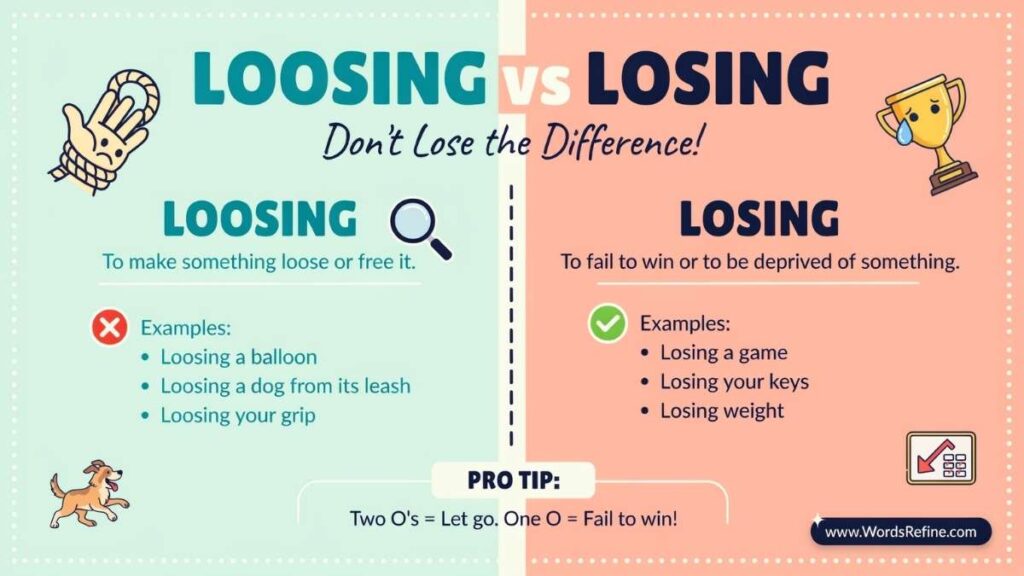
Have you ever typed “loosing” when you meant “losing” and wondered why that extra “o” appeared? You are certainly not alone. The confusion between loosing vs losing is common because these words look remarkably similar, yet their meanings are completely different. Losing comes from “lose” and refers to misplacing something, experiencing a loss, or failing to win. Loosing comes from “loose” and means releasing, freeing, or setting something loose. Fortunately, this spelling mix-up is easy to fix once you understand the difference. In this guide, you well learn their meanings, correct usage, common mistakes, and practical examples to help you choose the right word confidently.
Loosing vs Losing Quick Answer
“Losing” is the correct word when you mean misplacing something, experiencing a loss, failing to win, or no longer having something. It comes from the verb “lose.” For example, you might be losing your keys, losing money, or losing a game.
“Loosing,” on the other hand, is a valid word with a different meaning. It comes from “loose” and means releasing, freeing, or setting something free. For example, “The keeper was loosing the horses from their restraints.”
In short, remember this simple rule: lose becomes losing, while loose becomes loosing. The extra “o” changes the meaning, so choose carefully.
What Does Losing Mean?
Losing is the present participle of lose. The word can describe several situations, but they generally involve loss, reduction, failure, separation, or absence.
For example, you can lose an object when you no longer know where it is.
I keep losing my phone.
You can lose a competition when you fail to win.
Our team is losing the game.
You can lose money when you spend more than you earn.
The business is losing money this month.
You can also lose interest when something no longer seems enjoyable or important.
She is losing interest in the course.
Likewise, you can lose patience when you become frustrated.
I’m losing patience with these delays.
Losing can also describe something less tangible, such as confidence, hope, focus, motivation, or control.
He is losing confidence before the presentation.
She is losing hope after several failed attempts.
I’m losing focus because of the constant noise.
The driver is losing control of the vehicle.
In each example, something is disappearing, decreasing, weakening, or no longer being maintained.
Losing can also describe separation from another person. For instance, losing someone may refer to the death of a loved one, the end of a relationship, or becoming separated from someone.
She is struggling with losing a loved one.
He was afraid of losing his best friend.
They were losing touch after moving to different cities.
Although the context changes, the spelling remains the same.
What Does Loosing Mean?
Loosing is the present participle of loose when loose functions as a verb.
As a verb, loose means to release, free, untie, or let something go. Therefore, loosing describes an action in which something or someone is being released.
For example:
The archer was loosing an arrow.
She was loosing the rope from the post.
The guard was loosing the prisoners.
These examples show why loosing is a real English word. It is not simply a misspelling of losing.
However, loosing is uncommon in ordinary modern writing. In many everyday situations, writers are more likely to use words such as releasing, freeing, or untying.
For example, you would normally write:
She released the rope.
The guard freed the prisoner.
He untied the horse.
The verb loose still appears in certain contexts, particularly when something is released, set free, or sent forward. The expression “loose an arrow,” for example, is a traditional use of the verb.
Therefore, loosing is not always wrong. It is simply used for a different meaning from losing.
Learn the difference between commonly mixed-up more words
Labelled vs Labeled Which one Is Correct?
Losing vs Loosing Meaning and Usage
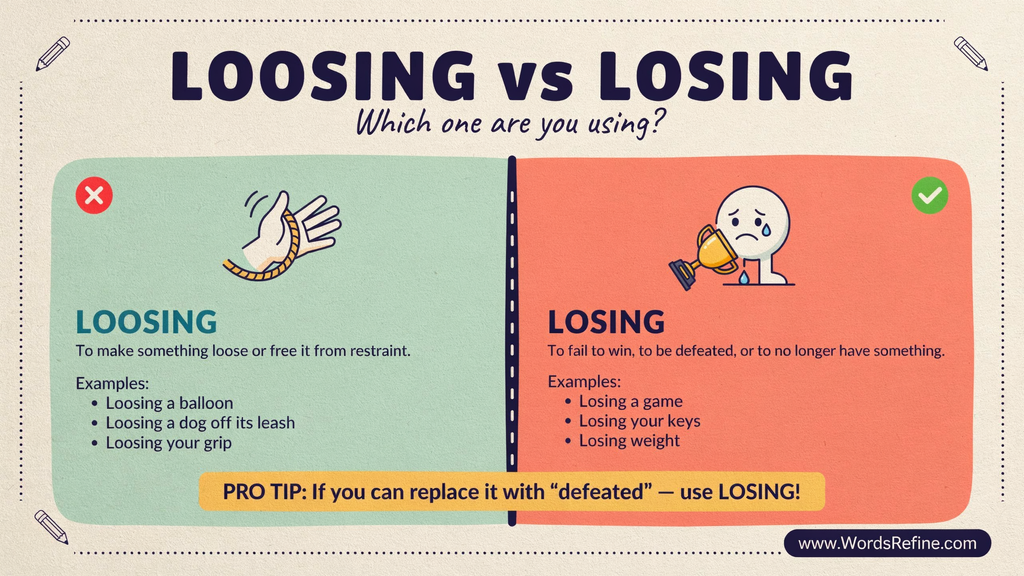
The difference between losing vs loosing becomes much clearer when you compare their base verbs.
Lose means to no longer have something, misplace something, fail to win, or experience a reduction.
Loose, when used as a verb, means to release, free, untie, or let something go.
This gives you a simple pattern:
Lose becomes losing.
Loose becomes loosing.
Consider these sentences:
I’m losing my wallet.
The workers are loosing the ropes.
The first sentence means the speaker may no longer have or be able to find the wallet. The second means the workers are releasing or untieing the ropes.
The extra “o” is therefore more than a spelling detail. It changes the meaning of the word.
Consider another pair:
She is losing her patience.
She is loosing the rope.
In the first sentence, her patience is running out. In the second, she is releasing the rope.
This is why confusing losing and loosing can create strange sentences. If you write “I’m loosing weight,” you are not using the normal verb for weight reduction.
The correct sentence is:
I’m losing weight.
The same distinction applies to expressions such as losing someone, losing interest, losing patience, losing your voice, and losing your mind.
Why Is Losing Spelled With One O?
Many people wonder why losing has one “o” when loose has two.
The answer becomes clear when you look at the base word.
Losing comes from lose, not loose.
When you form the present participle of lose, you add -ing and remove the final e.
Lose becomes losing.
The spelling does not become loosing because losing is not formed from loose.
By contrast, loosing comes from loose.
Loose becomes loosing.
In this case, the two o’s remain because they belong to the base word loose.
This gives you an easy spelling rule to remember.
If the base verb is lose, write losing.
If the base verb is loose, write loosing.
The difference between lose and loose is therefore the foundation of the difference between losing and loosing.
Think of them as two separate word families. Losing belongs to the lose family. Loosing belongs to the loose family. Once you identify the family, the correct spelling becomes much easier to remember.
Losing Someone vs Loosing Someone
“Losing someone” is the correct phrase when you mean being separated from someone, no longer having someone in your life, ending a relationship, or experiencing the death of a loved one.
For example:
She is afraid of losing someone she loves.
He is still grieving after losing his father.
They worried about losing their close friendship.
The phrase can also describe losing contact with someone.
I don’t want to lose touch with my old friends.
Here, losing comes from lose because something or someone is no longer being retained or remains absent from your life.
“Loosing someone” has a completely different meaning. It would suggest releasing or freeing someone.
For example:
The guard was loosing the prisoner.
This sentence describes releasing the prisoner. It does not describe emotional loss or separation.
Therefore, when you mean separation, grief, or no longer having someone in your life, use losing.
Losing someone is correct for that meaning.
Loosing someone is appropriate only when you genuinely mean releasing or freeing someone.
Losing Weight vs Loosing Weight
“Losing weight” is the correct phrase when you mean that someone’s body weight is decreasing.
For example:
She is losing weight through regular exercise.
I’ve been losing weight gradually.
He wants to lose weight before the competition.
The phrase comes from the verb lose because it describes a reduction in weight.
“Loosing weight” is not the standard expression for this meaning.
If you write “loosing weight,” the extra “o” changes the base verb from lose to loose. As a result, the sentence no longer expresses the normal idea of weight reduction.
So, when you want the correct spelling of losing weight, remember that losing is the appropriate form.
Learn the difference between tricky grammar more words
Rosin vs Resin Which One Is Correct and What’s the Difference?
Losing My Mind vs Loosing My Mind
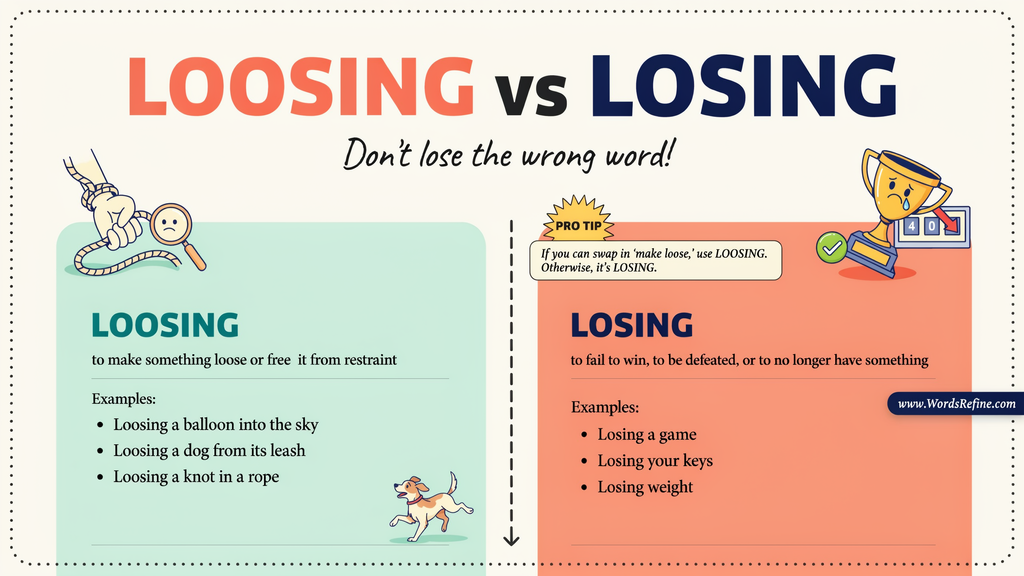
The Losing my mind” is the correct phrase.
It is an informal expression that can mean becoming extremely worried, confused, frustrated, overwhelmed, or unable to think clearly.
For example:
I’m losing my mind trying to find my keys.
She thought she was losing her mind after working all night.
You can also use “losing your mind” in casual conversation when someone is behaving unusually or becoming extremely excited.
Are you losing your mind?
The phrase “loosing my mind” is incorrect when you mean the common expression.
The reason is simple. The phrase comes from lose, not loose.
Lose becomes losing.
Therefore, “losing my mind” is the correct spelling for the idiom.
Once you connect the phrase with the verb lose, the spelling becomes much easier to remember.
Losing Your Voice, Interest, Patience, and Hair
The word losing appears in many everyday expressions. Because these phrases are so common, they also provide useful examples for understanding when to use losing correctly.
When your voice becomes weaker or disappears, you are losing your voice.
For example:
I’m losing my voice after talking all day.
She was losing her voice during the concert.
He could barely speak because he was losing his voice.
The phrase uses losing because it describes a loss of your normal ability to speak. Loosing would not express this meaning.
The same rule applies to losing interest. When something no longer holds your attention or enthusiasm, you are losing interest.
For example:
I’m losing interest in the book.
She is slowly losing interest in the project.
The students were losing interest in the lesson.
Again, losing comes from lose because the person is experiencing a decrease in interest.
Losing patience works in much the same way. It describes becoming less patient, usually because something is frustrating, repetitive, or taking too long.
For example:
I’m losing patience with these delays.
She is losing patience with the repeated interruptions.
The teacher was losing patience after explaining the same point several times.
You can also use losing when someone experiences hair loss.
For example:
He is worried about losing his hair.
She started losing hair during a stressful period.
The phrase uses losing because the person is experiencing a reduction in the amount of hair.
These examples show how versatile losing can be. It can describe physical things, emotions, abilities, relationships, and abstract qualities. The context changes, but the spelling stays the same.
Lose vs Loose The Foundation of the Spelling Difference
Understanding lose vs loose makes the difference between losing and loosing much easier to remember.
Lose is a verb. It can mean to misplace something, no longer have something, fail to win, experience a reduction, or become separated from someone or something.
For example:
I don’t want to lose my phone.
Our team might lose the match.
She doesn’t want to lose her job.
He could lose his confidence.
Loose has several uses. As an adjective, it usually describes something that is not tight, firmly attached, or securely fitted.
For example:
My shirt is loose.
The screw is loose.
The dog got loose from the yard.
Loose can also function as a verb meaning to release or set something free.
For example:
They loosed the horses.
The archer loosed an arrow.
The guard loosed the prisoner.
This distinction explains the spelling of the two present participles.
Lose becomes losing.
Loose becomes loosing.
If you mean that something is disappearing, decreasing, being misplaced, or no longer being retained, use losing.
If you mean releasing or setting something free, loosing can be correct.
The important point is that loose does not produce losing, and lose does not produce loosing.
Difference Between Lose, Loose, Losing, vs Loosing
The four words lose, loose, losing, and loosing look closely related, but they do not have the same meaning or grammatical function.
Lose is a verb that describes experiencing loss, misplacing something, failing to win, or no longer having something.
For example:
Don’t lose your keys.
Loose is commonly used as an adjective meaning not tight or not firmly fixed.
For example:
The handle is loose.
Loose can also be a verb meaning to release or set something free.
For example:
The workers loosed the animals.
Losing is the present participle of lose.
For example:
She is losing her patience.
Loosing is the present participle of loose when loose is used as a verb.
For example:
The archer was loosing an arrow.
The easiest way to keep these words apart is to connect each form to its base verb.
Lose and losing belong together.
Loose and loosing belong together.
Once you make that connection, the spelling becomes much easier to remember.
Learn the difference between commonly g confusing ord pairs
Compair vs Compare Which One Is Correct?
Losing vs Loosing Grammar How the Verb Forms Work
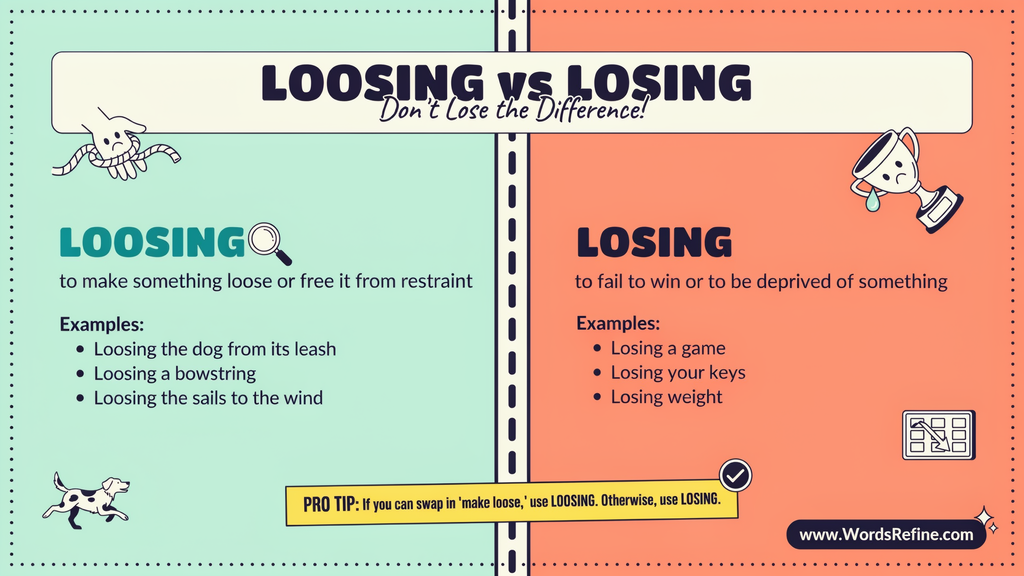
From a grammar perspective, losing vs loosing are present participles. A present participle is a verb form ending in -ing. It can appear in continuous verb forms and can also function in other grammatical roles depending on the sentence.
The present participle of lose is losing.
For example:
I am losing my keys.
They are losing the match.
She is losing confidence.
The present participle of loose, when loose functions as a verb, is loosing.
For example:
The archer is loosing an arrow.
The workers are loosing the ropes.
The handler is loosing the animals.
The spelling difference comes from the base verbs rather than from a special rule that applies only to these words.
Lose becomes losing.
Loose becomes loosing.
The past tense of lose is different. It is lost.
For example:
I lost my keys yesterday.
They lost the game.
She lost interest in the project.
Lost is an irregular form of lose, so it does not follow the same spelling pattern as losing.
The main verb forms can therefore be remembered as follows:
Lose, lost, losing.
Loose, loosed, loosing.
Keeping each group together can help prevent common spelling mistakes.
Losing vs Loosing Examples
Examples make the difference easier to understand because they show how each word works in an actual sentence.
Consider these examples of losing:
I’m losing my phone again.
She is losing confidence in the plan.
They are losing the game.
He is losing money on the business.
We are losing valuable time.
The company is losing customers.
She is losing focus during the meeting.
He is losing control of the situation.
Each sentence involves some form of loss, reduction, absence, or failure.
Now consider examples of loosing:
The archer was loosing an arrow.
The workers were loosing the ropes.
The keeper was loosing the animals from their enclosure.
These sentences involve releasing or setting something free.
The contrast becomes clearer when you compare the meanings directly.
I am losing the game.
The archer is loosing an arrow.
She is losing her patience.
The guard is loosing the prisoner.
He is losing control.
The workers are loosing the ropes.
The first sentence in each pair relates to lose. The second relates to loose as a verb.
Common Mistakes With Losing vs Loosing
One of the most common spelling mistakes is adding an unnecessary “o” to losing.
For example:
I am loosing my keys.
The correct version is:
I am losing my keys.
The mistake often happens because writers remember the spelling of loose and accidentally carry the extra “o” into losing. However, losing does not come from loose. It comes from lose.
Another common mistake appears in the phrase losing weight.
Incorrect:
She is loosing weight.
Correct:
She is losing weight.
The same confusion appears in several familiar expressions.
Incorrect:
I’m loosing my mind.
Correct:
I’m losing my mind.
Incorrect:
He is loosing interest.
Correct:
He is losing interest.
Incorrect:
She is loosing patience.
Correct:
She is losing patience.
Incorrect:
They are loosing the game.
Correct:
They are losing the game.
These mistakes may look small, but they change the word being used. When you see loosing in a sentence about loss, reduction, defeat, or absence, check whether you actually mean losing.
Is Loosing a Correct English Word?
Yes, loosing is a real English word. It is the present participle of loose when loose is used as a verb.
It can mean releasing, freeing, untieing, or letting something go.
For example:
The archer was loosing arrows.
The workers were loosing the ropes.
The guard was loosing the prisoners.
However, loosing is not the spelling you should use simply because losing looks too short.
If your sentence describes something being lost, reduced, misplaced, or no longer retained, use losing.
If your sentence describes something being released or set free, loosing may be appropriate.
Therefore, saying that loosing is never a word would be inaccurate. The word exists. It simply has a different meaning and is much less common in everyday English.
Is It Losing vs Loosing? A Fast Decision Test
When you are unsure whether to write losing vs loosing, ask yourself one simple question:
Am I talking about loss or release?
If the answer is loss, use losing.
If the answer is release, loosing may be correct.
For example:
I am losing my wallet.
This describes misplacing or no longer having something, so losing is correct.
The archer is loosing an arrow.
This describes releasing an arrow, so loosing is correct.
She is losing interest.
This describes a decrease in interest, so losing is correct.
The guard is loosing the prisoner.
This describes releasing the prisoner, so loosing is correct.
You can also check the base verb.
If the sentence makes sense with lose, use losing.
If it makes sense with loose as a verb, use loosing.
For example:
I am losing my patience.
The base verb is lose.
The archer is loosing an arrow.
The base verb is loose.
This quick test works especially well when you are writing quickly and do not have time to think about the spelling for long.
Learn the difference between often confused words
Performing vs Preforming Which One Is Correct?
Pronunciation of Losing and Loosing
Pronunciation can contribute to the confusion because losing and loosing sound very similar.
Losing is generally pronounced with a “z” sound in the middle.
Loosing has an “s” sound, similar to the sound in loose.
A simple way to hear the difference is to compare their base forms.
Lose has the “z” sound that carries into losing.
Loose has the “s” sound that carries into loosing.
Even so, pronunciation should not be your only test. When you are writing, meaning and the base verb provide a more reliable guide.
Lose gives you losing.
Loose gives you loosing.
Losing a Game The Correct Expression
“Losing a game” is the correct expression when a person or team is failing to win. It comes from the verb “lose,” which refers to experiencing a loss or failing to achieve victory.
For example:
“Our team is losing the game.”
“They were losing the game by two points.”
“The players are worried about losing the final match.”
In each sentence, “losing” describes the possibility or experience of not winning.
Why “Loosing a Game” Is Incorrect
“Loosing a game” does not normally express the idea of failing to win. “Loosing” comes from “loose” and means releasing, freeing, or setting something free.
Because of this, “loosing a game” sounds incorrect in the context of a competition. The word suggests releasing something rather than being defeated.
For example, you can say, “The team is losing the game,” but not “The team is loosing the game” when you mean that the team is failing to win.
Losing a Game, Match, or Competition
The same spelling rule applies to other competitive situations. Use “losing” whenever you mean failing to win a game, match, competition, or championship.
For example:
“She is worried about losing the match.”
“They are losing the competition.”
“Our team is close to losing the championship.”
Remember the simple rule: if the meaning is failing to win, use “losing.” The extra “o” in “loosing” changes the meaning completely.
Losing a Game: The Correct Expression
“Losing a game” is the correct expression when a person or team is failing to win. It comes from the verb “lose,” which refers to experiencing a loss or failing to achieve victory.
For example:
“Our team is losing the game.”
“They were losing the game by two points.”
“The players are worried about losing the final match.”
In each sentence, “losing” describes the possibility or experience of not winning.
Why “Loosing a Game” Is Incorrect
“Loosing a game” does not normally express the idea of failing to win. “Loosing” comes from “loose” and means releasing, freeing, or setting something free.
Because of this, “loosing a game” sounds incorrect in the context of a competition. The word suggests releasing something rather than being defeated.
For example, you can say, “The team is losing the game,” but not “The team is loosing the game” when you mean that the team is failing to win.
Losing a Game, Match, or Competition
The same spelling rule applies to other competitive situations. Use “losing” whenever you mean failing to win a game, match, competition, or championship.
For example:
“She is worried about losing the match.”
“They are losing the competition.”
“Our team is close to losing the championship.”
Remember the simple rule: if the meaning is failing to win, use “losing.” The extra “o” in “loosing” changes the meaning completely.
Losing Something Another Everyday Use
Losing something is one of the most common uses of losing.
You can lose almost anything you own, carry, or need.
I keep losing my keys.
She is always losing her phone charger.
He keeps losing his wallet.
They were afraid of losing important documents.
In these examples, losing means misplacing something or no longer knowing where it is.
Losing something does not necessarily mean that the object has been destroyed. If you lose your keys, the keys may still exist. You simply cannot find them or access them.
The same idea applies to many abstract things.
You can lose money, lose time, lose confidence, lose hope, lose focus, lose motivation, or lose control.
Although the objects and situations differ, the underlying idea remains similar: something is no longer available, retained, or possessed in the way it was before.
Losing a Loved One and Losing Hope
The word losing can describe more than physical objects or competitive situations. It can also describe difficult emotional experiences, such as losing a loved one or losing hope.
Losing a loved one usually refers to experiencing the death of someone close to you. It can also describe the deep sense of separation that follows such a loss.
For example:
She is still grieving after losing her mother.
He struggled with losing a loved one.
They found it difficult to cope with losing someone they loved.
In these sentences, losing comes from lose because the person is experiencing the absence of someone who was part of their life.
You can also use losing when talking about hope.
For example:
She is losing hope after several unsuccessful attempts.
He felt as though he was losing hope.
The team is losing hope of reaching the final.
Losing hope means that your confidence or expectation of a positive outcome is gradually becoming weaker.
The same pattern applies to losing faith, losing confidence, and losing motivation. In each case, something a person once had is becoming weaker or disappearing.
Losing Control, Focus, and Track
The Losing is also common when describing situations in which someone can no longer maintain control, concentration, or awareness.
Losing control means no longer being able to manage a situation, action, emotion, or object effectively.
For example:
The driver was losing control of the car.
She felt she was losing control of the situation.
He started losing control of his emotions.
Losing focus means becoming less concentrated or attentive.
For example:
I’m losing focus because the room is so noisy.
She started losing focus during the long meeting.
The students were losing focus near the end of the lesson.
You can also talk about losing track of something. This means no longer knowing where something is, what is happening, or how much of something has occurred.
For example:
I lost track of time while reading.
She is losing track of the conversation.
He lost track of how many emails he had answered.
These expressions use losing or lost because they describe something becoming unavailable, unclear, or difficult to maintain.
Learn the difference between basic English word mistakes
Tomatoes vs Tomatos Which one Is Correct?
Losing Time, Money, and Motivation
The Losing can describe the disappearance or waste of valuable resources such as time and money.
Losing time means allowing time to pass without making the progress you intended.
For example:
We are losing time by waiting for the equipment.
The team is losing valuable time.
I don’t want to lose any more time.
Losing money can mean spending more than you earn, suffering a financial loss, or failing to recover money that was invested.
For example:
The company is losing money every month.
He is worried about losing money on the investment.
They were losing money because of rising costs.
The word losing can also describe a decrease in motivation.
For example:
I’m losing motivation to finish the project.
She is slowly losing motivation to continue.
The students were losing motivation after repeated setbacks.
In each case, losing describes something that is decreasing or becoming harder to maintain.
Losing Confidence and Losing Touch
Confidence and relationships can also be described with losing.
Losing confidence means becoming less certain about your abilities, decisions, or chances of success.
For example:
She is losing confidence before the competition.
He started losing confidence after several mistakes.
The team is losing confidence after a series of defeats.
Losing touch has a different meaning. It usually means gradually stopping communication with someone or becoming less connected with them.
For example:
I’m afraid of losing touch with my old friends.
They lost touch after moving to different cities.
We stayed in contact because we didn’t want to lose touch.
The phrase losing touch can also describe becoming less familiar with a skill, subject, or activity.
For example:
I haven’t practiced my Spanish in years, so I’m losing touch with the language.
Again, losing is the correct form because the meaning involves something becoming less available or less familiar.
How to Remember the Correct Spelling
The easiest way to remember losing vs. loosing is to identify the base verb.
Ask yourself whether you mean lose or loose.
If you mean lose, the correct form is losing.
If you mean loose as a verb, loosing can be correct.
A simple memory trick is to connect lose with loss.
Lose contains one “o,” and losing also contains one “o.”
Lose → losing
If something is lost, you are losing it.
For example:
I’m losing my keys.
She is losing interest.
They are losing the game.
Loose has two “o’s,” and loosing keeps those two “o’s.”
Loose → loosing
If something is being released or set free, loosing may be correct.
For example:
The archer is loosing an arrow.
The workers are loosing the ropes.
The keeper is loosing the animals.
Another useful trick is to remember that loose is related to the idea of being free or not tight.
A loose rope is not tight.
To loose something can mean to release it.
Lose, however, relates to loss.
You lose something when you no longer have it.
Once you connect the meaning with the base word, the spelling becomes much easier.
Is Losing Spelled With One O or Two?
Losing is spelled with one “o.”
The correct spelling is losing.
The spelling loosing is incorrect when you mean loss, reduction, defeat, or absence.
This confusion happens because loose contains two “o’s.” However, losing comes from lose, which contains only one “o.”
For example:
Correct: I am losing my keys.
Incorrect: I am loosing my keys.
Correct: She is losing weight.
Incorrect: She is loosing weight.
Correct: They are losing the game.
Incorrect: They are loosing the game.
Correct: He is losing interest.
Incorrect: He is loosing interest.
When you are unsure, return to the base verb. If the base verb is lose, use losing with one “o.”
Learn the difference between everyday English mistakes
Inquiries vs Queries What’s the Difference ?
When Should You Use Loosing?
You should use loosing when you genuinely mean releasing, freeing, or letting something go and loose is functioning as a verb.
For example:
The archer was loosing an arrow.
The workers were loosing the ropes.
The guard was loosing the prisoners.
The word can also appear in literary, historical, or specialized contexts where something is deliberately released.
However, you should not use loosing simply because you think losing needs two “o’s.” In everyday English, most sentences that describe loss require losing.
For example, these phrases normally need losing:
1losing someone
2losing weight
3losing my mind
4losing your voice
5losing interest
6losing patience
7losing hair
8losing a game
9losing money
10losing hope
11losing focus
12losing control
Adding the extra “o” changes the base verb and can make the sentence confusing or incorrect.
Why Do People Spell Losing as Loosing?
People often spell losing as loosing because lose and loose look and sound closely related.
The two words share several letters, and loose contains the familiar double “o” that can be tempting to carry into a related-looking form.
Pronunciation can add to the confusion as well. Losing has a “z” sound in the middle, while loosing has an “s” sound.
Another reason is that loose is a familiar word. We commonly use it to describe something that is not tight.
For example:
My shoes are loose.
The screw is loose.
The dog is loose.
When a writer then needs the -ing form of lose, the extra “o” can accidentally slip into the spelling.
The best solution is not to memorize every phrase separately. Instead, remember the relationship between the base verbs.
Lose gives you losing.
Loose gives you loosing.
That small distinction prevents many common spelling mistakes.
Losing vs Loosing in a Sentence
Looking at the words in complete sentences can make their difference even clearer.
I am losing my keys.
This means I cannot find my keys or no longer have them with me.
The dog is loose.
Here, loose is an adjective describing the dog’s condition.
The keeper is loosing the dog.
Here, loosing is a verb describing the act of releasing the dog.
She is losing her patience.
Her patience is gradually running out.
The worker is loosing the rope.
The worker is releasing or untieing the rope.
These examples show why context matters. The words may look similar, but their meanings are not interchangeable.
Common Spelling Mistakes With Lose vs Loose
The confusion between lose and loose often extends beyond losing and loosing.
A common mistake is writing loose when the intended word is lose.
Incorrect:
I don’t want to loose my phone.
Correct:
I don’t want to lose my phone.
Another common mistake is using loose when someone means that a team failed to win.
Incorrect:
Our team will loose the match.
Correct:
Our team will lose the match.
The reverse mistake also occurs when writers use lose instead of loose.
Incorrect:
My shoes are lose.
Correct:
My shoes are loose.
Here, loose is an adjective because the shoes are not tight.
These mistakes become easier to avoid when you remember the basic meanings.
Lose is connected with loss or failure.
Loose is connected with freedom, space, or a lack of tightness.
Once that distinction is clear, losing and loosing become much easier to handle.
Using “Loose” Instead of “Lose”
A common spelling mistake is using “loose” when you actually mean “lose.” Use “lose” when you mean to misplace something, experience a loss, or fail to win.
Incorrect: “I don’t want to loose my phone.”
Correct: “I don’t want to lose my phone.”
The key is to remember that “lose” is connected with loss. If something is no longer in your possession, you usually need “lose.”
Using “Lose” Instead of “Loose”
The opposite mistake happens when writers use “lose” instead of “loose.” Use “loose” when something is not tight, firmly attached, or securely held.
Incorrect: “My shoes are lose.”
Correct: “My shoes are loose.”
Here, “loose” is an adjective because the shoes are not tight. The same rule applies to phrases such as “a loose button,” “loose clothing,” or “a loose rope.”
How to Remember “Lose” and “Loose”
A simple memory trick can help you keep these words straight. “Lose” has one “o” and relates to loss, failure, or misplacing something. “Loose” has two “o’s” and relates to something that is free, relaxed, or not tight.
Once you understand this basic difference, related forms such as “losing” and “loosing” become much easier to distinguish. Remember: you lose something, but something can be loose.
Learn the difference between more words people mix up
Lend vs Lent What’s the Difference and When to Use Each?
A Quick Reference for Lose, Loose, Losing, vs Loosing
Lose is a verb meaning to no longer have something, misplace something, fail to win, or experience a loss.
For example:
I don’t want to lose my wallet.
Loose is commonly an adjective meaning not tight, but it can also be a verb meaning to release or free something.
For example:
My jacket is loose.
The archer loosed an arrow.
Losing is the present participle of lose.
For example:
She is losing her confidence.
Loosing is the present participle of loose when loose is used as a verb.
For example:
The archer is loosing an arrow.
The key is to connect each -ing form with its correct base verb.
Lose → losing
Loose → loosing
Practice Session loosing vs losing
Choose the correct word to complete each sentence. Use lose, loose, losing, vs loosing where appropriate.
- I keep ________ my keys whenever I am in a hurry.
- She is ________ interest in the course because the lessons feel repetitive.
- The team is ________ the game by three points.
- He does not want to ________ his phone again.
- My shoes are too ________, so I need a smaller size.
- The company is ________ money because of rising costs.
- I am ________ my patience with these constant delays.
- She is afraid of ________ her closest friend.
- The archer was ________ an arrow toward the target.
- We cannot afford to ________ any more time.
- He is ________ confidence after making several mistakes.
- The dog got ________ and ran into the garden.
- She is ________ weight through regular exercise.
- I thought I was ________ my mind after searching everywhere for my missing wallet.
- The guard was ________ the prisoners from their restraints.
- Be careful not to ________ your important documents.
- The students were ________ focus during the long lecture.
- The rope is ________, so make sure you tie it securely.
- They are worried about ________ valuable customers.
- The workers were ________ the ropes from the posts.
- He is ________ his voice after talking for several hours.
- Our team cannot afford to ________ this match.
- She was ________ hope after receiving another rejection.
- I do not want to ________ touch with my old classmates.
- The horse was ________ from the stable before the race.
Answers
- losing
- losing
- losing
- lose
- loose
- losing
- losing
- losing
- loosing
- lose
- losing
- loose
- losing
- losing
- loosing
- lose
- losing
- loose
- losing
- loosing
- losing
- lose
- losing
- lose
- loosed
Here’s a trusted source for clear word meanings:
FAQs
Is it “loosing me” or “losing me”?
“Losing me” is correct when you mean no longer having someone or failing to keep a relationship. For example, “If you keep ignoring me, you’re losing me.” “Loosing me” would mean releasing or setting someone free, which is a very different meaning.
How do you use “loosing” in a sentence?
“Loosing” is used when someone releases, frees, or unties something. For example, “The hunter was loosing the dogs from their restraints.” It comes from the verb “loose,” meaning to release or set free.
Is it “losing” or “loosing” money?
“Losing money” is correct. It means having less money because of spending, business losses, poor investments, or another financial problem. For example, “The company is losing money this year.” “Loosing money” is incorrect in this context.
What does “losing” mean in English?
“Losing” is the present participle of “lose.” It can mean misplacing something, no longer having something, failing to win, or experiencing a reduction. For example, “I’m losing my keys,” “They’re losing the game,” and “She’s losing confidence.”
Which word should you use when someone dies: “losing” or “loosing”?
“Losing” is correct when referring to someone’s death. For example, “She is grieving after losing her father.” The phrase “losing a loved one” means experiencing the death of someone close to you. “Loosing” does not have this meaning.
What is the difference between “losing” and “loosing”?
“Losing” comes from “lose” and refers to misplacing something, experiencing a loss, failing to win, or no longer having something. “Loosing” comes from “loose” and means releasing, freeing, or untieing something. The extra “o” changes the meaning completely.
Is it “lose my mind” or “loose my mind”?
“Lose my mind” is correct. The expression means becoming extremely upset, confused, angry, or unable to think clearly. For example, “I thought I was going to lose my mind during the long wait.” “Loose my mind” is not correct for this expression.
Is it “lose money” or “loose money”?
“Lose money” is correct when you mean to suffer a financial loss. For example, “You could lose money if you invest without researching the company.” “Loose” means not tight or securely fixed, so it does not fit this meaning.
Do you “lose” or “loose” a person?
You “lose” a person when you can no longer find them, no longer have them in your life, or experience their death. For example, “I don’t want to lose my best friend.” “Loose” only applies when someone or something is being released or set free.
Is it “losing” or “loosing” my mind?
“Losing my mind” is correct. It is a common expression used when someone feels extremely frustrated, overwhelmed, confused, or emotionally distressed. For example, “I’ve been searching for my phone for an hour, and I’m losing my mind.”
Is “loose my hair” correct?
“Loose my hair” is not correct when you mean that your hair is falling out. The correct phrase is “lose my hair” or “losing my hair.” For example, “I’m worried about losing my hair.” “Loose” describes something that is not tight or firmly attached.
Why do people confuse “loose” and “lose”?
People often confuse “loose” and “lose” because their spellings are similar and their pronunciation can sound confusing, especially for English learners. Remember that “lose” has one “o” between the “l” and “s,” while “loose” has two. The meaning also differs: “lose” refers to experiencing a loss, while “loose” means not tight or securely fixed.
Can “loosing” ever be correct?
Yes. “Loosing” is a real English word, although it is much less common than “losing.” It is the present participle of “loose” when “loose” is used as a verb meaning to release or set free. For example, “The soldiers were loosing the prisoners from their restraints.”
What is the easiest way to remember “losing” and “loosing”?
Think of the base verbs. “Losing” comes from “lose,” so it has one “o.” “Loosing” comes from “loose,” so it keeps the two “o’s.” If you mean suffering a loss, misplacing something, or failing to win, use “losing.” If you mean releasing or setting something free, use “loosing.”
Is “losing” always related to failure?
No. “Losing” does not always mean failing. It can also mean misplacing something, no longer having something, experiencing a reduction, or gradually becoming without something. For example, you can be “losing interest,” “losing time,” “losing your voice,” or “losing focus” without experiencing a competition or failure.
Conclusion
Loosing vs losing may look like twins, but they definitely don’t mean the same thing. Losing comes from lose and covers everyday situations such as losing your keys, losing money, losing a game, or losing your patience. Loosing comes from loose and means releasing, freeing, or untieing something.
The easiest trick is to check the base word. If you mean a loss, choose lose and losing. If you mean setting something free, choose loose and loosing. That extra “o” isn’t just sitting there for decoration. It changes the meaning of the word.
So, the next time you wonder whether it’s loosing vs losing, remember: you can lose your keys, but you can loose a dog from its leash. English spelling can be sneaky, but this one doesn’t have to loose your patience!

Diora AJS she is an experienced blogger and passionate English language enthusiast at Words Refine. With a keen eye for language and a love for clear communication, she writes practical content about grammar, word meanings, usage, and commonly confused terms. Her goal is to make English easier to understand through clear explanations and relatable examples, helping readers write accurately and communicate with confidence.